1 Organochlorine Pesticides in Honey and Pollen Samples from Managed Colonies of the 1
Honey Bee Apis mellifera Linnaeus and the Stingless Bee Scaptotrigona mexicana Guérin 2
from Southern, Mexico 3
4
Jovani Ruiz-Toledo 1†, Rémy Vandame2, Ricardo A. Castro-Chan1, Rosa P. Penilla-Navarro3,
5
Jaime Gómez1, Daniel Sánchez1†*
6 7
1 El Colegio de la Frontera Sur Unidad Tapachula, Carretera Antiguo Aeropuerto Km 2.5, CP
8
30700 Tapachula, Chiapas, México. E-mails: [email protected] (J.R-T); [email protected] 9
(J.G); [email protected] (R.A.C-C)
10
2El Colegio de la Frontera Sur Unidad San Cristóbal de las Casas, Periférico Sur s/n, María
11
Auxiliadora, CP 29290 San Cristóbal de Las Casas, Chiapas, México. E-mail: [email protected] 12
(R.V)
13
3Centro Regional de Investigación en Salud Pública, Instituto Nacional de Salud Pública,
14
Laboratorio de Resistencia a Insecticidas, 4a. Norte y 19 Calle Poniente S/N, CP 30700
15
Tapachula, Chiapas, México. E-mail: [email protected] (R.P.P-N)
16 17
†These authors contributed equally to this work.
18 19
* Author to whom correspondence should be addressed; E-Mail: [email protected] (D.S) Tel.:
20
+52 01 962 62 89800 -Ext. 5400
21 22 23 24
2 Abstract
25
In this paper we show the results of investigating the presence of organochlorine pesticides in
26
honey and pollen samples from managed colonies of the honey bee, Apis mellifera L. and of the
27
stingless bee Scaptotrigona Mexicana Guérin. We found that 88.44% and 93.33% of honey
28
samples, and 22.22% and 100% of pollen samples of S. mexicana and A. mellifera, respectively,
29
resulted positive to at least one organochlorine. The most abundant pesticides were DDE, DDT,
30
Endrin and heptaclor. Despite the low foraging range of S. mexicana the number of pesticides
31
detected in the honey samples was similar to that of A. mellifera. Paradoxically we a found a
32
small number of organochlorines in pollen samples of S. mexicana, perhaps indicating a rapid
33
turnover of this material as compared to A. mellifera.
34 35
Keywords 36
Pesticides, native bee, persistency, biomonitoring
3 Introduction
42
Bees are essential organisms that contribute enormously in preserving ecosystems and human
43
well-being by both pollinating wild plants and increasing the productivity of crops [1]. Highly
44
social species, like honey bees and stingless bees, also produce highly appreciated substances
45
with well-deserved high value in the market, merely honey, wax and propolis, which represent an
46
important economic input for many countries [2]. Many social bees manage to store several
47
kilograms of such products by means of food recruitment communication: they fly several
48
kilometers (up to 5 km in the case of larger species) from the colony, return safely and inform
49
nestmates the location of sources of nectar, pollen and resins. This way the foraging force of a
50
colony focuses in certain patches, instead of wandering around looking for food [3–6].
51
Unfortunately, since it is not uncommon for bees to share space with agroecosystems,
52
communication also increases the likelihood of transporting agrochemicals like pesticides to the
53
colony, causing several deleterious effects in bee populations, either chronic or acute [7–10].
54 55
Pest control is currently thought to be better approached by an integrated pest management
56
scheme, in which cultural, biological and chemical strategies, if used judiciously, are supposed to
57
represent little threat to non-target organisms like bees [11]. However, the most common
58
practices involve the use of chemicals alone, which might pose serious negative effects upon
59
human and environmental health. Acute poisoning of beneficial arthropods during application of
60
pesticides is of current concern, but long term exposure to minute, sublethal, amounts in
61
resources collected by bees, for example, can cause a slow decline in the populations of these
62
species, by affecting several essential physiological and behavioral functions, like reproduction
63
and learning [12–15]. This has taken research to develop new molecules that degrade quickly in
64
the environment and are more specific. Examples of this are organophosphorus pesticides,
4
pyrethroids and macrolides [16,17]. However, they are more expensive that older alternatives,
66
like organochlorines which, despite the ban in many parts of the world, they are still under heavy
67
production use in third and developing countries, or they were just recently forbidden, like in
68
Mexico [18].
69 70
Organochlorine pesticides (OCs) are characterized by their high chemical stability, low water
71
solubility and high solubility in organic solvents. Such features allow organochlorines to
72
bioaccumulate and biomagnificate in the fatty bodies of animals [19–21]. Among the most
73
persistent OCs we can find: DDT (half lifetime: 10 to 15 years), toxaphene (12 years), endrin (10
74
years), chlordane (8 years), dieldrin (7 years), aldrin (5 years), heptachlor (4 years) and lindane (2
75
years) [19,22]. In Mexico, OCs began to be used intensively in the 1940s with the arrival of the
76
Green Revolution [23,24].In the state of Chiapas, in southeastern Mexico, OCs were used
77
intensively both in agriculture and in public health programs aimed to eradicate populations of
78
Anopheles spp, vectors of malaria. However, research showed a set of human health disorders
79
and reduction in fauna associated with OCs exposure, so banning began as early as in the 1970s
80
[25,26], but their effects are still present [25,26]. Chiapas was one of the last states in which DDT
81
was banned in agriculture, but it was used until the beginning of the 21st century, since as
82
mentioned lines above, it was considered a key element in the control of malaria [27,28].
83 84
Within Chiapas, in the Soconusco region OCs were used for more than 40 years for pest control,
85
mainly in coffee and cotton crops (Table 1). The area devoted to cotton cultivation grew
86
remarkably, from 518 to 35,227 ha cultivated in 1950 – 1978 [29], supposedly thanks to the
87
implementation of modern agricultural technologies, particularly the use of insecticides. Official
88
records indicate that a mixture of toxaphene and DDT was sprayed in doses of 6-7 L/ha per cycle
5
[30]. Catalán [29] reported that the application of toxaphene/DDT was as frequent as 21 times per
90
crop cycle; moreover 1,109,650.5 L/year of insecticides were applied when the cultivated cotton
91
acreage was the largest. The Soconusco region is also known for the high incidence of malaria, so
92
DDT was also used to control mosquitoes, with up to one monthly application of 2 g/m2 on
93
average [31,32]. It is estimated that 69,545 ton of DDT were used just during the Mexican health
94
campaigns in 1957-2000 [33]. It is also important to recall that the phenologies of the crops, the
95
life cycles of the insect pests and climatic conditions make the application of pesticides variable
96
along time and space. Thus it is not surprising that several studies had reported seasonal and
97
spatial variation in pesticide availability in many types of matrixes. For example, Peruzzo et al.
98
[34] and Ruiz-Toledo et al. [35] reported variation in the concentration of glyphosate in water
99
samples collected in rainy and dry seasons in Argentina and Mexico, respectively; Helm et al.
100
[36] also showed a seasonal trend of polychlorinated naphthalene’s (PCNs) with top levels
101
occurring during Winter in Canada, Russia and USA; Eqani et al. [37] also found higher
102
concentrations of organochlorine pesticides (OCPs) and polychlorinated biphenyls in fishes
103
during the winter season in Pakistan and China. This means that bees are also exposed to variable
104
concentrations of pesticides, which, along the availability of food sources, can have variable
105
impacts in the survival of these species. Moreover, the identity of the bee species can imply
106
enormous differences in their chances of survival, since larger species can fly longer distances to
107
forage, and thus avoid contaminated patches, while smaller species are more limited in this
108
regard.
109 110
The aim of this study was to study the seasonal and the spatial variation in the levels of
111
organochlorine pesticides present, if any, in honey and pollen of managed colonies of both the
112
honey bee Apis mellifera L. and the stingless bee Scaptotrigona mexicana Guérin in a highly
6
fragmented landscape, dominated by mango and soybean. We chose these organisms because
114
they are the most common species reared for pollination and honey production and they have
115
different sizes and thus have different foraging distances.
116 117
Materials and methods 118
Study area 119
The study was carried out in the city of Tapachula, located in the Soconusco region, Chiapas in
120
southern Mexico, between June 2015 and May 2016. Honey and pollen samples were taken
121
directly from colonies housed in wood boxes of S. mexicana and A. mellifera. All colonies used
122
in this study were considered healthy after a careful inspection by a certified beekeeper.
123 124
Sample collection 125
Six colonies of each species were selected at random and moved to two locations, three colonies
126
of each species in each location. Each colony was sampled three times: June 2015, November
127
2015 and May 2016. Pollen samples from honey bee colonies were collected by using pollen
128
traps in the entrance. Next, samples were transferred into a 15 ml Falcon tube for transportation;
129
honey was squeezed from the comb into a 50 ml polyethylene Falcon tube. Honey and pollen
130
samples from S. mexicana were obtained from pots inside the colony using a sterilized syringe or
131
a spoon, respectively, and transported in 15 ml Falcon tubes. All samples were placed inside a
132
cool box with ice packs and frozen at -20 °C until extraction. The total number of samples
133
collected was 36 for honey (18 for A. mellifera y 18 for S. mexicana) and 36 for pollen (18 for A. 134
mellifera y 18 for S. mexicana).
7 Organochlorine extraction
138
Organochlorine residues were extracted according to the methodology by Wiest et al. [38]. Five
139
grams of honey or two grams of pollen were weighed in a 50 ml centrifuge tube, 10 ml of water
140
were added and the mixture was vigorously shaken to dissolve honey. Next, 10 ml of acetonitrile
141
(ACN) and 3 ml of hexane (only for pollen), 4 g of anhydrous MgSO4, 1 g of sodium chloride, 1
142
g of sodium citrate dihydrate and 500 mg of disodium citrate sesquihydrate were added; the tube
143
is immediately shaken by hand, vortexed one minute and then centrifuged for 2 min at 5000 g.
144
Six ml of supernatant were transferred into a 15 ml PSA tube that contained 900 mg of anhydrous
145
MgSO4, 150 mg of PSA bonded silica and 150 mg of C18 bonded silica. Then, this tube was
146
immediately shaken by hand, vortexed for 10 s and centrifuged for 2 min at 5000 g. Finally, 4 ml
147
of the extract were transferred into a 10 ml glass cone-ended centrifuge tube, evaporated until a
148
final volume of 50 µl and kept at −18◦C until analysis.
149 150
Chemicals 151
For validation and standardization of the analytical method we used a mixture of standard-grade
152
OCs from Ultra Scientific: aldrin, β-HCH, α-HCH, γ-HCH, δ-HCH, DDD, DDE,
p,p'-153
DDT, dieldrin, α-endosulfan, β-endosulfan, endosulfan sulfate, endrin, endrin aldehyde,
154
heptachlor, and heptachlor epoxide. The organic solvents used for extraction of OCs were
HPLC-155
grade hexane and dichloromethane from Sigma-Aldrich.
156 157
Gas chromatography analysis 158
The extracts were analyzed by gas chromatography using a Perkin Elmer Clarus 500 gas
159
chromatograph, equipped with an electron capture detector, autosampler, and a programmable
160
split/splitless injector. The injection volume of extract was 2 µl in splitless mode. The initial
8
temperature of the injector was 120 °C, and the speed of the carrier gas (hydrogen) was 48 cm/s.
162
The detector temperature was 350 °C, and the make-up flow was 30 ml/min. An Agilent J&W
163
DB-35MS column (p/n 122-3832) of 30 m length, 0.250 mm inner diameter, and 0.25 μm film
164
thickness was used. The initial oven temperature was 110 °C, which was maintained for 1.4 min,
165
followed by a temperature ramp with increments of 13 °C/min up to 285 °C, holding at 285 °C
166
for 1 min, another ramp of 30 °C/min up to 300 °C, and holding until the end of the routine (3
167
min). The total time of the analysis was 19.36 min.
168 169
Under previous described conditions the residue levels of OCs were quantitatively determined by
170
the external standard method using peak area. The limits of detection and quantification were
171
determined by the least squares regression method on the OC curves, using data generated by
172
nine replicates near the lowest concentration attainable on the calibration curve. The detection
173
limits varied from 0.55 to 1.14 μg/L, and the quantification limits between 1.78 and 3.79 μg/L,
174
depending on the pesticide. Recoveries were determined by spiking with the surrogate standards
175
prior to extraction. Amounts were similar to detected quantities of analytes in the samples. The
176
recoveries of the OCs ranged from 80 to 102%.
177 178
Statistical analysis 179
A descriptive analysis of the levels of OCs was conducted by calculating geometric means,
180
standard deviations and minimum and maximum. Descriptive analysis and graphs were obtained
181
using the R software package.
9 Results
186
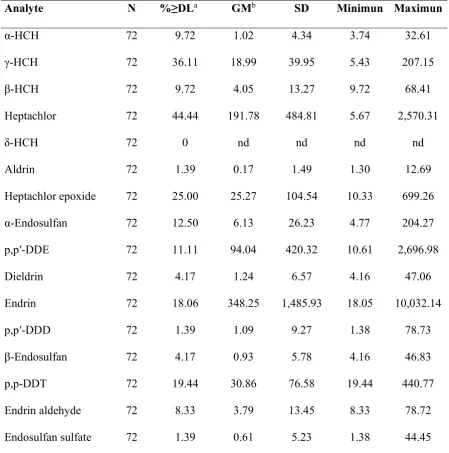
Overall, we detected 15 out of the 16 organochlorine compounds included in our screening list
187
(Table 2). We found that 22.22% of S. mexicana pollen, 88.33% of S. mexicana honey, 100% of
188
A. mellifera pollen and 94.44% of A. mellifera honey samples were positive to at least one
189
organochlorine. Thus there was variation in the amount and identity of the pesticides detected in
190
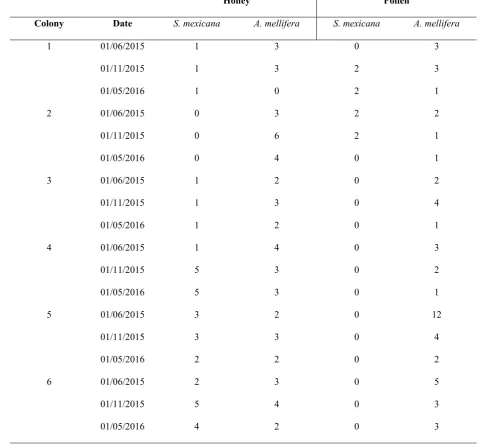
the different matrixes, colonies, species and dates (Table 3, Figure 1).
191 192
For S. mexicana the most abundant pesticide was γ-HCH, present in four pollen samples and nine
193
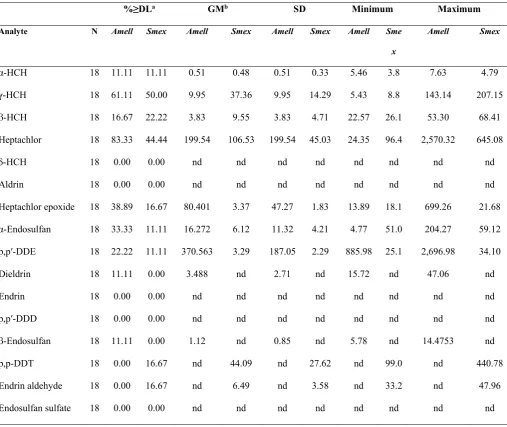
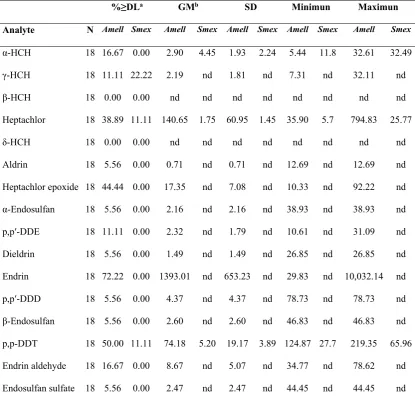
honey samples (22.22% and 50%, respectively); for A. mellifera, 72.22% (13 samples) of the
194
pollen samples contained γ-HCH in greater quantity but 83.33% (15 samples) of the honey
195
samples contained heptachlor (Table 2 and Table 4). All S. mexicana and A. mellifera colonies
196
survived in the study period, and no visible sign of weakening could be observed at the end of the
197
study.
198 199
Discussions 200
In this study we aimed to detect and quantify organochlorine pesticides in honey and pollen
201
samples from two bee species, the honey bee A. mellifera and the small-sized stingless bee S. 202
mexicana, which have putatively different flight ranges. All samples had at least one
203
organochlorine, but the pollen samples from honey bees had the higher number of pesticides.
204
Slight differences in the number and identity of pesticides between sampling sites and season
205
were found, but no pattern could be discerned.
206 207
It is not uncommon to find honey bee products like honey, pollen and wax, from colonies located
208
in agricultural landscapes, contaminated with pesticides [39–41] in countries like Argentina [42],
10
Bélgica [43], Brazil [44], China [45], Colombia [46], Egypt [47], France [38], Germany [48],
210
Greece [49], India [50], Mexico [51], Poland [52], Portugal and Spain [53], Turkey [54] y USA
211
[41]. However, given the seasonal variation in the agricultural activities related to insecticide
212
application, climatic factors, among others, not all samples show evidence of contact with such
213
chemicals [55]; for instance, Balayiannis and Balayiannis [56] found organophosphorous
214
insecticides in 56% of their honey samples; Mullin et al. [41], Pohorecka et al. [57] and Panseri
215
[58] reported that 60%, 50% and 94% of their samples (wax, pollen, honey and bee workers) had
216
residues of at least two pesticides. We found no clear correlation between date, site and colony
217
and the presence of pesticides; actually we failed to carry out a survey about the strategy that
218
local growers adopt to apply insecticides to control pest, i.e. whether they constantly monitor pest
219
abundance or they carry out preventive measures and apply insecticides regardless pest
220
abundance. Additionally, it is important to consider the location of our colonies in the agricultural
221
landscape, since its closeness to farms determines the likelihood that bee workers find pesticides
222
[59]; this has yet to be investigated.
223 224
Spatial and temporal variations in the identity and amount of pesticides have been documented.
225
Chauzat et al. [60] reported that in 2002-2005 in France, there was variation in the concentrations
226
of several pesticides; Pirard et al. [43], Nguyen et al. [61], Mullin et al. [41], García-Chao et al.
227
[62], Bernal et al. [63] and Valdovinos-Flores et al. [51], also found, in different countries,
228
variations in the amount and identity of pesticides in distant localities. The most common
229
chemicals include fungicides, herbicides [64,41,63,65], neonicotinoids [64,60,66,67],
230
organophosphorous [47], organochlorines and pyretroids [18]. Given the reduced use of
231
neonicotinoids in our study area and the short halftime of organophosphorous insecticides we
232
focused on organochlorines.
11
The concentration of the pesticides in our study also varied between sites, date of sampling,
234
colonies and type of sample. Many studies have also shown a similar pattern. For instance,
235
Mullin et al. [41] reported 121 pesticides (and metabolites) at concentrations ranging 99-204 ppm
236
in pollen, wax and worker samples; Santos de Azebedo [68] found aldrin (2 ng/g), endosulfan (1
237
- 33 ng/g), endrin aldehyde, heptachlor epoxide, p, p'-DDE and p, p'-DDT (1-94 ng/g) in pollen
238
samples; Panseri et al. [58] found DDT, DDD y DDE in honey samples at 8.8 ng/g, 1.9 ng/g and
239
15.4±0.3 ng/g, respectively; Malhat et al. [18] documented that a honey sample had γ-HCH at a
240
concentration higher than the permissible upper limit (0.01 mg/kg); in Mexico,
Valdovinos-241
Flores et al. [51] reported samples of honey and wax contaminated with 93 pesticides, including
242
DDT at 0.175 mg/kg. In our study we found endrin (10 mg/kg), p,pʹ-DDE (2.7 mg/kg) and 243
heptachlor (2.6 mg/kg) to be the most abundant pesticides, even at concentrations higher than
244
reported in other works. Surprisingly the concentrations we found are close to the LD50
245
calculated for honeybees, but our colonies did not show any clear sign of depopulation or reduced
246
activity [69].
247 248
It has been shown that the amount and variety of pesticides in honey bee colonies is closely
249
related to the closeness to the source of contamination and the length of the exposure
250
[64,18,41,58,60,62]. Other important factor is the half-life of the pesticides; organochlorine
251
pesticides have been banned for decades in many countries, including Mexico, but residues are
252
still present. Table 2 shows that DDT, DDE and DDD can be found in the study zone. It is
253
possible to estimate how recent are DDT applications by calculating the ratio DDE/DDT [70]. It
254
is worrying to discover that our data reveals that it is highly likely that DDT is still used despite
255
the ban, so the current policies are not efficient in controlling the production and marketing of
256
organochlorines in this part of Mexico.
12
Pollen samples from A. mellifera had the highest number of pesticides (14 out of 16) with the
258
highest concentrations, so they represent a closer view of the situation regarding OCs in the study
259
area. Chauzat et al. [66] also pointed out that pollen is the best matrix to determine the presence
260
of pesticides. Moreover, other studies have indicated that the high octanol/water partition
261
coefficient (log Kow) of pesticides allows them to be absorbed by pollen more easily than by
262
honey [59]. Scaptotrigona mexicana pollen and honey samples only resulted positive to 4 and 9
263
OCs, respectively. Such difference might be the result of the shorter foraging range of S. 264
mexicana; it is estimated that 10000 - 25000 honey bee workers make 10 round trips to collect
265
food, and that the exploring area covers up to 10 km2 around the colony [44,71–73]. Thus, the
266
likelihood that foragers encounter pesticides is high [74]. In the case of S. mexicana it is known
267
that, given its size and the smaller number of workers compared to A. mellifera, the foraging
268
range is far shorter than for A. mellifera [75], thus reducing the exposure to a lesser degree.
269 270
Conclusions 271
Our data provide a clear indication of the widespread use of OCs in the study area, confirming
272
honey bee and beehive matrixes as appropriate sentinels for bio-environmental monitoring. This
273
could be an effective tool for beekeepers to select production areas in particular for the
274
production of organic honey. In addition, this study revealed, for the first time, that bees in our
275
study area are exposed to OCs pesticides, which represents a risk to both bees and human health.
276
Our study has unexpectedly revealed the presence of a wide spectrum of OC compounds, even
277
though it is not officially used in Chiapas from the 2000’s. Efforts should be directed to find out
278
the source of these compounds and to make sure none of them is being smuggled into the
279
country. However, more studies conducted in other parts of Mexico might be necessary in order
13
to determine the actual the prevalence of these pesticides residues, and their impact on the honey
281
industry and the safety of consumers.
282 283
Acknowledgments 284
We acknowledge CONACYT for the PhD scholarship granted to Jovani Ruiz-Toledo for his
285
studies and COCYTECH for the economic help through the program “Beca-tesis de posgrado”.
286
We are also grateful to Agustín Méndez for technical and field assistance.
287 288
Author Contributions 289
Jovani Ruiz-Toledo and Daniel Sánchez initiated the study idea and developed the concept
290
together with Rémy Vandame, Ricardo A. Castro-Chan, Rosa P. Penilla-Navarro and Jaime
291
Gómez. Ricardo A. Castro-Chan contributed to chromatography analysis. Jovani Ruiz-Toledo
292
and Daniel Sánchez drafted the manuscript. All authors contributed to and approved the final
293
version of the manuscript.
294 295
Conflicts of Interest 296
The authors declare no conflict of interest.
297 298
References 299
1. Klein, A.-M.; Vaissiére, B. E.; Cane, J. H.; Steffan-Dewenter, I.; Cunningham, S. A.;
300
Kremen, C.; Tscharntke, T. Importance of pollinators in changing landscapes for world
301
crops. Proc. R. Soc. B2007, 271, 303–313, doi:10.1098/rspb.2006.3721.
302
2. Winston, M. L. The Biology of the Honey Bee; Press, H. U., Ed.; 1995;
303
3. Wilms, W.; Wiechers, B. Floral resource partitioning between native Melipona bees and
14
the introduced Africanized honey bee in the Brazilian Atlantic rain forest. Apidologie 305
1997, 339–355.
306
4. Biesmeijer, J. C.; Roberts, S. P. M.; Reemer, M.; Ohlemüller, R.; Edwards, M.; Peeters, T.;
307
Schaffers, a P.; Potts, S. G.; Kleukers, R.; Thomas, C. D.; Settele, J.; Kunin, W. E.
308
Parallel declines in pollinators and insect-pollinated plants in Britain and the Netherlands.
309
Science2006, 313, 351–354, doi:10.1126/science.1127863.
310
5. Chauzat, A. M.; Carpentier, P.; Martel, A.; Cougoule, N.; Porta, P.; Lachaize, J.; Madec,
311
F.; Faucon, J.; Chauzat, M. Influence of Pesticide Residues on Honey Bee ( Hymenoptera :
312
Apidae ) Colony Health in France. 2009.
313
6. Wilms, W.; Imperatriz-Fonseca, V. L.; Engels, W. Resource Partitioning between Highly
314
Eusocial Bees and Possible Impact of the Introduced Africanized Honey Bee on Native
315
Stingless Bees in the Brazilian Atlantic Rainforest. Studies on Neotropical Fauna and 316
Environment2010, 31, 137–151, doi:10.1076/snfe.31.3.137.13336.
317
7. Singaravelan, N.; Inbar, M.; Ne’eman, G.; Distl, M.; Wink, M.; Izhaki, I. The effects of
318
nectar-nicotine on colony fitness of caged honeybees. Journal of chemical ecology2006,
319
32, 49–59, doi:10.1007/s10886-006-9350-2.
320
8. Aliouane, Y.; El Hassani, A. K.; Gary, V.; Armengaud, C.; Lambin, M.; Gauthier, M.
321
Subchronic exposure of honeybees to sublethal doses of pesticides: effects on behavior.
322
Environmental toxicology and chemistry / SETAC2009, 28, 113–22,
doi:10.1897/08-323
110.1.
324
9. Belzunces, L. P.; Tchamitchian, S.; Brunet, J.-L. Neural effects of insecticides in the honey
325
bee. Apidologie2012, 43, 348–370, doi:10.1007/s13592-012-0134-0.
326
10. Pettis, J. S.; VanEngelsdorp, D.; Johnson, J.; Dively, G. Pesticide exposure in honey bees
327
results in increased levels of the gut pathogen Nosema. Naturwissenschaften2012, 99,
15
153–158, doi:10.1007/s00114-011-0881-1.
329
11. Peshin, R.; Dhawan, A. K. Integrated Pest Management: Volume 1: Innovation-330
Development Process; Springer S.; 2009;
331
12. Williamson, S. M.; Wright, G. A. Exposure to multiple cholinergic pesticides impairs
332
olfactory learning and memory in honeybees. The Journal of Experimental Biology2013,
333
216, doi:10.1242/jeb.083931.
334
13. Nie, H.; Su, S. Differential physiological effects of neonicotinoid insecticides on honey
335
bees : A comparison between Apis mellifera and Apis cerana. Pesticide Biochemistry and 336
Physiology2017, doi:10.1016/j.pestbp.2017.06.010.
337
14. Carrillo, M. P.; Bovi, T. D. S.; Negrão, A. F.; Orsi, R. D. O. Influence of agrochemicals
338
fipronil and imidacloprid on the learning behavior of Apis mellifera L. honeybees - doi:
339
10.4025/actascianimsci.v35i4.18683. Acta Scientiarum. Animal Sciences2013, 35, 431–
340
434, doi:10.4025/actascianimsci.v35i4.18683.
341
15. Wu, J. Y.; Anelli, C. M.; Sheppard, W. S. Sub-lethal effects of pesticide residues in brood
342
comb on worker honey bee (Apis mellifera) development and longevity. PloS one2011, 6,
343
e14720.
344
16. Wang, J.; Leung, D. Analyses of macrolide antibiotic residues in eggs, raw milk, and
345
honey using both ultra-performance liquid chromatography/quadrupole time-of-flight mass
346
spectrometry and high-performance liquid chromatography/tandem mass spectrometry.
347
Rapid communications in mass Spectrometry2007, 21, 3213–3222.
348
17. Fenner, K.; Canonica, S.; Wackett, L. P.; Elsner, M. Evaluating Pesticide Degradation in
349
Emerging Opportunities. Science2013, 341, 752–758, doi:10.1126/science.1236281.
350
18. Malhat, F. M.; Haggag, M. N.; Loutfy, N. M.; Osman, M. A. M.; Ahmed, M. T. Residues
351
of organochlorine and synthetic pyrethroid pesticides in honey, an indicator of ambient
16
environment, a pilot study. Chemosphere2015, 120, 457–461,
353
doi:10.1016/j.chemosphere.2014.08.032.
354
19. Calva, L. G.; Torres, M. Plaguicidas Organoclorados. Departamento de Hidrobiologia. 355
D.C.B.S. UAM-I. Contactos1998, 30, 35–46.
356
20. Gallardo, E. G.; Borja, A. V.; Méndez, G. J.; Sánchez, T. G.; B.H., O.; Ramírez, H. J.
357
Situación actual de la malaria y el uso del DDT en México; UNEP.; 2000;
358
21. Albert, A.; Benítez, A. Contaminación e Impacto Ambiental: Diagnóstico y Tendencias. In
359
Golfo de México Contaminación e Impacto Ambiental: Diagnóstico y Tendencias; Botello,
360
J.A.V., Osten, R., Gold-Bouchot, G., Agraz-Hernández, C., Ed.; Ed. Univ. Autón. de
361
Campeche, Univ. Nal.: Campeche, México, 2005; pp. 237–248.
362
22. Ritter, L.; Solomon, K. R.; Forget, J.; Stemeroff, M.; O’Leary, C. Persistent organic 363
pollutants: An assessment report on: DDT, Aldrin, Dieldrin, Endrin, Chlordane, 364
Heptachlor, Hexachlorobenzene, Mirex, Toxaphene, Polychlorinated Biphenyls, Dioxins 365
and Furans. For: The International Programme on Chemical Safety (IPCS) wi; 1995;
366
23. González-Farias, F.; Cisneros Estrada, X.; Fuentes Ruíz, C.; Díaz González, G.; Botello,
367
A. V. Pesticides distribution in sediments of a tropical coastal lagoon adjacent to an
368
irrigation district in northwest mexico. Environmental Technology (United Kingdom) 369
2002, 23, 1247–1256, doi:10.1080/09593332308618323.
370
24. Albert, L. Panorama de los plaguicidas en México. Rev. Toxicol. en Línea (retel) No2005,
371
1–17.
372
25. Jayaraj, R.; Megha, P.; Sreedev, P. Organochlorine pesticides, their toxic effects on living
373
organisms and their fate in the environment. Interdisciplinary Toxicology2016, 9, 90–100,
374
doi:10.1515/intox-2016-0012.
375
26. Lyall, K.; Croen, L. A.; Sjodin, A.; Yoshida, C. K.; Zerbo, O.; Kharrazi, M.; Windham, G.
17
Polychlorinated Biphenyl and Organochlorine Pesticide Concentrations in\nMaternal
Mid-377
Pregnancy Serum Samples: Association with Autism Spectrum\nDisorder and Intellectual
378
Disability. Environmental Health Perspectives2017, 125, 474–480, doi:10.1289/EHP277.
379
27. Castro-Castro, V.; Siu-Rodas, Y.; González-Huerta, L. V; Y.Sokolov, M. Efecto tóxico de
380
DDT y endosulfan en postlarvas de camarón blanco, Litopenaeus vannamei
381
(Decapoda:Penaeidae)de Chiapas,México. Revista de Biología Tropical2005, 53, 141–
382
151.
383
28. Alegria, H. A.; Wong, F.; Jantunen, L. M.; Bidleman, T. F.; Figueroa, M. S.; Bouchot, G.
384
G.; Moreno, V. C.; Waliszewski, S. M.; Infanzon, R. Organochlorine pesticides and PCBs
385
in air of southern Mexico (2002-2004). Atmospheric Environment2008, 42, 8810–8818,
386
doi:10.1016/j.atmosenv.2008.04.053.
387
29. Catalán, T. F. La crisis de la producción de algodón y la expansión de la soya en la región 388
del Soconusco, Chiapas 1970-1988; Chiapas, México, 1995;
389
30. SAGARPA, S. de A. G. D. R. P. y A. Cultivo el algodonero, ciclo P.V. 95/95 1995.
390
31. Herrera-Portugal, C.; Franco, G.; Reyes, K.; Rodríguez, M. Á.; Schlottfeldt, Y. Niveles
391
sanguíneos de DDT y DDE en mujeres en edad reproductiva de Tapachula , Chiapas (
392
México ). Higiene y Sanidad Ambiental2008, 319, 315–319.
393
32. Pérez-Maldonado, I. N.; Trejo, A.; Ruepert, C.; Jovel, R. del C.; Méndez, M. P.; Ferrari,
394
M.; Saballos-Sobalvarro, E.; Alexander, C.; Yáñez-Estrada, L.; Lopez, D.; Henao, S.;
395
Pinto, E. R.; Díaz-Barriga, F. Assessment of DDT levels in selected environmental media
396
and biological samples from Mexico and Central America. Chemosphere2010, 78, 1244–
397
1249, doi:10.1016/j.chemosphere.2009.12.040.
398
33. ISAT Diagnóstico situacional del uso de DDT y el control de la malaria. Informe regional
399
para México y Centroamérica. 2001.
18
34. Peruzzo, P. J.; Porta, A. a; Ronco, A. E. Levels of glyphosate in surface waters, sediments
401
and soils associated with direct sowing soybean cultivation in north pampasic region of
402
Argentina. Environ. Pollut.2008, 156, 61–6, doi:10.1016/j.envpol.2008.01.015.
403
35. Ruiz-Toledo, J.; Castro, R.; Rivero-Pérez, N.; Bello-Mendoza, R.; Sánchez, D. Occurrence
404
of Glyphosate in Water Bodies Derived from Intensive Agriculture in a Tropical Region of
405
Southern. Bull. Environ. Contam. Toxicol.2014, 289–293,
doi:10.1007/s00128-014-1328-406
0.
407
36. Helm, P. A.; Bidleman, T. F.; Li, H. H.; Fellin, P. Seasonal and Spatial Variation of
408
Polychlorinated Naphthalenes and Non-/Mono-Ortho-Substituted Polychlorinated
409
Biphenyls in Arctic Air. Environmental Science & Technology2004, 38, 5514–5521,
410
doi:10.1021/es049619h.
411
37. Eqani, S. A.; Naseem, R.; Cincinelli, A.; Zhang, G.; Mohammad, A.; Qadir, A.; Rashid,
412
A.; Bokhari, H.; Jones, K. C.; Katsoyiannis, A. Uptake of organochlorine pesticides
413
(OCPs) and polychlorinated biphenyls (PCBs) by river water fish : The case of River
414
Chenab. Science of the Total Environment, The2013, 450–451, 83–91,
415
doi:10.1016/j.scitotenv.2013.01.052.
416
38. Wiest, L.; Buleté, A.; Giroud, B.; Fratta, C.; Amic, S.; Lambert, O.; Pouliquen, H.;
417
Arnaudguilhem, C. Multi-residue analysis of 80 environmental contaminants in honeys ,
418
honeybees and pollens by one extraction procedure followed by liquid and gas
419
chromatography coupled with mass spectrometric detection. Journal of Chromatography A 420
2011, 1218, 5743–5756, doi:10.1016/j.chroma.2011.06.079.
421
39. Bogdanov, S. Contaminants of bee products. Apidologie2006, 37, 1–18,
422
doi:10.1051/apido.
423
40. Johnson, R. M.; Dahlgren, L.; Siegfried, B. D.; Ellis, M. D. Acaricide, Fungicide and Drug
19
Interactions in Honey Bees (Apis mellifera). PLoS ONE2013, 8,
425
doi:10.1371/journal.pone.0054092.
426
41. Mullin, C. a; Frazier, M.; Frazier, J. L.; Ashcraft, S.; Simonds, R.; Vanengelsdorp, D.;
427
Pettis, J. S. High levels of miticides and agrochemicals in North American apiaries:
428
implications for honey bee health. PloS one2010, 5, e9754,
429
doi:10.1371/journal.pone.0009754.
430
42. Fontana, A. R.; Camargo, A. B.; Altamirano, J. C. Coacervative microextraction
431
ultrasound-assisted back-extraction technique for determination of organophosphates
432
pesticides in honey samples by gas chromatography-mass spectrometry. Journal of 433
Chromatography A2010, 1217, 6334–6341, doi:10.1016/j.chroma.2010.08.021.
434
43. Pirard, C.; Widart, J.; Nguyen, B.; Deleuze, C.; Heudt, L.; Haubruge, E.; Pauw, E. De;
435
Focant, J. Development and validation of a multi-residue method for pesticide
436
determination in honey using on-column liquid–liquid extraction and liquid
437
chromatography–tandem mass spectrometry. Journal of Chromatography A2007, 1152,
438
116–123, doi:10.1016/J.CHROMA.2007.03.035.
439
44. Rissato, S. R.; Galhiane, M. S.; de Almeida, M. V.; Gerenutti, M.; Apon, B. M.
440
Multiresidue determination of pesticides in honey samples by gas chromatography-mass
441
spectrometry and application in environmental contamination. Food Chemistry2007, 101,
442
1719–1726, doi:10.1016/j.foodchem.2005.10.034.
443
45. Jin, Z.; Lin, Z.; Chen, M.; Ma, Y.; Tan, J.; Fan, Y.; Wen, J.; Chen, Z.; Tu, F.
444
Determination of Multiple Pesticide Residues in Honey Using Gas
Chromatography-445
Electron Impact Ionization-Mass Spectrometry. Chinese Journal of Chromatography 446
2006, 24, 440–447, doi:10.1016/S1872-2059(06)60019-9.
447
46. Rodríguez, D. L.; Ahumada, D. A.; Díaz, A. C.; Guerrero, J. A. Evaluation of pesticide
20
residues in honey from different geographic regions of Colombia. Food Control2014, 37,
449
33–40, doi:10.1016/j.foodcont.2013.09.011.
450
47. Al Naggar, Y.; Codling, G.; Vogt, A.; Naiem, E.; Mona, M.; Seif, A.; Giesy, J. P.
451
Organophosphorus insecticides in honey, pollen and bees (Apis mellifera L.) and their
452
potential hazard to bee colonies in Egypt. Ecotoxicology and Environmental Safety2015,
453
114, 1–8, doi:10.1016/j.ecoenv.2014.12.039.
454
48. Wallner, K. Varroacides and their residues in bee products. Apidologie1999, 30, 235–248,
455
doi:10.1051/apido:19990212.
456
49. Kasiotis, K. M.; Anagnostopoulos, C.; Anastasiadou, P.; Machera, K. Pesticide residues in
457
honeybees, honey and bee pollen by LC-MS/MS screening: Reported death incidents in
458
honeybees. Science of the Total Environment2014, 485–486, 633–642,
459
doi:10.1016/j.scitotenv.2014.03.042.
460
50. Choudhary, A.; Sharma, D. C. Pesticide Residues in Honey Samples from Himachal
461
Pradesh (India). Bulletin of Environmental Contamination and Toxicology2008, 80, 417–
462
422, doi:10.1007/s00128-008-9426-5.
463
51. Valdovinos-Flores, C.; Alcantar-Rosales, V. M.; Gaspar-Ramírez, O.; Saldaña-Loza, L.
464
M.; Dorantes-Ugalde, J. A. Agricultural pesticide residues in honey and wax combs from
465
Southeastern, Central and Northeastern Mexico. Journal of Apicultural Research2017, 56,
466
667–679, doi:10.1080/00218839.2017.1340798.
467
52. Bargańska, Ż.; Ślebioda, M.; Namieśnik, J. Pesticide residues levels in honey from apiaries
468
located of Northern Poland. Food Control2013, 31, 196–201,
469
doi:10.1016/J.FOODCONT.2012.09.049.
470
53. Blasco, C.; Fernández, M.; Pena, A.; Lino, C.; Silveira, M. I.; Font, G.; Picó, Y.
471
21 Agricultural and Food Chemistry2003, 51, 8132–8138, doi:10.1021/jf034870m.
473
54. Erdoğrul, Ö. Levels of selected pesticides in honey samples from Kahramanmaraş, Turkey.
474
Food Control2007, 18, 866–871, doi:https://doi.org/10.1016/j.foodcont.2006.05.001.
475
55. Conti, M. E.; Botrè, F. Honeybees and Their Products as Potential Bioindicators of Heavy
476
Metals Contamination. Environmental Monitoring and Assessment2001, 69, 267–282,
477
doi:10.1023/A:1010719107006.
478
56. Balayiannis, G.; Balayiannis, P. Bee honey as an environmental bioindicator of pesticides’
479
occurrence in six agricultural areas of Greece. Archives of Environmental Contamination 480
and Toxicology2008, 55, 462–470, doi:10.1007/s00244-007-9126-x.
481
57. Pohorecka, K.; Skubida, P.; Miszczak, A.; Semkiw, P.; Sikorski, P.; Zagibajło, K.; Teper,
482
D.; Kołtowski, Z.; Skubida, M.; Zdańska, D.; Bober, A. Residues of Neonicotinoid
483
Insecticides in Bee Collected Plant Materials from Oilseed Rape Crops and their Effect on
484
Bee Colonies. Journal of Apicultural Science2012, 56, 115–134,
doi:10.2478/v10289-485
012-0029-3.
486
58. Panseri, S.; Catalano, A.; Giorgi, A.; Arioli, F.; Procopio, A.; Britti, D.; Chiesa, L. M.
487
Occurrence of pesticide residues in Italian honey from different areas in relation to its
488
potential contamination sources. Food Control2014, 38, 150–156,
489
doi:10.1016/j.foodcont.2013.10.024.
490
59. de Oliveira, R. C.; Queiroz, S. C. do N.; da Luz, C. F. P.; Porto, R. S.; Rath, S. Bee pollen
491
as a bioindicator of environmental pesticide contamination. Chemosphere2016, 163, 525–
492
534, doi:10.1016/j.chemosphere.2016.08.022.
493
60. Chauzat, M.-P.; Martel, A.-C.; Cougoule, N.; Porta, P.; Lachaize, J.; Zeggane, S.; Aubert,
494
M.; Carpentier, P.; Faucon, J.-P. An assessment of honeybee colony matrices, Apis 495
mellifera (Hymenoptera: Apidae) to monitor pesticide presence in continental France.
22 Environmental Toxicology and Chemistry2011, 30, 103–111, doi:10.1002/etc.361.
497
61. Nguyen, B. K.; Saegerman, C.; Pirard, C.; Mignon, J.; Widart, J.; Thirionet, B.;
498
Verheggen, F. J.; Berkvens, D.; Pauw, E. De; Hubruge, E. Does Imidacloprid
Seed-499
Treated Maize Have an Impact on Honey Bee Mortality? Entomological Society of 500
America2009, 102, 616–623.
501
62. García-Chao, M.; Agruña, M. J.; Calvete, G. F.; Sakkas, V.; Llompart, M.; Dagnac, T.
502
Validation of an off line solid phase extraction liquid chromatography–tandem mass
503
spectrometry method for the determination of systemic insecticide residues in honey and
504
pollen samples collected in apiaries from NW Spain. Analytica Chimica Acta2010, 672,
505
107–113, doi:10.1016/J.ACA.2010.03.011.
506
63. Bernal, J.; Garrido-Bailon, E.; Del Nozal, M. J.; Gonzalez-Porto, A. V; Martin-Hernandez,
507
R.; Diego, J. C.; Jimenez, J. J.; Bernal, J. L.; Higes, M. Overview of pesticide residues in
508
stored pollen and their potential effect on bee colony (Apis mellifera) losses in Spain.
509
Journal of economic entomology2010, 103, 1964–1971.
510
64. Chauzat, A. M.; Carpentier, P.; Martel, A.; Bougeard, S.; Cougoule, N.; Porta, P.;
511
Lachaize, J.; Aubert, M.; Faucon, J.; Chauzat, M. Influence of Pesticide Residues on
512
Honey Bee ( Hymenoptera:Apidae ) Colony Health in France. 2009.
513
65. Genersch, E.; Ohe, W. Von Der; Kaats, H.; Schroeder, A.; Otten, C.; Buchler, R.; Berg, S.;
514
Ritter, W.; Muhlen, W.; Gisder, S.; Meixner, M.; Liebig, G.; Rosenkranz, P. The German
515
bee monitoring project : a long term study to understand periodically high winter losses of
516
honey bee colonies. Apidologie2010, 41, 332–352.
517
66. Chauzat, A. M.; Faucon, J.; Martel, A.; Cougoule, N.; Aubert, M.; Chauzat, M.; Lachaize,
518
J. A Survey of Pesticide Residues in Pollen Loads Collected by Honey Bees in France.
519
Journal of Economic Entomology2006, 99, 253–262.
23
67. Higes, M.; Martín-Hernández, R.; Martínez-Salvador, A.; Garrido-Bailón, E.;
González-521
Porto, A. V.; Meana, A.; Bernal, J. L.; Del Nozal, M. J.; Bernal, J. A preliminary study of
522
the epidemiological factors related to honey bee colony loss in Spain. Environmental 523
Microbiology Reports2010, 2, 243–250, doi:10.1111/j.1758-2229.2009.00099.x.
524
68. Santos de Azevedo, L. Polen coletado por Apis mellifera no diagnóstico da poluição
525
ambiental causada por praguicidas e metais no Brasil, 2005.
526
69. Devillers, J.; Pham-Delegue, M. Honey Bees : Estimating the environmental impact of 527
chemicals; Devillers, J., Pham-Delegue, M., Eds.; Taylor & Francis: Bologna, Italy, 2002;
528
ISBN 0203218655.
529
70. Bordajandi, L. R.; Gómez, G.; Fernández, M. A.; Abad, E.; Rivera, J.; González, M. J.
530
Study on PCBs, PCDD/Fs, organochlorine pesticides, heavy metals and arsenic content in
531
freshwater fish species from the River Turia (Spain). Chemosphere2003, 53, 163–171,
532
doi:10.1016/S0045-6535(03)00417-X.
533
71. SENASICA Manual de buenas prácticas pecuarias en la producción de miel; 2008;
534
72. Ratnieks, F.; Visscher, K. Agricultural impact of Afrincanized Honey bees in Sinaloa,
535
Mexico. California agriculture1996, 50, 24–28.
536
73. Sherry, D.; Mitchell, J. Neuroethology of foraging. In Foraging behaviour and ecology;
537
Stephens, D., Brown, J., Ydenberg, R., Eds.; EUA, 2007; pp. 61–104.
538
74. Krupke, C. H.; Hunt, G. J.; Eitzer, B. D.; Andino, G.; Given, K. Multiple routes of
539
pesticide exposure for honey bees living near agricultural fields. PloS one2012, 7, e29268,
540
doi:10.1371/journal.pone.0029268.
541
75. Roubik, D. W. Ecology and natural history of tropical bees; Cambridge University Press,
542
C., Ed.; 1992;
543
76. Hernández-Romero, A. H.; Tovilla-Hernández, C.; Malo, E. A.; Bello-Mendoza, R. Water
24
quality and presence of pesticides in a tropical coastal wetland in southern Mexico. Marine 545
Pollution Bulletin2004, 48, 1130–1141, doi:10.1016/j.marpolbul.2004.01.003.
546
77. Wong, F.; Alegria, H. A.; Bidleman, T. F. Organochlorine pesticides in soils of Mexico
547
and the potential for soil-air exchange. Environmental Pollution2010, 158, 749–755,
548
doi:10.1016/j.envpol.2009.10.013.
549
78. Herrera-Portugal, C.; Franco, G.; Bermudez, G.; Schottfeldt, Y.; Barrientos, H. Niveles de
550
DDT y metabolitos (DDE y DDD) en peces de consumo humano. Hig. Sanid. Ambient. 551
2013, 13, 1080–1085.
552
79. Herrera-Portugal, C.; Franco, G.; Barrientos, H.; Rodríguez, M. A. La contaminación por
553
DDT en quesos de la Costa de Chiapas , México. Hig. Sanid. Ambient.2017, 17, 1519–
554
1522.
555
80. Barraza-Villarreal, A.; Farías, P.; Díaz Sánchez, V.; Bailey, J. L.; De Jager, T.; Ayotte, P.;
556
Hernández-Ávila, M.; Dewailly, E. Nonoccupational determinants of plasma DDT and
557
p,p′-DDE in men from Chiapas, Mexico. Archives of Environmental Health2004, 59, 42–
558
49, doi:10.3200/AEOH.59.1.42-49.
559
81. Herrera-Portugal, C.; Franco-Sánchez, G.; Zelada-Castillo, V.; Schlottfeldt-Trujillo, Y.;
560
Rodríguez-Feliciano, M. A.; Barrientos-Becerra, H. Niveles de plaguicidas organoclorados
561
(DDT y DDE) en niños de comunidades endémicas de paludismo en Chiapas, México.
562
Revista Latinoamericana de Recursos Naturales2008, 4, 349–356.
563
82. Trejo-Acevedo, A.; Rivero-Pérez, N. E.; Flores-Ramírez, R.; Orta-García, S. T.;
Varela-564
Silva, J. A.; Pérez-Maldonado, I. N. Assessment of the levels of persistent organic
565
pollutants and 1-hydroxypyrene in blood and urine samples from Mexican children living
566
in an endemic malaria area in Mexico. Bulletin of Environmental Contamination and 567
Toxicology2012, 88, 828–832, doi:10.1007/s00128-012-0593-z.
25
83. Rivero-Pérez, N. E.; Trejo-Acevedo, A.; Herrera-Portugal, C. Exposición a plaguicidas en
569
niños de la zona platanera del Soconusco, Chiapas. Revista AIDIS de ingeniería Ciencias 570
Ambientales: Investigación, desarrollo y práctica2014, 7, 179–188.
571
84. Ruiz-Suárez, L. E.; Castro-Chan, R. A.; Rivero-Pérez, N. E.; Trejo-Acevedo, A.;
Guillén-572
Navarro, G. K.; Geissen, V.; Bello-Mendoza, R. Levels of organochlorine pesticides in
573
blood plasma from residents of malaria-endemic communities in Chiapas, Mexico.
574
International Journal of Environmental Research and Public Health2014, 11, 10444–
575
10460, doi:10.3390/ijerph111010444.
26 Tables and figures
593
Table 1. Organochlorine residues reported in the Soconusco region, Chiapas, México.
594
Sample Organochlorine
pesticide Concentration Reference
Water DDD 2 µg/L Hernández-Romero et al. [76]
Sediments of lagoon system DDE Endosulfan 247 ng/L 814 ng/L
Hernández-Romero et al. [76]
Air Chlordane
Toxaphene Dieldrin Endosulfan DDT 5.8-12 pg/m3 6.2-229 pg/m3 0.9-11 pg/m3 92-341 pg/m3 239-2360 pg/m3
Alegría et al. [28]
Soil Toxaphene Chlordane Endosulfan
DDT
<0.0033- 2.7 ng/g <LD- 334 ng/g <LD- 909 ng/g <LD- 360 ng/g
Wong et al. [77]
Fish DDT 373.67-1937.90 ng/g lipids Herrera-Portugal et al.[78]
Cheese DDT
DDD DDE
7.0 – 10.87 ng/g lipids 1.11 – 3.71 ng/g lipids 17.0 – 38.52 ng/g lipids
Herrera-Portugal et al. [79]
Blood plasma DDT
DDE Lindane Lindane β-HCH, Heptachlor β-endosulfan Endrin aldehyde 67.4 μg/L nd – 46.76 μg/L 12.08 ± 8.58 μg/L
50.2 ng/mL 15.4-17,886.5 ng/g lipid
1596.4 ng/g Lipid 6.37-29.66 μg/L
nd – 68.09 μg/L 53.32 ± 35.61 μg/L
203.5 μg/L 3213.8 ng/g Lipid 15,457 ng/g Lipid 1.1-222.6 μg/L
351.1-6,153.8 ng/g lipid 1,596.4 ng/g Lipid
0.77-6.25 μg/L 2.03-8.74 μg/L 1.74-4.40 μg/L 0.70-43.90 μg/L
0.51-6.76 μg/L
Barraza-Villareal et al. [80] Herrera-Portugal et al.[31] Herrera-Portugal et al.[81] Pérez-Maldonado et al. [32]
Trejo-Acevedo et al. [82] Rivero-Pérez et al. [83]
Ruiz-Suárez et al. [84]
Herrera-Portugal et al. [31] Herrera-Portugal et al. [81] Barraza-Villareal et al. [80] Trejo-Acevedo et al.[82]
Rivero-Pérez et al. [83] Ruiz-Suárez et al. [84]
Trejo-Acevedo et al.[82] Rivero-Pérez et al. [83] Ruiz-Suárez et al. [84]
27 Table 2. Concentration of OCs in honey and pollen samples from A. mellifera and S. mexicana.
596
Analyte N %≥DLa GMb SD Minimun Maximun
α-HCH 72 9.72 1.02 4.34 3.74 32.61
γ-HCH 72 36.11 18.99 39.95 5.43 207.15
β-HCH 72 9.72 4.05 13.27 9.72 68.41
Heptachlor 72 44.44 191.78 484.81 5.67 2,570.31
δ-HCH 72 0 nd nd nd nd
Aldrin 72 1.39 0.17 1.49 1.30 12.69
Heptachlor epoxide 72 25.00 25.27 104.54 10.33 699.26
α-Endosulfan 72 12.50 6.13 26.23 4.77 204.27
p,pʹ-DDE 72 11.11 94.04 420.32 10.61 2,696.98
Dieldrin 72 4.17 1.24 6.57 4.16 47.06
Endrin 72 18.06 348.25 1,485.93 18.05 10,032.14
p,pʹ-DDD 72 1.39 1.09 9.27 1.38 78.73
β-Endosulfan 72 4.17 0.93 5.78 4.16 46.83
p,p-DDT 72 19.44 30.86 76.58 19.44 440.77
Endrin aldehyde 72 8.33 3.79 13.45 8.33 78.72
Endosulfan sulfate 72 1.39 0.61 5.23 1.38 44.45
Organochlorines pesticides concentration in honey and pollen are reported in µg/Kg; a % of samples with detectable
597
levels (%≥DL); b values reported as geometric mean (GM); (SD) standard deviation; (nd) not detected.
28 Table 3. Number of pesticides detected in each sample in each colony in our study. Each sample
601
was collected in a different date. Colonies 1, 2 and 3 are located in site 1, separated by 27
602
kilometers from site 2 where colonies 3, 4 and 5 are located.
603 604
Honey Pollen
Colony Date S. mexicana A. mellifera S. mexicana A. mellifera
1 01/06/2015 1 3 0 3
01/11/2015 1 3 2 3
01/05/2016 1 0 2 1
2 01/06/2015 0 3 2 2
01/11/2015 0 6 2 1
01/05/2016 0 4 0 1
3 01/06/2015 1 2 0 2
01/11/2015 1 3 0 4
01/05/2016 1 2 0 1
4 01/06/2015 1 4 0 3
01/11/2015 5 3 0 2
01/05/2016 5 3 0 1
5 01/06/2015 3 2 0 12
01/11/2015 3 3 0 4
01/05/2016 2 2 0 2
6 01/06/2015 2 3 0 5
01/11/2015 5 4 0 3
01/05/2016 4 2 0 3
29 Table 4. Concentration of OCs in honey samples of A. mellifera (Amell) and S. mexicana (Smex)
608
%≥DLa GMb SD Minimum Maximum
Analyte N Amell Smex Amell Smex Amell Smex Amell Sme
x
Amell Smex
α-HCH 18 11.11 11.11 0.51 0.48 0.51 0.33 5.46 3.8 7.63 4.79
γ-HCH 18 61.11 50.00 9.95 37.36 9.95 14.29 5.43 8.8 143.14 207.15
β-HCH 18 16.67 22.22 3.83 9.55 3.83 4.71 22.57 26.1 53.30 68.41
Heptachlor 18 83.33 44.44 199.54 106.53 199.54 45.03 24.35 96.4 2,570.32 645.08
δ-HCH 18 0.00 0.00 nd nd nd nd nd nd nd nd
Aldrin 18 0.00 0.00 nd nd nd nd nd nd nd nd
Heptachlor epoxide 18 38.89 16.67 80.401 3.37 47.27 1.83 13.89 18.1 699.26 21.68
α-Endosulfan 18 33.33 11.11 16.272 6.12 11.32 4.21 4.77 51.0 204.27 59.12
p,pʹ-DDE 18 22.22 11.11 370.563 3.29 187.05 2.29 885.98 25.1 2,696.98 34.10
Dieldrin 18 11.11 0.00 3.488 nd 2.71 nd 15.72 nd 47.06 nd
Endrin 18 0.00 0.00 nd nd nd nd nd nd nd nd
p,pʹ-DDD 18 0.00 0.00 nd nd nd nd nd nd nd nd
β-Endosulfan 18 11.11 0.00 1.12 nd 0.85 nd 5.78 nd 14.4753 nd
p,p-DDT 18 0.00 16.67 nd 44.09 nd 27.62 nd 99.0 nd 440.78
Endrin aldehyde 18 0.00 16.67 nd 6.49 nd 3.58 nd 33.2 nd 47.96
Endosulfan sulfate 18 0.00 0.00 nd nd nd nd nd nd nd nd
Organochlorines pesticides concentration in honey reported in µg/Kg; a % of samples with detectable levels (%≥DL);
609
b values reported as geometric mean (GM); (SD) standard deviation; (nd) not detected.
30 Table 5. Concentration of OCs in pollen samples of A. mellifera and S. mexicana.
616
%≥DLa GMb SD Minimun Maximun
Analyte N Amell Smex Amell Smex Amell Smex Amell Smex Amell Smex
α-HCH 18 16.67 0.00 2.90 4.45 1.93 2.24 5.44 11.8 32.61 32.49
γ-HCH 18 11.11 22.22 2.19 nd 1.81 nd 7.31 nd 32.11 nd
β-HCH 18 0.00 0.00 nd nd nd nd nd nd nd nd
Heptachlor 18 38.89 11.11 140.65 1.75 60.95 1.45 35.90 5.7 794.83 25.77
δ-HCH 18 0.00 0.00 nd nd nd nd nd nd nd nd
Aldrin 18 5.56 0.00 0.71 nd 0.71 nd 12.69 nd 12.69 nd
Heptachlor epoxide 18 44.44 0.00 17.35 nd 7.08 nd 10.33 nd 92.22 nd
α-Endosulfan 18 5.56 0.00 2.16 nd 2.16 nd 38.93 nd 38.93 nd
p,pʹ-DDE 18 11.11 0.00 2.32 nd 1.79 nd 10.61 nd 31.09 nd
Dieldrin 18 5.56 0.00 1.49 nd 1.49 nd 26.85 nd 26.85 nd
Endrin 18 72.22 0.00 1393.01 nd 653.23 nd 29.83 nd 10,032.14 nd
p,pʹ-DDD 18 5.56 0.00 4.37 nd 4.37 nd 78.73 nd 78.73 nd
β-Endosulfan 18 5.56 0.00 2.60 nd 2.60 nd 46.83 nd 46.83 nd
p,p-DDT 18 50.00 11.11 74.18 5.20 19.17 3.89 124.87 27.7 219.35 65.96
Endrin aldehyde 18 16.67 0.00 8.67 nd 5.07 nd 34.77 nd 78.62 nd
Endosulfan sulfate 18 5.56 0.00 2.47 nd 2.47 nd 44.45 nd 44.45 nd
Concentration in µg/Kg; a % of samples with detectable levels (%≥DL); b values reported as geometric mean (GM); 1
617
A. mellifera and 2S. mexicana; (SD) standard deviation; (nd) not detected.
31 Figure 1. Concentration of organochlorines in honey and pollen samples from A. mellifera and S. 625
mexicana from June 2015 to May 2016
626 627