Available online: https://edupediapublications.org/journals/index.php/IJR/ P a g e | 2416
Design Of Wireless Sensor Network Using Chain Based
Data Aggregation Techniques
Soma Samyuktha
Assistant professor in Christu Jyoti Institute of Technology & Science,jangoan
Abstract
Data gathering from out of reach remote stations and pass on the data to a base station is one of the focused on utilizations of sensor systems , in sort out to keep the system working for long time and less deferral. In this paper, propose Chain based Data Aggregation strategies characterized how information is assembled at the sensor hubs and in addition how bundles are directed through the system, have a noteworthy effect on vitality utilization and generally speaking organize productivity, those methods are PEGASIS – Power Productive Gathering for Sensor Informational Systems and COSEN – Chain Oriented Sensor Network. Similar investigation and recreation demonstrate that COSEN give a decent trade off between vitality effectiveness and inactivity.
Key words—sensor organize, information conglomeration, arrange productivity, vitality effectiveness and inactivity
1.INTRODUCTION
Remote sensor arrange is an intriguing region for inquire about presently a days, because of gigantic potential utilization of sensor systems in various regions. A sensor arrange is an included detecting, preparing, correspondence capacity which serves to watch respond to occasions and marvel in a predetermined condition. By systems administration little sensor hubs, it progresses toward becoming simple to acquire the information about physical marvels which
was particularly troublesome with ordinary ways. Remote sensor arrange ordinarily comprise of tens to thousands of sensor hubs. These hubs gather process and pass this gathered data to a focal base station . WSNs have special attributes, for example, low obligation cycle, control imperatives and constrained battery life, repetitive information securing, versatility of hubs, and dynamic system topology, and so forth. By and by, remote sensor systems are growing gigantically. It is likewise expected that inside 10-15 a long time the world will be altogether secured with remote sensor systems which can be gotten to through web.. It is additionally considered that Internet will turn into the physical organize. Remote Sensor Networks are broadly utilized as a part of hardware. This new innovation has various applications in various regions including therapeutic, military, home robotization and activity control administration, barrier furthermore, shrewd spaces.
Available online: https://edupediapublications.org/journals/index.php/IJR/ P a g e | 2417 Where I is the quantity of rounds and N is the
number of hubs in the network.
COSEN – Chain Oriented Sensor Network, is a progressive chain based convention. In this system hubs which are closer to base station are called as abnormal state hubs. Hubs which are a long way from base station are called as low level hubs. All abnormal state hubs having abnormal state pioneer chose in view of remaining vitality and low level hubs having low level pioneer chose in view of remaining vitality. All low level pioneers gather the information from low level hubs and transmit the information to the abnormal state pioneer. The abnormal state pioneer is the hub which transmits the information to the base station.
This paper is composed as takes after: area 2 presents a general thought of the related directing conventions. Segment 3 portrays the design of our proposed convention took after by recreation brings about segment 4. At long last segment 5 finishes up the paper.
2. DIRECTING PROTOCOLS
Directing in remote sensor systems unique in relation to Ad-hoc steering in settled systems in different ways. There is no foundation, remote connections are questionable, sensor hubs may come up short, and directing conventions need to meet strict vitality sparing prerequisites. Numerous directing calculations were created, as of late, the enthusiasm on bunched WSNs has created a vital research works. A CH might be chosen by the sensors in a group or pre-doled out by the organize architect. A CH may likewise be only one of the sensors or on the other hand a hub that is wealthier in assets. Additionally the group enrollment of a hub might be settled or variable. In this area, the survey of different CH choice calculations is given. A
large portion of the conventions named either information driven, various leveled or area based. Information driven conventions are question construct and depend with respect to the naming of wanted information. In various leveled conventions, the system is separated into groups. Each bunch having one group head. Information are gathered and collected at each bunch head before transmission to the BS. Progressive directing conventions perform superior to other conventions. Among the various leveled classification LEACH-Low Vitality Adaptive Clustering Hierarchy, PEGASIS – Power Effective Gathering Sensor Informational Systems, Limit Sensitive Energy Efficient Network Protocol (Youngster) and Base-station Controlled Dynamic Clustering Convention (BCDCP) give rich arrangements in the region of organize layer.
PEGASIS is viewed as an expansion of the LEACH calculation. In LEACH hubs are as groups yet in PEGASIS hubs framed as chain.Based on this structure, every hub transmits to and gets from just a single Nearest hub of its neighbors. With this reason, the hubs modify the energy of their transmissions. The hub performs information total and advances it the hub in the chain that speaks with the sink. In each cycle, one hub in the anchor is chosen to speak with the sink. The chain is built with an avaricious calculation. In this proposition COSEN convention accomplishes less postponement contrasted with PEGASIS.
3. COSEN : CHAIN ORIENTED SENSOR NETWORK
Available online: https://edupediapublications.org/journals/index.php/IJR/ P a g e | 2418 dynamic power. So the hubs can oblige/alter
for any required separate.
3.1Chain Formation Phase:
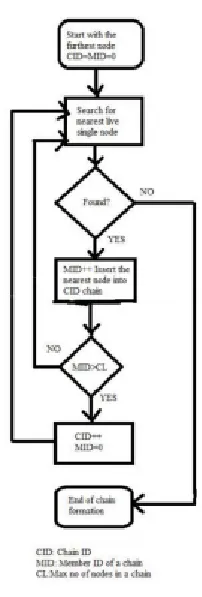
In an objective field, the sensor hubs are arbitrarily sent. These sensor hubs shapes abnormal state and low level chains in light of the rest of the vitality. Abnormal state hubs chooses the pioneer in each chain and gathers the information from low level pioneers , transmits the information to the base station. The chain arrangement calculation, at first base station chooses uttermost hub chain id and part id is zero , then it seek for closest alive hub includes into the chain like that chain arrangement is finished. In the event that chain length surpasses part id it will begins another chain development .the flowchart delineated in fig 1 gives, COSEN performs better. The advantages of utilizing a slight bigger span between pioneers determinations instead of choosing pioneers in each round are
i)less correspondence overhead ii) diminishment of time required for choosing pioneers in each round and iii) expands the usage of larger amount chain.
3.2 Data gathering and Transmission Phase
Once the development of chain and determination of pioneers are finished, the sensor hubs start the information accumulation process. Chain arrangement stage will lead just when it is basic to remake the new chains. Accepted that all the sensor hubs have data to send to BSs so the data is collected before transmission at each of the hub. The token system took after by COSEN is same as PEGASIS.
From figure2, n3 hub is picked as pioneer hub and it transmit the token to end of the chain
n1. Presently each end node(n1 and n5) begins transmits the information to its next hub. In this hub it gets the information and further breakers with its own information and after that sends the data to next hub. In this way the information is engendered from last hub to chain pioneer. Presently every one of the pioneers transmits the information to its more elevated amount chain by utilizing a similar procedure until the more elevated amount pioneer gets every one of the information. At long last, this larger amount pioneer transmits the information to BS after information combination.
Figure 1. Chain Formation Algorithm
Available online: https://edupediapublications.org/journals/index.php/IJR/ P a g e | 2419
4. Simulation Results
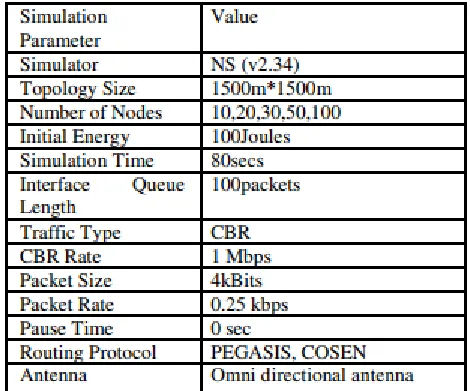
The IEEE 802.11 Protocol is utilized as the MAC layer convention. The radio channel display takes after a Two Ray Ground with an Omni-directional radio wire. We consider steady piece rate (CBR) information activity and haphazardly pick distinctive source-goal associations. Each source sends one CBR bundles whose sends one CBR Packets whose size is 4000 Bits for each second .The portability display is in light of the irregular waypoint demonstrate in a field of 1500m*1500m. In this portability demonstrate, every hub moves o an irregular chose goal with a steady speed from a uniform dispersion among the hubs. After the hub achieves its goal, it stops for a delay time interim and picks another goal and consistent speed. The itemized recreation parameters are appeared in table
Figure 3. Simulation Parameter Table
From reproduction comes about figure 4 demonstrates that correlation of vitality utilization. It is demonstrated that for a few hundreds of rounds COSEN spends vitality around same as PEGASIS. in any case, the great point for COSEN is that, it spends vitality in completely dispersed way with the
goal that it expends more vitality contrasted with PEGASIS.
From figure 5 COSEN sets aside less opportunity to complete a solitary round contrasted with PEGASIS. A definitive change of COSEN from PEGASIS is that, the deferral is much lower in COSEN, because of various chains in COSEN.
From figure 6 demonstrates Time required for different back to back rounds. For 100 rounds PEGASIS requires 5000 seconds, COSEN requires just a single fifth of that time. COSEN performs superior to PEGASIS.
From figure 7 As the quantity of transmissions builds the dead hub rate will increments. COSEN contains less number of dead hubs contrasted with PEGASIS so that arrange lifetime of COSEN will be more. From
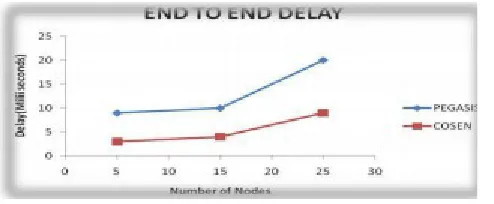
figure 8 Data transmission from hubs to base station takes additional time in PEGASIS because of single chain , so PEGASIS takes more defer contrasted with COSEN.
From figure 9 Lifetime remains relentless in both PEGASIS what's more, COSEN. Lifetime of the system relies upon the dead hub rate, if the dead hub rate is more than lifetime of the system is less if not, lifetime of the system is more.
Available online: https://edupediapublications.org/journals/index.php/IJR/ P a g e | 2420 Figure 4 Energy Consumption Comparison
Figure 5 Time required for single round
Figure 6. Time required for multiple rounds
Figure 7 Dead Node Percentage
Figure 8 End to End Delay
Figure 9 Lifetime Percentage
Figure 10 Packet Delivery Ratio
5. Conclusion
Available online: https://edupediapublications.org/journals/index.php/IJR/ P a g e | 2421 lifetime of COSEN is 92.23%. besides,
COSEN is straightforward and simple to execute. Here for the purpose of straightforwardness we depict a two-layer various leveled chain based convention. In our future work we need to incorporate other issues, for example, MAC layer transmission clashes, sensor rest/wake cycles and so forth.
REFERENCES
[1] Nahdia Tabassum, Quazi Ehsanul Kabir Mamun, Yoshiyori Urano GITS, Waseda University, COSEN Proceedings of the Third
International Conference on Information
Technology: New Generations (ITNG'06)
[2] K. Akkaya and M. Younis, "A Survey of Routing Protocols in Wireless Sensor Networks ", Elsevier Network Journal, Vol. 3/3 , 2005, pp. 325-349.
[3] Sohrabi et al., ―Protocols for Self-Organization of a Wireless Sensor Network‖, IEEE Personal Communications, Vol. No.5, pp. 16-27, Oct 2000.
[4] I.F. Akyildiz et al., ―Wireless Sensor Networks: A Survey‖, Computer Networks, vol. 38, Mar 2002, pp. 393- 422.
5] R. Szewczyk, J. Polastre, A. Mainwaring and D. Culler, Lessons From Sensor Network Expedition‖, 1 st European Workshop on Wireless Sensor Network (EWSN '04), Germany, Jan 19-21, 2004
[6] W.B. Heinzelman, A. Chandrakasan, and H. Balakrishanan, ―An Application-Specific Protocol
Architechture for Wireless Microsensor
Networks‖, IEEE Trans. Wireless Commun., vol. 1, no. 4, Oct. 2002, pp. 660- 70.
[7] C. Intanagonwiwat, R. Govindan, D. Estrin, J. Heidemann, and F. Silva, ―Directed Diffusion for Wireless Sensor Networking‖, ACM/IEEE Transactions on Networking, Vol. 11, No. 1, Feb 2003, pp. 2--16.
[8] K. Akkaya and M. Younis, ―Energy-aware Routing of Delay-constrained Data in Wireless Sensor Networks‖, Journal of Communication Systems, special issue on QoS support and service differentiation in wireless networks, Vol. 17(6), 2004, pp. 663-687.
[9] Zhao F et al., ''Collaborative signal and information processing: an information-directed approach'', Proceedings of the IEEE, 91, No 8, Aug 2003, pp 1199—1209.
[10] W.R. Heinzelman, A. Chandrakasan, and H. Balakrishnan, ―Energy-efficient Communication
Protocols for Wireless Microsensor
Networks‖,Proceedings of the 33rd Hawaii International Conference on System Sciences, Jan. 2000.
[11] J.N. Al-Karaki and A.E. Kamal, ―Routing Techniques in Wireless Sensor Networks: A Survey‖, in IEEEWireless Communications, vol. 11, no. 6, Dec 2004.
[12] S. Lindsay and C. Raghavendra, ―PEGASIS: Power Efficient Gathering in Sensor Information
Systems‖, international Conf. on
Communications, 2001.
[13] A. Manjeshwar and D.P. Agrawal, ―TEEN: A Routing Protocol for Enhanced Efficiency in Wireless Sensor Networks‖, 1st Intl. Workshop on Parallel and Distributed Computing, Apr 2001.
[14] J. Kulik , W. Heinzelman , H. Balakrishnan,―Negotiation-based protocols for disseminating information in wireless sensor networks‖, Wireless Networks, v.8 n.2/3, Mar. 2002, , pp.169-185.