A New Design And Implementation On Convolution Blind Source
Seperation
M Naziya & M Srujana
1Pg Scholar,Department of ECE, Vaageswari College of engineering, Karimnagar
2Ass.t Prof, Department of ECE, Vaageswari College of engineering, Karimnagar.
ABSTRACT
Brief presents an efficient very-large-scale
integration architecture design for convolutive
blind source separation (CBSS). The CBSS
separation network derived from the information
maximization (Infomax) approach is adopted.
The proposed CBSS chip design consists mainly
of Infomax filtering modules and scaling factor
computation modules. In an Infomax filtering
module, input samples are filtered by an Infomax
filter with the weights updated by
Infomax-driven stochastic learning rules. As for the
scaling factor computation module, all
operations including logistic sigmoid are
integrated and implemented by the circuit design
based on a piecewise-linear approximation
scheme. The proposed prototype chipis
implemented via a semicustom design
using90-nmCMOS technology on a die size of
approximately 0.54×0.54 mm2.
I. INTRODUCTION
Blind source separation (BSS) attempts to
separate sources from mixed signals when most
of the information for sources and mixing
process is unknown. Such restrictions make BSS
a challenging task for researchers. BSS has
become a very important research topic in a lot
of fields. Notable examples include audio signal
processing, biomedical signal processing,
communication systems, and image processing .
Without a filtering effect, instantaneous mixing
is considered a simple version of the mixing
process of the source signals. However, for
audio sources passing through an environmental
filtering before arriving at the microphones, a
convolutive mixing process occurs, and
convolutive BSS (CBSS) is used to recover the
original audio sources. Independent component
analysis (ICA) is the conventional means of
solving the BSS or CBSS problem. However,
this method is often highly computationally
intensive and introduces time-consuming
processes for software implementation. More
than a faster solution than software
implementation, hardware solution achieves
solutions for ICA-based BSS has drawn
considerable attention recently. Cohen and
Andreou explored the feasibility of combining
above-andsubthreshold CMOS circuit
techniques for implementing an analog BSS chip
that integrates an analog I/O interface, weight
coefficients, and adaptation blocks. This chip
incorporates the use of the Herault–Jutten ICA
algorithm. Cho and Lee implemented a fully
analog CMOS chip based on information
maximization (Infomax) ICA, as developed by
Bell and Sejnowski. The chip incorporated a
modular architecture to extend its use as a
multichip. Apart from these analog BSS chips,
various fieldprogrammable gate array(FPGA)
implementations with digital architectures have
been developed. Li and Lin realized the Infomax
BSS algorithm based on system-level FPGA
design, by using Quartus II, DSP builder, and
Simulink. Du and Qi presented an FPGA
implementation for the parallel ICA (pICA)
algorithm, which focuses on reducing
dimensionality in hyperspectral image analysis.
The pICA algorithm consists of three temporally
independent functional modules that are
synthesized individually with some
reconfigurable components developed for reuse.
Based on Infomax BSS, Ounas et al. introduced
a low-cost digital architecture implemented on
FPGA. This design used merely one neuron to
support sequential operations of the neurons in
neural network. In 2008, Shyu et al.designed a
pipelined architecture for FPGA implementation
based on FastICA for separating mixtures of
biomedical signals, including
electroencephalogram (EEG), magneto
encephalography (MEG), and electrocardiogram
(ECG). In this design, floating-point arithmetic
units were used to increase the precision of the
numbers and ensure the FastICA performance.
II. LITERATURE SURVEY
Separating brain imaging signals by maximizing
their autocorrelations is an important component
of blind source separation (BSS). Canonical
correlation analysis (CCA), one of leading BSS
techniques, has been widely used for analyzing
optical imaging (OI) and functional magnetic
resonance imaging (fMRI) data. However,
because of the need to reduce dimensionality and
ignore spatial autocorrelation, CCA is
problematic for separating temporal signal
sources. To solve the problems of CCA,
"straightforward image projection" (SIP) has
been incorporated into temporal BSS. This novel
method, termed low-dimensional canonical
correlation analysis (LD-CCA), relies on the
spatial and temporal autocorrelations of all
genuine signals of interest. Incorporating both
introduce a "generalized timecourse" technique
in which data are artificially reorganized prior to
separation. The quantity of spatial plus temporal
autocorrelations can then be defined. By
maximizing temporal and spatial
autocorrelations in combination, LD-CCA is
able to obtain expected "real" signal sources.
Generalized timecourses are low-dimensional,
eliminating the need for dimension reduction.
This removes the risk of discarding useful
information. The new method is compared with
temporal CCA and temporal independent
component analysis (tICA). Comparison of
simulated data showed that LD-CCA was more
effective for recovering signal sources.
Comparisons using real intrinsic OI and fMRI
data also supported the validity of LD-CCA.
Online blind source separation (BSS) is
proposed to overcome the high computational
cost problem, which limits the practical
applications of traditional batch BSS algorithms
III PROPOSED VLSI BLIND SOURCE
SEPARATOR
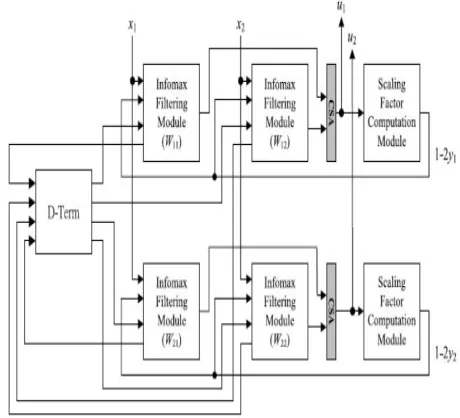
The proposed CBSS system is shown in the
FIG.1. The CBSS chip mainly consists of two
functional cores: Infomax filtering module and
scaling factor computation module.
Additionally, the Infomax filtering outputs are
added with the help of two small carry-save
adders (CSAs). The current prototype chip is
used for two sources and two sensors by
utilizing four Infomax filtering modules along
with two scaling factor computation modules.
FIG. : The block diagram of a proposed CBSS
system.
IV INFOMAX FILTERING MODULE
The Infomax filtering module for the proposed
system is shown in fig.2. the CBSS separation
network contains four causal FIR filters. These
filters are adaptive because stochastic learning
rules which are derived from the Infomax
approach will alter the tap coefficients and are
thus referred to herein as the Infomax adaptive
filter or the Infomax filter. The Infomax filtering
Infomax filtering module, an input sample
passes through lower and upper register chains.
These samples are multiplied with filter weights
and scaling factors, respectively. The
multiplication results of all of the taps are
accumulated by a two-stage summation. The
first stage adopts carry lookahead adders to
generate the intermediate addition results for
multiplication of every two successive taps. The
above intermediate addition results are summed
up by using a carry save addition scheme. A
CSA(carry save adder) can accept more than two
data inputs.
fig.2.
INFOMAX FILTERING
V CONCLUSION
An efficient VLSI architecture design for CBSS
with less delay has been presented in this paper.
The architecture mainly consists of Infomax
filtering modules and scaling factor computation
modules and a D-term. CBSS separation
network derived from the Infomax approach.
The proposed system has high performance and
has less delay as compared with the other
existing system. By the usage of vedic multiplier
in Infomax filter increases the speed as well as
performance of the proposed system.
REFERENCES
[1] G. Zhou, Z. Yang, S. Xie, and J. M. Yang,
“Online blind source separation using
incremental nonnegative matrix factorization
with volume constraint,” IEEE Trans. Neural
Netw., vol. 22, no. 4, pp. 550–560, Apr. 2011.
[2] M. Li, Y. Liu, G. Feng, Z. Zhou, and D. Hu,
“OI and fMRI signal separation using both temporal and spatial autocorrelations,” IEEE
Trans. Biomed. Eng., vol. 57, no. 8, pp. 1917–
1926, Aug. 2010.
[3] A. Tonazzini, I. Gerace, and F. Martinelli,
“Multichannel blind separation and
deconvolution of images for document analysis,”
IEEE Trans. Image Process., vol. 19, no. 4, pp.
912–925, Apr. 2010.
[4] H. L. N. Thi and C. Jutte, “Blind source
separation for convolutive mixtures,” Signal
Process., vol. 45, no. 2, pp. 209–229, Aug. 1995.
[5] A. J. Bell and T. J. Sejnowski, “Blind
separation and blind deconvolution: An
information-theoretic approach,” in Proc. Int.
Conf. Acoust., Speech, Signal Process., May
[6] A. Hyvärinen and E. Oja, “Independent
component analysis: Algorithms and
applications,” Neural Netw., vol. 13, no. 4/5, pp.
411–430, May/Jun. 2000.
[7] M. H. Cohen and A. G. Andreou, “Analog
CMOS integration and experimentation with an
autoadaptive independent component analyzer,”
IEEE Trans. Circuits Syst. II, Analog Digit.
[8] K. S. Cho and S. Y. Lee, “Implementation of
InfoMax ICA algorithm with analog CMOS
circuits,” in Proc. Int. Workshop Independent
Compon. Anal. Blind Signal Separation, Dec.
2001, pp. 70–73.
[9] Z. Li and Q. Lin, “FPGA implementation of
Infomax BSS algorithm with fixed-point number
representation,” in Proc. Int. Conf. Neural Netw.
Brain, 2005, vol. 2, pp. 889–892.
[10] H. Du and H. Qi, “An FPGA
implementation of parallel ICA for
dimensionality reduction in hyperspectral
images,” in Proc. IEEE Int. Geosci. Remote
Sens.Symp., Sep. 2004, pp. 3257–3260.
[11] M. Ounas, R. Touhami, and M. C. E.
Yagoub, “Low cost architecture of digital circuit
for FPGA implementation based ICA training
algorithm of blind signal separation,” in Proc.
Int. Symp. Signals, Syst. Electron., 2007, pp.
135– 138.
[12] K. K. Shyu, M. H. Lee, Y. T. Wu, and P. L.
Lee, “Implementation of pipelined FastICA on
FPGA for real-time blind source separation,”
IEEE Trans. Neural Netw., vol. 19, no. 6, pp.
958–970, Jun. 2008.
[13] A. Acharyya, K. Maharatna, J. Sun, B. M.
Al-Hashimi, and S. R. Gunn, “Hardware
efficient fixed-point VLSI architecture for 2D
Kurtotic FastICA,” in Proc. Eur. Conf. Circuit
Theory Des., Aug. 23–27, 2009, pp. 165–168.
[14] C. K. Chen et al., “A low power
independent component analysis processor in 90
nm CMOS technology for portable EEG signal
processing systems,” in Proc. IEEE Int. Symp.
Circuits Syst., May 15–18, 2011, pp. 801–804.
[15] H. Qi and X. Wang, “Comparative study of
VLSI solutions to independent component
analysis,” IEEE Trans. Ind. Electron., vol. 54,
no. 1, pp. 548–558, Feb. 2007.
[16] K. Torkkola, “Blind separation of
convolved sources based on information
maximization,” in Proc. IEEE Signal Process.
Soc. Workshop, Sep. 1996,pp. 423–432.
[17] C. Jutten and J. Herault, “Blind separation
on neuromimetic architecture,” Signal Process.,
vol. 24,no. 1, pp. 1–10, Jul. 1991.
[18] J. F. Cardoso, “Infomax and maximum
likelihood for blind source separation,”IEEE
Signal Process. Lett., vol. 4, no. 4, pp. 112–114,
Apr. 1997.
[19] A. J. Bell and T. J. Sejnowski, “An
information-maximization approach to blind
separation and blind deconvolution,” Neural
Comput., vol. 7, pp. 1129–1159, Nov. 1995.
[20] M. S. Pedersen, J. Larsen, U. Kjems, and
L. C. Parra, “A survey of convolutive blind source separation methods,” in Handbook of
Speech Processing. New York, NY, USA:
Springer-Verlag, 2007.
[21] L. D. Van andW. S. Feng, “An efficient
systolic architecture for the DLMS adaptive
filter and its applications,” IEEE Trans. Circuits
Syst. II, Analog Digit. Signal Process., vol. 48,
no. 4, pp. 359–366, Apr. 2001.
[22] G. Long, F. Ling, and J. G. Proakis, “The
LMS algorithm with delayed coefficient
adaptation,” IEEE Trans. Acoust., Speech,
Signal Process., vol. 37, no. 9, pp. 1397–1405,
Sep. 1989.
[23] C. Alippi and G. Storti-Gajani, “Simple
approximation of sigmoidal functions: Realistic
design of digital networks capable of learning,”
in Proc. IEEE Int. Symp. Circuits Syst., 1991,
pp. 1505–1508.
[24] D. J. Myers and R. A. Hutchinson,
“Efficient implementation of piecewise linear
activation function for digital VLSI neural
networks,” Electron. Lett., vol. 25, no. 24, pp.