ISSN 2286-4822 www.euacademic.org
Impact Factor: 3.1 (UIF) DRJI Value: 5.9 (B+)
Amendment of Saline-Alkaline back Cotton Soil
with Peg for
Oryza Sativa
L.
B. L. CHAVAN Professor School of Earth Sciences, Solapur University Solapur, Maharashtra India
Abstract:
Salinity constitutes the most stringent factor in limiting plant growth thereby the agricultural productivity. Effect of different concentrations of PEG (5 ppm, 10 ppm, 15 ppm, 20 ppm, 25 ppm and 30 ppm) was studied on the germination, seedling growth, root-shoot biomass and chlorophyll contents of Oryza sativa L. cv. Krishna hamsa. PEG treatment has been found effective to increase germination and early seedling growth. Germination and almost all the morphological parameters including the chlorophyll a, chlorophyll b and total chlorophyll contents showed increase in all PEG treated sets.
Key words: Germination, Biomass, Chlorophyll, Root length, Shoot length, Soil salinity, Oryza Sativa L.
Introduction:
demands to increase the total yield. Rice is one of the most effective and commercial means of reclaiming hundreds of thousands of hectares of saline lands in India, if cultivated effectively and efficiently by advanced methods. Salinity is one of the major obstacles in enhancing rice production as it decreases germination and reduces the growth of shoot, root and biomass. Therefore, development of salt tolerant varieties or the uses of soil amendments for reclamation of salinity have been considered as suitable strategies to increase rice production in saline prone areas. The objectives of this research were to study the performance of paddy crop under salinity stress if treated with Polyethelene Glycol (PEG) as soil amendment under laboratory conditions. Keeping the above facts in view, present investigations were carried out.
Materials and Methods:
The soil samples from upper layer (25 cm) of non saline and saline soil were collected in polythene bags from the agricultural field of village Pakni, District Solapur and analysed for their physico-chemical parameters using standard methods (Goel and Trivedi, 2000; Guptta, 2002). Polyethylene glycol (PEG) is a form condensation polymers of ethylene oxide water with general formula H(OCH2CH2)n OH, where n is the
Oryza sativa L. were thoroughly washed with tap water for 5 minutes, surface sterilized with 10 : 1 distilled water/ bleach (commercial NaOCl) solution for 5 minutes and then 5 times with autoclaved distilled water (Ali et al., 2013). These seeds were then exposed to hydro priming at room temperature for 2 days (Ibrahim et al., 2013) and allowed to germinate in 20 cm diameter Petri plates with a tight-fitting lid.
Results and Discussion:
The Physico-chemical parameters of saline-alkaline black cotton soil and the non-saline soil (control) used were studied and results are presented in Table 1. The saline soil was alkaline with pH 8.72 and EC 0.88 having poor organic carbon (0.21%) and organic matter (0.362%) reflecting it as unfit for agricultural cultivation. The non-saline (control) soil was having pH 7.2, organic matter 0.383% and organic carbon 0.23% which was slightly higher than the saline-alkaline black cotton soil. SAR value for saline-alkaline black cotton was 3.71 whereas for non-saline (control) soil, it was 4.75.
Table 1: Physico chemical Properties of saline alkaline black cotton soil and control soil
No any germination or seedling survived in untreated saline-alkaline black cotton soil (blank). Hence, no data was obtained from blank set and not considered for further data analysis. The presence of soluble salts in the plant growth media is a major factor that reduces the seed germination and crop growth (Chavan, 2013). Agricultural crops are sensitive to stress in their early seedling growth stages. Once the crop grows and passes these stages, it can often tolerate and grow well in higher salinity conditions (Rehman et al., 1996; Chavan, 2014). In view to such goal, Polyethylene Glycol (PEG) studied in present investigation was found beneficial for the paddy crop (Oryza sativa L.).
Parameter Saline Soil Control Soil
pH 8.72 7.2
EC 0.88 0.91
Organic carbon (%) 0.21 0.23
Organic matter(%) 0.362 0.383
Ca (cmol/kg) 1.32 1.21
Mg(cmol/kg) 0.46 0.52
Na(cmol/kg) 4.94 4.42
Table 2: Effect of PEG on the seed germination (%) at different
periods in Oryza sativa L.
Treatment Germination percentage in Oryza sativa L.
Expt. set 1st Day 2nd Day 3rd Day 4th Day 5th Day
Control 26.50(±1.1) 65.75(±1.0) 79.75(±1.0) 88.00(±1.3) 88.25(±1.5) 05 ppm PEG 28.00(±0.5) 76.25(±1.8) 84.50(±1.4) 88.75(±1.1) 89.00(±1.9) 10 ppm PEG 28.25(±2.1) 78.00(±1.8) 86.00(±1.6) 87.25(±1.0) 87.75(±1.8 15 ppm PEG 27.25(±1.6) 75.50(±2.0) 86.25(±1.3) 88.00(±1.8) 88.00(±0.3) 20 ppm PEG 27.50(±0.7) 69.25(±1.2) 75.75(±1.7) 76.25(±1.6) 76.25(±0.5) 25 ppm PEG 27.50(±1.3) 66.50 ±1.6) 75.25(±1.5) 75.75(±1.1) 76.50(±1.1) 30 ppm PEG 7.25 (±1.5) 63.25(±0.5) 73.25(±0.5) 73.50(±1.6) 74.00(±2.1)
Bracket values indicates SD.
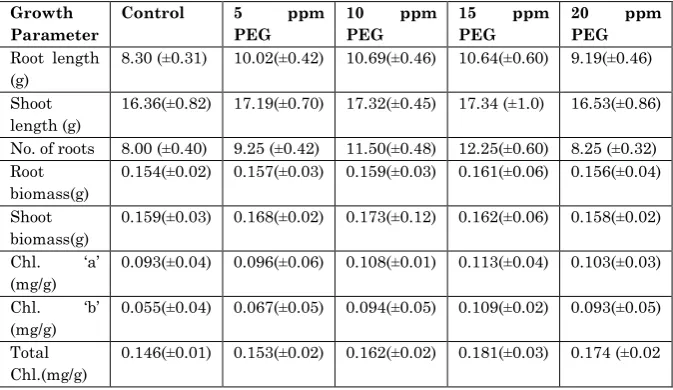
Table 3: Effect of PEG on different morphological growth parameters of Oryza sativa L. per seedling indicating mean with respective standard deviation in bracket.
The results reveal that the root, shoot and chlorophyll contents were well improved against the salt stress and seedlings were well nourished by PEG treatment (Table 3). Root length and shoot length in control set were 8.30 (±0.31) and 16.36 (±0.82) which were lowest as compared with respective lengths in PEG treated sets. Number of roots was found improved in 5 to 25 ppm PEG concentrations but decreased at 30 ppm indicating
Growth Parameter
Control 5 ppm PEG
10 ppm PEG
15 ppm PEG
20 ppm PEG
Root length (g)
8.30 (±0.31) 10.02(±0.42) 10.69(±0.46) 10.64(±0.60) 9.19(±0.46) Shoot
length (g)
16.36(±0.82) 17.19(±0.70) 17.32(±0.45) 17.34 (±1.0) 16.53(±0.86) No. of roots 8.00 (±0.40) 9.25 (±0.42) 11.50(±0.48) 12.25(±0.60) 8.25 (±0.32) Root
biomass(g)
0.154(±0.02) 0.157(±0.03) 0.159(±0.03) 0.161(±0.06) 0.156(±0.04) Shoot
biomass(g)
0.159(±0.03) 0.168(±0.02) 0.173(±0.12) 0.162(±0.06) 0.158(±0.02) Chl. ‘a’
(mg/g)
0.093(±0.04) 0.096(±0.06) 0.108(±0.01) 0.113(±0.04) 0.103(±0.03) Chl. ‘b’
(mg/g)
0.055(±0.04) 0.067(±0.05) 0.094(±0.05) 0.109(±0.02) 0.093(±0.05) Total
Chl.(mg/g)
slight phyto-toxicity evidenced by reduced biomass and chlorophyll contents. The chlorophyll contents have been found increased with increase in the PEG concentration up to 25 ppm in treated saline-soil and decreased thereafter.
Conclusion:
From the results of this investigation, it is evident that the PEG can be recommended as one of the treatment solution for the amendment of saline soil to cutivate paddy crop (Oryza sativa L.)
REFERENCES:
Ali M. K. (2013). Rice (Oryza Savita L) candidates against global warming. Annals of Bioogical research, 4(8):9-16. Chavan, B.L (2014). Treatment of saline-alkaline black cotton
soil with PEG for germination and growth of Triticum aestivum seedlings, Int. J. Res.in Mgmt. & Bus. Stud. 1(4), 23-26, also available also at www.ijrmbs.com. Chavan B.L. (2013) Sustainable and cost effective treatment for
the reclamation of saline alkaline black cotton soil, Final technical report on the Major Research Project submitted to UGC, New Delhi.
Goel, P.K. and Trivedi, R.K. (2000). Methods in environmental analysis water, soil, air. Handbook, Environmental Publication, Karad.
Guptta, P.K. (2002). Methods in environmental analysis water, soil and air. Handbook, Agrobios publication, Jodhpur, Rajasthan, India
Kapoor R.T.(2011). Salinity -induced changes in germination, biomass and physiological characteristics of Oryza sativa L. International conference of advance in Biotechnology and Pharmaceutical sciences (ICABPS), 2011.
Ibrahim N.D., Z. Bhadmus and A. Singh (2013) Hydro-priming and Re-drying effects on germination, emergence and growth of upland rice (Oryza sativa L.), Nig. J. of Basic and App. Sc., 21(2), 157-164, also available at http://www.ajol.info/index.php/njbas/index.
Rehman, S., Harris P.J.C, Bourne W.F. and Wilkin J. (1996). The effect of sodium chloride on germination and the potassium and calcium content of Acacis seeds. Seed Sci. and Technol., 25: 45-57.