A STUDY ON EFFICIENT COMMUNITY DETECTION
TECHNIQUES IN SOCIAL NETWORKS
Arindam Roy
1, Priyanshu Thakuria
2, Gypsy Nandi
3Department of CSE &IT,School of Technology, Assam Don Bosco University, Azara Guwahati (India)
ABSTRACT
Presently, there are many algorithms and techniques used for detecting communities in social networks, but not all
of them are well suited for various types of networks such as dynamic social networks. Detection of community in
social networks is broadly classified into four types – node-based, hierarchy-based, network-centric and
group-centric. Majority of these techniques use the concept of graph mining which is a technique enormously used for
mining online social networks. In this paper, we study efficient community detection techniques by making a
comparative study of few such algorithms that are often been used for this purpose.
Keywords: Divisive Hierarchy-Based Technique, Girvan-Newman, Network Centric, Node Similarity,
Online Social Networks
I. INTRODUCTION
Social networking in the recent years has become an increasingly important area because of its unique ability to
enable social contact over the internet for geographically backward areas. A social network can be represented as a
graph, in which nodes represent users and links represent the connections among the users of the graph. Social
communities have emerged as new networked systems and are being of current research interests. Such communities
are formed based on working environment, family relationships, friendships, demographic regions, etc. In graph
terms, a social community can also be considered as a clique, in which the community is a subset whose nodes or
vertices are all adjacent to each other.
A community in a social network can also be defined as a collection of users considered as a group such that there
are high interrelations or associations among members within the group. Communities help us understand the
structure of given social networks and clarify the functions and properties of the networks. An important problem in
the area of social networking is that of community detection. In case of community detection the main aim is to
partition the network into dense regions of the graphs. A wide application of community detection is for generating
recommendations based on how members within a community display similar tastes and preferences.
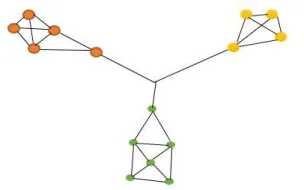
Fig. 1 below illustrates a simple example of a social network where there are mainly three communities formed
based on similar tastes and/or preferences. Each community in the network is highlighted with a different color.
Detecting communities in a network also provides us meaningful insights to its internal structure as well as its
uncovered parts of the network thus helps in preventing potential networking diseases such as virus or worm
propagation.
Fig 1: A simple social network showing communities (each community is colored differently)
The rest of the paper is organized as follows. Section II discusses about the standard community detection
techniques that are currently often applied for such analysis. Section III discusses about the framework of the
standard community detection techniques and algorithms. In section IV a brief conclusion of the paper is given
along with scope of future works in this area of research.
II. DISCUSSION ON STANDARD COMMUNITY DETECTION TECHNIQUES
In [14], a survey on community detection techniques has been done in the context of online social networks (OSN).
In OSN, nodes represent individuals and edges indicate relationships between them. In this survey various
community detection methods for networks with static and dynamic nature are also discussed. Also in [15], a
classification for community detection methods has been made based on the type and nature of social networks.
Overlapped community means that a node in the network may be affiliated to more than one community. After
reviewing [16], it can be come to the conclusion that quality and scalability are the major issues in this problem area
and also a measure that can be used for comparing and analyzing various such community detection techniques.
The standard community detection techniques can be broadly classified into four categories:
a. Node-centric Community Detection
b. Group-Centric Community Detection
c. Hierarchy-Centric Community Detection
d. Network-Centric Community Detection
In node-centric community detection, each of the nodes that are present in the graph has to satisfy certain properties.
One of them is the complete mutuality cliques that have a complete subgraph in which all nodes are adjacent to each
other [10].
The group-centric criterion requires the whole group to satisfy a certain condition. It considers connection inside a
group as a whole. It is acceptable to have some nodes in the group with some low connectivity as long as the group
overall satisfies certain requirements.[10]
Another line of community detection research is to build a hierarchical structure of communities based on network
topology. There are divisive algorithms that can be applied for detection of the communities. One is the
Newman-Girvan algorithm [4] where the betweenness for all edges is calculated in the network and the edge with the highest
The Network-centric community detection has to consider the global topology of a network. It aims to partition
nodes of a network into a number of disjoint sets. Typically, network-centric-community detection aims to optimize
a criterion defined over a network partition rather than over one group.[10]
There are also some other models and concepts of community detection techniques that have been proposed by
several authors. Bayesian models [2] are used for detecting latent communities from a social network. For instance,
two users engaging in conversation related to politics are more likely to be members of a community on politics.
Quick Community Adaptation [3] can be an adaptive modularity-based method for identifying and tracing
community structure of dynamic online social networks.
Again, a node with a neighborhood that is too small is labeled a noise point, unless it falls within the neighborhood
of a core point, and then it is labeled a border point. Core points connect to other nearby core points to form the
center of a community [7]. The structure of social networks is an important research area and has attracted much
scientific interest. Algorithm for detecting communities can be found which considers influential nodes based on
random walk. Random walk can explore the underlying network structure and this concept has also been employed
to reveal communities structure in social networks [8].
A new approach called “mutual accessibility” is proposed [12] to discover communities in a social network
environment. Experimental results on a real world social network [6] show that a simple thresholding method with
edge weights based on node attributes is sufficiently to identify a strong network community.
III.
FRAMEWORK OF THE STANDARD COMMUNITY DETECTION TECHNIQUES
In this section, we will discuss in detail two main standard community detection techniques used for social networks
by considering the several advantages and simplicity of these techniques. The first one is the Girvan-Newman
algorithm that detects communities by progressively removing edges from the original network and the second is the
clustering based on the node similarity technique.
a). Girvan-Newman Community Detection Technique
In Girvan-Newman algorithm, weak edges are progressively removed from the network and then the connected
components of the remaining network form the communities. Instead of trying to construct a measure that tells us
which edges are the most central to communities, the Girvan–Newman algorithm focuses on edges that are most
likely "between" communities.
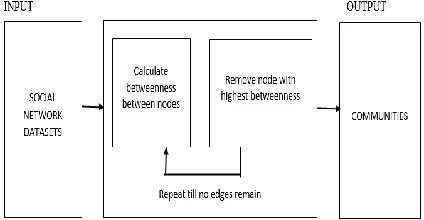
As shown in Fig. 2 above, in case of Girvan-Newman algorithm, we can consider social network datasets as the
input and then we calculate between ness between nodes and then remove node with the highest betweenness. This
process is repeated until no edges remain. Finally, we get several clusters or communities of nodes as the output.
Algorithm 1 below discusses the Girvan–Newman algorithm.
---
Algorithm 1: Girvan-Newman [4]
---
1. The betweenness of all existing edges in the network is calculated first.
2. The edge with the highest betweenness is removed.
3. The betweenness of all edges affected by the removal is recalculated.
4. Steps 2 and 3 are repeated until no edges remain.
---
In the first step of Algorithm 1, the betweenness of all existing edges in the network is calculated. Edge
betweenness of an edge is defined by the number of shortest paths that pass along the edge. Then in the second step
the edge with the highest betweenness is removed. In step 3 the betweenness of all the edges affected by the removal
is recalculated. Step 2 and step 3 are repeated until all edges are considered and no edges remain.
Fig 3: A graph with 8 nodes
For the above graph displayed in Fig. 3, the betweenness of edge (3, 4) is 3, as the shortest path from node 1 to 6,7
and 8 passes through the edge (3,4).
The edge with the highest betweenness generally acts as the bridge between 2 communities. Thus, when we remove
the edges with highest betweenness, we get different communities.
b). Clustering-based Community Detection Technique
In network-centric community detection, we consider connections as features and then apply Jaccard similarity to
compute vertex similarity. The Jaccard similarity coefficient of two vertices is the number of common neighbors
divided by the number of vertices that are neighbors of at least one of the two vertices being considered. For
instance, for the graph given below we can compute the Jaccard similarity as follows:
For the above graph displayed in Fig. 4 the Jaccard similarity of nodes 3 and 5 would be:
Jaccard Similarity (3,5) =
= 0.2
Then, after applying Jaccard similarity, we use classical K-Means clustering technique to cluster the communities.
This is explained in Algorithm 2 given below.
---
Algorithm 2: Clustering-based on node similarity [10]
---
1.Consider connections as features.
2.Apply Cosine or Jaccard similarity to compute vertex similarity
3.Apply Classical K-Means clustering algorithm
---
In Step 1 of Algorithm 2, all the connections or edges are considered as features. In the next step, we apply Cosine
or Jaccard similarity to compute the vertex similarity. In step 3, we apply classical K-means clustering algorithm.
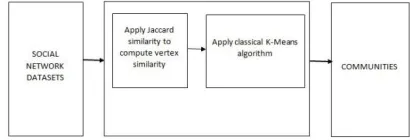
As shown in Fig. 5, for clustering-based community detection technique, we can take as input any social network
dataset. Then we apply Jaccard similarity to compute vertex similarity. And then, we apply classical k-means
technique. After all the steps are completed, we get the required communities.
Fig 5: The standard process of clustering based on node similarity technique for community
detection
c).Node-centric Community Detection Technique
The next technique that we will talk about is the node-centric community detection technique. In this technique the
node has to satisfy certain properties. One of the properties is complete mutuality which is based on the concept of
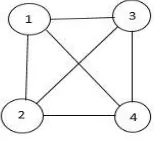
cliques. Clique is a maximum complete subgraph in which all nodes are adjacent to each other. For example in Fig.
6 below, nodes below, nodes 1,2,3 and 4 form a clique.
Now if we are required to find the maximum clique, then in a clique of size k, each node maintains degree>=k-1.
Nodes with degree <k-1 will not be included in the maximum clique.
Algorithm 3 below discusses the Maximum Clique technique used for community detection among nodes.
---
Algorithm 3: Maximum Clique [10]
---
1. We first sample a sub-network from the network.
2. Then we find a clique in the sub-network, by a greedy approach.
3. Say the clique above is size k, in order to find out a larger clique, all nodes with degree <=k-1 should be
removed.
4. We repeat until the network is small enough.
---
Fig 7: A graph with 7 nodes
For Fig. 7 above, if we want to find the maximum clique, then we can first find a clique {1,2,3}of size 3. In order to
find a clique>3, we have to remove all nodes with degree <=3-1=2. Hence, we can remove nodes 5, 6 and 7. The
resultant clique is shown in Fig. 8.
Fig 8: A clique consisting of four nodes
TABLE 1 below illustrates about the strengths and weaknesses of the three techniques discussed above.
TABLE 1: Strength and Weaknesses of Three Standard Community Detection Techniques
Community
Detection
Technique
Strength Weakness
Girvan-Newman
Removes the nodes
with highest
betweenness
Is
computationally
costly
Clustering
Based on Node
Takes common
node attached to a
Difficult for large
Similarity node
Node-Centric
Technique
Many nodes will be
pruned
It will repeat until
the network is
small enough
IV. CONCLUSIONS AND FUTURE WORK
Social networking in the recent years has become an increasingly important application because of its unique ability
to enable social contact over the internet for geographically backward areas. This paper covers the fundamental
concepts of community detection and gives an overview of three standard community detection techniques that are
available. In the future, new community detection technique can be developed that takes into consideration the
limitations mentioned for these three community detection techniques.
REFERENCES
[1]. Guo-Jun Qi, Charu C. Aggarwal, Thomas Huang: Community Detection with edge content in social media
networks. Data Engineering (ICDE), 2012 IEEE 28th International Conference.
[2]. Mrinmaya Sachan, Danish Contractor, Tanveer A. Faruquie, L. Venkata Subramaniam: Using Content and
Interactions for Discovering Communities in Social Networks, Proceedings of the 21st international conference
on World Wide Web, 331-340.
[3]. Nam P. Nguyen, Thang N. Dinh, Ying Xuan, My T. Thai: Adaptive Algorithms for Detecting Community
Structure in Dynamic Social Networks, in Proc. IEEE INFOCOM, Shangai,Apr.2011,pp.2282-2290.
[4]. Deepjyoti Choudhury, Arnab Paul: Community detection in social network: An Overview, Volume: 02 Special
Issue: 02, Dec-2013, Available @ http://www.ijret.org
[5]. Jaewon Yang, Julian McAuley, JureLeskovec: Community Detection in Networks with Node attributes, pp.
1151-1156,2013.
[6]. KarstenSteinhaeuser and Nitesh V. Chawla: Community Detection in a Large Real-World Social Network In:
Liu, H., Salerno, J.J., Young, M.J.(eds.)Social Computing, Behavioral Modeling and Prediction, pp. 168-175.
Springer US(2008).
[7]. Nathan Aston, Wei Hu: Community Detection in Dynamic Social Networks, Date of Conference 10-15 April
2011, Conference Location: Shangai
[8]. Chang Su, Yukun Wang, Lan Zhang: Community Detection in Social Networks Based on Influential Nodes,
Journal of Software, Vol. 9, No. 9, September 2014
[9]. Lei Tang and Huan Liu ,Chapter 1: Social Media and Social Computing
[10].Lei Tang and Huan Liu. Community Detection and Mining in Social Media, Morgan & Claypool Publishers,
[11].Tsuyoshi Murata, Handbook of Social Network Technologies and Applications, Chapter 12 : Detecting
Communities in Social Networks
[12].The Stanford University By Jure Leslovec: Retrieved fromhttps://snap.stanford.edu/data/egonetsFacebook.html
[13].The Dolphins Dataset Retrieved from
http://www.casos.cs.cmu.edu/computational_tools/datasets/external/dolphins/index.php
[14].AmitDhumal and PravinKamde. Survey on Community Detection in Online Social Networks, International
Jounal of Computer Aplications (0975-8887) Volume 121-No.9, July 2015
[15].Pourkazemi,M.,Keyvanpour,M. A survey on community detection methods based on the nature of social
networks. Published in Computer and knowledge Engineering (ICCKE), 2013 3th International eConference ,
Oct. 31 2013-Nov.1 2013
[16].Chintalapudi, S.R, Krishna Prasad, M.H.M.A survey on community detection algorithms in large scale real
world networks. Computing for Sustainable Global Development (INDIACom), 2015 2nd International