Amar Issaa*, Oussama Mansourb, Tamim Hammada
a. Department of Pharmaceutics, Faculty of Pharmacy, Tishreen University, Latakia, Syria.
b. Department of Medicinal Chemistry and quality Control, Faculty of Pharmacy, Tishreen University, Latakia, Syria.
*Corresponding author’s E-mail: [email protected]
Accepted on: 12-08-2014; Finalized on: 30-09-2014. ABSTRACT
Patient compliance is a key factor in recovery or healing, and hard-to-swallow tablets are one of barriers against patient compliance. The purpose of this study is to formulate and evaluate different formulations of Orally Disintegrating Tablets (ODTs) of Chlorpheniramine Maleate. Tablets were prepared by the direct compression method. Three types of diluents were used: lactose, mannitol, and glucose. For each group, 40 mg of five different disintegrants such as crospovidone (kollidon-CL®), microcrystalline cellulose, microcrystalline cellulose, sodium starch glycolate, and sodium croscarmillose were experimented. The lowest disintegration time (17±2.5 sec) was found in the formulation which contains glucose as a diluent and kollidon-CL® as a disintegrant. Followed by the formulation which contains mannitol as a diluent and kollidon-CL® as a disintegrant with a disintegration time of 21.16±3.5 sec. These formulations also showed the highest dissolution rate, compared to other formulations. All tablets had a uniform weight and content. They had good mechanical strength, and all of them released 80% of their chlorpheniramine maleate's content in less than 30 minutes. Tablets with lower disintegrating time released their active ingredient in less time.
Keywords: Orally Disintegrating Tablets, Chlorpheniramine Maleate, Disintegrants, Diluents, Disintegration time.
INTRODUCTION
ne of the greatest challenges facing the pharmaceutical industry today is how to make drugs easy to take so that patients positively enjoy the experience.1-3 Hard-to-swallow tablets are one of the key barriers to patient compliance, and to obviate this problem, researchers have developed a new dosage form called Orally Disintegrating Tablets (ODTs) which disintegrate in mouth rapidly, usually within a matter of seconds, when placed upon the tongue without the need for water.4-6 Thus they are suitable for geriatric, pediatric, and traveling patients who suffer from inaccessibility to water.7,8 In addition to that, ODTs are able to release the active ingredients rapidly, giving the fast effect that needed for some cases like allergy, pain, and anxiety.9 Moreover, drug candidates which undergo pre-gastric absorption when formulated as orally disintegrating tablets may show increased oral bioavailability.10,11
The US FDA ODT guideline suggests 30 seconds (in vitro) as the preferred disintegration time whereas the disintegration time recommended by European pharmacopoeia is less than 3minutes.
Although different technologies, including molding, sublimation, direct compression, wet granulation, freeze drying and spray drying, have been used to prepare ODTs and have advanced considerably along with the rapid market growth of ODTs product, the direct compression method was reported as the simplest and most cost-effective ODTs manufacturing procedure. Moreover, the ODTs prepared by direct compression shows better physical strength than those prepared by other methods.12-14
The pharmaceutical active ingredients, which have been formulated as ODTs, are still limited worldwide, in spite of their features and benefits. Hence, the present work aims to prepare and study different formulations of Orally Disintegrating Tablets of chlorpheniramine maleate by direct compression method.
Chlorpheniramine maleate is a first-generation alkylamine antihistamine used as a treatment of allergic conditions such as rhinitis and urticaria. It's known as OTC sedative drug because it passes the blood brain barrier.15-17 In addition, Chlorpheniramine maleate has been proved to have an antidepressant property.18 The bioavailability of chlorpheniramine maleate is 0.4 and its half time is about 30 hours. Chlorpheniramine maleate is freely soluble in water and has a pKa=9.2.19-21 Chlorpheniramine maleate does not exist in such dosage form.
MATERIALS AND METHODS
Materials
Chlorpheniramine maleate was received as a gift sample from Syphcopharma, Syria. Super disintegrants such as: Crospovidone (Kollidon-CL®: polyplasdon XL-10), Microcrystalline Cellulose (Avicel PH 101® and Avicel PH 102®), Sodium Croscarmillose (Ac-di-sol®) were obtained as gift samples from Alpha Pharmaceutical Industries, Aleppo, Syria. All other materials like lactose, mannitol, glucose, sodium saccharin, Aerosil 200 and analytical solutions were of analytical grade.
Preparation of Orally Disintegrating Tablets
Chlorpheniramine maleate ODTs were prepared by direct compression method according to this united formula:
Comparative Study of Different Formulations of Chlorpheniramine Maleate Orally
Disintegrating Tablets
O
Chlorpheniramine Maleate 4 mg
Disintegrant 40 mg
Diluent 238 mg
Aerosil200 1% (3 mg)
Sweetener (Sodium Saccharine) 15 mg
Fifteen prepared formulations which have different diluents and/or different disintegrants are given in Table 1.
Table 1: Various formulations of Chlorpheniramine Maleate ODTs.
All ingredients were weighed and mixed uniformly together. The obtained blend was lubricated with aerosol 200. The tablets were compressed using single punch tablet compression machine to get a tablet of 300 mg weight containing 4 mg of chlorpheniramine maleate.
The prepared tablets were divided to three groups of three different diluents:
Group A contains lactose
Group B contains mannitol
Group C contains glucose
For each group, five different super disintegrants were used:
Crospovidon (Kollidon-CL®: PolyplasdonXL-10), Microcrystalline Cellulose (AvicelPH 102®), Microcrystalline Cellulose (AvicelPH 101®), Sodium Starch Glycolate (Primojel®) and Sodium Croscarmillose (Ac-di-sol®). The other ingredients like sodium saccharin as a sweetener and aerosil 200 as a lubricant were kept constant.
Evaluation of prepared tablets
Weight Uniformity
Twenty randomly selected tablets were weighed individually. The average weight and the standard deviation were calculated.
None of the tablets should deviate from the average weight by more than ±10% as indicted in the European pharmacopeia, 2005.12
Content uniformity
The content uniformity test is used to ensure that every tablet contains the amount of drug substance intended with little variation among tablets within a batch.
Ten tablets were selected at random and HPLC (High Performance Liquid Chromatography) analytical method was applied to assay the individual content of the active ingredient in each tablet by pulverizing it to a fine powder and solute it in 500 ml of HCl 0.01Mas indicated in the USP-NF. 30th ed., 2007.22
The preparation complies if not more than one (all within limits) individual content is outside the limits of 85 to 115% of the average content and none is outside the limits of 75 to 125% of the average content.
Hardness and friability tests
Hardness or crushing strength of the tested Orally Disintegrating Tablet formulations was measured using the hardness tester (Erweka D-63150: GmbH/TBH.200, Germany) as indicated by Niazi, 2004.
The friability of a sample of 20 orally disintegrating tablets was measured utilizing a LOGAN instrument corp. FAB-2. Pre-weighed tablets were placed in a plastic chambered friabilator attached to a motor revolving at a speed of 25 rpm for 4 min.23 The tablets were then de-dusted, reweighed, and percentage weight loss (friability) was calculated by the equation.
% = ℎ
ℎ × 100
In-vitro Disintegration test
In vitro disintegration time (DT) of the orally
disintegrating tablets was determined by placing 10 mL of phosphate buffer (pH= 7.2) at 25oC in a petri dish of 10 cm diameter.24-27 The tablet was then carefully positioned in the center of the petri dish and the time required for the tablet to completely disintegrate into fine particles was noted. Measurements were carried out in replicates of six tablet (n=6) and mean SD values were recorded.
Dissolution Test
predetermined time intervals (1, 2, 3, 4, 5, 7, 10, 15, 20 and 30 min), replaced with equal volume of fresh medium, and analyzed with HPLC analytical method. 22,28-30
Assay
HPLC analytical method was used, and a calibration curve was drawn by a series of Chlorpheniramine maleate standard solutions which was prepared from a mother solution (28mg/100ml).
A standard solution for each used excipient was also prepared and analyzed by HPLC method to get their chromatogram.22,28,29
HPLC Parameters
HPLC was performed on C-18 column following the
parameters developed by Maithani et al., 2010. 20 µL of
the sample was injected and the analysis was carried using phosphate buffer (pH=5.8): acetonitrile (55:45) as a mobile phase at a flow rate of 1 ml/min. Detection was accomplished by UV spectrophotometer at 255 nm.
RESULTS AND DISCUSSION
Chlorpheniramine Maleate assay
The typical calibration curve for Chlorpheniramine Maleate analyzed by HPLC method and detected by UV spectrophotometer was:
= 116656 −3775.8
= 0.9966
HPLC showed that all excipients except sodium saccharine had no absorbance of U.V at the same wavelength with chlorpheniramine maleate, this result matches with that obtained by Dibbern et al., 2002.31 Hence, HPLC method can cancel this U.V absorption interference and gives accurate assay results.
Evaluation of Prepared Tablets
The data obtained from post-compression parameters such as weight variation, drug content, hardness, friability were all in boundary of standard limit.
All the tablets passed weight variation test as the percentage weight variation was within the pharmacopoeial limits.
The percentages drug contents of all the tablets were found to be in the acceptable limits.
The hardness of all prepared tablets were found to be in the range of 3.75±0.42 to 15.3±1.51 kg/cm2.
In all the formulations the loss in total weight of the tablets due to friability was less than 1% (in the range of 0.4-0.96%).
The last two parameters indicated good mechanical strength with an ability to withstand physical and mechanical stress conditions while handling.
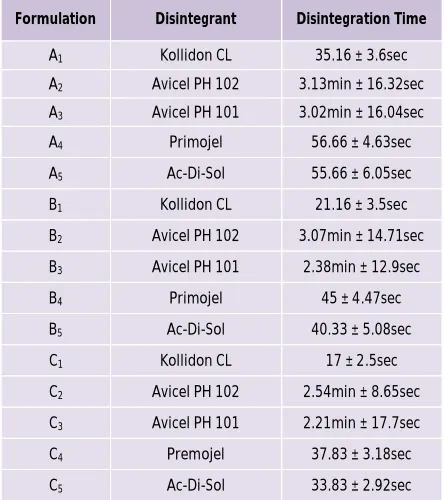
Disintegration time was found in the range of17 ± 2.5sec to 3.13min±16.32sec Tables 2.
Table 2: Disintegration Time of Group A, B and C Formulations prepared by lactose, mannitol and glucose respectively.
Disintegration Time Disintegrant
Formulation
35.16 ± 3.6sec Kollidon CL
A1
3.13min ± 16.32sec Avicel PH 102
A2
3.02min ± 16.04sec Avicel PH 101
A3
56.66 ± 4.63sec Primojel
A4
55.66 ± 6.05sec Ac-Di-Sol
A5
21.16 ± 3.5sec Kollidon CL
B1
3.07min ± 14.71sec Avicel PH 102
B2
2.38min ± 12.9sec Avicel PH 101
B3
45 ± 4.47sec Primojel
B4
40.33 ± 5.08sec Ac-Di-Sol
B5
17 ± 2.5sec Kollidon CL
C1
2.54min ± 8.65sec Avicel PH 102
C2
2.21min ± 17.7sec Avicel PH 101
C3
37.83 ± 3.18sec Premojel
C4
33.83 ± 2.92sec Ac-Di-Sol
C5
Comparative study of ODTs combinations prepared by the same superd is integrant and different diluents, showed that the least disintegration time was for group C prepared by glucose as a diluent, followed by group B prepared by mannitol, then group A prepared by lactose, respectively. This might be due to the high solubility of glucose compared to the other two diluents.32
Generally, mannitol is desirable in orally disintegrating dosage forms, because it gives good mouth feel and a pleasant sweet taste. While comparing the disintegration time values of different groups to each other, tablet which contain Kollidon-CL as a disintegrant exhibited the least disintegration time (17±2.5 sec, 21.16±3.5 sec, and 35.16±3.6 sec for formulations C1, B1 and A1, respectively) compared to other formulations in the same group. This might be due to high porosity of Kollidon- CL which is a cross-linked synthetic polymer.32 Hence, water can get throw the pores rapidly exhibiting high capillary activity. That can accelerate tablet swelling and disintegration with little tendency to form gels. Additionally, as Kollidon-CL is non-ionic compound, the disintegration is independent of the acidity of gastro-intestinal tract.
The disintegration time of tablets prepared by Kollidon-CL® was shorter than those prepared by Ac-di-sol because of the inner adhesive, fibrous and non-porous structure of Ac-di-sol.32,33 Hence, the intramolecular bounds must be broken and a hydrophilic network have to be formed for the swelling and disintegration of tablet. This may delay tablet disintegration.
Tablets prepared by primojel were in the third place of disintegration time (37.83±3.18 sec, 45±4.47 sec, and 56.66±4.63 sec for C4, B4 and A4, respectively). This might be due to the non-porous structure of primojel and its gel-forming tendency which may reduce the ability of swelling and disintegrating.
The longest disintegration time found was more than 3 minutes and resulted from the use of Avicel. Those results emphase that the binding role of Avicel is stronger than its disintegrate effect which is also done by the mechanism of swelling.
Previous results concluded that the least disintegration time (17±2.5 sec) was for the tablets prepared by Kollidon-CL as a disintegrant and glucose as a diluent, followed by tablets prepared by Kollidon-CL and mannitol (21.16±3.5 sec).
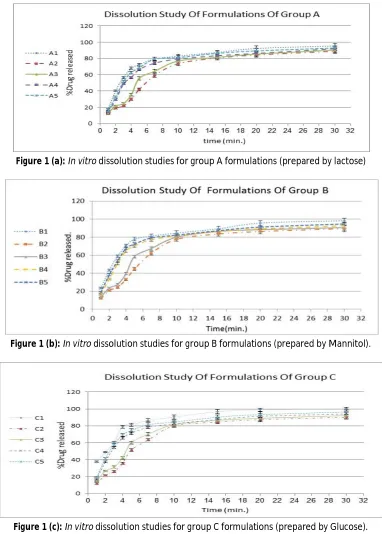
In vitro dissolution studies are shown in Figure. 1 (a, b, c). The cumulative percentage of drug release were within pharmacopeia limits.22
Figure 1 (a): In vitro dissolution studies for group A formulations (prepared by lactose)
Figure 1 (b): In vitro dissolution studies for group B formulations (prepared by Mannitol).
As the dissolution of tablets depends on disintegration time, thus tablets with less disintegration time are capable to release their contents in shorter time, the dissolution test results obviously complied with the disintegration time of tablets.
In addition, as indicated by Rowe et al., 2009 and Balasubramaniam, 2009, the specific surface area of Kollidon-CL (polyplasdon XL- 10) is about 1.2-1.4 m2/g which is bigger than the other disintegrant such as Ac-di-sol and Primojel (0.81-0.83 m2/g and 0.185 m2/g for, respectively).32,34 This fact can also explain the rapid dissolution of tablets prepared by Kollidon-CL compared to other disintegrant.
CONCLUSION
The present investigation successfully formulates Orally Disintegrating tablets of Chlorpheniramine Maleate by direct compression method which is found to be useful to prepare ODTs with sufficient mechanical strength and short disintegration time. Among the prepared formulation, tablets prepared by Kollidon-CL® as a disintegrate and Glucose or Mannitol as diluent showed the best performance in disintegrant time (about 17 sec) compared to other formulations.
Acknowledgement: The authors would like to thank Syphcopharma (Syria) and Alpha Pharmaceutical Industries (Aleppo, Syria) for offering the active ingredient and all excipients used in this study. Writing assistance provided by Dr. Wissam Zam, from the Faculty of Pharmacy at Al-Andalus University (Syria)is greatly appreciated.
REFERENCES
1. Debjit B, Chiranjib B, Krishnakanth P, Margret Ch, Fast
Dissolving Tablet: An Overview, Journal of Chemical and Pharmaceutical Research, 1(1), 2009, 163-177.
2. Pahwa R, Piplani M, Sharma PC, Kaushik D, Sanju N, Orally
Disintegrating Tablets - Friendly to Pediatrics and Geriatrics, Archives of Applied Science Research, 2(2), 2010, 35-48.
3. Shailesh Sh, New Generation Of Tablet: Fast Dissolving Tablet,
Pharmaceutical reviews, 6(1), 2008, 44-68.
4. Deshpande KB, Ganesh NS, Orodispersible Tablets: An
Overview Of Formulation And Technology, International Journal Of Pharma And Bio Sciences, 2(1), 2011, 726-734.
5. McLaughlin R, Banbury S, Crowley K, Orally Disintegrating
Tablets: The Effect of Recent FDA Guidance on ODT Technologies and Applications, Pharmaceutical Technology, 2009, http://www.pharmatech.com
6. U.S. Department of Health and Human Services Food and Drug
Administration, Guidance for Industry Orally Disintegrating Tablets, Center for Drug Evaluation and Research (CDER), 2008, 1-6.
7. Navarro V, Improving medication compliance in patients with
depression: Use of orodispersible tablets, Adv.Ther., 27(11), 2010, 785-95.
8. Reddy LH, Ghosh BR, Fast dissolving drug delivery systems: A
review of the literature, Ind J Pharm Sci, 64(4), 2002, 331-336.
9. Sharma S, Pharmainfo.net, 2009,
<www.pharmainfo.net/reviews/orodispersable-tablet-review>.
10. Shyamala B, Narmada GY, Rapid Dissolving Tablets: A Novel
Dosage Form. The Indian Pharmacist, 13(8), 2002, 9-12.
11. Wagh MP, Yewale CP, Zate SU, Kothawade PI, Mahale GH,
Formulation And Evaluation Of Fast Dispersible Tablets Of Aceclofenac Using Different Super disintegrant, International Journal of Pharmacy and Pharmaceutical Sciences, 2(1), 2010, 154-157.
12. European pharmacopeia, 2005.
13. Biradar SS, Bhagavati ST, Kuppasad IJ, Fast Dissolving Drug
Delivery Systems: A Brief Overview, Internet J. Pharmacology, 4(2), 2006.
14. FuY, Yang Sh, Hoon JS, Kimura S, Kinam P, Orally Fast
Disintegrating Tablets: Developments, Technologies, Taste-Masking and Clinical Studies, Critical Reviews in Therapeutic Drug Carrier Systems USA, 21(6), 2004 433–475.
15. Hirani JJ, Rathod DA, Vadalia KR, Orally Disintegrating Tablets:
A Review. Tropical Journal of Pharmaceutical Research, 8(2), 2009, 161-172.
16. Harvey R, Lippincott`s Illustrate Reviews, Laale Professional,
3rd, 2006, 515-520.
17. Lullman H, Mohr K, Ziegler A, Bieger D, Color Atlas Of
Pharmacology, Thieme Stuttgart NewYork, 2nd edition, 2000,
114, 326.
18. Olson J, Clinical Pharmacology, University Of Washington,
140-141.
19. Webster DR, Paton DM, Clinical Pharmacokinetics Of
H1-Receptor Antagonists (The Antihistamines),
ClinPharmacokinet, 10(6), 1985, 477-97.
20. Hasenöhrl RU, Weth K, Huston JP, Intraventricular infusion of
the histamine H1 receptor antagonist chlorpheniramine improves maze performance and has anxiolytic-like effects in
aged hybrid Fischer 344xBrown Norway rats, Pubmed Exp
Brain Res, 128(4), 2012, 435-40.
21. Wagh MA, Dilip KP, Salunkhe KS, Chavan NV, Daga VR,
Techniques used in orally disintegrating drug delivery system, International Journal of Drug Delivery, 2, 2010, 98-107.
22. USP-NF. 30th ed., 2007.
23. Niazisk, Handbook Of Pharmaceutical Manufacturing
Formulation, Taylor & Francis 2004.
24. Alanazi F, Evaluation Of Spray And Freeze Dried Excipient Bases
Containing Disintegrating Accelerators For The Formulation Of
Metoclopramide Orally Disintegrating Tablets, Saudi
Pharmaceutical Journal, 15(2), 2007, 105-119.
25. Anupama K, Shelly Kh, Neena B, Formulation And Evaluation Of
Mouth Dissolving Tablets Of Oxcarbazepine, International Journal of Pharmacy and Pharmaceutical Sciences, 1(1), 2009, 12-23.
26. Shailendra K, Dina N, Rishab J, Pankaj S, Fast Disintegrating
Combination Tablets Of Omeprazole And Domperidone, Asian Journal of Pharmaceutical and Clinical Research, 2(3), 2009, 74-82.
27. Sunita AC, Tejal AM, Ankit BC, Formulation, Development and
28. Maithani M, Raturi R, Gautam V, Kumar D, Chaudhary A, Gaurav A, Singh R, Development And Validation Of A Rp-Hplc Method For The Determination Of Chlorpheniramine Maleate And Phenylephrine In Pharmaceutical Dosage Form, Pharmacie Globale International Journal Of Comprehensive Pharmacy 1(5), 2010, 15-20.
29. British pharmacopiea, Vol III, London, 2009.
30. Klancke J, Dissolution Testing Of Orally Disintegrating Tablets,
Dissolution Technologies, 10(2), 2010, 6-8.
31. Dibbern WH, Muller RM, Wirbitzki E, UV and IR Spectra, Editio
Cantor Verlag, Frankfurt, 2002, 482.
32. Rowe R, Sheskey, Quinn ME, Handbook of Pharmaceutical
Excipients, Pharmaceutical Press, USA, 6thed., 2009, 206-208,
663.
33. Ferrero C, Munoz N, Velasco MV, Munuz-Ruiz A,
Jimenez-Castellanos R, Disintegrating Efficiency Of Croscarmellose Sodium In A Direct compression formulation, International Journal of Pharmaceutics Spain, 147, 1997, 11-21.
34. Balasubramaniam J, Influence of Super disintegrants on the
Rate of Drug Dissolution from Oral Solid Dosage Forms, 2009, <http://mail to: [email protected]>, India.