Exclusive central diffractive production of scalar, pseudoscalar
and vector mesons
P. Lebiedowicz1,a, O. Nachtmann2, and A. Szczurek1,3
1Institute of Nuclear Physics PAN, Radzikowskiego 152, PL-31-342 Kraków, Poland
2Institut für Theoretische Physik, Universität Heidelberg, Philosophenweg 16, D-69120 Heidelberg,
Ger-many
3University of Rzeszów, PL-35-959 Rzeszów, Poland
Abstract. We discuss exclusive central diffractive production of scalar (f0(980),
f0(1370), f0(1500)), pseudoscalar (η,η(958)), and vector (ρ0) mesons in proton-proton collisions. The amplitudes are formulated in terms of effective vertices required to respect standard rules of Quantum Field Theory and propagators for the exchanged pomeron and reggeons. Different pomeron-pomeron-meson tensorial (vectorial) coupling structures are possible in general. In most cases two lowest orbital angular momentum -spin couplings are necessary to describe experimental differential distributions. For the
f0(980) andηproduction the reggeon-pomeron, pomeron-reggeon, and reggeon-reggeon exchanges are included in addition, which seems to be necessary at relatively low en-ergies. The theoretical results are compared with the WA102 experimental data, in or-der to determine the model parameters. For theρ0production the photon-pomeron and pomeron-photon exchanges are considered. The coupling parameters of tensor pomeron and/or reggeon are fixed from the H1 and ZEUS experimental data of theγp → ρ0p reaction. We present first predictions of this mechanism for pp → ppπ+π−reaction being studied at COMPASS, RHIC, Tevatron, and LHC. Correlation in azimuthal angle between outgoing protons and distribution in pion rapidities at √s = 7 TeV are pre-sented. We show that high-energy central production of mesons could provide crucial information on the spin structure of the soft pomeron.
1 Introduction
There is a growing interest in understanding the mechanism of exclusive meson production both at low and high energies, for a review see [1]. In Ref. [2] we performed application of the "tensorial" pomeron model [3] for the exclusive production of scalar (JPC = 0++) and pseudoscalar (JPC = 0−+) mesons in the pp → ppMreaction and we compared results of our calculations with WA102 experimental data. At high energies the dominant contribution to this reaction comes from pomeron-pomeron (or pomeron-pomeron-reggeon) fusion. While it is clear that the effective pomeron must be a colour singlet, its spin structure and couplings to hadrons are not finally established. Although, it is also commonly assumed in the literature that the pomeron has a "vectorial" nature [4] there are strong hints from the Quantum Field Theory that it should have rather "tensorial" properties [3].
ae-mail: [email protected]
DOI: 10.1051/
C
Owned by the authors, published by EDP Sciences, 2014
/201
IP, IR IP, IR
M(k) p(pa) p(p1)
p(pb) p(p2) IG= 0+
IP, f2IR(a2IR)
γ
π−(p4)
p(pa) p(p1)
p(pb) p(p2)
π+(p3)
ρ0(ω)
ρ0
Figure 1. Left: diagram of the central exclusiveIG =0+meson production by a fusion of pomeron/reggeon-pomeron/reggeon. Right: diagram of the central exclusiveρ0meson production via pomeron/reggeon-photon (or photon-pomeron/reggeon) exchanges and its subsequent decay intoπ+π−pair.
Indeed, tests for the helicity structure of the pomeron have been devised in [5] for diffractive contributions to electron-proton scattering, that is, for virtual-photon–proton reactions. For central meson production in proton-proton collisions such tests were discussed in [6–8]. The general structure of helicity amplitudes of the simple Regge behaviour was also considered in Ref. [9, 10].
In Ref. [2] we discussed differences between results of the "tensorial pomeron" and "vectorial pomeron" models of central exclusive production for the scalar and pseudoscalar mesons. In order to calculate these contributions we must know the effectiveIPpropagator, theIPppandIPIPMvertices, see Fig. 1 (left). The formulae for corresponding propagators and vertices are presented and discussed in detail in Refs. [2, 3]. In [2] we gave the values of the lowest orbital angular momentumland of the corresponding total spinS, which can lead to the production ofMin the fictitious fusion of two tensorial or vectorial "pomeron particles". In most cases one has to add coherently amplitudes for two couplings with different orbital angular momentum and spin of two "pomeron particles". The corresponding coupling constants are not known and have been fitted to existing experimental data.
We focus on exclusive central production ofρ0 resonance in the context of theoretical concept of tensor pomeron proposed in Ref. [3]. Due to its quantum numbers this resonance state can be produced only by photon-pomeron or photon-reggeon mechanisms. The diagrams to be considered are shown in Fig. 1 (right). In the amplitude for theγp→ρ0psubprocess we included both pomeron and f2IR exchanges. All effective vertices and propagators have been taken here from Ref. [3]. All the details will be presented elsewhere [11]. Needless to say that at lower energies there is also an importantρ0 → π+π−background from the non-central diffractive processes.1 Two of us proposed some time ago a simple Regge-like model for theπ+π−andK+K−continuum based on the exchange of two pomerons/reggeons [1, 16–18].
Several experimental groups, e.g. COMPASS [19], STAR [20], CDF [21], ALICE [22], AT-LAS+ALFA [23], and CMS+TOTEM [24] have potential to make very significant contributions in understanding the spin structure of the soft pomeron and the role of subleading trajectories.
2 Results
The theoretical results are compared with the WA102 experimental data in order to determine the model parameters. At low energy theππ-fusion contribution [25] dominates while at high energies the dominant contribution comes from pomeron-pomeron (IPIP) fusion. For pseudoscalar meson pro-duction we can expect large contributions fromωωexchanges due to the large coupling of theω meson to the nucleon. At higher subsystem energies squareds13ands23the meson exchanges are cor-rected to obtain the high energy behaviour appropriate forω-reggeon exchanges. This seems to be the
1There the dominant mechanism is the hadronic bremsstrahlung-type mechanism. Similar processes were discussed at high
(deg) pp φ
0 50 100 150
b) μ ( pp φ d σ d 0 0.1 0.2 0.3 0.4 0.5 (1370) 0 pp f → pp via IP IP - fusion
29.1 GeV s WA102 data (l,S) (0,0) only
T IP T IP V IP V IP (deg) pp φ
0 50 100 150
b) μ( pp φ d σ d 0 0.2 0.4 0.6 0.8 1 (1500) 0 pp f → pp 29.1 GeV s WA102 data (l,S) (0,0) (l,S) (2,2) total (deg) pp φ
0 50 100 150
b) μ( pp φ d σ d 0 0.2 0.4 0.6 (958) η pp → pp 29.1 GeV s WA102 data (l,S) (1,1) (3,3) T IP T IP V IP V IP
Figure 2. Distributions in azimuthal angle between outgoing protons for the central exclusivef0(1370),f0(1500) andη(958) mesons production by a fusion of two tensor (the black solid line) or two vector (the red long-dashed line) pomerons. The WA102 experimental data points from [28] have been normalized to the total cross section from [26] at √s = 29.1 GeV. The solid line is the result including coherently two (l,S) couplings. For the tensorial pomeron case we show the individual (l,S) spin contributions to the cross section.
case for theηmeson production where we have included also exchanges of subleading trajectories [2] which improves the agreement with experimental data.
In Fig. 2 we show the distribution in azimuthal angleφpp between outgoing protons for central exclusive meson production by the fusion of two tensor (solid line) or two vector (long-dashed line) pomerons at √s=29.1 GeV. The strengths of the (l,S) couplings were adjusted to roughly reproduce the WA102 data from [27]. The tensorial pomeron with the (l,S)=(0,0) coupling alone already de-scribes the azimuthal angular correlation forf0(1370) meson reasonable well. The vectorial pomeron with the (l,S)=(0,0) term alone is disfavoured here. The preference of the f0(1370) for theφpp ≈π domain in contrast to the enigmatic f0(980) and f0(1500) scalars has been observed by the WA102 Collaboration [28]. The contribution of the (0,0) component alone is not able to describe the az-imuthal angular dependence for these states. We observe a large interference of two (l,S) components in the amplitude. For production of pseudoscalar mesons in both models of pomeron the theoretical distributions are somewhat skewed due to phase space angular dependence. The contribution of the (1,1) component alone in the tensorial pomeron model is not able to describe the WA102 data [27].
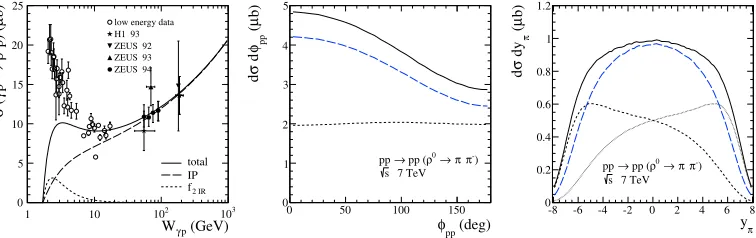
Fig. 3 (left panel) shows the integrated cross section for theγp →ρ0preaction as a function of center-of-mass energy together with the experimental data. In our calculations we taken default values for the parameters of the propagators and vertices [3, 11]. We show distributions in the azimuthal an-gle between outgoing protons (center panel) and in the pion rapidity (right panel) at√s=7 TeV. For theφppdistribution, the effect of deviation from a constant is due to interference of pomeron-photon and photon-pomeron amplitudes. Similar effect was discussed first in Ref. [29] for the exclusive production ofJ/ψmeson. These correlations are quite different than those for double-pomeron mech-anism [1, 17] and could be therefore used at least to partial separation of these two mechmech-anisms.2 The rapidities of the two pions are strongly correlated. The f2IRexchange included in the amplitude contributes at backward/forward pion rapidities and its contribution is non-negligible even at the LHC energies.
2Theρ0contribution in the azimuthal angle region (φ
(GeV) p γ W
1 10 2
10 103
b) μ p) ( 0ρ → p γ ( σ 0 5 10 15 20 25
low energy data H1 93 ZEUS 92 ZEUS 93 ZEUS 94 total IP 2 IR f (deg) pp φ
0 50 100 150
b) μ ( pp φ d σ d 0 1 2 3 4 5 ) -π π → 0 ρ pp ( → pp 7 TeV s π y
-8 -6 -4 -2 0 2 4 6 8
b) μ ( π dy σ d 0 0.2 0.4 0.6 0.8 1 1.2 ) -π π → 0 ρ pp ( → pp 7 TeV s
Figure 3. Left panel: the elasticρ0photoproduction cross section as a function of center-of-mass energy. Our results are compared with the ZEUS and H1 experimental data, see [14] for references. The solid line corresponds to result with both the pomeron andf2IRexchanges. The individual pomeron and reggeon exchange contributions
are denoted by the long-dashed and short-dashed lines, respectively. Center and right panels: distributions in azimuthal angle between outgoing protons and in the pion rapidity at √s=7 TeV. The solid lines correspond to the situation when both the pomeron andf2IRexchanges in the amplitude are included. The blue long-dashed
line blue corresponds to the pomeron exchange alone. The short-dashed and dotted lines represent contributions separately from the photon-pomeron and pomeron-photon diagrams, respectively.
3 Conclusions
We have analysed proton-proton collisions with the exclusive central production of scalar and pseu-doscalar mesons. We have presented the predictions of two different models of the soft pomeron. The first one is the commonly used model with vectorial pomeron which is, however, difficult to be supported from a theoretical point of view. The second one is a recently proposed model of tensorial pomeron [3], which, in our opinion, has better theoretical foundations. We have performed calcula-tions of several differential distributions. We wish to emphasize that the tensorial pomeron can, at least, equally well describe experimental data on the exclusive meson production discussed here as the less theoretically justified vectorial pomeron frequently used in the literature. The models contain only a few free coupling parameters to be determined by experiment. The existing low-energy exper-imental data do not allow to clearly distinguish between the two models as the presence of subleading reggeon exchanges is at low energies very probable for many reactions. Production ofηmeson seems to be less affected by contributions from subleading exchanges. Pseudoscalar meson production could be of particular interest for testing the nature of the soft pomeron since there the distribution in the azimuthal angleφppbetween the two outgoing protons may contain, for the tensorial pomeron, a term which is not possible for the vectorial pomeron, see [2]. It would clearly be interesting to extend the studies of central meson production in diffractive processes to higher energies. For the resonances decaying e.g. into theππchannel an interference of the resonance signals with the two-pion con-tinuum has to be included in addition. This requires a consistent model of the resonances and the non-resonant background.
dependence on proton transverse momenta and azimuthal angle correlations between outgoing protons could be used to separate theρ0contribution. We conclude that the measurement of forward/backward protons is crucial in better understanding of the mechanism of thepp→ ppπ+π−reaction.
Acknowledgments. The work of P.L. was supported by the National Science Centre (NCN) on the basis of decisions DEC-2011/01/N/ST2/04116, DEC-2013/08/T/ST2/00165 and by the START fellowship from the Foundation for Polish Science (FNP).
References
[1] P. Lebiedowicz, Ph.D. thesis, Exclusive reactions with light mesons: From low to high energies, IFJ PAN, 2014. The thesis is available at http://www.ifj.edu.pl/msd/rozprawy_dr/rozpr_Lebiedowicz.pdf.
[2] P. Lebiedowicz, O. Nachtmann, A. Szczurek, Annals Phys.344(2014) 301. [3] C. Ewerz, M. Maniatis, O. Nachtmann, Annals Phys.342(2014) 31.
[4] A. Donnachie, H.G. Dosch, P.V. Landshoff, O. Nachtmann,Pomeron physics and QCD, Cam-bridge University Press, 2002.
[5] T. Arens, O. Nachtmann, M. Diehl, P.V. Landshoff, Z. Phys.C74(1997) 651. [6] F. Close and G. Schuler, Phys. Lett.B458(1999) 127.
[7] F. Close and G. Schuler, Phys. Lett.B464(1999) 279. [8] F. Close, A. Kirk, G. Schuler, Phys. Lett.B477(2000) 13.
[9] A.B. Kaidalov, V.A. Khoze, A.D. Martin, M.G. Ryskin, Eur. Phys. J.C31(2003) 387. [10] V.A. Petrov, R.A. Ryutin, A.E. Sobol, J.-P. Guillaud, JHEP 0506 (2005) 007.
[11] P. Lebiedowicz, O. Nachtmann, A. Szczurek, publication in preparation. [12] P. Lebiedowicz and A. Szczurek, Phys. Rev.D83(2011) 076002. [13] P. Lebiedowicz and A. Szczurek, Phys. Rev.D87(2013) 074037.
[14] A. Cisek, P. Lebiedowicz, W. Schäfer, A. Szczurek, Phys. Rev.D83(2011) 114004. [15] P. Lebiedowicz and A. Szczurek, Phys. Rev.D87(2013) 114013.
[16] P. Lebiedowicz and A. Szczurek, Phys. Rev.D81(2010) 036003. [17] P. Lebiedowicz, R. Pasechnik, A. Szczurek, Phys. Lett.B701(2011) 434. [18] P. Lebiedowicz and A. Szczurek, Phys. Rev.D85(2012) 014026. [19] A. Austregesilo (COMPASS Collaboration), arXiv:1309.5705 [hep-ex].
[20] J. Turnau (STAR Collaboration), PoS(DIS2014)098, 28 April-2 May 2014, Warsaw. [21] M. Albrow, A. ´Swie¸ch, M. ˙Zurek (CDF Collaboration), arXiv:1310.3839 [hep-ex];
M. ˙Zurek, contribution to these proceedings.
[22] R. Schicker (ALICE Collaboration), arXiv:1205.2588 [hep-ex]; R. Schicker, contribution to these proceedings.
[23] R. Staszewski, P. Lebiedowicz, M. Trzebi´nski, J. Chwastowski, A. Szczurek, Acta Phys. Pol.
B42(2011) 1861.
[24] M. Deile (TOTEM Collaboration), PoS(DIS2014)076, 28 April-2 May 2014, Warsaw. [25] A. Szczurek and P. Lebiedowicz, Nucl. Phys.A826(2009) 101.
[26] A. Kirk, Phys. Lett.B489(2000) 29.

![Figure 2. √tensorial pomeron case we show the individual ((1370),line) pomerons. The WA102 experimental data points from [28] have been normalized to the total cross sectionfrom [26] atand Distributions in azimuthal angle between outgoing protons for the c](https://thumb-us.123doks.com/thumbv2/123dok_us/8189049.1367688/3.482.47.433.86.205/tensorial-individual-experimental-normalized-sectionfrom-distributions-azimuthal-outgoing.webp)