STUDY ON DYNAMIC BEHAVIOUR OF NANOBAR
USING NONLOCAL ELASTICITY THEORY
K.Ajeetha
1, M.G.Rajendran
2 1PG Student,
2Professor, School of Civil Engineering, Karunya University,
Coimbatore, Tamilnadu, (India)
ABSTRACT
In this paper, undamped free axial vibration of nanobar is investigated using Eringen’s nonlocal elasticity theory. The governing equation for undamped free axial vibration of nanobars is derived using Euler Bernoulli beam theory and by introducing Eringen’s nonlocal elasticity theory. The solutions are obtained for clamped-clamped, clamped-free, and the bar with concentrated end mass boundary conditions. The effect of nonlocal parameter on the free axial vibrational frequencies of nanobar is studied. The analytical results and the available solutions are compared and the frequencies for all the boundary conditions are in excellent agreement with the existing results.
Keywords: Nanobars, Nonlocal Elasticity Theory, Axial Vibration, Natural Frequency
I. INTRODUCTION
Carbon nanotubes are discovered by Iijima [1] in 1991. Carbon nanotubes are the strongest and stiffest materials
in terms of tensile strength and elastic modulus. The studies related with nanostructures have shown that CNTs
have good electrical properties and high mechanical strength, so they can be used for nanoelectronics,
nanodevices and nanocomposites [2].
C. M. Wang et al. [3] reviews recent research studies on the buckling of carbon nanotubes. The structure and
properties of carbon nanotubes are introduced. The various buckling behaviours exhibited by carbon nanotubes
are also presented. It also found that CNTs have the remarkable flexibility and stability under external loading.
S.Adhikari et al. [4] studied the Free and forced axial vibrations of damped nonlocal rods using dynamic finite
element method. Helong wu [5] investigated the free vibration and elastic buckling of sandwich beams with a
stiff core and functionally graded carbon nanotube reinforced composite (FG-CNTRC) face sheets within the
framework of Timoshenko beam theory. Metin Aydogdu [6] developed the Nonlocal elastic rod model and
applied it to investigate the small scale effect on axial vibration of the nanorods. [7] In this study generalized
non local beam theory is proposed to study bending, buckling free vibrations of nanobeams. Nonlocal
constitutive equations of Eringen are used in the formulations. J.N. Reddy, et al. [8] developed non- linear finite
element models based on Eringen’s [9] non-local differential model to obtain numerical results for static
scale based on the nonlocal elasticity theory. Q.Wang, K.M.Liew [12] investigated The Scale effects on static
deformation of micro and nanorods or nanotubes. The nonlocal Euler-Bernoulli beam theory and Timoshenko
beam theories are used. As studied earlier, the nanobars have varied engineering applications as components in
nano devices, nano- composites, electrical and electromechanical instruments due to their good electrical
properties and high mechanical strength. During operation often these components may be subjected to external
loads, which may have an impact on their dynamics characteristics. The response characteristics of
nanostructures are very different from other micro/ macro structures due to the inherent size effect. Hence
studies on the vibrational behavior of nanobars must be carried out for their rational design in nano devices The
authors of this paper are of the opinion that the studies here to reported are not sufficient to thoroughly
understand the effect of small scale parameter and the limitations of classical elastic theory in dealing with the
length scale of nanobars. The main objective of this paper is to carry out undamped free axial vibration of the
nanobars under arbitrary boundary conditions using nonlocal elasticity theory and to study the effect of the
nonlocal parameter on the vibrational frequencies.
II. NONLOCAL ELASTICITY THEORY
In the analysis of macro beams, the classical theory of elasticity is used. But when the small scale/ nanoscale
(e.g. CNT) is taken into account, the classical theory does not hold good. Hence the Nonlocal elasticity theory
which was proposed by Eringen is adopted to account for small scale effect in elasticity by assuming the stress
at a reference point to be a functional of the strain field at every pointin the body [9]. In this way, the internal
size scale could be considered in the constitutive equations simply as a material parameter. The application of
nonlocal elasticity, in micro and nano materials, has received much attention among the nanotechnology
community recently. This important length scale effect is used in vibration, buckling and bending of CNTs
studies. The application of nonlocal elasticity is recommend in revealing scale effects for nano-materials like
CNTs.
ccording to Eringen, the nonlocal stress tensor at point X is expressed as
Use of integral constitutive relations is relatively more difficult in computation than using algebraic or
differential constitutive relations. Realizing this fact Eringen proposed an equivalent differential model as
is the function of material constant,
material constant
a = internal characteristic lengths (such as the lattice spacing).
III. FORMULATION OF GOVERNING EQUATION
The governing equation for an undamped free axial vibration of a nanobar using nonlocal elasticity theory is
derived on the assumptions of the Euler Bernoulli beam theory.
Fig.1 Equilibrium Condition of a Differential Element of a Nanobar Subjected to the Axial
Force.
Force equilibrium along horizontal direction,
-NL+ ( NL + dx ) - m dx = 0
(1)
Nonlocal constitutive law
τxx = E (2)
For local,
NL = dA (3)
For nonlocal,
N = ∫ dA (4)
Integrating (2) w.r.to area,
τxx dA = dA
N = NL (5)
Diff (5) w.r. to x,
(6)
(7)
Solution for the harmonic vibration
Let (8)
Substitute (8) into (7)
Let (9)
k = dimensionless frequency parameter
(10)
The solution is (11)
IV. ANALYSIS OF NANOBAR WITH VARIOUS BOUNDARY CONDITIONS
4.1 Clamped – Clamped
The solution is
Boundary conditions
A=0 (12)
(ii)
B (13)
To satisfy (13), can be chosen as
(14)
Substituting (10) in (14) ,we get
4.2 Clamped Free
Boundary conditions
A= 0 (15)
(16)
To satisfy (16),
Solving we get
4.3 Bar with Free Concentrated End Mass
The solution is
Boundary conditions
(i)
A= 0
If m is very small compared to the beam mass (m =
(if m = 0)
Choosing , where n =1,3,5 ...
When n=1
=
V. RESULTS AND DISCUSSIONS
Frequency analysis has been done for nanobars of various spans with different nonlocal parameters, lengths and
mode numbers. The results are graphically depicted for various boundary conditions.
5.1 Results
0 1 2 3 4 5 6 7 8
0 5 10 15 20 25 30
0 0.7nm 1nm 1.4nm 2nm
Length L(nm)
e0a
F
req
u
en
cy
ratio
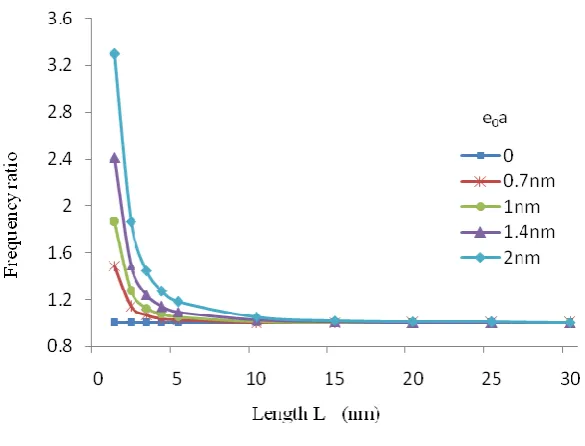
Fig 2. Small Scale Effect on Clamped-Clamped Nanobar at Different Scale Coefficients for
0 1 2 3 4 5 6 7 8 9 10
0 5 10 15 20 25 30
n=1
n=2
n=3
Length L(nm)
Fre
q
u
en
cy
ratio
e
0a = 1nm
Fig 3.Small Scale Effect on Clamped-Clamped Nanobar for First Three Frequencies
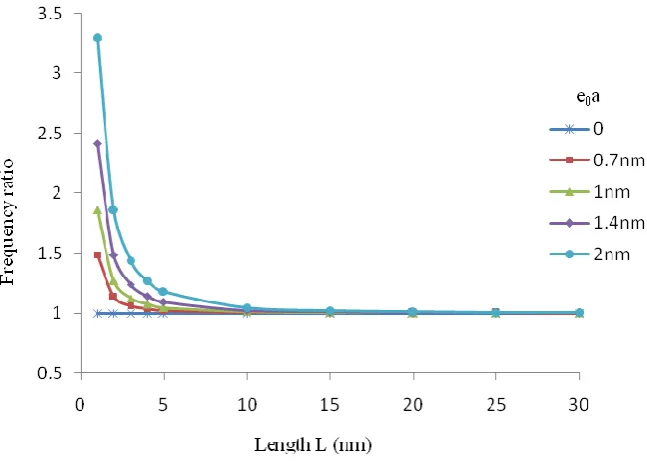
Fig 4.Small Scale Effect on Clamped-Free Nanobars at Different Scale Coefficients for
Fig 5. Small Scale Effect on Clamped-Free Nanobar for First Three Frequencies
Fig 6. Small Scale Effect on Bar with Concentrated End Mass at Different Scale Coefficients for
Fig 7. Small Scale Effect on Bar with Concentrated End Mass for Three Frequencies.
5.2 Discussions
The ratio of local frequency to nonlocal frequency is discussed for various boundary conditions for different
scale coefficients, lengths and mode numbers to illustrate the influence of small length scale on the undamped
axial vibration of nanobars. Variation of fundamental frequency parameter with length of rod is given for
different scale coefficients e0a for three boundary conditions considered in Figs. 2, 4, 6. From these figures it is
evident that, nonlocal solution of the frequency is smaller than the classical result due to the effect of small
length scale. Increasing the nonlocal parameter decreases the frequency (i.e. increases frequency ratio).The
result may be interpreted as increasing the nonlocal parameter for fixed L leads to a decrease in the stiffness of
structure. For L ≥ 20nm all results converge to the local frequency. Frequency ratio decreases with the increase
of the rod length L. It means nonlocal effects are lost after a certain length. e0a = 0 corresponds to classical
solution where ratio of classical frequency to nonlocal frequency equals to unity.
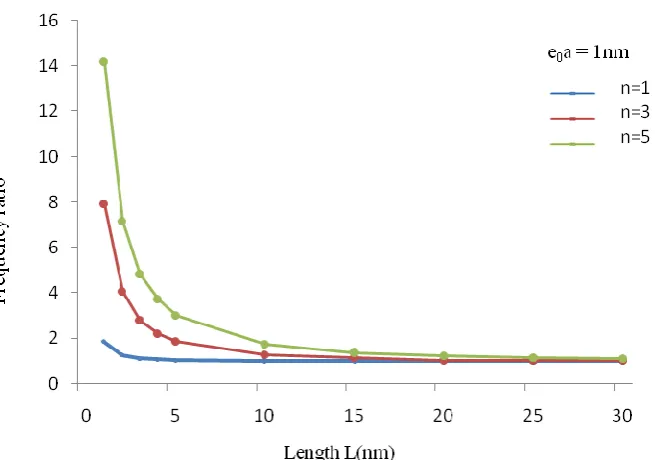
In figures 3, 5, 7, the three frequency parameters are depicted for e0a = 1 nm for C–C, C–F, Bar with free
concentrated end mass boundary conditions, respectively. Effect of small length scale is higher for higher
modes. Nonlocal effects are lost almost at L = 10 for n = l, but same effects disappear at nearly L = 25 for n = 3.
This is because of small wavelength effects for higher modes.
VI. CONCLUSIONS
The above analytical investigations lead to the conclusion that the effect of the increase in nonlocal parameter is
to decrease the frequency of axial vibration in nanobars. The nonlocal effects are very minimal at L=10 nm and
disappear for greater lengths. The followings are noteworthy
• Frequency Ratio decreases with increase in the bar length which means that the nonlocal effects are lost
after a certain length.
• Ratio of classical frequency to nonlocal frequency tends to unity when nonlocal parameter tends to zero.
• Effect of small length scale is higher for higher modes.
VII. ACKNOWLEDGEMENT
The authors are thankful to the Management of Karunya University for providing necessary facilities to carry
out the work reported in this paper.
REFERENCES
[1] Iijima.S., “Helical microtubules of graphitic carbon”,Nature, 354, 1991, 56-58
[2] Ball.P., “Roll up for revolution”, Nature,414,2001,142-144
[3] C.M.Wang et al., “Recent Studies on Buckling of Carbon Nanotubes”, Journal of applied mechanics
reviews, 2010, Vol. 63
[4] S.Adhikari ,T.Murmu, M.A Mccarthy, “Dynamic finite element analysis of axially vibrating nonlocal
rods”, Journal of finite elements in analysis and design, 2013, vol 63
[5] Helong Wu., “Free Vibration and Buckling Analysis of Sandwich Beams with Functionally Graded
Carbon Nanotube-Reinforced Composite Face Sheets” International Journal of Structural Stability and
Dynamics Vol. 15,2015, No. 7
[6] Metin Aydogdu., “Axial vibration of the nanorods with the nonlocal continuum rod model”, Physica E
41, 2009, 861–864
[7] Metin Aydogdu, “A general nonlocal beam theory:its application to nanobeam bending,buckling and
vibration” Journal of physica E 41, 2009
[8] J.N. Reddy, Samiel-Borgi and JaniRomanoff, “ Non-linear analysis of functionally graded microbeams
using Eringen's non-local differential model”, International Journal of Non-Linear Mechanics 67, 2014,
308–318
[9] A. Cemal Eringen , “On differential equations of nonlocal elasticity and solutions of screw dislocation
and surface waves”, Journal of applied physics 54, 1983, 4703.
[10] Raffaele Barretta ,Francescco Marotti,Marina Diaco, “Small-scale effects in nanorods” Journal of Acta
Mech 225, (2014)
[11] Chawis Thongyothee, Somchai Chucheepsakuland Teng Li, “Nonlocal Elasticity Theory for Free
Vibration of Single-walled Carbon Nanotubes”. Advanced Materials Research, 2013, Vol. 747
[12] Q.Wang,K.M.Liew, “Application of nonlocal continuum mechanics to static analysis of micro and
nano structures” Journal of physics letter A ,363, 2007
[13] Devesh Kumar,christian Heinrich,anthony M.Wass, “Buckling analysis of carbon nanotubes modelled