DIGITAL IMAGE WATERMARKING TECHNIQUES:
A SURVEY
Ankita Singh
1, Dr. A.K Sharma
2¹·²Department Computer Science & Engineering
Madan Mohan Malaviya University of Technology Gorakhpur (U.P) INDIA
ABSTRACT
Nowadays Internet becomes most popular and synergistic for degeneration of information. The expansion of
the internet has frequently increased the accessibility of multimedia data such as audio images and videos to the
public. Due to the explosive growth in internet technology, digital data can be easily plagiarized, modified or
deleted without proper authentication and authorization. In current scenario protection of multimedia digital
content has become an important issue. Digital watermarking promises to address these issues. Digital
watermarking is the method of embedding data into digital multimedia content .This paper reviews different
methods of digital watermarking for protecting digital information.
Keywords—DCT, DWT, DFT,JOINT DWT-DCT.
I.INTRODUCTION
Digital Image Processing is a highly developing area with various rising applications in Computer Science. It is
a very prominent field for the research work as its techniques are used in almost all kinds of tasks like human
computer interface, medical visualization, image enhancement, law enforcement, artistic effect, image
restoration and digital watermarking for security purposes.
The term digital watermarking was firstly used by TIRKEL in 1993[1]. TIRKEL presented two watermarking
techniques to hide the watermark data in the images. Digital watermark is a kind of marker which is used in
hiding digital information in a carrier signal. Digital image watermarking is a process of information hiding.
Information is in the form of digital content like image, text, audio & video. Basically digital watermarking is a
method for embedding some secret information and additional information in the cover image which can be
later extracted or detected for different purposes like authentication, owner identification content protection and
copyright protection etc [2]. The main aim of watermarking is to embed information imperceptibility and
robustly in the cover data .Basically digital watermarking is used for security of digital content. Digital
watermarking is a very development field and used in various applications which have been proved to be
successful .The digital watermarking has been applied in a number of image process techniques. The aim of
every application is to providing security of the digital contents . The digital watermarking applications are
broadcast monitoring[3] , digital fingerprinting[4] , transaction tracking [5],copyright protection[6], temper
detection[7] ,data hiding [8]and authentication[9] etc. This paper includes the survey of the latest methods that
This paper is organized in different sections. In section 2 we have discussed working of digital image
watermarking .Section 3 defines the digital watermarking techniques and its classification. Finally section 4
draws conclusion.
II. DIGITAL WATERMARKING WORKING PRINCIPLE
Every Digital watermarking technique follows the two algorithms .First one as the embedding and other one as
the detecting algorithm. These two processes are same for all the type of watermarking techniques.
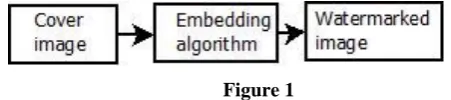
In Embedding process the watermark is embedded in the cover image by using the embedding algorithm
Figure 1 shows the watermarking embedding process.
Figure 1
In detection or extraction process the embedded watermark is detected or recovered by using the detection
algorithm. Figure 2 shows the watermark detection process.
Figure 2
III. CLASSIFICATION OF WATERMARKING TECHNIQUES
Digital watermarking techniques can be categorized into multiple categories dependent upon the various
domains. According to working domain watermarking technique is divided into two domains named as spatial
domain and frequency domain. According to human perception watermarking technique is categorized into
invisible watermarking technique and visible watermarking technique. Based on application domain
watermarking technique is divided into source based watermarking technique and destination based technique
.In this paper we focused on only working domain based watermarking techniques. The spatial domain
techniques deal with the pixels. In frequency domain image is segmented into multiple frequency bands.
Commonly used spatial domain techniques are LSB , predictive coding scheme & correlation based techniques.
Mostly used frequency domain techniques are DWT ,DFT ,DCT . In comparison to spatial domain techniques
frequency domain techniques are better in terms of robustness and imperceptibility .
Table1.Comparison between spatial domain and frequency domain[10,11].
Factors Spatial Domain Frequency
Domain
Computation Cost Low High
Robustness Fragile More Robust
Perceptual Quality High Control Low Control
Computational
Complexity
Computational
Time
Less More
Capacity High Low
Example of
Application
Mainly
Authentication
Copy Rights
3.1 Spatial domain watermarking
In spatial domain watermarking image is represented in the form of pixels. In this process embedding is
performed after changing the pixels values[12]. In this techniques intensity values and color values of some
selected pixels are modified .Commonly used method in the spatial domain techniques is least significant bit.
Following are the main steps that are used to perform LSB process[12].
1. Select the host image and watermark image.
2. Choose the number of bits of host image so that it can maintain the quality of the image.
3. Quality of image depends upon the number of bits chosen. Embed the MSB of watermark or secret image in
LSB of host image.1. Select the cover image and watermark image
Host image
(10011010 00010000 10111111 01010101)
Watermark image
( 1 1 0 0 )
Watermarked image
(10011011 00010001 10111110 010101000
Frequency domain watermarking
Frequency domain watermarking is preferred over the spatial domain watermarking because the watermark
placed by them cannot be easily destroyed and changed by the attackers. In the frequency domain the watermark
is embedded by changing the magnitude of coefficients in a transform domain. Frequency domain also known as
time domain. Time domain based watermarking techniques provide high capacity and high robustness against
many geometrical attacks. Due to the embedding of watermark into the changed coefficients of the transformed
image, it is more robust as comparison to spatial domain.[13]
Discrete cosine transform(DCT)
Discrete cosine transform represents a finite sequence of data points in term of a sum of cosine functions
oscillating at different frequencies. It transform the spatial domain in to the frequency domain.It is more robust
and same as DFT. DFT uses complex number and DCT uses resal numbers.DCT divides an image into different
frequency bands which are high, middle and low frequency bands.
Steps in DCT block based watermarking algorithm are following [14]
1.Divide the image into non overlapping blocks of 8*8.
2.At each block apply forward DCT.
3.Implement some block selection criteria.
5.Embed the watermark by modifying the selected coefficient.
6.Apply inverse DCT transform on each block
Discrete Fourier transform (DFT)
By using DFT continuous functions are transformed into its corresponding frequency domain components. It
decomposes an image in sine and cosine wave form. There are two types of embedding procedures are used in
DFT. One is the direct embedding technique and the second one is template based technique. In direct
embedding technique embedding of watermark is performed after modification of DFT magnitude phase
coefficients. In template based technique templates are used . It is used to calculate the transformation
factor.DFT is useful for the periodic, digital signals or discrete time [15].
In this complex values are used. It can be recovered from geometric distortion due to RST invariant.
Discrete wavelet transform (DWT)[16]
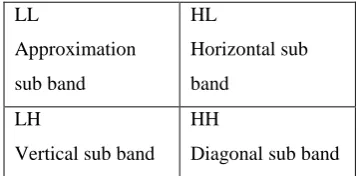
Discrete wavelet analysis is multi resolution analysis. It splits the image into wavelet coefficients and scaling
function. It divides the image into four sidebands. One part is low frequency of original image, the one bottom
left contains vertical detail of the original image. Top right contains high frequency of original image. This
process is repeated until the whole signal has been completely decomposed. DWT is more robust in comparison
to DFT because it works in time as well as in frequency .Fourier transform only deals with frequency
component.
LL
Approximation
sub band
HL
Horizontal sub
band
LH
Vertical sub band HH
Diagonal sub band
Figure 3: one level DWT decomposition.
3.3 Joint DWT-DCT-
DWT –DCT based hybrid watermarking algorithm improved thewatermarking performance in comaprison to DCT based approach.It s highly robust and more secured technique. Arnold transform is used to improve the security and robustness, because in this approach watermark is firstly scrambled.The reason of using hybrd approach is based on the fact that join transform could make up fo the drawbacks of each other.The application of joint DWT-DCT results in higher imperceptibility and robustness[17,18]. In the DWT-DCT based approach following steps are followed.
1. Apply DWT to original image and chose LL subband at level 1.
2. Divide this LL subband into 8*8 blocks.
3. Apply DCT to each block and then find mid band frequency coefficients.
IV.CONCLUSION
Digital watermarking provides security to the digital content. Today digital watermarking focus various issues
survey of various Digital watermarking techniques under time and transform domain.This paper throughly
covers and discusss various digital image watermarking techniques both in the spatial and transform domain.The
transform domain based techniques provide robustness and the paper discuss the different levels of robustnesss
for different attacks.The paper comprises that existing techniques should be merged together to provde better
security in solutions to the existing problems
REFERENCE
[1] R.G. Schyndel, A. Tirkel, and C.F Osborne, ―A Digital Watermark‖, Proceedings of IEEE International
conference on Image Processing, ICIP-1994, pp. 86-90, 1994.
[2] Christine I. Podilchuk, Edward J. Delp, ―Digital watermarking: Algorithms and applications‖, IEEE
Signal processing Magazine, July 2001.
[3] L. Li and X. Li,” Watermarking Protocol for Broadcast Monitoring”, International Conference on E
business and E-Government (ICEE) (2010).
[4] D. Zhang, S. Xu, Y. Wang, J. Zhang and Y. Li, ”A Digital Fingerprinting Scheme of Digital Image”.
International Conference on Computational Intelligence and Software Engineerin (CISE) (2010).
[5] S. Emmanuel, A. P. Vinod, D. Rajan and C.K. Heng, “An Authentication Watermarking Scheme with
Transaction Tracking Enabled”, Digital Ecosystem and Technologies Conference, 2007.DEST’07 Inaugural
IEEE-IES.
[6] Y.-C. Wang and J.-f. Niu, “Research on Digital Content Copyright Protection System”, IEEE International
Conference on Network Infrastructure and Digital Content, 2009. IC-NIDC (2009).
[7] S.-L. Hsieh, C.-P. Yeh and I-J. Tsai, “An Image Copyright Protection Scheme with Tamper Detection
Capability”, Symposia and Workshops on Ubiquitous, Autonomic and trusted Computing,2009.UIC-ATC’09
[8] Z. Ni, Y.Q. Shi, N. Ansari, W. Su, Q. Sun and X. Lin, “Robust Lossless Image Data Hiding Designed for
Semi-Fragile Image Authentication”, IEEE Transactions on Circuits and Systems for Video Technology,
vol. 18, no. 4.
[9] [9] J. Zhu, Q. Wei, J. Xiao and Y. Wang,” A Fragile Software Watermarking Algorithm for Content
Authentication”, IEEE Youth Conference on Information, Computing and Telecommunication,
2009.YC-ICT’09
[10] Jiang Xuehua, ―Digital Watermarking and Its Application in Image Copyright Protection‖, 2010
International Conference on Intelligent Computation Technology and Automation.
[11] CHAPTER 2: LITERATURE REVIEW, Source: Internet
[12] N. Chandrakar and J. Baggaa,”Performance Comparison of Digital Image Watermarking Techniques: A
Survey”, International Journal of computer Application Technology and Research, vol. 2, no. 2, (2013),
pp. 126-130.
[13] Chirag Sharma, eepak Prashar, “ T based robust technique of watermarking applied on igital Images”,
[14] V. M. Potdar, S. Han and E. Chang, “A Survey of Digital Image Watermarking Techniques”, 2005 3rd
IEEE International Conference on Industrial Informatics (INDIN).
[15] G. Rafael, C. Gonzalez and R. E. Woods, “Digital Image Processing”, ThirdEdition, (2008).
[16] Falkowski, B.J., Lim, L.S., “Image atermarking Using adamard Transforms”, in IEE Electronics Letters,
United Kingdom, vol. 36, no.3, pp. 211-213, February 2000.
[17] R.Dubolia and R.gupta,(2011)’’Digital Image Watermarking by using DWT and DCT and Comparison
based on PSNR”, IEEE communication systems and network Technologies, pp.593-596.