2126 | P a g e
3D - 2D Surface Optimization using Genetics Methods
Kiran Malik
1,Dr.Sunita Choudhary
2 1Research Scholar Banasthali Vidyapith, Rajasthan (India)
2
Associate Professor Banasthali Vidyapith,Rajasthan (India)
Abstract
A 3D surface is required to transform to 2D surface to achieve device specific projection. In this paper, the genetic modeling is applied for this transformation and projection. The method used the possible connectivity as the population set and applied different combinations of genetic operators to optimize and filter the connectivity. The surface regulation is provided using Delaunay Triangulation method and later on mathematical rule based genetic method is applied for surface transformation and optimization. The comparative evaluations are provided against different genetic combinations in terms of crossover and mutation operators. The paper also identified the effective genetic combination to optimize the transformation results.
Keywords:
genetic, optimization, crossover, mutation, selection, Delaunay triangulation
I. INTRODUCTION
Each shape or the object defined in the real 3D environment is recognized by its surface. The actual view by
using which the object is recognized including the texture comes under the surface of that object. The surface is
not only represented by the realistic view only, but it is internally described by the architectural view. Each
surface is internally defined by various points and construction lines. This kind of structural representation of an
object or surface is called Wireframe modeling.
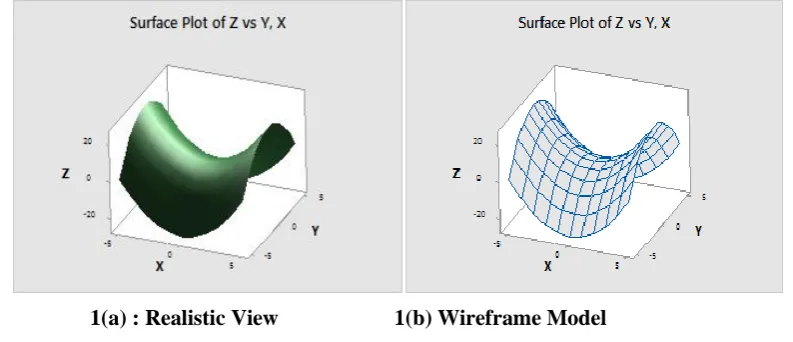
The wireframe modeling is the construction level representation of 3D object or surface. The generation of the
object or surface is actually done through wireframe modeling. The post processing on the surface such as the
modification in the object structure or shape is also possible from wireframe model. The wireframe model is
also a 3D base representation which is composed using the internal points, edges and the polygons. The realistic
view and the structural wireframe model of an object are shown in figure 1.
1(a) : Realistic View
1(b) Wireframe Model
2127 | P a g e
The realistic 3D objects are when represented to the 2D place or surface; there is the requirement of coordinatelevel transition. The transition of 3D surface to 2D object is required without losing the surface structure or the
construction information. As the 2D plane surface does not have Z axis, there is the requirement to Z coordinate
of each vertex, line and polygon to equivalent (x,y) coordinate. Along with this transition, the requirement is to
identify the edges or polygons that are visible to the surface and that are hidden because of depth constraint. In
this paper, a genetic based model is provided to perform the transition of 3D surface on 2D place using genetic
approach.
In this paper, a genetic adaptive method is defined to transform the 3D architectural surface on 2D plane. In this
section, a brief introduction to the surface generation and different modeling available for surface representation
are discussed. In section II, the work provided by the earlier researchers is discussed. In section III, the research
methodology to use the genetic for surface reconstruction and transformation are provided. In section IV, the
optimization results obtained from the work are presented. In section V, the conclusion obtained from work is
provided.
II. RELATED WORK
Lot of work is already provided by the researchers to generate the 3D surface to project them in 2D place. In this
section, the work provided by the earlier researchers is discussed. Bebis et al.[1] has explored the usage of
genetic algorithm to generate the 2D surface and object by accepting the 3D object structure as input. The model
specific evaluation was provided by the author by applying the algebraic function and relatively applied the
filtration on different viewpoints. The graph level projection and the coordinate level transformations were used
by the author. The mesh generation and evaluation using different measures were used by the author. Cignoni et
al.[2] has used the attribute derivation method for mesh generation and formulation under texture and encoding
map. Author applied the color estimation, frequency mapping and shape driven analysis based on available
scalar information. The featured encoding was provided by the author for surface generation. Chen et al. applied
the visual characterization based transformation of 3D surface to 2D environment. The work was applied based
on the rendering analysis applied on depth images. The featured evaluation with error prediction and noise
reduction was provided by the author. The quality driven analysis respective to defined viewpoint was applied
by the author. Manbae et al.[4] applied the transformation of 3D images to 2D depth images by integrating the
rendering features. The color, saliency, localization and the luminance features were used under weight
computation for this projection. The stable and acceptable perceptions were considered by the author to diverse
the 3D surface. The transformation is applied on stereoscopic images and based on this the realistic
representation of 3D object on 2D surface is provided. Kita et al.[5] has defined a registration of 3D image using
2D transformation method. The 3D object formation from coordinate driven analysis is provided by the author.
The integration of these images was done from coordinate exploration with contour level Skelton generation.
The feature specific object filteration and transformation to the structural form is provided by the author.
Li et al.[6] has defined a work on 3D to 2D transformation using adaptive finite element analysis. The
dimension specific analysis and the component observation is provided to improve the accuracy in measured
feature form. The dimension specific observation was provided by the author. Liu et al.[7] has used the genetic
based dual model to improve the triangulation approach. The minimum point identification using Hessian
2128 | P a g e
the points are identified, the convergence method is applied for optimization of this triangulation. The problemspecific validation and optimization is also provided by the author. Newman et al.[8] has described the power
and speed based representation and generation of 2D modeling of 3D design structure. The specific point based
transformation and analysis on the relational generation was provided. The hypermedia method was included to
prioritize the features relative to the available environment constraints. Author[9] has defined a work on the
planner object to explore the viewpoint specific representation and analysis. The invariant features were
processed by the author. The moment driven features were identified by the author using fourier descriptor. The
moment driven Fourier descriptor was processed under algebraic modeling to optimize the transformation.
Tokunaga et al.[10] has processed the realistic object modeling using the point collision analysis and the
integration of the cutting tool to the environment. The configuration level optimization at coordinate and space
level was provided by the author. The position driven observation and orientation with parameter specification
was provided in the surface space. Kagehiro et al.[11] has used the 3D object recognition method under point
driven analysis. The surface continuity and smoothness generation was defined by the author with relative
segmentation map and patch formation. Wagao et al.[12] has processed the optical model to collaborate the 2D
and 3D images with specification of data feature in angular range. The feature fusion and rate updation was
provided in this work. The feature level processing without the existence of reference image was evaluated.
III. GENETIC BASED 3D-2D TRANSFORMATION
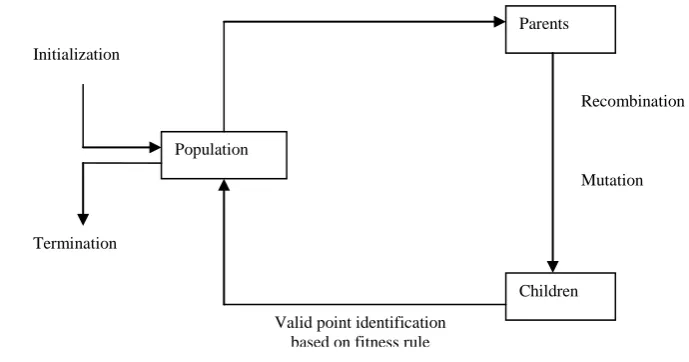
Genetics is the evolutionary optimization method which describes the constraint formulation while generating the child dataset. The genetic modeling can be used to provide the solution of any constraint or unconstraint problem by observing the relational aspect in existing population elements. At first, the population is generated based on the application and the domain requirement. Later, by observing the population elements the constraints are defined based on optimization vector. In this work, the genetic process has generated the population set in the form of connectivity sequence or the polygons. In iterations of genetic process, two parent polygons are selected and processed under the defined constraints. These constraints are applied with the fitness rule to generate the feasible population sequences or polygons. These fitness rules are defined with specification of some objective to optimize the projected surface on 2D plane. The selection of the visible edges and polygons is also done in this stage. The behavior of genetic algorithm is shown in figure 2.
Figure 2: Genetic Process Model
Parents
Children Population
Initialization
Termination
Recombination
Mutation Fitness based Ranked Selection
2129 | P a g e
As shown in the figure 2, the genetic process begins with the specification of the raw data pool at the initialization stage. The transformation of this data pool is done to the sequenced population set based on the domain or application requirement. Once the population is obtained, the constraints are applied under data size, construction rules and the optimization requirement. These constraints are applied collectively within fitness rule. Based on these rules, the parent sequences are selected or generated from the pool. The accuracy of the fitness rule defines the reliability of the genetic process. Once the parents are identified, the crossover process is applied to generate the next child sequence from the parents. The crossover operator is applied to generate the comparative and composite evaluation between these two parents. The crossover is called the extension function that is applied on candidate parents and to generate the new population element. The basic structure or the features of generated child are same as of parent. Before including the new generated child element to the population, the verification is applied under redundancy vector. The mutation function is applied to avoid this redundancy by altering the generated child based on some defined rule.
This whole process of genetic integration is repeated till the optimization objective is not achieved or the number of fix number of iterations not gets executed. The formulation of the fitness function, mutation function, fitness function is done based on the application and domain constraints and the objective regulation. In this paper, the genetic modeling is applied to transform the 3D structural surface object to 2D based on the connectivity driven optimization. Various elements, functions and connectivity constraints were considered while formulating the surface generation. Various work stages associated to the surface reconstruction are described below:
Objective Function: The objective function defined for optimization of surface is minimization of cost
that defines in terms of distance.
Fitness Functions: To achieve this objective function, there is need to define fitness function that is
distance formula.
Chromosome: The random permutation of vertex set is defined as chromosome.
Population Pool: The collection of 20 chromosomes is defined as population pool set. Initially 20
chromosomes are generated, which are updated, with each genetics iterations. In each iteration the best
connectivity (chromosome) is selected from the population pool.
Encoding Method: Connectivity of nodes using random permutation of node sequence.
Selection Criteria: Combination of ranked selection, PMX crossover and the random mutation function. Stopping Criteria: Fix number of iterations or cost remains same in last 10 iterations.
IV. RESULTS
In this paper, the genetic adaptive model is defined for transforming the 3D object or surface to 2D plane or
environment. The constraints associated to the genetic modeling, input data and the procedural constraints
2130 | P a g e
Table 1 : Environmental Constraints
Features Values
Initial Input Random 3D Structural Points
Objective Function Connectivity Driven Optimization
Fileration Hidden Points, Hidden Surfaces, Collinear Points
Type of Crossover PMX, Two Point Crossover, One Point Crossover, AMX, Intermediate and Scattered
Selection Function Ranked
Mutation Function Uniform, Random, Adaptive Feasible
The random generated 3D surface points are processed on the defined environmental constraints associated to
the genetic algorithm and the optimized transformed surface is generated. The analysis is here provided in terms
of optimization outcome achieved by applying the different crossover operators and mutation function. Table 2
is showing the optimization values in terms of combination instances obtained by applying the different
crossover operators.
Table 1: Number of Optimized Combination Instances Respective to Crossover Operators
Crossover Operator Number of Combination Instances given Optimized Value
PMX 42
Two point X 7
one point X 3
AMX 7
Scattered 31
Intermediate 15
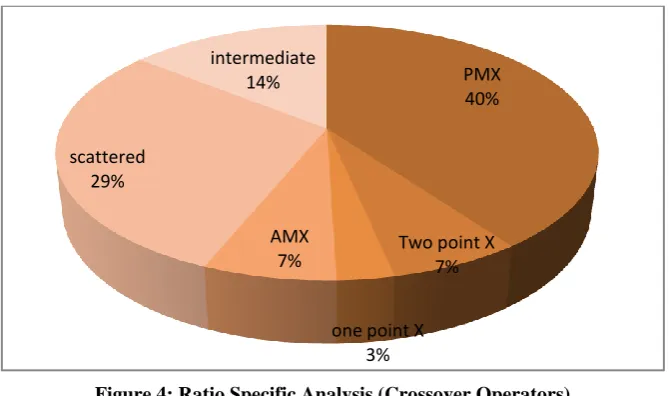
Figure 2 shows the analysis results obtained in ratio form. Out of 105 different combinations, about 40%
combinations by PMX operator provided the optimized results. The second optimum result is provided by
Scattered Crossover. This crossover is the part of the optimized genetic operators’ combination with 29%. The
least optimum result is provided by one point crossover with 3%.
Figure 4: Ratio Specific Analysis (Crossover Operators)
After obtaining, the most effective crossover, different combinations of mutation functions are tested with PMX
crossover. In this analysis, the crossover function is PMX and the selection function is ranked selection. Three
different mutation functions are taken, including Uniform Mutation, Random Mutation and Adaptive Feasible
PMX 40%
Two point X 7%
one point X 3% AMX
7% scattered
29%
2131 | P a g e
Mutation Function. Each of the combinations listed in table 3 are applied for five different passes and analysis isdone in terms of optimized cost.
Table 3: Different Combination of Genetic Operators with Varying Mutation Function
Genetic Operator Combinations Passes
Ranked/PMX/Uniform 5
Ranked/PMX/Random 5
Ranked/PMX/Adaptive Feasible 4
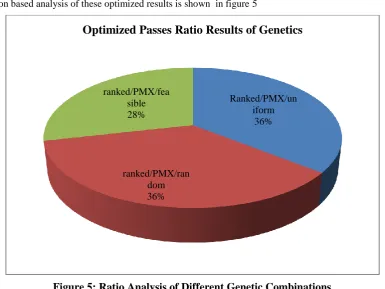
The ration based analysis of these optimized results is shown in figure 5
Figure 5: Ratio Analysis of Different Genetic Combinations
The figure shows that the crossover and the selection function are fixed and the analysis is taken for the
mutation function analysis. The figure shows that the Random and Uniform combination provided the equalized
effective results
V. CONCLUSION
The realistic objects are available in 3D plane, which are required to project on 2D environment for structural
representation. To present these 3D structural points to 2D surface, some transformation method is required. In
this paper, a genetic based optimization model is provided to process the initially available point set and to
transform it to 2D environment. In this paper, the genetic process model with relative work stages is defined.
Various genetic integrated operators are applied and the comparative derivation is also provided in this paper to
identify the most effective genetic combination.
Ranked/PMX/un iform
36%
ranked/PMX/ran dom 36% ranked/PMX/fea
sible 28%
2132 | P a g e
REFERENCES
[1] Bebis George, Louis Sushil, Varol Yaakov, and Yfantis Angelo, "Genetic Object Recognition Using
Combinations of Views", IEEE Transactions on Evolutionary Computation, pp 132-146, Vol 6, 2002. [2] Cignoni P., Monotony C., Rocchiniz C. and Scopigno R., "A general method for Preserving Attribute
Values on Simplified Meshes", Proceedings of Visualization, pp 59-66, 1998.
[3] Hua Chen, Tao Liu, Mengshu Ge and Bojin Zhuang, "A Depth Optimization Method For 2D-To-3D
Conversion Based on RGB-D Images", Proceedings of IC-NIDC, pp 223-227, 2014.
[4] Kim Manbae, "2D-to-3D Conversion Using Color and Edge", IEEE International SoC Design Conference, pp 171 - 172, 2014
[5] Kita Yasuyo, Wilson Dale L., Noble J. Alison and Kita Nobuyuki, "A Quick 3D-2D Registration Method
for a Wide-range of Applications", Proceedings. 15th International Conference on Pattern Recognition, pp 981 - 986, Vol 1, 2000
[6] Li Erping and McEwan P M, "3D to 2D Transformation Solution of Transient Eddy Current
Electromagnetic Fields in an Actuator", IEEE Transactionson Magnetics, pp 1733-1736, Vol. 29, Issue. 2, 1993.
[7] Liu Guangyuan, Li Xuedong, Wang Shuxin,Yongqiang Ma, “An improved Genetics Algorithm Based on
Triangulation”, IEEE 978-1-4244-4738-1, pp 447 - 451, 2009.
[8] R. M. Newman, M. Tovey, C. S. Porter and N. Bussard, "Line to form to line – transformations between
2D and 3D in design and documentation", Proceeding 28th Euromicro Conference, pp 122 - 128, 2002 [9] T. H. Reiss, "Features Invariant to Linear Transformations in 2D and 3D", 11th IAPR International
Conference on Image, Speech and Signal Analysis, pp 493 - 496, 1992
[10] H. Tokunaga, F. Tanaka, T. Kishinami, "Method of Offset Surface Generation based on Configuration
Space", IEEE International Conference on Robotics and automation, pp 2740-2745, 1995
[11] Kagehiro Wagao, Takayuki Okatani and Koichiro Deguchi, "3D object surface generation from range
point data for object shape model matching", Proceedings of the 41st SICE Annual Conference, pp 1416 - 1419, Vol 3, 2002