Complementarity in nuclear structure studies
P.E. Garrett1,a
1Department of Physics, University of Guelph, Guelph, ON, N1G2W1, Canada
Abstract.The nuclear many-body system displays a wide variety of behaviors, including collective and
single-particle degrees of freedom. Specific reactions may probe these different aspects, the data from which may both
complement and also appear to be in conflict with each other. In the present work, examples are given where information from one experiment enhances and reinforces the information from another, and also an example where the data appear to be in conflict and result in a re-interpretation of structure.
1 Introduction
The atomic nucleus enjoys a rather unique place in physics. A many-body fermionic system with two ba-sic building blocks, it exhibits incredibly complex exci-tations. Compared with molecular systems, for example, where rotational, vibrational, and electronic excitation en-ergy scales differ by one to two orders of magnitude, in the nuclear system the energy scales are approximately equal. Because of this, very detailed spectroscopy is re-quired to determine the nature of the excitation; the exci-tation energy alone is insufficient. Fortunately, we have at our disposal a wide variety of probes that can be used, some of which are highly selective and directly probe the components in the wave function, such single- and two-nucleon-transfer reactions, high-energy inelastic hadronic scattering, etc., and others that are insensitive to the details of the nuclear wave functions, such as fusion-evaporation reactions and low-energy inelastic scattering.
Nuclei lying on or near the valley of stability can typ-ically be studied by the variety of techniques mentioned above so that a large complementary set of data can be ob-tained. The complementary data can shed light on both collective, pairing, and single-particle aspects of the exci-tations, although sometimes in a contradictory way. While the contradictions can appear at first to be puzzling, the full scope of information ultimately leads to a deeper un-derstanding of excited states in nuclei. Further, the cor-rect interpretation of excited states in nuclei near stability is vital to serve as benchmarks when attempting to eluci-date structure in nuclei far from stability. In the following, I give some examples of the usefulness of complemen-tary data in working out electromagnetic transition matrix elements, namely combining data from experiments that measure level lifetimes or matrix elements via Coulomb excitation, and experiments that achieve high-sensitivity to weak decay branches. Further, an example is given of
ae-mail: [email protected]
the contradictory conclusions that may be reached regard-ing the nature of excited states when viewed with different probes.
2 Complementarity in electromagnetic
matrix elements
Electromagnetic matrix elements provide critically impor-tant information for nuclear structure. Direct lifetime measurements can be obtained via electronic timing tech-niques, or Doppler-shift techniques. Once the lifetime is known, the matrix elements can be calculated through knowledge of theγ-ray transition branches. Coulomb ex-citation, on the other hand, provides direct information on the matrix elements through the measurements of the
γ-ray yields. Provided that the reaction takes place in a “safe” manner, calculations of the well-known electro-magnetic interaction can be performed that are effectively exact, even if carried out in a semi-classical approxima-tion.
One of the issues that Coulomb excitation may suffer from arises from ambiguities in the population pathways. For example, a high-lying 4+state may be reached via a directE4 transition from the ground state, via successive E2 transitions in a two-step excitation involving the first 2+state, the second 2+state, etc., or any other multi-step combination provided that the angular-momentum/parity selection rules are obeyed. Typically, when going beyond all but the lowest excitations these ambiguities greatly in-crease the uncertainties on the extracted matrix elements. However, these can be overcome provided that: a) there are sufficiently large number of complementary data in the form of already known level lifetimes, transition branch-ing ratios, etc., or b) the Coulomb-excitation experiment is performed under a variety of conditions, such as changing projectiles, measuring yields as a function of the scattering angle, etc.
Much of the Coulomb excitation data for stable nu-clei currently available was obtained in the late 1960’s
798.01 798.03 798.05 798.07 E ( ) 1312.36 1312.38 1312.40 1312.42 1312.44 E ( )
-0.8 -0.4 0.0 0.4 0.8 cos 1387.60 1387.70 E ( ) 1038.70 1038.80 E ( ) 2505.8 2506.2 2506.6 2507.0 E ( )
-0.8 -0.4 0.0 0.4 0.8 cos 2930.0 2931.0 2932.0 E ( )
( )=0.032 0.008
4+ 12+1
( )=0.015 0.007 2+ 22
+ 1
( )=0.076 0.008
3 -1 2+1
( )=0.069 0.013
4+ 42+2
( )=0.350 0.021
1 -10+1
( )=0.608 0.028
1+ 10+1
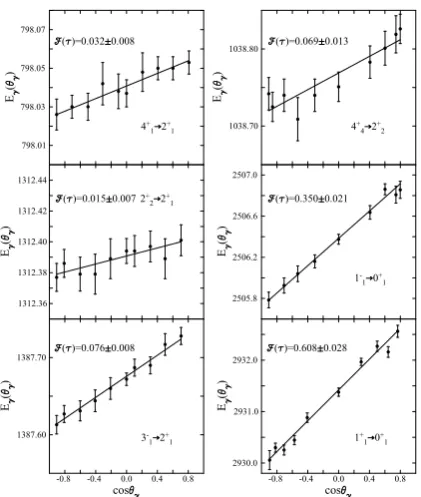
Figure 1.Examples of Doppler shifts from the112Cd(n,nγ) re-action. From data like these, using knowledge of the stopping powers the level lifetimes can be extracted. A major advantage
of the (n,nγ) reaction with accelerator-produced nearly
mono-energetic neutrons is the ability to choose the maximum excita-tion energy of the nucleus, and hence control the feeding to a state of interest.
and early 1970’s, often using small volume Ge(Li) detec-tors or NaI detecdetec-tors. Using the stable even-even Cd iso-topes as an example, despite their pivotal role serving as a benchmark for multi-phonon vibrational excitations (see e.g. Kernet al. [1]), only in114Cd [2] are there an ex-tensive set of matrix elements from data obtained using a modest setup of NaI, Ge(Li), and PPAC detectors. The remaining stable even-even Cd isotopes have been exam-ined in Coulomb excitation using NaI detectors (see, e.g. Ref. [3]). The Coulomb excitation data [3] for the series of Cd isotopes was crucial in establishing the validity of the multi-phonon vibrational picture, but the more extensive data on114Cd, which raised serious questions regarding its structure, remained isolated in the sense that it was never followed up; despite the extraction of large values of< β > for the114Cd 0+states through the use of the Kumar-Cline sum rules, probing Coulomb excitation experiments on the other Cd isotopes were not performed. The lack of high-precision and extensive data, together with the apparent success of models like the IBM incorporating mixing with the deformed intruder bands [4, 5] that could reproduce the set ofB(E2) values and level energies as known at the time, created the persistent impression that the mid-shell even-even Cd isotopes were, in fact, paradigms of vibra-tional motion [1].
Beginning in the mid-1990’s, an extensive program of investigation of the stable even-even Cd isotopes was ini-tiated at the University of Kentucky accelerator laboratory
using the powerful (n,nγ) reaction. This reaction, which for low neutron energies of several MeV is dominated by the compound nucleus reaction, has the advantage of high cross section for low-spin states, including spin 0, and ob-servable Doppler shifts for states with lifetimes up to ap-proximately 1 ps. Taking advantage of either the3H(p,n) ord(d,n) reactions to produce nearly mono-energetic neu-trons, the maximum excitation energy of the target nucleus can be chosen in such as way as to minimize the prob-lematic feeding issue that plagues Doppler-shift analysis in charged-particle fusion-evaporation reactions. Figure 1 shows some examples of Doppler shifts extracted from the 112Cd(n,nγ) reaction. The Doppler shift of the 798-keV γray, which is the 4+1 →2+1 transition in112Cd, is a mere 25 eV from the most forward to the most backward angles measured; very high statistics combined with a large dis-persion for the ADC (i.e. small keV per channel) and the use of radioactive sources placed in view of the hpGe de-tectors to provide for continuous monitoring for gain shifts as a function of angle enable the extraction of such small energy shifts. Knowledge of the stopping power then al-lows for the determination of the level lifetime [6]. The 798-keV transition shown in Fig. 1 has a Doppler shift corresponding toτ=1000+1000
−340 fs, in excellent agreement with the literature value ofτ=1300±100 fs [7].
The first nucleus of the series of even-even Cd iso-topes to be studied with the (n,nγ) reaction, 112Cd, was initially interpreted [8] in terms of the vibrational limit of the IBM. Soon thereafter, measurements [9, 10] on110Cd were also viewed as being in good agreement with the vi-brational model. However, a study [12] of116Cd found that the decays of the 0+2 and 0+3 states could not be explained in the usual strong-mixing scenario [4, 11]; the decay of the intruder band head (the 0+3 state in116Cd) remained enhanced over the decay of the 0+“two-phonon” state, de-spite the latter being lower in energy. A re-examination of the (n,nγ) results for112Cd with a more extensive analy-sis found serious discrepancies between the experimental data and IBM-2 calculations for the three-phonon levels [13], as did a study of114Cd [14]. In fact, while in any one particular nucleus the discrepancies might not be viewed as serious, it was realized that the discrepancies occurred systematically across the mid-shell Cd isotopes [15], and thus unlikely to be due to mixing.
While the (n,nγ) reaction provides a wealth of spec-troscopic information, including the level lifetimes or lim-its for most of the levels observed [10, 13, 14], due to the backgrounds present in the in-beam studies and the large sample sizes required for the inelastic neutron scattering, it is not particularly sensitive to low-energy transitions be-tween highly-excited states. These transitions are often the most important ones to properly characterize the collectiv-ity, but also very often have branching ratios below the 10−3level. Therefore, further experiments that are sensi-tive to particularly weak, low-energy transitions need to be performed. It was for this reason that a program pursuing high-statisticsβ-decay measurements was initiated.
1500 1700 1900 2100 2300 50
200 500 2000 10000
700 900 1100 1300 1500
0 100 200
800 1000 1200 1400 1600
0 200 400 600 800
700 900 1100 1300 1500
0 100 200 300 400
a)
b)
c)
d)
Counts per 0.85 keV
E (keV)
Figure 2. Examples of coincidence spectra obtained from the decay of
112In/112Ag→112Cd with the 8π
spec-trometer. The spectrum in panel a) re-sults from a coincidence gate on the
617-keV 2+1 → 0+1 transition.
Transi-tions from all known 2+levels between
2 MeV and 3 MeV are marked with a vertical line. The spectrum in panel b) is obtained with a coincidence gate on
the 816-keV 0+3 → 2+1 γray, where the
vertical lines guide the eye (where nec-essary) to locations for an expected
tran-sition from the 2+ states identified with
their energies. The spectrum in panel c) is obtained with a coincidence gate on
the 695-keV 2+2 →2+1 γray, and that in
panel d) is obtained with a coincidence
gate on the 798-keV 4+1→2+1γray.
and its auxiliary devices. The 8πspectrometer consisted of 20 hpGe detectors equipped with BGO anti-Compton shields surrounding a target chamber with a radius of 11 cm. Internal to the vacuum is a tape on which the beam is deposited at the focus of the array, and which can be moved in a controlled manner to transport the activity out of the target chamber. Also present inside the target cham-ber are optional auxiliary detectors consisting of 20 thin plastic scintillators forβ-particle tagging, or 5 Si(Li) de-tectors for conversion electron studies. The power of the 8πspectrometer is aptly demonstrated in Fig. 2 that shows a series ofγ-ray coincidence spectra with gates on selected
γ-rays following theβdecay of a beam of112In and112Ag.
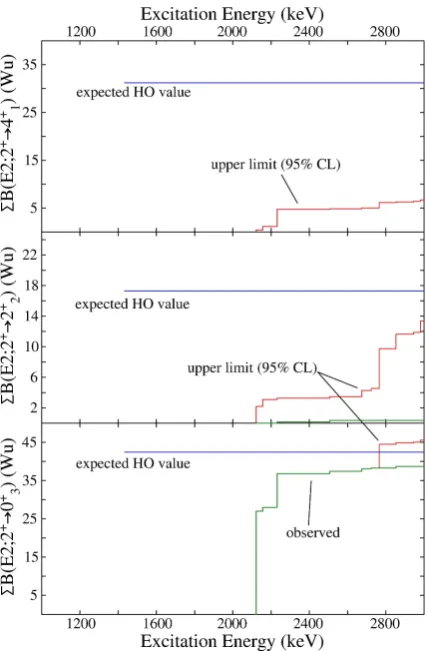
When seeking evidence for the existence of multi-phonon structures, as the energy and multi-phonon number in-creases, the increasing level density would be expected to fragment the collective wave function, potentially over many states. Thus, failure to locate the expected E2 strength in one particular state may not necessarily indi-cate a lack of existence of the multi-phonon excitation. However, with the highly sensitive data from theβ de-cay, and the knowledge thatallknown states of a partic-ular spin up to a certain energy are populated, the sum of the observed (or upper limit) of theE2 strength can be constructed. From the data like those presented in Fig. 2, combined with the lifetimes from the (n,nγ) ex-periment, theB(E2) for all decays into specific final states can be examined. This is shown in Fig. 3 for112Cd for de-cays from high-lying 2+states into the hypothesized two-phonon states; while there would be agreement for decay into the purported 0+ two-phonon state, the strength for decay into the 2+ two-phonon is much weaker than ex-pected, and there isnodecay, and a severe upper limit on its possibility, into the 4+ two-phonon state. It can thus be concluded that the 2+three phonon strength is not frag-mented – it does not exist.
Recently, a series [16–20] of Coulomb excitation ex-periments were performed with GAMMASPHERE in in-verse kinematics of Xe beams on C targets. The aims of these experiments were to determine theB(E2) values for excitation to low-lying 2+states, and an extensive set of matrix elements for each nucleus was determined. These measurements convincingly demonstrated the power of modern spectrometers to extract multiple, high-precision matrix elements through Coulomb excitation, and the ma-jority of them were completed with less than a day, and in some cases only 12 hours, of beam time.
Figure 3. Cumulative sum of the observed, and upper
lim-its ofB(E2; 2+ → 4+1) (top), B(E2; 2+ → 2+2) (middle), and
B(E2; 2+→0+3) (bottom) values (in W.u.)vs.excitation energy.
The expected harmonic vibrator (HV) values are indicated.
Figure 4.Portion of theγ-ray spectrum measured in coincidence
with the 914-keV 0+2 → 2+1 transition. The observed 360-keV
γ-ray is the 2+ → 0+ transition in the “Kπ = 0+2” band. The
branching fraction for the 360-keV transition extracted from the
present data is 5.4±0.3%.
3 Complementarity and contradictions in
structure assignments
While there are many situations where data from one type of experiment can enhance the results from another, as
demonstrated above, in some cases the opposite, at least at first glance, appears to occur. One of the more com-mon examples of this can occurs when the different exper-iments are sensitive to different components in the wave functions. For example, Coulomb excitation is sensitive to the collective components in wave functions whereas single-nucleon transfer is sensitive to the single-particle components.
Some 15 years ago, results [21] from the112Cd(n,nγ) provided, as believed at the time, firm identification of the quadrupole-octupole-coupled (QOC) quintuplet of states. These states, with spin-parity 1−−5−, formed by the cou-pling of the quadrupole phonon to the octupole phonon, are expected to occur in the vicinity ofE(2+1)+E(3−1), the sum of the excitation energies of the 2+1 and 3−1 levels. In 112Cd, such a situation exists as shown in Fig. 5, where the
arrows are labelled with the observedB(E2) orB(E3) val-ues in W.u. The observed enhancedB(E2) values for the 2−, 3−, and 5−decays to the 3−1level was taken as firm ev-idence for their assignment as members of the QOC quin-tuplet of states.
The QOC quintuplet assignment [21] in 112Cd re-mained firm, and indeed served as a template for assign-ments in neighboring Cd isotopes [14, 22, 23]. However, very recently we have re-measured the111Cd(d,p)112Cd reaction using 22 MeV polarized deuterons with the Q3D spectrometer at the Maier Leibnitz Laboratorium located on the joint campuses of the Technische Universität and Ludwig Maximilians Universität München. A portion of the spectrum collected atθ=40◦is shown in Fig. 6, where some of the peaks have been labelled with the correspond-ing excitation energies in keV of the levels in112Cd. The most remarkable feature of the spectrum is the intensity of the 5−level at 2373 keV, and the 6−level at 2818 keV.
30.2
22 58 85
50 (190)
20 46
0 0
2 618
3 2005
5 2373 3 2416
1 2507 4 2591 2 2669
5 2570
6 2818
<
< <
Figure 5. Partial level scheme of the low-lying negative-parity
states in112Cd. The 3−
1 octupole state has an enhancedB(E3)
value for decay to the ground state, establishing its one-phonon nature. The coupling of the quadrupole and octupole one-phonon states is expected to give rise to a quintuplet of states located at
approximately the sum of the 2+1 and 3+1 energies. This is
ob-served, with several of these negative-parity states possessing
en-hancedB(E2) values for decay to the 3−1 octupole phonon level,
350 450 550 650 Channel
1000 3000 5000 7000 9000 11000 13000
Counts per channel
2301 0
+
2373 5
-2506 2
+
2571 5
-2635 2
+
2674 2
+
2723 2
+
2766 2
+
2818 6
-2867 3
+ 2899 5
-2834 0
+
2650 0
+
2711 4
+
2932 1
+
2962 4
-111
Cd(d,p)
112Cd
E
d= 22 MeV
=40
oFigure 6. Portion of the
spectrum observed with the
111Cd(d,p)112Cd reaction
us-ing 22 MeV deuteron beams. Because of the nature of the single-nucleon transfer reaction,
only states with significant
two-quasiparticle components in their wave functions of the form
jt ⊗ jtr, where jt is the target
single-particle configuration and
jtr is the configuration of the
transferred particle, should be strongly populated.
These are the largest peaks in the spectrum, and from their spectroscopic strengths they are clearly dominated by the s1/2⊗h11/2two-quasi-neutron configuration, thes1/2 con-figuration forming the ground state of111Cd. This assign-ment is at odds with the identification of the 2373-keV 5− state as a member of the QOC quintuplet, but the strength observed in the (d,p) reaction is irrefutable. A possible explanation lies in the suggestion that the Cd isotopes may representγ-soft rotors [24]; in that picture, the 5− level would be a rotational band member based on the 3− one-phonon state, and thus could be directly populated in the (d,p) reaction.
4 Summary
Complementary data obtained from a variety of reactions are vital to our understanding of the nature of nuclear exci-tations. Some complementary experiments, such asβ de-cay and Coulomb excitation (or other methods to extract nuclear level lifetimes) reinforce each other. Still other reactions may at first appear to provide contradictory re-sults, but ultimately provide a much deeper insight to the true nature of the excitation of the nuclear system. The wide variety of reactions and probes that can be brought to bear on stable nuclei continues to provide new insights into nuclear structure, and offers the best opportunity to es-tablish benchmarks for structure that are necessary when exploring nuclei offstability.
Acknowledgements
Much of the work presented here has formed the gradu-ate research work of K.L. Green, A.J. Radich, and D.S. Jamieson. Their contribbution is gratefully acknowledged.
References
[1] J. Kernet al., Nucl. Phys. A593, 21 (1995) [2] K. Fahlanderet al., Nucl. Phys. A485, 317 (1988) [3] F.K. McGowanet al., Nucl. Phys.66, 97 (1965) [4] K. Heydeet al., Phys. Rev. C25, 3160 (1982) [5] P.D. Duval and B.R. Barrett, Nucl. Phys. A376, 213
(1982)
[6] T. Belgyaet al., Nucl. Phys. A607, 43 (1996) [7] D. De Frenne and E. Jacobs, Nucl. Data Sheets79,
639 (1996)
[8] H. Lehmannet al., Phys. Lett. B387, 259 (1996) [9] F. Corminboeuf et al., Phys. Rev. Lett. 84, 4060
(2000)
[10] F. Corminboeuf et al., Phys. Rev. C 63, 014305 (2000)
[11] M. Délèzeet al., Nucl. Phys. A551, 269 (1993) [12] M. Kadiet al., Phys. Rev. C68, 031306(R) (2003) [13] P.E. Garrettet al., Phys. Rev. C75, 054310 (2007) [14] D. Bandyopadhyayet al., Phys. Rev. C76, 054308
(2007)
[15] P.E. Garrettet al., Phys. Rev. C78, 044307 (2008) [16] G. Rainovskiet al., Phys. Lett.B68311 (2010) [17] L. Coquardet al., Phys. Rev. C83, 044318 (2011) [18] L. Coquardet al., Phys. Rev. C80, 061304(R) (2009) [19] L. Coquardet al., Phys. Rev. C82, 024317 (2010) [20] T. Ahnet al., Phys. Lett. B679, 19 (2009) [21] P.E. Garrettet al., Phys. Rev. C59, 2455 (1999) [22] A. Gadeet al., Phys. Rev. C66, 034311 (2002) [23] J.C. Batchelder et al., Phys. Rev. C 80, 054318
(2009)