48 | P a g e
A robust method in reducing the PAPR in OFDM using a
hybrid SLM and PTS model
Neha Khatri
1, Vijay Bisen
2 1M.Tech Student, Vikrant Institute of Technology and Management.
2
Assistant Professor, Vikrant Institute of Technology and Management.
ABSTRCT
The Orthogonal Frequency Division Multiplexing (OFDM) is an excellent and reliable technique for next
generation wireless communication. Large Peak-to-Average Power Ratio (PAPR) is the one of the major
drawback of the Orthogonal Frequency Division Multiplexing (OFDM) transmitted signal. In this paper, a new
hybrid technique based on SLM and PTS scheme is presented to reduce the high Peak-to-Average Power Ratio
(PAPR) of Orthogonal Frequency Division Multiplexing (OFDM) signals. We have compared the proposed
technique with the SLM, PTS and Original schemes. Although all the others existing techniques like Partial
Transmit Sequences (PTS), Selective Mapping (SLM) and Iterative flipping schemes can reduce the
Peak-to-Average Power Ratio (PAPR), but the computer simulation results shows that the Proposed technique based on
SLM and PTS scheme can offer better Peak-to-Average Power Ratio (PAPR) reduction than SLM, PTS, Iterative
flipping techniques. But the proposed scheme is more complex than the existing techniques
.
Keywords
-Peak-to-Average Power Ratio (PAPR), Orthogonal Frequency Division Multiplexing
(OFDM), Selective Mapping (SLM), Partial Transmit Sequences (PTS), Iterative flipping scheme,
proposed scheme.
I INTRODUCTION
49 | P a g e
Among these methods, partial transmit sequences (PTS) scheme is the most efficient approach and a least distortion-less scheme for PAPR reduction by optimally combining signal sub-blocks. In PTS technique, the input date block is broken up into disjoint sub-blocks. The sub-blocks are multiplied by phase weighting factors and then added together to produce alternative transmit containing the same information. The phase weighting factors, which amplitude is usually set to 1, are selected such that the resulting PAPR is minimized. The number of allowed phase weighting factors should not be excessively high, to keep the number of required side information bits and the search complexity within a reasonable limit. However, the exhaustive search complexity of the ordinary PTS technique increases exponentially with number of sub-blocks, so it is practically not realizable for a large number of sub-blocks. To find out a best weighting factor is a complex and difficulty problem.
The advent of evolutionary computation has inspired new resources for optimization problem solving, such as the optimal design of code division multiple access (CDMA) and fuzzy system. In contrast to traditional computation systems which may be good at accurate and exact computation, but have brittle operations, evolutionary computation provides a more robust and efficient approach for solving complex real world problem. Many evolutionary algorithms, such as Genetic algorithm (GA) [14-15], ant colony optimization (ACO) [16], simulated annealing (SA) [17] and particle swarm optimization (PSO) [18-24], have been proposed. GAs is stochastic search procedures based on the mechanics of natural selection, genetics, and evolution. Since they simultaneously evaluate many points in the search space, they are more likely to find the global solution of a given problem. PSO is a population-based stochastic optimization technique based on the movement of swarms and inspired by social behavior of bird flocking or fish schooling. Compared with GA [14] [15], PSO has some attractive characteristics. It has memory, so the knowledge of good solutions is retained by all particles; whereas in GA, previous knowledge of the problem is destroyed once the populations changed. It has constructive cooperation between particles, particles in the swarm share information between them. In this paper, we present a novel approach to tackle the PAPR problem to reduce the complexity based on the relationship between the phase weighting factors and the sub-block partition schemes. Specifically, we apply the PSO to search the optimal combination of phase factors with largely reduced complexity. Numerical results show that the proposed scheme can achieve better PAPR reduction with lower computational complexity compared with that of the GA approaches.
The rest of this paper is organized as follow. In Section 2, definition of PAPR of OFDM system and the principles of PTS techniques are introduced. The particle swarm optimization algorithm based PTS OFDM system has been examined in Section 3. Section 4 provides some performance results and a comparison of the proposed method with related work. Some conclusions are given in Section 5.
50 | P a g e
(WLAN), and the IEEE 802.16a standard for Wireless Metropolitan Area Networks (WMAN) [1]. For an OFDM system with N sub-carriers, an oversampling rate of L can be achieved by inserting (L-1)·N zeros in the middle of the modulated symbol vector to form a 1×LN data
vector X, i.e.
The PAPR computed from the L-times oversampled time-domain signal samples is given by
1.1
The CCDF of the PAPR
The cumulative distribution function (CDF) of the PAPR is one of the most frequently used performance measures for PAPR reduction techniques. In the literature, the complementary CDF (CCDF) is commonly used instead of the CDF itself. The CCDF of the PAPR denotes the probability that the PAPR of a data block exceeds a given threshold. From the central limit theorem, the real and imaginary parts of the time domain signal samples follow Gaussian distributions, assuming each distribution with a mean of zero and a variance of 0.5 for a multicarrier signal with a large number of subcarriers. Hence, the amplitude of a multicarrier signal has a Rayleigh distribution, while the power distribution becomes a central chi-square distribution with two degrees of freedom. The CDF of the instantaneous power of a signal sample is given by The CCDF of the PAPR of a data block with Nyquist rate sampling is derived as this expression assumes that the N time domain signal samples are mutually independent and uncorrelated.
Methods of reducing PAPR
Distortion : Clipping, Companding techniques.
Distortion less : Selected Mapping (SLM),Partial Transmit Sequence (PTS) Others : Active Constellation Extension (ACE),Tone Reservation (TR) Here we are suggesting a new method which improve both.
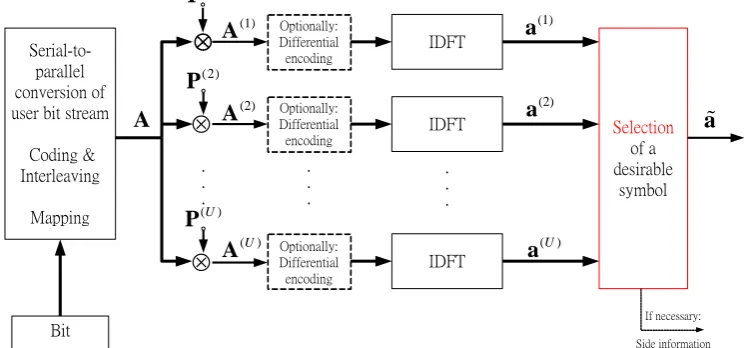
II SELECTED MAPPING AND PARTIAL TRANSMIT SEQUENCE
2.1 SLM(Selective Mapping)
1. A set of U markedly different, distinct, pseudo-random but fixed vectors P(u) = [P0(u) ,…, PN-1(u)], with
must be defined.
2. The subcarrier vector Ais multiplied subcarrier-wise with each one of the U vectors P(u), then resulting to component
1
0 ,
1 ,
,
/ 2 1 , 0,
, 0 ,
/ 2 ,
,
1
L N
X
X
X N
X N
X N
X
2
0 1 2
max
kk LN
k
x
PAPR
E x
( )
( ) ( )
,
[0, 2 ),
u n
j
u u
n n
51 | P a g e
3. Then all U alternative subcarrier vectors are transformed into time domain to get and finally that transmit sequence with the lowest PAPR is chosen.
4. For implementation, the SLM technique needs U IDFT operations, and the number of required side information bits is ,denotes the smallest integer that exceed y.
Figure 1:Selective mapping block diagram
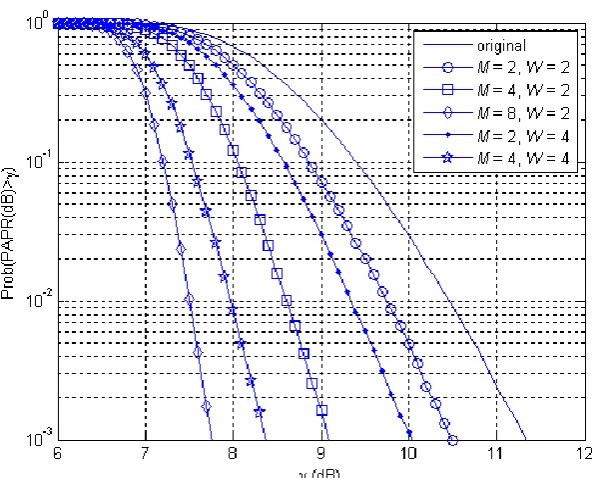
Figure 2 : PAPR Reduction using SLM
Serial-to-parallel conversion of user bit stream
Coding & Interleaving
Mapping
Bit source
Optionally: Differential
encoding
Optionally: Differential
encoding Optionally: Differential
encoding
IDFT IDFT
IDFT
Selection
of a desirable
symbol
If necessary:
Side information
A
(1)
A
(2)
A
(U)
A
a
(U)(2)
a
(1)
a
a
. . .
. . . .
. .
(1)
P
(2)
P
(U)
52 | P a g e
2.2Partial Transmit Sequence
Figure 3 : Partial transmit sequence block diagram
Figure 4 : PAPR reduction using PTS
Serial-to-parallel conversion of user bit stream
Coding & Interleaving
Mapping
Subblock partationing
Optionally: Differential encoding
Bit source
IDFT
IDFT IDFT
Pack value optimization
+
(2)A
( )M
A
(1)
A
a
(1)(2)
a
(M)
a
(1)
b
(2)
b
. . .
. . .
. . .
If necessary : side information
a
(M)
53 | P a g e
In the PTS technique, an input data a block of N symbols is partitioned into disjoint sub-blocks. The subcarriers in each sub-block are weighted by a phase weighting factor for that sub-block. The phase weighting factors are selected such that the PAPR of the combined signal is minimized. For further PAPR reduction, the PTS scheme can be easily combined with the investigated symbol transform scheme. The principle structure of PTS method is shown in Fig. 1 as that in [11]. PTS method is to divide data block into sub-blocks or clusters and then multiply the appropriate phase weighting factors to each sub-blocks to reduce PAPR. We define the data block
as a vector
X
X
1X
2
X
N
T. Then, X is partitioned into M disjoint sub-blocks represented by the vectorX
such that1
M i i
X
X
III MODIFIED SLM-PTS
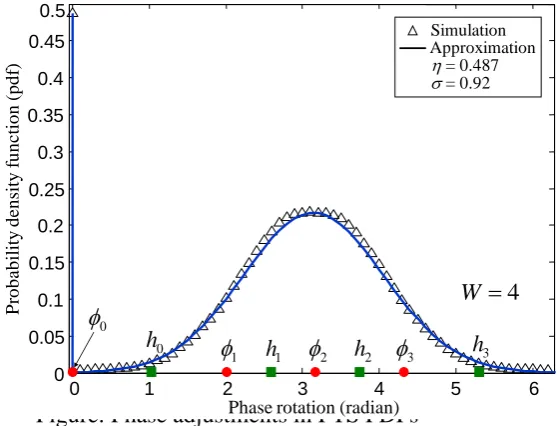
3.1 Phase adjustments in PTS: To reduce the amplitude of a high power sample, one straightforward means is to adjust the phases of some chosen sub-blocks to the reverse of the reference phase to keep the phases of the other sub-blocks unchanged.
Thus the amplitude of the composed signal vector in this sample can be substantially reduced It is found that the phase adjustments of these M sub-blocks are not in uniform distribution.
The distribution contains a delta function at zero, corresponding to the probability of maintaining the original phase in a sub-block, and a Gaussian-like distribution with the mean .
Figure: Phase adjustments in PTS PDFs
Figure 5 : PDF Vs Phase rotation
0 1 2 3 4 5 6 00.05 0.1 0.15 0.2 0.25 0.3 0.35 0.4 0.45 0.5
P
ro
b
ab
il
it
y
d
en
sit
y
fu
n
ct
io
n
(p
d
f)
Phase rotation (radian)
Simulation Approximation
= 0.487
= 0.92
0
2
h
2 1
3h
30
h
1
h
4
54 | P a g e
3.1 PTS with Non-uniform Phase Set:
For M = 2, which leads to two rotational phase factors 1 and -1 being the same as that applied in the conventional PTS However, for M > 2 we need to figure out the optimal set of phase factors in the minimum mean square error (MMSE) sense. The distribution of the phase adjustments can be approximated as where is the probability of maintaining the original phase and is the standard deviation that fit in with the Gaussian-like distribution
where is the probability of maintaining the original phase and is the standard deviation that fit in with the Gaussian-like distribution
IV CONCLUSIONS.
Equivalently, the outage probability can be improved by a factor of 10 for a specific PAPR threshold. It must be noted that the optimal set of phase factors can be determined in advance based on system parameters. The required side information is the same as the conventional PTS scheme with uniform phase factors.
REFERENCES
[1] R. van Nee and R. Prasad, OFDM for Wireless Multimedia Communication. Boston, MA: Artech House, 2000.
[2] T. A. Wilkinson and A. E. Jones, “Minimization of the peak-to-mean envelope power ratio of multicarrier transmission schemes by block coding,” in Proc. IEEE 45th Vehicular Technology Conf., Chicago, IL, pp. 825–829, 1995.
[3] J. A. Davis and J. Jedwab, “Peak-to-mean power control in OFDM, golay complementary sequences, and Reed–Muller codes,” IEEE Trans. Inf. Theory, Vol. 45, no. 7, pp. 2397–2417, 1999.
[4] J. A. Davis and J. Jedwab, "Peak-to-mean Power control and error correction for OFDM transmission using Golay sequences and Reed-Muller codes"' Electronic, Letters, Vol. 300, No. 4, pp. 267-268, 1997. [5] S. H. Muller, J.B. Huber, "OFDM with reduced peak-to-average power ratio by optimum combination of
partial transmit sequences", Electron. Letters, Vol.33, pp.368-369, 27, 1997.
[6] R. W. Bauml, R. F. H. Fischer, and J. B. Huber, “Reducing the peak-to-average power ratio of multicarrier modulation by selected mapping,” Electron. Letters, Vol. 32, no. 22, pp. 2056–1257, 1996.
[7] H. G. Ryu, J. E. Lee, and J. S. Park, "Dummy sequence insertion (DSI) for PAPR reduction in the OFDM communication system," IEEE Trans. Consum. Electron., Vol.50, pp.89–94, 2004.