DOI: 10.1534/genetics.106.070235
Patterns of Recombination and MLH1 Foci Density Along Mouse
Chromosomes: Modeling Effects of Interference
and Obligate Chiasma
M. Falque,*
,1R. Mercier,
†C. Me´zard,
†D. de Vienne* and O. C. Martin*
,‡*UMR de Ge´ne´tique Ve´ge´tale, INRA, Universite´ Paris-Sud, CNRS, AgroParisTech, F-91190 Gif-sur-Yvette, France,†Station de Ge´ne´tique et d’Ame´lioration des Plantes, Institut Jean Pierre Bourgin, INRA, Route de Saint-Cyr, F-78026 Versailles
Cedex, France and‡Universite´ Paris-Sud, LPTMS, UMR8626, CNRS, F-91405, Orsay, France Manuscript received December 22, 2006
Accepted for publication April 19, 2007
ABSTRACT
Crossover interference in meiosis is often modeled via stationary renewal processes. Here we consider a new model to incorporate the known biological feature of ‘‘obligate chiasma’’ whereby in most organisms each bivalent almost always has at least one crossover. The initial crossover is modeled as uniformly dis-tributed along the chromosome, and starting from its position, subsequent crossovers are placed with forward and backward stationary renewal processes using a chi-square distribution of intercrossover dis-tances. We used our model as well as the standard chi-square model to simulate the patterns of crossover densities along bivalents or chromatids for those having zero, one, two, or three or more crossovers; indeed, such patterns depend on the number of crossovers. With both models, simulated patterns com-pare very well to those found experimentally in mice, both for MLH1 foci on bivalents and for crossovers on genetic maps. However, our model provides a better fit to experimental data as compared to the standard chi-square model, particularly regarding the distribution of numbers of crossovers per chromo-some. Finally, our model predicts an enhancement of the recombination rate near the extremities, which, however, explains only a part of the pattern observed in mouse.
M
EIOSIS is a key step in the life cycle of organisms that reproduce sexually because it is the process that leads to the halving of chromosome number; ploidy level is restored at the fertilization step. In the meiotic process, crossovers (COs) play a crucial role, ensuring the proper segregation of homologous chromosomes at the first division. Indeed, they make a mechanical link between homologs that is essential to ensure that the cell will send each homolog to opposite poles. A CO may be observed cytologically because it forms a struc-ture called chiasma. In addition, genetic recombina-tion due to COs is an important evolurecombina-tionary force involved in shaping the genetic diversity of natural and artificial populations. For instance, the frequency of COs may be different between sexes or according tothe mode of reproduction (Lenormandand Dutheil
2005; Roze and Lenormand 2005) and seems to play
an evolutionary role.
COs lead to reciprocal exchange of large fragments of homologous nonsister chromatids (supplemental Figure 1 at http://www.genetics.org/supplemental/). Thus, the genetic outcome of COs is the reassociation of genetic markers located on both sides of the CO point. COs occur in the context of a bivalent that is a
structure associating two homologous chromosomes, each formed by two sister chromatids. Each gamete will inherit one of these chromatids. When a bivalent ex-hibits one CO, two nonsister chromatids are recom-bined while the other two remain unchanged. With two COs on one bivalent, three kinds of chromatids are recovered with zero, one, or two COs (supplemental Figure 1). It is generally considered that there is no chromatid interference (Zhaoet al. 1995; Copenhaver et al. 1998);i.e., when two COs occur on the bivalent the chromatids involved in each CO are randomly and independently chosen.
CO distribution along chromosomes may be estimated at the bivalent level, by direct cytological observation of chiasmata or by immunofluorescent observation of foci of different proteins associated with CO formation (Lawrieet al. 1995; Froenickeet al. 2002;deBoeret al. 2006). In such cases, one measures the density of chi-asmata or foci along the bivalent, and the distance is measured in micrometers under the microscope. Al-ternatively, CO distributions may be estimated at the chromatid level by analyzing segregation data from
high-density linkage-mapping experiments (Broman
et al. 2002). In such cases, the CO position is between two adjacent genetic markers that display recombina-tion, and the distance is measured in units of genetic distance (centimorgans). In all cases, CO density is not uniformly distributed along physical chromosomes; the
1Corresponding author:UMR de Ge´ne´tique Ve´ge´tale, INRA, Universite´
Paris-Sud, CNRS, AgroParisTech, Ferme du Moulon, 91190 Gif-sur-Yvette, France. E-mail: [email protected]
pattern varies greatly among species and even among chromosomes within a species. A very common rule is that COs are strongly suppressed at the centromere regions, even if in some species COs have been found preferentially localized in pericentromeric regions ( Jones 1984; Choo1998; see review by Mezard2006). Although the causes of such variability are still not understood, it is clear that CO distribution is a highly regulated process. First, in most organisms, each pair of chromosomes, what-ever their size, bears at least one CO ( Jonesand Franklin 2006). Second, COs are not independent of each other: the occurrence of one CO inhibits the occurrence of others in a distance-dependent manner, resulting in COs being spaced more evenly through the chromosomes than would be expected if they occurred independently. This phenomenon is known as positive interference (hereafter referred to as interference; Jones 1984). As a conse-quence, the number of COs is often limited (typically one to two COs per chromosome in mouse). The existence of interference has been confirmed in most species tested (exceptions includeSchizosaccharomyces pombe and Aspergillus nidulans) although its mechanism remains mys-terious (Zicklerand Kleckner1999). In addition, data
obtained in yeast (Hollingsworth and Brill 2004;
Stahl et al. 2004), human (Housworth and Stahl 2003), andArabidopsis thaliana(wild type, Lamet al. 2005; Copenhaver et al. 2002; mutants, Higgins et al. 2004; Mercieret al. 2005) strongly suggest that while most COs are subject to interference, some of them are not, defining two classes of COs (Mezardet al. 2007). The ratio of inter-fering COs to noninterinter-fering COs differs between the species in which it has been studied. In yeast,30% of the COs seem to escape the interference mechanism and inA. thalianait is15%. In mouse, several results (reviewed in de Boer et al. 2006) suggest that non-interfering COs constitute10% of the total CO number. At the two extremes areCaenorhabditis elegansthat has only interfering COs and S. pombe with only noninterfering COs. Interestingly, interfering COs can be specifically detected during meiosis, using immunodetection of the MLH1, one of the proteins involved in this pathway of CO formation.
Interference is thus important for the dynamics of diversity and genetic linkage in natural populations or in controlled crosses. In particular, it should be properly modeled when building linkage maps because the map function converting recombination fractions into addi-tive genetic distances depends on the frequency of double COs, and this frequency is sensitive to interference. Moreover, interference reduces the probability of close recombination events on a gamete, thereby strongly affecting the way the genetic material is shuffled at each generation.
Numerous models have been proposed to describe the role of interference in the positioning of COs along chromosomes (Mezardet al. 2007). An important math-ematical model of the field is the ‘‘chi-square model’’
(also called ‘‘counting model’’) that produces a very satisfactory fit of predicted CO distribution to genetic data sets in many cases (Fosset al. 1993). The chi-square model is based on the assumption that a fixed number of failed events separate COs. That was motivated by the fact that biologically, meiotic recombination is known to be initiated by DNA double-strand breaks that are repaired as either COs or non-CO (Bishopand Zickler 2004). Thus, the failed events would be the non-CO events. However, the chi-square model based on a fixed number of failed events between two COs is challenged by data that suggest that the number of failed events varies between sexes and individuals in the same species, between chromosomes in the same nucleus, and even along chromosomes or in mutant context (Lin et al. 2001; Esch2005; Martiniet al. 2006). Furthermore, the biological foundation of the chi-square model remains speculative as no biological process has been described that directly counts DNA double-strand breaks, although some interesting hypotheses of ordered clusters of re-combination intermediates have been proposed by Stahlet al. (2004). Nevertheless, this model still pro-vides a very good fit to genetic data and can be used to model CO distribution without assuming any particular biological process (deBoeret al. 2006). Very similar to this chi-square model, the gamma model (McPeekand Speed1995) is obtained by pulling inter-CO distances from a gamma probability distribution. For integer val-ues of its parameter, the gamma model is strictly equi-valent to the chi-square model.
linkage maps published by Bromanet al. (2002). Finally we show that our model naturally leads to an enhanced recombination rate along physical chromosomes near the telomeres and compare this to the mouse data in Froenickeet al. (2002).
MODELS
Distance units and chromosome length:Throughout this article, positions of loci along a chromosome are expressed either in physical micrometer distance along the synaptonemal complex (SC) or in genetic distance as for linkage maps. In addition, we also introduce the interference-relevant distance (IRD), which is the dis-tance for the coordinate space in which we suppose that interference is produced.
SC distances can be measured from microscope image analysis as described by Froenickeet al. (2002). They reflect a certain degree of chromatin condensa-tion that may be heterogeneous, so this distance is not expected to be linear in the physical distance (measured in base pairs along the DNA molecule).
Genetic distances are expressed in morgans; this unit is defined as the distance over which the mean number of COs arising on a chromatid is one per meiosis. In the coordinate space of genetic distance, the CO density is thus uniformly distributed along the chromosome. In general, genetic distance is proportional neither to SC distance nor to physical distance in base pairs along the DNA molecule.
We define IRD as the coordinate space in which we model interference. This space is most commonly sup-posed to be the same as the genetic distance space, since most interference models suppose that two COs are less likely to occur when the genetic distance between them becomes low. This means that such models consider that the closer two intervals are on the linkage map, the less likely they are to be both recombinant in the same meiosis. In this article, we introduce a new interference model in which IRD and genetic distances are not pro-portional to each other.
It is possible to convert positions from one coordinate space to another, provided that the CO density along each space is known. So if rCO;SCðxÞ, rCO;GðxÞ, and rCO;IRDðxÞare the CO densities at positionxin the SC space, the genetic space, and the IRD space, respec-tively, andXSC,XG, andXIRDare the positions of a given
locus in these three spaces, respectively, correspond-ences between these positions may be calculated using the relation
ðXSC
0
rCO;SCðxÞdx ¼
ðXG
0
rCO;GðxÞdx¼
ðXIRD
0
rCO;IRDðxÞdx:
At the chromatid level, rCO;GðxÞ ¼1 for any x by definition of the genetic distance. At the bivalent level, we see later thatrCO;GðxÞ ¼2 for anyx.
From bivalents to chromatids: Interference arises at the bivalent level, which consists of the four aligned chromatids tied together in the SC. For each CO gen-erated, the two (nonsister) chromatids involved are chosen at random with equal probabilities among the four possible pairs, following the hypothesis of no chro-matid interference (supplemental Figure 1 at http:// www.genetics.org/supplemental/). Thus, once COs have been placed along a bivalent by using any model of interference, it is possible to model the position of COs along a chromatid derived from this bivalent by ran-domly selecting on average half of the COs and discard-ing the other ones. This is called ‘‘random thinndiscard-ing’’ (McPeekand Speed1995). Then, the mean density of COs on the bivalent must be 2.0 per morgan because each CO has a probability of 1
2 to be passed on to a
chromatid and there the density of COs must be 1.0 by definition of the morgan unit for genetic distance.
each value of d has to be divided by 2(m 1 1). The biological interpretation of this model is that the current CO prevents the followingmputative ones from being realized so they are ‘‘skipped.’’ Whenm¼0, we recover the noninterfering model (Haldane’s model). The chi-square model has been applied to describe interference in a number of different organisms, and adjustments to biological data lead to average values ofm¼2 for Neu-rospora,m ¼ 4 for Drosophila (Foss et al. 1993), and
m¼3–9 for Arabidopsis, depending on chromosomes
(Copenhaveret al. 2002; Lamet al. 2005).
‘‘Forced initial CO’’ model for obligate chiasma:For each bivalent, having at least one CO ensures that mei-osis will correctly segregate the chromosomes. In gen-eral, SRPs do not lead to OC because there is some chance that the interval generated by the SRP will be larger than the length of the chromosome.
We describe here an interference model in which the OC rule is enforced by construction: we directly gener-ate the position of an initial CO with a uniform distri-bution along the IRD space. Then we generate further COs successively toward each end of the bivalent via SRPs using for each inter-CO distanceda sum ofm11 exponentially distributed random variables. The result-ing process is referred to as forced initial CO (FIC). Both the FIC and the chi-square models involve SRPs parameterized by the integer m, which specifies the number of putative points to skip. Note that both the chi-square and our FIC model involve a single param-etermthat describes the intensity of the interference; no other adjustment to the data can be made because we assume given the genetic length of the chromosome.
The FIC model is not a SRP, and it generates CO distributions that are not uniform ifmis different from zero. In other words, the IRD space within the FIC model is different from the genetic distance space. So we have to go from this IRD space to the distance of interest that can be either the SC distance or the genetic distance, de-pending on the type of data that we want to compare to. For this, we simulate 53 105 bivalents to numerically obtain the CO density distribution along IRD space, and, after CO positions have been simulated, we convert their IRD position into either SC or genetic positions as de-scribed before (no adjustable parameter here).
To ensure an average number of 2 COs per morgan unit of bivalent length, we do not know of a mathemat-ical solution to calculate the rescaling coefficient that should be applied tod. So we determine this rescaling coefficient numerically by simulating COs on 104 biva-lents and iterating this process on the rescaling co-efficient until the average simulated number of COs per morgan unit of bivalent length reaches 2.06103.
DATA SETS AND ANALYSIS
Modeling interference between MLH1 foci using data from FROENICKE et al. (2002): The mouse data kindly
provided to us by Lorrie Anderson specify, for each chromosome separately, the positions of the MLH1 foci, measured in relative SC distances, decomposed accord-ing to whether one focus or two foci are observed on the same SC, as displayed in Figure 3 of Froenicke et al. (2002). That study used male mice of strain C57BL/6J. During meiosis, the MLH1 foci were detected by im-munofluorescence, their position (in micrometers) on the SC was measured, and the identification of the cor-responding chromosome number was obtained by chro-mosome ‘‘painting.’’ MLH1 foci are associated with the formation of a subset of COs corresponding to the in-terfering pathway (Argueso et al. 2004; deBoeret al. 2006). See Froenickeet al. (2002) for further details.
We calculated 95% confidence intervals on frequen-cies of MLH1 foci on bivalents estimated from experi-mental data as 61:96pffiffiffiffiffiffiffiffiffiffiffiffiffiffiffiffiffiffiffiffiffiffiffiffifð1fÞ=N, where f is the estimated frequency of these foci and N is the total number of bivalents observed.
We use both our FIC model and the standard chi-square model to simulate (i) frequencies of SCs with zero, one, two, or three or more COs and (ii) patterns of COs along SCs having one CO and along SCs having two
COs. The MLH1 mapping data of Froenicke et al.
(2002) give the position in fractions of the total SC length. We convert this fraction into the usual genetic distance as described before, using the density distribu-tion of MLH1 foci along the SC space. This last density distribution is taken from the data of Froenickeet al. (2002). We also use the experimental data set to de-termine the genetic length of each chromosome, as half the average number of MLH1 foci per bivalent. To stay as close as possible to the data published in Froenicke et al. (2002), we use here only fractions of total SC lengths, so standardized positions on each chromosome go from zero to one. The interference parametermis the only quantity we can adjust; for this adjustment, we proceed as follows: (1) for every pair of adjacent MLH1 foci in the experimental data set, we calculate the ge-netic distancedbetween both foci; (2) we calculate the distribution of d as the frequencies of d-values falling into 10 bins of identical width, spanning the length of the chromosome; (3) for all integer values ofmbetween 0 and 50, we simulate 107 meioses using our models, derive a series of simulateddvalues, and calculate their distribution as for experimental data; (4) for each value ofm, we measure the goodness-of-fit of the model as the sum of squares of differences between experimental and simulated frequencies over the 10 distance bins; and (5) finally we setmto the value for which this sum of squares of differences reaches a minimum.
simulated COs are pooled over chromosomes as for ex-perimental MLH1 foci.
Modeling interference between COs using data from BROMANet al. (2002):The data kindly provided to us by Karl Broman specify separately for each chromosome the positions of COs, measured in genetic distance, on a high-density mouse linkage map reflecting female meio-sis. Data are decomposed according to whether zero, one, two, or three COs are observed on the same gam-etic chromosome as displayed in Figure 3 of Broman et al. (2002). That work pooled two data sets from 94 progeny of each of the interspecific BSB and BSS backcross populations, respectively (C57BL/6J3 Mus spretus) F13C57BL/6J and (C57BL/6J3SPRET/Ei)
F1 3 SPRET/Ei (Rowe et al. 1994), genotyped with respectively 1372 and 4913 genetic markers, 904
mark-ers being common to both populations. See Broman
et al. (2002) for further details.
Here for each chromosome we setmton1, wheren is the parameter of the gamma model estimated by Bromanet al. (2002). Indeed, the gamma model with an integer value of n is strictly equivalent to a chi-square model withm¼n1 (McPeekand Speed1995). So we apply our model without using any adjusted parameter. For chromosomes 17 and 18, genetic length was esti-mated by Bromanet al. (2002) to values slightly,50 cM. Since such values are not in accordance with the OC constraint and thus are not allowed for the FIC model, we set those chromosome lengths to 50 cM for the sim-ulations. In general, increasing the genetic length will lower the goodness-of-fit to the data, and so this proce-dure should not skew the analysis in favor of the model. Density data pooling over chromosomes is performed as for MLH1 data, by pooling COs instead of MLH1 foci.
Modeling the heterogeneity of MLH1 foci distribu-tion along chromosomes:If there were a unique path-way to produce COs, the distribution of MLH1 foci would give an exact picture of the pattern of recombination rate along the bivalent. Under this simplified hypothe-sis, we investigate to what extent the observed distribu-tion of MLH1 foci along SCs could be a consequence of both interference and the OC constraint.
To do this, we simulate crossovers on bivalents with our FIC model considering IRD positions to be the same as SC positions, and so no conversion between these positions is necessary. We thus compare directly the sim-ulated pattern of CO density along IRD space with the pattern of MLH1 foci density along SC space, to see to what extent these patterns may be shaped by interfer-ence and OC.
As before, we pool data over chromosomes by taking the experimental densities of foci for each chromosome and pooling them. The same procedure is used in the simulations where for each chromosome the value ofm is adjusted to the data as seen before.
So far we have never considered centromere effects, one reason being that both the Froenickeet al. (2002)
and the Bromanet al. (2002) studies are on mice where chromosomes are telocentric. Nevertheless, in most organisms, the centromere suppression effect is the dominant effect patterning recombination rate along chromosomes, so we cannot escape modeling it here. We have thus extended our model to take into account in an all-or-none fashion the effect of the centromere on recombination. In this extended model, we simulate the COs as follows: the first CO must fall outside the cen-tromere; and subsequent ones are generated as before but only those outside the centromere are kept.
RESULTS
Patterning of MLH1 foci along the chromosome:
In Figure 1 we show the histograms ofsimulatedCO fre-quencies on bivalents (along the genetic map) when one has one, two, and three COs. The pattern appears as a ripple effect, the more COs there are, the more ripples appear. For meioses with just one CO, the distribution is lower at the chromosome ends while it is higher for meioses with two COs. Further ripples appear when the number of COs grows, and the density is higher in the middle for an odd number of COs and lower for an even number of COs. If interference is absent (m¼0), each of the curves is completely flat, while as mgrows, the ripples become stronger (Figure 1). Another feature is the dependence on the chromosome length; for short
chromosomes (between 50 and 70 cM) andm
interme-diate to large, the curve associated with having two COs has a deep trough near the middle. For long chromo-somes, the patterning becomes weaker (Figure 1), and for very long chromosomes, the ripples disappear, leaving just the uniform distribution. Qualitatively, the chi-square model and our FIC model lead to similar pat-terns (Figure 1). However, for short chromosomes, the FIC model predicts a lower proportion of bivalents with two and three COs and a greater proportion of bivalents with one CO, as compared to the chi-square model (Figure 1). This difference becomes greater for shorter chromosomes and weaker interference, and, inversely, the differences between the models become negligible for long chromosomes or strong interference.
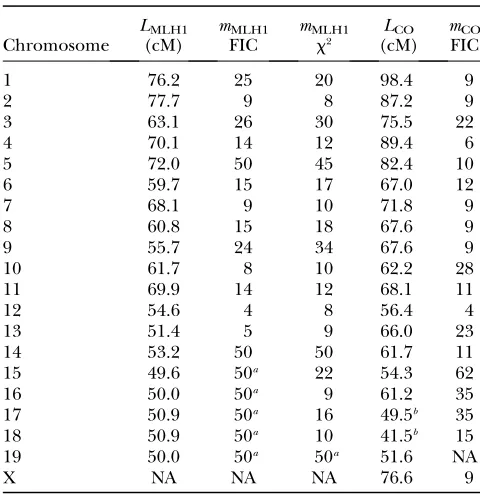
Let us now compare our model with the experimental distributions obtained by Froenickeet al. (2002). Table 1 gives the values of interference parametermin the chi-square model and in our FIC model after adjustment to the experimental data for each chromosome. For short chromosomes 15–19, because of OC there are only a very small number of bivalents with two MLH1 foci in the experimental data, so that sometimes no adjustment was possible form. In such cases, however, the value ofm has almost no effect on the outcome of the models, so thatmwas arbitrarily set to 50.
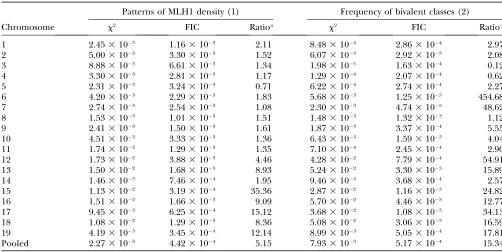
chi-square and the FIC models give a similarly good fit to the data for longer chromosomes (1–11), whereas in shorter chromosomes (12–19) the chi-square model of-ten of-tends to predict too few bivalents with one CO and too many ones with zero or two COs, so that the FIC model provides a more satisfactory fit to the data. To obtain an objective measure of the goodness-of-fit to the data for each model, we calculated sums of squares of differences between observed and expected frequen-cies of bivalents with zero, one, two, and three or more MLH1 foci or simulated COs (Table 2). The lower this value the better the model fits the data. Pooling all chro-mosomes together as explained before, this sum of squares is 5.23104for the FIC model and 7.93103 for the chi-square model, a value 15 times higher than with the FIC model.
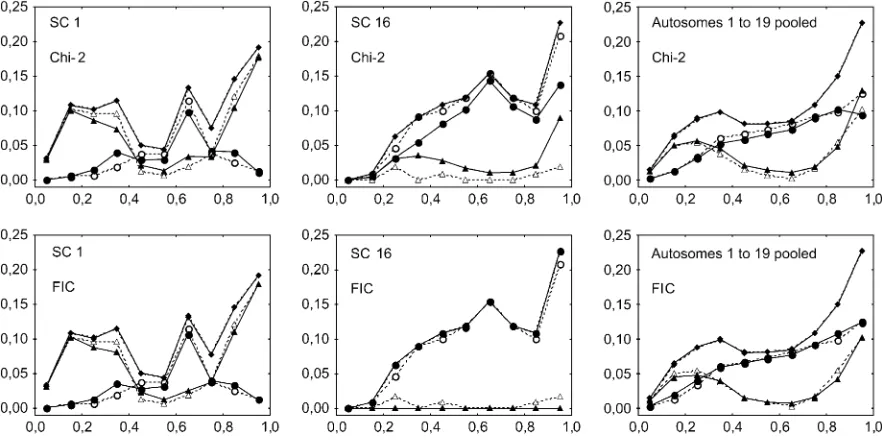
Figure 3 shows the expected and observed patterns of MLH1 foci density along the SC for bivalents having ex-actly 1 or exex-actly 2 MLH1 foci, as well as for all bivalents. These last curves for all bivalents show a perfect fit be-tween models and data by construction. They are strongly asymmetric, with very low MLH1 densities at the cen-tromeric end and very high ones at the telomeric end. Figure 3 shows graphs for two chromosomes and for all
19 autosomes pooled together, and a similar figure with each of the 19 autosomes is given as supplemental Fig-ure 2 at http://www.genetics.org/supplemental/. Note that a difference between Figure 1 and Figure 3 is that IRD positions were converted into SC positions in Fig-ure 3 and into genetic positions in FigFig-ure 1. As observed in Figure 2, simulations reproduce the experimental data equally well for the chi-square and the FIC models in longer chromosomes (1–11), whereas for shorter ones (12–19) the FIC model shows a slightly better fit. The smallest chromosomes are also noisier because they have so few meioses with two MLH1 foci. As previously, we measured goodness-of-fit to the data for the FIC and chi-square models by calculating sums of squares of dif-ferences between observed and expected frequencies of MLH1 foci in the different bins along bivalents (Table 2). Lower values again indicate better fits to the data. Pooling all chromosomes together as explained before, this sum of squares is 4.43104for the FIC model and 2.3 3 103 for the chi-square model, so that the FIC model gives a value five times lower than the chi-square model.
Interestingly, among 2020 bivalents analyzed in the ex-perimental data set, 20 of them had no CO belonging
Figure1.—Frequencies of crossovers (COs) along bivalents having one (circles), two (triangles), or three COs (squares) and for
to the subset marked by MLH1. If such observations are not artifacts, the FIC model alone, by construction, is not able to account for them (seediscussion). We also see that essentially no cases of three or more COs are produced within our FIC model; the reason is that interference in the mouse is strong (mis large).
Modeling the pattern of COs along chromatids: Fig-ure 4 shows the predicted patterns of CO density along chromatids within the FIC and chi-square models. Quali-tatively, the patterns are similar to the case of the bivalents (Figure 1), although the variations are less pronounced here, in particular for the case of the single CO curve. Again, the intensity of the pattern depends on chromo-some length andmand is stronger for smaller
chromo-somes and higher values of m. Differences between
chi-square and FIC models (Figure 4) are qualitatively similar to those observed at the bivalent level (Figure 1), though less pronounced.
In Figure 5 we compare experimental data to simu-lations obtained with the FIC model, in direct analogy
with what was done for Figures 2 and 3 except that the x-axis corresponds to genetic distance in Figure 5, d–f, instead of SC distance in Figure 3. The experimental data are linkage mapping data of Bromanet al. (2002), and we also use his values ofmfor the interference pa-rameter. For chromosome 1 (Figure 5, a and d), the intensity of the patterning is weak and the data are noisy, but this is the chromosome where the patterning effect is weakest because it is long. Most of the chromosomes have a clear patterning effect and resemble that given in Figure 5e: the single CO events arise dominantly near the center, and if a gamete has more than one CO these arise only rarely near the center. This is confirmed in Figure 5f, where counts of COs are pooled over all chro-mosomes. A figure similar to Figure 5, but for all indivi-dual chromosomes is available as supplemental Figure 3 at http://www.genetics.org/supplemental/.
Obligate chiasma produces a ‘‘smile’’ in the CO density: Here we point out that the obligate chiasma constraint along with interference leads to a natural enhancement of CO rates at the extremities of a chro-mosome. To see this, we apply our FIC model of OC with interference and determine the density of COs as a function of IRD position. Then comparing the results to the data of Froenickeet al. (2002) indicates to what ex-tent the density distribution of COs along IRD space may explain this distribution along SC space. Our re-sults show that COs arise more frequently near the ex-tremities of the chromosome and less in the center. We call this a smile effect. The results are presented in Fig-ure 6. Not surprisingly, the strength of the smile de-pends on the length of the chromosome and on the parameterm. As an example, the enhancement of the CO rate at telomeres compared to the center reaches 24% form¼8. Note that SRP models without OC, like the chi-square model, do not lead to any such smile effect. We also modeled the case of a metacentric chromo-some with complete suppression of recombination within the centromere and none outside its range. Results are shown in Figure 6; the recombination rate appears to be higher both near the centromere and near the telo-meres (double smile) for 100-cM chromosomes, whereas this effect is not observed with 60-cM chromosomes.
Finally, we compare our theoretically motivated smile shapes to the actual data of total MLH1 foci densities (see Figure 3), using the SC distances provided in Froenicke et al. (2002) and considering that SC and IRD distances are identical. The results are displayed in Figure 7. The theoretical smile leads to an enhancement at the telo-mere compared to the center of34%, while that of the experimental data is 179%.
DISCUSSION
Multiple distance coordinate spaces and interference:
As explained before, positions along a bivalent or a chro-matid may be expressed in four different metrics: (1) TABLE 1
Estimates of chromosome genetic lengthLand interference
parametermfrom female mouse CO mapping along
genetic maps (data from BROMANet al. 2002) or
from male mouse MLH1 foci mapping along
bivalents (data from FROENICKEet al. 2002)
Chromosome LMLH1 (cM) mMLH1 FIC mMLH1 x2 LCO (cM) mCO FIC
1 76.2 25 20 98.4 9
2 77.7 9 8 87.2 9
3 63.1 26 30 75.5 22
4 70.1 14 12 89.4 6
5 72.0 50 45 82.4 10
6 59.7 15 17 67.0 12
7 68.1 9 10 71.8 9
8 60.8 15 18 67.6 9
9 55.7 24 34 67.6 9
10 61.7 8 10 62.2 28
11 69.9 14 12 68.1 11
12 54.6 4 8 56.4 4
13 51.4 5 9 66.0 23
14 53.2 50 50 61.7 11
15 49.6 50a 22 54.3 62
16 50.0 50a 9 61.2 35
17 50.9 50a 16 49.5b 35
18 50.9 50a 10 41.5b 15
19 50.0 50a 50a 51.6 NA
X NA NA NA 76.6 9
For MLH1 foci data, estimates ofmare obtained with either the FIC model or the standard chi-square model. For CO data,mwas estimated with the FIC model.
a
For short chromosomes, given the very small number of biva-lents with two MLH1 foci, an arbitrary value ofm¼50 was used.
b
For chromosomes 17 and 18, genetic length was estimated from the data of Bromanet al. (2002) to values,50 cM. Since
the physical distance in base pairs along the DNA mol-ecule, (2) the cytological distance measured in microm-eters along a chromosome axis that may be observed under the microscope (e.g., the SC distance), (3) the IRD space that we define here as the relevant metric to study the relation between the strength with which two loci interfere and the distance between these loci, and (4) the genetic distance related to the expected number of COs. The experimental relationship between genetic
and physical (SC) distances is illustrated by the curves of total MLH1 foci density in Figure 3. Concerning IRD distances, no experimental data are available to date, but the predicted relationship between genetic and IRD distances under the hypotheses of the FIC model is illus-trated in Figure 6.
In studies of interference, a major question is to know more precisely to what the IRD space may be related. For instance, the well-known Kosambi mapping function
Figure2.—Experimental and simulated frequencies of bivalents having zero, one, two, or three or more (x-axis) experimental
MLH1 foci (open bars) or simulated COs (solid and dashed bars). Error bars indicate 95% confidence intervals (see text). Ex-perimental data come from cytogenetical observations of MLH1 foci on male mice synaptonemal complexes (SCs) by Froenicke
(Kosambi1944) assumes that considering two segments of equal size on a linkage map, the probability of having a CO in the second segment, conditional on having a CO in the first segment, is proportional to the genetic distance between both segments. This model thus as-sumes that the IRD space is the genetic distance space. This holds for all SRP models, in particular for the chi-square (Fosset al. 1993) and gamma (McPeekand
Speed1995) models. On the other hand, in our FIC
model, as well as the beam-film model (Kleckneret al. 2004), the polymerization model (Kingand Mortimer 1990), and particular count-location models (Goldgar and Fain1988), COs simulated by the models are not uniformly distributed, so the IRD space is different from the genetic distance space. Unfortunately, to our knowl-edge there are to date no biological data that would explain the mode of action of interference so that one would be able to interpret IRD space in clear biological terms.
FIC model:Our FIC model was developed to enforce the biological OC constraint ( Jonesand Franklin2006)
observed in many organisms. Previous work (Broman
and Weber 2000) enforced this OC constraint only
within the so-called ‘‘count-location’’ models (different from the chi-square model; Sturt 1976; Karlin and Liberman1978; Goldgarand Fain1988; Langeet al. 1997); however, there is no biological hypothesis
moti-vating these models. Moreover, except for Goldgar
and Fain (1988), they do not incorporate inhibition effects between nearby COs, so such models do not describe distance-dependent interference.
In the FIC model, we have enforced the OC constraint in a biologically motivated way as follows. We consider that in the initial phase there are many attempts to generate a CO; one commonly estimates the number of double-strand breaks potentially initiating a CO to be 10–40 times larger than the final number of COs that succeed in doing so (Moens et al. 2002; Anderson and Stack2005; Chelyshevaet al. 2005; see review in Mezardet al. 2007). When one of those attempts suc-ceeds, we hypothesize that it then inhibits nearby at-tempts in progress. Such an inhibition could be steric and molecular based, but its mechanism is still
un-known. Note that when m ¼0, the chi-square model
coincides with the Haldane model of no interference, while the FIC coincides with a count location model (Karlinand Liberman1978) where zero CO events are forbidden.
Within the FIC model, we place the first CO along the chromosome with the uniform distribution as measured in IRD space. However, this first CO may be placed by following another distribution. For instance, one may hy-pothesize that this density distribution is that observed for early recombination nodules along the bivalent. TABLE 2
Sum of squares of differences between simulated and experimental frequencies of (1) MLH1 foci in 10 different bins along bivalents having one, two, and three or more foci (patterns of MLH1 density) and (2) bivalents with zero, one, two, and
three or more MLH1 foci (frequency of bivalent classes) for the chi-square and FIC models
Patterns of MLH1 density (1) Frequency of bivalent classes (2)
Chromosome x2 FIC Ratioa x2 FIC Ratioa
1 2.453103 1.163103 2.11 8.483104 2.863104 2.97
2 5.003103 3.303103 1.52 6.073103 2.923103 2.08
3 8.883103 6.613103 1.34 1.983105 1.633104 0.12
4 3.303103 2.813103 1.17 1.293104 2.073104 0.62
5 2.313103 3.243103 0.71 6.223104 2.743104 2.27
6 4.203103 2.293103 1.83 5.683103 1.253105 454.68
7 2.743103 2.543103 1.08 2.303103 4.743105 48.62
8 1.533103 1.013103 1.51 1.483103 1.323103 1.12
9 2.413103 1.503103 1.61 1.873103 3.373104 5.55
10 4.513103 3.333103 1.36 6.433103 1.593103 4.04
11 1.743103 1.293103 1.35 7.103104 2.453104 2.90
12 1.733102 3.883103 4.46 4.283102 7.793104 54.91
13 1.503102 1.683103 8.93 5.243102 3.303103 15.89
14 1.463103 7.463104 1.95 9.463104 3.683104 2.57
15 1.133102 3.193104 35.36 2.873102 1.163103 24.82
16 1.513102 1.663103 9.09 5.703102 4.463103 12.77
17 9.453103 6.253104 15.12 3.683102 1.083103 34.13
18 1.083102 1.293103 8.36 5.083102 3.063103 16.59
19 4.193103 3.453104 12.14 8.993103 5.053104 17.81
Pooled 2.273103 4.423104 5.15 7.933103 5.173104 15.34
aRatios between sums of squares of differences obtained for chi-square and FIC models: ratio values,1 indicate a better fit to
Validation of the FIC model: Our FIC model incor-porates both the obligate chiasma and interference effects of the chi-square model type. This FIC model gives a very good fit to mouse experimental data, both for MLH1 foci distribution along the SC and for CO distribution along the genetic map. The mouse data are especially appropriate in this respect because interfer-ence is strong there, but in certain other organisms achiasmatic bivalents have been reported so the FIC model will be less appropriate for them. In both simu-lated and experimental data, when there are two COs, they tend to be away from the middle of the chromo-some, whereas single COs are clustered toward the mid-dle. Such a patterning was commonly observed a long time ago in experimental data sets ( Jones1984), for
example, from Drosophila (Charles 1938) and from
humans (Laurieand Hulten1985).
The fits on individual chromosomes show some lo-cal discrepancies (see supplemental Figures 2 and 3 at http://www.genetics.org/supplemental/ for details) whereas this is not the case when data are pooled for all chromosomes. In the case of MLH1 foci, such local discrepancies may be interpreted as local variations of interference. Indeed, such local variations of interfer-ence along chromosomes have already been demon-strated in humans (Linet al. 2001) and inA. thaliana
(Drouaud et al. 2007) although they are difficult to observe. In the case of COs, local discrepancies can be explained either by local variations of interference or by local variations of the intensity of the non-MLH1 pathway, also referred to as the noninterfering pathway (Mezardet al. 2007).
The values of the interference parametermMLH1(see
Table 1) that we obtained by fitting the distribution of inter-CO distances may be interpreted as a measure of the intensity of interference between MLH1 foci in mouse male meiosis. However, the values of the param-eternof the gamma function estimated bydeBoeret al. (2006) were, respectively, 11.5 and 11.8 for chromo-somes 1 and 2, which is not really in accordance with our estimates ofm, although the observations were made in both cases with MLH1 foci during mouse male meiosis. In their work,deBoeret al. (2006) estimatednby fitting the histogram of inter-MLH1 distances (based on SC distances) to a gamma function and applied subsequent corrections for the finite length of the chromosome and for the limited resolution of immunofluorescent obser-vations. These histograms were based on the SC distance between MLH1 foci, so the underlying model corre-sponded to a modified gamma model in which the SRP would be applied along the SC coordinate space instead of the genetic space. On the other hand, the SRPs used
Figure3.—Experimental and simulated frequencies of MLH1 foci along individual synaptonemal complexes (SCs) from
cen-tromere (left end) to telomere (right end), for bivalents having one (circles) or two (triangles) MLH1 and for all bivalents (dia-monds). Experimental data (open symbols and dashed lines) come from cytogenetical observations of MLH1 foci on male mice bivalents by Froenickeet al. (2002). Simulations (solid symbols and lines) are computed using the chi-square model or our FIC
in our approach are based on genetic distance just as the standard gamma and chi-square models (McPeek and
Speed1995). Given the high heterogeneity of MLH1
foci density along SC distances (Figure 7), it is not sur-prising that the two methods lead to different estimates ofm.
As discussed above, local variations of interference along chromosomes have been demonstrated in some organisms. In such cases, the use of a constant value for m in both chi-square and FIC models is questionable and should probably be restricted to chromosome seg-ments where interference may be considered homoge-neous. Moreover, the use of a constant value formhas also been seriously challenged in yeast by the fact that the ratio crossovers/noncrossovers increases as the fre-quency of double-strand breaks decreases, which is referred to as ‘‘crossover homeostasis’’ (Martini et al. 2006). To us this suggests that the interference in IRD space extends over distances that are not sensitive to precursor density; IRD distance itself is then the main factor determining the strength of interference. Fur-ther developments toward interference models includ-ing possible variations of m would be highly valuable provided that enough high-resolution data are available to estimate the parameters.
Relevance of OC modeling:Our comparison of FIC and chi-square models for their ability to reproduce the
histograms of relative frequencies of mouse bivalents with zero, one, two, and three or more MLH1 foci shows better adjustments with the FIC model for most of the individual chromosomes as well as for all chromosomes pooled (Figure 2). Considering the patterns of MLH1 foci along mouse bivalents with one and with two foci, the FIC model also globally gives better results than the chi-square model without obligate chiasma. Note, how-ever, that the difference is clearly visible in this second case only for some chromosomes, especially the shortest ones, and nearly visible when all chromosomes are pooled (Figure 3; supplemental Figure 2 at http://www. genetics.org/supplemental/). Furthermore, there is no case where the chi-square model gives a clearly better adjustment than the FIC model even though both mod-els involve just one adjustable parameter. In addition, the FIC model leads to better goodness-of-fit values for (1) the frequencies of bivalents with zero, one, two, or three or more MLH1 foci and (2) MLH1 densities in different bins along chromosomes. It is thus relevant, given today’s high-quality data, to use models incorpo-rating the OC constraint in mouse and maybe in other organisms with OC too.
In our approach (the FIC model), we forced explicitly the presence of an initial chiasma, so the OC rule was absolutely respected. In other approaches such as the beam-film model (Kleckner et al. 2004) or the
Figure4.—Simulated distribution of CO frequency along the genetic map for gametes having one, two, or three COs. Symbols
polymerization model (Kingand Mortimer1990), there are numerous precursor sites from which at least one chi-asma later should appear, nearly always enforcing the OC hypothesis in practice. Mixture models including one in-terfering and one noninin-terfering pathway (Copenhaver et al. 2002; Stahl et al. 2004) may also lead to few ach-iasmatic bivalents.
But we also saw that the Froenickeet al. (2002) data set gave rise to 20 bivalents without MLH1. These bi-valents cannot be accounted for with our FIC model, even though their frequency is,1%. Two possible ex-planations may be considered:
1. MLH1 foci may escape cytological observation, as discussed by Froenickeet al. (2002). These authors explain that the number of MLH1 foci may be un-derestimated if ‘‘some MLH1 protein was lost during the spreading procedure or was not accessible to antibodies’’ or because of synchronism issues. 2. MLH1 foci do not mark all COs, so that given the
probable existence of10% MLH1-independent
non-interfering COs in mouse (de Boer et al. 2006), it may simply be concluded that 20 bivalents had only
MLH1-independent COs. This shows the need for more global models incorporating both the OC fea-tured in the FIC model and mixtures of interfering and noninterfering pathways as used by Copenhaver et al. (2002) in Arabidopsis and by Stahlet al. (2004) and Malkovaet al. (2004) in yeast.
Heterogeneity in the CO rate along chromosomes:
The correspondence between physical and genetic dis-tance is determined by the recombination rate along each chromosome. In all organisms, these rates vary a lot with in particular a frequent strong suppression effect in and near the centromeres and typically en-hancements near the telomeres ( Jones1984; Mezard 2006). Many forces shape these variations: (1) the dis-tribution of chiasma precursors, which may be ap-proached by counting early recombination nodules; (2) chromatin compaction, leading in particular to the centromere effect (Choo 1998); and (3) factors that may determine the way precursors commit or not to turn into COs, including the forces behind interference and obligate chiasma effects. In the case of mouse chro-mosomes, where the centromere is at one end and the
Figure5.—Experimental and simulated distributions of COs. Experimental data come from mouse female meiosis analyzed via
mapping experiments Bromanet al. (2002). Simulations are computed using our FIC model. Values of genetic chromosome
length (in morgans) and interference parametermused for simulations are calculated from Bromanet al. (2002) respectively
as the average number of COs per gamete in experimental data and the estimated parametern of the gamma model 1 (see values in Table 1). For chromosomes 17 and 18, where Broman found genetic lengths,50 cM, we use a length of 50 cM for simulations (see text). (a and d) Chromosome 1 (long); (b and e) chromosome 16 (short); (c and f) frequencies from pooled numbers of gametes or COs over all 20 chromosomes. Graphs of other individual chromosomes are given in supplemental Figure 3 at http://www.genetics.org/supplemental/. (a–c) Frequency of gametes with zero, one, two, and three or more COs (x-axis) in experimental and simulated data. Open bars indicate experimental data, and solid bars indicate simulated data. Error bars in-dicate 95% confidence intervals (see text). (d–f) Frequency distribution of COs along the genetic map, from centromere (left end) to telomere (right end) for gametes with exactly one (circles) or two (triangles) COs.x-axis: relative position of the middle of the bin along the genetic map. All bin sizes are 0.1. Open symbols and dashed lines indicate mouse experimental data. Solid symbols and lines indicate simulated data. Simulated CO frequencies are calculated from 53 105 simulated meioses using
telomere at the other end, this second force may explain the strong asymmetry observed in the experimental curves of Figures 3 and 7. Qualitatively, the theoretical smile shown by our FIC model can be understood as related to the third force and may be explained as follows. In our model of obligate chiasma, the first CO is distributed uniformly, and the next ones are produced by a stationary renewal process. When the interference is positive and acts out to a distance comparable to the length of the chromosome, putting down a second CO will be possible only when the first one is toward one end of the chromosome; this leads to an enhancement of the CO density toward the ends. The simulations
proceed in an ‘‘interference’’ coordinate system that is not known ahead of time; there the density of COs shows a smile effect, with an enhancement toward the ends of the chromosome. Similar end effects arise in other models of interference such as the beam-film (Kleckneret al. 2004) and polymerization (Kingand Mortimer1990) models. It is not unreasonable to con-sider that this interference-relevant coordinate system is tied to physical space (in micrometers) and the SC coordinate system is a natural candidate. Using the FIC model with OC then reveals a hitherto underappreci-ated fact that a combination of effects due to OC, inter-ference, and genetic length of the chromosome may give rise to the enhancement of recombination at the ends.
We saw that this predicted smile effect appeared in the MLH1 data of Froenickeet al. (2002), though with a much larger enhancement effect at the telomere than predicted by our FIC model. However, male and female meioses behave differently in mice (deBoeret al. 2006). de Boeret al.’s Figure 1.E compares the densities of male and female mice along the SC and shows a much steeper rise near the telomere in males compared to females. Our model thus seems more applicable to the case of female meiosis.
In male mice, other forces must be driving the telo-mere enhancement of recombination. They can be due
Figure6.—Simulated frequencies of COs along gametes.
Positions are expressed in the interference-relevant distance (IRD) space (see text). The initial CO is uniformly distributed except for the curves with centromere effect. Genetic size of chromosome: 100 and 60 cM. Interference is modeled using our FIC model with interference parameterm. Triangles,m¼ 0; circles,m¼4; squares,m¼12, without centromere effect (solid symbols and lines) or with all recombination sup-pressed between positions 0.4 and 0.6 (centromere effect, open symbols and dashed lines). x-axis: relative position of the middle of the bin along the IRD space. All bin sizes are 0.05. CO frequencies are calculated from 53107simulated
meioses.
Figure7.—Experimental frequencies of mouse MLH1 foci
along synaptonemal complexes (dashed line and open sym-bols) compared to simulated frequencies of crossovers (COs, solid line and symbols) under the hypothesis that IRD dis-tance is the same as SC disdis-tance. MLH1 foci and simulated COs are first counted for each chromosome independently and then pooled. Experimental data come from cytologenet-ical observations of mouse chromosomes by Froenickeet al.
to heterogeneity in the distribution of recombination precursors, leading to an enhancement of CO near telomeres. This is not specific to the mouse: in maize, the distribution of early recombination nodules mark-ing precursors increases from centromere to telomeres (Stack and Anderson 2002) but this increase is less pronounced than the one of late recombination nod-ules (chiasmata). So both effects, distribution of pre-cursors and the smile, may shape the final distribution of COs. On the centromere side, it is more difficult to conclude anything: the experimental data do show a local maximum in the density of MLH1 foci, but this density is strongly lowered when one approaches too much the centromere. Clearly it would be necessary to go beyond our all-or-none modeling of centromeric suppression. Nevertheless, the local maximum observed in experimental data suggests that our smile effect might be somewhat at work in mouse meiosis.
We thank warmly Lorrie Anderson and Karl Broman who provided us with their remarkable data sets. We also thank Jan Drouaud, Adrienne Ressayre, Christine Dillmann, and Domenica Manicacci for fruitful discussions on interference and helpful comments on the manuscript and four anonymous reviewers for their valuable criticisms.
LITERATURE CITED
Anderson, L. K., and S. M. Stack, 2005 Recombination nodules in
plants. Cytogenet. Genome Res.109:198–204.
Argueso, J. L., J. Wanat, Z. Gemiciand E. Alani, 2004 Competing
crossover pathways act during meiosis inSaccharomyces cerevisiae. Genetics168:1805–1816.
Bishop, D. K., and D. Zickler, 2004 Early decision; meiotic
cross-over interference prior to stable strand exchange and synapsis. Cell117:9–15.
Broman, K. W., and J. L. Weber, 2000 Characterization of human
crossover interference. Am. J. Hum. Genet.66:1911–1926. Broman, K. W., L. B. Rowe, G. A. Churchill and K. Paigen,
2002 Crossover interference in the mouse. Genetics 160:
1123–1131.
Charles, D. R., 1938 The spatial distribution of cross-overs in
X-chromosome tetrads of Drosophila melanogaster. J. Genet.36:
103–126.
Chelysheva, L., S. Diallo, D. Vezon, G. Gendrot, N. Vrielynck et al., 2005 AtREC8 and AtSCC3 are essential to the monopolar orientation of the kinetochores during meiosis. J. Cell Sci.118:
4621–4632.
Choo, K. H., 1998 Why is the centromere so cold? Genome Res.8:
81–82.
Copenhaver, G. P., W. E. Browneand D. Preuss, 1998 Assaying
genome-wide recombination and centromere functions with Ara-bidopsis tetrads. Proc. Natl. Acad. Sci. USA95:247–252. Copenhaver, G. P., E. A. Housworthand F. W. Stahl, 2002
Cross-over interference in Arabidopsis. Genetics160:1631–1639.
deBoer, E., P. Stam, A. J. Dietrich, A. Pastinkand C. Heyting,
2006 Two levels of interference in mouse meiotic recombina-tion. Proc. Natl. Acad. Sci. USA103:9607–9612.
Drouaud, J., R. Mercier, L. Chelysheva, A. Be´ rard, M. Falque et al., 2007 Sex-specific crossover distributions and variations in interference level along Arabidopsis thaliana chromosome 4. PLoS Genet. (in press).
Esch, E., 2005 Estimation of gametic frequencies from F-2
popula-tions using the EM algorithm and its application in the analysis of crossover interference in rice. Theor. Appl. Genet.111:100–109. Foss, E., R. Lande, F. W. Stahland C. M. Steinberg, 1993 Chiasma
interference as a function of genetic distance. Genetics 133:
681–691.
Froenicke, L., L. K. Anderson, J. Wienberg and T. Ashley,
2002 Male mouse recombination maps for each autosome iden-tified by chromosome painting. Am. J. Hum. Genet.71:1353– 1368.
Goldgar, D. E., and P. R. Fain, 1988 Models of multilocus
recom-bination: nonrandomness in chiasma number and crossover po-sitions. Am. J. Hum. Genet.43:38–45.
Haldane, J. B. S., 1919 The combination of linkage values and the
calculation of distance between loci of linked factors. J. Genet.8:
299–309.
Higgins, J. D., S. J. Armstrong, F. C. Franklinand G. H. Jones,
2004 The Arabidopsis MutS homolog AtMSH4 functions at an early step in recombination: evidence for two classes of recom-bination in Arabidopsis. Genes Dev.18:2557–2570.
Hollingsworth, N. M., and S. J. Brill, 2004 The Mus81 solution
to resolution: generating meiotic crossovers without Holliday junctions. Genes Dev.18:117–125.
Housworth, E. A., and F. W. Stahl, 2003 Crossover interference in
humans. Am. J. Hum. Genet.73:188–197.
Jones, G. H., 1984 The control of chiasma distribution. Symp. Soc.
Exp. Biol.38:293–320.
Jones, G. H., and F. C. Franklin, 2006 Meiotic crossing-over:
obli-gation and interference. Cell126:246–248.
Karlin, S., and U. Liberman, 1978 Classifications and comparisons
of multilocus recombination distributions. Proc. Natl. Acad. Sci. USA75:6332–6336.
King, J. S., and R. K. Mortimer, 1990 A polymerization model of
chiasma interference and corresponding computer simulation. Genetics126:1127–1138.
Kleckner, N., D. Zickler, G. H. Jones, J. Dekker, R. Padmoreet al.,
2004 A mechanical basis for chromosome function. Proc. Natl. Acad. Sci. USA101:12592–12597.
Kosambi, D., 1944 The estimation of map distances from
recombi-nation values. Ann. Eugen.12:172–175.
Lam, S. Y., S. R. Horn, S. J. Radford, E. A. Housworth, F. W. Stahl et al., 2005 Crossover interference on nucleolus organizing region-bearing chromosomes in Arabidopsis. Genetics170:807–812. Lange, K., H. Zhaoand T. P. Speed, 1997 The Poisson-skip model of
crossing-over. Ann. Appl. Probab.7:299–313.
Laurie, D. A., and M. Hulten, 1985 Further studies on chiasma
dis-tribution and interference in the human male. Ann. Hum. Genet.49:203–214.
Lawrie, N. M., C. Teaseand M. A. Hulte´ n, 1995 Chiasma
fre-quency, distribution and interference maps of mouse autosomes. Chromosoma104:308–314.
Lenormand, T., and J. Dutheil, 2005 Recombination difference
between sexes: a role for haploid selection. PLoS Biol. 3:
396–403.
Lin, S., R. Chengand F. A. Wright, 2001 Genetic crossover
inter-ference in the human genome. Ann. Hum. Genet.65:79–93. Malkova, A., J. Swanson, M. German, J. H. McCusker, E. A. Housworth
et al., 2004 Gene conversion and crossing over along the 405-kb left arm ofSaccharomyces cerevisiaechromosome VII. Genetics168:
49–63.
Martini, E., R. L. Diaz, N. Hunterand S. Keeney, 2006 Crossover
homeostasis in yeast meiosis. Cell126:285–295.
McPeek, M. S., and T. P. Speed, 1995 Modeling interference in
ge-netic recombination. Gege-netics139:1031–1044.
Mercier, R., S. Jolivet, D. Vezon, E. Huppe, L. Chelyshevaet al.,
2005 Two meiotic crossover classes cohabit in Arabidopsis: one is dependent on MER3, whereas the other one is not. Curr. Biol.15:692–701.
Mezard, C., 2006 Meiotic recombination hotspots in plants.
Bio-chem. Soc. Trans.34:531–534.
Mezard, C., J. Vignard, J. Drouaudand R. Mercier, 2007 The
road to crossovers: plants have their say. Trends Genet.23:
91–99.
Moens, P. B., N. K. Kolas, M. Tarsounas, E. Marcon, P. E. Cohen et al., 2002 The time course and chromosomal localization of recombination-related proteins at meiosis in the mouse are compatible with models that can resolve the early DNA-DNA in-teractions without reciprocal recombination. J. Cell Sci. 115:
1611–1622.
available as a community genetic mapping resource. Mamm. Ge-nome5:253–274.
Roze, D., and T. Lenormand, 2005 Self-fertilization and the
evolu-tion of recombinaevolu-tion. Genetics170:841–857.
Stack, S. M., and L. K. Anderson, 2002 Crossing over as assessed by
late recombination nodules is related to the pattern of synapsis and the distribution of early recombination nodules in maize. Chromosome Res.10:329–345.
Stahl, F. W., H. M. Foss, L. S. Young, R. H. Borts, M. F. F. Abdullah et al., 2004 Does crossover interference count inSaccharomyces cerevisiae? Genetics168:35–48.
Sturt, E., 1976 A mapping function for human chromosomes.
Ann. Hum. Genet.40:147–163.
Zhao, H., and T. P. Speed, 1996 On genetic map functions. Genetics142:
1369–1377.
Zhao, H., M. S. McPeekand T. P Speed, 1995 Statistical analysis of
chromatid interference. Genetics139:1057–1065.
Zickler, D., and N. Kleckner, 1999 Meiotic chromosomes:
in-tegrating structure and function. Annu. Rev. Genet. 33:
603–754.