ISSN (Print) : 2320 – 3765 ISSN (Online): 2278 – 8875
I
nternational
J
ournal of
A
dvanced
R
esearch in
E
lectrical,
E
lectronics and
I
nstrumentation
E
ngineering
(An ISO 3297: 2007 Certified Organization) Website: www.ijareeie.com
Vol. 6, Issue 3, March 2017
Robust Image Watermarking Using
Contourlet Transform
Deeksha Chauhan
1, Isha Chauhan
2, Poonam Yadav
3, Shalu Kumari
4,Dr. Dushyant Singh
5B.Tech Student, PG Dept. of Electronics and Communication, RBSETC, Bichpuri, Agra, UP, India1, 2, 3, 4
H.O.D, PG Dept. of Electronics and Communication, RBSETC, Bichpuri, Agra, UP, India5
ABSTRACT: In this paper, we propose a more efficient method for digital watermarking of still images using contourlet transform (CT). The paper is aimed to demonstrate that more data can be hidden in the multiple subbands more securely and the extraction is not possible without knowledge of the subbands containing the data as well as the key used for encryption. Hence,we also demonstrate the importance of key or scaling factor and display results for various values of the key.
KEYWORDS: Contourlet Transform, Contourlet Subbands, Encryption, Decryption, Robustness
I. INTRODUCTION
The expansion of the Internet has frequently increased the availability of digital data such as audio, images and videos to the public. These data are actually very easy to hack: information becomes vulnerable to interception, copying, tampering or corruption. In this situation, there is a strong need for techniques to protect the copyright of the original data to prevent its unauthorized duplication. To meet this need, digital watermarking is a method of signal processing which inserted into a digital document an invisible watermark, containing a code robust against any attack that can affect the watermarked data.
Current methods of watermarking images, depending on whether the original image is used during watermark extraction process or not, could be divided into two categories: blind and non-blind methods. Schemes reported in [2,
3] are non-blind methods, while the methods in [4–9] are categorized as blind methods. Most of the reported schemes use an additive watermark to the image in the spatial domain or in frequency domain. Recent works on digital watermarking for still images are applied on frequency domain.
Among the transform domain techniques, discrete wavelet transform (DWT) based techniques are more popular, since DWT has a number of advantages over other transforms including frequency localization, multiresolution representation, superior HVS modelling, linear complexity, and adaptivity [10]. Even though DWT is popular, powerful, and familiar among watermarking techniques, it has its own limitations in capturing the directional information such as smooth contours and the directional edges of the image. This problem is addressed by contourlet transform (CT) [11]. The contourlet transform was developed as an improvement over wavelet where the directional information is important. In addition to multiscale and timefrequency localization proprieties of wavelets, CT offers directionality and anisotropy.
II. DISCRETE CONTOURLET TRANSFORM
Figure 1: Contourlet filter bank
At each level, the LP decomposition generates a downsampled lowpass version of the original, and the difference between the original and the prediction results in a bandpass image. The bandpass image obtained in the LP decomposition is further processed by a DFB. A DFB is designed to capture the high frequency content like smooth contours and directional edges. Here we demonstrate the contourlet transform of the Landscape image of resolution 512*512 as show in figure 2.
ISSN (Print) : 2320 – 3765 ISSN (Online): 2278 – 8875
I
nternational
J
ournal of
A
dvanced
R
esearch in
E
lectrical,
E
lectronics and
I
nstrumentation
E
ngineering
(An ISO 3297: 2007 Certified Organization) Website: www.ijareeie.com
Vol. 6, Issue 3, March 2017
III. PROPOSED METHOD
We select contourlet transform for watermark embedding because it captures the directional edges and smooth contours better than other transforms. In our approach, the watermark is a grayscale image whose subbands are which is embedded into the subbands of the host image in its contourlet domain.The robustness and imperceptibility of watermarked image is increased by selecting the particular valure for the multiplicative factor, alpha.
A. Watermarking technique
The watermark, which is of 25% size of host image, is embedded into grey image of size N*N. The host image and the watermark are transformed into the contourlet domain. The steps involved in watermark embedding are –
Step 1: Take L-level transform of host image, f (i, j), of size N*N which has been multiplied element wise with an encryption key.
Step 2: Match the size of different subbands to find appropriate size for bookmark to fit in, else adjust size by adding zeroes to remaining positions.
Step 3: Modify the subband as-
f’k (i, j) =fk (i, j) +α*wk (i, j)
Here k is the selected subband and α is a weighting factor which controls robustness and perceptual quality.
Step 4: Takeinverse contourlet transform (ICT) is applied by considering the modified directional subbands to obtain the watermarked image
B. Watermark extraction technique
For retrieving the watermark, we need a copy of the original image as a reference. The extraction process consists of the following steps.
Step 1: Both watermarked and original images are transformed into CT domain.
Step2: The directional subband and the lowpass image of the embedded watermark will be retrieved by subtracting the highest frequency subbands of the original and the watermarked image by using
w’k (i, j) = [f’k (i, j) - fk (i, j)] / α
Here w’ (i, j) is the required watermark.
By increasing the levels of decomposition, the watermarking capacity is also increased, and the quality of extracted watermark is improved. In order to achieve this goal, after selecting a subband, we can use other directional subbands which have the highest level of entropy.
IV. EXPERIMENTAL RESULTS
Figure 4-Bookmark image Figure 5- Host Image
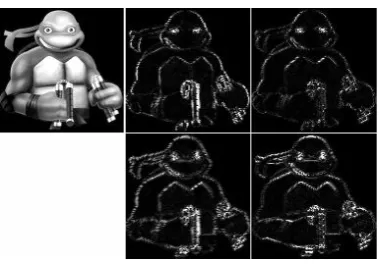
Above given are the host image (in which water mark is to be inserted) and the watermark. We take contourlet transform of the host image as well as the bookmark but with different levels of decomposition. The number of levels used for contourlet transform are [2 2 2 2 2] for host image and [2] for bookmark
Figure 6- Contourlet transform for the bookmark image
ISSN (Print) : 2320 – 3765 ISSN (Online): 2278 – 8875
I
nternational
J
ournal of
A
dvanced
R
esearch in
E
lectrical,
E
lectronics and
I
nstrumentation
E
ngineering
(An ISO 3297: 2007 Certified Organization) Website: www.ijareeie.com
Vol. 6, Issue 3, March 2017
Figure 7- Bookmarked image
This is the bookmarked image using the scaling factor of 0.01. This scaling factor gives appropriate result yet some distortion can be observed. These distortions are from the low pass subband which has been put in the highest entropy subband. This distortion can be further reduced by decreasing the value of scaling factor much more. The image can be processed to retrieve the watermark.
Figure 8- Retrieved Watermark
Figure 9- Retrieved watermark when one number in key erred. Input key=5262537
Figure 10- Retrieved watermark when two numbers in key erred. Input key=5242537
The key has been taken such that the first three letters contain the subband information while the other 4 are used for element wise multiplication as mentioned above. Any error in the key distorts the data. Hence extraction is not possible without knowledge of number of subbands, the subbands containing the different subbands of host image as well as the numbers used for element wise multiplication. Hence, paper demonstrates the effectiveness of the contourlet transform for hiding data.
ISSN (Print) : 2320 – 3765 ISSN (Online): 2278 – 8875
I
nternational
J
ournal of
A
dvanced
R
esearch in
E
lectrical,
E
lectronics and
I
nstrumentation
E
ngineering
(An ISO 3297: 2007 Certified Organization) Website: www.ijareeie.com
Vol. 6, Issue 3, March 2017
REFERENCES
[1] Sirvan Khalighi1, Parisa Tirdad1, HamidR Rabiee2; A ContourletBasedImage Watermarking Scheme with High Resistance to Removal and Geometrical Attacks; EURASIP Journal on Advances in Signal Processing20102010:540723
[2] Zaboli S, Moin MS: CEW: A non-blindadaptive image watermarking approach based on entropy in contourlet domain. 2007 IEEE International Symposium on Industrial Electronics, ISIE 2007, June 2007, esp 16871692.
[3] Jayalakshmi M, Merchant SN, Desai UB: Digital watermarking in contourlet domain. 18th International Conference on Pattern Recognition, ICPR 2006, August2006, chn 861864.
[4] 4. Duan G, Ho ATS, and Zhao X: A Novel nonredundant contourlet transform for robust image watermarking against nongeometrical and geometrical attacks. Proceedings of the 5th International Conference on Visual Information Engineering (VIE '08), August 2008 124129. [5] Xiao S, Ling H, Zou F, Lu Z: Adaptive image watermarking algorithm in contourlet domain. 2007 JapanChina Joint Workshop in Frontier
of Computer Science and Technology, FCST 2007, November 2007, chn 125130.
[6] Salahi E, Moin MS, Salahi A: A new visually imperceptible and robust image watermarking scheme in Contourlet domain. 2008 4th International Conference on Intelligent Information Hiding and Multimedia Signal Processing, IIHMSP 2008, August 2008, chn 457460. [7] Shu Z, Wang S, Deng C, and Liu G, Zhang L: Watermarking algorithm based on contourlet transform and human visual model. 2008
International Conference on Embedded Software and Systems, ICESS08, July 2008, chn 348352.
[8] Lian X, Ding X, Guo D: Digital watermarking based on nonsampled contourlet transform. 2007 IEEE International Workshop on Ant counterfeiting, Security, Identification, ASID, April 2007, chn 138141.
[9] Wei F, Ming T, HongBing J: An adaptive watermark scheme based on contourlet transform. International Symposium on computer Science and Computational Technology, ISCSCT 2008, December 2008, chn 677681.
[10] Meerwald P, Uhl A: A survey of wavelet domain watermarking algorithms. Electronic Imaging, Security and Watermarking of Multimedia Contents, January 2001, Proceedings of SPIE 4314: