1171 | P a g e
Simulation and Experimental measurement of Shaft
Voltage, Bearing current in Induction Motor drive using
Micro-controller
Chandrashekar S M
1, , A Ramachandran
2, , M Channa Reddy
3ABSTRACT
Generally the Induction Motor (IM) is considered to be a constant speed motor. But due to the advancement in
electronics, the IM speed can be controlled as per requirement within limits. While doing the speed control of
IM, the ratio of Voltage to frequency to be constant at all speeds. For efficient operation, the 2-level inverter
with Pulse Width Modulation (PWM) can be used. However, in this method the inverter output will not be
sinusoidal. It will be a stepped square wave, due to that the voltage at the star point of the IM stator winding
will not be zero. Hence there exists a voltage with respect to the common ground. This is known as Common
Mode Voltage (CMV). The CMV will induce a voltage in the rotor shaft; there by a current will flow to the
common ground via the bearing. Due to the flow of current through the bearing the electrical discharge
machining (EDM) will takes place at the inner race of the bearing. Hence the life of the bearing will get
reduced. To minimize the effect of shaft voltage and bearing current a 3-level inverter can be used. The 3-level
inverter output will produce less shaft voltage and bearing current when compared to 2-level inverter. In this
paper the authors have done both the 2-level and 3-level inverter for running the IM. The Arduino
Micro-controller is used for generating the Space Vector Modulation (SVM) signals and the necessary isolation has
been done using opto-isolators. Simulation has been done using MATLAB/Simulink and the results are verified
with the experimental results. The Fast Fourier Transform (FFT) has been done for the experimentally recorded
shaft voltage and the bearing current for the 2-level and 3-level inverter outputs by using signal analysis
software. The experimental and simulated results are compared.
Keywords: Common mode voltage, Induction Motor, space vector modulation, Shaft voltage, Bearing current.
I. INTRODUCTION
It is impossible to get zero Voltage at the star point of the stator winding of the IM [3, 15], if the 3Φ inverter is fed from a single DC source. Hence there will be a common mode voltage (CMV) at the star point. Due to the CMV there will be a voltage induced in the shaft of the IM. The 3Φ inverter is widely used in variable speed IM drive System.
The 2- level inverter has 2-levels of voltage [±2/3Vdc, ±1/3Vdc], hence the output waveform of two level inverter is stepped square wave. To minimize the CMV the 3-level inverter can be used.
1172 | P a g e
using inverter, than operating the motor with sinusoidal mains at supply frequency of 50/60Hz [8]. From the references [4, 5, 6, 7 & 8] the inverter fed IM bearings have more probability of failing than mains operated 50/60Hz supply. Also in the year 1924, P. Alger and H. Samson [13] have discussed about the shaft current in electric machines. Due to the existence of CMV, the currents flowing from the shaft to the common ground through the bearing in variable speed drive systems using Converter-Inverter and also by fast switching of the inverter devices has been reported for almost a decade ago [9, 10 & 11]. Annette Muetze et al. [5] also reported about shaft to ground currents due to the existence of CMV and the capacitance between stator and rotor windings with high dv/dt at the input of the IM [4, 5 & 12]. In addition, B. Muralidhara etal. [1, 2] has reported about the CMV and shaft voltage results in the flow of current to the common ground. D. Busse etal. [8], in the year 1997 discussed about the characteristics of shaft voltage and bearing currents. As summarized by Chen etal. [9 & 13] there are three general types of motor bearing currents (stator to rotor bearing current, stator winding to ground current, rotor to shaft current) that can be associated with PWM voltage source inverter (VSI) drive [5, 7 & 12]. Therefore for the safe operation of the motor connected with inverter system, it is essential to reduce the shaft voltage and there by the current flows from shaft to the ground [14, 15]. To reduce the shaft voltage it is necessary to measure and reduce the CMV.II CMV, SHAFT VOLTAGE, BEARING CURRENT AND SUM OF PHASE CURRENT IN INVERTER DRIVEN AC IM
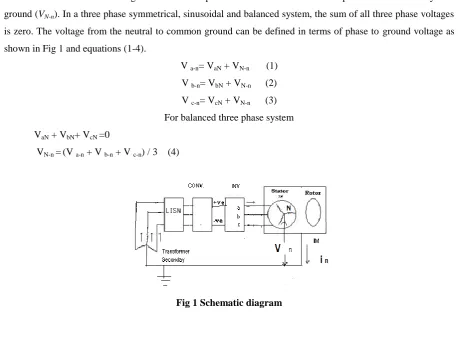
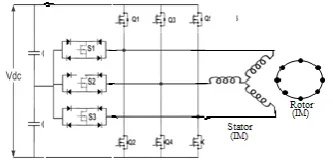
It is important to define the CMV in mathematical terms in order to compare its characteristics among different types of source and load combinations. In 3Φ AC loads, the phase to ground voltages (Va-n, Vb-n and Vc-n) can be written as the sum of the voltages to the neutral point of the load and the neutral point of the load to system ground (VN-n). In a three phase symmetrical, sinusoidal and balanced system, the sum of all three phase voltages is zero. The voltage from the neutral to common ground can be defined in terms of phase to ground voltage as shown in Fig 1 and equations (1-4).
V a-n= VaN + VN-n (1) V b-n= VbN + VN-n (2) V c-n= VcN + VN-n (3) For balanced three phase system VaN + VbN+ VcN =0
VN-n =(V a-n + V b-n + V c-n) / 3 (4)
1173 | P a g e
III THE PROPOSED WORK
Simulation, experiment of 2-level, 3-level inverter using SVM for the speed control of induction motor, has been done. The CMV, Phase voltage, sum of phase currents, shaft induced voltage, and the current flowing from the shaft to the common ground (bearing current) using MSO, associated with isolation module are measured. The Hall-effect sensor is used for the measurement of line current and the high frequency current probe is used for the measurement of bearing current. The inverter is built using the MOSFET devices, DC link capacitors and other electronic components.
SVM methodologies have the advantages of more output voltage when compared to sine triangle pulse width modulation (SPWM) method [16]. The advantage of using the SVM is that the gating signal for the power devices can be easily programmed using μ-controllers / digital signal processor (DSP) which offers improved dc bus utilization [17] and reduced switching losses.
SPACE VECTOR MODULATION
The experimental work uses a SVM method, which produces the output voltage by using the 3 nearby output vectors. When one of the reference vector moves from one sector to another, results in an output vector abrupt change. In addition it is necessary to find the switching patterns and switching time of the states at each change of the reference voltage. The main advantages are to overcome the variation in DC bus voltage, the ratio V/f of IM is maintained constant by compensating for regulation in inverters. SVM treats sinusoidal voltage as a rotating constant amplitude vector rotating with constant frequency. This PWM technique represents the reference voltage Vref by a combination of the eight switching patterns in a Hexagon. The a-b-c reference frame can be transformed into the stationary α-β reference frame that consists of the horizontal (α) and vertical (β) axes (Coordinate Transformation). The 3Φ voltage vector is transformed into a vector in the stationary α-β coordinate frame which represents the spatial vector sum of the 3Φ voltages. The voltage vectors (V1-V6) divide the hexagon plane into six sectors( i.e., sector-1to sector-6) which is generated by two adjacent non-zero vectors. Fig 2 shows the switching vectors of 2-level inverter in hexagon. The 3Φ voltages are shown in equations (5-7).
Va = Vm Sinωt (5)
Vb = Vm Sin(ωt-1200) (6) Vc = Vm Sin(ωt-2400) (7)
1174 | P a g e
Fig 3 Sampled reference vector in sector-1
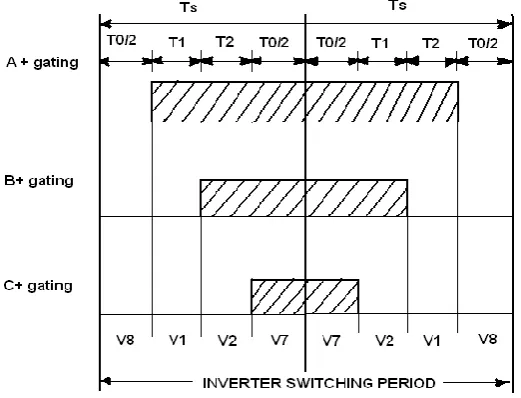
SVM is a better technique for generating a fundamental output (~sine wave) that provides a higher output voltage to the 3Φ IM when compared to sinusoidal PWM. The switching vectors and sectors is shown in the Fig (2-4). Table I shows the switching sequence of vectors for 2-level 3Φ inverter.
Fig 4 SVM pattern in Sector-1
TABLE I
Switching vectors for 2-level Inverter using SVM
Vector A
+ B
+ C
+ A
- B
- C
-
VAB VBC VCA
V0[000] 0 0 0 1 1 1 0 0 0
V1[100] 1 0 0 0 1 1 +VDC 0 -VDC
V2[110] 1 1 0 0 0 1 0 +VD
C
-VDC
V3[010] 0 1 0 1 0 1 -VDC +VD
C
0
V4[011] 0 1 1 1 0 0 -VDC 0 +VDC
V5[001] 0 0 1 1 1 0 0 -VDC +VDC
V6[101] 1 0 1 0 1 0 +VDC -VDC 0
V7[111] 1 1 1 0 0 0 0 0 0
Note: 1 means ON, 0 means OFF [top switch of 3Φ inverter]
1175 | P a g e
Fig 5 Hexagon of 3-level inverter
TABLE II
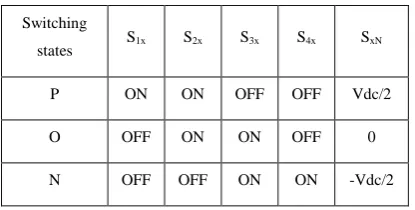
Switching vectors for 3-level 3Φ Inverter
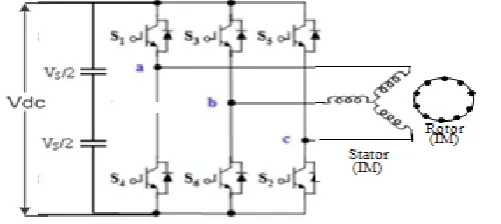
Simulation: The simulation circuit for 2-level, 3-level inverter is shown in Fig (6, 8) and the results of simulated output is shown in Fig (7, 9) for 2-level and 3-level inverter.
Fig 6, Simulation Circuit 2-level inverter (Matlab/simulink)
Fig 7 Simulation Results of 2-level Inverter [top to bottom] (Simulation, 30Hz) CH1phase voltage, CH2 line current,
CH3 CMV, CH4 Sum of phase current, CH5 Bearing current,
CH6 (Sum of ph Ct. – Bearing Ct.) = [(CH4)-(CH5)]
Switching
states S1x S2x S3x S4x SxN
P ON ON OFF OFF Vdc/2
O OFF ON ON OFF 0
1176 | P a g e
Fig 8 Simulation circuit of 3-level Inverter (Matlab/simulink).
Fig 9 Simulation output of 3-level Inverter (top to bottom) CH1 Phase Voltage, CH2 Line Voltage, CH3 Bearing Current,
CH4 Common mode Voltage, CH5 Line Current
IV . EXPERIMENTAL SETUP
The Fig 1 shows the schematic diagram. Fig (10, 11) show the experimental circuit diagram of 2-level and 3-level inverter. Fig 12 shows the photograph of the experimental setup. In the 2-3-level and 3-3-level inverter, the MOSFETs are used as devices with necessary snubber circuit. The microcontroller output after isolation is given to the gate of the devices [3, 15 & 16]. The microcontroller is programmed for different frequencies of operation of the IM for 2-level, 3-level and the typical output of the microcontroller is given in the Fig (13). While running the IM with the above said setup the shaft voltage, CMV, phase voltage, the current flowing from shaft to common ground and the sum of phase current are recorded using the high frequency current probe and Agilent MSO for further analysis are shown in the Fig (14) & (15).
1177 | P a g e
Fig.11.3-level Inverter Circuit diagram.
The necessary FFT has been done in simulation using MATLAB/Simulink and the experimental results using signal analysis software. At the end, the results are discussed showing the sum of phase current and the bearing current are same in magnitude and phase. Also the CMV, the shaft voltage is the same in magnitude and phase, for different frequencies of operation of the IM viz 30Hz, 40Hz and 50Hz.
Fig.12, Photograph of Experimental setup
Fig. 13, Gate pulses generated by µ controller (3-level Inverter)
1178 | P a g e
Fig.15, 3-level Inverter output,CH1-Phase Voltage, CH2 CMV, CH3 Shaft Voltage,
CH4 Bearing current.
FFT Analysis of Simulation and Experimentation
Fig.16, FFT of CMV 2-level, 40Hz
0 500 1000 1500 2000 2500 3000 3500 4000
0 10 20 30
Frequency (Hz)
Am
p
lit
u
d
e
i
n
Vol
ts
Fig.17, FFT of CMV Exptl. 2level, 40Hz
0 500 1000 1500 2000 2500 3000 3500 4000
0.0 0.2 0.4 0.6 0.8 1.0 1.2 1.4 1.6 1.8 2.0
Frequency (Hz)
Am
p
lit
u
d
e
i
n
Vo
lt
1179 | P a g e
Fig.18, FFT of shaft voltage, Exptl. 2level, 40HzFig.19, FFT of Bearing current, 2level, 40Hz
0 400 800 1200 1600 2000 2400 2800 3200 3600 4000
0.000 0.002 0.004 0.006 0.008 0.010 0.012 0.014 Frequency (Hz) Am p lit u d e (Am p e re s)
Fig.20, FFT of bearing current, Exptl. 2level, 40Hz
0.6 0.65 0.7 0.75 0.8 0.85 0.9 0.95 1 -0.5
0 0.5
Selected signal: 40 cycles. FFT window (in red): 1 cycles
Time (s)
0 200 400 600 800 1000
0 20 40 60 80 100 Frequency (Hz)
Fundamental (40Hz) = 0.003548 , THD= 80.31%
Ma g ( % of Fu nda me nta l)
Fig.21, FFT of CMV, 3level, 40Hz
0 500 1000 1500 2000 2500 3000 3500 4000 4500 5000 0 4 8 12 16 20 Frequency (Hz) Am p lit u d e o f C M V in Vo lt s
1180 | P a g e
0 500 1000 1500 2000 2500 3000 3500 4000 4500 5000
0 4 8 12 16 20 Frequency (Hz) Sh a ft Vo lt a g e Am p lit u d e i n v o lt s
Fig.23, FFT of Shaft voltage, Exptl.3level, 40Hz
0.6 0.65 0.7 0.75 0.8 0.85 0.9 0.95 1 -0.02
0 0.02
Selected signal: 40 cycles. FFT window (in red): 1 cycles
Time (s)
0 200 400 600 800 1000
0 20 40 60 80 100 Frequency (Hz) Fundamental (40Hz) = 0.0001774 , THD= 80.31%
M ag (% o f Fu nd am en ta l)
Fig. 24, FFT of Bearing current, 3 level, 40Hz
0 500 1000 1500 2000 2500 3000 3500 4000 4500 5000 0.000 0.001 0.002 0.003 0.004 Frequency (Hz) Bea ri n g cu rre n t Am p lit u d e i n Am p s
Fig.25, FFT of Bearing current, Exptl. 3 level, 40Hz
V. RESULTS AND CONCLUSION
1181 | P a g e
TABLE-IIIComparison of CMV, Shaft Voltage and Bearing Current in 2-level, 3-level inverter fed to IM
parameters
Simulation Results (40HZ operation)
Experimental Results (40HZ operation)
CMV(in Volts) Bearing current(mA) CMV (in Volts)
Shaft voltage
(in Volts) Bearing current(mA)
2-level 36 7.7 29 25 8.1
3-level 25 1.17 18 18 1.15
VI .ACKNOWLEDGEMENT
The authors are thankful to KRJS Management, Dean, Principal and Head/ECE of Vemana Institute of Technology, Bangalore. Also thankful to all the faculties of ECE and workshop staff for their support in carrying out the fabrication and the experiments related to this work.
REFERENCES
[1] B Muralidhara, A. Ramachandran, R. Srinivasan, M Channa Reddy ―Common Mode Voltage and EMI as the source of Disturbance to Communication Network Caused by Modern AC Motor Drive‖, Proceedings of 42ndIETE Mid-Term Symposium, dated 15-17, April 2011, Bangalore, India, pp. 90 – 94.
[2] C. R. Paul, Introduction to Electromagnetic Compatibility Wiley Series in Microwave and Optical Engineering, John Wiley & Sons, Inc. 1992.
[3] ABB automation Inc., IEEE industry applications Magazine, July, Aug. 1999.
[4] A. Binder, R. Aust, and A. Schrepfer, ―Bearing currents—A danger to inverter-fed AC-motors?‖ Iron Steel Eng., vol. 76, pp. 47–52, Jul. 99.
[5] A. Muetze and A. Binder, ―Calculation of circulating bearing currents in machines of inverter-based drive systems,‖ IEEE Trans. Ind. Electron., vol.54, no. 2, pp. 935–938, Apr. 2007. [6] A. Muetze and A. Binder, ―Don’t lose your bearings Mitigation techniques for bearing currents in inverter-supplied drive systems,‖ IEEE Industrial Applications. Mag., vol. 12, no. 4, pp. 22–31, Jul./Aug. 2006.
[7] A. Muetze and A. Binder, ―Systematic approach to bearing current Evaluation in variable speed drive systems, ‖Eur. Trans. Electrical Power, vol. 15, no. 3, pp. 217–227, 2005.
[8] D. Busse, J. Erdman, R. Kerkman, and D. Schlegel, ―Bearing currents and their relationship to PWM drives, ‖IEEE Trans. Power Electron., vol. 12, no. 2, pp. 243–252, Mar. 1997.
[9] Chen.S, ―Bearing current, EMI and soft switching in induction motor drives,‖ Ph.D. dissertation, Univ. Michigan, Ann Arbor, MI, 1996.
[10] J. Erdman, R. Kerkman, and D. Schlegel, ―Effect of PWM inverters on AC motor bearing currents and shaft voltages,‖ IEEE Trans. Ind. Appl., vol. 32, no. 2, pp. 250–259, Mar./Apr. 1996.
1182 | P a g e
[12] Z. Krzemien, ―Bearing currents in induction motors supplied with power from PWM inverters,‖ in Proc.ICEM, Istanbul, Turkey, 1998, pp. 592–596
[13] P. Alger and H. Samson ―Shaft currents in Electric machines‖ in Proceeding AIRE Conf. Feb, 1924. [14] A. Ramachandran, M.Channa Reddy, Ranjan Moodithaya,‖ Minimization and identification of conducted
emission bearing current in variable speed induction motor drives using PWM inverter‖, Sadhana,Vol.33,Part5,October 2008.
[15] G. Skibinski, J. Pankau, R. Sladky, J. Campbell (Rockwell Automation-Allen-Bradley Company): Generation,Control and Regulations of EMI from AC drives.
[16] P. Srikant Varma and G.Narayanan, ―Space vector PWM as a modified form of sine triangle PWM for simple analog or digital implementation‖ IETE journal of research, vol.52,no.6, Nov/Dec.2006. pp 435-449.
[17] G. Narayanan, and V.T. Ranganathan, ―Synchronised PWM strategies based on space vector approach :Principles of waveform generation‖, IEEE Proceedings- Electric Power Applications, vol 146 No.3, May1999,pp. 267-275.
Mr.Chandrashekar S.M1 received B E, and M. E degree in Electrical engineering from Bangalore University; Bangalore .He is working as an Associate Professor, Vemana I T, Bangalore -560034. India. He has guided many Undergraduate students in Power Electronics field. At present pursing for Ph.D. Degree (Research Scholar) with JNTU, Hyderabad, India. He is the life member of ISTE.(email:[email protected])
Dr.A.Ramachandran2 obtained his Bachelor’s, Master’s and doctoral Degree in Electrical Engineering from Bangalore University, Bangalore, India. He was with National Aerospace Laboratories Bangalore, India, as scientist in various capacities, and was working in the areas of Power Electronics & drives for the past 41years. He was heading the Instrumentation & controls group of Propulsion Division, and guided many Bachelors and Masters Degree students for their dissertation work. He has also guided Ph.D work for the dissertation work and earlier worked has principal. After superannuation and at present as professor ECE department, Vemana I.T.Bangalore-34, having number of papers to his credit both in the national/international Journals / conferences. (email:[email protected])