208 | P a g e
A STUDY TO PROPOSE ALTERNATE CONTAINER
TRANSPORT
P Niharika
1Dr. Ravulaparti Ramarao
21
PG Student, Department of Civil Engineering, Pydah College of Engg& Tech, VSKP, AP, (India)
2
Professor, Department of Civil Engineering, Pydah College of Engg&Tech, VSKP, AP, (India)
ABSTRACT
Ports have been synonymous with the development of civilizations. Ocean based transport is the cheapest mode of conveyance of cargo and men, since it does not require special tracks or surfaces to operate on. They are harbingers of economic growth, and hence oceans have been converted into highways of international trade. With constant and consistent increase in international commerce and trade, port operating speeds have gained incredible importance. Profound changes also appeared in the method in which goods are transported over the past 50 years with the inception of containerization. Ships, terminals and loading equipment all adapted to accommodate containerization. Container ships have evolved from a 1000 TEU ship to 18000 TEU Triple E Class ships that are 400 m long (much taller than Eiffel Tower) and in order to accommodate these ever-expanding container ships, container ports needed to deepen the channels, modernize their equipment and other important systems such as container transport to Container Freight Station. The conventional system of transporting containers through trailers is contributing to pollution in unprecedented ways and also need regular maintenance activity to sustain. In light of this increased pollution, use of sky wheels technology that turning the known railway system, upside down achieving at one stroke, both mass high speed handling of railway and easy accessibility to handle cargo/ containers as well as people by having all the traction and propulsion systems overhead. Adoption of such proven and tested technology which doesn’t produce any emissions will bring out tremendous change in port container operations and reduce vehicular emissions to a great extent.
Key Words: Ports, Container Handling, Container Transport, Pollution and Clean technologies
I INTRODUCTION
For decades together, goods trade and transport have emerged from ports. Cities and civilizations thrived around
ports and harbours, population spreading inland away from the port and lead to the formation of “port city”.
Global destinations such as London, New York which are two of the world’s biggest financial centers, have
their origins as shipping trade centers. Visakhapatnam is no stranger to this list. The relationship between a port
and city relationship is not just restricted to economic prosperity but also often shapes the landscape of the city
playing a key role for urban development. Development in Information Technology itself is not sufficient for the
economic development of any nation. The world economy still relies very heavily on distribution and exchange
209 | P a g e
market. Ports are the prime movers for many industries such as steel mills and oil refinery, especially withprominent industries like HPCL, Vizag Steel Plant, Coromandel Fertilizers that import raw materials from
aboard as well as export. The location of ports becomes a key factor in planning their facilities. Besides major
industries, several medium, micro scale industries and ancillary units also depend heavily on ports.
II NEED FOR PRESENT STUDY
In the recent years, major challenge faced by container terminals worldwide has been to keep up with the pace
of rapidly developing ship trade such as increase in vessel size and the corresponding pressures upon the spatial
and time aspects of container handling. These issues present unique challenges for the structural designers and
container terminal operational managers. These issues are not just about technical considerations associated with
the vessels construction, but extend into machinery limitations, port capabilities, operation times and inland
transportation infrastructure. Containerization demands a large terminal space. Standard operations indicate that
ship of 5,000 TEU needs a minimum of 12 hectares of unloading space, while unloading it entirely requires an
equivalent of about 7 double-stack trains of 400 containers each. Conventional port areas are often not adequate
for the location of container transshipment infrastructures, particularly because of draft issues as well as
required space for terminal operations. Many container vessels require a draft of at least 14 m. A similar
challenge applies to container rail terminals and hence many are forcefully relocated to the periphery of
metropolitan areas. Also, container handling equipment, such as gantry cranes, yard equipment, road and rail
infrastructure, comprise important investments for port authorities and intermodal transport. For instance, the
costs of a modern ship to shore container crane is in the range of 4 to 10 million US $ depending on the size.
Several developing countries cannot afford these infrastructures with local capital and so have difficulties to
participate effectively in international trade. In view of environmental impact, port management authorities are
under tremendous pressure to reduce the harmful effects. Ports also impact the environment severely in various
ways. Initial construction at green-field sites has a chance of displacing indigenous wildlife.
The wake of vessels may also disrupt wildlife and make certain areas inhabitable. One of the modern hazard,
pollution in urban clusters arise as more and more ports are expanding in close vicinity to cities and severely
affect the health of residents as well as people working around the port. Building materials such as like cement,
concrete have huge environmental impact at all stages of its use starting from quarrying to placing and
construction. Dredging of channels and berths has considerable environment impact upon the surrounding area
and also on the dumping yard where the dredged material is placed. At times the dredged material can be laden
with toxins from shipping vessels or contaminants from cargo/ containers that enter the adjacent area as drained
run-off from the quays. Further the transport of containers from container terminals/ storage yards to the
container freight stations through trailers is adding to the pollution woes of every port city. The route traced by
trailers is completely enveloped in heavy vehicular emissions and also PM emissions.
These challenges, technological, environmental and economical, posed due to the evolution of ULCS in turn are
lead to increasing demand of land for expanding terminals and investment in terminal infrastructure and
container transportation have led to numerous countries looking for alternates to conventional container freight
210 | P a g e
designed setup and transported directly to the Container Freight Station (CFS) within or outside the city, therewill be a considerable reduction in vehicular emissions. Such alternate transport systems for container
transportation will lead to evolution of clean and green port technologies thereby removing environmental
obstacles in their development and further promote a positive change in the economy
.
III OBJECTIVES OF THE PRESENT WORK
The following are the objectives of the present work
1. To study the existing container handling system at Visakha Container Terminal Private Ltd (VCTPL).
2. To assess the proposal of Skywheels technology as container freight transport alternative for the
current system.
3. To study the various environmental and operational forces that act on the proposed structure.
4.
To analyse the proposed structure when subjected to environmental and operational forces usingSAP2000 software and present comparative results
.
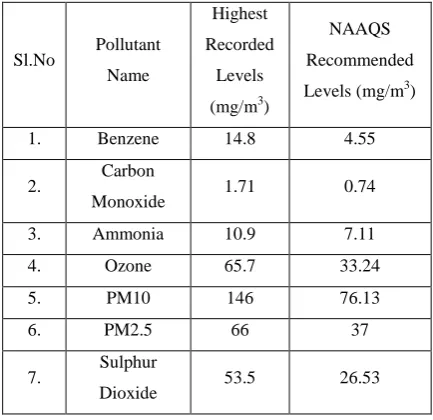
IV POLLUTION LEVELS IN VISAKHAPATNAM
Visakhapatnam, popularly known as Vizag is hailed as City of Destiny houses several industries that have raised
pollution to alarming levels over the years. Pollution rise is also strongly related to increase in population which
led to rapid urbanization. Increase in personal vehicles, transportation facilities, construction and various
development activities altogether have fueled the tremendous increase in pollution levels and lead to the present
alarming situation and Visakhapatnam is categorized under Critically Polluted Areas. can be referred to as bowl
area with regards to environmental impact assessment as it is surrounded by hill ranges (Eastern Ghats) on three
sides and sea on the other side inversion conditions due to negative adiabatic lapse rate are common here.
Sl.No Pollutant Name
Highest
Recorded
Levels
(mg/m3)
NAAQS
Recommended
Levels (mg/m3)
1. Benzene 14.8 4.55
2. Carbon
Monoxide 1.71 0.74
3. Ammonia 10.9 7.11
4. Ozone 65.7 33.24
5. PM10 146 76.13
6. PM2.5 66 37
7. Sulphur
Dioxide 53.5 26.53
211 | P a g e
In addition to the deteriorating air quality, ground water quality is also drastically reduced due to the presence ofpetroleum refineries, steel, zinc and fertilizer plants.
V SKYWHEELS FOR CONTAINER TRANSPORT
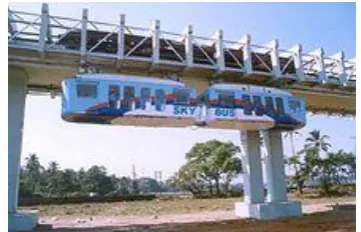
Container transport through trailers can be replaced conveniently by Sky wheels technology which employs
proven and tested railway technology turned upside down achieving at one stroke, both mass high speed
handling of railway and easy accessibility to handle cargo/ containers as shown in Fig.1.This system which uses
electrical power if adopted has tremendous potential to achieve transport efficiency as well as reduce harmful
vehicular emissions.
Fig -1: Prototype of Sky wheels in Madgaon, Goa
VI MODELLING AND METHODOLOGY
The development of an appropriate model is important and it completely determines the insight into the actual
physical problem. The tool SAP2000 will solve the model and the response of materials taken is presented. In
the present analysis of sky wheels technology, the dimensions of the model were taken from the sky bus metro
test track constructed at Madgaon, Goa. The model is prepared by taking frame members for the entire structure
in SAP2000 software as shown below in Fig.2
212 | P a g e
For analyzing the structure the various forces that are considered are dead load i.e., self-weight of the structure,live load i.e., wheel load of the railway bogie placed in the structure at the top and wind load on the structure.
One load combination is analyzed using the tool and results generated.
VII RESULTS
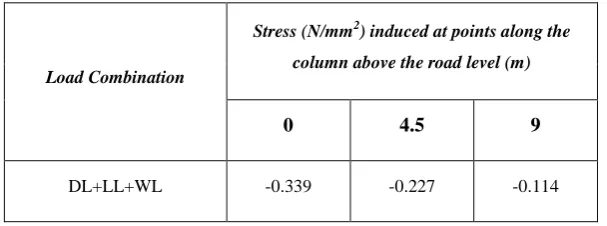
The response of the structure for the load combination is analyzed and the variation of stress in the pillar that is
based on the divider of the road is presented below in Table-2 and Chart-1
Load Combination
Stress (N/mm2) induced at points along the
column above the road level (m)
0 4.5 9
DL+LL+WL -0.339 -0.227 -0.114
Table -2: Stress induced in the column above road level
Chart -1: Stress induced in column above road level
VIII CONCLUSIONS
Adoption of sky wheels technology in place of conventional container transport through trailers will
reduce the harmful pollution effects that are plaguing Visakhapatnam for years and also improve the
quality of public health.
There will be an improvement in air quality once the age-old manufacturing equipment in industries are
replaced with sustainable and clean technologies.
It can be observed from the analysis that the maximum stress of 0.339 N/mm2 is induced in the column
above road level is at the road column contact portion.
Results show that proper optimal design can be achieved for the proposed structure and it will turn out
213 | P a g e
REFERENCES
[1]. Bojji Rajaram (1989), “Skywheels - New Mass Transit System”, International Conference on Railways at
Bologna, Italy.
[2]. Stopford. M (2002), Is the Drive For Ever Bigger Containerships Irresistible? Lloyds List Shipping
Forecasting Conference
[3]. United Nations Conference on Trade and Development (UNCTAD), Review of Maritime Transport 2012
[4]. United Nations Conference on Trade and Development (UNCTAD), Review of Maritime Transport 2014
[5]. http://icfbogie.com/