GENETIC MAPPING IN SACCHAROMYCES
IV.
MAPPING OF TEMPERATURE-SENSITIVE GENES AND USEOF DISOMIC STRAINS IN LOCALIZING GENES
R. K. MORTIMERZ AND D. C. HAWTHORNE
Division of Medical Physics, Donner Laboratory, University of California, Berkeley 94720, and Department of Generics, Uniuersity of Washington, Seattle 98105
Manuscript received January 18, 1973 Transmitted by G. R. FINE
ABSTRACT
Through use of tetrad, random spore, trisomic, and mitotic analysis pro-
cedures a large number of genes, including 48 new genetic markers, were studied f o r their locations on the genetic maps of the yeast Smcharomyces cereuisiae. Eighteen new centromere linked genes were discovered and all but one was located on various ones of the 16 previously-established chromosomes. Five fragments of linked genes were also assigned to chromosomes; four were located on known chromosomes while the fifth determined one arm of a new chromosome. The experiments indicate that seventeen is likely to be the haploid chromosome number in this yeast. Most chromosomes have been established by genetic means to be metacentric and their genetic lengths vary from 5 cM to approximately 400 cM. Functionally-related sets of genes generally were found to be dispersed over the genome.
PREVIOUS genetic mapping studies in the yeast Saccharomyces cereuisiae have established the location of over 100 genes on sixteen chromosomes and six fragments
(HAWTHORNE
and MORTIMER 1960,1968; LINDEGREN et al. 1962;HWANG,
LINDEGREN
and LINDEGREN 1963, 1964; MORTIMER and HAWTHORNE 1966). The sixteen chromosomcs were each defined by independently-segregating sets of one or more centromere-linked genes whereas the fragments represented groups of linked genes not associated with a centromere. A seventeenth chromo- some has since been proposed by RESNICK (1969). Additional chromosomes are implied from the linkage studies of LINDEGREN and coworkers (LINDEGREN et al. 1962; SHULT,DESBOROUGH
and LINDEGREN 1962;HWANG
and LINDEGREN 1966;SHULT,
LINDEGREN
and LINDEGREN 1967). These authors contend that several genes originally assigned to one of the 16 chromosomes are in reality located on separate chromosomes which assort preferentially with respect to certain other chromosomes. Thus, some uncertainty attaches to the number of chromosomes that comprise the yeast genome as determined by genetic mapping studies. Cyto- logical investigations also have, so far, failed to yield a consistent estimate of theThis work was supported by Public Health Service Grant No. AI-00328 and a grant to the University of California
a The major part of this study was performed while the senior author was on sabbatical leave at the University of by the U.S. Atomic Energy Commission.
Washington and supported by a John Simon Guggenheim Memorial Fellowship.
34
TABLE 1Second division segregation frequencies of 48 genes in Saccharomyces cerevisiae
Division segregation
Gene First Second Percent second - cdcl cdc2 cdc4 cdc5 cdc6 cdc7 cdc8 cdc9 cdc10 cdcll c d d 3 cdcl4 cdcl5 cly2 cly3 cly4 clyS cly6 cly7 ciy8 cly9 let1 mesl nu13 pet14 pet1 8 pet19 prtl prt2 prt3 rad2 rad1 8 rad52 rad55 rnnl ma2 rna3 ma4 m a 5 m a 8 r m l l
SUP30
SUPS1
SUP62 SUP71 SUP (his2) tsml34 tsm437 10 26 59 52 12 15 29 9 24 29 12 70 26 46 35 9 7 11 32 10 16 18 3 20 17 23 98 19 13 18 115 13 78 26 5 105 38 10 5 13 66 99 189 21 39 12 8 16 30 75 11 21 22 2 29 18 0 33 30 71 4 60 10 28 22 17 60 23 3 1 13 44 45 10 208 24 38 43 237 39 39 61 11 11 51 19 15 25 36 6 10 49 2 3 11 31 75 74 16* 29 *
65 12* 50* 67
Of 53 * 72 50* 13* 57* 22 * 76 76 61 65 70 16* 5' 81 69 73 29 *
68 56 74 71 68 75 33* 70 69 1 O* 58 66 75 66 35' 6' 5* 70 5* 20' 58 66 Source+
L. HARTWELL
L. HARTWELL
L. HARTWELL L. HARTWELL
L. HARTWELL L. HARTWELL
L. HARTWELL L. HARTWELL
L. HARTWELL L. HARTWELL L. HARTWELL
C. MCLAUGHLIN L. HARTWELL
L. HARTWELL
L. HARTWELL
L. HARTWELL L. HARTWELL
Id. HARTWELL
L. HARTWELL L. HARTWELL L. HARTWELL
L. HARTWELL
. . . . . . . . . . . .
L. HARTWELL L. HARTWELL L. HARTWELL M. RESNICK M. RESNICK M. RFSNICK
L. HARTWELL L. HARTWELL L. HARTWELL L. HARTWELL L. &TWELL L. HARTWELL L. HARTWELL . . . . . . . . . . . . . . .
L. HARTWELL
L. HARTWELL
* Percent second division segregation significantly less than 66.7 (P
<
0.N).G E N E T I C M A P P I N G IN SACCHAROMYCES 35 chromosome number in yeast
(MATILE,
MOOR
andROBINOW
1969). Because ofthese uncertainties and because adequate genetic maps are an important frame- work for a number of genetic and molecular studies, the present extension of our previous mapping work was undertaken.
The specific objectives of this study were to (a) assign the fragments to estab- lished or new chromosomes, (b) map as many as possible of a set of conditional mutants
(HARTWELL
1967) and previously identified but unmapped genes, and(c) resolve some of the uncertainties in the earlier maps.
MATERIALS A N D M E T H O D S
The new genetic markers used in these studies are listed in Table 1. Also included in this table are the centromere linkage data and sources for the various markers. A major source of new genes was a set of 35 temperature-sensitive lethals characterized by HARTWELL and CO- workers (HARTWELL 1967, 1971 ; HARTWELL and MCLAUGHLIN 1968; HARTWELL, MCLAUGHLIN and WARNER 1970; HARTWELL, CULOTTI and REID 1970; C U L O ~ and HARTWELL 1971). These mutants have been shown to affect protein synthesis (ils, m s , prt), R N A synthesis ( m a ) , the cell division cycle (cdc), and cell lysis ( c l y ) . Other genes used in these experiments are described in our previous publications (HAWTHORNE and MORTIMER 1960, 1968; MORTIMER and HAW-
THORNE 1966, 1969) or, for the radiation sensitivity genes (rad), in the article by GAME and Cox (1971). The gene symbols, in addition to those defined above or in text, are those proposed at the IVth International Yeast Genetics Conference, Osaka, (VON BORSTEL 1969).
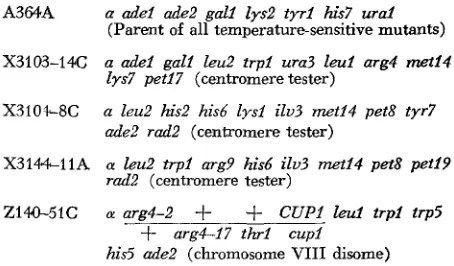
To describe all the stocks used in this study would be very difficult and of limited value. Approximately 300 hybrids were constructed throughout the course of the experiments and some had quite complicated genotypes. To illustrate the types of stocks used, the genotypes of some of the principal strains are described below:
A364A a adel ade2 gall lys2 tyrl his7 ural (Parent of all temperature-sensitive mutants) a adel gall leu2 trpl ura3 leu1 arg4 m t 1 4 Zys7 pet27 (centromere tester)
a leu2 his2 his6 lysl ilu3 met14 pet8 tyr7 ade2 rad2 (centromere tester)
X314411A CY leu2 trpl arg9 his6 ilv3 met14 pet8 pet19 radz (centromere tester)
214.0-51C a: arg4-2 f f CUP4 leu1 trpl trp5 X3103-14C
X3101-8C
__
f arg4-17 thrl cup1 his5 d e 2 (chromosome VI11 disc”)
The media and procedures for maintenance of stocks, construction and sporulation of hybrids, dissection of asci, and scoring of genetic characters have been described (JOHNSTON and MORTIMER 1959, HAWTHORNE and MORTIMER 1960,1968; MORTIMER and HAWTHORNE 1966,1969; HARTWELL 1967, HARTWELL, CULOTTI and REID 1970; HARTWELL, MCLAUGHLIN and WARNER 1970).
To place genes on the genetic maps of yeast, four different approaches were employed: tetrad analysis, random spore analysis, mitotic mapping, and trisomic analysis. The investigation of a
36 R. K. MORTIMER A N D D. C. H A W T H O R N E
incorporated into hybrids designed for either random spore or mitotic recombination studies to detect linkage with a n assortment of markers dispersed over the genome.
For the random spore analyses, the hybrids were heterozygous for an ochre-specific nonsense suppressor, an ochre allele of can2 (canavanine resistance), and miscellaneous markers. Asci were treated with “glusulase” (Endo Laboratories, Garden City, N.Y.), sonicated, and the resultant suspension of spores and diploid cells was plated on synthetic medium containing canavanine. Because canavanine resistance was suppressible, only those spores that lacked the suppressor but carried the canavanine resistance gene were able to grow on this medium. Clones derived from these spores were then tested for the phenotypes of the other heterozygous markers. Linkage of
a gene to the suppressor or to the canavanine resistance gene was detected as a departure from
1:l segregation of this gene in the selected spore population. Linkage between two unselected markers was reflected as an excess of parental over recombinant segregants.
In the mitotic recombination analyses, new genes were screened for location on the chromo- some arms that carried ade2 (fragment 1 and XV-R), ade4 (unmapped), ade5 (VII-L), ade6 (VII-R), and ade8 (fragment 2 and IV-R). The adenine genes affect the pigmentation of the vegetative colony (EPHRUSSI, HOTMNGUER and TAVLITSKI 1W; ROMAN 1956). Homozygous ade2 confers a red pigmentation, whereas additional homozygosity of ade4, ade5, a d d , or ade8 blocks the formation of the pigment. The hybrids, therefore, were either heterozygous for ade2 or homozygous for ade2 and heterozygous for ade4, ade5, ade6, or d e b . Mitotic crossing over between the heterozygous signal marker and its centromere followed by appropriate centromere disjunction will result in a red-white sectored colony (ROMAN 1956, 1963). Both the red and white sectors from a number of sectored colonies were recovered and their phenotypes determined. Coincident sectoring for the new gene indicated it was on the same chromosome arm as the signal marker. X-rays (IO Krad) were used to induce the sectoring because of their relative specificity for the induction of mitotic crossing over (NAKAI and MORTIMER 1969).
A selective system for obtaining mitotic recombinants was used in the attempt to locate the ochre-specific suppressors SUP2, SUP5, and SUP8. The hybrids were homozygous for the ochre alleles ca d - 5 3 and Zeu2-2, and heterozygous for the suppressor and for markers in repulsion on the various chromosome arms. Because of the presence of the suppressor the hybrid was sensitive to canavanine. Resistant clones isolated after irradiation lacked the suppressor, presumably because of mitotic recombination; the lack of the suppressor was confirmed by checking the phenotype for leucine. The phenotypes for the other markers were also determined, and if a recessive gene was expressed, it was assumed that its dominant allele was located on the same chromosome arm as the suppressor.
Trisomic analysis was used extensively i n locating the fragments and, to a lesser extent, i n assigning unmapped genes to particular chromosomes. Strains singly disomic f o r the chromosomes I, 11, 111, VI, VII, or VIII, or the unidentified chromosomes bearing tyr6 (fragment 2), ura4, and met4 were available. Some of these strains had been selected for other studies, while the rest were simply chance products found during previous tetrad analyses. Crosses of stocks bearing unmapped genes to these disomic strains were expected to yield asci with 4+:&, 3+:1--, and
2+:2- ratisos for any gene located on the trisomic chromosome. In practice, hybrids were con- structed with at least one known marker on the trisomic chromosome in duplex configuration
(+/+/-) in order to verify the transmission of the extra chromosome. With some of the less stable disomes, the simultaneous loss of the new input marker and the signal marker for the disome provided evidence for their being on the same chromosome. The three cases involving disomes for unmapped genes required only one or two crosses to the centromere marker stocks to identify the chromosome in the disomic state. However, the crosses involving new genes and the known singly disomic stocks were seldom rewarding. An approach that proved much more efficient involved the use of multiply disomic progeny derived from triploid meioses. From 10% to 15% of the spores from triploid yeast form visible colonies and these have been shown to be disomic for from 1 to 5 chromosomes or else near diploid in constitution (PARRY and Cox 1971).
GENETIC MAPPING I N SACCHAROMYCES 37
versa, that gene or fragment was excluded from the disomic chromosome. Analysis of a number of such multiply trisomic crosses served to exclude each of the fragments from all, o r all but one, of the 16 chromosomes.
RESULTS
A. Localization of genes
1.
Centromere-linked genes: The numbers of first and second division segrega- tions of the set of 48 genes which were given special emphasis in the present investigation are presented in Table 1. Similar data for the other genes used in this study are included in our earlier publications (HAWTHORNE and MORTIMER 1960, 1968; MORTIMER andHAWTHORNE
1966). Of the genes listed in Table 1, 20 show significant centromere linkage(SDS
frequericy less than 2/3). Two of these genes, SUP30 and SUP51, were previously shown to be near the centromere of chromosomeX
(HAWTHORNE and MORTIMER 1968). Strains bearing the other 18 centromere markers, cdc4, cdc5, cdc7, cdc8, cdcl0, c d c l l , cdcl 4 , cdcl5, letl,petl8, cly2, cly3, cly9, rad52, rna2, r n a l l , SUP71, and sup(his2), were each crossed to a set of strains that carried markers near the centromeres of up to 10
of the 16 chromosomes described in our earlier study
(HAWTHORNE
and MORTI-MER 1968). At most, analysis of two such crosses served to locate a centromere-
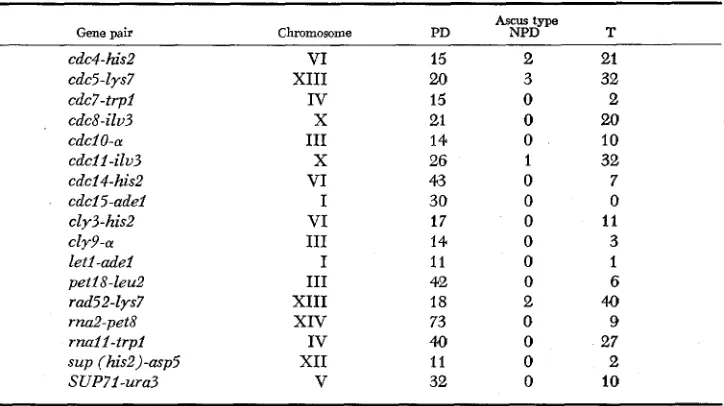
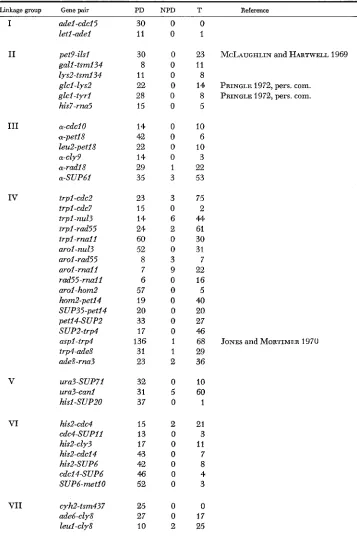
linked gene. The tetrad data that establish linkage of 17 of these genes to one of the established centromere genes are presented in Table 2. The detailed assign- ment of these genes to specific locations on the various chromosomes will be pre- sented in a later section. Only one gene in this set of centromere-linked genes was not located. This gene, cly2, which should be within 30
CM
of its centromere onTABLE 2
Asem-type ratios that determine linkage of the new centromere-linked genes with genes near the centromeres of the established linkage groups
Ascus type
Gene pair Chromosome PD NPD T
cdc4-his2 VI 15 2 21
cdc5-lys7 XI11 U) 3 32
cdc7-trpl IV 15 0 2
cdc8-ilu3
x
21 0 20cdci0-a I11 14 0 10
cdcil -ilu3 X 26 1 32
cdcl4-his2 VI 43 0 7
cdcl5-adel I 30 0 0
cly3-his2 VI 17 0 11
cly9-a 111 14 0 3
let1 -adel I 11 0 1
pet18-leu2 I11 42 0 6
rad5 2-lys7 XI11 18 2 40
ra2-pet8 XIV 73 0 9
m a l l - t r p l IV 40 0 27
s u p (his2)-asp5 XI1 11 0 2
38 R. K. MORTIMER A N D D. C. H A W T H O R N E
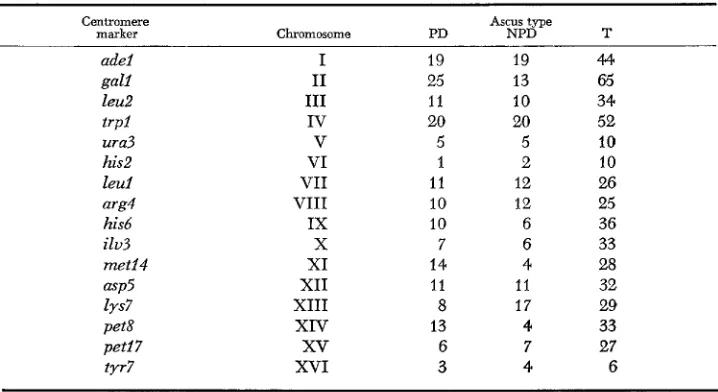
TABLE 3
Ascus-type ratios (PD: NPD: T ) for cly2 in combination with centromere markers on the established linkage groups
Centromere Ascus type
marker Chromosome PD NPD T
adel I 19 19 44
gall I1 25 13 65
leu2 I11 11 10 34
trpl IV 20 20 52
ura3 V 5 5 10
his2 VI 1 2 10
leu1 VI1 11 12 26
arg4 VI11 10 12 25
his6 IX 10 6 36
ilv3 X 7 6 33
met14 XI 14 4 28
asp5 XI1 11 11 32
lys7 XI11 8 17 29
pet8 XIV 13 4 33
peti7
xv
6 7 27tyr7 XVI 3 4 6
the basis of its SDS frequency fails to show the degree of linkage to any of the centromere markers of chromosomes I to XVI that would be expected if it was located on one of these chromosomes (Table 3 ) . This implies either that cZy2 marks the centromere of a new chromosome or that the data that indicate that this gene is centromere-linked are statistically significant (0.02
<
P<
0.05) only as a result of expected sampling fluctuations. Study of additional crosses would be required to discriminate between these possibilities.Five additional centromere-linked genes have been identified and located by other investigators: ilsl on chromosome I1
(MCLAUGHLIN
and HARTWELL 1969), leuR and iZv2 on chromosome VI1 (MAGEE, in press), rad1 = uvsl on chromo- some XVI (RESNICK 1969; GAME and Cox 1971), and rad5 = uvsl0 = rev2 on chrosmosome XI1(SNOW
1967; LEMONTT 1971; GAME and Cox 1971). These genes will also be added tothe map.2. Random spore analysis: Random spore analysis, carried out according to the method described above (MATERIALS AND METHODS), was used principally to test for linkage of genes to the eight tyrosine-inserting suppressors (HAWTHORNE and
MORTIMER
1968; GILMORE, STEWART and SHERMAN 1971). Five of these genes had been mapped: SUP6 and S U P l l on CHR. VI, SUP4 and SUP7 on CHR. X, and SUP3 on CHR. XV. SUP2 and SUP8 were located on the right arms of CHR. IV and CHR. XIII, respectively, as part of this study (see following section), and SUP5 is unmapped. Several combinations of suppressors with the temperature- sensitive lethals were tested: c dc l, 2,3, 6,9, and 13 U . S . SUP2,3,4,5,6,7,8, andI I ; p r t l , 2,3, m a l , 2,3,4,5, 8, and I1 U . S . SUP5 and 8; cdc7,8, IO, 12, cly3,4,
and 8 U . S . SUP6. Miscellaneous genes in these crosses were also examined for
GENETIC MAPPING I N SACCHAROMYCES
TABLE 4
Random spore analysis
39
Gene pair
Spore genotype Parental Recombinant
canl-ura3 canl-prt3 canl-cdcl SUP11 -cdc4 SUPb-cly3 SUP8-rml SUPS-pet17
578 308
69 1 1
34 6
101 19
41 13
82 38
4++8 335
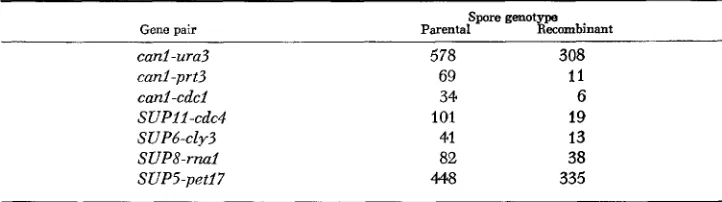
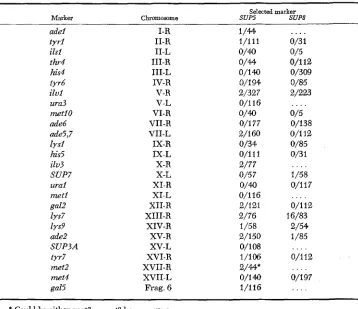
spore clones was analyzed for each diploid. Linkage of the unselected markers to either the suppressor or the canavanine gene could be revealed by these tests and seven cases of linkage were found in the 138 combinations tested (Table
4):
canl-ura3, canl-prt3, canl-cdcl, SUPll-cdc4, SUP6-cly3, SUP8-rna1, and SUPS- petl7. Two of these linkages had already been predicted from the tetrad analysis results. Both cdc4 and cZy3 had been located on CHR.VI
on the basis of their linkage to his2 (Table 2) and the two suppressors were already known to be on this chromosome(HAWTHORNE
and MORTIMER 1968). T h e linkage of ura3 (CHR. V-L) to canl was also confirmed by tetrad analysis (Table 8). The remaining linkages have not as yet been confirmed by other methods.3. Mitotic segregation analysis: Most of the conditional mutants that failed to show centromere linkage were screened for mitotic linkage to ade2, adel, ade5, ade6, and ade8 as described in MATERIALS AND METHODS. Four combinations showed mitotic linkage: prtl-ade2, tsm437-ade5, rna3-ade8, and cZy8-ade6 (Table
5 ) .
With the exception of prtl-ade2, these linkages have been confirmed by tetrad analysis (Table 8).W e expected that mitotic analysis would be more efficient for the location of the suppressors, SUP2, SUPS, and SUP8, since it was possible to select for loss of the suppressor and then screen these mitotic segregants for simultaneous homozygosity of markers on the various chromosome arms (see MATERIALS AND METHODS). Only one cross (involving met8 on CHR. II-R, ade5,7 on CHR. VII-L, Zysl on
CHR.
IX-R, and tyr6 on CHR. IV-R) was required to locate SUP2 on the right arm of chromosome IV. This cross gave 12 tyr6/tyr6 homozygotes from a sample of 32 suppressor-less recombinants. Eight crosses with markers covering twenty chromosome arms were analyzed before SUP8 was located on CHR. XIII-R. A sample of 83 suppressor-less recombinants included 16 that were Zys7/lys7 homozygotes. Twelve crosses with heterozygous markers on 28 arms have been examined without success in the attempt to locate SUP5 (Table 6). Random spore results (Table 4) suggest that this suppressor may be on chromo- some XV. However, there is no concomitant sectoring of this suppressor with either the right arm (ade2) o r the left arm (SUP3A) markers to support this observation.40 R. K. MORTIMER A N D D. C. H A W T H O R N E
Mitotic segregation analysis: concomitant segregations of temperature-sensitive lethals with adenine genes*
Selected marker
Locus ode2 ade4 a d d d e 6 &8
cdcl 2 3 4 6 8 9 10 ll 13 2 4 5 4 7 8
p r t l 2 3 tsm437 rnal 2 3 4 5 8 11 clyl 0/11 0/3 0/4 0/11 0/4 . . . 0/5 . . . 0/4 0/6 0/12 0/8 0/9 0/7 0/6 0/6 0/6 11/23 1/17 0/17 0/12 0/17 1/18 o/= 1/30
o/w
. . . . . . 0/11 0/7 . . . . . . 0/11 0/6 0/5 1/6 0/2 0/91 / 6 0/7 0/9 0/6 0/3 0/10 0/16 0/10 5/17 1/12 0/8 0/4 w 5 0/17 . . . . . . . . 013 w2-3
o/=
o / a
1/28 0/117 . . . 0/17 . . . . . . 1 /32 0/27 0/31 0/34 0/29 0/28 0/25 I/%
O / B
0/34 . . . . . . . . . 10/18 . . .
o / a
0/21 0/114
* The ratios represent the number of concomitant segregation of the mutant locus and the selected marker divided by the total number of sectored colonies tested.
GENETIC M A P P I N G I N SACCHAROMYCES
TABLE 6
Mitotic segregation analysis: concomitant segregations of chromoso,m markers with SUP5 and SUPS
41
Selected marker
Marker Chromosome SUP5 5up8
adel tyrl ilsl thr4 his4 fyr6 ilvl ura3 net10
d e 6
de5,7 lysl his5 ilv3 SUP7 urai mer1 gal2 lys7 lys9
d e 2
SUP3A tyr7 met2
n e t 4
gal5 I-R II-R II-L III-R III-L IV-R V-R v - L VI-R VII-R VII-L IX-R IX-L X-R x - L XI-R XI-L XII-R XIII-R XIV-R XV-R x v - L XVI-R XVII-R XVII-L Frag. 6 1/44 1/111 0/40 O/# 0/14Q 0/194 2/327 0/116 0/177 2/160 0/34 O/l11 2/77 0/5 7
0/40 0/116 2/121 2/76 1/58 2/150 0/1m 1/106 2/&* O/lM l / l i 6
. . . .
0/3 1 0/5 0/112 0/300 0/85 2/223 0/5 0/138 0/112 0/85 0/3 1 1/58 0/117 . . . . . . . . . . . . 0/112 16/83 2/54 1 /85 0/112 0/197 . . . .* Could be either mer2 or met8 homozygous
sucrose fermenters while 3 of 4 his6/his6 sectors were sucrose non-fermenters
(suc/suc)
.
A surprising observation arose in a similar analysis with chromosome IV in the attempt to locate the fragment 2 genes, arol, hon2, etc. with respect to tr pl, ga13, and the centromere. Since trpl and gal? are tightly centromere-linked a strong selection system was deemed necessary. In this case, gal?/ga13 homozy- gotes were selected on galactose-ethanol medium from a gal3 gall0 trpl a r o l / f
gall0
4-
f
diploid. Homozygosity for gall0 results in poisoning by the galactose and this is relieved by homozygosity for gal?(DOUGLAS
andHAWTHORNE
1964).
A sample of 108 ga13/gaZ3 isolates included 35 that were tr42 R. K. MORTIMER A N D D. C . HAWTHORNE
4.
Disomic and aneuploid analyses:a. Singly disomic strains: Strains which have arisen as meiotic products of diploids, and which have been identified to be disomic for a particular chromo- some, were initially assumed to be haploid for the remaining chromosomes. How- ever, it was found that such strains have a tendency to either lose the extra chromosome or to become disomic for additional chromosomes. To contend with this possible source of error, the hybrids were constructed, when possible, with a signal marker in duplex configuration on the trisomic chromosome and with a number of markers on the other chromosomes which had been introduced by the haploid parent. Irregular segregations for the signal marker coupled with 2:2 segregations for the markers on the other chromosomes established that the chro- mosomal constitution of the hybrid was as expected. Irregular segregation of an unmapped gene from the haploid parent indicated that it was on the same chro- mosome as the signal gene.
Two classes of singly disomic strains were available: (1) those disomic for one of the established chromosomes, and (2) those disomic for one of the fragments or for the chromosome bearing a n unmapped gene. The first class included strains disomic for chromosomes I, 11,111, VI, VII, o r VIII, while the second class repre- sented the unidentified chromosomes bearing tyr6 (fragment 2), ura4, and met4.
The first class of disomic strains was used in crosses with unmapped genes or with genes on the fragments. However, because of its low efficiency in locating genes this approach was used in only a limited fashion. The chromosome I disome was crossed to a strain bearing genes on fragments 3,
4,
and5.
The gene adellocated on chromosome I showed trisomic segregation, whereas the fragment markers met;!
(F3),
his5 (F4), and trp3(F5)
all segregated 2:2. The results exclude these three fragments from chromosomeI.
I n a similar fashion, these three fragments were excluded from chromosome VI. The chromosome VI11 disome, which was heterozygous for thrl on this chromosome, was crossed to strains carrying cdcl to cdcl3 and clyl to cly8. I n all 21 crosses t h r l segregated as expected from a trisome, whereas the temperature-sensitive mutants segre- gated 2:2 in all but one cross which involved cdcl2. Accordingly, all of the above set of genes except cdcl2 are excluded from this chromosome. Tetrad analysis results that confirm the location of cdcl2 o n chromosome VI11 are presented in a following section.The second class of singly disomic strains proved to be more useful in mapping. These three strains were disomic for the chromosomes carrying tyr6 (fragment 2), met4 and ura4, respectively. I n each, the markers gene was heterozygous. Each strain was crossed to a set of strains that collectively carried genes on the 16 established chromosomes. Trisomic segregations for the unmapped gene and for one of the chromosome markers established the location of the gene on that chromosome. I n this fashion, tyr6 (fragment 2) was assigned to chromosome
Iv
and uru4 to chromosome XII. However, i n crosses involving the met4 disome, the markers for the sixteen chromosomes segregated normally. These results exclude met4 from chromosome I to XVI and indicate a seventeenth chromosome. However, the fragment3
gene met2 gave trisomic ratios in crosses with the met4G E N E T I C M A P P I N G I N SACCHAROMYCES 43
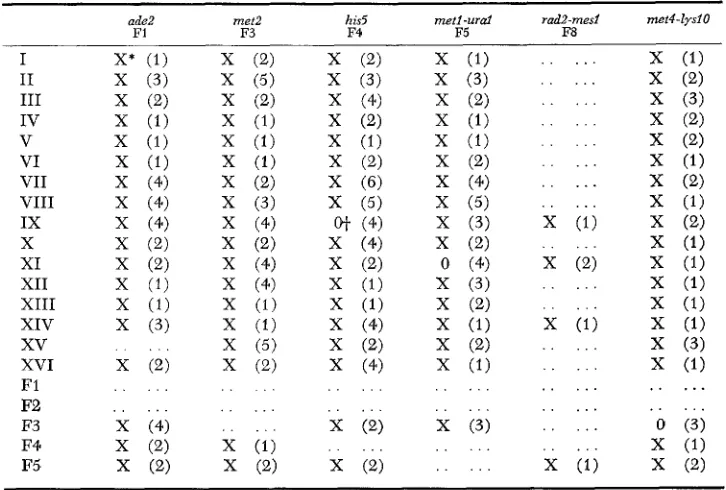
b. Multiply disomic strains: To associate the remaining fragments with estab- lished chromosomes, multiply disomic strains derived from meioses of triploids were crossed to strains carrying genes on a number of chromosomes as well as on many of the fragments. Irregular segregation of a chromosome marker in a cross in which a fragment marker segregated 2:2, or vice versa, excluded the fragment from that chromosome. Because of the multiply trisomic nature of these crosses, coincident aneuploid segregations for a chromosome marker and a fragment marker provided a less definite indication of association. The results of a number of such crosses are summarized in Table 7. Fragment 1 was excluded from all except chromosome XV. In no cross was either this fragment or chromosome XV trisomic. The proximal gene, ade2, on fragment 1 was checked for linkage to the gene pet17 which marks the centromere of chromosome XV and positive linkage was established (Table 8 ) . The assignment of fragment 2 to chromosome IV was described above. Fragment 3 marked by met2 was independently excluded from chromosomes
I
to XVI. This independent result was another reason for the assignment of genes of this fragment and metl-ZysZO to chromosome XVII. Frag- ment 4, marked by his5, was excluded from all but chromosome IX. In four crosses, coincident trisomy for his5 and the chromosomeIX
genes, his6 and/or l y s l , was observed, providing a strong indication that fragment4
and chromo-TABLE 7
-.
1 .Uisome exclusion results
ade2 met2 his5 met1 -urd rad2-mesl meil-lys~O
F1 F3 F4 F5 F8
* X indicates that either the fragment marker or chromosome marker, but not both, gave tris- omic segregations, Number in parentheses is the number of crosses in which exclusion was observed.
44
R. K. MORTIMER AND D. C. HAWTHORNETABLE 8
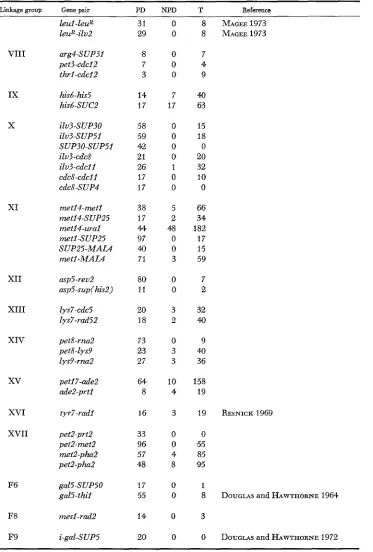
Tetrad data indicating gene to gene linkage
NPD T Reference
Linkage group I
Gene pair
adel-cdci5 let1 -adel PD 30 11 0 0 0 1 pet9-ilsi gall -tsm134 lysZ-tsml34 glci-lys2 glci-tyri his7-rna5
I1 30
8 11 22 28 15
23 MCLAUCHLIN and HARTWELL 1969 11
8
14 PRINGLE 1972, pers. com. 8 PRINGLE 1972, pers. com. 5
111 a-CdCiO
a-peti8 leuZ-peti8 a-cly9 a-rad18 a-SUP61 14 42 22 14 29 35 10 6 10 3 22 53
IV trpl -cdc2
trpl-cdc7 trpi-nul3 trpi-rad55 t r p i - m a l l aroi-nul3 aroi-rad55 a r o i - r m i i rad55-rmil aroi-hom2 hom2-pet14 SUP35-peti4 peti4-SUP2 SUP2-trp4 aspi-trp4 trp4-ade8 ade8-rna3 23 15 14 24 60 52 8 7 6 57 19 20 33 17 136 31 23 3 0 6 2 0 0 3 9 0 0 0 0 0 0 1 1 2 75 2 44 61 30 31 7 22 16 5 40 20 27 46
68 JON= and MORTIMER 1970 29 36 V VI ura3-SUP71 ura3-can1 hisl-SUP20 32 31 37 0 5 0 10 61) 1 his2-cdc4 cdc4-SUPil his2-cly3 his2-cdcl4 hisZ-SUP6 cdcl4-SUPb s U P b - ~ ~ ~ t l o
15 13 17 43 42 46 52 21 3 11 7 8 4 3
VI1 cyhZ-tsm437
G E N E T I C M A P P I N G IN SACCHAROMYCES 45
TABLE 8-Continued
Linkage group Gene pair PD NPD T Reference
Leu1 - LeuR LeuR-iLu2
31 0
29 0
8 MA GEE^^^^
8 MA GEE^^^^
VI11 arg4-SUP31 pet3-cdcl2 thrl -c&I 2
8 0
7 0
3 0
7 4 9 IX X his6 his5 his6-SUC2
14 7
17 17 40 63 ilv3-SUP30 iLu3-SUPSI SUP30-SUP5I iLu3-cdc8 ilu3-cdcll cdc8-cdcll cdc8-SUP4 15 18 0 20 32 10 0
58 0
59 0
42 0
21 0
26 1
17 0
17 0
XI m e t 1 4 - m t l met14-SUP25 metl4-ural metl-SUP25 SUP25-MAL4 metl-MAL4
38 5
17 2
4 4 4 a
97 0
4 0 0
71 3
66 34 182 17 15 59 XI1 XI11 XIV asp5-reu2 asp5-sup(his2) Lys7-cdc5 lys7-rad52
80 0
11 0
7
2
20 3
18 2
32
4Q
petS-rna2 pet8 - Lys9 Lys9-rnn2
73 0
23 3
27 3
9
40 36
xv
pet17-adeZade2-prtl
64 10
8 4
158 19
XVI
XVII
tyr7-rad1 16 3 19 RESNICK 1969
peL-prf2 petZ-met2 m e t 2 - p h d petZ-pha2
gaL5-SUP50 gaL5-thiZ
33 0
96 0
57 4
48 8 0 55 85 95
F6 17 0
55 0
1
8 DOUGLAS and HAWTHORNE 1964 F8
F9
mesl -rad2 14 0 3
46 R. K. MORTIMER A N D D. C. HAWTHORNE
some IX are associated. This was confirmed by a mitotic segregation analysis as described in the preceding section. Fragment
5
marked by m e t l , ural and trp3was excluded from all but chromosome XI. I n three crosses, m e t l 4 , located on chromosome XI, and the fragment
5
genes, showed coincident trisomy. This observation was confirmed by a tetrad analysis that demonstrated linkage between met14 and metl (see below).B. Chromosome maps
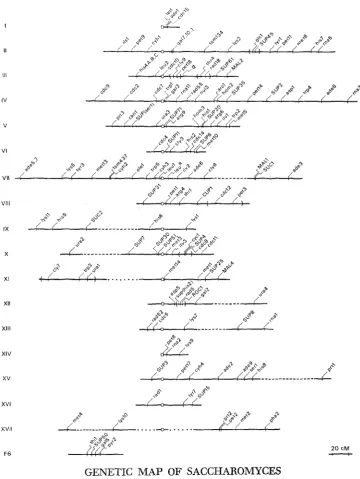
The genetic maps of Saccharomyces cerevisiae presented in Figure 1 represent a n extension of our previous maps with the inclusion of the above results. Dis- tances were calculated according to standard methods, and uncertainties in sequence, where they exist, are indicated. The assignment of genes to specific locations on the various chromosomes is presented below:
CHR. I: Two new genes have been placed on chromosome I-cdcl5 and letl.
Because of the close linkages involved, their sequence is unknown except that let1
is proximal to adel or on the other arm since the one tetratype ascus was
FDS
for letl and SDS for adel; no exchanges have been obtained between adel and
cdcl5.
C H R . 11: The four genes added to chromosome I1 are ilsl, tsm134, glcl, and ma5. MCLAUGHLIN and
HARTWELL
(1969) have located ilsl distal to pet9 on the left arm of this chromosome. On the right arm, the temperature-sensitive lethaltsm134 was positioned between gall and lys2 on the basis of a tetrad analysis involving these three genes (Table 8 ) . The glycogen storage gene, glcl has been positioned by PRINGLE (1972) about midway between lys2 and t y r l but its position relative to SUP45, also located in this interval, is unknown. The distal gene on this chromosome arm is ma5. Its position was assigned from an exami- nation of its segregation relative to his7 and t y r l .
CHR. 111: The addition of five new genes to chromosome I11 presents us with additional uncertain sequences. Only
FDS
tetrads have been obtained f o r cdcl0,so it could be on either the right or left arm. The genes cZy9 and pet18 are on the right arm proximal to a; they have not been tested against one another. The
radiation sensitivity gene, rad18 ( u z s l ) is distal to O( about the same distance as
thr4 but has not been ordered with respect to this gene. SUP61 is located distal to these two genes but has not been ordered relative to M A L 2 which is in the same region. On the basis of its distance from e, SUP61 is tentatively placed
proximal to M A L 2 .
47
Vlll
IX
X
XI
XI1
Xlll
XIV
xv
XVI
XVll
F6
48
R. K. MORTIMER A N D D. C . HAWTHORNEmutant cdc7 is close to trpl and in a cross involving these two genes and r n a l l one crossover ascus favored the sequence cdc7-centromere-trpl-rnull. The gene rad55 which confers sensitivity to X-rays also is loosely linked to trpl. It is not linked to cdc2 but is linked to r n a l l . I n contrast to cdc2, rad55 sectors mitotically with a d d . Of 173 colonies sectored for a d d , eleven were also sectored for X-ray sensitivity conferred by homozygosity for rad55. All 11 colonies sectored for rad55 were also sectored for arol but 22 additional arol sectors did not involve rad55. This establishes that rad55 is in the trpl-mol interval on the right arm of CHR. IV. Because of its failure to sector with a d d , cdc2 is placed on the left arm. Meiotic analysis favors placement of r m l l between trpl and rad55 and its failure to sector with a d d can be explained by its relative proximity to the centromere on this exceptionally long arm.
CHR. V: A number of uncertainties arise in the attempt to position the new genes on
CHR.
V. The canavanine resistance gene, canl, was located on the left arm of this chromosome on the basis of its linkage to ura3 and its lack of linkage to markers on the right arm. However, its position relative to SUP(ser1) is uncer- tain because these two genes have not been studied i n the same cross. It is tenta- tively placed distal to SUP(ser2) because of its greater map distance from ura3 (Table 8, MORTIMER and HAWTHORNE 1966). The temperature-sensitive lethal prt3 showed linkage to can1 by random spore analysis (Table4).
Analysis of the segregation of these two genes relative to ura3 led to the conclusion that p r d is distal to canl. Thus the tentative left arm sequence is centromere-SUP(ser1)- canl-prt3. The position of cdcl in this sequence is unknown since only random spore linkage of this gene to canl has been determined (Table 4). Additions to the right arm ofCHR.
V involve a centromere-linked UGA suppressor, SUP71 and the weak ochre suppressor SUP20 formerly located on fragment 1 (now XV-R). The position of SUP71 with respect to arg9 has not been determined. There was only one exchange in 38 tetrads between SUP20 and hisl and in this tetratype ascus SUP20 and iZul were in a parental ditype array. Thus SUP20 is placed distal to hisl. The gene met5 had been mapped distal to trp2 in another study (LINDEGREN et al. 1962).CHR. VI: Three genes have been added to the chromosome VI map-cdc4, cZy3, and cdcl4. cdc4 was placed on a new left arm of this chromosome from a n examination of its second division segregation frequency and its segregation relative to S U P l l and his2 (Tables 1
,
2 and 8). On the right arm, cZy3 has been located between S U P l l and his2 as a consequence of its distances from the centro- mere and his2. The cell-division-cycle mutant cdcl4 was located between his2 and SUP6, and met10 was positioned distal to this suppressor from a tetrad analysis of a cross heterozygous for all four genes. This analysis was complicated by the high frequency of gene conversion encountered in the his2-SUP6 interval (HURST, FOGEL and MORTIMER 1972). Of 62 complete tetrads analyzed, only 36 segregated 2:2 for all four genes. Assuming the sequence centromere-hisa-(I) -GENETIC M A P P I N G I N SACCHAROMYCES 49
CHR.
VII:
Two temperature-sensitive lethals have been added to the map of this chromosome. tsm437 showed mitotic linkage to ade5 and subsequently was shown to be tightly linked to cyh2, also located on the left arm of VI1 (Tables5
and 8). No exchanges were observed between these two genes in 25 asci. Distal to ade6 on the right arm is cZy8. Again both mitotic and meiotic results support this positioning (Tables5
and 8). Two other genes, leuR and iZv2, have been located by MAGEE (1972) in the centromere-ade6 region in the sequence centro- mere-leuR-iZu2-ade6. The arrangement of the other genes on this chromosome remains as described in our earlier publication (HAWTHORNE and MORTIMER1968).
CHR.
VIII: Although one of the incentives for initiating the present study was to map in greater detail the region around arg4 because of previous work on this gene (FOGEL and MORTIMER 1969;HURST,
FOGEL and MORTIMER 1972) only one additional gene was located on this chromosome and it was far removed from arg4. The cell cycle mutant cdcl2 was located on VI11 by trisomic analysis and has been shown to exhibit linkage to pet3 (Table 8). However the order of these two genes relative to the centromere was not determined.CHR.
IX: Fragment 4, which contains the genes SUC2, his5, and Zysll, was located on the left arm of this chromosome by trisomic and mitotic analyses(sections 3 and 4, Table 7). Our earlier results (MORTIMER and HAWTHORNE 1966) indicated that SUC2 was the proximal gene of fragment 4. Thus the left arm sequence is centromere-his6-SUC2-h~s5-Zy~ll. Significant meiotic linkage between his6 and SUC2 (formerly S U C l ) , however, does not exist. The ascus type ratios for these two genes are 17:17:63
(HAWTHORNE
and MORTIMER 1960).CHR.
X:
Two cell division cycle mutants, cdc8 and cdcll, have been placed on the right arm of this chromosome; cdc8 is closely linked to SUP4 while cdcll is distal. Also closely linked to SUP4 and cdc8 is the structural gene for iso-l-cyto- chrome-c, cycl (SHERMAN, personal communication). On the left arm, SUP30 and SUP51 are closely linked with no reciprocal exchanges in 42 tetrads. In one ascus, SUP30 segregated 3:l while SUP5l segregated2:2;
hence these two sup- pressors are not alleles. The tentative order of genes, based on SDS frequencies, is centromere-SUP51-SUP3O. The gene ura2 was assigned to chromosome X by trisomic analysis ( LACROUTE, personal communication). This gene sectors concomitantly (9/14) with SUP7 located on the left arm of this chromosome. Because uru2 is not centromere-linked it is placed distal to SUP7.CHR.
XI: Trisomic analysis (Table 7) was used to locate fragment 5 on this chromosome which was formerly identified only by the centromere-linked gene, metl4. The standard markers for this fragment, met1 and ural, were examined for linkage to metl4 and the metl4-met? combination showed significant meiotic linkage. Analysis of a cross heterozygous for metl4, metl, SUP25, and MAL4 revealed that these four genes were arranged in that sequence (Table 8). A50 R. K. MORTIMER A N D D. C. HAWTHORNE
which are linked to ural have been assigned to the left arm of CHR. XI. However, the sequence of these three genes relative to each other or to the centromere is unknown, with the exception that cZy7 is not located between trp3 and u r a l .
CHR. XII: Two new centromere-linked genes, sup(his2) and rad5 are located on chromosome XII. rad5 (formerly uvs-l0 and reu2) was located by LEMONTT
(1971), while sup(his2) was mapped during the present study. This recessive suppressor, isolated as part of this study, may be an allele of one of the recessive missense suppressors described by GORMAN and GORMAN (1971). Both sup(his2)
and rad5 show close linkage to asp5 and both are placed distal to this gene from a n examination of exchanges in asci from crosses heterozygous for the two gene combinations. However, the sequence of sup(his2), rad5, and
RQCI,
which are all located in the asp5-gaU interval, is unknown. Analysis of a disome for the chromosome that carries ura4 revealed that this gene is also onCHR.
XI1 (section4).
Mitotic sectors for ura4 were recovered from a cross heterozygous for bothgaZ2 and u r d . Of 100 colonies sectored for ura4, 7 were sectored for gaZ2. This places ura4 distal to gsZ2.
CHR. XIII: The two new genes on the left arm of this chromosome, cdc5 and
rad52 ( s s l )
,
have not been included in the same cross; the tentative order rad52-cdc5-centromere is based on SDS frequencies (Table 1 ) . The location of SUP8
distal to Zys7 on the right arm was by a mitotic analysis (section 3, Table 6 ) . Random spore analysis indicated linkage between rnal and SUP8 (Table
4).
CHR. XIV: Only one additional gene was positioned on this chromosome. The temperature-sensitive lethal m a 2 was found to be linked to pet8. Analysis of a cross heterozygous for pet8, m a 2 , and Zys9 revealed that rna2 is in the middle. Of a sample of 53 asci, 7 had a n exchange between pet8 and m a 2 ;
5
of these 7asci were i n a PD array for m a 2 relative to Zys9, the other two asci had a n additional exchange between m a 2 and Zys9. Because exchanges between centro- mere XIV and pet8 are rare, it is unknown whether pet8 is on the same side of the centromere as the other two genes.
CHR. XV: Disomic studies assigned the genes of the former fragment 1 to chromosome XV and they were placed on the right arm by the linkage between
petl7 and ade2. A mitotic analysis placed prtl on the right arm also (Table 5 ) ;
the tetrad data for prtl against ade2 indicate that it is distal to and far removed from ade2; it has not been tested for linkage with the other markers on this arm. Random spore analysis suggested linkage of SUPS to pet27 (Table
4).
However, mitotic analysis failed to reveal sectoring of this suppressor with either ade2(XV-R) or SUP3A (XV-L) and hence SUP5 was not placed on this chromosome. One other revision from our previous map places SUP20 on CHR. V (see above). The tetrad data of this suppressor with ade2 now stands at 22 PD:7 NPD: 58 T. CHR. XVI: No new genes were found to be on this chromosome. However, we have added to the map the gene rad1 ( u v s l ) which was located by RESNICK
(1969).
GENETIC M A P P I N G I N SACCHAROMYCES 51
firmed. In 352 asci, the percent SDS for rad2 was 67.3 (Table
1).
This chromo- some number has been reassigned to the sequence of genes met4-lyslO-centro- mere-prt2-pet2-met2-pha2 described in the above section on mitotic segregation analysis (section 3 ) . An uncertainty in this sequence is in order of pet2 and prt2 relative to the other genes. I n 33 tetrads, no exchanges were observed between these two genes. It is possible that cZy2 is linked to the centromere of this chromo- some (Table 3) but no data are available to establish this point.Fragment 6: None of the mutants i n this linkage group result in a clear reces- sive phenotype and hence disomic studies to assign this fragment to a centromere were precluded. There is close linkage between SUP50 and gaZ5, formerly placed on fragment 8 (MORTIMER and HAWTHORNE 1966). Although it has not been tested, it is likely that the thiamine genes designated thil and thi2 are alleles or identical; therefore another linkage group will be assigned to fragment 8.
Fragment 7: The closely linked genes controlling the fermentation of sucrose SUC3, maltose MAL?, and alpha-methyl glucoside MGL2 (MORTIMER and
HAWTHORNE
1966) were not included in this investigation.Fragment 8: The methionyl synthetase mutant mesl was found to be linked to rad2 (uvs9) but neither gene has been associated with a n established chromo- some.
Fragment 9: The repressor locus for galactose utilization i-gal is tightly linked to
SUP5
(DOUGLAS andHAWTHORNE
1972). This suppressor has been excluded from most of the chromosome arms by the results of the mitotic analyses(Table 6).
DISCUSSION
These experiments establish that seventeen is the minimum number of chro- mosomes in the haploid genome of the yeast Saccharomyces cerevisiae. Sixteen of these chromosomes had been characterized in previous mapping studies and their independence was confirmed in numerous crosses involving either tetrad or trisomic analysis. Twenty-one new centromere-linked genes were examined and all except one were located on various one of these sixteen chromosomes. The seventeenth chromosome was identified by trisomic analysis and no markers were found near its centromere, although it is possible that the unassigned centromere gene is on this chromosome. Of five fragments of linked genes studied, four were assigned to certain of the established chromosomes and the fifth constitutes one arm of the new chromosome. W e believe that seventeen is likely to be the haploid chromosome number for the following reason. There are now 56 genes classified as centromere markers. The number of genes per centromere, assuming 17 chro- mosomes, is 3.5. The number of unmarked centromeres, assuming the centro- mere genes are randomly distributed over the centromeres, would be 0.6. Since the centromere of chromosome XVII is unmarked, no additional chromosomes need to be proposed.
52 R. K . MORTIMER A N D D. C. HAWTHORNE
tions were indicated by the viability patterns for the four ascospores. W e are reasonably confident that our own summations of the data were obtained from cross-fertile hybrids. From results obtained with specific hybrids, SHULT, DES- BOROUGH and LINDEGREN (1962) and SHULT, LINDEGREN and
LINDEGREN
(1967) contend that we erred in placing CUP1 on chromosome VI11 and leu1 on chromosome VI1 (HAWTHORNE and MORTIMER 1960).
In
the first instance, they found a hybrid displaying “reverse linkage” for CUP1 and arg4 with 1 PD, 18 NPD, and 21 T asci. I n the second case, a series of hybrids was obtained in which leu1 failed to show linkage with trp5 and adeb while these markers on opposite arms of chromosome VI1 retained their linkage with one another. They proposed that the linkages normally seen are the consequences of affinity or preferential segregation of non-homologous centromeres. W e will not offer another interpretation of their results but simply reiterate that the original assign- ment of these loci to chromosomes VI11 and VI1 has been confirmed by the tri- somic studies during this investigation and by mitotic recombination experiments with the markers on chromosome VI1 (NAKAI and MORTIMER 1969).The genetic lengths of the various chromosomes in S. cereuisiae differ greatly. Chromosomes I, VI, and XIV all are relatively short (< 50cM) whereas four chromosomes, 11, IV, VII, and XV, are exceptionally long (> 250cM). An approach that permits comparison of the genetic lengths with the physical lengths of the different chromosomes has recently been developed and initial results indicate a good correlation (PETES and FANGMAN 1972; BLAMIRE et
d.
1972). An interesting exception involves chromosome I with a genetic length of only 5 cM. This chromosome was found to be of intermediate physical size and the basis of this discrepancy was found to be due to the presence of a majority of the ribosomal RNA cistrons on this chromosome ( FINKELSTEIN, BLAMIRE and MAR- MUR 1972). The average size of a yeast chromosome has been estimated, from the haploid DNA content and chromosome number, to be about 7 X lo8 daltons of DNA (PETES and FANGMAN 1972), a value about one-fourth that of Escher- ichia coli. The physical separation studies are consistent with this estimate and with the assumption that each chromosome is a single DNA molecule.Locating genes on the genetic maps of yeast is inherently difficult because of the large number of chromosomes and extreme genetic lengths of some of these chromosomes. It can be estimated that the likelihood that two genes selected at random would show significant linkage is in the order of 0.01. However, through use of the various tactics described in this report, it has been possible to locate a relatively high percentage of the genes selected for study. For example, 24 of the
35 temperature-sensitive lethals were mapped and a comparable fraction applies to the other genes included in this study and in our earlier experiments.
G E N E T I C M A P P I N G I N SACCHAROMYCES
53
reported as being correlated to the positions of the genes along the chromosome
(TAURO,
HALVORSON
andEPSTEIN
1968).In
particular, this consideration may have bearing on the location of the cell division cycle mutants.Several broad categories of genes, such as those controlling vitamin biosynthe- sis, antibiotic sensitivity, and radiation sensitivity, have received only limited attention for mapping purposes. Additional genes that control critical cellular functions could be studied in cold sensitive as well as heat sensitive mutants or suppressible lethals. For any substantial extension of the linkage maps, one will probably need to employ these new sources of markers.
We wish to express our thanks to L. HARTWELL, C. MCLAUGHLIN and M. RESNICK for pro- viding some of the cultures used in this investigation. Additionally, F. SHERMAN, F. LACROUTE, J. PRINGLE and P. MAGEE kindly made available unpublished results which are included in this paper. Critical reading of the manuscript was done by L. HARTWELL and S. FOGEL, although any remaining deficiencies are clearly our responsibility. The excellent technical assistance of MRS. JEAN WARFEL and MR. T. MCKEY is greatly appreciated.
L I T E R A T U R E CITED
BLAMIRE, J., D. R. CRYER, D. B. FINKEL~TEIN and J. MARMUR, 1972 Sedimentation properties of yeast nuclear and mitochondrial DNA. J. Mol. Biol. 67: 11-24.
CULOTTI, J. and L. H. HARTWELL, 1971 Genetic control of the cell division cycle in yeast. 111.
Seven genes controlling nuclear division. Exptl. Cell Res. 67: 389-401.
DOUGLAS, H. C. and D. C. HAWTHORNE, 1964 Enzymatic expression and genetic linkage of genes 1972 Uninducible mutants in the gal i locus of Saccharomyces cereuisiae. I. Bact. 109: 1139-1143. EPHRUSSI, B., H. HOTTINGUER and J. TAVLITSKI, 1949 Action de l’acriflavine sur les levures. 11.
Btude gbnCtique du mutant “petite colonies.” Ann. Inst. Pasteur 76: 419-450.
FINKELSTEIN, D. B., J. BLAMIRE and J. MARMUR, 1972 Location of ribosomal RNA cistrons in yeast. Nature New Biol. 240 : 279-281.
FOGEL, S. and R. K. MORTIMER, 1969 Informational transfer in meiotic gene conversion. Proc. Nat. Acad. Sci. U.S. 62: 96-103.
GAME, J. C. and B. S. Cox, 1971 Allelism tests of mutants affecting sensitivity to radiation in yeast and a proposed nomenclature. Mutation Res. 12: 328-331.
GILMORE, R. A., J. W. STEWART and F. SHERMAN, 1971 Amino acid replacements resulting from super-suppression of nonsense mutants of iso-l -cytochrome c from yeast. J. Mol. Biol.
61: 157-173.
Genetic analysis of a gene required for the expression of allele specific missense suppression in Saccharomyces cereuisiae. Genetics 67 : 337-352.
Macromolecule synthesis in temperature-sensitive mutants of yeast. J. Bacteriol. 93: 1662-1670. ~ , 1971 Genetic control of the cell division cycle in yeast.
11. Genes controlling DNA replication and its initiation. J. Mol. Biol. 59: 183-194.
HARTWELL, L. H. and C. S. MCLAUGHLIN, 1968 Temperature-sensitive mutants of yeast exhibiting a rapid inhibition of protein synthesis. J. Bacteriol. 96: 16641671.
HARTWELL, L. H., J. CULOTTI and B. REID, 1970 Genetic control osf the cell division cycle in yeast. I. Detection of mutants. Proc. Natl. Acad. Sci. US. 66: 352-359.
HARTWELL, L. H., C. S. MCLAUGHLIN and J. R. WARNER, 1970 Identification of ten genes that cmtrol ribosome formation in yeast. Molec. Gen. Genet. 109: 42-56.
HARTWELL, L. H., R. K. MORTIMER, J. CULOTTI and M. CULOTTI, 1973 Genetic control of the cell division cycle in yeast: V. Genetic analysis of cdc mutants. Genetics (in press).
HAWTHORNE, D. C. and R. K. MORTIMER, 1960 Chromosome mapping in Saccharomyces: controlling galactose utilization in Saccharomyces. Genetics 49 : 837-844.
-
,GORMAN, J. A. and J. GORMAN, 1971
54
R. K. M O R T I M E R A N D D. C. H A W T H O R N Ecentromere-linked genes. Genetics 45 : 1085-1 1 IO. - , 1968 Genetic mapping of non- sense suppressors in yeast. Genetics 60: 735-742.
HURST, D. D., S. FOGEL and R. K. MORTIMER, 1972 Conversion-associated recombination in yeast. Proc. Natl. Acad. Sci. U.S. 69: 101-105.
HWANG, Y. L. and C. C. LINDEGREN, 1966 Sites of affinity and linear arrangement of genes on chromosome V of Saccharomyces. Can. J. Genet. Cytol. 8 : 677-694.
HWANG, Y. L., G. LINDEGREN and C. C. LINDEGREN, 1963 Mapping the eleventh centromere in Saccharomyces. Can. J. Genet. Cytol. 5 : 290-298. -, 1964 The twelfth chromosome of Saccharomyces. Can. J. Genet. Cytol. 6 : 373-380.
JAMES, A P., 1955 A genetic analysis of “sectoring” of ultraviolet-induced variant colonies of yeast. Genetics 40: 204-213.
JOHNSTON, J. R. and R. K. MORTIMER, 1959 Use of snail digestive juice in isolation of yeast spore tetrads. J. Bacterid. 78: 292.
JONES, G. E. and R. K. MORTIMER, 1970 L-asparaginase-deficient mutants of yeast. Science 167:
LEMONTT, J. T., 1971 Mutants of yeast defective in mutation induced by ultraviolet light. Genetics 68: 21-33.
LINDEGREN, C. C., G. LINDEGREN, E. SHULT and Y. L. HWANG, 1962 Centromeres, sites of affinity and gene loci on the chromosomes of Saccharomyces. Nature 194: 260-265.
MAGEE, P. T., 1973 Isolation and genetics of a thiaisoleucine-resistant mutant of Saccharomyces cereuisiae. (Submitted for publication).
MATILE, P. H , H. MOOR and C. F. ROBINOW, 1969 Yeast cytology. pp. 219-302. In: The Yeasts. Edited by A. H. ROSE and J. S. HARRISON. Academic Press, London.
MCLAUGHLIN, C. S. and L. H. HARTWELL, 1969 A mutant of yeast with a defective methionyl t-RNA synthetase. Genetics 61: 557-566.
MORTIMER, R. K. and D. C. HAWTHORNE, 1966 Genetic mapping in Saccharomyces. Genetics 53: 165-173. -, 1969 Yeast Genetics. pp. 385-460. In: The Yeasts. Edited by A. H. ROSE and J. S. HARRISON. Academic Press, London.
NAKAI, S. and R. K. MORTIMER, 1969 Studies of the genetic mechanism of radiation-induced mitotic segregation in yeast. Molec. Gen. Genet. 103: 329-338.
PARRY, E. M. and B. S. Cox, 1971 The tolerance of aneuploidy in yeast. Genet. Res. Camb. 16:
PETES, T. D and W. L. FANGMAN, 1972 Sedimentation properties of yeast chromosomal DNA.
Proc. Natl. Acad. Sci. U.S. 69: 1188-1191.
PRINGLE, J., 1972 Genetic and physiological characterization of a mutant which prevents glycogen accumulation i n yeast. Genetics 71 : S48 (abstract).
RESNICK, M. A , 1969 Genetic control of radiation sensitivity in Saccharomyces cereuisiae. Genetics 62: 519-531.
ROMAN, H , 1956 A system selective f o r mutations affecting the synthesis of adenine in yeast. C. R. Lab. Carlsberg, SBr. Physiol. 26: 299-314. __ , 1962 Genic conversion in fungi. pp. 209-227. Methodology in Basic Genetics. Edited by W. J. BURDETTE. Holden-Day, San Francisco
SHULT, E. E., S. DE~BOROUGH and C. C LINDEGREN, 1962 Preferential segregation in Saccharo- myces. Genet. Res. 3 : 196-209.
SHULT, E. E , G. LINDEGREN and C. C. LINDEGREN, 1967 Hybrid specific linkage relations in Saccharomyces Can J. Genet. Cytol. 9: 723-759
SNOW, R., 1967
TAURO, P., H. 0. HALVORSON and R. L EPSTEIN, 1968 181-182.
333-340
Mutants of yeast sensitive to ultraviolet light. J. Bacteriol. 94: 571-575. Time of gene expression in relation to centromere distance during the cell cycle of Saccharomyces cereuisiae. Proc. Natl. Acad. Sci. U.S 5 9 : 277-284.