Copyright 0 1986 by the Genetics Society of America
DNA SYNTHESIS AT THE SITE
OF A RED-MEDIATED
EXCHANGE IN PHAGE
X
FRANKLIN W. STAHL AND MARY M. STAHL Institute of Molecular Biology, University of Oregon, Eugene, Oregon 97403
Manuscript received October 2 1, 1985 Revised copy accepted Accepted January 2, 1986
ABSTRACT
In phage A, progeny particles bearing unreplicated chromosomes are recom- binant by action of A’s Red system only near the right end of the chromosome. These recombinants are frequently heterozygous (heteroduplex) for markers lo- cated there. In replication-blocked crosses involving two heavy-labeled parents we find that particles in the solitary peak, containing progeny with fully con- served DNA, vary in density. Those on the heavy side of this peak are more apt t o be heterozygous than are those on the light side. T h e data fit a model in which a double chain cut at cos, A’s packaging origin, is followed by partial exonucleolytic degradation of A’s r chain from the right end leftward. The exposed 1 chain, which thereby constitutes a 3‘ overhang, invades a n intact, circular homologue afrter itself suffering some degradation. Completion of the recombinant chromosome sometimes involves DNA synthesis primed by the in- vading chain.
ROSSES with density-labeled phage
X under conditions of limited DNA
C
replication have revealed properties of the several recombination systems that can operate on the phage (for a review, see STAHL 1984). This paper deals with the Red pathway ofX operating in cells deprived
of E. coli recom- bination pathways by a recA mutation. A model has been proposed for the operation of this system on phages for which DNA replication has been blocked (STAHL, KOBAYASHI and STAHL 1985; STAHL and STAHL 1985). T h e features of replication-blocked recombination in RecA- cells that led to the model include the following: (1) Recombination is maximal at the right end of the chromosome and declines monotonically leftward (STAHL et al. 1974). (2) If cos, the sequence that determines the ends of the phage particle chromosome, is relocated, then the high rate of recombination follows cos to its new location (STAHL, KOBAYASHI and STAHL 1982). (3) T h e particles that experienced re- combination near cos, at least when cos is in its standard location, have regions of heteroduplex DNA which can exceed 20% of the length of X (i.e., 10 kb) (RUSSO 1973; STAHL et al. 1974). (4) T h e heteroduplexes may be thought of as having most of their DNA from one parent, with a minority contribution (near the right end) from the other. This minority contribution is on the chain that has its 5’ end at the right (the r chain) (STAHL and STAHL 1974). (5)2
F. W. STAHL AND M . M. STAHLWhen one parent in a cross carries a noncuttable cos at the standard location, recombination occurs at the right-hand end more often than if both parents have a noncuttable cos; that is, a single cuttable cos stimulates recombination
(STAHL, KOBAYASHI and STAHL 1985). (In these crosses the resulting conserved
recombinant chromosomes are packaged from functional cos sites cloned in the middle of the X chromosome.) (6) In cos’ X cos- crosses, most or all of the recombinants stimulated by the functional cos inherit the mutant, nonfunctional cos-the functional cos appears to be destroyed in the recombination process
(STAHL, KOBAYASHI and STAHL 1985).
(7)
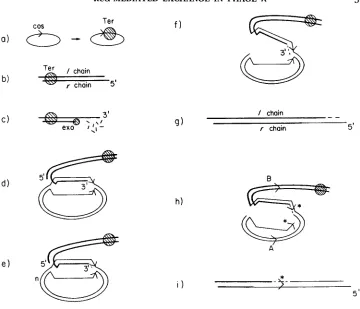
EcoRI cuts delivered to X in vivo in RecA- cells stimulate Red-mediated recombination in their vicinity (D. S. T H A L E R , personal communi cation).T h e model deduced from the properties cited above and from the estab- lished in vitro properties of the red gene protein products is shown in Figure
1 and is described in the legend.
Fact (5) above implies that a double-chain cut at cos can provoke breakjoin recombination (Figure lh). When both parents carry cuttable cos (Figure Id), the same break-join event could obtain. However, in the model as presented, we have suggested that the recombination act is completed near cos not by break-join, but by DNA synthesis primed by the invading 3‘ end (Figure le). Here, we present evidence for such DNA synthesis.
MATERIALS AND METHODS
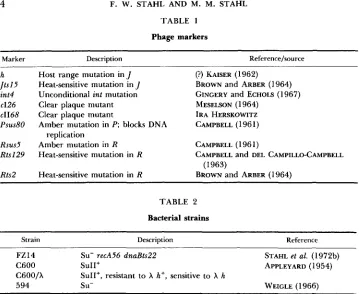
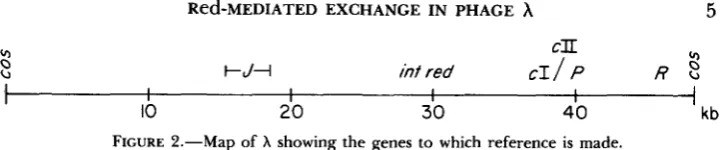
T h e phage mutations and and bacterial strains employed are described in Tables 1 and 2, respectively. Figure 2 shows the map locations of the X markers employed.
Phages were density-labeled with ”C and I5N as described in M. M. STAHL, and F. W. STAHL (1971), except that the ratio I3C/C was 0.99.
Crosses were performed in tryptone broth supplemented with 0.05 mg/ml of each of the four deoxynucleosides and with glucose at 10 mg/ml to swamp out unincorpor- ated isotope in the labeled X stocks.
Density gradient centrifugation was in cesium formate at refractive index 1.3798. After 2 days’ centrifugation in Beckman SW50.1 rotor at 27,000 or 30,000 rpm, fractions were collected through the bottom of the tube. [For further details, see M. M. STAHL and F. W. STAHL (1971), MCMILIN and Russo (1972) and STAHL et al. ( 1 972a).] For the detection of c-hets, fractions were plated on deep tryptone agar plates (M. LIEB, personal communication). c-hets were scored for markers in genes R and J
as follows: Each c-het was picked (with a sterile bit of glass tubing) into 1 ml of buffer. T h e buffer was then “spotted” on a top layer seeded with C600 and incubated at 42” to distinguish Rts129 from Rts+ and on 594 seeded with XRsus5 to distinguish Rsus5
from RSUS+. T h e h marker in gene] was scored by spotting on C600/X. [See ARBER et al. (I 983) for general X methodology.]
RESULTS
Red-MEDIATED EXCHANGE IN PHAGE 3
Ter / chain
*
r chain 5’n
f l
- -
I chain
r chain 5‘
9)
i )
0
A
*
-
-5 ‘
4
F. W . STAHL AND M. M. STAHLTABLE 1
Phage markers
Marker h Jts I5 int4 cI26 cII68 PsusdO Rsus5 Rtsl29 RtsZ Description
Host range mutation in J Heat-sensitive mutation in J Unconditional int mutation Clear plaque mutant Clear plaque mutant
Amber mutation in P ; blocks DNA
Amber mutation in R Heat-sensitive mutation in R
replication
Heat-sensitive mutation in R
Reference/source
(?) KAISER (1 962) BROWN and ARBER (1964) GINGERY and ECHOLS ( 1 967) MESELSON (1 964)
IRA HERSKOWITZ CAMPBELL (1961)
CAMPBELL ( 1 96 1 )
CAMPBELL and DEL CAMPILLO-CAMPBELL
BROWN and ARBER (1964) (1963)
TABLE 2
Bacterial strains
Strain Description Reference
FZ14 Su- recA56 dnaBts22 STAHL et al. (1972b)
C600 S U I I + APPLEYARD (1954)
C600/X SuII’, resistant to X h’, sensitive to X h
594
su-
WEIGLE (1966)from cos leftward beyond the marked site, then the resulting packaged chro- mosome will be homoduplex for that site. If degradation does not reach the marked site, then the particle will be heteroduplex. T h e heteroduplex nature of a progeny particle can be detected by a plaque assay; the amount of DNA synthesis in a progeny particle is given by its position in a cesium salt equilib- rium density gradient. Our model predicts that the amount of DNA synthesis in a particle will correlate positively with homozygosis for markers near the right end of the chromosome.
Our crosses to assess this correlation have the following features: T h e labeled (”C, I5N) parents differ by two clear-plaque mutations. One parent is c I 2 6 and the other is c I I 6 8 (see Figure
2).
Particles that are heteroduplex over both genes will be trans heteroduplexes and will be expected to make mottled plaques, since the two c mutations will .both complement and recombine to produce turbid areas in the plaques. Particles that are wild type on one chain but mutant on the other at one or the other locus will likewise make mottled plaques. Phage that are wild type on both chains are expected to be rare, and are so observed; they will make turbid plaques. We shall call all of these particles, which are detectably biparental in the c region, “c-hets.” Our first datum is simply the frequency of c-hets among the progeny of a cross as a function of position in the conserved, “fully heavy” peak.Red-MEDIATED EXCHANGE I N PHAGE 5
v,
v, CII
2
I-J+ inf red C I l P R EI I 1 I
I
I
IO 20 30 40 kb
FIGURE 2.-Map of X showing the genes to which reference is made.
trans heteroduplexes and will make plaques that contain both ts+ and sus+
particles; those heteroduplexes that are wild type on one chain will do likewise, as will the presumably rare particles that are wild type on both chains. We call all of these particles, which are detectably biparental at R, “R-hets.” Our second datum is the frequency of R-hets among c-hets as a function of position in the density gradient.
If the 1 chain of X chromosomes can be degraded from the right end to the left of c and can recover by synthesis back to cos, or part of the way back to cos, before completing the act by breaking and joining, the frequency of c-hets will vary across the conserved peak, being higher on the heavy side. On the other hand, if degradation and resynthesis cannot extend left of c, but can extend left of R , then the frequency of c-hets will be constant, but R-hets will vary across the gradient.
Both parents had an amber mutation in the P gene (Psus80), and crosses were conducted in the Su- dnaBts strain FZ14 at 41.5”, so that chromosome replication was “double-blocked” (MCMILIN and Russo 1972). T h e crosses were
cII68 Psus80 Rts129 X cI26 Psus80 Rsus5. T h e progeny of each cross was
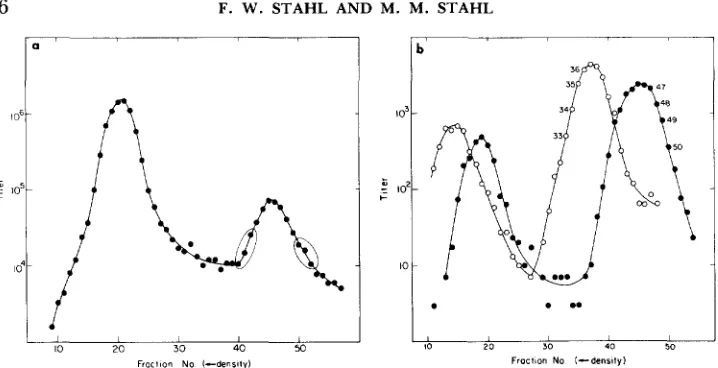
centrifuged to near equilibrium in cesium formate, and fractions were assayed for phage titer (Figures 3a and 4a). Each gradient gave a peak of unadsorbed phage and a single peak of progeny phage, which is lighter than the unad- sorbed phage by virtue of newly synthesized protein coats. T h e progeny peaks appear to be slightly broader than the unadsorbed phage peaks, suggesting some DNA synthesis. In each experiment, fractions from the heavy flank and fractions from the light flank of the progeny peak were separately pooled and recentrifuged (Figures 3b and 4b). Then, fractions from the heavy side of the rebanded pool of heavy fractions were compared with fractions from the light side of the rebanded pool of light fractions. In each experiment (Tables 3 and 4) these fractions differed from each other with respect to both the frequency of c-hets and the frequency of R-hets among c-hets. Both frequencies were greater in the heavy fractions than in the light fractions. These data support the version of our model in which DNA synthesis, primed by the invading 3’ chain, sometimes is the route by which a cos is acquired by the incipient recombinant.
6
lo3
E 102-
IO
F. W. STAHL AND M. M. STAHL
b
-
-
0 0 0.
1
10 20 30 40 50
'i
i
h' 0
1 1 , I
10 20 3 0 40 50
Froclion No I-densly1
FIGURE 3.-Experiment I. a, Density-labeled phages were crossed in the recA dnaBts strain FZ14. Replication was blocked by high temperature (39") and by the presence of Psus80 in each parent. The lysate was centrifuged in cesium formate. The left-hand peak contains unabsorbed parental phages. The right-hand peak is composed of fully conserved progeny. The replication blocks have prevented the appearance of semiconserved or fully light progeny particles. b, Frac- tions 40-42 from (a) were pooled and recentrifuged, as were fractions 50-52, in a separate tube. Fractions 33-36 from the respun heavy fractions and fractions 47-50 of the respun light fractions were analyzed to provide the data in Table 3. Key: 0, recentrifuged heavy fractions; number of fractions in this gradient was 114. 0, recentrifuged light fractions; number of fractions in this gradient was 110.
gene; see Figure 2). Our model (Figure lg) predicts that conserved progeny that are hterozygous at c and homozygous at both R and J will be recombinant for
R
and J. The mismatch correction explanation for the DNA synthesis makes no such prediction. In Experiment 111 (density profile not shown) the cI26 Psus80 RsusS parent carried theh
marker. In light fractions of rebanded light fractions, we scored c-hets for their genotype at both J and R. (In this experiment both parents were i d . This mutation, by blocking Int-dependent chromosome packaging, resulted in c-het frequencies about twice those seen in Experiments I and 11.) The J locus was typed by spotting picked c-hets onC600/X. Negative spots imply homozygosis for
h+,
whereas positive spots areeither
h
orh/h+.
Therefore, the phage of interest are those that areh+,
c-hets and homozygotes atR.
We found that 32 of 34 of the c-hets that wereh+R
homozygotes were
R
sus, the recombinant genotype for J andR.
Thus, the DNA synthesis associated with R-homozygosity is comprehended by the model in Figure 1.Which recombination pathway generates the recombinants? Our crosses are conducted with Red+ phage in recA bacteria. Since the bacterial recombi-
Red-MEDIATED EXCHANGE IN PHAGE h
a I I I 1
t
I I I I
20 30 40 50
Fraction No. (-density)
’
3 50 60
Fraction
No.
(-density)7
a
F. W. STAHL AND M. M . STAHLx D
a
M
0
*""
3
10 F. W. STAHL AND M. M. STAHL
nation pathways are RecA+-dependent, it is likely that the recombinants ob- served in our crosses are Red-mediated. T o verify this likelihood, we assessed the requirement for Red under the cross conditions we employed.
Under double-block conditions (i.e., both parents Psus80, host FZ 14), we crossed AJtsZS cI26 X RtsP. In one cross, both parents were red’; in a parallel cross, both parents were red3. In the red+ cross,
28
of 87 J + R + plaques counted were either E + homoduplexes or c/c+ heteroduplexes. These recombinants aredue to exchange in the cI-R interval. Most of the J+cR+ recombinants are presumably due to Int acting in the J-c1 interval. In the Red- cross, all of the 114 J+R+ plaques counted were c. Thus, most or all of the recombination at the right end in our experiments is, in fact, due to Red.
I DISCUSSION
We have observed DNA synthesis associated with homozygosity in nonrepli- cated, Red-mediated recombinants. We have interpreted that synthesis in terms of a model (Figure 1) in which the synthesis occurs on one chain from a point left of the homozygous site toward the right end of the recombinant chro- mosome. Within this framework, our observation that c-hets are less frequent among lighter phage suggests that this synthesis can extend from c to the right end of the chromosome (Figure
2). Since the synthesis is presumed to be
confined to one chain, 10% or more of the DNA can become light. In Figure 3b are shown the rebanded fractions of Experiment I. When plating the frac- tions from this gradient, we also plated the region corresponding to the un- absorbed phage. These unadsorbed phage peaks can be used as density refer- ences. Along with the knowledge of the total number of fractions in the gradient, they allow a rough estimate of the amount of DNA synthesis that distinguishes the heavy and the light fractions. Based on many (unpublished) observations, A progeny containing fully conserved chromosomes band halfway between the density-labeled unadsorbed phage and the fully light progeny (see also MESELSON and WEIGLE 1961). If we take the heavier progeny peak to correspond to no DNA synthesis, then the position of the lighter peak corre- sponds to 16% new DNA synthesis. This estimate of the amount of synthesis is compatible with the expectations of the model.Previous work has shown that Red-mediated recombination is dependent on replication. Recombinants in the interval from A’s left end to c are almost totally missing from the peak of fully conserved phage, but are appropriately represented in a light peak (STAHL et al. 1972b). This phenomenon has been subject to two interpretations, which are not mutually exclusive. One ex+- nation (STAHL, KOBAYASHI and STAHL 1985) supposes that, among nonrepli- cating chromosomes, cos provides the only substrate on which the Red system can act. Replicating chromosomes, on the other hand, provide suitable sub- strates for Red activity more or less everywhere along the chromosome. Since
Red-MEDIATED EXCHANGE IN PHAGE
1 1
not that replication is required to initiate recombination but that replication is necessary to complete some intermediate; that is, that Red is a break-copy system in which forked structures initiated by recombination enzymes evolve into replication forks [see MOSIG, SHAW and GARCIA
(1984)
and SKALKA(1977)l.
Two advances in our understanding of Red make the latter view less useful for X than it once was:(1)
Red can catalyze break-join recombination (STAHL, KOBAYASHI and STAHL1985);
(2) synthesis primed by a 3’ invading
end appears able to extend from left of c to cox without any apparent involve- ment of dnaB or P product, both of which may be essential components of a replication fork (for a review, see FURTH and WICKNER1983).
If polymerase alone can provide the necessary DNA synthesis to “repair” a segment of that length, then there may be no obstacle to its synthesizing the full length of A. If that is so, the lack of recombination in the middle and left arm of X in replication-blocked crosses is due to a lack of initiation structures, such as those generated by cos, rather than to a shortage of routes for completing the event.We thank SUSAN ROSENBERG, ANIMESH RAY and LYNN THOMASON for help with the manuscript. The work was supported by National Science Foundation grant PCM 8409843 and National Institutes of Health grant GM 33677-01. F.W.S. is American Cancer Society research professor of molecular genetics.
LITERATURE CITED
APPLEYARD, R. K., 1954 Segregation of new lysogenic types during growth of a doubly lysogenic strain derived from Escherichia coli K12. Genetics 3 9 440-452.
ARBER, W., L. ENQUIST, B. HOHN, N. E. MURRAY and K. MURRAY, 1983 Experimental methods for use with lambda. pp. 433-466. In: Lambda 11, Edited by R. W. HENDRIX, J. W. ROBERTS, F. W. STAHL and R. A. WEISBERG. Cold Spring Harbor Laboratory, Cold Spring Harbor, New York.
BROWN, A. and W. ARBER, 1964 Temperature-sensitive mutants of coliphage lambda. Virology
CAMPBELL, A., 1961
CAMPBELL, A. and A. DEL CAMPILLO-CAMPBELL, 1963 Mutant of lambda bacteriophage producing a thermolabile endolysin. J. Bacteriol. 8 5 1202-1207.
FURTH, M. E. and S . H. WICKNER, 1983 Lambda DNA replication. pp. 145-173. In: Lambda ZI, Edited by R. W. HENDRIX, J. W. ROBERTS, F. W. STAHL and R. A. WEISBERG. Cold Spring Harbor Laboratory, Cold Spring Harbor, New York.
GINGERY, R. and H. ECHOLS, 1967 Mutants of bacteriophage lambda unable to integrate into the host chromosome. Proc. Natl. Acad. Sci. USA 5 8 1507-1514.
KAISER, A. D., 1962 The production of phage chromosome fragments and their capacity for genetic transfer. J. Mol. Biol. 4: 275-287.
Lu, A.-L., S. CLARK and P. MODRICH, 1983 Methyl-directed repair of DNA base-pair mismatches
in vitro. Proc. Natl. Acad. Sci. USA 80: 4639-4643.
MCMILIN, K. D. and V. E. A. R u m , 1972 Maturation and recombination of bacteriophage lambda DNA molecules in the absence of DNA duplication. J. Mol. Biol. 6 8 49-55.
MESELSON, M., 1964 On the mechanism of genetic recombination between DNA molecules. J. Mol. Biol. 9 734-745.
MESELSON, M. and J. J. WEIGLE, 1961 Chromosome breakage accompanying genetic recombi- nation in bacteriophage. Proc. Natl. Acad. Sci. USA 47: 857-868.
24: 237-239.
1 2
MOSIG, G., M. SHAW AND G. M. GARCIA, 1984
F. W. STAHL AND M. M. STAHL
On the role of DNA replication, endonuclease VII, and rII proteins in processing of recombinational intermediates in phage T4. Cold Spring Harbor Symp. Quant. Biol. 4 9 371-382.
PUKKILA, P. J., J. PETERSON, G. HERMAN, P. MODRICH and M. MESELSON, 1983 Effects of high levels of DNA adenine methylation on methyl-directed mismatch repair in Escherichia coli. Genetics 104 571-582.
On the physical structure of X recombinant DNA. Mol. Gen. Genet. 122:
DNA replication-bacteriophage lambda. Curr. Top. Microbiol. Immunol.
A perspective on double-strand cuts in genetic recombination. pp. 429-440. In: Genetics: New Frontiers, Vol. 1 , Edited by V. L. CHOPRA, B. C. JOSHI, R. P. SHARMA and H. C. BANSAL. Oxford & IBH, New Delhi.
Distance from cohesive end site cos deter- mines the replication requirement for recombination in phage A. Proc. Natl. Acad. Sci. USA
STAHL, F. W., I. KOBAYASHI and M. M. STAHL, 1985 In phage A, cos is a recombinator in the Red pathway. J. Mol. Biol. 181: 199-209.
STAHL, F. W., K. D. MCMILIN, M. M. STAHL, J. M. CRASEMANN and S. LAM, 1974 The distri- bution of crossovers along unreplicated lambda bacteriophage chromosomes. Genetics 77:
STAHL, F. W., K. D. MCMILIN, M. M. STAHL, R. E. MALONE, Y. Nozu and V. E. A. Russo, 1972a A role for recombination in the production of “free-loader’’ lambda bacteriophage particles. J. Mol. Biol. 68: 57-67.
STAHL, F. W., K. D. MCMILIN, M. M. STAHL and Y. NOZU, 1972b An enhancing role for DNA synthesis in formation of bacteriophage lambda recombinants. Proc. Natl. Acad. Sci. USA 6 9
DNA synthesis associated with recombination. 11. Recom- bination between repressed chromosomes. pp. 443-453. In: The Bacteriophage Lambda, Edited by A. D. HERSHEY. Cold Spring Harbor Laboratory, Cold Spring Harbor, New York.
Red-mediated recombination in bacteriophage lambda. pp. 407-419. In: Mechanisms in Recombination, Edited by R. F. GRELL. Plenum, New York. Russo, V. E. A., 1973
SKALKA, A. M., 1977
STAHL, F. W., 1984 353-366.
78: 201-237.
STAHL, F. W., I. KOBAYASHI and M. M. STAHL, 1982
79: 63 18-632 1 .
395-408.
3598-3601.
STAHL, F. W. and M. M. STAHL, 1971
STAHL, F. W. and M. M. STAHL, 1974
STAHL, F. W. and M. M. STAHL, 1985 Non-reciprocal crossing over in phage A. J. Genet. 64: 31-39.
STAHL, M. M. and F. W. STAHL, 1971 DNA synthesis associated with recombination. I. Recom- bination in a DNA-negative host. pp. 431-442. In: The Bacteriophage Lambda, Edited by A. D. HERSHEY. Cold Spring Harbor Laboratory, Cold Spring Harbor, New York.
WEIGLE, J., 1966 Assembly of phage lambda in vitro. Proc. Natl. Acad. Sci. USA 55: 1462- 1466.