Unified Action
[S]eparate ground, sea and air warfare is gone forever. If ever again we should be involved in war, we will fight in all elements, with all services, as one single concentrated effort. Peacetime preparatory and organizational activity must conform to this fact.
President Dwight D. Eisenhower Special Message to the Congress on Reorganization
of the Defense Establishment, 3 April 1958
2-1. In full spectrum op-erations, Army forces op-erate as part of a joint force, often within a mul-tinational and interagen-cy environment. Unified action describes the wide scope of actions (including the synchronization of ac-tivities with governmen-tal and nongovernmental agencies) taking place within unified commands, subordinate unified (sub-unified) commands, or joint task forces under the overall direction of the commanders of those
com-mands. Public law charges combatant commanders with employing military forces through unified action. Under unified action, commanders integrate joint, single-service, special, and supporting operations with interagency, nongovernmental, and multinational-to include United Nations (UN}-operations (see JP 0-2).
2-2. Unified action links subordinates to the combatant commander under combatant command (command authority) (COCOM). Multinational, inter-agency, and nonmilitary forces work with the combatant commander through cooperation and coordination. Regardless of the task or the nature of the threat, combatant commanders employ air, land, sea, space, and special op-erations forces, and coordinate with multinational and interagency partners, to achieve strategic and operational objectives. They formulate theater strategies and campaigns, organize joint forces, designate operational areas, and provide strategic guidance and operational focus to subordinates. The aim is to achieve unity of effort among many diverse agencies in a complex environment. Subordinate joint force commanders (JFCs) synchronize joint operations in time and space, direct the action of foreign military forces
CONTENTS
The Levels of War 2-2
The Strategic LeveL 2-2
The Operational Level 2-2
The Tactical LeveL 2-5
Conduct of Unified Action 2-6
Joint Operations 2-6
The Other Armed Forces 2-7
Employing Army Forces in Joint
Operations 2-9
Multinational Operations 2-14
Interagency Coordination 2-18
Considerations for Unified Action 2-19
Military Considerations 2-20
Political Considerations 2-23
(multinational operations), and coordinate with governmental and nongov-ernmental organizations (interagency coordination) to achieve the same goal.
Unified Action in Haiti
In September 1994, the US Army's XVIII Airborne Corps participated in Operation Uphold Democracy, a UN-sanctioned operation to return Haiti's deposed president, Jean-Bertrand Aristide, to office. The National Security Council's Haiti Interagency Working Group planned the operation with the UN, Joint Chiefs of Staff, US Atlantic Command, and XVIII Airborne Corps. Together, the agencies and headquarters developed flexible force deployment options that reflected changing political conditions. Army forces with staff augmentation served as Joint Task Forces (JTFs) 180 and 190. On arrival, they stabilized the country until President Aristide's return. JTF 190 worked with the combatant commander, supporting governmental and nongovernmental agencies, joint and multinational forces, and nongovernmental organizations to secure the cities and countryside, disarm the Haitian military, replace the local police, and assist the Haitian people. Army forces then supported the UN by stabilizing the country until elections were held in March 1995.
THE LEVELS OF WAR
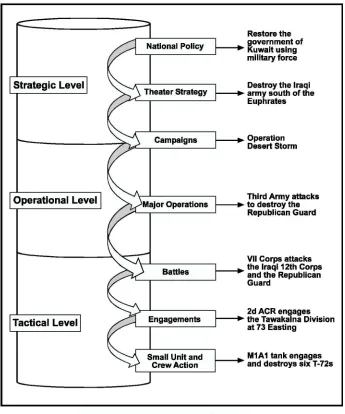
2-3. The levels of war are doctrinal perspectives that clarify the links be-tween strategic objectives and tactical actions. Although there are no finite limits or boundaries between them, the three levels are strategic, operational and tactical. Understanding the interdependent relationship of all three helps commanders visualize a logical flow of operations, allocate resources, and assign tasks. Actions within the three levels are not associated with a particular command level, unit size, equipment type, or force or component type. Instead, actions are defined as strategic, operational, or tactical based on their effect or contribution to achieving strategic, operational, or tactical objectives (see Figure 2-1).
THE STRATEGIC LEVEL
2-4. The strategic level is that level at which a nation, often as one of a group of nations, determines national and multinational security objectives and guidance and develops and uses national resources to accomplish them. Strategy is the art and science of developing and employing armed forces and other instruments of national power in a synchronized fashion to secure national or multinational objectives. The National Command Authorities (NCA) translate policy into national strategic military objectives. These national strategic objectives facilitate theater strategic planning. Military strategy, derived from policy, is the basis for all operations (see JP 3-0).
THE OPERATIONAL LEVEL
within theaters or areas of operations (AOs). It links the tactical employment of forces to strategic objectives. The focus at this level is on operational art-the use of military forces to achieve strategic goals through the design, or-ganization, integration, and conduct of theater strategies, campaigns, major operations, and battles. A campaign is a related series of military operations aimed at accomplishing a strategic or operational objective within a given time and space. A major operation is a series of tactical actions (bat-tles, engagements, strikes) conducted by various combat forces of a single or several services, coordinated in time and place, to accom-plish operational, and sometimes strategic objectives in an opera-tional area. These actions are conducted simultaneously or sequentially un-der a common plan and are controlled by a single commander. Operational art determines when, where, and for what purpose major forces are employed to influence the enemy disposition before combat. It governs the deployment of those forces, their commitment to or withdrawal from battle, and the
Strategic level
Operational level
Tactical level
National Policy
Restore the government of Kuwait using military force
Theater Strategy army south of theDestroy the Iraqi Euphrates
Campaigns Operation Desert Storm
Third Army attacks to destroy the Republican Guard
Battles
VIICorps attacks the Iraqi 12th Corps and the Republican Guard
Engagements 2d ACR engagesthe Tawakalna Division at 73 Easting
M1A1tank engages and destroys six T-72s Small Unit and
Crew Action
arrangement of battles and major operations to achieve operational and strategic objectives. Figure 2-1 (page 2-3) illustrates the link between the levels of war and the plans and actions of military forces.
2-6. Operational art helps commanders use resources efficiently and effec-tively to achieve strategic objectives. It includes employing military forces and arranging their efforts in time, space, and purpose. Operational art helps commanders understand the conditions for victory before seeking battle. It provides a framework to assist commanders in ordering their thoughts when designing campaigns and major operations. Without operational art, war would be a set of disconnected engagements with relative attrition the only measure of success. Operational art requires commanders who can visualize, anticipate, create, and seize opportunities. It is practiced not only by JFCs, but also by their senior staff officers and subordinate commanders.
2-7. Operations usually imply broader dimensions of time and space than tactics; the strategic orientation at the operational level requires command-ers to look beyond the immediate situation. While tactical commanders fight the current battle, operational commanders look deeper in time, space, and events. They seek to shape the possibilities of upcoming events in advance to create the most favorable conditions possible for subordinate commanders, whose tactical activities execute the campaign. Likewise, operational com-manders anticipate the results of battles and engagements, and prepare to exploit them to obtain the greatest strategic advantage.
2-8. Operational commanders continually communicate with their strategic superiors to obtain direction and ensure common understanding of events. Mutual confidence and communications among commanders and staffs allow the flexibility to adapt to tactical circumstances as they develop. Tactical re-sults influence the conduct of campaigns through a complex interaction of op-erational and tactical dynamics. Operational commanders create the condi-tions for the conduct of battles and engagements, while the results of battles and engagements shape the conduct of the campaign. In this regard, com-manders exploit tactical victories to gain strategic advantage, or even to re-verse the strategic effect of tactical losses.
2-9. Operational art is translated into operation plans through operational design. A well-designed plan and successfully executed operation shape the situation for tactical actions. Executed skillfully, a good plan increases the chances of tactical success. It does this by creating advantages for friendly forces and disadvantages for the enemy. A flexible plan gives tactical com-manders freedom to seize opportunities or react effectively to unforeseen en-emy actions and capabilities. Flexible execution maintains the operational initiative and maximizes tactical opportunities.
the chances of tactical success, are important attributes of an operational commander. Tactical commanders must understand the operational context within which battles and engagements are fought as well. This understand-ing allows them to seize opportunities (both foreseen and unforeseen) that contribute to achieving operational goals or defeating enemy initiatives that threaten those goals. Operational commanders require experience at both the operational and tactical levels. From this experience, they gain the instincts and intuition, as well as the knowledge, that underlie an understanding of the interrelation of tactical and operational possibilities and needs.
2-11. Among many considerations, operational art requires commanders to answer the following questions:
.
What military (or related political and social) conditions must be pro-duced in the operational area to achieve the strategic goal (ends)?.
What sequence of actions is most likely to produce that condition(ways)?
.
How should resources be applied to accomplish that sequence of actions (means)?.
What are the likely costs or risks in performing that sequence of ac-tions (risk management)?THE TACTICAL LEVEL
2-12. Tactics is the employment of units in combat. It includes the ordered arrangement and maneuver of units in relation to each other, the terrain, and the enemy to translate potential combat power into victorious battles and engagements. A battle consists of a set of related engagements that last longer and involve larger forces than an engagement. Battles can affect the course of a campaign or major operation. An engagement is a small tactical conflict between oppos-ing maneuver forces, usually conducted at brigade level and below. Engagements are usually short-minutes, hours, or a day (see FM 3-90).
2-13. Tactics is also the realm of close combat, where friendly forces are in immediate contact and use direct and indirect fires to defeat or destroy en-emy forces and to seize or retain ground. Exposure to close combat separates Army forces from most of their counterparts. Army forces fight until the pur-pose of the operation is accomplished. Because of this, they are organized to endure losses, provided with combat service support (CSS) to generate and sustain combat power, and trained to deal with uncertainty.
Operation Assured Response-An Example of Joint Synergy
During the 1996 Operation Assured Response in Liberia, forces from the Republic of Georgia, Italy, and Germany joined with US special operations, Air Force, Navy, and Marine forces to conduct a noncombatant evacuation operation. In early April 1996, gunmen had filled the streets of Monrovia, Liberia, as the country split into armed factions intent on seizing power. The situation worsened as faction members took hostages. On 9 April, President Clinton ordered the US military to evacuate American personnel and designated third-party foreign nationals. The Army deployed Special Forces, an airborne company, signal augmentation and a medical section as part of a special operations task force from Special Operations Command-Europe. Army forces entered Monrovia's Mamba Point embassy district, where they established security for international relief agencies headquartered there. Additional Army forces reinforced the Marine guards at the American embassy and secured the central evacuee assembly collection point. Upon securing the evacuees, Navy helicopters took them to Sierra Leone. The combined capabilities of Army forces, other services, and multinational troops demonstrated joint synergy and resulted in the successful evacuation of individuals from 73 countries.
CONDUCT OF UNIFIED
ACTION
2-15. In unified action, Army forces synchronize their actions with those of other participants to achieve unity of effort and accomplish the combatant commander's objectives. The capabilities of joint, multinational, and inter-agency partners can expand strengths, compensate for limitations, and pro-vide operational and tactical depth to Army forces.
JOINT OPERATIONS
2-16. Joint operations involve forces of two or more services un-der a single commanun-der. Land op-erations and joint operations are mutually enabling-land opera-tions are inherently joint opera-tions. Joint integration allows JFCs to attack an opponent throughout the depth of their AO, seize the initiative, maintain mo-mentum, and exploit success. Ef-fective joint integration does not require joint commands at all
echelons, but does require understanding joint synergy at all levels of com-mand. Joint synergy extends the concept of combined arms synergy familiar to soldiers. The strengths of each service component combine to overcome the limitations or reinforce the effects of the other components. The combination of multiple and diverse joint force capabilities creates military power more potent than the sum of its parts.
Unless limited by the establishing directive, the commander of the sup-ported force will have the authority to exercise general direction of the sup-porting effort. General direction in-cludes the designation and prioritiz-ation of targets or objectives, timing and duration of the supporting ac-tion, and other instructions necessary for coordination and efficiency.
2-17. JFCs often establish supported and supporting relationships among components. They may change these relationships between phases of the campaign or major operation or between tasks within phases. Each subordi-nate element of the joint force can support or be supported by other elements. For example, the Navy component commander or joint force maritime compo-nent commander (JFMCC) is normally the supported commander for sea con-trol operations; the joint force air component commander (JFACC) is nor-mally the supported commander for counter air operations. Army forces may be the supporting force during certain phases of the campaign and become the supported force in other phases. Inside JFC-assigned AOs, Ihe land and naval force commanders are the supported commanders and synchronize ma-neuver, fires, and interdiction.
THE OTHER ARMED FORCES
2-18. Through Title 10, US Code (USC), and DODD 5100.1, Congress has or-ganized the national defense and defined the function of each armed service. All US armed forces-Army, Air Force, Navy, Marine Corps, Coast Guard-and special operations forces (SOF) are required to provide globally respon-sive assets to support combatant commanders' theater strategies and the national security strategy. The capabilities of the other armed forces comple-ment those of Army forces. During joint operations, they provide support consistent with JFC-directed missions.
Air Force
2-19. Air Force air platform support is invaluable in creating the conditions for success before and during land operations. Support of the land force com-mander's concept for ground operations is an essential and integral part of each phase of the operation. Air Force strategic and intratheater airlift, di-rected by US Transportation Command, supports the movement of Army forces, especially initial-entry forces, into an AO. Air assets move Army forces between and within theaters to support JFC objectives. Fires from Air Force systems create the conditions for decisive land operations. In addition, the Air Force provides a variety of information-related functions--to include in-telligence, surveillance, and reconnaissance--that support land operations.
2-20. Support from Army forces made available to the JFACC for tasking-including Army aviation, air defense, military intelligence, and field artillery-is invaluable in accomplishing portions of the counterair, interdic-tion, theater reconnaissance, and surveillance missions. Such missions may support operations directed by the land component commander or JFC. The effectiveness of air interdiction and close air support depends, to a large de-gree, on integrating land maneuver with the joint force concept of operations. Land force commanders understand that defeating enemy air and space ca-pabilities is necessary to ensure freedom of action on the ground.
Navy and Marine Corps
designated sea areas and the associated airspace and underwater volume. It affords Army forces uninhibited transit to any trouble spot in the world.
2-22. Maritime power projection covers a broad spectrum of offensive naval operations. Those most important to Army force operations include employ-ment of carrier-based aircraft, lodgment by amphibious assault or maritime pre-positioned deployment, and naval bombardment with guns and missiles. Naval forces establish and protect the sea routes that form strategic lines of communications for land forces. The Navy provides strategic sealift vital for deploying Army forces. Army forces cannot conduct sustained land operations unless the Navy controls the sea. Additionally, naval forces augment theater aerospace assets and provide complementary amphibious entry capabilities.
2-23. The Marine Corps, with its expeditionary character and potent forcible entry capabilities, complements the other services with its ability to react rapidly and seize bases suitable for force projection. The Marine Corps often provides powerful air and ground capabilities that complement or reinforce those of Army forces. When coordinated under a joint force land component commander (JFLCC), Army and Marine forces provide a highly flexible force capable of decisive land operations in any environment.
Coast Guard
2-24. The Coast Guard is an armed force under the Department of Transpor-tation. It has a statutory civil law enforcement mission and authority. Army forces support Coast Guard forces, especially during counterdrug interdiction and seizure operations. When directed by the president or upon a formal declaration of war, the Coast Guard becomes a specialized service under the Navy. The Coast Guard and Navy cooperate in naval coastal warfare mis-sions during peace, conflict, and war. During deployment and redeployment operations, the Coast Guard supports force projection. It protects military shipping at seaports of embarkation and debarkation in the US and overseas. The Coast Guard supports JFCs with port security units and patrol craft.
Special Operations Forces
2-25. SOF provide flexible, rapidly de-ployable capabilities that are useful across the range of military operations. SOF can reinforce, augment, and com-plement conventional forces. They can also conduct independent operations in situations that demand a small, discrete, highly trained force. SOF provide the NCA and combatant commanders with options that limit the risk of escalation that might otherwise accompany the
commitment of larger conventional forces. In war, SOF normally support the theater campaign or major operations of the JFC. In military operations other than war (MOOTW), SOF support combatant commander theater en-gagement plans, often directly supporting a US ambassador. Combatant com-manders establish or designate operational command and support rela-tionships for SOF based on mission requirements.
Army Special Operations
Forces
.
Special Forces.
Rangers.
Special operations aviation.
Civil affairs.
Psychological operations.
Signal units2-26. Land force commanders frequently require Army special operations forces (ARSOF) assets. ARSOF can conduct diverse missions and are a valuable combat multiplier for land operations (see FM 3-05). For example, psychological operations units can fuse the capabilities of US government de-partments and agencies to counter adversary propaganda, misinformation and disinformation. SOF language capabilities and regional and cultural skills are also useful in stability operations and support operations.
EMPLOYING ARMY FORCES IN JOINT OPERATIONS
2-27. Joint doctrine describes the employment of US forces in joint operations. Army force commanders are always either subordinate to or designated as a JFC. Understanding the command and control (C2) re-lationships among the compo-nents of a joint force is the key to effective joint operations.
Army Forces in Unified Commands
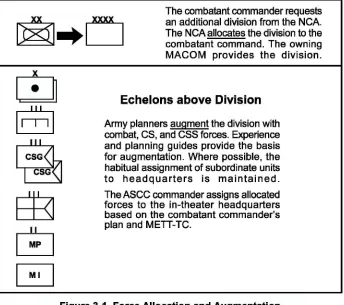
2-28. Except for forces ex-empted by the secretary of defense, military departments assign all forces, to include nonfederalized Army National Guard and unmobilized US Army Reserve forces, under COCOM of combatant com-manders (see JP 0-2). The Joint Strategic Capabilities Plan (JSCP) apportions major Army forces by type to combatant commanders for de-liberate planning. In addition to forces assigned in peace-time, Army forces are allocated to combatant commanders in response to crises. The secretary of defense, through
the chairman of the Joint Chiefs of Staff, directs commanders to reinforce the supported combatant augmentation forces.
Assigned forces are those forces that have been placed under the
combatant command (command
authority) of a unified command-er by the secretary of defense. Forces and resources so assigned are available for normal peace-time operations of that command.
Apportioned forces and resourc-es are those made available for deliberate planning as of a cer-tain date. They may include as-signed, those expected through mobilization, and those program-med.
Allocated forces and resources are those provided by the NCA for execution planning or actual implementation.
Augm.entation forces are forces to be transferred from a sup-porting commander to the
com-batant command (command
au-thority) or operational control of a supported commander during the execution of an operation order approved by the NCA.
other combatant commander with
Chain of Command
departments to their respective major service commands. An administrative control relationship exists between the secretary of the military department and the respective service component commands. It is for carrying out the military departments' Title 10 responsibilities of recruiting, manning, equipping, training, and providing service forces to the combatant commanders. Although the service branch of the chain of command is distinct from the operating branch, both the Army service component command (ASCC) and the ARFOR operate within the combatant commander's chain of command.
COCOM
Service Forces
(not assigned by
"Forces For")
- -
,
I I I I I I I I I
Service Component Commands
OPCON I Service Componentl
Forces
OPCON
I I J
I I I I I I I I I I
Subordinate Unified Command
Service Componentl
Forces OPCONfTACON
I
Service ComponentlForces
I I 1
OPCONfTACON I
---
ServiceComponentl Forces
Note:
This diagram is only an example. It does not prescribe joint force organization. Service components at lower echelons may only contain service forces.
LEGEND
-
Chain of Command- - - -
Administrative Control-. -
Channel of CommunicationEstablishes and As required by
gain-As required by gaining maintains commu- ing component
com-nications with: mander command
Haspriorities Gaining component
Gaining command established by: commander
Gaining unit can OPCON; TACON; OPCON; TACON;direct impose further direct support; mutual support; mutual support; command relation- support; general sup- general support; close
shipl authority of: port; close support support
Command Relationships
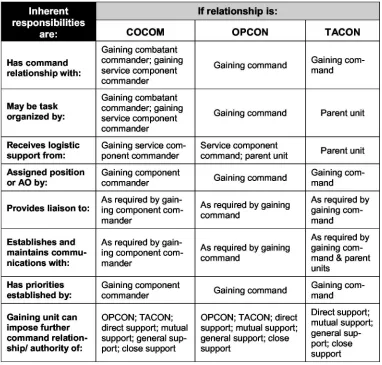
2-30. At theater level, when Army forces operate outside the US, they are as-signed under a JFC (see JP 0-2; JP 3-0; FM 3-100.7). A JFC is a combatant commander, subunified commander, or joint task force (JTF) commander authorized to exercise COCOM or operational control (OPCON) over a joint force. Combatant commanders provide strategic direction and operational fo-cus to forces by developing strategy, planning theater campaigns, organizing the theater, and establishing command relationships. JFCs plan, conduct, and support campaigns in the theater of war, subordinate theater campaigns, major operations, and battles. The four joint command relationships are COCOM, OPCON, tactical control (TACON), and support (see Figure 2-3).
Inherent responsibilities
are:
Has command relationship with:
If relationship is:
COCOM OPCON TACON
Gaining combatant commander; gaining service component commander
Gaining command Gaining com-mand
May be task organized by:
Receives logistic support from:
Assigned position or AO by:
Provides liaison to:
Gaining combatant commander; gaining service component commander
Gaining service com-ponent commander
Gaining command
Service component command; parent unit
Parent unit
Parent unit
Gaining com-mand
As required by gaining com-mand Gaining component
commander Gaining command
As required by gain-ing component com-mander
As required by gaining command
As required by gaining com-mand & parent units Gaining com-mand Direct support; mutual support; general sup-port; close support Figure 2-3. Joint Command Relationships and Inherent Responsibilities
2-31. Combatant Command (Command Authority). COCOM is a
commands, service component commands, functional component commands, and JTFs.
2-32. Operational Control. OPCON is inherent in COCOM. It is the auth-ority to perform those functions of command that involve organizing and employing commands and forces, assigning tasks, designating objectives, and giving authoritative direction necessary to accomplish the mission. OPCON may be exercised at any echelon at or below the level of the combatant com-mand. It can be delegated or transferred. Army commanders use it routinely to task organize forces. The secretary of defense must approve transferring OPCON of units between combatant commanders.
2-33. Tactical Control. TACON is authority normally limited to the de-tailed and specified local direction of movement and maneuver of forces to ac-complish a task. It allows commanders below combatant command level to apply force and direct the tactical use of CSS assets but does not provide authority to change organizational structure or direct administrative or logis-tic support. The commander of the parent unit continues to exercise those responsibilities unless otherwise specified in the establishing directive Com-batant commanders use TACON to delegate limited authority to direct the tactical use of combat forces. TACON is often the command relationship es-tablished between forces of different nations in a multinational force. It may be appropriate when tactical-level Army units are placed under another service headquarters. Army commanders make one Army force TACON to another when they want to withhold authority to change the subordinate force organizational structure and leave responsibility for administrative support or CSS with the parent unit of the subordinate force.
2-34. Administrative Control. Unless the secretary of defense specifies otherwise, ad-ministrative control (ADCON) of Army forces remains within the Army chain of com-mand, from lowest lev-els to the ASCC to the secretary of the Army. Administrative control is the direction or exer-cise of authority over subordinate or other organizations with
re-spect to administration and support. It includes organization of service forces, control of resources and equipment, personnel management, unit logistics, individual and unit training, readiness, mobilization, demobilization, discipline, and other matters not included in operational missions of the subordinate or other organizations. ADCON is synonymous with Title 10 USC administration and support responsibilities. It is always subject to the command authority of the combatant commander.
Sample Army ADCON Responsibilities
.
Personnel (including postal and personnel accounting).
Finance (including commercial or vendor services).
Medical and dental.
Legal.
Provost marshal.
Logistics: Classes I, II, III, IV, and IX, maintenance, distribution, contracting, and mortuary affairs.
General engineering (including public works)CATEGORY DEFINITION
General support The action given to the supported force as a wholerather than to a particular subdivision thereof.
The action that units render each other against an
Mutual support enemy because of their assigned tasks, their position
relative to each other and to the enemy, and their inherent capabilities.
A mission requiring a force to support another
Direct support specific force and authorizing it to answer directly the supported force's request for assistance.
The action of the supporting force against targets or objectives that are sufficiently near the supported
Close support force as to require detailed integration or coordination of the supporting action with fire, movement, or other actions of the supported force.
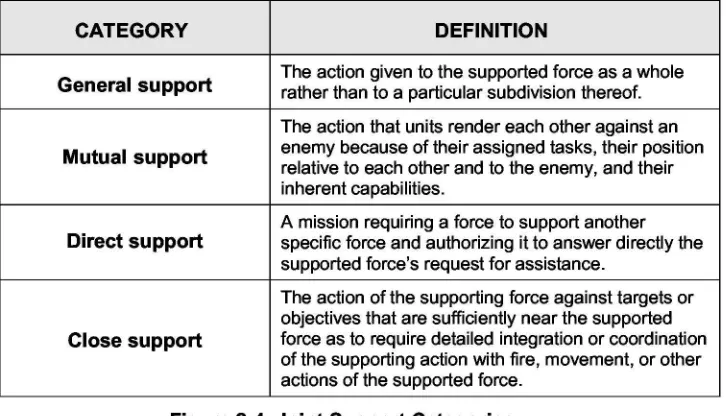
2-35. Support. Joint doctrine establishes support as a command authority. Commanders establish it between subordinate commanders when one organization must aid, protect, or sustain another (see JP 0-2;JP 3-0). Under joint doctrine, there are four categories of support (see Figure 2-4). General
and direct support describe the supporting command's focus. Mutual and close support are forms of activity based on proximity and combat actions. Army doctrine establishes four support relationships: direct, reinforcing, gen-eral, and general support reinforcing (see Chapter 4).
Figure 2-4. Joint Support Categories
The Army Service Component Command
2-36. The ASCC commander is the senior Army commander in a combatant commander's area of responsibility. The ASCC commander, using ADCON authority, is responsible for the Army Title 10 functions of preparing, main-taining, training, equipping, administering, and supporting Army forces at-tached to joint forces subordinate to the combatant command. Peacetime training of assigned Army forces is also under the ASCC. Combatant com-manders may assign ASCCs responsibility for significant lead-service combat support (such as chemical decontamination) or common user logistic (CUL) functions. The ASCC also provides theater-strategic and operational-level support to combatant command campaign and major operation planning.
include---.
Recommending to the JFC or subunified commander the proper em-ployment of Army component forces..
Accomplishing operational missions as assigned..
Selecting and nominating Army units for assignment to subordinate theater forces..
Informing the combatant commander of Army CSS effects on opera-tional capabilities..
Providing data to supporting operation plans as requested..
Ensuring signal interoperability.TheARFOR
2-38. An ARFOR consists of the senior Army headquarters and all Army forces assigned or attached to a combatant command, subordi-nate joint force command, joint functional command, or multina-tional command. Providing Army forces within a joint operational area (JOA) is the responsibility of the ASCC of the combatant command. The term ARFOR is commonly used to describe both the headquarters of the Army forces provided to the joint force and the Army forces themselves. An ARFOR commander may not have OPCON of all of Army forces provided to the JFC; however, the ARFOR commander remains responsible for their administra-tive control (ADCON). See FM 3-100.7 for ARFOR organizational structures.
2-39. An ARFOR is designated whenever Army forces are involved in an op-eration. Even if separate Army forces are conducting independent operations within a JOA, there is only one ARFOR headquarters in that JOA. ASCCs, numbered army, and corps headquarters (with augmentation) are capable of serving as ARFOR headquarters. In certain smaller-scale contingencies, a di-vision headquarters may be designated as ARFOR headquarters; however, a division headquarters requires extensive augmentation for this mission.
2-40. The ARFOR commander may also serve as JFLCC. A dual-hatted ARFOR commander normally gives some Army-specific tasks to a deputy commander. However, if an ARFOR commander becomes JTF commander, the next senior Army headquarters assumes ARFOR responsibilities. Combatant commanders may receive another Army headquarters for this.
2-41. An ARFOR headquarters may have a TSC attached to perform operational-level logistic and personnel support tasks. These include Title 10 lead service CUL support responsibilities and interagency support re-quirements.
MULTINATIONAL OPERATIONS
2-43. Multinational operations are con-ducted within the structure of an alliance or a coalition (see JP 3-16; FM 3-16). Mili-tary alliances, such as the North Atlantic Treaty Organization (NATO), may afford participating nations time to establish formal, standard agreements for broad, long-term objectives. Alliance members strive to field compatible military systems, establish common procedures, and develop contingency plans to meet potential threats in a fully integrated manner.
2-44. Nations usually form coalitions for
focused, short-term purposes. Often, coalition operations are conducted under the authority of a UN resolution. In successful coalitions, all parties agree to the commitment of forces, even if the resources each invests are different. While each nation has its own agenda, each brings value to the coalition, even if solely by contributing to the legitimacy of the enterprise.
2-45. An Army force com-mander designated as a multinational force com-mander faces many com-plex demands. These may include dealing with cul-tural issues, interoper-ability challenges, and an immature theater C2 or-ganization. Commanders may also be required to address different national procedures, the sharing of intelligence, and theater support functions. Since coalition operations are not structured around standing agreements, a preliminary understanding of the requirements for operating with a specific
foreign military may occur through peacetime military engagement. These developmental activities include, but are not limited to, ongoing personal contacts, pre-positioning of equipment, exercises, exchange programs, and humanitarian assistance. Every multinational operation is different. Commanders analyze the mission's peculiar requirements so they can exploit the advantages and compensate for the limitations of a multinational force.
An alliance is the result of formal agreements (i.e., treaties) between two or more nations for broad, long-term ob-jectives which further the common interests of the members.
A coalition is an ad hoc arrangement between two or more nations for common action.
The written basis for allied unity of command is found in directives issued by the Combined Chiefs of Staff. The true basis lies in the earnest cooperation of the senior officers assigned to an allied theater. Since coop-eration, in turn, implies such things as self-lessness, devotion to a common cause, gener-osity in attitude, and mutual confidence, it is easy to see that actual unity in an allied command depends directly upon the individ-uals in the field This problem involves the human equation and must be met day by day. Patience, tolerance, frankness, absolute hon-esty in all dealings, particularly with all persons of the opposite nationality, and firm-ness, are absolutely essential.
General Dwight D. Eisenhower "Memorandum for an Allied Command. For Admiral Louis Mountbatten," 1943
partners provide additional resources to address the CSS challenges inherent in a force projection strategy. Deploying and employing combat power from a force projection base that is friendly, secure, and close to the AO-especially when that base offers a mature infrastructure-is preferable to making a forcible entry from a distant base.
2-47. The Army TSC normally provides multinational CSS and, with proper augmentation, other specific CSS functions. Although each nation is respon-sible for sustaining the forces it deploys, multinational CSS may achieve sig-nificant economy of force. Multinational CSS may be provided by lead nation, role specialist nation, or acquisition and cross-service agreements. However, an international agreement is required to provide support under the lead na-tion and role specialist nation methods. Ideally, the TSC provides common multinational CSS, and with proper augmentation, other CSS functions, as the ASCC determines. For theater-level support operations to function prop-erly, combatant commanders must clearly articulate their CSS priorities. The formation of multinational CSS staff sections facilitates CSS coordination, reduces competition among multinational partners for common support, and lessens the burden on each (see JP 4-08).
Command and Control of Multinational Operations
2-48. Unity of command is unlikely in multinational operations. The level of command authority vested in a multinational force commander is established by agreement among the multinational partners. The president of the United States retains command authority over US forces. Most nations have similar restrictions. However, in certain circumstances, it may be prudent or advan-tageous to place Army forces under OPCON of a foreign commander.
2-49. To compensate for limited unity of command, commanders concentrate on achieving unity of effort. Consensus building, rather than direct command authority, is often the key element of successful multinational operations. Political and military policies of multinational partners can limit options for the organization of a multinational command. Long-standing alliances, such as NATO, have integrated command structures with designated nations pro-viding force commanders. Staffs are integrated, and senior representatives from member nations often lead subordinate allied commands. Coalition command is more challenging because it involves combining forces with no standing C2 arrangements. Command relationships and C2 structures usu-ally evolve as the coalition develops. Multinational C2 structures are usually one of three types: parallel command, lead nation command, or a combination of the two (see JP 3-16).
2-51. Lead nation command exists when the nation providing most of the forces and resources provides the multinational force commander. The lead nation can retain its own C2 structure and employ other national forces as subordinate formations. Commanders may combine other nations' staffs to better coordinate complementary capabilities. More commonly, limited integration of national staffs characterizes lead nation command. Lead nation and parallel command structures can exist simultaneously within a multina-tional force. This occurs when two or more nations serve as controlling ele-ments for a mix of international forces. This was the command arrangement used by the Gulf War coalition. Western national forces were aligned under US leadership while Islamic forces were aligned under Saudi leadership.
2-52. The creation of an effective multinational staff requires experience, imagination, and cultural sensitivity. There is always a temptation to push multinational participants into secondary positions and do things according to US Army doctrine or habit. Long-term friction and potentially catastrophic misunderstandings usually cancel out the short-term gain in productivity these actions produce. Multinational commanders carefully tailor the staff to balance coalition and US officers, and take particular care to accord coalition officers the same access and influence as their countrymen.
2-53. During multinational operations, US forces establish liaison with as-signed multinational forces early. Additional specialized liaison personnel in fields such as aviation, fire support, engineer, intelligence, public affairs, and civil affairs are also exchanged based on mission requirements. This integra-tion fosters common understanding of missions and tactics, facilitates trans-fer of information, and enhances mutual trust and confidence.
2-54. An integrated command structure is probably most effective when partners are similar in culture, doctrine, training, and equipment, or if ex-tensive cooperative experience exists. This approach requires each troop-con-tributing nation to receive, understand, plan, and implement missions the same way as the other troop-contributing nations. However, if the multina-tional force is composed of dissimilar nations, it may require a modified ap-proach to achieve unity of effort. The JFC or multinational force commander may use his own staff for most planning functions, other national augmen-tees for their national expertise, and liaison officers to translate and relay in-structions to their national forces. As capabilities develop, commanders may also consider using coordination centers to enhance stability and interaction within the multinational force (see JP 3-16; FM 3-16).
Conducting Multinational Operations
2-55. Commanders have to accommodate differences in operational and tacti-cal capabilities among multinational forces. For example, not all armies have the staff structures or means to process, reproduce, or rapidly disseminate plans and orders. Decision authority delegated to staffs and subordinate commanders also varies among armies.
and fire support coordinating measures (FSCMs). All elements of the force must fully understand and strictly adhere to them. Detailed war-gaming, planning, and rehearsals help develop a common understanding of the operation plan and control measures. Operational and tactical plans address recognition signals, FSCMs, air support, communications, and liaison.
2-57. The collection, production, and dissemination of intelligence are major challenges in a multinational operation. There are many instances in which direct access to finished intelligence, raw data, source information, or intelli-gence systems is not allowed outside national channels. Multinational part-ners also normally operate separate intelligence systems to support their own policy and military forces. These national systems may vary widely in sophis-tication and focus. However, at a minimum, each nation contributes valuable human intelligence to the multinational effort. Commanders establish sys-tems that maximize each nation's contribution and provide an effective intel-ligence picture to all units. Commanders arrange for the rapid dissemination of releasable intelligence and the use of available intelligence assets by all partners. A multinational intelligence staff at the headquarters facilitates in-tegration of intelligence efforts.
2-58. Mission assignments of multinational units should reflect the capabili-ties and limitations of each national contingent. Some significant factors are relative mobility and size; intelligence collection assets; and long-range fire, SOF, and organic CSS capabilities. The ability to contribute to theater air and missile defense, training for operations in special environments, and preparing for defensive operations involving weapons of mass destruction is also important. Rapport with the local population, language considerations, and special skills should be considered as well. Multinational commanders may assign host nation forces home defense or police missions, such as rear area and base security. They may also entrust air defense, coastal defense, or a special operation to a single member of the multinational force based on the special capabilities of that force. The national pride of multinational partners is an important intangible factor that is considered when assigning missions.
INTERAGENCY COORDINATION
2-59. The instruments of national power complement and reinforce each other. By understanding the influence of other agencies, commanders can add diplomatic, informational, and economic depth to their military efforts. US military capabilities allow other agencies to interact with foreign powers from a position of strength and security. Just as integrating different unit capabili-ties results in the advantages of combined arms warfare, so synchronizing military power with other instruments of national power leads to dynamic strategic capabilities.
reports through the interagency working group to the Joint Staff. The Joint Staff links the JFC to this process.
2-61. The intricate links among the instruments of national power demand that commanders consider how all capabilities and agencies can contribute to achieving the desired end state. Interagency coordination forges a vital link between military operations and the activities of organizations such as nongovernmental organizations (NGOs); governmental agencies of the US, host nation, and partner nations; and regional, international, and UN organi-zations. Theater strategies routinely employ the capabilities of the entire US interagency network. The National Security Act of 1947 establishes an inter-agency process for national security-related issues. The National Security Council provides national-level oversight of this process (see JP 3-08).
2-62. Interagency cooperation poses challenges. Among the most difficult is lack of mutual familiarity among the various agencies. In joint operations, leaders from the different services generally share a common tradition and understanding of military matters. Interagency operations bring together leaders and staffs that often have no common experiences. The institutional values and experiences of the separate agencies and departments sometimes have few common points of reference. Some may even conflict. However, edu-cation and teamwork can create an understanding and awareness of the mis-sions, strengths, weaknesses, and outlooks of the interagency members. This understanding can mitigate the friction inherent in interagency operations.
2-63. Along with international, host nation, and official US agencies, Army forces frequently operate with NGOs, such as the American Red Cross and World Emergency Relief. Working with NGOs often requires soldiers and leaders to be flexible and adaptive. Sometimes these organizations may not care to cooperate with military forces. However, US armed forces cooperate as much as their mission allows. Effective cooperation and coordination with NGOs reinforces the legitimacy of the armed forces involved in a unified ac-tion. Often NGOs-if they are well disposed toward the military--can provide useful information and insights concerning the local populace.
2-64. NGO capabilities can dramatically reduce the military resources re-quired for civil-military operations. NGOs have local contacts and experi-ences. They conduct such diverse activities as education, technical projects, relief activities, refugee assistance, public policy, and developmental pro-grams. NGOs are frequently on the scene of a crisis before US forces. They routinely operate in high-risk areas and usually remain long after military forces have departed. They are a significant factor and must be integrated into planning, preparing, executing, and assessing military operations. Commanders consider the activities of NGOs as well as mutual security and resource or support requirements when conducting unified action.
CONSIDERATIONS
FOR UNIFIED ACTION
MILITARY POLITICAL CULTURAL
. Targeting
.
Goals and objectives.
Culture and language.
Fire support coordination.
National control of.
Communication.
Air and missile defense forces.
Media relations.
Teamwork and trust.
Consensus building.
Law enforcement.
Doctrine, organization,and training
.
Equipmentbut highlight factors important to effectively employing Army forces in uni-fied action.
Figure 2-5. Considerations for Unified Action
MILITARY CONSIDERATIONS
2-66. Unified action requires commanders to consider the same military fac-tors they consider when conducting joint operations (see FM 3-16; FM 3-16). However, participation of multinational and interagency partners adds addi-tionallayers of complexity. The following areas require additional attention from commanders and staffs of units conducting unified action.
Targeting
2-67. The JFC defines how the land component participates in the joint tar-geting process. JFCs may delegate targeting oversight functions to a
subordi-nate commander or may establish a joint or multinational targeting board. The targeting board may serve as either an integrating center or review mechanism. It prepares targeting guidance, refines joint target lists, and re-views target information from a campaign perspective. It is not normally in-volved in selecting specific targets and aim points or in developing attack packages (seeJP 3-60; FM 3-60).
Fire Support Coordination
2-68. JFCs and multinational force
L t d
.
t..
t.
t.
n er, IC Ion IS an ac .on 0commanders normally establIsh AOs
.
.
£or thaIr su or ma es.
.
b d.
t WI.
thm.
thaIr.
dIvert, dIsrupt, delay, ord t th ' £
AOs, land and naval force com- ~~.:Oy eten~~r ~s;,r a<:~ manders are normally supported ml I a~y po e~ la
f£e ~.re II commanders and synchronize maneu- can. tef. uS:l £e ec Ive y ver, fires, and interdiction. These agalns rIen y orces.
commanders designate target priories and the effects and timing of fires. However, all missions must contribute to accomplishing joint force objectives.
2-69. Synchronizing operations in land or naval AOs with wider joint
operations is particularly important. To facilitate synchronization, JFCs establish priorities for execution of operations throughout the theater or JOA,
including within the land and naval force commanders' AOs. Commanders assigned theater-wide functions by the JFC coordinate with the land and
naval force commanders when their operations, to include attacking targets,
2-70. Army force commanders recognize the enormous potential of synchronizing maneuver with interdiction. They visualize the links between operations within the land AO and joint operations occurring outside it. They identify interdiction targets outside the land AO that can help create conditions for their decisive operations. They advocate combinations of ma-neuver and interdiction inside and outside the land AO that impose dilem-mas on the enemy. Army commanders understand the theater-wide flexibility and reach of unified air operations. When required, they support joint inter-diction outside land AOs with Army assets.
2-71. Integrating joint fires requires the development and full understanding of and strict adherence to common maneuver control measures and FSCMs. To ensure timely and effective fires, JFCs develop control measures and FSCMs early and emphasize them continuously. Land and amphibious force commanders may establish a fire support coordination line (FSCL) within their AO to facilitate current and future operations, and to protect the force (see JP 3-09). The FSCL is an FSCM that is established and adjusted by land and amphibious force commanders within their boundaries in consultation with superior, subordinate, supporting, and affected commanders. FSCLs fa-cilitate the expeditious attack of surface targets of opportunity beyond the co-ordinating measure. An FSCL applies to all fires of air-, land-, and sea-based weapons systems using any type of ammunition. Coordination of attacks be-yond the FSCL is especially important to commanders of air, land, and spe-cial operations forces.
2-72. Forces attacking targets beyond an FSCL must inform all affected commanders in enough time to allow necessary action to avoid fratricide, both in the air and on the ground. In exceptional circumstances, the inability to conduct this coordination does not preclude attacking targets beyond the FSCL. However, failure to coordinate increases the risk of fratricide and may waste limited resources. Short of an FSCL, the appropriate land or amphibi-ous force commander controls all air-to-ground and surface-to-surface attack operations. For example, air strikes short of the FSCL--both close air sup-port and air interdiction-must be under positive or procedural control (for example, by forward air controllers or tactical air control parties) to ensure proper clearance of fires. This control is exercised through the operations staff or with designated procedures.
2-73. The FSCL is not a boundary. The establishing commander synchronizes operations on either side of the FSCL out to the limits of the land AO. The es-tablishment of an FSCL does not create a "free-fire area" beyond the FSCL. When targets are attacked beyond an FSCL, the attacks must not produce adverse effects forward, on, or to the rear of the line. Attacks beyond the FSCL must be consistent with the establishing commander's priorities, tim-ing, and desired effects. They are deconflicted with the supported headquar-ters whenever possible.
Air and Missile Defense
defense plans. When the JFC apportions ARFOR assets, including opera-tional-level assets, to the air component for counter air missions, they are generally placed in direct support to the air component. Normally, Army corps retain control of organic air defense units. The JFC may designate the joint or multinational air component commander as the AADC.
Teamwork and Trust
2-75. In unified action, commanders rely upon rapport, respect, knowledge of partners, team building, and patience. Commanders build teamwork and trust in a joint or multinational force in many ways. They and their staffs should establish a direct, personal relationship with their counterparts. Commanders must establish and maintain a climate of mutual respect. They should know their partners as well as they know their adversary. Team building is essential. It can be accomplished through training, exercises, and assigning missions that fit organizational capabilities. Building teamwork and trust takes time and requires the patience all participants. The result is enhanced mutual confidence and unity of effort.
Doctrine, Organization, and Training
2-76. National and service military doctrines vary. Some doctrines emphasize the offense, others the defense. US Army doctrine stresses rapid, agile opera-tions based on exercising disciplined initiative within the commander's in-tent. When determining the units best suited for particular missions, com-manders must be sensitive to doctrinal differences and their consequences. In dealing with joint and multinational forces, commanders must remember that doctrine and organization are closely linked. Removing part of a service's or nation's force structure may make it unbalanced and make it fight in a way not supported by its doctrine and training. Adjusting a component's force structure, if authorized, must be done with extreme caution. Commanders also need to understand the training level of participating forces. All armies do not have the same training resources. A battalion-sized unit from one country may have different capabilities than one from a different country. Commanders must understand that not all organizations are the same.
Equipment
POLITICAL CONSIDERATIONS
2-78. Political considerations are prominent in unified action. Gaining and maintaining unity of effort in multinational and interagency environments requires constant attention. Commanders remain aware of the goals and ob-jectives of the various participants. They recognize that control of national forces and nonmilitary partners by their political leaders may affect mission accomplishment. Commanders constantly work to sustain political consensus among the leaders, nations, and organizations involved in the operation.
Goals and Objectives
2-79. States act to serve their national interests. No two partners share the same reasons for conducting a military operation. National goals can be har-monized with a common strategy, but they are seldom identical. Motivations of multinational partners may differ, but multinational objectives should be attainable, clearly defined, and supported by each member state. Successful coalitions and alliances build upon a common purpose. Emphasizing com-monalties can reduce friction and maintain cohesion.
National Control of Forces
2-80. Most forces and agencies have the capability for direct and near imme-diate communications from the operational area to their respective political leaders. This capability can facilitate coordination of political issues. It can also allow those leaders to issue guidance directly to their deployed national forces or veto operational decisions. Likewise, Army force commanders are linked to the appropriate US agencies and political leaders.
Consensus Building
2-81. Reaching a consensus on a goal is the most important prerequisite for successful unified action. Because consensus is frail, commanders continually nurture it. A common goal is important, so commanders expend a lot of time and effort clarifying and restating it. Commanders seek a clearly defined, de-cisive, and attainable end state and measures of effectiveness. Some partners may resist establishing these to the level of detail that US commanders pre-fer. The minimum requirement is a set of identifiable military conditions that commanders can use to direct military operations.
CULTURAL CONSIDERATIONS
2-82. Understanding and dealing with cultural considerations can make the difference between success and failure in unified action. National and organ-izational culture, language, communication, media relations, and law en-forcement all play important roles in this environment.
Cultural and Language
Communication
Media Relations
interoperability. Even seemingly minor differences, such as dietary restrictions or officer-enlisted relationships, can significantly affect military operations. Commanders may have to accommodate cultural sensitivities and overcome diverse or conflicting religious, social, or traditional requirements.
2-84. Overcoming language barriers is a significant challenge. Unified action is often multilingual. Even when partners share a common language, differ-ent terminology and jargon can hinder understanding. Whether spoken or written, all participants must understand all communications. Commanders recognize translation difficulties. Translating orders adds time to planning. Translation errors can cause mistakes or misunderstandings. Few transla-tors have both the language and cultural expertise and the depth of doctrinal understanding necessary. Dedicated liaison and linguist teams can mitigate this problem but cannot eliminate it. Clear, concise orders and briefings are easier to translate than complicated ones. Simplicity helps achieve the mu-tual understanding necessary for success. Backbriefs to commanders ensure that multinational subordinates understand intent and tasks.
2-85. Differences in individual assumptions and organizational perspectives can cloud common understanding. Commanders involve representatives from each partner in defining issues in clear, unambiguous, agreed-upon terms. How something is said is particularly important in the interagency environ-ment. To preclude misunderstandings, military planners anticipate confusion and take measures to clarify and establish common terms with clear and spe-cific usage. To reduce duplication and increase coherence, commanders get from all participants a clear expression of their perceived role and mission as well as the resources they intend to contribute. Understanding each partici-pant's agenda helps commanders synchronize the efforts of the each organi-zation throughout the campaign. Common understanding also helps identify obstacles, such as conflicting multinational or interagency priorities.
La w Enforcement
Strategic
Responsiveness
Generally, he who occupies the field of battle first and awaits his en-emy is at ease; he who comes later to the scene and rushes into the fight is weary.
3-1. Strategic respon-siveness requires Army forces trained, organ-ized, and equipped for global operations, and commanders and units proficient at force pro-jection. Strategically re-sponsive Army forces -including active com-ponent (AC) and reserve component (RC) forces based in the continental United States (CONUS) and overseas---generate and sustain maximum
combat power at the time and place joint force commanders (JFCs) require.
3-2. Strategic responsiveness imposes a unique set of dynamics on the US Army. The Army depends on assets apportioned by the National Command Authorities and allocated by the US Transportation Command to combatant
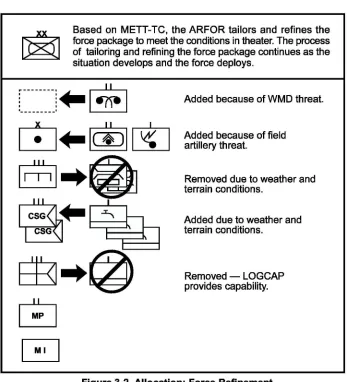
commanders and JFCs. The combatant commander establishes the priority for movement of forces into the theater. That decision drives allocation of strategic lift and ultimately determines how rapidly Army forces deploy. Although US strategic lift assets exceed those of any other nation, the available lift is almost never enough to move large Army forces at one time. Consequently, commanders carefully tailor both the elements of the force and the sequence in which they deploy them to match theater conditions.
3-3. The range of possible scenarios complicates training. Army forces cannot train for every possible mission; they usually train for war and prepare for specific missions as time and circumstances permit. The volatile nature of crises requires Army forces to simultaneously train, deploy, and execute.
RESPONSIVE
ARMY FORCES
Sun Tzu
The Art of War
CONTENTS
Responsive Army Forces 3-0
Attributes of Strategically
Responsive Army Forces 3-1
Considerations of Strategic
Responsiveness 3-4
Force Projection Operations 3-12
Force Projection Characteristics 3-13
Joint Systems 3-15
Entry Operations 3-16
Security of Force Projection
Operations 3-17
Intermediate Staging Bases 3-17
Commanders conduct (plan, prepare, execute, and continuously assess) op-erations with initial-entry forces, while assembling and preparing follow-on forces. To seize the initiative during deployment and the early phases of an operation, commanders accept calculated risks, even when the enemy situa-tion is not well developed. Balancing these dynamics is an art mastered through study, experience, and judgment.
3-4. Modernization will transform Army force projection capabilities. Contin-gency operations in the 1990s normally followed a sequence of alert, deploy-ment, extended build-up, and shaping operations-followed by a period of de-cisive operations to terminate the conflict. Operations Desert Shield and Desert Storm exemplify this sequence. The interim Army force now being de-veloped will consist of lethal and highly mobile initial-entry Army units that will deploy, contain large-scale aggression, and shape the situation in the land area of operations (AO) for much earlier decisive operations. In smaller-scale contingencies, combinations of modernized brigades and forcible entry units will provide JFCs with decisive initial-entry capabilities. When fielded, the objective Army force will achieve the strategic responsiveness necessary to conduct nearly simultaneous deployment, shaping, and decisive operations in a manner similar to that of Operation Just Cause, but against more robust opponents. The Army is modernizing combat service support (CSS) capabili-ties as well. Improvements are underway to reduce the CSS footprint and re-plenishment demands by leveraging CSS reach capabilities. At the same time, the Army is investing in new systems that minimize support require-ments and radically improve the manner in which it transports and sustains soldiers, equipment, and materiel.
3-5. The payoff for mastering the art of strategic responsiveness is opera-tional success. Fast deploying and rapidly expansible Army forces provide JFCs with the means to introduce an operationally significant land force into a crisis theater on short notice. Responsiveness provides JFCs a preemptive capability to deter adversaries, shape the situation, and fight and win if de-terrence fails. Responsive Army forces provide immediate options for seizing or regaining the operational initiative. They complement and reinforce the other services with combat, combat support (CS), and CSS units that can be swiftly tailored, deployed, and employed to produce decisive effects.
ATTRIBUTES OF STRATEGICALLY RESPONSIVE ARMY FORCES
3-6. Seven attributes of strategically responsive forces drive programmatic and operational requirements. The Army is redesigning the force around them.
Structure, equipment, and
training-including deployment doc-trine; power projection platforms; com-mand and control (C2) systems; intel-ligence, surveillance, and reconnaissance systems; and joint transportation systems---establish the foundation for responsive forces.
Attributes of Strategically Responsive Forces
.
Responsive.
Deployable.
Agile.
Versatile.
LethalResponsive
Deployable
3-7. Each operation is different: there may not be a single ideal deployment sequence that optimizes all seven force attributes. However, from an opera-tional perspective, commanders train their forces to emphasize all seven. Upon alert, commanders tailor and sequence the force to balance the attrib-utes while meeting JFC requirements.
3-8. Responsiveness is an attitude that spans operational planning, prepara-tion, execuprepara-tion, and assessment. It establishes the conditions for successful operational and tactical maneuver at the outset of operations. Responsiveness is more than the ability to quickly deploy: it requires that the right Army forces--those the JFC needs to deter an adversary or take decisive action if deterrence fails--deploy to the right place at the right time. Forward de-ployed units, forward positioned capabilities, peacetime military engagement, and force projection from anywhere the needed capabilities reside all contrib-ute to Army force responsiveness.
3-9. Responsiveness also emphasizes training, planning, and preparation for deployment. Commanders recognize that crises rarely allow sufficient time to correct training deficiencies between alert and deployment. They ensure that their units are prepared to accomplish their mission essential task list (METL) tasks before alert and to concentrate on mission-specific training in the time available afterwards. In addition, commanders emphasize individual preparation and equipment readiness. Finally, commanders review and prac-tice alert and deployment plans and procedures, updating them based on les-sons learned. They pay particular attention to the automated data used for deployment planning, ensuring that it accurately reflects unit organization and equipment.
3-10. Responsiveness requires balancing the demands of readiness with the realities of day-to-day training. Commanders develop and implement mission readiness postures appropriate for their unit. They evaluate the mission of the unit and carefully design mission readiness cycles to match the required readiness posture.
Agile
3-12. Agility is a tenet of Army operations as well as a responsive force at-tribute. A responsive, agile force package is one that is sustainable and mo-bile enough to accomplish the mission. Limitations on available lift compel commanders to balance competing mission requirements, in some cases de-veloping innovative solutions. It also requires commanders to anticipate a full range of tasks and include capabilities to accomplish them. Finally, agile forces are mentally and physically able to transition within or between types of operations without losing momentum. Commanders develop this state of mind through tough, realistic training. Mentally agile commanders, staffs, and soldiers adapt force packages, strategies, and tactics to mission require-ments in dynamic environments.
Responsive
and Agile--Operation
Uphold Democracy
The 1994 Operation Uphold Democracy in Haiti demanded Army forces to demonstrate an extraordinary degree of agility and responsiveness. Months before operations began, the 82d Airborne Division prepared plans for a short-notice forcible entry into Haiti. Completed plans detailing the use of overwhelming lethal force to seize key targets awaited only a decision to execute. Then, on 19 September, with the 82d already in flight to execute the plan, word suddenly arrived that a last-minute diplomatic effort had succeeded in securing the permissive entry of US forces.
With the sudden change in conditions, the Haiti mission passed from the invasion force, which returned home, to the 10th Mountain Division, which began arriving in Port-au-Prince in a matter of hours. In addition, special operations forces (SOF) blanketed the country within a week. Active engagement of the populace quickly established a measure of trust that furthered both SOF security and the effectiveness of the mission. Meanwhile, although initial living and working conditions in Port-au-Prince and elsewhere were predictably austere, CSS forces responded rapidly as equipment and other resources poured into Haiti.
American agility notwithstanding, conditions on the ground in Haiti remained unclear. Joint Task Force (JTF) 180 commander, LTG H. Hugh Shelton, found himself in the unanticipated position of negotiating the terms of a transition of power and working with representatives of the very regime he had earlier expected to remove. In turn, JTF 190 commander, MG David Meade, worked to secure the cooperation of police and civil officials in the capital. Army forces responded flexibly to a highly fluid and ambiguous situation.
Versatile