Chemical Hydrolysis Optimization for Release of
Sugars from Wheat Bran
Suksham Pal, Jyoti Handa, Palki Sahib Kaur and Upendra Kumar Jain
Department of Biotechnology, Chandigarh Group of Colleges, Landran Mohali, Punjab, India
Abstract
In this present study, experiments were carried for the acid and base hydrolysis of lignocelluloses in wheat bran to release the maximum amount of reducing sugars which can be used for biofuel production. Two acids, dilute HCl and dilute H2SO4 and one base, NaOH (1-5%) were taken. Using three different approaches cold acid/base treatment, hot acid/base treatment and acid/base treatment combined with moist heat under pressure with different parameters were optimized i.e. acid concentration, base concentration, heating time. The acid treatment combined with moist heat under pressure was found to be most efficient. Also increasing the concentrations of acids and base significantly increased the release of reducing sugars, which were estimated by DNS method.
Keywords: Acid, Base, hydrolysis, reducing sugars, lignocelluloses.
1. Introduction
The world dependence on oil can be reduced by production of liquid biofuels from lignocellulosic biomass. Lignocellulose consists of three major components: Cellulose, which accounts for approx. 40 % of the lignocelluloses, consists of high molecular weight polymers of glucose. Hemicellulose, which accounts for 25 % of the lignocellulose and comprises shorter polymers of various sugars and lastly, lignin, which accounts for 20 % of the lignocellulose and consists of a tri-dimensional polymer of propyl-phenol. Lignocellulose is much more difficult to convert into ethanol than sugars, starches and oils. For high yields of reducing sugars, lignocellulose has to be first hydrolyzed. The lignocellulosic biomass materials has major advantage that it is a renewable substrate for bioethanol production that does not compete with food production and animal feed and these lignocellulosic materials also contribute to environmental sustainability[1].
Hydrolysis is the most important unit operation in lignocelluloses for bioethanol production. The efficiency of this step determines the overall efficiency and economics of the whole process. The enzymes, inorganic and organic acids are commonly used chemicals which hydrolyze lignocelluloses in a very effective manner. The enzymes usage in the hydrolysis of lignocelluloses is more
efficient than the use of inorganic catalysts, because of high specificity and working at mild process conditions, but there is limited use of enzymes in industrial processes as most enzymes at high temperatures are relatively unstable and the isolation and purification cost is very high.. Various types of acids, concentrated or diluted, are used such as sulphuric, hydrochloric, hydrofluoric, phosphoric, nitric and formic acid [2]. The most commonly used catalysts for hydrolysis of lignocellulosic biomass are sulphuric and hydrochloric acids [3]. Pretreatment with dilute sodium hydroxide causes biomass swelling, decrease in the cellulose degree of polymerization (DP) and disruption of the lignin structure. Alkali treatment results in a sharp increase in saccharification, with manifold improvement in yields. Therefore different approaches cold acid/base treatment, hot acid/base treatment and acid/base treatment combined with moist heat under pressure with different parameters i.e. acid concentration, base concentration, heating time have been considered for hydrolysis.
2. Material and methods
2.1. Preparation of wheat bran slurry:
Wheat bran was procured from local market. 10 mL of acid/base solution was added in 1 gm of wheat bran in 20 mL flask. It was used as primary substrate for acid/base hydrolysis
2.2. Acid/Base used
In case of acids, hydrochloric acid and sulphuric acid were used and NaOH was used as basic solution for hydrolysis of wheat bran.
2.3. Estimation of reducing sugar concentration:
Methods used: Optimization of acid hydrolysis of wheat bran, following factors were optimized with respect to glucose yield:
a. Type of acid/base
b. Concentration of acid/base c. Heating time
d. Autoclaving for different time period Total of five different conditions were considered with varying acid and base concentration ranging from 1 to 5 % (v/v) and were designated as H1, H2, H3, H4, and H5 for HCl; S1, S2, S3, S4, S5 for H2SO4 and N1, N2, N3, N4 and N5 for NaOH, respectively. In control flask, distilled water was added instead of acid or base.
10 mL of acid/base solution was added in 1 gm of wheat bean. Three different methods were employed for optimization of acid hydrolysis of wheat bran.
a. Cold acid treatment b. Hot acid treatment
c. Acid hydrolysis in combination to moist heat under pressure (Autoclave) treatment.
2.3.1 Cold acid treatment:
Different acid/base treatments were given using two different acids and a base. Flasks were labelled accordingly and incubated at room temperature for 60 min. Reducing sugar concentration after hydrolysis was determined using DNS method.
2.3.2 Hot acid treatment:
In this set of experiments, effect of acid/base concentration, heating time period, autoclaving was checked sequentially. Sugar concentration is determined by DNS method. Sequence of steps followed during optimization of hot acid treatments:
Step-1: Optimization of Acid/base concentration: Wheat bran stocks treated with different acid/base concentrations were heated in boiling water bath for 60 min and resulting reducing sugar concentration was determined by DNS method.
Step-2: Optimization of heating time: The treatment which yielded highest reducing sugar yield was considered for optimization of heating time. Here, the wheat bran stock was treated with optimized acid/base concentration at 100 º for variable heating period i.e. 0-120 min with 30 min interval.
2.3.3
Effect of autoclaving (Acid hydrolysis in
combination to moist heat under pressure
(Autoclave) treatment):
Wheat bran slurry treated with acids/base 1 % (V/V) and was autoclaved at 15 psi for 15 and 30 min. 1% (V/V) acid concentration is considered to avoid un-necessary decrease in pH of slurry which is not favorable for fermentation processes.
3. Results
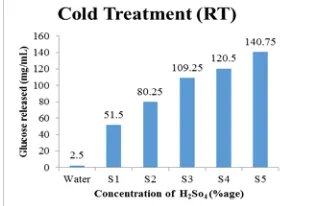
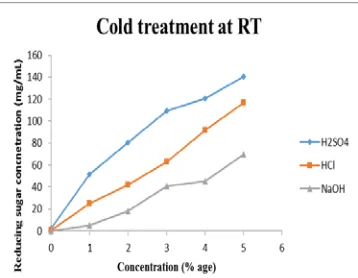
In first set of experiments, cold acid and base treatment was done on wheat bran for release of reducing sugars. Dilute acid/base concentrations in range of 1-5% were used for hydrolysis. Wheat bran soaked in varied acid/base concentrations was allowed to undergo hydrolysis at room temperature for 60 min. It was observed that with increase in sulphuric acid concentration from 1-5% resulted in increase in reducing sugar concentration from 2.5-140.75 mg/mL, however hydrochloric acid treatment resulted in increase from 0.56 to 116 mg/mL reducing sugars concentration (Fig: 1 a, b).
Whereas, in case of NaOH alkaline solution treatment there was not so significant release of reducing sugars i.e. only 0 to 69.5 mg/ml reducing sugar concentration was found after cold treatment with dilute NaOH treatment (Fig: 1 c). In control flask distilled water was added instead of any of the acid/ base solutions. Maximum reducing sugar concentration was observed to be in 5% sulphuric acid treatment i.e. 140.75 mg/mL in comparison to HCl (116 mg/mL) and NaOH (69.5 mg/mL) treatment (Fig 2).
Fig 1a: Effect of cold acid treatment at RT on sugar release by H2SO4
Fig 1b: Effect of cold acid treatment at RT on sugar release by HCl.
Fig 2: Comparison profile of all three chemicals i.e. H2SO4,
HCl, NaOH
In next experiment, effect of heat was studied release of reducing sugars. In this experiment hydrolysis of wheat bran was carried out at 100 ºC (water bath) under varied acid/base concentration. Same trend of increase in reducing sugar concentration irrespective of acid/base concentration in all three chemicals (i.e. H2SO4, HCl and NaOH) was observed. Increase from 94.75 to 188.25 mg/mL, 6.5 to 154.75 mg/mL and 0 to 113.25 mg/mL was observed with increase in acid/base concentration from1-5% after hot acid/ base treatment with H2SO4, HCl and NaOH respectively (Fig 3 a, b, c).
While comparing hydrolysis sugar release profile, maximum sugar concentration was found in 5% H2SO4 treated wheat bran yielding 188.25 mg/mL reducing sugar (Fig:4). It was observed that in all of the three chemicals 5% solution yielded maximum reducing sugars, so in next set of experiments 5% solution was used for hydrolysis of wheat bran.
Fig 4: Comparison profile of all three chemicals i.e. H2SO4,
HCl, NaOH
Effect of hydrolysis time at 100 ºC was checked on release of sugars. Time was varied in range of 0-120 min with an interval of 30 min. It was observed that with increase in hydrolysis time also helped in increasing reducing sugar concentration. Maximum sugar concentration was observed in case of 5% H2SO4 in comparison to HCl (151 mg/mL) and NaOH (137.75 mg/mL) after 120 min which yielded 171 mg/mL (Fig: 5).
Fig 5: Effect of hydrolysis time Fig 3a: Effect of hot acid treatment on
sugar release by H2SO4
Fig 3b: Effect of hot acid treatment on sugar release by HCl
Fig 3c: Effect of hot acid treatment on sugar release by NaOH
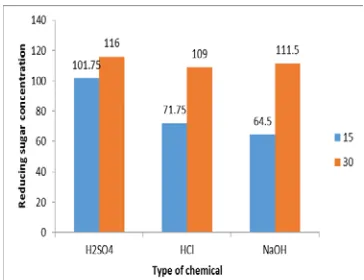
Hydrolysis of lignocelluloses with dilute acid/base requires high temperature and low residence time, as high concentrations of acid/base with high residence time produce toxic components which inhibits and reduces fermentation performance. Steam is known to provide an effective vehicle for rapidly heating cellulosics to the targeted temperature without excessive dilution of released sugars. So the effect of autoclaving i.e. moist heat under pressure (121ºC, 15 psi) was checked on release of sugars using two different time period i.e. 15 and 30 min. Autoclaving helped significantly in release of sugars within 15 and 30 min. Highest sugar yield of 116 mg/mL was observed in 1% H2SO4 treated wheat bran in comparison to 109 and 111 mg/mL reducing sugars produced after HCl and NaOH moist heat treatment (Fig 6). Comparative data of acid and base hydrolysis is summarized in Table 1.
Fig 6: Effect of moist heat treatment on release of sugars
Table 1: Effect of various acid base hydrolysis treatment on reducing sugars from wheat bran. Reducing sugar
concentration
H2SO4 (mg/mL)
HCl (mg/mL)
NaOH (mg/mL) Cold treatment 5% 140.75 116.75 69.5
Hot treatment 5% (60 min)
188.25 154.75 113.25
Hot treatment 5% (120 min)
171 151 137.75
Autoclaving (30 min)
116 109 111.5
Discussion
It is evident from the observing Figure 1(a, b) that increase in acid concentration was resulting in increase in reaction rate at temperature of 100 ˚C for reaction time of 60 min. At 1% H2SO4 and HCl (v/v) rate of release of sugars was low, maximum sugar concentration was observed at 5% with concentration of 188.25 mg/mL and 154.75 mg/mL with of volumetric productivity of 3.13
mg/mL/min respectively. Lenihan et al., also observed increased release of sugars with increase in acid concentration from 2.5 to 10% using potato peel as substrate [3]. They also observed that, with increase in acid concentration above (10%) there is increased rate of both production and decomposition of sugars. However, Sun and Cheng, observed 19.71 and 22.93% reducing sugars from Bermuda grass and rye straw, respectively using 1.5% sulphuric acid followed by enzymatic hydrolysis [4]. Another study showed sugar yield of 565 and 287 mg/g from wheat and rice straw after acid pretreatment [5]. On contrary, treatment with alkaline solution NaOH is also an alternative method of hydrolysis, which result in cellulose swelling, cellulose decrystallization, and degradation of side chains of esters and glycosides leading to structural modification of lignin, hemicellulose salvation [6]. In NaOH treatment also increase in sugar yield with increase in concentration was observed and maximum yield was observed to be at 5% with sugar concentration of 69.5 and 113.25 at room temperature and at 100 ˚C, although yields were lower in comparison o acid pretreatment. Sun et al., 1995, observed release of 60% lignin and 80% hemicelluloses after treatment with 1.5% sodium hydroxide at 20 °C for 144 h [7]. Zhu et al, also observed, 37% increase in biogas production from sodium hydroxide treated corn stover in comparison to untreated cellulose [8]. Effect of autoclaving i.e. moist heat treatment in combination to acid treatment was studied using 1% acid and base. It was observed that autoclaving helped in increasing volumetric productivity of sugars i.e. from 3.1 to 3.86 mg/mL/min when autoclaved for 30 min at 121 °C at 15 psi pressure using 1% H2SO4, however in case of HCl and NaOH treatment, there was increase from 2.57 to 3.63 mg/mL/min and 1.88 to 3.71 mg/mL/min respectively.
4. Conclusion
While comparing all acid/base treatments, maximum reducing sugar concentration was observed in hot acid treatment with 5% H2SO4 for 60 min yielded 188.25 mg/mL of sugar concentration. But maximum volumetric productivity of reducing sugars was observed in moist heat acid treatment i.e. 3.86 mg/mL/min in comparison to 3.13 mg/mL/min with hot acid treatment. H2SO4 treatment was found to be more efficient in releasing free reducing sugars from wheat bran in comparison with HCl and NaOH treatment.
Acknowledgements
References
1. Demirabas, A., 2008. Products from lignocellulosic materials via degradation processs, Energy Sources Part A, 30, 27-37.
2. Galbe, M. & Zacchi, G. (2002). A review of the production of ethanol from softwood. Applied Microbiology and Biotechnology Vol.59, No.6, (July, 2002), pp. 618-628.
3. Lenihan, P.; Orozco, A.; O’Neil, E.; Ahmad,M.,N.,M.; Rooney, D.,W. & Walker G.,M. (2010). Dilute acid hydrolysis of lignocellulosic biomass. Chemical Engineering Journal, Vol. 156, No.2, (January, 2010), pp. 395-403.
4. Sun YE, Cheng JJ. Dilute acid pretreatment of rye straw and Bermuda grass for ethanol production. Bioresour Technol. 2005;96:1599–1606
5. Saha BC, Iten BL, Cotta M, Wu YV. Dilute acid pretreatment, enzymatic saccharification, and fermentation of rice hulls to ethanol. Biotechnol Prog. 2005; 21:3816–3822.
6. Cheng YS, Zheng Y, Yu CW, Dooley TM, Jenkins BM, Gheynst JSV. Evaluation of high solids alkaline pretreatment of rice straw. Appl Biochem Biotech. 2010;162:1768–1784
7. Sun R, Lawther JM, Banks WB. Influence of alkaline pre-treatments on the cell wall components of wheat straw. Industrial Crop Prod. 1995;2:127–145
8. Zhu J, Wan C, Li Y. Enhanced solid-state anaerobic digestion of corn stover by alkaline pretreatment. Bioresour Technol. 2010; 101:7523–7528.
Suksham Pal received her B.Sc. degree in 2005, M,Sc. degree in 2008
from Panjab University, Chandigarh and PhD degree in 2017 from IMTECH, Chandigarh. Currently working as Assistant Professor in Department of Biotechnology, C.G.C. Landran Mohali. Her area of interest includes Yeast fermentation, Microbiology, Molecular Biology and site directed mutation. She has published research papers in various reputed journals.
Jyoti Handa received her B.Tech in 2008 and M.Tech. in 2012 from
Kurukshetra University, Kurukshetra, India . She is currently working as Assistant Professor in Department of Biotechnology, C.G.C. Landran. Her area of interest includes Microbiology and Molecular Biology. She has published research papers in various reputed journals and presented papers in various national and international conferences.
Palki Sahib Kaur received her B.Sc. degree in 2004 from Panjab
University, Chandigarh and M.Sc. degree in 2006 from Punjabi University, Patiala and M.Phil. in 2008 from Periyar University, Salem and B.Ed in 2013 from Punjabi university , Patiala and pursuing PhD. in Industrial Biotechnology from PTU, Jalandhar. Currently working as Head, Department of Biotechnology, C.G.C. Landran Mohali. Her area of interest includes Industrial Microbiology. She has published research papers in various reputed journals.
Upendra Kumar Jain: Director – Principal Chandigarh College of