Failure of mean-field approximation in weakly coupled
dila-ton gravity
MaximFitkevich1,2,∗
1Institute for Nuclear Research of the Russian Academy of Sciences, 60th October Anniversary Prospect, 7a, 117312 Moscow, Russia
2Moscow Institute of Physics and Technology, Institutskii per. 9, Dolgoprudny 141700, Moscow Re-gion, Russia
Abstract.We investigate black hole evaporation in a weakly coupled model of two-dimensional dilaton gravity paying a particular attention to the validity of the semiclassical mean-field approximation. Our model is obtained by adding a reflecting boundary to the celebrated RST model describingNgravitating mass-less scalar fields to one-loop level. The boundary cuts offthe region of strong
coupling. Although our model is explicitly weakly coupled, we find that the mean field approximation inevitably fails at the end of black hole evaporation. We propose an alternative semiclassical method aiming at direct calculation of S-matrix elements and illustrate it in a simple shell model.
1 Introduction
Mean-field theory points at a non-unitary evolution in quantum gravity [1]. It implies that quantum entanglement between the black hole interior and the rest of the Universe is de-stroyed by evaporation process, so that initially pure states transform into mixed states of Hawking quanta. An intuition based on AdS/CFT correspondence makes us believe that quantum gravity is unitary, and, to the contrary, mean field theory may break near the black hole horizon [2]. Nevertheless no mechanism explaining restoration of quantum coherence was proposed.
Therefore, we still need simple solvable models to address the black hole information puzzle. One may hope to resolve it in the simplified context of two-dimensional dilaton gravity. This class of models has been thoroughly investigated in 1991-96 but now it is mostly forgotten because the information loss problem there still persists. In this article we argue that difficulties of these models are not related to their fundamental inconsistency, but to the failure of the standard mean field approach. We propose a new semiclassical method to compute directly the S-matrix elements for processes of gravitational scattering to test unitarity explicitly.
Recently we proposed the weakly coupled model of two-dimensional dilaton gravity with a dynamical boundary [3], [4]. We showed that this model possesses an infinite number of exact analytic solutions. The model used in this report is obtained by adding one-loop quantum corrections, both in the bulk and at the boundary.
a modified model describing evaporating black holes and consider semiclassical solutions. In Section 3 we argue that the mean field theory inevitably breaks down at the last stage of black hole evaporation. In Section 4 we compute the semiclassical amplitude of point particle gravitational scattering offthe boundary. We pay particular attention to the high-energy processes which produce black holes at classics.
2 Weakly coupled dilaton gravity
For a start we consider the CGHS model of gravity with a boundary [7],
SCGHS =
Md
2x√−ge−2φR+4(∇φ)2+4λ2+
∂Mdτe
−2φ(K+2λ) (1)
with appropriate choice of the boundary terms ensuring self-consistency. The spacetime boundary∂Min Eq. (1) is situated on the lineφ=φ0, whereφis the dilaton. We introduced the proper timeτalong the boundary and its extrinsic curvatureK=∇µnµwith outer-directed normalnµ∝∂µφ. The gravitational coupling parametereφ<eφ0, it makes the model weakly
coupled. Note that black holes in the model (1) have masses larger thanMcr=2λe−2φ0[4].
As a matter content we add the massless scalar field f,
Sf =−1
2
Md
2x√−g(∇f)2. (2)
This field is Weyl-invariant, it decouples from the metric and splits into two non-interacting chiral sectors: f(u, v) = fout(u)+ fin(v), where u, vare the null coordinates. However, the
spacetime boundary∂M:u =U(v) mixes left- and right-moving components according to the reflection lawfout(U(v))= fin(v).
Next, we incorporate Hawking evaporation and its backreaction on the metric by adding one-loop corrections to the action,
SQ=
Md
2x√−g−1
2(∇χ)2+QχR−Q2φR
+
∂Mdτ
(Qχ−Q2φ)K+λQ2 . (3)
Action for the fieldχencodes one-loop contributions fromN =24Q2massless scalar fields similar to (2). The choice of additional boundary terms is unique and fixed by the Wess-Zumino consistency condition.
The last bulk term∝Q2 makes our model equivalent to the RST model [8]. This model admits exact bulk solutions in the conformal gaugeds2=−e2φ(u,v)dvdu,
χ(u, v)=2Qφ(u, v)+χ˜out(u)+χ˜in(v), e−2φ+Q2φ=−λ2vu− T(v)− H(u), (4)
∂2vT = (∂vfin)2
2 +
(∂vχ˜in)2
2 +Q∂2vχ˜in, ∂2uH =(∂ufout)
2
2 +
(∂uχ˜out)2
2 +Q∂2uχ˜out , (5) where the functions ˜χin, ˜χout are fixed by the initial conditions atu → −∞ andv → +∞. Vacuum configuration is
˜
χin(v)=Qln (λv), χ˜out(u)=Qln (−λu).
The boundary conditions atφ=φ0give differential equation for the form of the boundary u=U(v),
∂vU= e
−2φ0
λ2(e−2φ0+Q2/2)2
∂vT+λ2U+Q
2 2
∂2vU ∂vU
2
u
vsingularity
boundary
last r ay
T(v)
B u
vsingularity
boundary
boundary
thunde rpop
T(v)
B
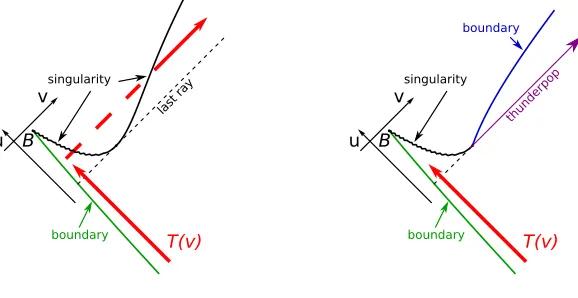
Figure 1. Left panel: the spacetime for the solution of Eq. (6). Red arrows schematically depict the wave packets reflecting from the regular timelike boundary (green). It crosses the singularity through unphysical regionφ > φ0after reflection offthe boundary. Right panel: glued spacetime where the solution above the last ray is replaced with a regular boundary (blue) satisfying Eq. (6). The thunderpop is emited from the point where the singularity becomes null and the blach hole ceases to exsist.
where the incoming wave packetT(v) is specified by initial conditions. We solved Eq. (6) with asymptotic behaviourU(v)∼ −e−2φ0/(λ2v) atv→0 corresponding to the flat spacetime
at the beginning of the scattering process, see Fig. 1. Using the inverse functionv=V(u) we obtainedH(u) from Eq. (4).
We observe that at large energies the lineφ(v,u)=φ0has a bifurcation pointBin Fig. 1. The second branch ofφ=φ0 : ¯U(v)U(v) is spacelike. It can be interpreted as a black hole singularity since the boundary conditions for the fields are violated there. The singularity touches the last ray in Fig. 1 and eventually becomes timelike. Fields to the future of the last ray are in causal contact with the black hole interior. Clearly, one cannot propagate through the unphysical regionφ > φ0. Rather, we have to glue a new solution with a timelike boundary satisfying Eq. (6), see the right panel of Fig. 1.
The new glued solution is continuous, it describes a flat spacetime in the asymptotic future and the total energy is conserved. Unfortunately, new difficulties appear. The solution is not smooth at the last ray and it has a delta-functional singularity in energy density usually called the thunderpop [8]. This is a signal of large quantum fluctuations near the last ray. Clearly, the thunderpop is an artefact of the mean field theory and it should be smeared out in the full quantum treatment. However, the only way to avoid the thunderpop within the mean field theory is to introduce a naked singularity which we initially tried to avoid.
3 Failure of the mean field theory
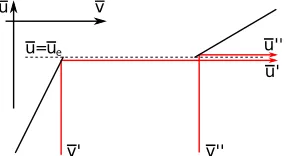
Note that the above violation of the mean field theory is general, not specific to our model. Namely, consider [9] the correlation function of the scalar field in a vicinity of the last ray ¯
u=u¯e, see Fig. 2,
G(¯u,u¯)=f
flat null coordinates ¯v,u¯at the boundary ¯v=¯v(¯u). This correlation function differs from the vacuum one
Gvac(¯u,u¯)∝ln|u¯−u¯|
within an arbitrary small interval∼εnear the last ray because ¯v(¯ue+0) v(¯¯ue−0). This
implies presence of particles moving along the last ray with arbitrary large momenta∼ε−1. Therefore, the thunderbolt as a general unphysical feature which may be blurred by intro-ducing quantum region of size∆u¯ ∼ λ−1. Direct calculations show that instant change of boundary conditions in quantum field theory indeed produces singular waves with infinite energy [10].
v'
_
v''_
u''
_
u'
_
u
_
u
_
u
_
v
_
= e
Figure 2.Thunderbolt arises due to sudden jump of the boundary across the null ray ¯u=u¯e.
The thunderbolt argument alongside with analysis of evaporating solutions in Section 2 implies that the mean field theory inevitably breaks down. The true reason is that considered glued solutions are singular and cannot be used as correct saddle points of the path integral,
Ψout|Sˆ|Ψin=
DΦ Ψin[Φ]Ψout∗ [Φ]eiS[Φ] ≈
DΦeiSe f f[Φc], ⇐ δ
δΦS =0, (7) whereΦ = {gµν, φ,f}represents all fields. Therefore, the semiclassical expansion fails at zero order1.
To overcome this obstacle we propose a modified semiclassical approach based on ana-lytic continuation of gravitational S-matrix elements. The gravitational scattering amplitude is saturated by configurations which satisfy asymptotically flat boundary conditions for initial and final states. If the black hole is formed a real analytic solution with correct behaviour in future does not exist. Therefore, the integral (7) is saturated by complex-valued saddle point solutions. Since there are many complex solutions to the field equations we need a criterion to pick up the branch giving the leading physical contribution to the path integral.
The criterion was derived in the simple models describing spherically-symmetric gravitationally-interacting shells of matter [11], [12]. The prescription is to add an imagi-nary contribution to the shell’s total energy,
M → M+i , → +0. (8)
The corresponding complex solution gives correct semiclassical amplitude (7) which we cal-culate in the next Section for the dilaton gravity with the boundary (1) interacting with a massive pointlike particle.
1Alternative reasoning relies on observation that the Dirichlet boundary conditionφ=φ
0is in fact an infinitely stiffinteraction of the pointlike particle with dilaton field and may be inconsistent itself on the quantum level. The
closest analogy is the Klein paradox: it is known that a relativistic electron scattering offthe potentialV ∼2me
4 Semiclassical S-matrix elements
In this Section we investigate a toy model of the massive particle interacting with the CGHS gravity with the boundary. Definition of the S-matrix
ˆ
S = lim
tout→+∞
tin→ −∞ ˆ
U0(0,tout) ˆU(tout,tin) ˆU0(tin,0)
includes interacting and free evolution operators ˆU,Uˆ0. Thus, the path integral (7) contains
Se f f[Φ]=SCGHS+Sm+S0(0−,tin)+S0(tout,0+)−ilnΨin−ilnΨ∗out . (9)
The dilaton gravity actionSCGHScontains the boundary terms on the surfaces of the constant
Schwarzschild timet =tin,out and at large distancer =r∞. The second term is the action of
the massive particle,
Sm=−m
ds
−gµν
dyµ dτ
dyν
dτ , (10)
whereyµ(τ) parametrizes the worldline andτis the corresponding proper time. Free actions S0emerge from the free evolution operators in the definition of S-matrix and
Ψin≈exp (ipinr) , Ψout ≈exp (ipoutr)
are the wave functions of the particle at the beginning and at the end of the scattering process. A covariant junction condition at the worldlineyµ(τ) is
4e−2φ[uµ∂
µφ]=m, (11)
whereuµis the right-directed normal to the worldline and square brackets denote jump of the derivative inside.
The saddle-point solutions describe flat and Schwarzschild spacetimes,
φ=−λr,
ds2 =−dT2+dr2, r<r(τ),
ds2=−f(r)dt2+ dr2
f(r) , f(r)=1− M 2λe−2
λr r>r(τ),
to the left and to the right of the particle’s worldliner(τ), whereT andtare the respective times.
Using Eq. (11) one rewrites this condition as
dr dτ
2
+Ve f f(r)=0, Ve f f(r)=1−
M m +
m 8λe−2
λr2. (12)
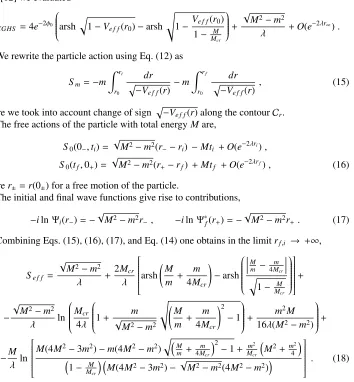
At small energies the particle classically reflects from the boundary: ˙r → −r. At large˙ energy when the black hole classically forms the event horizonrh = 21λln 2Mλ appears at real axis of rand one should deform r-contour avoiding coordinate singularity. The prescrip-tion (8) implies thatrhis bypassed from below, see Fig. 3.
Using the outer Schwarzschild metric, one finds the time contour corresponding to the trajectory in Fig. 3, see the right panel. The half-residue contributes twice at the event horizon into the imaginary part of the outer time,
m(tout−tin)=2πRes(f(r))−1 r=rh
= π
r
0
r
h_
_
i
i
2
Figure 3. Left panel: the real contourCr bypassing the event horizon rh by a tiny excursion into
the complex plane. Right panel: the Schwarzschild time contour corresponding to the solution with regularigation (8).
Now we evaluate the total action (9). First, the gravity action becomes
SCGHS =2e−2φ0
ds K−2
t=ti
dσe−2φK −2
t=tf
dσe−2φK+O(e−2λr∞). (14)
Discontinuity of the normalnµacross the particle’s worldline gives rise to non-zero contri-butions from intersection points with surfacest=tin,outand the boundaryφ=φ0. Following Ref. [12] we evaluated
SCGHS =4e−2φ0
arsh
1−Ve f f(r0)−arsh
1−Ve f f(r0) 1−MMcr
+
√
M2−m2
λ +O(e
−2λr∞).
We rewrite the particle action using Eq. (12) as
Sm=−m
ri
r0
dr
−Ve f f(r)−
m rf
r0
dr
−Ve f f(r)
, (15)
where we took into account change of sign −Ve f f(r) along the contourCr.
The free actions of the particle with total energyMare,
S0(0−,ti)= √M2−m2(r−−ri) −Mti +O(e−2λri),
S0(tf,0+)=
√
M2−m2(r+−rf)+Mtf +O(e−2λrf), (16)
wherer±=r(0±) for a free motion of the particle.
The initial and final wave functions give rise to contributions,
−ilnΨi(r−)=−
√
M2−m2r−, −ilnΨ∗
f(r+)=−
√
M2−m2r+. (17)
Combining Eqs. (15), (16), (17), and Eq. (14) one obtains in the limitrf,i → +∞,
Se f f =
√
M2−m2
λ + 2Mcr λ arsh M m + m 4Mcr −arsh M
m −4Mmcr
1−MMcr + − √
M2−m2
λ ln
M4λcr
1+ √ m M2−m2
M
m +
m 4Mcr
2
−1
+ m
2M 16λ(M2−m2)
+
−Mλ ln
M(4M2−3m2)−m(4M2−m2)M m+4Mmcr
2
−1+Mm2 cr
M2+m2 4
1− MMcr M(4M2−3m2)− √
M2−m2(4M2−m2)
M/Mcr 1
m/M 1 2 3 Re Scr
cr m/M 1 M/Mcr
1 2 3 Im Scr
cr
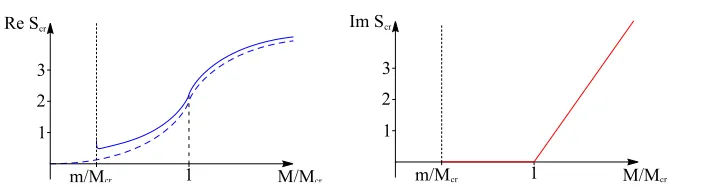
Figure 4. Real (blue) and imaginary (red) parts of the total action (18) atm=Mcr/3 as functions of
M. Dashed blue plot corresponds to the casem=0, Eq. (19). For the real part we tookMcr =2λ. The
intervalM<mis kinematically forbidden.
One notes that all divergences cancel out as expected according to S-matrix definition. In the massless case Eq. (18) simplifies,
lim
m→0Se f f =−
M−Mcr
λ ln
1−MM
cr
+ M
λ
1−ln Mcr 2λ
. (19)
Equation (19) can be compared with particular S-matrix elements in field theory where initial and final states describeδ–like wave packets.
The semiclassical exponent of the amplitude is shown in in Fig. 4 as a function of the total energyM. Its imaginary part is zero if the reflection is subcritical (m<M <Mcr) and
linearly grows withMat higher energy,
m Se f f = π
λ(M−Mcr) , M>Mcr.
Positive imaginary part of Se f f at M > Mcr implies that the reflection probability is
exponentially supressed,
P ≈exp−2m Se f f
=exp (−SBH+Scr) , (20)
whereSBH =2λπMis the black hole entropy andScris the entropy of the black hole with crit-ical massMcr=2λe−2φ0. Appearance of the critical entropy in the transition probability (20)
is physically reasonable since the suppression is expected to vanish on the verge of classical black hole formation. It does not agree with suppression by the number of black hole states eSBH which may signal the inconsistency of the model.
5 Conclusions
In this report we considered the weakly coupled dilaton gravity and reaffirmed that the appar-ent non-unitarity remains in the models with boundaries. The usual mean field approximation produces singular solutions which cannot be used as the true saddle points of the path integral for S-matrix elements.
classical solution in the model with scalar field.
Acknowledgments. We are grateful to D. Levkov, Y. Zenkevich and S. Sibiryakov for collaboration in this research. We thank D. Eremeev for help at early stages of this project. The work is supported by the RSF grant 14-22-00161.
References
[1] S. W. Hawking, Phys. Rev. D142460 (1976).
[2] A. Almheiri, D. Marolf, J. Polchinski and J. Sully, JHEP1302062 (2013). [3] M. Fitkevich, EPJ Web Conf.12505004 (2016).
[4] M. Fitkevich, D. Levkov and Y. Zenkevich, JHEP1704108 (2017).
[5] M. Fitkevich, D. Levkov and Y. Zenkevich, “Dilaton gravity with a boundary: from unitarity to black hole evaporation,”(in preparation).
[6] M. Fitkevich, D. Levkov and S. Sibiryakov,(in preparation).
[7] C. G. Callan, Jr., S. B. Giddings, J. A. Harvey and A. Strominger, Phys. Rev. D45no.4, R1005 (1992).
[8] J. G. Russo, L. Susskind and L. Thorlacius, Phys. Rev. D463444 (1992). [9] A. Strominger, “Les Houches lectures on black holes,” (1994).