AASTeX
and
the
challenges
of
publishing
in
an
increasingly
interactive
environment
GregSchwarz1, 1Data Editor
American Astronomical Society
Abstract.In 2016 the American Astronomical Society (AAS) released two new versions of its LaTeX classfile, AASTeX. These were the first changes in over 11 years and in-cluded many new features to enhance an author’s ability to present their science in a format conducive to publishing in the AAS environment. While LaTeX is an excellent way to convey the written word, it lacks robust support for many desirable features in-cluding collaborative editing, large table support and figure interactivity. Bridging the gap between the old methods of writing and reviewing a printed manuscript and the new features the AAS has available and is working on implementing in a published HTML article is an ongoing challenge. This talk will highlight the new features of AASTeX and discuss how AAS publishing will move forward.
1 Introduction
LaTeX is a programming language for manuscript typesetting that is well suited to displaying math-ematics, making it a natural fit for astronomy and astrophysics articles. In the early Internet, the American Astronomical Society (AAS) envisioned a future where authors could electronically submit a LaTeX manuscripts to save time and effort. To take advantage of this, the first LaTeX macros were
written in 1989 for authors to format a manuscript for the AAS Journal’s exact specifications. During the 1990s many additional versions were created both by the AAS and third parties. These LaTeX upgrades were coincident with the AAS’s first electronic HTML journals in the mid 1990s. In 1999 the AAS publication board decided to push the envelope of HTML publishing by expanding beyond the then standard of text, tables and figures. The AAS Journals now offer many different data and
narrative options. These distinctive HTML features give authors much more flexibility to control the narrative when describing their results. They also are very powerful for readers by allowing unique interactions with the data. Authors also have more ways to provide access to the data used in their articles. Since these attributes only appear in the final HTML article it is challenging to present these items with only LaTeX manuscript to collaborators when composing the paper and also to the science editor and reviewer during peer review.
This article discusses the latest upgrades to AASTeX, the custom designed classfile for LaTeX used by all the AAS Journals. While the upgrade provides a richer template for authors it lacks
much of the functionality that is only available in a web environment. The latter portion of this article describes the available HTML only attributes and ends with a discussion on where the AAS publishing will go in the future.
2 New AASTeX features
In early 2016 the AAS released AASTeX v6.0. It was the first new classfile update in 11 years. Version v6.1 was released in early 2017. This list is a summary of some of the new features in the latest versions.
1. Based on the popular emulateapj classfile.
2. Front end changes including:
(a) watermarking,
(b) author/affiliation/collaboration upgrades, and
(c) front matter truncation.
3. Two new author revision mark up styles.
4. New Figure commands,
(a) figure set mark up (see Section 3.2) and (b) support for figures consisting of multiple files.
5. Improved table features including:
(a) automatic column numbering, (b) math mode in designated columns, (c) the ability to hide columns, (d) decimal alignment, and (e) splitting wide tables. 6. Improved software citation,
(a) an upgraded bst file for creating 1st class references with bibtex and (b) a new software command to highlight code used in the work.
Many of these improvements were based on author suggestions. More information about the most recent version of AASTeX can be found at http://journals.aas.org/authors/aastex.html.
3 HTML only article features
The AAS Journals offer a wide range of options for authors to provide information that simply could
much of the functionality that is only available in a web environment. The latter portion of this article describes the available HTML only attributes and ends with a discussion on where the AAS publishing will go in the future.
2 New AASTeX features
In early 2016 the AAS released AASTeX v6.0. It was the first new classfile update in 11 years. Version v6.1 was released in early 2017. This list is a summary of some of the new features in the latest versions.
1. Based on the popular emulateapj classfile.
2. Front end changes including:
(a) watermarking,
(b) author/affiliation/collaboration upgrades, and (c) front matter truncation.
3. Two new author revision mark up styles.
4. New Figure commands,
(a) figure set mark up (see Section 3.2) and (b) support for figures consisting of multiple files.
5. Improved table features including:
(a) automatic column numbering, (b) math mode in designated columns, (c) the ability to hide columns, (d) decimal alignment, and (e) splitting wide tables. 6. Improved software citation,
(a) an upgraded bst file for creating 1st class references with bibtex and (b) a new software command to highlight code used in the work.
Many of these improvements were based on author suggestions. More information about the most recent version of AASTeX can be found at http://journals.aas.org/authors/aastex.html.
3 HTML only article features
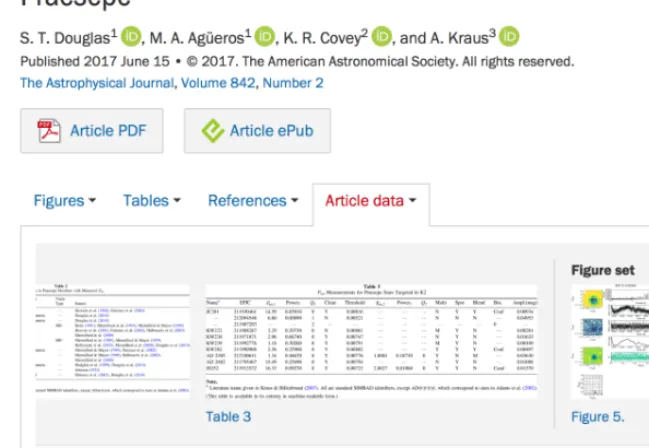
The AAS Journals offer a wide range of options for authors to provide information that simply could not be published years ago or at best only existed temporarily on personal websites. This section briefly discusses these HTML only features, all of which are highlighted in a new tab called "Article Data." Figure 1 shows an example which illustrates how easy it is for a reader to identify and find this HTML only information.
Figure 1.Some data products available under the "Article Data" tab of Douglas et al. 2017, ApJ, 842, 2. This
article has multiple MRTs and a Figure Set.
3.1 Machine readable tables
Astronomers are very good at distilling large, raw data into useful catalogs. These catalogs often have characteristics that make them impossible to show as regular LaTeX tables such as extreme length or to wide for a print page. To address this issue the first non-LaTeX option, machine readable tables (MRT), began in 2000. A MRT consists of a meta-data header attached to a formatted data file. The meta-data uses the same standards and styles developed by CDS for their VizieR catalogs. In 17 years more than 10,000 MRTs have been created in over 5,000 articles making it the most used data feature. Many of these tables have been incorporated into CDS as VizieR catalogs.
3.2 Figure sets
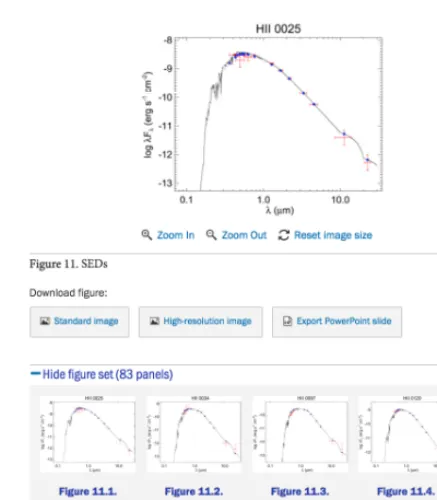
Figure 2. Example of a Figure Set from Somers and Stassun 2017, AJ, 153, 3. The Figure Set contains 83 component figures of various stellar SED fits. Clicking on the thumbnail in the lower scroll bar section displays the full version above.
3.3 Data behind the Figure
Governments agencies have increasingly mandated that authors provide the data used in the articles produced using their funding. In 2010 the AAS created Data behind the Figure (DbF) to give authors another way to incorporate the underlying data into their articles to help satisfy these mandates. Since figures can be astronomical images or vector drawn graphics, a DbF can be either a MRT or a FITS format. Over 250 articles have had DbFs.
3.4 Streaming video and Interactive figures
Authors have been allowed to include animations with their article since the AAS started publishing its journals electronically. The movie was available for download and a reader had to play it locally thus a specific video standard was enforced for all submission to ensured that the experience would be the same for all readers. This added an extra burden for the author nor was it a great experience for the reader. Now that streaming services are ubiquitous the HTML article has been updated so that all videos are streamed inline much like an embedded YouTube video. In addition, the video standards have been relaxed which makes it easier to use author produced movies. We currently have over 2,500 animations in the AAS Journals primarily generated by the solar physics community.
Figure 2. Example of a Figure Set from Somers and Stassun 2017, AJ, 153, 3. The Figure Set contains 83 component figures of various stellar SED fits. Clicking on the thumbnail in the lower scroll bar section displays the full version above.
3.3 Data behind the Figure
Governments agencies have increasingly mandated that authors provide the data used in the articles produced using their funding. In 2010 the AAS created Data behind the Figure (DbF) to give authors another way to incorporate the underlying data into their articles to help satisfy these mandates. Since figures can be astronomical images or vector drawn graphics, a DbF can be either a MRT or a FITS format. Over 250 articles have had DbFs.
3.4 Streaming video and Interactive figures
Authors have been allowed to include animations with their article since the AAS started publishing its journals electronically. The movie was available for download and a reader had to play it locally thus a specific video standard was enforced for all submission to ensured that the experience would be the same for all readers. This added an extra burden for the author nor was it a great experience for the reader. Now that streaming services are ubiquitous the HTML article has been updated so that all videos are streamed inline much like an embedded YouTube video. In addition, the video standards have been relaxed which makes it easier to use author produced movies. We currently have over 2,500 animations in the AAS Journals primarily generated by the solar physics community.
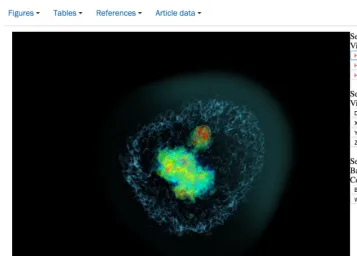
Interactive figures allow the reader to manipulate the information contained in an image. This also adds clarity for complex figures and helps further the author’s narrative. Interactive control is provided via a dynamic JavaScript and HTML framework. The most common example of an interactive figure
is a 3D model. The majority of the 17 interactive figures currently published are 3D figures. Since this is a new technology the AAS offers limited support on an ad hoc basis. Figure 3 shows an example of an interactive figure.
Figure 3.Example of an interactive figure from Kolb et al. 2017, ApJ, 844, 1. In this custom created figure, the
JavaScript controls on the right set the initial orientation and turn on/offsome aspects of the image. 3D movement
is obtained by moving the mouse within the image.
3.5 External repository support
While the AAS can capture and publish a large range of data products not everything authors produced can be hosted. Examples include extremely large files (>GBs), databases and active source code. For these cases the AAS has developed recommendations and tutorials for using 3rd party repositories. Authors are requested to use repositories that issue DOIs for their holdings so that they can be prop-erly cited and will be protected against link rot. Currently we recommend Zenodo, DataVerse, and Figshare but will soon be including the Canadian CANFAR repository, gSTAR center at Swinburne University, Australia, and the joint AAS/University of Arizona Astrolabe project.
of articles but will go live for all AAS Journals in 2018. Using the experience working with MAST, the AAS plans to partner with other data centers to provide a similar functionality.
Figure 4.Query to authors about MAST data products presented at submission (left) and the external MAST site where authors collect their data for DOI minting (right). While participation is voluntary, the AAS believe that the advantages of interconnectivity between the literature and archives will accelerate acceptance of these data collection links.
4 Data review
The adoption of these data products outlined in Section 3 is related to how long they have been available. In an effort to speed up adoption and increase general awareness the AAS data editors now
conducted a data review of all submitted manuscripts. The data review does the following.
1. Search for vector drawn graphics figures that contain highly useful data that would be easy to capture for DbFs (Section 3.3). Simple examples include light curves, spectra, etc.
2. Encourage authors to follow the new software policy (http://journals.aas.org/policy/software.
html) by properly tagging and citing the code used.
3. Check for supplementary data not optimally stored, such as a personal website, and recommend better alternatives (Section 3.4).
4. Check that animations meet new streaming requirements and remind authors that this function-ality exists in cases where videos could be made from the simulations (Section 3.4).
of articles but will go live for all AAS Journals in 2018. Using the experience working with MAST, the AAS plans to partner with other data centers to provide a similar functionality.
Figure 4.Query to authors about MAST data products presented at submission (left) and the external MAST site where authors collect their data for DOI minting (right). While participation is voluntary, the AAS believe that the advantages of interconnectivity between the literature and archives will accelerate acceptance of these data collection links.
4 Data review
The adoption of these data products outlined in Section 3 is related to how long they have been available. In an effort to speed up adoption and increase general awareness the AAS data editors now
conducted a data review of all submitted manuscripts. The data review does the following.
1. Search for vector drawn graphics figures that contain highly useful data that would be easy to capture for DbFs (Section 3.3). Simple examples include light curves, spectra, etc.
2. Encourage authors to follow the new software policy (http://journals.aas.org/policy/software.
html) by properly tagging and citing the code used.
3. Check for supplementary data not optimally stored, such as a personal website, and recommend better alternatives (Section 3.4).
4. Check that animations meet new streaming requirements and remind authors that this function-ality exists in cases where videos could be made from the simulations (Section 3.4).
5. Suggest better ways to set up an article and potentially save publication charges. A common example is merging similar figures into a Figure Set (Section 3.2).
5 Future
The AAS believes that there is great benefit to both the author and the reader to have these data items integrated into the article thus the future work includes better collection of meta-data, more author interactive figure tutorials, and HTML proofing.
The current trick is how to integrate these HTML only items into a system based on writing and reviewing manuscripts in LaTeX which is inherently paper, or PDF, based. Some improvements to the AASTeX classfile will help but we are also investigating different ways to write manuscripts. As
a first step in this direction, the AAS has partnered with the collaborative writing tools of Authorea and Overleaf. With these tools authors can easily collaborate with co-authors and track all changes. In addition, Authorea and Overleaf authors can do a direct submission of the manuscript to the AAS peer review system when they are ready for publication. All of these collaborative tools will save time and effort in constructing their papers. Another interesting, albeit long term investigation would be
Jupyter notebooks based articles.