Security Reductions of the Second Round SHA-3 Candidates
Elena Andreeva, Bart Mennink and Bart Preneel
Dept. Electrical Engineering, ESAT/COSIC and IBBT Katholieke Universiteit Leuven, Belgium
{elena.andreeva, bart.mennink}@esat.kuleuven.be
Abstract. In 2007, the US National Institute for Standards and Technology announced a call for the design of a new cryptographic hash algorithm in response to vulnerabilities identified in existing hash functions, such as MD5 and SHA-1. NIST received many submissions, 51 of which got accepted to the first round. At present, 14 candidates are left in the second round. An important criterion in the selection process is the SHA-3 hash function security and more concretely, the possible security reductions of the hash function to the security of its underlying building blocks. While some of the candidates are supported with firm security reductions, for most of the schemes these results are still incomplete. In this paper, we compare the state of the art provable security reductions of the second round candidates. We discuss all SHA-3 candidates at a high functional level, and analyze and summarize the security reduction results. Surprisingly, we derive some security bounds from the literature, which the hash function designers seem to be unaware of. Additionally, we generalize the well-known proof of collision resistance preservation, such that all SHA-3 candidates with a suffix-free padding are covered.
1 Introduction
Hash functions are a building block for numerous cryptographic applications. In 2004 a series of attacks by Wang et al. [66,67] have exposed security vulnerabilities in the design of the most widely adopted and deployed SHA-1 hash function. As a result, the US National Institute for Standards and Technology (NIST) recommended the replacement of SHA-1 by the SHA-2 hash function family and announced a call for the design of a new SHA-3 hashing algorithm. The SHA-3 hash function must allow for message digests of length 224,256,384 and 512 bits, it should be efficient, and most importantly it should provide an adequate level of security. In the current second round, 14 candidate hash functions are still in the race for the selection of the SHA-3 hash function. These candidates are under active evaluation by the cryptographic community. As a result of the per-formed comparative analysis, several classifications of the SHA-3 candidates, mostly focussed on hardware performance, appeared in the literature [33,64,32,45]. A classification based on the spec-ified by NIST security criteria is however still due.
NIST Security Requirements.NIST specifies a number of security requirements [55] to be sat-isfied by the future SHA-3 function: (i) at least one variant of the hash function must securely support HMAC and randomized hashing. Furthermore, for alln-bit digest values, the hash function must provide (ii) preimage resistance of approximatelynbits,(iii) second preimage resistance of approximatelyn−L bits, where the first preimage is of length at most 2Lblocks,(iv) collision resistance of approximatelyn/2 bits, and(v)all variants must be resistant to the length-extension attack. Finally,(vi) for any m≤n, the hash function specified by taking a fixed subset ofm bits of the function’s output is required to satisfy properties(ii)-(v)with nreplaced bym.
integral building blocks (e.g., the underlying block cipher or permutation(s)) are assumed to be ideal, i.e. random primitives. Additionally, to argue collision resistance we extend the standard proof of Merkle-Damg˚ard collision resistance [27,53] to cover all SHA-3 candidate hash functions with a suffix-free padding (App. A). Notice that the basic Merkle-Damg˚ard proof does not suffice in the presence of a final transformation and/or a chopping.
Furthermore, we consider the indifferentiability of the candidates. Informally, indifferentiability guarantees that a design has no structural design flaws [26], and in particular (as formally proven in App. B) an indifferentiability result provides upper bounds on the advantage of finding preim-ages, second preimages and collisions.
Our main contribution consists in performing a comparative survey of the existing security results on the 14 hash function candidates and results derivable from earlier works on hash functions, and suggesting possible research directions aimed at resolving some of the identified open problems. Section 2 briefly covers the notation, and the basic principles of hash function design. In Sect. 3, we consider all candidates from a provable security point of view. We give a high level algorithmic description of each hash function, and discuss the existing security results. All results are summa-rized in Table 1. We conclude the paper with Sect. 4 and give some final remarks on the security comparison.
2 Preliminaries
For a positive integer valuen∈N, we denote byZn2 the set of bit strings of lengthn, and by (Zn2)∗
the set of strings of length a positive multiple of n bits. We denote byZ∗2 the set of bit strings of
arbitrary length. Ifx, yare two bit strings, their concatenation is denoted byxky. By|x|we denote the length of a bit string x, and for m, n ∈ N we denote by hmin the encoding of m as an n-bit
string. The function chopn(x) chops offn bits of a bit stringx.
Throughout, we use a unified notation for all candidates. The value n denotes the output size of the hash function, l the size of the chaining value, andm the number of message bits compressed in one iteration of the compression function. A padded message is always parsed as a sequence of
k≥1 message blocks of length mbits: (M1, . . . , Mk).
2.1 Security Notions
In this section we investigate the security of the hash functions in the ‘ideal model’ and the more classical ‘generic’ security.
Security in the ideal model. In the ideal model, a compressing function F (either on fixed or arbitrary input lengths) that uses one or more underlying building blocks is viewed insecure if there exists a successful information-theoretic adversary that has only query access to the idealized underlying primitives of F. The complexity of the attack is measured by the number of queries
q to the primitive made by the adversary. In this work it is clear from the context which of the underlying primitives is assumed to be ideal. The three main security properties required from the SHA-3 hash function are preimage, second preimage and collision resistance. For each of these three notions, with AdvatkF , where atk∈ {pre,sec,col}, we denote the maximum advantage of an adversary to break the functionF under the security notion atk. The advantage is the probability function taken over all random choices of the underlying primitives, and the maximum is taken over all adversaries that make at mostq queries to their oracles.
framework introduced by Maurer et al. [52] is an extension of the classical notion of indistinguisha-bility, and ensures that a hash function has no structural defects. We denote the indifferentiability security of a hash functionHbyAdvproH , maximized over all distinguishers making at mostqqueries of maximal lengthK ≥0 message blocks to their oracles. We refer to [26] for a formal definition. An indifferentiability bound guarantees security of the hash function against specific attacks. In par-ticular, one can obtain a bound onAdvatkH , for any security notion atk:AdvatkH ≤PratkRO+Adv
pro
H , where PratkRO denotes the success probability of a generic attack againstH under atk. This bound is proven in Thm. 2 (App. B).
Generic security.The generic collision resistance security in the context of this work deals with analyzing the collision resistance of hash functions in the standard model. A hash function H is called generically (t, ε) collision resistant if no adversary running in time at most t can find two different messages M, M0 such that H(M) = H(M0) with advantage more thanε. We denote by
AdvgcolH the generic collision resistance security of the function H, maximized over all ‘efficient’ adversaries. We refer the reader to [59,58,3] for a more formal discussion.
To argue generic collision resistance security of the hash function H(as domain extenders of fixed input length compression functions) we use the composition result of [27,53] and extend it to a wider class of suffix-free hash functions (App. A). This result concludes the collision resistance of the hash functionHassuming collision resistance security guarantees from the underlying compres-sion functions. We then translate ideal model collicompres-sion resistance security results on the comprescompres-sion functions via the latter composition to ideal model collision results on the hash function (expressed by AdvcolH). A generic collision result, generally speaking, applies to a wider class of schemes for which no bounds on the collision resistance security of the underlying compression functions is known, e.g. forBLAKE and BMW.
If a compressing function F outputs a bit string of length n, one expects to find collisions with high probability after approximately 2n/2 queries (due to the birthday attack). Similarly, (second)
preimages can be found with high probability after approximately 2n queries1. Moreover, finding second preimages is provably harder than finding collisions, and similar for preimages (depending on the specification ofF) [59]. Formally, we haveΩ(q2/2n) =AdvFcol=O(1),Ω(q/2n) =AdvsecF ≤
AdvcolF , and Ω(q/2n) =AdvFpre≤AdvcolF +ε, where εis negligible ifF is a variable input length compressing function. In the remainder, we will consider these bounds for granted, and only include security results that improve either of these bounds. A bound is calledtight if the lower and upper bound are the same up to a constant factor, and optimal if the bound is tight with respect to the original lower bound.
2.2 Compression Function Design Strategies
A common way to build compression functions is to base it on a block cipher [57,21,62], or on a (limited number of) permutation(s) [20,60,61]. Preneel et al. [57] analyzed and categorized 64 block cipher based compression functions. Twelve of them are formally proven secure by Black et al. [21]. These results have been recently generalized by Stam [62]. Interestingly, the latter result implies security bounds for some compression functions that do not fit in the PGV-model, like
ECHO, Hamsi and SIMD. Throughout, by ‘PGVx’ we denote the xth type compression function
1Kelsey and Schneier [42] describe a second preimage attack on the Merkle-Damg˚ard hash function that requires at
most approximately 2n−Lqueries, where the first preimage is of length at most 2Lblocks. This attack does, however,
of [57]. We note that PGV1, PGV3 and PGV5 are better known as the Matyas-Meyer-Oseas, the Miyaguchi-Preneel and the Davies-Meyer compression functions, respectively.
In the context of permutation based compression functions, Black et al. [20] analyzed 2l- to l-bit compression functions based on one l-bit permutation, and proved them insecure. This result has been generalized by Rogaway and Steinberger [60], Stam [61] and Steinberger [63] to compression functions with arbitrary input and output sizes, and an arbitrary number of underlying permu-tations. Their bounds indicate the number of queries required to find collisions or preimages for permutation based compression functions.
2.3 Hash Function Design Strategies
In order to allow the hashing of arbitrarily long strings, all SHA-3 candidates employ a specific mode of operation. Central to all designs is theiterated hash function principle[47]: on input of an initialization vectorIV, the iterated hash functionHf based on the compression functionf proceeds
a padded message (M1, . . . , Mk) as follows:
Hf(IV;M1, . . . , Mk) =hk, where: h0 =IV,
hi =f(hi−1, Mi) for i= 1, . . . , k.
This principle is also called the plain Merkle-Damg˚ard (MD) design [53,27]. Each of the 14 remain-ing candidates is based on this design, possibly followed by a final transformation (FT), and/or a
chop-function2.
The padding function pad:Z∗2 →(Zm2 )
∗
is an injective mapping that transforms a message of ar-bitrary length to a message of length a multiple of mbits (the number of message bits compressed in one compression function iteration). Most of the candidates employ a sufficiently strong padding rule (cf. App. C). Additionally, in some of the designs the message blocks are compressed along with specific counters or tweaks, which may strengthen the padding rule. We distinguish between ‘prefix-free’ and/or ‘suffix-free’ padding.
A padding rule is called suffix-free, if for any distinct M, M0, there exists no bit string X
such that pad(M0) = Xkpad(M). The plain MD design with any suffix-free padding (also called MD-strengthening [47]) preserves collision resistance [53,27]. We generalize this result in Thm. 1 (App. A): informally, this preservation result also holds if the iteration is finalized by a distinct compression function and/or thechop-function. Other security properties, like preimage resistance, are however not preserved in the MD design [3]. It is also proven that the MD design with a suffix-free padding need not necessarily be indifferentiable [26]. However, the MD construction is
indifferentiable if it ends with a chopping function or a final transformation, both when the un-derlying compression function is ideal or when the hash function is based on a PGV compression function [26,39,51].
A padding rule is called prefix-free, if for any distinct M, M0, there exists no bit string X such that pad(M0) = pad(M)kX. It has been proved that the MD design, based on ideal compression function or ideal PGV construction, with prefix-free padding is indifferentiable from a random or-acle [25,26,39,51]. Security notions like collision-resistance, are however not preserved in the MD design with prefix-free only padding.
2A functiongis a final transformation if it differs fromf, and is applied to the final state, possibly with the injection
HAIFA design.A concrete design based on the MD principle is the HAIFA construction [18]. In HAIFA the message is padded in a specific way so as to solve some deficiencies of the original MD construction: in the iteration, each message block is accompanied with a fixed (optional) salt ofs
bits and a (mandatory) counter Ci oft bits. The counterCi keeps track of the number of message
bits hashed so far, and equals 0 by definition if the ith block does not contain any message bits. Partially due to the properties of this counter, the HAIFA padding rule is suffix- and prefix-free. As a consequence, the construction preserves collision resistance (cf. Thm. 1) and the indifferentiability results of [26] carry over. For the HAIFA design, these indifferentiability results are improved in [16]. Furthermore, the HAIFA construction is proven secure against second preimage attacks if the underlying compression function is assumed to behave like an ideal primitive [23].
Wide-pipe design. In the wide-pipe design [50], the iterated state size is significantly larger than the final hash output: at the end of the iteration, a fraction of the output of a construction is discarded. As proved in [26], the MD construction with a distinct final transformation and/or chopping at the end is indifferentiable from a random oracle.
Sponge functions. We do not explicitly consider sponge functions [15] or their generalization [1] as a specific type of construction: all SHA-3 candidates known to be sponge(-like) functions,
CubeHash, Fugue, JH, Keccak and Luffa, can be described in terms of the chop-MD construction (possibly with a final transformation before or instead of the chopping).
3 SHA-3 Hash Function Candidates
In this section, we analyze the security of the 14 remaining SHA-3 candidates in more detail. For simplicity, we only consider the proposals of the SHA-3 candidates that output digests of 256 or 512 bits. Observe that in many candidate SHA-3 hash function families, the algorithms that output 224 or 384 bits are the same as the 256- or 512-bits algorithms, except for an additional chopping at the end. Particularly, the results of [26] and Thm. 1 carry over in most of the cases. The same remark applies to requirement (vi)of NIST.
Requirement (i). All designers claim that their proposal can safely be used in HMAC mode [9] or for randomized hashing [41], and we do not discuss it here;
Requirements (ii)-(iv). Preimage, second preimage and collision resistance of each hash func-tion are discussed in this secfunc-tion. Addifunc-tionally, we consider the indifferentiability of the candi-dates;
Requirement (v). All hash function candidates are secure against the length extension attack, and thus we do not discuss it further.
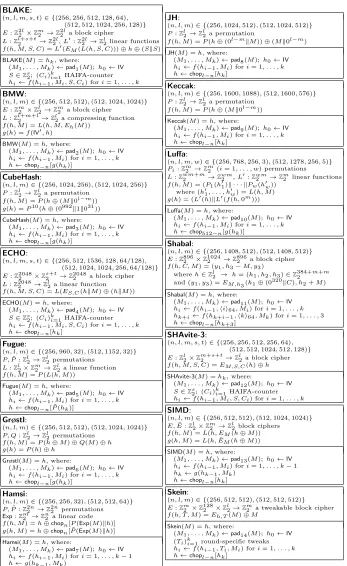
Below, we examine the SHA-3 candidate hash functions in more detail. Each paragraph contains an informal discussion for each of the second round SHA-3 candidates and their security reduc-tion results. The mathematical descripreduc-tions of the (abstracted) designs are given in Fig. 1, and the candidates’ padding functions are summarized in App. C. The concrete security results for all current candidate hash functions are summarized in Table 1. More precisely, for each candidate and each security notion, this table includes the security bound, as far as it exists, and the underlying assumption.
3.1.The BLAKEhash function [6] is a HAIFA construction. The message blocks are accompanied with a HAIFA-counter, and more generally, the function employs a suffix- and prefix-free padding rule. The compression function f is block cipher based3. It moreover employs an injective linear
3As observed in [6, Sect. 5], the core part of the compression function can be seen as a permutation keyed by the
BLAKE:
(n, l, m, s, t)∈ {(256,256,512,128,64),
(512,512,1024,256,128)} E:Z22l×Zm2 →Z22la block cipher
L:Zl2+s+t→Z22l,L0:Z22l→Zl2linear functions f(h, M, S, C) =L0(EM(L(h, S, C)))⊕h⊕(SkS)
BLAKE(M) =hk, where:
(M1, . . . , Mk)←pad1(M);h0←IV S∈Zs2; (Ci)ki=1HAIFA-counter hi←f(hi−1, Mi, S, Ci) fori= 1, . . . , k
BMW:
(n, l, m)∈ {(256,512,512),(512,1024,1024)} E:Zm2 ×Zl2→Zm2 a block cipher
L:Zl2+m+l→Zl2a compressing function f(h, M) =L(h, M, Eh(M))
g(h) =f(IV0, h) BMW(M) =h, where:
(M1, . . . , Mk)←pad2(M);h0←IV hi←f(hi−1, Mi) fori= 1, . . . , k h←chopl−n[g(hk)]
CubeHash:
(n, l, m)∈ {(256,1024,256),(512,1024,256)} P:Zl2→Zl2a permutation
f(h, M) =P(h⊕(Mk0l−m))
g(h) =P10(h⊕(0992k1k031))
CubeHash(M) =h, where:
(M1, . . . , Mk)←pad3(M);h0←IV hi←f(hi−1, Mi) fori= 1, . . . , k h←chopl−n[g(hk)]
ECHO:
(n, l, m, s, t)∈ {(256,512,1536,128,64/128),
(512,1024,1024,256,64/128)} E:Z20482 ×Z
s+t
2 →Z20482 a block cipher L:Z20482 →Zl2a linear function f(h, M, S, C) =L(ES,C(hkM)⊕(hkM))
ECHO(M) =h, where:
(M1, . . . , Mk)←pad4(M);h0←IV S∈Zs2; (Ci)ki=1HAIFA-counter hi←f(hi−1, Mi, S, Ci) fori= 1, . . . , k h←chopl−n[hk]
Fugue:
(n, l, m)∈ {(256,960,32),(512,1152,32)} P,P˜:Zl2→Zl2permutations
L:Zl2×Zm2 →Zl2a linear function f(h, M) =P(L(h, M))
Fugue(M) =h, where:
(M1, . . . , Mk)←pad5(M);h0←IV hi←f(hi−1, Mi) fori= 1, . . . , k h←chopl−n[ ˜P(hk)]
Grøstl:
(n, l, m)∈ {(256,512,512),(512,1024,1024)} P, Q:Zl2→Zl2permutations
f(h, M) =P(h⊕M)⊕Q(M)⊕h g(h) =P(h)⊕h
Grøstl(M) =h, where:
(M1, . . . , Mk)←pad6(M);h0←IV hi←f(hi−1, Mi) fori= 1, . . . , k h←chopl−n[g(hk)]
Hamsi:
(n, l, m)∈ {(256,256,32),(512,512,64)} P,P˜:Z22n→Z22npermutations
Exp:Zm2 →Zn2 a linear code f(h, M) =h⊕chopn[P(Exp(M)kh)]
g(h, M) =h⊕chopn[ ˜P(Exp(M)kh)]
Hamsi(M) =h, where:
(M1, . . . , Mk)←pad7(M);h0←IV hi←f(hi−1, Mi) fori= 1, . . . , k−1 h←g(hk−1, Mk)
JH:
(n, l, m)∈ {(256,1024,512),(512,1024,512)} P:Zl2→Zl2a permutation
f(h, M) =P(h⊕(0l−mkM))⊕(Mk0l−m) JH(M) =h, where:
(M1, . . . , Mk)←pad8(M); h0←IV hi←f(hi−1, Mi) fori= 1, . . . , k h←chopl−n[hk]
Keccak:
(n, l, m)∈ {(256,1600,1088),(512,1600,576)} P:Zl2→Zl2a permutation
f(h, M) =P(h⊕(Mk0l−m)) Keccak(M) =h, where:
(M1, . . . , Mk)←pad9(M); h0←IV hi←f(hi−1, Mi) fori= 1, . . . , k h←chopl−n[hk]
Luffa:
(n, l, m, w)∈ {(256,768,256,3),(512,1278,256,5)} Pi:Zm2 →Zm2 (i= 1, . . . , w) permutations
L:Zwm2 +m→Zwm2 ,L0:Zwm2 →Zm2 linear functions f(h, M) = (P1(h10)k · · · kPw(h0w))
where (h01, . . . , h0w) =L(h, M)
g(h) = (L0(h)kL0(f(h,0m)))
Luffa(M) =h, where:
(M1, . . . , Mk)←pad10(M); h0←IV hi←f(hi−1, Mi) fori= 1, . . . , k h←chop512−n[g(hk)]
Shabal:
(n, l, m)∈ {(256,1408,512),(512,1408,512)} E:Z8962 ×Z10242 →Z8962 a block cipher f(h, C, M) = (y1, h3−M, y3)
whereh∈Zl2 → h= (h1, h2, h3)∈Z384+2 m+m
and (y1, y3) =EM,h3(h1⊕(0320kC), h2+M)
Shabal(M) =h, where:
(M1, . . . , Mk)←pad11(M); h0←IV hi←f(hi−1,hii64, Mi) fori= 1, . . . , k hk+i←f(hk+i−1,hki64, Mk) fori= 1, . . . ,3 h←chopl−n[hk+3]
SHAvite-3:
(n, l, m, s, t)∈ {(256,256,512,256,64),
(512,512,1024,512,128)} E:Zl2×Zm2+s+t→Z
l
2a block cipher f(h, M, S, C) =EM,S,C(h)⊕h
SHAvite-3(M) =hk, where:
(M1, . . . , Mk)←pad12(M); h0←IV S∈Zs
2; (Ci)ki=1HAIFA-counter hi←f(hi−1, Mi, S, Ci) fori= 1, . . . , k
SIMD:
(n, l, m)∈ {(256,512,512),(512,1024,1024)} E,E˜:Zl2×Zm2 →Zl2block ciphers f(h, M) =L(h, EM(h⊕M)) g(h, M) =L(h,E˜M(h⊕M))
SIMD(M) =h, where:
(M1, . . . , Mk)←pad13(M); h0←IV hi←f(hi−1, Mi) fori= 1, . . . , k−1 hk←g(hk−1, Mk)
h←chopl−n[hk]
Skein:
(n, l, m)∈ {(256,512,512),(512,512,512)} E:Zm2 ×Z1282 ×Zl2→Zm2 a tweakable block cipher f(h, T , M) =Eh,T(M)⊕M
Skein(M) =h, where:
(M1, . . . , Mk)←pad14(M); h0←IV
(Ti)ki=1round-specific tweaks hi←f(hi−1, Ti, Mi) fori= 1, . . . , k h←chopl−n[hk]
Fig. 1. The padding rules employed by the functions are summarized in App. C. In all algorithm descriptions,IV denotes an initialization vector,hdenotes state values, M denotes message blocks,
S denotes a (fixed) salt, C denotes a counter and T denotes a tweak. The functions L, L0,Exp
functionL, and a linear functionL0 that XORs the first and second halves of the input.
Security ofBLAKE.The compression function ofBLAKEshows similarities with the PGV5 com-pression function [21], but no security results are known for this variation. The mode of operation ofBLAKEis based on the HAIFA structure, and as a consequence all security properties regarding this type hold [18]. In particular, the design preserves collision resistance, and as a consequence we obtain AdvcolH = Θ(q2/2n) (if f is assumed ideal). Also, the design is secure against second preimage attacks. Additionally, a preimage for BLAKEimplies a preimage for its last compression function, and we obtainAdvpreH =Θ(q/2n). Furthermore, the BLAKEhash function is indifferen-tiable from a random oracle if the underlying compression function is assumed to be ideal, due to the HAIFA counter [26,16].
3.2. The Blue Midnight Wish (BMW) hash function [38] is a chop-MD construction, with a final transformation before chopping. The hash function employs a suffix-free padding rule. The com-pression function f is block cipher based4, and the final transformation g consists of the same compression function with the chaining value processed as a message, and with an initial value as chaining input. The compression function employs a function Lwhich consists of two compression functions with specific properties as specified in [38].
Security of BMW. The compression function of BMW shows similarities with the PGV3 com-pression function [21], but no security results are known for this variation. Thm. 1 applies toBMW, where the final transformation has no message block as input, and as a consequence we obtain
AdvcolH =Θ(q2/2n) (if f is assumed ideal). Additionally, a preimage for BMW implies a preimage for its final transformation, and we obtainAdvpreH =Θ(q/2n). Furthermore, albeit no indifferentia-bility proof for theBMWhash function is known, we note that BMWcan be seen as a combination of the HMAC- and the chop-construction, both proven indifferentiable from a random oracle [26]. We remark that a distinguisher for the compression function of BMWis derived in [5].
3.3. The CubeHash hash function [12] is a chop-MD construction, with a final transformation before chopping. The compression functionf is permutation based, and the final transformation g
consists of flipping a certain bit in the state and applying 10 more compression function rounds on zero-messages.
Security of CubeHash.The compression function ofCubeHashis based on one permutation5, and collisions and preimages for the compression function can be found in one query to the permutation [20]. TheCubeHashhash function is as parazoa design proven indifferentiable from a random oracle if the underlying permutation is assumed to be ideal [1]. Using Thm. 2, this indifferentiability bound additionally renders an optimal collision resistance bound for CubeHash, AdvcolH = Θ(q2/2n), as well as an improved upper bound O
q 2n +
q2
2l−n
on the preimage and second preimage resistance. Note that these bounds are optimal for then= 256 variant.
3.4. TheECHO hash function [11] is a chop-HAIFA construction. The message blocks are accom-panied with a HAIFA-counter, and more generally, the function employs a suffix- and prefix-free padding rule. The compression function f is block cipher based6. It moreover employs a linear functionL that chops the state in blocks of lengthl bits, and XORs these.
Security of ECHO. The compression function of ECHO is a ‘chopped single call Type-I’
com-4
As observed in [38], the compression function can be seen as a generalized PGV3 construction, where the function
f0 of [38] defines the block cipher keyed with the chaining value.
5
Effectively, this permutation consists of one simpler permutation executed 16 times iteratively.
6As observed in [11], the core part of the compression function can be seen as a permutation keyed by the salt and
pression function in the categorization of [62]. Therefore, the results of [62, Thm. 15] carry over, yielding optimal security bounds for the compression function. Observe that these results can eas-ily be adjusted to obtain bound Advcolchop◦f = Θ(q2/2n). ECHO is a combination of HAIFA and
chop-MD, but it is unclear whether all HAIFA security properties hold after chopping. Still, Thm. 1 applies to ECHO, and as a consequence we obtain AdvcolH = Θ(q2/2n). Additionally, a preimage forECHO implies a preimage for its last compression function, and we obtainAdvpreH =Θ(q/2n). Furthermore, the ECHO hash function would be indifferentiable from a random oracle if the un-derlying compression function is assumed to be ideal, due to the chopping function at the end [26]. However, the compression function of ECHOis easily differentiable from a random oracle [35], and we cannot directly apply the results of [26].
3.5. The Fugue hash function [40] is a chop-MD construction, with a final transformation before chopping. The hash function employs a suffix-free padding rule. The compression function f is permutation based, and the final transformation consists of a permutation ˜P which differs fromP
in the parametrization. The compression function employs a linear functionLfor message injection (TIX of [40]).
Security ofFugue.The compression function ofFugueis based on one permutation, and collisions and preimages for the compression function can be found in one query to the permutation [20]. As a consequence, the result of Thm. 1 is irrelevant, even though the padding rule ofFugueis suffix-free. The Fugue hash function is as parazoa design proven indifferentiable from a random oracle if the underlying permutationsP and ˜P are assumed to be ideal [1]. Using Thm. 2, this indifferentiability bound additionally renders an optimal collision resistance bound for Fugue, AdvcolH = Θ(q2/2n), as well as an improved upper boundO
q 2n +
q2
2l−m−n
on the preimage and second preimage resis-tance. Note that these bounds are optimal for then= 256 variant. We remark that a distinguisher for the final round of Fugueis derived in [8,36].
3.6. The Grøstl hash function [37] is a chop-MD construction, with a final transformation before chopping. The hash function employs a suffix-free padding rule. The compression function f is permutation based, and the final transformation g is defined asg(h) =P(h)⊕h.
Security of Grøstl. The compression function of Grøstl is permutation based, and the results of [60,61] apply. Furthermore, the preimage resistance of the compression function is analyzed in [34], and an upper bound for collision resistance can be obtained easily. As a consequence, we obtain tight security bounds on the compression function, Advpref = Θ(q2/2l) and Advcolf = Θ(q4/2l). Thm. 1 applies to Grøstl, where the final transformation has no message block as input. Observe that we also have Advcolchop◦g = Θ(q2/2n), and as a consequence we obtain AdvcolH = Θ(q2/2n). Additionally, a preimage for Grøstl implies a preimage for its final transformation, and we obtain
AdvpreH =Θ(q/2n). Furthermore, theGrøstlhash function is proven indifferentiable from a random oracle if the underlying permutations are ideal [2].
3.7. TheHamsi hash function [46] is a MD construction, with a final transformation before chop-ping. The hash function employs a suffix-free padding rule. The compression functionf is permu-tation based, but the last round is executed with a compression functiongbased on a permutation
˜
P which differs from P in the parametrization. The compression functions employ a linear code
Expfor message injection [46].
function g. Thm. 1 applies to Hamsi, and as a consequence we obtain AdvcolH =Θ(q2/2n). Addi-tionally, a preimage for Hamsiimplies a preimage for its last compression function, and we obtain
AdvpreH =Θ(q/2n). Furthermore, albeit no indifferentiability proof for theHamsi hash function is known, we note thatHamsican be seen as a variation of the NMAC-construction, which is proven indifferentiable from a random oracle [26].
3.8.TheJH hash function [68] is a chop-MD construction. The hash function employs a suffix-free padding rule. The compression function f is permutation based.
Security of JH. The compression function ofJH is based on one permutation, and collisions and preimages for the compression function can be found in one query to the permutation [20]. As a consequence, the result of Thm. 1 is irrelevant, even though the padding rule of JH is suffix-free. TheJHhash function is proven optimally collision resistant [48], and proven indifferentiable from a random oracle if the underlying permutation is assumed to be ideal [17]. Using Thm. 2, this indif-ferentiability bound additionally renders an improved upper boundO2qn +
q3
2l−m
on the preimage and second preimage resistance.
3.9. The Keccak hash function [14] is a chop-MD construction. The compression function f is permutation based. The hash function output is obtained by chopping offl−nbits of the state7. Notice that the parameters ofKeccak satisfyl= 2n+m.
Security of Keccak. The compression function of Keccak is based on one permutation, and col-lisions and preimages for the compression function can be found in one query to the permutation [20]. The Keccak hash function is proven indifferentiable from a random oracle if the underlying permutation is assumed to be ideal [13]. Using Thm. 2, this indifferentiability bound additionally renders an optimal collision resistance bound forKeccak,AdvcolH =Θ(q2/2n), as well as an optimal preimage second preimage resistance boundΘ(q/2n).
3.10. The Luffahash function [28] is a chop-MD construction, with a final transformation before chopping. The compression functionf is permutation based, and the final transformationg is built on this compression function and a linear function L0 that chops the state in blocks of length m
bits, and XORs these. The compression function employs a linear function Lfor message injection (MI of [28])8. Notice that the state size of Luffasatisfiesl=w·m.
Security of Luffa. The compression function ofLuffa is based onw permutations executed inde-pendently. As a consequence, collisions and preimages for the compression function can be found in at most 5 queries to the permutations [20]. TheLuffahash function borrows characteristics from the sponge design and is similar to the parazoa design, if the permutation P consisting of the w
permutationsPi is considered ideal, and ideas from the indifferentiability proofs of [1,13] may carry
over. However, for the case ofwdifferent permutationsPi this is not immediately clear. We remark
that a distinguisher for the permutation ofLuffais derived in [43].
3.11.TheShabalhash function [24] is a chop-MD construction. The message blocks are accompa-nied with a counter, and the last block is iterated three times. In particular, the function employs a suffix- and prefix-free padding rule. The compression function f is block cipher based9. Notice
that the parameters ofShabalsatisfyl= 384 + 2m.
7We notice that sponge functions are designed more general [15], but forKeccakthis description suffices.
8
We defined the output transformation in a slightly more complicated but unified way. Essentially,Luffa256simply
outputsL0(h). Observe that we implicitly captured the extra compression function call in the adjusted padding.
9
Security of Shabal. A bound on the collision resistance of the compression function of Shabalis derived in [24]. Concretely, it is proven that theShabalcompression function is collision resistant up toq = 2(l−m)/2 queries. Thm. 1 applies toShabal. Collision and preimage resistance of Shabalare studied in [24], yielding optimal bounds AdvpreH =Θ(q/2n) and AdvcolH =Θ(q2/2n). Furthermore, the same authors prove the Shabalhash function to be indifferentiable from a random oracle if the underlying block cipher is assumed to be ideal [24]. Using Thm. 2, this indifferentiability bound additionally renders an improved upper bound O2qn + q
2
2l−m
on the second preimage resistance. Note that this bound is optimal for the n= 256 variant. We remark that a distinguisher for the block cipher ofShabalis derived in [4,7,44,56,65].
3.12.The SHAvite-3 hash function [19] is a HAIFA construction. The message blocks are accom-panied with a HAIFA-counter, and more generally, the function employs a suffix- and prefix-free padding rule. The compression function f is block cipher based.
Security ofSHAvite-3.The compression function ofSHAvite-3is the PGV5 compression function, and the security results of [21] carry over. As a consequence, we obtain optimal security bounds on the compression function. The mode of operation of SHAvite-3 is based on the HAIFA structure, and as a consequence all security properties regarding this type hold [18]. In particular, the design preserves collision resistance, and as a consequence we obtainAdvcolH =Θ(q2/2n). Also, the design is secure against second preimage attacks. Additionally, a preimage forSHAvite-3 implies a preim-age for its last compression function, and we obtainAdvpreH =Θ(q/2n). Finally, theSHAvite-3hash function is indifferentiable from a random oracle if the underlying block cipher is assumed to be ideal, due to the prefix-free padding [26]. This result has been improved under the assumption that the underlying compression function is ideal [16]. However, the compression function ofSHAvite-3
is easily differentiable from a random oracle due to the presence of fixed-points.
3.13.The SIMDhash function [49] is a chop-MD construction, with a final transformation before chopping. The hash function employs a suffix-free padding rule. The compression functionf is block cipher based, but the last round is executed with a compression functiongbased on a block cipher
˜
E which differs from E in the parametrization. These function employ a quasi-group operation10
L [49].
Security ofSIMD.The compression function ofSIMDis a ‘rate-1 Type-I’ compression function in the categorization of [62]. Therefore, the results of [62, Thm. 6] carry over, yielding optimal secu-rity bounds for the compression function. Observe that these bounds also apply to the functiong. Observe moreover that these results can easily be adjusted to obtain boundAdvcolchop◦g =Θ(q2/2n).
Thm. 1 applies toSIMD, and as a consequence we obtainAdvcolH =Θ(q2/2n). Additionally, a preim-age forSIMDimplies a preimage for its last compression function, and we obtainAdvpreH =Θ(q/2n). Furthermore, theSIMDhash function would be indifferentiable from a random oracle if the under-lying compression functions are assumed to be ideal, due to the chopping function at the end [26]. However, the compression functions of SIMD are easily differentiable from a random oracle [22], and we cannot directly apply the results of [26].
3.14.TheSkeinhash function [31] is a chop-MD construction. The message blocks are accompanied with a round-specific tweak11, and more generally, the function employs a suffix- and prefix-free
10For any of the variables fixed, the functionLis a permutation.
11
More formally, the design is based on the UBI (unique block identifier) chaining mode which queries its underlying
tweakable block cipher on additional tweaks, that differ in each iteration. The general description ofSkeininvolves
padding rule. The compression function f is based on a tweakable block cipher.
Security of Skein. The compression function of Skein is the PGV1 compression function, with a difference that a tweak is involved. As claimed in [10], the results of [21] carry over, which in turn results in optimal security bounds on the compression function. Thm. 1 applies toSkein, and as a consequence we obtainAdvcolH =Θ(q2/2n). Additionally, a preimage for Skein implies a preimage for its last compression function, and we obtain AdvpreH = Θ(q/2n). Furthermore, the Skein hash function is proven indifferentiable from a random oracle if the underlying tweakable block cipher is assumed to be ideal [10]. This proof is based on the preimage-awareness approach [30]. Using
Thm. 2, this indifferentiability bound additionally renders an improved upper boundO
q 2n +
q2
2l
on the second preimage resistance. Note that this bound is optimal for then= 256 variant.
4 Summary and Conclusions
In this survey, we compared the security achieved by the remaining round 2 SHA-3 hash function candidates, when their underlying primitives are assumed to be ideal. The main contribution of this paper is the summary of the security reductions for the hash function candidates in Table 1. Before giving an interpretation of these results, we first make some remarks on the provided classification.
– Assuming ideality of the underlying primitives (permutations or block ciphers) is not realistic. In particular, none of the candidates’ primitives is ideal, and some even have identified weaknesses. However, assuming ideality of these primitives gives significantly more confidence in the security of the higher level structure and is the only way to get useful (and comparable) security bounds on the candidate hash functions;
– The fact that different hash functions have different bounds, does not directly imply that one of the functions offers a higher level of security: albeit the underlying structure of the basic primitives is abstracted away (see the previous item), still many differences among the schemes remain (chaining size, message input size, etc.). Moreover, not all bounds are tight.
Security of the compression function. For the sponge(-like) hash functions,CubeHash,Fugue,
JH,Keccak and Luffa, collisions and preimages for the compression function can be found in a constant number of queries. This does not have direct implications for the security of the hash function. In fact, the only consequence is that it becomes unreasonable to assume ideality of the compression function in order to prove security at a higher level. Most of the remaining nine candidates are provided with a tight bound for collision and/or preimage resistance of the compression function, merely due to the results of [21,62]. Single exceptions are BLAKE
and BMW, for which the results of [62] are not directly applicable. No security results are known for the second preimage resistance of the nine remaining candidates: albeit collision resistance implies second preimage resistance [59], the obtained security bounds would be below the requirements of NIST [55];
Indifferentiability of the hash function. Nine of the candidates are proven indifferentiable from a random oracle, and six of the candidates have a similar constructions to ones proven indifferentiable. We note that there exist some differences among the bounds. For instance, for the hash function variant outputting n= 512 bits, the indifferentiability bounds vary between
O(Kq3/2512) and O((Kq)2/21024). These differences are mainly caused by the fact that the bounds are parameterized by the internal chaining value size l, rather than the output size n
(as is the case for bounds on the collision resistance). As a consequence, a higher state size often
consists of another execution of the compression function, with an output-specific tweak and with message 0m. As
results in a better indifferentiability bound. The indifferentiability results are powerful, as they render bounds on the (second) preimage and collision resistance of the design (Thm. 2);
(Second) preimage resistance of the hash function. Most of the hash functions are not pro-vided with an optimal security bound on the second preimage resistance. Main cause for this is that the MD design does not preserve second preimage resistance [3]. Additionally, the second preimage bound that can be derived via the indifferentiability (Thm. 2) is not always sufficiently tight. Proving security against these attacks could be attempted either by making a different (possibly weaker) assumption on the compression function or by basing it directly on the ideal-ity of the underlying block cipher or permutation(s). We notice that a fruitful direction might be the graph based approach followed by the designers of Shabal[24];
Collision resistance of the hash function. Except for the sponge(-like) functions, the collision resistance preservation result of Thm. 1 (App. A) applies to all candidates. This theorem results in a bound on the generic collision resistance of the hash function, which, intuitively, means that ‘finding collisions for the hash function is at least as hard as finding collisions for (one of) the underlying function(s)’. Together with the collision resistance bounds on the compression functions in the ideal model, the preservation result allows for obtaining a collision resistance bound on the entire hash function. This leads to optimal bounds on the collision resistance for
ECHO, Grøstl, Hamsi, SHAvite-3, SIMD and Skein. For BLAKE, CubeHash, Fugue, JH, Keccak
and Shabal, the same optimal bound is obtained differently (e.g. based on the indifferentiability of the hash function). Again, the graph based approach may be suitable to prove collision resistance of the candidates for which no collision resistance bound is yet obtained.
A hash function that is provided with a sound security analysis, is not necessarily a ‘good’ function, nor is it a ‘bad’ function if only little security results are known. The quality of the hash function depends further on other criteria not covered in this classification, such as the strength of the basic underlying primitives and software/hardware performance. Yet, security reductions guarantee that the hash function has no severe structural weaknesses, and in particular that the design does not suffer weaknesses that can be trivially exploited by cryptanalysts. Therefore, we see the provided security analysis as a fair comparison of the SHA-3 candidates and an important contribution to the selection of the finalists. To the best of our knowledge, we included all security results to date. However, we welcome suggestions, remarks or information about provable security results that could improve the quality of this work.
Acknowledgments. This work has been funded in part by the IAP Program P6/26 BCRYPT of the Belgian State (Belgian Science Policy), and in part by the European Commission through the ICT program under contract ICT-2007-216676 ECRYPT II. The first author is supported by a Ph.D. Fellowship from the Flemish Research Foundation (FWO-Vlaanderen). The second author is supported by a Ph.D. Fellowship from the Institute for the Promotion of Innovation through Science and Technology in Flanders (IWT-Vlaanderen).
We would like to thank Joan Daemen, Praveen Gauravaram, Charanjit Jutla and Christian Rech-berger for the helpful comments.
References
1. Andreeva, E., Mennink, B., Preneel, B.: The parazoa family: Generalizing the sponge hash functions. Cryptology ePrint Archive, Report 2011/028 (2011)
typ e sf pf ( n, l, m ) Adv pre f Adv sec f Adv col f Adv pre H Adv sec H Adv gcol H Adv col H Adv pro H BLAKE HAIF A ! ! (256 , 256 , 512) or (512 , 512 , 1024) PGV5-lik e E ideal PGV5-lik e E ideal Θ ( q / 2 n) f ideal Θ ( q / 2 n) f ideal ≤ Adv gcol f Θ ( q 2/ 2 n) f ideal (pro of b y preserv ation) Θ ( K q 2/ 2 n) f ideal BMW chop-(MD+FT) ! % (256 , 512 , 512) or (512 , 1024 , 1024) PGV3-lik e E ideal PGV3-lik e E ideal Θ ( q / 2 n) f ideal ≤ Adv gcol f + Adv gcol chop ◦ g Θ ( q 2/ 2 n) f ideal (pro of b y preserv ation) chopHMA C-lik e f ideal Cub eHash chop-(MD+FT) % % (256 , 1024 , 256) or (512 , 1024 , 256) Θ (1) P ideal Θ (1) P ideal Θ (1) P ideal O
q n2
+ q 2 2 l − n P ideal O
q n2
+ q 2 2 l − n P ideal (no preserv ation) Θ ( q 2/ 2 n) P ideal O (( K q ) 2/ 2 l − n) P ideal ECHO cho p-HA IF A ! ! (256 , 512 , 1536) or (512 , 1024 , 1024) Θ ( q / 2 l) E ideal Θ ( q 2/ 2 l) E ideal Θ ( q / 2 n) E ideal cho p-HA IF A f ideal ≤ Adv gcol chop ◦ f Θ ( q 2/ 2 n) E ideal (pro of b y preserv ation) cho pM D construction F ugu e chop-(MD+FT) ! % (256 , 960 , 32) or (512 , 1152 , 32) Θ (1) P ideal Θ (1) P ideal Θ (1) P ideal O
q n2
+ q 2 2 l − m − n P , ˜P ideal O
q n2
+ q 2 2 l − m − n P ,
˜Pideal
(no preserv ation) Θ ( q 2/ 2 n) P , ˜P ideal O (( K q ) 2/ 2 l − m − n) P ,
˜Pideal
Gr ø stl chop-(MD+FT) ! % (256 , 512 , 512) or (512 , 1024 , 1024) Θ ( q 2/ 2 l) P , Q ideal Θ ( q 4/ 2 l) P , Q ideal Θ ( q / 2 n) P ideal ≤ Adv gcol f + Adv gcol chop ◦ g Θ ( q 2/ 2 n) P , Q ideal (pro of b y preserv ation) O (( K q ) 4/ 2 l) P , Q ideal Hamsi MD+FT ! % (256 , 256 , 32) or (512 , 512 , 64) Θ ( q / 2 n) P ideal Θ ( q 2/ 2 n) P ideal Θ ( q / 2 n)
˜Pideal
≤ Adv gcol f + Adv gcol g Θ ( q 2/ 2 n) P , ˜P ideal (pro of b y preserv ation) NMA C-lik e f , g ideal JH cho p-MD ! % (256 , 1024 , 512) or (512 , 1024 , 512) Θ (1) P ideal Θ (1) P ideal Θ (1) P ideal O
q n2
+ q 3 2 l − m P ideal O
q n2
+ q 3 2 l − m P ideal (no preserv ation) Θ ( q 2/ 2 n) P ideal O q 3 2 l − m + K q 3 2 l − n P ideal Keccak cho p-MD % % (256 , 1600 , 1088) or (512 , 1600 , 576) Θ (1) P ideal Θ (1) P ideal Θ (1) P ideal Θ ( q / 2 n) P ideal Θ ( q / 2 n) P ideal (no preserv ation) Θ ( q 2/ 2 n) P ideal Θ (( K q ) 2/ 2 l − m ) P ideal Luffa chop-(MD+FT) % % (256 , 768 , 256) or (512 , 1278 , 256) Θ (1) Pi ideal Θ (1) Pi ideal Θ (1) Pi ideal (no preserv ation) sp onge-lik e Pi ideal Shabal cho p-MD ! ! (256 , 1408 , 512) or (512 , 1408 , 512) O ( q 2/ 2 l − m ) E ideal Θ ( q / 2 n) E ideal O
q n2
+ q 2 2 l − m E ideal ≤ Adv gcol chop ◦ f Θ ( q 2/ 2 n) E ideal O (( K q ) 2/ 2 l − m ) E ideal SHAvite -3 HAIF A ! ! (256 , 256 , 512) or (512 , 512 , 1024) Θ ( q / 2 n) E ideal Θ ( q 2/ 2 n) E ideal Θ ( q / 2 n) E ideal Θ ( q / 2 n) f ideal ≤ Adv gcol f Θ ( q 2/ 2 n) E ideal (pro of b y preserv ation) O (( K q ) 2/ 2 n) E ideal SIMD chop-(MD+FT) ! % (256 , 512 , 512) or (512 , 1024 , 1024) Θ ( q / 2 l) E ideal Θ ( q 2/ 2 l) E ideal Θ ( q / 2 n) ˜E ideal ≤ Adv gcol f + Adv gcol chop ◦ g Θ ( q 2/ 2 n) E , ˜E ideal (pro of b y preserv ation) cho pM D construction Sk ein cho p-MD ! ! (256 , 512 , 512) or (512 , 512 , 512) Θ ( q / 2 l) E ideal Θ ( q 2/ 2 l) E ideal Θ ( q / 2 n) E ideal O
q n2
3. Andreeva, E., Neven, G., Preneel, B., Shrimpton, T.: Seven-property-preserving iterated hashing: ROX. In: ASIACRYPT ’07. LNCS, vol. 4833, pp. 130–146. Springer-Verlag, Berlin (2007)
4. Aumasson, J.P.: On the pseudorandomness of Shabal’s keyed permutation (2009)
5. Aumasson, J.P.: Practical distinguisher for the compression function of Blue Midnight Wish (2010) 6. Aumasson, J.P., Henzen, L., Meier, W., Phan, R.: SHA-3 proposal BLAKE (2009)
7. Aumasson, J.P., Mashatan, A., Meier, W.: More on Shabal’s permutation (2009)
8. Aumasson, J.P., Phan, R.: On the cryptanalysis of the hash function Fugue: Partitioning and inside-out distin-guishers. Inf. Process. Lett. 111(11), 512–515 (2011)
9. Bellare, M., Canetti, R., Krawczyk, H.: Keying hash functions for message authentication. In: CRYPTO ’96. LNCS, vol. 1109, pp. 1–15. Springer-Verlag, Berlin (1996)
10. Bellare, M., Kohno, T., Lucks, S., Ferguson, N., Schneier, B., Whiting, D., Callas, J., Walker, J.: Provable security support for the skein hash family (2009)
11. Benadjila, R., Billet, O., Gilbert, H., Macario-Rat, G., Peyrin, T., Robshaw, M., Seurin, Y.: SHA-3 Proposal: ECHO (2009)
12. Bernstein, D.: CubeHash specification (2009)
13. Bertoni, G., Daemen, J., Peeters, M., Van Assche, G.: On the indifferentiability of the sponge construction. In: EUROCRYPT ’08. LNCS, vol. 4965, pp. 181–197. Springer-Verlag, Berlin (2008)
14. Bertoni, G., Daemen, J., Peeters, M., Van Assche, G.: The KECCAK sponge function family (2009) 15. Bertoni, G., Daemen, J., Peeters, M., Van Assche, G.: Sponge functions (ECRYPT Hash Workshop 2007) 16. Bhattacharyya, R., Mandal, A., Nandi, M.: Indifferentiability characterization of hash functions and optimal
bounds of popular domain extensions. In: INDOCRYPT ’09. LNCS, vol. 5922, pp. 199–218. Springer-Verlag, Berlin (2009)
17. Bhattacharyya, R., Mandal, A., Nandi, M.: Security analysis of the mode of JH hash function. In: FSE ’10. LNCS, vol. 6147, pp. 168–191. Springer-Verlag, Berlin (2010)
18. Biham, E., Dunkelman, O.: A framework for iterative hash functions – HAIFA. Cryptology ePrint Archive, Report 2007/278 (2007)
19. Biham, E., Dunkelman, O.: The SHAvite-3 Hash Function (2009)
20. Black, J., Cochran, M., Shrimpton, T.: On the impossibility of highly-efficient blockcipher-based hash functions. In: EUROCRYPT ’05. LNCS, vol. 3494, pp. 526–541. Springer-Verlag, Berlin (2005)
21. Black, J., Rogaway, P., Shrimpton, T.: Black-box analysis of the block-cipher-based hash-function constructions from PGV. In: CRYPTO ’02. LNCS, vol. 2442, pp. 320–335. Springer-Verlag, Berlin (2002)
22. Bouillaguet, C., Fouque, P.A., Leurent, G.: Security analysis of SIMD (2010)
23. Bouillaguet, C., Fouque, P.A., Shamir, A., Zimmer, S.: Second preimage attacks on dithered hash functions. Cryptology ePrint Archive, Report 2007/395 (2007)
24. Bresson, E., Canteaut, A., Chevallier-Mames, B., Clavier, C., Fuhr, T., Gouget, A., Icart, T., Misarsky, J.F., Naya-Plasencia, M., Paillier, P., Pornin, T., Reinhard, J.R., Thuillet, C., Videau, M.: Shabal, a Submission to NIST’s Cryptographic Hash Algorithm Competition (2009)
25. Chang, D., Lee, S., Nandi, M., Yung, M.: Indifferentiable security analysis of popular hash functions with prefix-free padding. In: ASIACRYPT ’06. LNCS, vol. 4284, pp. 283–298. Springer-Verlag, Berlin (2006)
26. Coron, J.S., Dodis, Y., Malinaud, C., Puniya, P.: Merkle-Damg˚ard revisited: How to construct a hash function.
In: CRYPTO ’05. LNCS, vol. 3621, pp. 430–448. Springer-Verlag, Berlin (2005)
27. Damg˚ard, I.: A design principle for hash functions. In: CRYPTO ’89. LNCS, vol. 435, pp. 416–427.
Springer-Verlag, Berlin (1990)
28. De Canni`ere, C., Sato, H., Watanabe, D.: Hash Function Luffa (2009)
29. Dodis, Y., Puniya, P.: Getting the best out of existing hash functions; or what if we are stuck with SHA? In: ACNS ’08. LNCS, vol. 5037, pp. 156–173. Springer-Verlag, Berlin (2008)
30. Dodis, Y., Ristenpart, T., Shrimpton, T.: Salvaging merkle-damg˚ard for practical applications. In: EUROCRYPT
’09. LNCS, vol. 5479, pp. 371–388. Springer-Verlag, Berlin (2009)
31. Ferguson, N., Lucks, S., Schneier, B., Whiting, D., Bellare, M., Kohno, T., Callas, J., Walker, J.: The Skein Hash Function Family (2009)
32. Ferguson, N., Lucks, S., Schneier, B., Whiting, D., Bellare, M., Kohno, T., Callas, J., Walker, J.: Engineering comparison of SHA-3 candidates (2010)
33. Fleischmann, E., Forler, C., Gorski, M.: Classification of the SHA-3 candidates. Cryptology ePrint Archive, Report 2008/511 (2008)
34. Fouque, P.A., Stern, J., Zimmer, S.: Cryptanalysis of tweaked versions of SMASH and reparation. In: SAC ’08. LNCS, vol. 5381, pp. 136–150. Springer-Verlag, Berlin (2009)
35. Gauravaram, P., Bagheri, N.: ECHO compression function is not indifferentiable from a FIL-RO (2010) 36. Gauravaram, P., Knudsen, L., Bagheri, N., Wei, L.: Improved security analysis of Fugue-256. In: ACISP 2011.
37. Gauravaram, P., Knudsen, L., Matusiewicz, K., Mendel, F., Rechberger, C., Schl¨affer, M., Thomsen, S.: Grøstl – a SHA-3 candidate (2009)
38. Gligoroski, D., Klima, V., Knapskog, S.J., El-Hadedy, M., Amundsen, J., Mjølsnes, S.F.: Cryptographic Hash Function BLUE MIDNIGHT WISH (2009)
39. Gong, Z., Lai, X., Chen, K.: A synthetic indifferentiability analysis of some block-cipher-based hash functions. Des. Codes Cryptography 48(3), 293–305 (2008)
40. Halevi, S., Hall, W., Jutla, C.: The Hash Function “Fugue” (2009)
41. Halevi, S., Krawczyk, H.: Strengthening digital signatures via randomized hashing. In: CRYPTO ’06. LNCS, vol. 4117, pp. 41–59. Springer-Verlag, Berlin (2006)
42. Kelsey, J., Schneier, B.: Second preimages on n-bit hash functions for much less than 2n work. In: EUROCRYPT ’05. LNCS, vol. 3494, pp. 474–490. Springer-Verlag, Berlin (2005)
43. Khovratovich, D., Naya-Plasencia, M., R¨ock, A., Schl¨affer, M.: Cryptanalysis ofLuffav2 components. In: SAC
’10. LNCS, vol. 6544, pp. 388–409. Springer-Verlag, Berlin (2011)
44. Knudsen, L., Matusiewicz, K., Thomsen, S.: Observations on the Shabal keyed permutation (2009)
45. Kobayashi, K., Ikegami, J., Matsuo, S., Sakiyama, K., Ohta, K.: Evaluation of hardware performance for the SHA-3 candidates using SASEBO-GII. Cryptology ePrint Archive, Report 2010/010 (2010)
46. K¨u¸c¨uk, ¨O.: The Hash Function Hamsi (2009)
47. Lai, X., Massey, J.: Hash function based on block ciphers. In: EUROCRYPT ’92. LNCS, vol. 658, pp. 55–70. Springer-Verlag, Berlin (1992)
48. Lee, J., Hong, D.: Collision resistance of the JH hash function. Cryptology ePrint Archive, Report 2011/019 (2011)
49. Leurent, G., Bouillaguet, C., Fouque, P.A.: SIMD is a Message Digest (2009)
50. Lucks, S.: A failure-friendly design principle for hash functions. In: ASIACRYPT ’05. LNCS, vol. 3788, pp. 474–494. Springer-Verlag, Berlin (2005)
51. Luo, Y., Gong, Z., Duan, M., Zhu, B., Lai, X.: Revisiting the indifferentiability of PGV hash functions. Cryptology ePrint Archive, Report 2009/265 (2009)
52. Maurer, U., Renner, R., Holenstein, C.: Indifferentiability, impossibility results on reductions, and applications to the random oracle methodology. In: TCC ’04. LNCS, vol. 2951, pp. 21–39. Springer-Verlag, Berlin (2004) 53. Merkle, R.: One way hash functions and DES. In: CRYPTO ’89. LNCS, vol. 435, pp. 428–446. Springer-Verlag,
Berlin (1990)
54. Nandi, M.: Characterizing padding rules of MD hash functions preserving collision security. In: ACISP ’09. LNCS, vol. 5594, pp. 171–184. Springer-Verlag, Berlin (2009)
55. National Institute for Standards and Technology. Announcing Request for Candidate Algorithm Nominations for a New Cryptographic Hash Algorithm (SHA3) Family (November 2007)
56. Novotney, P.: Distinguisher for Shabal’s permutation function. Cryptology ePrint Archive, Report 2010/398 (2010)
57. Preneel, B., Govaerts, R., Vandewalle, J.: Hash functions based on block ciphers: A synthetic approach. In: CRYPTO ’93. LNCS, vol. 773, pp. 368–378. Springer-Verlag, Berlin (1993)
58. Rogaway, P.: Formalizing human ignorance. In: VIETCRYPT ’06. LNCS, vol. 4341, pp. 211–228. Springer-Verlag, Berlin (2006)
59. Rogaway, P., Shrimpton, T.: Cryptographic hash-function basics: Definitions, implications, and separations for preimage resistance, second-preimage resistance, and collision resistance. In: FSE ’04. LNCS, vol. 3017, pp. 371– 388. Springer-Verlag, Berlin (2004)
60. Rogaway, P., Steinberger, J.: Security/efficiency tradeoffs for permutation-based hashing. In: EUROCRYPT ’08. LNCS, vol. 4965, pp. 220–236. Springer-Verlag, Berlin (2008)
61. Stam, M.: Beyond uniformity: Better security/efficiency tradeoffs for compression functions. In: CRYPTO ’08. LNCS, vol. 5157, pp. 397–412. Springer-Verlag, Berlin (2008)
62. Stam, M.: Blockcipher-based hashing revisited. In: FSE ’09. LNCS, vol. 5665, pp. 67–83. Springer-Verlag, Berlin (2009)
63. Steinberger, J.: Stam’s collision resistance conjecture. In: EUROCRYPT ’10. LNCS, vol. 6110, pp. 597–615. Springer-Verlag, Berlin (2010)
64. Tillich, S., Feldhofer, M., Kirschbaum, M., Plos, T., Schmidt, J.M., Szekely, A.: High-speed hardware implemen-tations of BLAKE, Blue Midnight Wish, CubeHash, ECHO, Fugue, Grøstl, Hamsi, JH, Keccak, Luffa, Shabal, SHAvite-3, SIMD, and Skein. Cryptology ePrint Archive, Report 2009/510 (2009)
65. Van Assche, G.: A rotational distinguisher on Shabal’s keyed permutation and its impact on the security proofs (2010)
66. Wang, X., Yin, Y.L., Yu, H.: Finding collisions in the full SHA-1. In: CRYPTO ’05. LNCS, vol. 3621, pp. 17–36. Springer-Verlag, Berlin (2005)
67. Wang, X., Yu, H.: How to break MD5 and other hash functions. In: EUROCRYPT ’05. LNCS, vol. 3494, pp. 19–35. Springer-Verlag, Berlin (2005)
A Preservation of Collision Resistance
For the purpose of the analysis of the SHA-3 candidates, we generalize the well-known result by Merkle and Damg˚ard. The result of Thm. 1 differs in three cases: we consider any suffix-free padding, the proof allows for different compression functions in one hash function evaluation, and it includes an optional chopping at the end. Related work can, a.o., be found in [53,27,29,54].
Theorem 1. Let l, m, n∈ N such that l ≥ n. Let pad :Z∗2 → (Zm2 )
∗
be a suffix-free padding and let f, g :Zl2×Zm2 → Zl2 be two compression functions. Consider the hash function H : Z∗2 → Zn2
defined as follows (cf. Fig. 2), where h0 =IV is the initialization vector:
H(M) =h, where: (M1, . . . , Mk) =pad(M),
hi=f(hi−1, Mi) for i= 1, . . . , k−1,
hk=g(hk−1, Mk),
h=chopl−n(hk).
Define the functiong0 :Zl2×Zm2 →Zn2 by g0 =chopl−n◦g. Then, the advantage of finding collisions
for H is upper bounded by the advantage of finding collisions for f or g0. Formally, if f is (t1, ε1)
collision secure, and g0 is (t2, ε2) collision secure, then H is (t, ε) collision secure for ε=ε1+ε2,
andt= min{t1, t2} −2(K−1)τf, where τf is the time to evaluatef and K is the maximum length
of the messages, in blocks.
Proof. Suppose A is a (t, ε) collision finding attacker for H. We construct collision finding adver-saries B1 and B2 forf and g, respectively, using the following observation.
Let M, M0 be two distinct messages such that H(M) =H(M0). Let (M1, . . . , Mk) be the padded
message ofM, and (M10, . . . , Mk00) be the padded message ofM0. Define the intermediate state values
hi, h0i similarly. A collision on M, M0 means thatchopl−n g(hk−1, Mk)
=chopl−n g(hk00−1, Mk00)
. Now, if (hk−1, Mk) 6= (hk00−1, Mk00) this results in a collision for g0. Assume the contrary, and let
j∈ {1, . . . ,min{k, k0} −1}be the minimal index such that (hk−j−1, Mk−j)6= (h0k0−j−1, Mk00−j). We notice that such index j exists: in case k=k0 it exists asM =6 M0, and in case k6=k0 it exists as the padding rule is suffix-free. By definition of the indexj, we havehk−j =h0k0−j, and in particular we obtain a collision for f:
f(hk−j−1, Mk−j) =hk−j =h0k0−j =f(h0k0−j−1, Mk00−j).
Both B1,B2 follow this procedure. If M, M0 define a collision for f, B1 outputs this collision.
Similarly for B2 and g0. Both adversaries work in time at most t+ 2(K −1)τf, from which we
deduce t≥min{t1, t2} −2(K−1)τf. The messages M, M0 define a collision for f org0. Thus, we
obtain ε≤ε1+ε2. ut
In case the design is based on the compression functionf only (but it may still include the chopping), the above result can easily be simplified to AdvgcolH (A) ≤ Advgcolf0 (B1), where f0 is defined by
f0 =chopl−n◦f. Observe that this result also holds if l=n, and in particular, the basic theorems
Fig. 2. A generalized Merkle-Damg˚ard structure.f, g are two compression functions, and chopl−n
chops offl−n bits of the state.
B Security Implications of Indifferentiability
Indifferentiability assures that a design is structurally correct, and that it can replace a random oracle without security loss. In particular, it guarantees that, up to a certain degree, the design is secured against any generic attack, like finding preimages, collisions, multicollisions, etc. In Thm. 2, we formally prove a security reduction to derive security against specific attacks from the indiffer-entiability of a hash function. This proof is based on a personal communication with Joan Daemen.
Theorem 2. LetHbe a hash function, built on underlying primitiveπ, andRObe a random oracle, where H and RO have the same domain and range space. Denote by AdvproH (q) the advantage of distinguishing (H, π) from (RO, S), for some simulator S, maximized over all distinguishers D
making at most q queries. Let atkbe a security property of H. Denote by AdvatkH (q) the advantage of breaking H underatk, maximized over all adversariesA making at most q queries. Then:
AdvatkH (q)≤PratkRO(q) +Adv pro
H (q), (1)
where PratkRO(q) denotes the success probability of a generic attack against H under atk, after at most q queries.
Proof. LetA be any (q, ε) attacker forH under security notion atk, and assumeε >PratkRO(q). We define a distinguisherD for the indifferentiability ofH as follows:Dmakes the same queries asA, and obtains a query historyQ(with query answers coming from eitherHorRO). Next,Doutputs 1 if Qviolates security notion atk, and 0 otherwise. Denote by AdvproH (D) the success probability of D. By definition, we havePr DH,π= 1
−Pr DRO,S = 1
=Adv
pro
H (D)≤Adv
pro
H (q). ByEH(resp.ERO), we denote the event thatQdefines a set of query pairs that breakH(resp.RO)
under security notion atk. The distinguisher outputs 1 if and only ifQviolates security notion atk, and hence we obtain:
Pr DH,π = 1=Pr DH,π = 1|EH
Pr(EH) +Pr DH,π = 1| ¬EH
Pr(¬EH) = 1·Pr(EH) + 0 =ε.
Similarly, we getPr DRO,S = 1
=Pr(ERO) =PratkRO(q). Asε >PratkRO(q), we consequently derive
ε≤PratkRO(q)+AdvproH (q). This holds for any (q, ε) adversary forHunder security notion atk, which
completes the proof. ut
C Padding Rules
the corresponding function. Formally, for each candidate, for n∈ {256,512} the padding function
pad: Z∗2 → (Zm2 )
∗
is defined as follows. For the hash functions BLAKE,ECHO, Shabal, SHAvite-3
and Skein, the complete padding rule of the corresponding hash function is additionally defined by a counter or tweak (as explained in Sect. 3). Particularly, all hash functions employ an injective padding rule.
BLAKE: pad1(M) =Mk1k0−|M|−t−2 modmk1kh|M|i t,
BMW: pad2(M) =Mk1k0−|M|−65 modmkh|M|i 64,
CubeHash: pad3(M) =Mk1k0−|M|−1 modm,
ECHO: pad4(M) =Mk1k0m−1−(|M|+144 modm)khni
16kh|M|i128,
Fugue: pad5(M) =Mk0−|M|modmkh|M|i 64,
Grøstl: pad6(M) =Mk1k0−|M|−65 modlkhd(|M|+ 65)/lei 64,
Hamsi: pad7(M) =Mk1k0−|M|−1 modmkh|M|i 64,
JH: pad8(M) =Mk1k0383+(−|M|modm)kh|M|i 128,
Keccak: pad9(M) =Mk1k0−|M|−1 mod 8khn/8i
8khm/8i8k1k0−(|M|−(|M|mod 8))−25 modm,
Luffa: pad10(M) =Mk1k0(−|M|−1 modm)+256,
Shabal: pad11(M) =Mk1k0−|M|−1 modm,
SHAvite-3:pad12(M) =Mk1k0−|M|−t−17 modmkh|M|i
tkhni16,
SIMD: pad13(M) =Mk0−|M|modmkh|M|i m,
Skein12: pad14(M) =M0k0(−|M0|modm)+m,whereM0 =
(
M if|M| ≡0 mod 8,
Mk1k0−|M|−1 mod 8 otherwise.
12