An Efficient Universal Multimode Background Subtraction
by Background Modeling
Pattupogula Subramanyam & Chandra Mohan Reddy Sivappagari
(M.tech scholar)1 ; (Associate Professor)2
Department of Electronics and Communication Engineering1,2
JNTUA College of Engineering Pulivendula, Pulivendula, Andhra Pradesh-516390,India2
[email protected], [email protected]2
Abstract
In this paper we are implementing a different method i.e. multi mode background subtraction. When we are capturing a video we are facing so many problems. So here we are dealing with those problems video change recognition, for example, changes, dynamic foundation, jitters in camera, and camera in motion. In this we are having so many techniques like in modeling of background, update the model, pixel classification of pixel and the usage of many color spaces. The first step in the proposed method it will separate the foreground and background of an image and it will estimate each pixel. And the next step is all the pixels are embedded together then we will get a mega pixel, where the initial probability will be denoised. From this we can get a binary mask for both YCbCr and RGB. In the proposed method CDnet and ESI data sets show superior performance.
Index Terms—change detection, Computer vision,
background subtraction, background model bank, color model, binary classification, segmenting foreground, classification of pixels.
I.
I
NTRODUCTION
Subtraction of Background (BS), a standout among that one can considered points in PC vision. It is a before fundamental handling advance in video preparing, it has various applications including video observation, movement checking, discovery human, motion acknowledgment, and so forth. Normally, a BS
Procedure delivers a closer view (FG) double cover given an information picture and a foundation (BG)
show. BS is a troublesome issue on account of the assorted variety in scenes foundation and the progressions started to that camera itself. Scene varieties can be in numerous structures, for example, to give some examples, dynamic foundation, brightening changes, irregular question movement, shadows, features, cover and in addition a large number of natural conditions like snowfall and daylight change. Moreover, these progressions connected to camera are because camera related and other sensor problems.
Current frameworks can solve few of these problems and a substantial segment of them are smooth interestingly changes, camera development and ecological circumstances. Any one scheme cannot tackle all tests with good performance. we bring a BS system which holds good against a variety of troubles. This method invents Background Model Bank (BMB) which contains diverse Back ground (BG) models. To detach frontal region pixels from changing establishment pixels caused by camera itself or scene assortments, we use Mega-Pixel (MP) concept to denoise pixel level probability assesses on different shading spaces to get various Foreground (FG) covers.
Foreground (FG) combined to convey a last yield FG shroud. A general establishment subtraction structure called Multimode Background Subtraction (MBS) with many genuine progressions: show invigorate framework, denoising spatial pixel-based probability measures, Background Model Bank (BMB),
Combination of various parallel veils and utilization of different shading areas in BS work.
camera can be displayed in [4] and [5] individually. Enhancements section is include:
• An itemized examination, combination of fitting shading spaces to BS.
• A new model refreshes system.
• A spatial denoising novel MP-based, a dynamic model choice plan altogether diminishes the quantity of parameters and increases computational speed.
Back Ground subtraction is very much inquired about themes in PC vision, in this manner, we show the execution of MBS by giving a far reaching examination 15 other cutting edge BS calculations on an arrangement of freely accessible testing groupings crosswise over 12 unique classifications, totaling to 56 video sets. To maintain a strategic distance from inclination in our assessments, we have embraced indistinguishable arrangements of measurements from prescribed by the CDnet 2014 [2]. The broad assessment of our framework shows better closer view division and prevalence of our framework in examination with existing best in class approaches.
II.
L
ITERATURE
R
EVIEW
In (Ghobadi et al., 2008) the forefront of 2D/3D recordings is removed just by characterizing a volume of intrigue and this is utilized for hand following and also signal acknowledgment. Harville et al. connected the standard approach of foundation demonstrating by Gaussian blends, see e.g. (Stauffer and Grimson, 1999), to shading and profundity recordings in (Harville et al., 2001). They are utilizing full measured profundity pictures so that there is no compelling reason to deal with the diverse resolutions. In (Bianchi et al., 2009) a somewhat straightforward way to deal with forefront division for 2D/3D recordings that depends on locale developing and shuns displaying the foundation is assessed, though in (Leens et al., 2009) a basic pixel-based foundation demonstrating technique called ViBe is utilized for shading and profundity measurements independently and the subsequent frontal area veils are combined with the assistance of
paired picture activities, for example, disintegration and widening. A more detailed strategy for melding shading and profundity is two-sided separating, which is utilized e.g. in (Crabb et al., 2008). Here the preparatory forefront is delivered by a separating plane in space and a reciprocal channel is connected to pick up the last outcomes.
The technique is shown on profundity increased alpha tangling, which is additionally the focal point of the paper (Wang et al., 2007).
In (Schuon et al., 2008) the capacity of two-sided separating to manage geometric items is shown and in (Chan et al., 2008) a variation intended to deal with commotion and invalid estimations is exhibited. The issue of combining the profundity and shading measurements and taking care of their distinctive nature is likewise examined throughout profundity upscaling. To that end a cost capacity or volume is characterized in (Yang et al., 2007), that portrays the cost of in principle every conceivable refinement of the profundity for a shading pixel. Again a respective channel is connected to this volume and after sub-pixel refinement a proposed profundity is picked up. The improvement is performed iteratively to accomplish the last profundity outline. The consolidation of a moment see is additionally talked about.
R.H. Evangelio [1] presents part Gaussians in blend show (SGMM) for foundation extraction. Gaussian blend models widely utilized as a part of the space of reconnaissance. Because of low memory necessity this model utilized as a part of the continuous application. Split and union calculation gives the arrangement if primary mode extends and that causes weaker circulation issue. SGMM characterize criteria of determination of modes for the instance of foundation subtraction. SGMM gives better foundation models as far as low handling time and low memory prerequisites; accordingly it is engaging in reconnaissance area.
L. Maddalena and A. Pestrosino: Self Organizing Background subtraction (SOBS) [2] for discovery of moving item in view of neural foundation display. Such model produce self-sorting out model naturally without earlier learning about included example. This versatile model foundation extraction with scene containing steady enlightenment variety, moving foundations and disguise can incorporate into moving article with foundation display shadows cast and accomplishes recognition of various sorts of video taken by stationary camera. The presentation of spatial rationality out of spotlight display refresh techniques prompts the socalled SC-SOBS calculation that gives encourage vigor against false recognition. L. Maddalena and A. Pestrosino talk about broad exploratory consequences of SOBS and SC-SOBS in light of progress location challenges. A. Morde, X. Ma, S. Guler [3] discussed about background display for change location. Change location or frontal area and foundation division, has been widely utilized as a part of picture handling and PC vision, as it is crucial advance for removing movement data from video outlines. Chybyshev likelihood disparity based foundation display show a strong constant foundation/frontal area division method. Such model upheld with fringe and repetitive movement identifiers. The framework utilizes identification of moving item shadows, and criticism from more elevated amount protest following and question grouping to refine the further division precision. In this strategy exhibit exploratory outcome on extensive variety of test recordings show
technique superior with camera jitter, dynamic foundations, and warm video and also cast shadows.
Pixel based adaptive segmenter (PBAS) is one of the strategy for recognizing moving article in the video outline utilizing foundation division with criticism [4]. Martin Hofmann, Philipp Tiefenbacher and Gerhard Rigoll talk about the novel strategy for recognition of protest i.e. for frontal area division. This versatile division system takes after a nonparametric foundation displaying worldview and the foundation is composed by as of late watched pixel history. The decision edge plays an imperative in pixel based versatile division for taking closer view choice. In this technique learning model used to refresh foundation of the question. The learning parameter presents dynamic controllers for every one of dynamic for each pixel state factors. Pixel based adaptive segmenter is best in class techniques.
III.
P
ROPOSED
M
ETHOD
Subtraction of background mainly classified into five-advance process: pre-preparing, foundation demonstrating, frontal area discovery, information approval and model refresh. Pre-preparing includes straightforward picture handling on input video, for example, arrange change and picture resizing for resulting steps. Foundation displaying is in charge of building a factual scene’s design, trailed by arrangement of pixels in the forefront recognition step. In the information approval step is to evacuate unsuitable pixels to frame the last frontal area veil [6]. The last advance is to refresh the models if important. Our developments principally fall in the utilization of various shading areas, foundation show bank for foundation demonstrating process, MP arrangement and mark amendment for closer view recognition, and a new self-updating system. All relevant subjects are discussed in detail.
A. BS with many color spaces
center on the top four broadly utilized shading spaces: HSV, RGB, YCbCr, HSI. RGB is a mainstream decision because of various factors:
brilliance and shading data is similarly disseminated in every one of the three shading channels;
powerful against both ecological and camera commotion [3];
The yield organization of most cameras and its immediate utilization in BS stays away from the calculation cost of shading change [5].
The utilization of the another shading spaces: HSI, YCbCr and HSV are inspired from vision of mankind.
Characterizing shading observation in HVS is that it has a tendency for doling out consistent shading to a question even under changing light after some space or time. The shading areas isolate the splendor and shading data, from YCbCr coordinate directions though HSI and HSV on polar directions.
As shading consistency influences BS to act more strong against light alterations, shadow and features,
the forefront discovery is not more prejudicial if splendor data isn't used. In near examinations on shading spaces [9],YCbCr is appeared to beat HSV, RGB and HSI shading spaces and is considered a reasonable shading space for closer view segmentation[7].
Fig.1. Block Diagram of Proposed Binary classification and mask generation
In RGB, when current picture contains diminishing pixels, misclassification increases since pixels are very. The way that all chromaticity lines in RGB space meet at the root makes dull pixels close or like any chromaticity line.
Similar circumstances do not happen exactly when illumination is less, yet moreover occurs when part of the photo ends in darkness. It is customary in indoors with complex scene dimensions and light sources. Object’s shadow is one such case. Prohibitive usage of YCbCr in such condition realizes a decrease in precision. In view of Human vision, two color spaces:
YCbCr and RGB to manage lighting up conditions. We by then pick the fitting redirects to scene being allude. It isn't the same as each and every current methodology that use every channel with a shading space. Under poor light environment, Y and RGB channels are used because color information is spread transversely finished RGB channels and Y addresses compel in a manner of speaking. In the midst of extraordinary light environment, we use the channels (Cr and Cb) of YCbCr to assemble frontal region division exactness. In the midst of direct lighting conditions, both above shading spaces supplement one another in giving an effective game plan.
To help our claim of using various shading spaces, a point by point quantitative examination is displayed in portion V by differentiating division accuracy across more than 12 particular arrangements using each shading space autonomously, two shading spaces solidified, and by intensely picking shading channels.
B. To Model a Background
BG showing is basic step in BS procedure and the Model’s exactness utilized effects the division works out as expected. Most BG models utilize an assortment of multi-detached pixel-wise credible foundation appear. Such an approach has two issues:
in any case, it is hard to pick the number of modes required to represent a pixel.
Likelihood development work. Second, and all the more out and out, between pixel conditions are rejected, which prompts poor division works out as expected.
Recollecting the genuine goal to exhibit the BG, we bring Background Model Bank (BMB), to incorporate diverse Background models. In creating BMB, every foundation preparing picture is overseen as a background show up with picked shading channel merged to form a vector. The central blueprint of background models are then joined into various commonplace BG models utilizing an iterative consecutive assembling framework. Two background average models (p and q alive and well) to measure more detectable than estimated corr_th are combined. The measurement can be calculated by
𝑐𝑜𝑟𝑟(𝑝, 𝑞)
=
(
(𝑝 − 𝜇𝑝)(𝑞 − 𝜇𝑞)
′
√(𝑝 − 𝜇𝑝)(𝑝 − 𝜇𝑝)
′
√(𝑞 − 𝜇𝑞)(𝑞 − 𝜇𝑞)
′
) (1)
𝑊ℎ𝑒𝑟𝑒 𝜇𝑝 𝑎𝑛𝑑 𝜇𝑞 𝑎𝑟𝑒 𝑑𝑒𝑓𝑖𝑛𝑒𝑑 𝑎𝑠
𝜇𝑝=
1
|𝑋|∑ 𝑃𝑗
𝑗
𝑎𝑛𝑑 𝜇𝑞 =
1
|𝑋|∑ 𝑞𝑗
𝑗
(2)
This procedure proceeds repetitively unless there are not any normal background models with Corr > corr_th. Utilization of casing level overcomes limitations of dimensions of scene. Normally genuine scenes involve distinctive kinds of items. The assortment in arrangements and communications between various sorts of issue and questions create extremely perplexing and boundless scene geometry. Illustrations incorporate varieties as a result of sudden variations in light and shake in the camera. This assorted variety makes it hard to precisely catch and model the scene.
easier than other ways.Only one Model is selected from BMB and rest is left.
The trial brings illustrates how various background models could capture adecent scene precisely. Contrasting with more unpredictable multi-modular, this approach get equivalent or good outcomes utilizing just straightforward twofold classifier for pixel arrangement, bringing about proficient execution.
C. Double Categorization
In this sub-portion, we discuss the parallel shroud age for each one of the picked shading channels. It is a four-phase process: shading channel sanctioning/deactivation, pixel-level probability estimation, MP advancement and typical probability estimation. Fig. 1 portrays the twofold cloak age process.
1)Color-Channels Activation/Deactivation:
In this progression, we are enacting or deactivating the shading channels Cb and Cr. The two channels are used if the average power of data picture is more conspicuous than precisely chose channel_th, which for the most part are not used.
In the event that the information picture force is more noteworthy than the decided parameter channel then no one but we can utilize both shading channels else, we can't actualize. This movement is careful to start/deactivate the shading channels Cb and Cr.
2) Estimation of Pixel-Level Probability:
Pixel-wise blunder, fail D (X) is registered in each of shading channel YCbCr and RGB and the picked one show as takes after.
𝑒𝑟𝑟𝐷(𝑋) = |𝐼𝐷(𝑋) − 𝜇𝐷𝑛(𝑋)| (3)
Where D implies the shading occupy being alluded to, ID (X) is the data picture, and μDn (X) is the picked ordinary BG appear. When we have determined the mix up, we check a fundamental probability I p of all pixels by subjecting to a limit.
𝑖𝑝(𝑒𝑟𝑟𝐷(𝑋)) =
1
(1 + 𝑒−𝑒𝑟𝑟𝐷(𝑋)) (4)
This method of the reasoning behind this change is that the higher the blunder the more probable that the pixel has a place with the FG.
3) Formation of Mega-Pixel:
The aim of this step is to exhibit denoising in space by w.r.t. the fundamental probability checks I p and shading data of the territory pixels within the arrangement of Super-Pixels (SP).
SPs have benefits to the extent that discovering neighborhood setting and immense diminishment in computational versatile quality. These counts join bordering pixels into single pixel in light of measurement of similarity. The SP division is nitty gritty as a chart separating issue. For an outline G = (V, E) and M number of SPs, the goal is to find a subset of edges A ⊆ E to unpleasant a diagram G = (V, A) with in any occasion M related sub-graphs. We have to calculate Entropy H and changing term B.
𝑚𝑎𝑥𝐴 𝐻(𝐴) + 𝜆𝐵(𝐴),
𝑠. 𝑡. 𝐴 ⊆ 𝐸 𝑎𝑛𝑑 𝑁𝐴≥ 𝑀 (5)
Where NA is the quantity of associated parts in G.A substantial entropy is related to smaller and similar groups, though the adjusting term empowers bunches with comparative size. To alleviate over-division, SPs are consolidated to frame substantially greater Mega-Pixels (MPs) utilizing (DBSCAN) Density-based spatial clustering of applications with noise bunching.
(DBSCAN) Density-based spatial grouping of uses with commotion is a thickness based grouping calculations in which bunches are described as high thickness zones, however the pitiful locale are managed as peculiarities or edges to different bundles. Many SPs are solidified to a Mega Pixel as per criteria:
MP
= { 1 𝑑𝑖𝑠𝑡 ≤ 𝑡ℎ𝑟𝑒𝑠ℎ𝑜𝑙𝑑𝑜𝑓𝑐𝑜𝑙𝑜𝑟 ∩ 𝑆𝑃𝑠 𝑎𝑟𝑒 𝑏𝑜𝑟𝑑𝑒𝑟𝑖𝑛𝑔
For any two neighboring SPs yandz, remove work depends on mean Lab shading distinction and is characterized as:
𝑑𝑖𝑠𝑡 = |𝜇𝑦𝐿− 𝜇𝑧𝐿| + |𝜇𝑦𝑎− 𝜇𝑧𝑎| + |𝜇𝑦𝑏− 𝜇𝑧𝑏| (6)
𝜇𝑦𝑐ℎ=
1
𝑌 ∑ 𝑐ℎ(𝑛𝑝)
𝑌
𝑛𝑝=1
(7)
Fig.2.Correlation of division with likelihood measurement of every pixel, normal movement likelihood estimation (center) based on SP, and normal movement likelihood estimation based on MP (right).
4) Labelling and Estimation of Average
Probability:
Next stage is to find likelihood of a MP y, signified as AP y, with a sum of Y pixels: In the following stage we are figuring the normal likelihood of
𝐴𝑃𝑦=
1
𝑌 ∑ 𝑖𝑝(𝑛𝑝)
𝑌
𝑛𝑝=1
(8)
np is the pixel document and I p is the fundamental probability of BG/FG check of all pixels. The Average Probability is designated to all pixels having a place with Mega-Pixel. To get Binary Mask Dmask (X) for every D, the probability measurement is put against a threshold prob_th. Usage of MP and its specific AP empower us to dole out a comparable probability to each pixel having a place with a comparable inquiry and in this way fabricates the division exactness.
For example, each one of the pixels having a place with the road in Fig. 2 should be BG. Unmistakably, in Fig. 2, as we move from left to right, pixels of road having wrong calculations of probability are discovered the center estimation of out using
neighboring pixels by methods for SPs or MP, in like manner upgrading the division exactness.
The ordinary probability of a MP addresses a comparative inquiry for every pixel or SPs. Show invigorate is an essential piece of a count to oversee the changes of scene over time. A commendable way for demonstrate invigorate is to substitute old with new ones. Such reviving instruments can be perilous since the invigorate rate is difficult to choose. For instance, a man sitting in a scene may transform into a bit of establishment if revive rate is more brisk. Some questions arise as when might it be prudent for it to wind up a bit of establishment or would it be a smart thought for it to ever transform into a bit of establishment? A revive instrument should have the ability to address two requests. At first, is there a prerequisite for indicate invigorate by any extent of the creative ability? Second, which is suitable invigorate rate? What is the criteria for triggering a model revival? In a standard observation scene, the amount of FG pixels alters in a modestly restrict broadens and basic changes can fill in as a pre-condition for model updation:
𝑚𝑜𝑑𝑒𝑙𝑢𝑝𝑑𝑎𝑡𝑒 = {1 𝑖𝑓 𝑟𝑎𝑡𝑒 𝑜𝑓 𝑐ℎ𝑎𝑛𝑔𝑒 ≥ 𝑡ℎ
0 𝑜𝑡ℎ𝑒𝑟𝑤𝑖𝑠𝑒
Where th is a precisely chosen parameter that suggests an adequately basic change for show revive. The rate Of Change is figured in perspective of the departure of the amount of ForeGround pixels in present packaging from the average. Formally, we portray it as:
𝑟𝑎𝑡𝑒 𝑜𝑓 𝑐ℎ𝑎𝑛𝑔𝑒
=∑𝑥∈𝑋𝑂𝑡(𝑋)−
1
ℎ(∑𝑡−1𝑖=𝑡−ℎ−1∑𝑥∈𝑋𝑂𝑖(𝑋))
1
ℎ(∑𝑡−1𝑖=𝑡−ℎ−1∑𝑥∈𝑋𝑂𝑖(𝑋))
(9)
Where Ot (X) is the yield parallel cover of current data picture at time t.
At the point when indicate invigorate instrument is actuated and rate Of Change is figured, a revive rate work f is used to blueprint of advance to choose a fitting invigorate rate U and portrayed as:
𝑈 = 𝑓(𝑟𝑎𝑡𝑒 𝑜𝑓 𝑐ℎ𝑎𝑛𝑔𝑒) (10)
perceive what sort of and how changes happen in a scene. Changes in BG can occur at different rates from the move back to sudden. The unfaltering light change during day from dawn to dusk is a tolerable instance of a gradual changing BG and needs a direct rate of revival. There can be startling changes caused by sudden light changes in domesic conditions or camera related problems.
Unable to choose a reasonable revive rate can realize an over the top number of false positives. Thusly it is basic for the computation to have the ability to intensely choose to fit to revive rate for developing BG. There are assorted choices for picking a revive rate work f going from clear direct to complex limits. Two candidates are a straight limit or an exponential limit in light of the ease of parameters and their reasonability.
An immediate limit gives an unmistakable direct link between advance rate and rate of revival. An exponential limit is used for greater sensitivity. This limit can suit to adjust during unexpected changein light. So,we used a less complex function:
𝑈 = 𝑚 ∗ 𝑟𝑎𝑡𝑒 𝑜𝑓 𝑐ℎ𝑎𝑛𝑔𝑒 (11)
where m=slope and 0<m<1. For instance, when m=0.25 and rate of advance=1, the processed revive rate would be 0.25, implies less weightage to old BG and more weightage to present one. After selecting the revival rate, a model is then invigorated as takes after
:
𝜇𝑛(𝑋) = (1 − 𝑈). 𝜇𝑛(𝑋) + 𝑈. 𝐼𝑡(𝑋) (12)
Where an It (X) address current data diagram at time t and (μn (X)) is the picked BG appear for current edge and is being invigorated.
The dynamic model revive framework grants to give sustenance to various circumstances in which standard philosophies miss the mark. For example, no model revive will be associated when there is no FG in the scene or FG isn't changing as the rate of advance is close to zero. Eventually, at whatever point there is a change in BG, it can continuously
choose revive rate and a while later invigorate BG appear.
IV. Algorithm Development
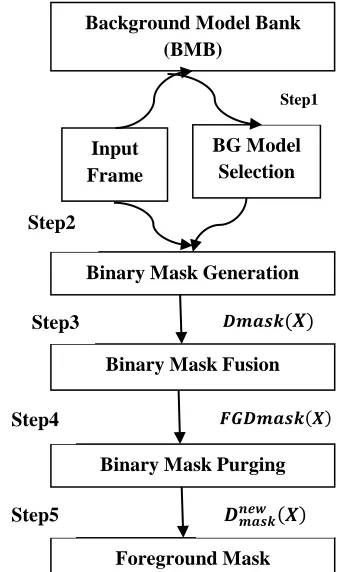
Around there, we delineate how solitary parts are solidified in our structure. The proposed structure includes five phases as showed up in Fig. 3. Every movement is depicted underneath.
Stage 1: Selecting the Background Model
The underlying advance is to pick a fitting BG Model for the moving toward edge. The decision measure relies upon recognizing the BG show in BMB that lifts the association w.r.t. picture I (X):
𝑐𝑜𝑟𝑟 = arg 𝑚𝑎𝑥𝑛 = 1, … , 𝑁
× ( (1 − 𝜇𝑖)(𝜇𝑛− 𝜇)
′
√(1 − 𝜇𝑖)(1 − 𝜇𝑖)′√(𝜇𝑛− 𝜇)(𝜇𝑛− 𝜇)′
) (13)
Here, the information picture and the picked BG exhibit are utilized to evaluate a hidden probability survey. The information picture is at the same time go to the MP module,
which partitions the photo in subjective number of MPs. Typical probability checks are figured for each MP using pixel-level probability measures and a while later thresholded to make Binary Mask(BM) for each shading channel. We demonstrate the BM for shading channel D as Dmask(X).
Step 3: Binary Masks Aggregation/Fusion
The BMs are then used to form Foreground Detection (FGD) masks for RGB and YCbCr color spaces. For YCbCr color space, if Cb and Cr channels are deactivated then FGDY CbCrmask will be reduced to the Y channel BM alone. Finally the two FGD masks are combined by taking logical AND between dilated versions of the two to obtain the actual FGD mask.
Stage 4: Purging of Binary Masks
At that point the FGD cover is connected to each bm which is gotten in stage 3. Here we can evacuate all of erroneously recognized closer view locales and
expands the order of FG and BG pixels in the last advance.
Stage 5: Foreground Mask
In the last advance of the procedure, FG cover is gotten by the intelligent OR of all the Dmask new (X) veils.
Fig 3. Universal Multimode Subtraction System. 𝑭𝑮𝑫𝒎𝒂𝒔𝒌(𝑿)
Binary Mask Generation
Binary Mask Fusion
Binary Mask Purging
Foreground Mask Step2
Step3
Step4
Step5
Background Model Bank (BMB)
BG Model Selection Input Frame
Step1
𝑫𝒎𝒂𝒔𝒌(𝑿)
𝑫𝒎𝒂𝒔𝒌𝒏𝒆𝒘 (𝑿)
𝑭𝑮𝑫𝒎𝒂𝒔𝒌(𝑿) Binary Mask Generation
Binary Mask Fusion
Binary Mask Purging
Foreground Mask Step2
Step3
Step4
Step5
Background Model Bank (BMB)
BG Model Selection Input
Frame
Step1
𝑫𝒎𝒂𝒔𝒌(𝑿)
V.
R
ESULTS
Fig: Super pixel imageFig: DB Scan Image
Fig3: Binary Mask Output
Fig4: Binary Mask after Thresholding
Fig5: Fig6:
] Fig7: Detected Foreground by Proposed Work
VI.
C
ONCLUSION
conditions to test the proposed method capabilities and advantages. In this 12, 10 categories MBs rank are in the top three ranks. In shadow suppression and in moving camera categories Mbs will give the better performance results. And the proposed method implementation is done by using the mat lab software. And in the future we can develop by using the c and c++ algorithms.
REFERENCES
[1] K. Toyama, J. Krumm, B. Brumitt, and B. Meyers, "Introvert: Principles and routine with regards to foundation support," in Proc. ICCV, Sep. 1999, pp. 255– 261.
[2] Y. Wang, P.- M. Jodoin, F. Porikli, J. Konrad, Y. Benezeth, and P. Ishwar, "CDnet 2014: An extended change location benchmark dataset," in Proc. Comput. Vis. Example Recognit. Workshops (CVPRW), 2014, pp. 387– 394.
[3] Change recognition Dataset, got to on Dec. 15, 2016. [Online].
Accessible: https://www.changedetection.net
[4] H. Sajid and S.- C. S. Cheung, "Foundation subtraction under sudden brightening change," in Proc. IEEE Multimedia Signal Process. (MMSP), Sep. 2014, pp. 1– 6.
[5] H. Sajid and S.- C. S. Cheung, "Foundation subtraction for static moving camera," in Proc. Int. Conf. Picture Process., Sep. 2015, pp. 4530– 4534.