Universally Composable Security Analysis of OAuth v2.0
Suresh Chari∗ Charanjit Jutla∗ Arnab Roy∗
Abstract
This paper defines an ideal functionality for delegation of web access to a third-party where the authentication mechanism is password-based. We give a universally-composable (UC) re-alization of this ideal functionality assuming the availability of an SSL-like ideal functionality. We also show that this implementation can be further refined to give a browser based imple-mentation whenever the browser supports https redirection. This impleimple-mentation matches the ’Authorization Code’ mode of the OAuth Version 2.0 Internet draft proposal, with the addi-tional requirement that the third-party along with the Authorization Server must support an SSL-like functionality.
From the universally-composable perspective, our ideal functionality definition is novel in the respect that it does not require the three parties to decide on a session identifier in advance, which is usually assumed in a UC setting. This allows us to realize the ideal functionality without any wrapper code, and thus exactly matching the desired protocol in the OAuth standard.
1
Introduction
We analyze the Web delegation protocol OAuth Version 2.0 in the Universal Composability (UC) Security framework [1]. In this framework one defines an ideal third party functionality which is handed inputs by all protocol participants, and the functionality then computes the requisite function, and returns portions of the computed function to each of the protocol participants as desired by the protocol. Security of a real-world implementation of the protocol is then proven by a simulation argument, which essentially shows that if an Adversary can gain any information in the real-world implementation, it can also obtain the same information in the ideal third party based protocol.
In the current paper, we only analyze the Authorization Code mode of OAuth 2.0. Analysis of the Implicit Grant mode of OAuth 2.0 will be given in Part II of this paper.
1.1 Index
Here is s summary of what is covered in this paper. Section 2 gives an introduction to Ideal Functionalities.
Section 3 gives an introduction to Simulation Based Security Definitions.
Section 5 defines the OAuth 2.0 Authorization Code Ideal Functionality Foauth∗. It assumes that the Client (also called Consumer) and Service Provider have globally known names, whereas the User (or user agent) only has local identity based on a userid, password account with these global entities.
Section 6 and Fig 4 give a real-world realization of the Ideal Functionality Foauth∗ using SSL. This implementation is general purpose and does not restrict the User code to be a user agent (i.e. an http browser). This section rigorously proves that this is a universally composable (UC) secure implementation. Later, in Fig 5 we give a refinement of this implementation where the User code is restricted to being a User Agent capable of handlinghttpsredirections. Further still, in Figs 6 and 7 we give refinements where some of the initial flows are based on hyper-links being sent by authenticated or unauthenticated emails respectively by the Client (Consumer) to the User.
1.2 Security Analysis Synopsis
Here are some the salient findings related to security of OAuth 2.0 Authorization Code mode.
1. The protocol in Fig 5, which we prove to be a secure realization of our Ideal Functionality for OAuth, is more or less the same as defined in the IETF internet draft OAuth Version 2.0 Authorization Code mode [2], except for a few fine points noted below.
2. Web-Servers which serve arbitrary Users on the Internet must have public keys for authen-ticating themselves. Thus, both the Service Provider and the Consumer (Client) must have public keys. Further, for simplicity, assuming that the public key of the Service Provider is attested by a global Certificate Authority (CA), the Public Key of the Client should at least be pre-registered with this globally certified Service Provider (if Client itself does not already have a globally certified public key). If the Client’s public key is not globally certified, then its public key must be distributed securely to applications running on User’s machine and capable of verifying signatures issued with this public key (in essence, implementing SSL). 3. Given that the Service Provider is required to have a globally certified public key, one can
assume that it can handle SSL requests, in particular https requests. Since the Client also has a public key with the public key securely delivered to the User, the User Machine’s application must be able to run a protocol with this Client which essentially implements SSL.
4. It is advisable that the login form presented by the Service Provider to the User contain both the Globally certified name of the Service Provider (e.g. Charles Schwab)and the Globally known name of the Client (e.g. turboTax) as to whom temporary access is being granted. While this is not that important in cases where the hyper-link to the Service Provider’s login page comes from the Client via an SSL connection, but it can be important where the hyper-link to the Service Provider’s login page comes via un-authenticated email (see fig 7). 5. In the flow where the Client (Consumer) presents the Authorization Code to the Server to
a Client’s redirect URI, a public key of the Client, and a certificate on this public key, the Server must check that this redirect URI belongs to the same entity, by either checking for this information in the certificate or by checking that this fact has been pre-registered. The session id for this session is saved by the Server along with this public key of the Client. Later, when the Client comes back to present the Authorization Code to get the AccessToken, the Server must check that this request is coming from a Client with the same public key. This can be done e.g. by using SSL/TLS two-side certificate checking1
.
We point out that this check is only required if the Client and User have an authentication mechanism (e.g. a userid, password) of their own, which is most likely the case. If the Client never authenticates the User, then because of other security issues, the fine points of the previous paragraph are moot.
6. If the Client authenticates the User, say by a userid, password account (which could be same or different from the account the User has with the Provider), then every fresh SSL session between the User and the Client must re-do this authentication. Thus, in the protocol we give (Figs 4 and 5), there are two SSL sessions between the User and the Client, and the second can be replaced by just using the first if the first is still active. If however, the first session has expired (and cannot even be refreshed) and a new SSL session must be established, then the authentication of the User by the Client must be re-done in this new SSL session.
2
Introduction to Ideal Functionalities
Cryptographic protocols are inherently multi-party protocols where the parties jointly compute some function. While the issue of liveness of protocols falls in the realm of distributed computing, we are interested here in issues related to privacy (secrecy) of the parties, as well as the related issue of authentication.
These multi-party privacy constraints of a protocol are best defined by hypothetically em-ploying an ideal trusted third party. In the simplest form of this definitional paradigm, all parties hand their respective inputs to the ideal trusted third party, which then computes the function on these inputs as desired by the protocol being defined, and then hands portions of the output to the individual parties, the portions restricted to what is desired by the protocol.
Note that in the above we assumed that the parties have a secure and persistent tunnel to the ideal third party, but this being just a definition this assumption is not a concern. In addition, if the protocol requires that a party in this multi-party protocol be a particular globally known entity, then we further assume that one of these secure tunnels is known to the ideal third party to be connected to that globally known entity.2
For parties that are not globally known, the ideal third party just assumes a persistent connection to some party (e.g. this will guarantee that it gives output to the same party that supplied some input using that tunnel). These issues will be brought up again in the examples below.
In a more general setting, this definitional paradigm also allows the ideal third party to leak certain information to an Adversary (without loss of generality, we always assume that there is only one monolithic adversary). This maybe a necessary part of the definition as otherwise
1
This essentially implements the Secure Channel Ideal Functionality (Fig 1).
2
there may not be any implementation possible in the real world (i.e. a distributed implementation without the ideal third party). In a further generalization, the ideal third party may also take directives and/or inputs from the Adversary.
Ideal Functionality Fsc
Fsc proceeds as follows, running with partiesP1, ..., Pn and an adversaryS.
1. Upon receiving a value (Establish-session, sid, Pj,initiator) from some party, Pi, send (sid,Establish-Session, Pi, Pj) to the adversary, and wait to receive a value
(Establish-session, sid, Pi,responder)fromPj. Once this value is received, set a boolean variableactive. Say thatPi andPj are thepartnersof this session.
2. Upon receiving a value(Send, sid, m)from a partnerPe,e∈ {i, j}, and ifactiveis set, send
(Received,sid, m)to the other partner and (sid, Pi,|m|)to the adversary.
3. Upon receiving a value(Expire-session, sid)from either partner, un-set the variableactive.
Figure 1: The Secure Channels functionality,Fsc
Ideal Functionality Fssl
The functionalityFssl is between a partyPj (the Server) and an unnamed party designated as the client. This models the asymmetric situation when the server has a public idenity but a client who connects to it has no global identity.
1. Upon receiving a value (Establish-session,sid, Pj,initiator)from some party, say Pi,
the functionality first sends the message (sid,Establish-Session, initiator, Pi, Pj) to the adversary. If the adversary responds positively the functionality records Pi as the client in this session and sends the message (sid,Establish−request) to Pj. When it receives the value (Establish-session, sid, responder) from Pj in response it sends
(sid,Establish-Session, respondor, Pj) to the adversary, and it sets the session asactive
between clientPi and serverPj.
2. Upon receiving a value (Send,sid, m)from a party Pe, it checks to see if the sessionsid is activeand thatPeis eitherPi orPj. It then sends(sid, Pe,|m|)to the adversary and when it receives a positive response it sends(Received,sid, m)to the other partner in the session.
3. Upon receiving a value (Expire-session, sid)from either the client or server in the session it sets state toinactiveand public delayed informs the other party.
Figure 2: The SSL functionality, Fssl
Finally, to allow a compositional definition, we assume that all parties (except the ideal third party, but including the Adversary) are driven by an all encompassing entity called the
Coming to our first example, we discuss the ideal functionality “Secure Channel” described in Fig 1. It is the ideal functionality representing authenticated and encrypted channels between two globally known parties, e.g. two parties with public keys in a PKI. Since, the same two parties may be involved in multiple different secure channel sessions (possibly concurrently), we assume that the two parties have decided on a session id (sid) before hand; infact this sid may be decided by the Environment as it drives all the parties anyway. We emphasize that this definition of secure channel requires that the parties have globally known names. For instance when party Pi initiates
a session with an Establish-session input to the ideal functionality, it is naming a party Pj with
which it wants to have the secure channel session. Similarly, the same named party Pj must
respond with the Establish-session input while namingPi. Once, both parties have supplied their
Establish-Session inputs, while naming the correct counter-parties, the ideal functionality sets its local state to active. From then on, either party can send a message to the other party using the ideal functionality, which only leaks the length of each message to the Adversary (it is possible to have an ideal functionality which does not even reveal the length of the message to the adversary, but implementing such a functionality in the real world may be very inefficient).
Moving on to the next example, the SSL ideal functionality in Fig 2, one notices in contrast to the secure-channel functionality above that only one of the peers is supposed to have a globally known name, and the session can be initiated by any partyP, and whose name is never referred to in any messages (initialization or otherwise). The adversary is leaked information about the name being used by this client (e.g. a temporary IP address), which is unavoidable in any real-world implementation.
3
Introduction to Simulation Based Security Definition
While the previous section only described a way to define the desired goal of a protocol using an ideal third party, one can also define security of a real-world protocol by relating it to this ideal functionality. Note that the ideal functionality has precisely characterized what output each legitimate party gets, and what is leaked to the Adversary. It also characterizes directives that an Adversary unavoidably controls, e.g. whether a message should be delivered to a counter-party or not. Thus, if we can show that the real world protocol has the same characteristics, we have managed to prove desired security constraints of the real protocol.
A real world protocol between some parties is said to realize an ideal functionality, if for every adversary in the the real world protocol, there is an adversary in the ideal world protocol (i.e. involving the ideal trusted third party representing the ideal functionality) such that the Environment interacting with the parties and the two adversaries (the real world and the ideal world) cannot distinguish between the two scenarios3
. Thus, in this definition the Environment gets the same amount of information in the real and the ideal world. Since the ideal world precisely defined what the Environment gets (actually what the Adversary gets, which it reports back to the Environment), one concludes that in the real world protocol also the Environment (and hence the
3
adversary) gets only the precisely defined information. More rigorous definitions can be found in [1].
Such realization proofs are done by a simulation argument. Given a real world protocol, and an AdversaryAin the real world, the proof constructs a SimulatorS that simulates the real world protocol toA. To do this simulation,Sis assumed to reside in the ideal world, and hence has access to the Ideal Functionality (as an ideal world Adversary S). If such a simulation is possible, then we have managed to construct for each adversary A in the real world an adversary A0 (which is obtained by juxtaposingSandA) in the ideal world, such that the Environment can not distinguish the two scenarios, and hence, by definition, security follows.
3.1 Utility of Ideal Functionality Based Definition
Since our definition of security is based on an ideal functionality, which sometimes describes in tedious details the various input/output characterizations and interactions with the adversary etc., one may wonder if one has covered all issues in such a definition. Luckily, most of the time the definitions are straightforward, and just describes the parties handing over their inputs, and then getting back the desired outputs, as well as a characterization of leakage to the Adversary. Thus, it is easy to be convinced that such a definition is the required security definition.
In many other cases, the protocol even in this ideal setting maybe more complicated, with multiple interactions. While, an advanced reader or someone well-versed with the issues may easily be convinced about the robustness of the definition, readers new to the issue may not be convinced. Fortunately, there is a way to validate these definitions, by using these protocols in higher level protocols, the latter being the end goal anyway.
In the compositional paradigm mentioned earlier, a theorem of Canetti [1] called the com[position theorem shows that once a real protocolρhas been proven to realize an ideal functionalityF, then one can build higher level real world protocols which realize higher level functionalities, say G, by assuming the availability of ideal functionality F in the real-world. The composition the-orem proves that having obtained such a hybrid protocol (i.e. a real-world protocol using ideal functionalityF), one can convert it to be a fully real-world protocol by embeddingρin place ofF. If the ideal functionality G, which is the end goal, is clearer to understand and characterize (hopefully this is the case as it is a high level goal), what we get is a real world protocol which realizes G. Then, we do not need to worry about whether F was a correct characterization, and in fact we have indirectly validated thatF had the desired properties in the sense that it helps us securely implement G.
4
Conventions for Defining Ideal Functionalities
Delayed Messages When an ideal functionality outputs a value to a party, this delivery of value can be either public delayed or private delayed. Essentially, since the network in the real-world is assumed to be under adversarial control, one can only guarantee delivery of messages in the real-world if the adversary complies. Thus, any value to be delivered to a party is termed “delayed”, which is a short form saying that the functionality requests the Adversary to deliver the value, and if the adversary responds positively, then the value is actually delivered. When the functionality terms the delivery public delayed, it means that the adversary gets to see the actual value, whereas if it is termed private delayed, then the adversary only gets to see the length of the message in bits.
Corruption Each ideal functionality has a function called Corrupt which the Adversary can call to declare a globally known entity (i.e. one with a public key in PKI) corrupted. The functionality then records in its local state that the party is corrupted. The functionality may choose to have a different behaviour based on whether certain parties are declared corrupted. Normally, this would mean, for example, instantly revealing some internal state of the ideal functionality to the Adversary, as that is what happens in the real-world. Ideally speaking, one would like to have the case that even if some parties in a protocol are corrupted, it does not affect the privacy of other parties, and most ideal functionality would be defined in that fashion. However, one cannot exclude some side effects from happening when some party in the protocol is corrupted.
As an interesting example related to OAuth, suppose that legitimate Clients (or Consumers) are registered with the Service Provider. In fact, under PKI attestation of the URIs of the Clients, the Service Provider just needs to know the global identity of these Clients. If a User agent contacts (under SSL) a Service Provider with a URI of a Client (attested under PKI to be associated with a globally known namePc), and further if the User Agent manages to
provide correct useridA, passwordAto the Service Provider under the same SSL session, then
the Provider can assuredly provide the clientPc information related to the account useridA.
Now consider the situation where the passwordAwas easy to guess, and hence the User Agent
was being driven by an illegitimate user (Adversary). If the Client was not authenticating the User on its own, then the Adversary would end up getting information related to useridA
(via the Client). But, if the Client was also authenticating the User under possibly a different useridB, passwordB, and if this password was tough to guess for the Adversary, then the
Client will never open a session with this illegitimate user. However, a different Client Pc0
which is a pre-registered Client may be malicious and may join forces with the Adversary. In this case, as soon as the illegitimate user presents useridA, passwordA, Pc0 to the Service
Provider, the information related to useridA is essentially given to the Adversary by the
Provider. The ideal functionality would do exactly that, but it needs to be informed thatPc0
has been corrupted (i.e. it has joined forces with the Adversary).
How-ever, this wrapper protocol could lead to an inefficient complete protocol, as it may take additional flows. Thus, in our definition of OAuth’s ideal functionality, we have minimized any such wrapper protocol for determination of sid, so that the resulting implementation is in line with practical implementations of OAuth. One implication of this is that the ideal functionality has many more flows than one would expect. For example, the Service Provider is not pre-determined by the sid, and is actually passed as an input by the Client. Similarly, the Client is not pre-determined by the sid, and the Client’s global identity is passed to the Provider (with possible Adversarial manipulation of this identity) in the ideal functionality.
5
The OAuth Ideal Functionality
Before we embark on giving a definition of the OAuth Ideal Functionality, we paraphrase the following abstract from the OAuth V2 Internet draft ( [2]):
“The OAuth 2.0 authorization protocol enables a third-party application to obtain limited access to an HTTP service, either on behalf of a resource owner by orchestrating an approval interaction between the resource owner and the HTTP service, or by allowing the third-party application to obtain access on its own behalf.”
In this paper we will focus mainly on the first kind of delegation which requires an approval interaction. In the ideal functionality definition, we will refer to the three parties named above as User (resource owner), Provider (HTTP Service), and Consumer (third-party). Moreover in this section, we will assume that the Provider and the Consumer have globally known names, e.g. public keys with certified domain names in PKI. Only the User willnot be assumed to have a global name. The case where the Consumer has a public key which is not certified by a global CA is dealt with in a later section.
In particular, the most interesting and wide-spread case arises where the User has ahuserid,passwordi
account with a Provider, which needs to be delegated to the Consumer. The basic idea of the defi-nition can be summarized as follows: A User starts of using a software provided by a ConsumerPc,
say as a website with PKI certified public key. To model this, the User calls the ideal functionality with an input message (sid,initiate, Pu, Pc). Heresidis a non-secret but unique session identifier
which is chosen by the User or Environment (wrapping the User). Note that Pu may just be a
temporary identifier, e.g. a temporary IP address. The Consumer, at some point decides that it needs access to data of the User held at a Provider Ps, again Ps being a website with a PKI
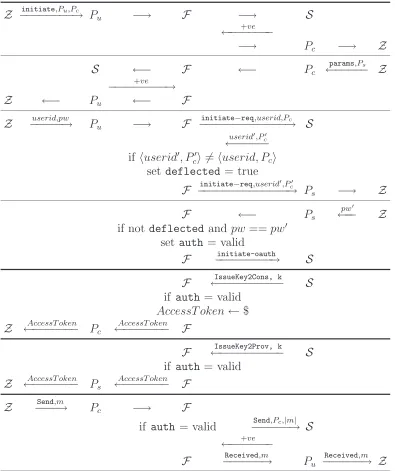
certified public key (see Fig 3 for a formal description and Fig 8 for a pictorial depiction). The ideal functionality then forwards the name Ps to the User, who in response provides a userid and
password to the ideal functionality (corresponding to its account at Ps). The ideal functionality
then provides the userid and the namePc toPs. At this point,Ps may abort, if for example it does
not wish to provide data to Pc, or if it deems userid to be invalid. Otherwise, it responds to the
ideal functionality with the pre-registeredpw0 corresponding to the userid provided4
.
The ideal functionality next checks the two passwords for equality (the one supplied by the
4
User and the one returned by the Provider). If they are not equal, the session is aborted, and the Adversary is also leaked this information (as it is highly inefficient to not leak this information in the real-world). If they are equal then the functionality sets a local status variable, say authentication status to valid, and this status is also revealed to the Adversary.
Next, the ideal Functionality issues a randomly generated AccessToken to the Provider Ps
and Consumer Pc, but only at the Adversary’s directive, i.e. the Adversary can cause denial of
service. This common and secret AccessToken may be used by the two parties to communicate any information related to the account corresponding to userid. Note again that the wrapper software of the Provider is given the userid and the AccessToken, and if the wrapper software is buggy, there are no security guarantees. The ideal functionality only guarantees that a userid has been provided to the Provider, and further that the password the Provider gave for this userid is same as the password provided by some arbitrary partyPu, and that the Provider shares the AccessToken with
a globally known entity Pc, the identity Pc being supplied by the same partyPu.
The ideal functionality also provides a capability for the User and the Consumer to send mes-sages to each other secretly. The authentication of mesmes-sages originating at Pc do not need any
particular mention since Pc has a global public key, but what is noteworthy is that the delivery of
these messages is only to the User who provided the correct password to the userid submitted to the Provider.5
The OAuth Ideal Functionality is defined in detail in Figure 3. In this detailed definition, one notices that the Adversary makes the “Issue Key” calls. As already mentioned, this makes sense as the network is assumed to be insecure, and hence the Adversary is assumed to control the network. Thus all network flow is directed by the Adversary, including the issuing of keys. Note that the Adversary does not control what keys are delivered (unless it has compromised the session), but only control when and if the keys are delivered.
There are certain other intricacies related to password-based authentication, which can be ignored in a first reading. Since the password in password-based accounts is usually human memorizable, it can not be assumed to have full 128 bit entropy (when talking about 128-bit security for the protocol). Thus, the ideal functionality we define must not guarantee 128-bit security, since any implementation of such an ideal functionality would require random 128 bit passwords.
However, as described in [?, ?], one can define an ideal functionality which guarantees that an Adversary can only by-pass the 128-bit security by performing online guessing attacks. Thus, other than these guessing attacks (which are un-avoidable), 128-bit security is guaranteed by the ideal functionality. So, how does one define an ideal functionality where such guessing attacks are feasible? The functionality allows the Adversary to call it with a guess of the password, and if the guess is correct, the Adversary is allowed to set shared keys of its choosing (basically giving it access to the secure channel being setup), and if the guess is incorrect then the session is considered interrupted, and the legitimate parties (essentially) abort.
5
Note that if the Adversary does not deflect the protocol, and change userid to some other userid’, then the account corresponds to userid as provided byPu. If however, the Adversary (say posing as another P
0
u) hijacks (or
6
Implementation of Ideal Functionality
F
oauth
∗The implementation of the Ideal Functionality Foauth∗ assuming ideal functionalities for SSL and Secure Channels is given in Figure 4. This implementation does not assume that the User program is just a User Agent (i.e. a browser implementing http). However, care has been taken to make this implementation easily refined into one where the User code can just be replaced by a browser that supports redirection. Indeed, such a implementation is given in Fig 5. Further, another implementation where a User may instead be sent a hyper-link of the Provider in an authenticated email (instead of a response to an https request) from the Consumer is given in Fig 6. This implementation is a further refinement of the one in Fig 5. Next, an implementation is given in Fig 7, where the hyper-link is sent via an unauthenticated channel, e.g. posted on a bulletin board. this implementation is a further refinement of the previous ones. Special attention should be paid to the notes at the bottom of the figures.
Theorem 1 The implementation realizes the functionality Foauth∗.
Proof: We will show that for every probabilistic polynomial time (PPT) adversaryA, there exists a PPT adversary A’, such that the ensembles, corresponding to the view of the environment in the experiment where it interacts with the adversaryA’ involved with the ideal functionality, and the experiment where it interacts with the adversary A involved with the real implementation, are indistinguishable. The adversary A’ in the ideal world is obtained by composing a simulator
S with A itself, where S using access to ideal functionality (as ideal world adversary) simulates the real-world to A. Further,S will ensure that the interaction of Foauth∗ with environment is also indistinguishable with interaction of real parties with the environment. Note that in the ideal world experiment, the partiesPu, Pc, Psrun as dummies and just pass back and forth the messages
betweenZ andFoauth∗, whereas in the real world, the partiesPu, Pc, Psare running the protocol
π. Thus to simulate the real world to A, S will need to simulate the real parties Pu, Pc, Pj to A.
We will show that S is able to do so (using access to ideal functionalityFoauth∗), and hence as
far as the environment Z is concerned the ideal world and the real world are indistinguishable. We will show later how S simulates SSL and SC, but for now we deal with how S simu-lates the real world parties. To begin with, in both worlds, the environment Z sends the input (sid,initiate, Pu, Pc) to Pu. In the real-world, this prompts Pu to Establish an SSL session by
calling the ideal functionalityFssl, which in turn calls the AdversaryAfor a response. This call to
Aneeds to be simulated byS, but since in the ideal worldS gets called byFoauth∗ as well,S can at that point simulate a call to A. IfA responds positively in the real-world, S in the ideal world callsFoauth∗ positively (noteS is usingAas a blackbox). Note that this leads to an output via
Pc to the environment of value (sid,params-req, Pu, Pc) in both worlds.
Next, in both worlds, the environmentZ sends input (sid,params, Ps) toPc. In the real world,
this promptsPc to senda message via the same SSL session toPu, which is promptly output back
to the environment. In the ideal world, the simulator S gets notified by the ideal functionality
Foauth∗ of this input fromPc (as it is being sent toPu public delayed), and henceS can simulate
a call to A regarding the size of the message in bits (which is what Fssl does in the real world). Further note that the message is also output to the environment in the ideal world.
Now consider the cases where one or more of the SSL sessions siduc1ssl, siduc2ssl, sidUPssl may be initiated by a corrupt principal (Pu0). We don’t have to consider the secure channelsidcssc because a secure channel authenticates both the peers, and we do not consider corruption of the client and/or the provider here.
Case siduc1
sslis initiated by a corrupt principal: First we see how an AdversaryA in the real-world accomplishes this. Assume that the Adversary has managed to corrupt a user (lets call it
Pu0; infact the userPu0 in this case may just be the Adversary). From now on we will identify
Pu0 withA, which goes well with our convention that there is only one monolithic Adversary. Next, when the legitimate userPu makes an Establish Session call toFssl, the AdversaryA does not respond with a positive response, and hence in a sense that SSL connection never takes place. Instead, the Adversary (via Pu0) initiates a new SSL establish session call to another instance ofFssl naming the same consumerPc as server.
since the Adversary is making this Establish session call to Fssl, the Simulator which is treating A as a black box can see this call being issued. Similarly, when A (viaPu0) sends a message (sid,par-req) by calling the Send function of Fssl, again S gets to see this call in the plain, and checks for integrity of the message, and if so, just responds positively to the ideal functionality Foauth∗’s public delayed output toPc. Thus, in both worldsPc outputs
the same value par-req to Z. Note that in the real-world Pc has no idea whether Pu0 is
legitimate or not, and hence as long as the message was of proper syntax, it will output it to
Z. Case sidUP
ssl is initiated by a corrupt principal: Again, as in the previous case, the Adversary may not respond positively to a legitimate SSL establish-session request, and instead start its own SSL session with the Provider Ps. However, since it is A that sends a message
(sid,initiate−req, userid00, pw00, Pc00) using this SSL session, S is able to see the message. If the message is not syntactically correct then S just stops. S then sends the message (sid,initiate−req, userid00, Pc00) toFoauth∗ which the latter is expecting. If useridorPc
have been altered from whatF sent to S, then F sets its deflection status to deflected. Note that this can only happen if A started its own SSL session, although A may choose to keep
useridand Pc same (which although not revealed to A in the real-world protocol, may still
be easily guess-able).
Next, the environment receives the output (sid,initiate−req, userid00, Pc00) in both the worlds. It responds with (sid,password, pw0) if the environment (i.e. Ps’s wrapper software)
determines that userid00 and Pc00 are valid parameters (or it may respond withbad-params; this case is easy to handle and we skip this case). Note that if Pc00 is different from Pc, but
still a pre-registered Consumer, then the environment is likely to pass it as a valid parameter. Further, since the SSL session is being initiated by the Adversary, the initial user Pu is out
of the picture. There are two sub-cases depending on the deflection status of F.
normal: In this case, on the input pw0 from Ps, the functionality F sets its authentication
status based on whetherpw0 is same aspw (supplied byPu). However, this is not what
message call to Fssl – see previous paragraph.) Now, both the real-world and the ideal-world are in sync.
deflected: In this case, on the input pw0 from Ps, the functionality F does not set its
authentication status anyway, soS just needs to call F’s TestPwdfunction with pw00. Next in the real world,Ps sends the message (sid,authgrant, AuthCode) over sidUPsslonly if passwords matched, in which case in the ideal world S (since it s informed the usurpation status) just generates random Authcode of its own and delivers it toA.
Note that, in the real-world the Adversary must initiate its own SSL session UC2 with the Consumer, otherwise the Authcode it obtained from the Provider cannot be delivered back to the Provider via the consumer. IfAindeed starts its own SSL session withPc, then since
it will call the SSL session with a Send Authcode, the Simulator can check if this Authcode is same as the one it generated for it.
Case sidCS
sc is initiated by a corrupt partyPc0. In the real-world Ps checks that this Pc0 is same as
the parameter sent to it in sidUPssl, or more precisely its replacement initiated by Adversary
A. Thus, Ps only continues with the protocol in the real-world if sidUPssl was replaced by Adversary, which had passed aPc0 then and which was validated by the Environment (i.e. the environment did not respond withbad−params. In such a scenario, recall that the ideal-world has set its deflection status as deflected (note corruptPc0 is not same asPc). This means that
the authentication status is empty. Now, if in the real-world Pc0 also happens to report the correct Authcode in sidCSsc, then Ps and Pc0 (i.e. A) will end up sharing a common random
AccessToken. To emulate this situation, S in the ideal world just calls Issue AccesToken to Provider with a randomly chosen k. This would lead to setting the AccessToken of the Provider to k if usurpation status was compromised (i.e. pw00 = pw0) and Pc0 is corrupted (which it is). The simulator S also sends a message to Pc0 (i.e. A) (accesstoken, k) under the appropriated sidCS
sc, thus completely emulating the real-world.
Case siduc2ssl is initiated by a corrupt principal: If in the real-world the first two SSL sessions were legitimate, and only this one is initiated by A then A can provide the correct Authcode to Consumer only with negligible probability, as Authcode is generated randomly. Thus, in this case in the real-world, the Provider and hence the Consumer will not output a common and random AccessToken. Since, the Simulator S knows that the first two SSL sessions were legitimate, and this one is not, it just does not make the calls to Foauth∗’s Issue Access Token functions.
If on the other hand, the SSL session between User and Provider was taken over by the Adversary, then, we know from the previous case that the Adversary knows the usurpation status, and in case of compromised status, has provided a random Authcode of its own. If
A in this corrupted SSL session sends the same Authcode to Pc, the S gets to see that, and
hence it means in the real world sincePc andPsbehave honestly,Ps will end up issuing valid
(and randomly generated) AccessToken toPc. So, S just makes the Issue AccessToken calls
for both Consumer and Provider with the same randomly chosen value k. Thus, the view of the Environment in both the worlds will be same.
As for the (sid,Send, m) values given by the Environment toPc in the real world, note that
password pw00 the Adversary had provided matched the password Ps had produced, which
means the usurpation status iscompromised. Thus in this situation, if this last SSL session was started by the Adversary, in the real world the Adversary would get the message m, and the same would hold in the ideal world.
7
Acknowledgements
The authors would like to thank Michael Steiner for several helpful comments. The authors would also like to thank Pau-Chen Chang, Mark Mcgloin, David Robinson, Jeffrey Hoy and Prashant Kulkarni for helpful discussions, and Mark in particular for encouraging us to write this paper.
References
[1] Ran Canetti, “ Universally Composable Security: A New Paradigm for Cryptographic Proto-cols”, Proc. Foundations of Computer Science, 2001: 136-145.
Ideal FunctionalityFoauth∗
Participants: An arbitrary UserPu, Service ProviderPs, ConsumerPc, and AdversaryS interact with functionalityFoauth∗ (orF).
Status Variables: Deflection Status (default: normal), Usurpation Status (default: normal), Au-thentication Status (default: empty).
Initiate: On receiving an input message (sid,initiate, Pu, Pc) fromPu, output (public delayed) the message (sid,params−req) to Pc. On receiving a reply (sid,params, Ps) from Pc, output (public delayed) the message (sid,params, Ps) toPu.
On receiving a response (sid,credentials, userid, pw) fromPu, output (sid,initiate−req, userid, Pc) to adversary S. On receiving a response (sid,initiate−req, userid0, P0
c) from adversaryS, output (sid,initiate−req, userid0, Pc) to0 Ps. Further, ifuserid0 is not the same asuseridorP0
cis not the same asPc, set thedeflection statusasdeflected. Next, on receiving a response (sid,password, pw0) from Ps, record pw0 locally. If the
de-flection status is not set as deflected, then check if pw = pw0, and if the two pass-words are not the same then set the authentication status as aborted and output (sid,abort−oauth) to the Adversary. Otherwise (if the passwords are same), set au-thentication statusasvalidand output (sid,initiate−oauth) to the Adversary. If the deflection status is set as deflected, skip the above steps and wait for a TestPwd call from S.
Instead of responding with a pw0, Ps may instead respond with (sid,bad−params), in which case the functionality sets the authentication status as aborted and outputs (sid,bad−params) toS.
The following call may be made by the AdversaryS (and onlyS).
TestPwd: On receiving a message (sid,testpwd, pw00) fromS: Ifpw0 is not recorded locally, then ignore this call. Else, if pw00=pw0 then set usurpation status ascompromised, otherwise set usurpation status as interrupted. Report the usurpation status to S. In either case reset
authentication status to empty. Note that deflection status is immaterial here, and S can make this call even if deflection status is normal.
The following two calls may also be made by the AdversaryS (and onlyS) in any order.
Issue Access Token to Consumer: On receiving a message (sid,IssueKey2Consumer, k) fromS, if the authentication status is set asvalidthen output a randomly generatedAccessTokento Pc. Else, if the usurpation status is set as compromised, outputk (provided as a parameter by the Adversary) toPc. In all other cases, obtain freshr←$, and outputrtoPc .
Issue Access Token to Service Provider: On receiving a message (sid,IssueKey2SP, k) from S: if the authentication status is set as validthen output the same AccessToken as above to Ps. Else, if the usurpation status is set as compromised, and P0
c is same as Pc or Pc0 is corrupted, output k (provided as a parameter by the Adversary) to Ps. In all other cases, obtain freshr←$, and outputrto Ps.
Send: On receiving an input (sid,Send, m) from ˆP which is either Pu or Pc, check if the authen-tication status is set asvalid. If so, send (sid,P ,ˆ |m|) to AdversaryS, and after receiving a positive deliver response fromS, output (sid,Received, m) to the counter-party of ˆP (i.e. Pc or Pu resp.). If instead, the usurpation status is set as compromisedand if Sendoriginates fromPc(i.e. ˆP isPc), andPc0==Pc, then send (sid,P , mˆ ) to adversaryS(i.e. the Adversary gets the messagem). In all other cases, send (sid,P ,ˆ |m|) toS and take no further action.
Implementation of Foauth∗ using Fssl and Fsc
Participants: The User Agent (Pu), Service Provider (Ps), Consumer (Pc), and AdversaryA.
Initiate: On receiving (sid,initiate, Pu, Pc) from Z, Pu initiates an SSL session with ses-sion id siduc1ssl with Pc and sends the message (sid,params−req, Pu, Pc). On receiving (sid,params−req, Pu, Pc) over SSL sessionsid
uc1
ssl,Pc outputs (sid,params−req, Pu, Pc). On receiving (sid,params, Ps) from Z, Pc sends the message (sid,params, Ps) to Pu using SSL session siduc1ssl.
On receiving (sid,params, Ps) over siduc1ssl, Pu outputs (sid,params, Ps) to Z. On receiving (sid,credentials, userid, pw) from Z, Pu initiates an SSL session with Ps with session id sidUPssl and sends (sid,initiate−req, userid, pw, Pc). On
receiv-ing (sid,initiate−req, userid, pw, Pc) over the SSL session sidUPssl, Ps queries the environment with (sid,initiate−req, userid, Pc). The environment responds with (sid,password, pw0). Ps tests whether pw = pw0. If the check succeeds, Ps gen-erates a random AuthCode, records (sid, Ps, Pc, Authcode), and sends the message (sid,authgrant, AuthCode) oversidUPssl.
If the environment responds toPswithbad−params,Ps just aborts.
On receiving (sid,authgrant, Authcode) oversidUP
ssl,Pu sends (sid,authgrant, Authcode) to Pc over anew SSL sessionsid
uc2
ssl.
On receiving (sid,authgrant, Authcode) over siduc2ssl,Pc initiates a secure channelFsc
with Ps with sid sid
cs
sc and sends Ps the message (sid,authgrant, Pc, Authcode). On receiving (sid,authgrant, Pc, Authcode) over sid
cs
sc, Ps checks it against the recorded information, and makes sure that the Secure channel is with the same global entity Pc as recorded earlier. If the check succeeds then it generatesAccessT okenand sends (sid,accesstoken, AccessT oken) oversidcssc. It also outputs (sid,keyCS, AccessT oken)
to the environment.
On receiving (sid,accesstoken, AccessT oken) over sidcssc, Pc outputs (sid,keyCS, AccessT oken) to the environment.
Send: On receiving (sid,send, m) from the environment, Pu sends the message (sid,send, m) to the peer over SSL session siduc2ssl. On the other hand, on receiving (sid,send, m) from the
environment,Pc checks that it has obtained an AccessToken fromPs, and only then it sends the message (sid,send, m) to the peer over SSL sessionsiduc2ssl.
Notes: 1. Pu can use the older SSL sessionsid
uc1
ssl instead of a freshsid
uc2
ssl, if the former is still
active.
2. If the Consumer also requires a password-based authentication of the User (possibly with a different userid, password than the one which the User has with the Provider), then if a fresh siduc2ssl is initiated, then this password-based authentication by the Consumer
must take place afresh as well.
Implementation of Foauth∗ using HTTPS Redirection
Participants: An arbitrary User AgentPu, a Service ProviderPs, a ConsumerPc, and Adversary A. The Service Provider and Consumer are assumed to have SSL supporting URIs with PKI certificates.
Initiate: On receiving an input (sid,initiate, Pu, Pc) from the environment, Pu initiates an https session with session id sidUC1ssl with the URI of Pc and query parameters (sid,params-req, Pu, Pc).
On receiving (sid,params-req, Pu, Pc) over https sidUC1ssl which it outputs to the
environ-ment, Pc obtains the input (sid,params, Ps) from the environement. ThenPc responds with (sid,redirect uri:Ps,client-params) to Pu using SSL session sidUC1ssl. SincePs is a globally known entity, the Consumer Pc can obtain a valid https URI of Ps. The query parameters calledclient-paramsincludes the https redirection URI ofPc itself, and other credentials of Pc. Since the response is a redirection https URI, the user agent Pu automatically initiates an SSL session withPswith session idsidUPssl and query parameter (sid,client-params).
On receiving this message,Psresponds toPuoversidUPssl, with a login-password form, to which
the user agent responds by outputting the form along with Ps’s identity to the environment (which in this case is possibly just a human User along with a certificate checker). The Environment (or the human) responds with auseridand passwordpw, which the User agent forwards to Ps using sidUPssl. Next, Ps queries the environment with the received userid along withclient-params(sincePc is also a globally known entity, this is just equivalent to outputting the identifierPcitself), to obtain a passwordpw0 corresponding to this userid (or a
bad-paramsresponse). Onpwvalidation (i.e. pw=pw0),Psgenerates a fresh random number
Authcode, and saves (sid,initiate, Ps, Pc, Authcode) in its local memory, and responds over
sidUPssl with the redirect URI of Pc (obtained from client-params) and query parameter (sid,authgrant, AuthCode).
Since the user-agent Pu receives a redirect URI, which is an https URI of Pc, it automatically starts a new SSL session sidUC2ssl with Pc, over which it sends query paramter (sid,authgrant, AuthCode). On receiving (sid,authgrant, Authcode) over sidUC2ssl, Pc initiates a secure channel Fsc with Ps with sid sidCSsc and sends Ps the message (sid,authgrant, Pc, Authcode).
On receiving (sid,authgrant, Pc, Authcode) over sidCSsc, Ps checks it against the recorded information. If the check succeeds then it generates a random AccessT oken and sends (sid,accesstoken, AccessT oken) oversidCS
sc. It also outputs (sid, KeyCS, AccessT oken) to
the environment.
On receiving (sid,accesstoken, AccessT oken) over sidCS
sc, Pc outputs (sid, KeyCS, AccessT oken) to the environment.
Send: This is same as in Fig 4.
Notes: 1. The User agent may check if the rediection URI ofPcis same as the URIPcit used in SSL session sidUC1
ssl, and if that session is still alive, it can use that same session instead
of a new sidUC2
ssl.
Implementation ofFoauth∗ using Authenticated E-mail and HTTPS Redirection
Participants: An arbitrary User AgentPu, a Service ProviderPs, a ConsumerPc, and Adversary A. The Service Provider and Consumer are assumed to have SSL supporting URIs with PKI certificates.
Initiate: On receiving an input (sid,initiate, Pu, Pc) from the environment, Pu initiates an https session with session id sidUC1ssl with the URI of Pc and query parameters (sid,params-req, Pu, Pc).
On receiving (sid,params-req, Pu, Pc) over https sidUC1ssl which it outputs to the
environ-ment, Pc obtains the input (sid,params, Ps) from the environement. ThenPc responds with (sid,uri:Ps,client-params) toPuusingFauth(Pc), SincePsis a globally known entity, the ConsumerPCcan obtain a valid https URI ofPs. The query parameters calledclient-params includes the https redirection URI ofPcitself, and other credentials ofPc. The user agentPu on receiving this authenticated message fromPc initiates an SSL session with Ps (using the supplied uri ofPs) with session idsidUPssl and query parameter (sid,client-params).a
On receiving this message, Ps responds to Pu over sidUPssl, with a login-password form, and
the rest of the implementation is same as in Fig 5
Notes: 1. The same notes as in Fig 5 apply here.
2. The ideal functionality Fauth is defined in the appendix. It essentially, delivers a
message only if the sender isPc, thus guaranteeing the receiver that the message received came fromPc. This, for example, can be the case where the User has a trusted email server, and the e-mail received has a certified signature ofPc.
3. Note that sessionsidUC1
sslneed not be an SSL session, butsidUC2sslmust be an SSL session.
a
technically, the User must click on the supplied link, but we will assume the worst case that the user always clicks on the link.
Implementation of Foauth∗ using Bulletin Board and HTTPS Redirection
Participants: An arbitrary User AgentPu, a Service ProviderPs, a ConsumerPc, and Adversary A. The Service Provider and Consumer are assumed to have SSL supporting URIs with PKI certificates.
Initiate: On receiving an input (sid,initiate, Pu, Pc) from the environment, Pu initiates an https session with session id sidUC1
ssl with the URI of Pc and query parameters (sid,params-req, Pu, Pc).
On receiving (sid,params-req, Pu, Pc) over https sidUC1ssl which it outputs to the
environ-ment, Pc obtains the input (sid,params, Ps) from the environement. ThenPc responds with (sid,uri:Ps,client-params) toPuusing an un-authenticated and unencrypted channel. Since Psis a globally known entity, the ConsumerPC can obtain a valid https URI ofPs. The query parameters called client-paramsincludes the https redirection URI of Pc itself, and other credentials of Pc. The user agent Pu on receiving this un-authenticated message from Pc, initiates an SSL session withPs(using the supplied uriPs) with session idsidUPssl and query
parameter (sid,client-params).a
On receiving this message, Ps first checks that the client-paramshas the URI of some Pc along with its Application name which are globally known (e.g. via PKI). Next,Psresponds toPuoversidUPssl, with a login-password formalong with the Application name ofPc displayed
on the form, to which the user agent responds by outputting the form along withPs’s identity to the environment (which in this case is possibly just a human User, along with a PKI certificate checker). We will assume here that the User Agent gets human assist in verifying the the Pc displayed on the form is the same as thePc initially supplied to the User-agent in theinitiatecall. b
The Environment (or the human) responds with a useridand passwordpw, which the User agent forwards to Ps usingsidUPssl. Rest of the implementation is same as in Fig 5
Notes: 1. The same notes as in Fig 6 apply here.
a
technically, the User must click on the supplied link, but we will assume the worst case that the user always clicks on the link.
b
More rigorously, this mode would require a different ideal functionality where both Ps and Pc are
provided in theparamsoutput toPu, instead ofPuprovidingPcin theinitiatecall.
Ideal Functionality Flow Foauth∗
Z initiate,Pu,Pc
−−−−−−−−→ Pu −→ F −→ S
+ve ←−−−−−−−
−→ Pc −→ Z
S ←− F ←− Pc
params,Ps ←−−−−− Z +ve
−−−−−−−−−→
Z ←− Pu ←− F
Z −−−−−→userid,pw Pu −→ F
initiate−req,userid,Pc −−−−−−−−−−−−−→ S
userid0,P0
c ←−−−−−
if huserid0, Pc0i 6=huserid, Pci
set deflected = true
F initiate−req,userid0,Pc0
−−−−−−−−−−−−−−→ Ps −→ Z
F ←− Ps
pw0
←−− Z
if notdeflected and pw ==pw0 set auth= valid
F −−−−−−−−−→initiate-oauth S
F ←−−−−−−−−−−IssueKey2Cons, k S
if auth= valid
AccessT oken←$
Z ←−−−−−−−AccessT oken Pc
AccessT oken ←−−−−−−− F
F ←−−−−−−−−−−IssueKey2Prov, k S
if auth= valid
Z ←−−−−−−−AccessT oken Ps
AccessT oken ←−−−−−−− F
Z −−−−→Send,m Pc −→ F
if auth = valid −−−−−−→ SSend,Pc,|m|
+ve ←−−−−−−−
F −−−−−−→Received,m Pu
Received,m −−−−−−→ Z
Implementation of Foauth∗ using Fssl
Z initiate,Pu,Pc −−−−−−−−→ Pu
Estab-sess,Pu,Pc
−−−−−−−−−−→ Fssluc1 −→ A
+ve ←−−−−−−−
Estab-req
−−−−−→ Pc
A ←− Fssluc1
Estab-sess
←−−−−−− Pc
Pu
Send,hpar-reqi
−−−−−−−−→ Fssluc1 −→ Pc
params-req −−−−−−→ Z
Z Ps
←− Pu ←− F
uc1 ssl
Send
←−− Pc
params,Ps ←−−−−− Z
Z −−−−−−−−→cred,userid,pw Pu
Estab-sess,Pu,Ps
−−−−−−−−−−→ Fsslup −→ A
+ve ←−−−−−−−
Estab-req
−−−−−→ Ps −→ Z
A ←− Fsslup ←− Ps
Estab-sess ←−−−−−− Z
Pu
Send,huserid,pw,Pci
−−−−−−−−−−−→ Fsslup −→ Ps
userid,Pc
−−−−−→ Z
Ps
password,pw0
←−−−−−−− Z
if pw ==pw0 Pu
Authcode
←−−−−− Fsslup
Send,Authcode
←−−−−−−−− AuthCode←$
Pu
Estab-sess,Pu,Pc
−−−−−−−−−−→ Fssluc2 −→ A
+ve ←−−−−−−−
Estab-req
−−−−−→ Pc −→ Z
A ←− Fssluc2 ←− Pc
Estab-sess ←−−−−−− Z
Pu
Send,AuthCode
−−−−−−−−→ Fssluc2 −→ Pc
Pc
Estab-sess,Pc,Ps
−−−−−−−−−−→ Fsc Estab-sess,P s,Pc
←−−−−−−−−−− Ps
Pc
Send,Authcode
−−−−−−−−→ Fsc −−−−−→Authcode Ps
if Authcode same
Z ←−−−−−−−AccessT oken Pc
AccessT oken
←−−−−−−− Fsc ←−−−−−−−−−−Send,AccessT oken AccessT oken ←$ −−−−−−−→ ZAccessT oken Z −−−−→Send,m Pc
if AccessToken 6=⊥ −−−−→Send,m Fssluc2
Received,m
−−−−−−→ Pu
Received,m −−−−−−→ Z
Protocol execution in the real world model
Participants: Parties P1, ..., Pn running protocolπ with adversaryA and environmentZ on input z. When a party wants to deliver a message to another party, it instructs the Adversary to do so by writing the message (and the recepient’s identity) on Adversary’s incoming message communication tape. All participants have the security parameter k.
1. While Z has not halted do:
(a) Z is activated (i.e., its activation tape is set to 1). In addition to its own readable tapes, Z has read access to the output tapes of all the parties and ofA. The activation ends whenZenters either the halting state or the waiting state. IfZenters the waiting state then it is assumed to have written some arbitrary value on the input tape of exactly one entity (eitherAor of one party out ofP1, ..., Pn). This entity is activated next.
(b) OnceAis activated, it proceeds according to its program performing one of the following operations:
i. Delivera (possibly fake) messagemto party Pi. Deliveringmmeans writing mon
the incoming message tape ofPi, together with the identity of some partyPj as the sender of this message.
ii. Corrupta partyPi. Upon corruptionAlearns the current internal state ofPi, and
Z learns thatPi was corrupted. (Say, the state ofPi is written onA’s input tape, andZ actually droveAto corruptPi.) Also, from this point on,Pi may no longer be activated.
In addition, at any time during its activationAmay write any information of its choice to its output tape.
IfAdelivered a message to some party in an activation, then this party is activated once Aenters the waiting state. Otherwise,Z is activated as in Step 1a.
(c) Once an uncorrupted partyPi is activated (either due to a new incoming message, deliv-ered byA, or due to a new input, generated byZ), it proceeds according to its program and possibly writes new information on its output tape and Adversary’s incoming mes-sage tape. Once Pi enters the waiting or the halt states, Z is activated as in Step 1a.
2. The output of the execution is the first bit of the output tape ofZ.
The ideal process
Participants: Environment Z and ideal-process adversaryS, interacting with ideal functionalityF and dummy parties ˜P1, ...,P˜n. All participants have the security parameterk;Z also has inputz.
• The ideal functionality acts as a joint sub-routine to all the dummy parties. Hence, all its communications to the dummy parties is trusted and secure. The ideal functionality also communicates with the adversary, and to model delayed delivery to the parties, the functionality takes delivery instructions from the adversary. The functionality may report to the adversary some crucial state changes, and on corruption of some party by the adversary (which is communicated to the functionality), the functionality may disclose more information to the adversary.
• The rest of the process is same as the real process, and the only role of the dummy parties is to copy its input from the environment to the sub-routine tape of the functionality, and similarly to copy the output from the functionality to the input tape of the encironment. The dummy parties never write on the incoming message communication tape of the Adversary.
Figure 11: The ideal process for a given ideal functionality,F.
Protocol execution in the F-hybrid model
Participants: PartiesP1, ..., Pn running protocolπwith multiple copies of an ideal functionalityF, with adversaryH, and with environment Z on input z. The hybrid process is similar to the ideal process, with F being a joint sub-routine to the parties, except that now the parties are not just dummies. They may communicate with the adversary, and have some other internal computations just as in the real process.
Figure 12: The hybrid model
Functionality F-auth
1. Upon receiving an input (Send,sid,Pi,Pj,m) from partyPi, send the input to the adversary.
2. Upon receiving a “deliver” response from the adversary, write (sid,Pi,Pj,m) on the subrou-tine tape ofPj.
3. Upon receiving a message (Corrupt-Sender,sid,m0) from the adversarybefore the “deliver” response, write (sid,Pi,Pj,m0) on the subroutine tape ofPj andhalt.