Hand Gesture Recognition System Using Image Processing
Technique
B.Teja Reddy
1, G.Venkata Rao
2, K.Likhitnath
3, A.Anjan
42
Assistant Professor,
1,3,4Student, Department of Electronics and Communication,
Lakireddy Balireddy College of Engineering, Mylavaram, India
Abstract:
A signal is a type of non verbal correspondence or non vocal correspondence in which unmistakable real activities impart specific messages, either set up of, or in conjunction with, discourse. Motions incorporate development of the hands, confront, or different parts of the body. Signals vary from physical non-verbal correspondence that does not convey particular messages, for example, simply expressive presentations, proxemics, or showcases of joint consideration. Motions enable people to convey an assortment of emotions and musings, from disdain and antagonistic vibe to endorsement and fondness, regularly together with non-verbal communication notwithstanding words when they talk. Motion handling happens in territories of the cerebrum, for example, Broca's and Wernicke's regions, which are utilized by discourse and gesture based communication. Actually, dialect is thought to have advanced from manual motions. The hypothesis that dialect advanced from manual signals, named Gestural Theory.
Keywords
Introduction, Pre-Processing and Segmentation, Feature Extraction, PCA method.
1.
Introduction
Communication via gestures is generally utilized by individuals who can't talk and hear or individuals who can hear yet can't talk. A communication via gestures is made out of different signals framed by various hand shapes, developments and introductions of hands or body, or outward appearances. There
are different gesture based communications over the world, each with its own particular vocabulary. These incorporate American Sign Language (ASL) in Northern America, British Sign Language (BSL) in Great Britain, Japanese Sign Language (JSL) in Japan, South African Sign Language (SASL), Indian Sign dialect (ISL) and so forth. Motions are utilized by the hard of hearing individuals to express their contemplations. Be that as it may, the utilization of these motions are constantly constrained in the hard of hearing moronic group, ordinary individuals never attempt to take in the communication via gestures. This causes a major hole in correspondence between the deaf– idiotic individuals and the typical individuals. Typically hard of hearing individuals look for the assistance of gesture based communication translators for making an interpretation of their contemplations to ordinary individuals and the other way around. Be that as it may, this framework is expensive and does not work for the duration of the life time of a hard of hearing individual. So a framework that naturally perceives the communication through signing signals is fundamental. Such a framework can limit the hole between hard of hearing individuals and typical individuals in the general public.
The general piece outline of hand motion acknowledgment framework appeared in Fig 1 as above, it comprises of four fundamental advances, for example, Image procurement, Pre-handling, Feature extraction and grouping. Hand Gestures give a characteristic and instinctive correspondence methodology for human– PC cooperation. Proficient human PC interfaces (HCIs) must be created to enable PCs to outwardly perceive close by signals. Be that as it may, vision-based hand following and motion acknowledgment is a testing issue because of the unpredictability of hand signals, which are rich in assorted varieties because of high degrees of flexibility (DOF) required by the human hand. With a specific end goal to effectively satisfy their part, the hand signal HCIs need to meet the prerequisites as far as real-time execution, acknowledgment precision and vigour against changes and jumbled foundation. To encourage the correspondence between the Deaf and hearing people, numerous signal acknowledgment frameworks utilized the assistance of shading markers or information gloves to make the errand less demanding. In any case, utilizing of markers and gloves forfeits the client's accommodation. In the exposition work, center is given hand signal acknowledgment without help of any markers and gloves. Distinguishing and following hand motions in an arrangement of pictures help in separating hand area. Along these lines, preparing time will be decreased and precision will be expanded as the highlights of that district will speak to the hand signal as it were.
To encourage the correspondence between the Deaf and hearing people, exceptionally talented translators have customarily been utilized. These translators have a tendency to be exorbitant and it is an incredible push to wind up a decent mediator that can decipher between a talked dialect and a gesture based communication effectively and productively. The utilization of a mediator isn't generally
fitting and they should be advised ahead of time when their administrations are to be required. Another essential truth to consider is that there will basically never be sufficient great prepared mediators that can help the a large number of hard of hearing individuals. A Machine Translator (MT) framework that can decipher between a talked dialect, for example, English and a communication via gestures, for example, ASL and ISL will take care of the above issue of lacking mediators. To picture a communication through signing, a MT framework must be created. Such a framework can be utilized as a part of a wide range of use areas, for example, Deaf communication and also English and gesture based communication training. This will make it less demanding for the Deaf to get to the different open and data administrations.
To encourage the correspondence between the Deaf and hearing people, numerous motion acknowledgment frameworks utilized the assistance of shading markers or information gloves to make the errand simpler. In any case, utilizing of markers and gloves forfeits the client's comfort. In the exposition work, center is given hand signal acknowledgment without help of any markers and gloves. Recognizing and following hand motions in a grouping of pictures help in separating hand area. Hence, preparing time will be decreased and exactness will be expanded as the highlights of that locale will speak to the hand motion as it were.
highlight change (SIFT) calculation and diminish the measurement of highlight vector of a picture utilizing Principle Component Analysis (PCA). Filter highlights, proposed are highlights (key focuses) extricated from pictures to help in solid coordinating between various perspectives of a similar question, picture grouping, and protest acknowledgment. The separated key focuses are invariant to scale, introduction and somewhat invariant to light changes, and are profoundly particular of the picture. In this way, the changed SIFT is received in thesis work for the uncovered hand
motion acknowledgment.
Fig.2 Project Block Diagram
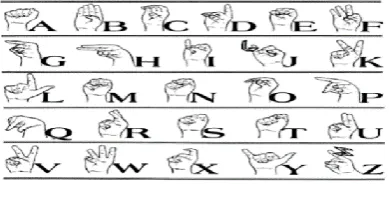
In paper work, hand signal acknowledgment framework comprises of the disconnected testing which is reached out by utilizing hand motion location. The model is utilized to perceived hand signal caught from webcam. Before building the model, pictures will be caught for each hand motion, which are the clench hand, record, palm, and little finger signals, for various individuals, scales, and turns and under various enlightenments. The framework can likewise perceive some other signals, for example, two, three, and five. All the preparation pictures show the hand signals with no different articles, and the foundation has no surface or protests (white divider). Hand Gesture Detection in a jumbled foundation will improve the execution of hand motion acknowledgment framework as far as exactness and speed since key focuses separated will speak to the hand signal. The Indian and American Sign Language letter sets for start to finish are appeared in Figure no 3.2 These letter sets are utilized for correspondence of hard of
hearing people. In this paper work we have utilized the Mat lab programming for execution of program utilizing advanced picture handling. The twisting between an info picture and database picture is removed utilizing pre-handling and a division.
Fig. 3 Hand gesture Sign Alphabets
2. Pre-Processing and segmentation:
picture information that smothers undesired contortions or improves some picture highlights vital for additionally handling.
3. Interest Point Descriptors
Filter highlights are particular, invariant highlights removed from pictures that take into consideration effective coordinating with different other view purposes of the separated highlights that may exist in the same or distinctive signals. The highlights are invariant to picture interpretation, scaling, and revolution additionally somewhat invariant to light changes. The calculation of SIFT picture highlights is in four fundamental advances
1. Scale-space Local Extreme Detection:
The initial step registers the areas of potential intrigue focuses in the picture by identifying the maxima and minima of an arrangement of contrast of Gaussian channels connected at various scales everywhere throughout the picture. The SIFT calculation was at first exhibited in a paper by David Lowe in 1999 (Lowe 1999) and afterward he condensed his calculation in 2004(Lowe 2004). Scale Invariant Feature Transform is utilized to extricate the highlights of picture by finding and Describing keypoints. The SIFT calculation for picture acknowledgment is apportioned into four unique stages. Information of a picture is entered in the circuit and in the principal square, differential of Gaussian pictures are processed. The consequences of DoG piece are set up for two next squares. OriMag figures introduction and slope greatness for each pixel. Finding and checking the strength of keypoints are done in KP piece. At long last, the descriptor square registers a 128 bytes definition for each stable keypoint. There is a FIFO memory in yield to spare the consequences of the arrangement. 2. Keypoint Localization: The keypoint confinement of the arrangement of intrigue
focuses found in Step 1, a steady set is chosen and further restricted in picture space.
2. Keypoint Localization:
The keypoint restriction of the arrangement of intrigue focuses found in Step 1, a steady set is chosen and further limited in picture space.
Fig.4 Block Diagram of SIFT
3. Orientation Assignment:
For all stable interest points selected, an orientation is then assigned to each key point based on local image features.
4. Key point descriptor:
At last, a neighbourhood include descriptor is figured at each key point. This descriptor depends on the neighbourhood picture inclination, changed by the introduction of the key point to give introduction invariance.
DIMENSIONALITY REDUCTION TECHNIQUE:
these foremost parts can be utilized as indicator factors in ensuing examination. It changes over a unique arbitrary vector, whose parts have connections, to another irregular vector, whose segments have no relationships, by an orthogonal change. Its depiction system can be separated into two sub-steps, projection grid creating and descriptor building up. It makes another vector altogether littler than a standard SIFT vector.
4.
Introduction To PCA
Central part investigation (PCA) is likely the most generally utilized subspace projection method for hand motion acknowledgment likewise known by Eigen hand signal based approach. Central Component Analysis is a generally utilized dimensionality decrease strategy for picture handling applications. PCA is an ideal component extraction and dimensionality lessening procedure, from the Information theoretic perspective. The thought is to discover the parts or the measurements along which the gathering of every conceivable picture is required to have its vitality circulated. At that point just those measurements are held, and whatever is left of the pictures are disposed of for the future phases of handling.
Classification Method
The Hamming or Euclidean separation between two component vectors to decide if the two vectors have a place with a similar key point in various pictures. Limit this separation creates a twofold choice, and modifying this edge empowers one to choose the fitting exchange off between false positives and false negatives and last phase of proposed piece graph we get a yield picture of hand signal with character show.
5.
Applications,
Limitations
and
Advantages
.
A. Applications
1. The system can be used at public places like, Airports, Railway Stations, Counters of Banks, Hotels, etc.
2. It can be used in intelligent classrooms and intelligent environments for real-time translation.
3. It can be also used in Virtual reality and computer games. As a translating device for Mute people.
B. Limitations
1. More light intensity exposure on hand gesture images affects the result accuracy.
2. Proper hand gesture image should be taken.
3. In hand gesture, image resolution, pixel density should be moderate. C. Advantages 1. Efficient way for mute communication. 2. Less time delays. 3. Quick Response Time.
4. Fully automate system robust system, and low power requirement.
C. Advantages
1. Efficient way for mute communication.
2. Less time delays.
3. Quick Response Time.
4. Fully automate system robust system, and low power requirement.
6. Conclusion
hand gestures. Also computation time will be less. This work can further be extended to text to speech conversion.
7.References
[1] Nasser H. Dardas and Nicolas D. Georganas, “Real-Time Hand Gesture Detection and Recognition Using Bag-of-Features and Support Vector Machine Techniques,” IEEE Transaction on Instrumentation and Measurement, volume 60, no. 11, pp.132-137 November 2011.
[2] A. El-Sawah, et.al “A prototype for 3-D hand tracking and gesture estimation,” IEEE Transaction Instrumentation Measurement. volume 57,no. 8, pp. 1627–1636, Augest 2008.
[3] Priyanka Mekala, et.al , Asad Davari“Real-time Sign Language Recognition based on Neural Network Architecture” 978-1-4244-95924/11/ ©2011IEEE.
[4] S. Pandita, and S. P. Narote “Hand Gesture Recognition using SIFT” International Journal of Engineering Research and Technology (IJERT) Volume 2, no.1, pp1760-1764, January 2013.
[5] Usha Gopalkrishanan , Vinod P. R, et.al “ Artificial Neural Network Based Method for Indian Sign Language Recognition” IEEE Conference on Information and Communication Technologies (ICT 2013).
[6] D. G. Lowe, “Distinctive image features from scale-invariant key points, “International Journal of Computer Science, volume 60, no. 2, pp. 91– 110, November 2004.