© 2018, IRJET | Impact Factor value: 6.171 | ISO 9001:2008 Certified Journal | Page 343
Optimal Generation Scheduling For Thermal Units
Nitish R. Patel
1, Nilesh K. Patel
21
PG student, Department of Electrical Engineering, Sankalchand Patel College of Engineering, Gujarat, India
2Associate professor, Department of Electrical Engineering, Sankalchand Patel College of Engineering,
Gujarat, India
---***---Abstract -
The main aim of this paper is to developshort-term generation scheduling. The scheduling problem is formulated by considering production cost and start-up cost of generating units and satisfying all equality and inequality constraint. A PSO techniques is used to obtain optimal scheduling of ten generating unit. Results generated are compared with other techniques. It was found that PSO technique are very effective and efficient to solved short term generation scheduling problem and provide economic benefits to the system operator to developed optimal scheduling.
Key Words: short-term scheduling, PSO, Economic Dispatch
1. INTRODUCTION
In deregulated power system, all the generating company are independently and separately operated. The system operator plan day ahead scheduling, that how many generating units are carried out to satisfy load demand. A short-term scheduling also known as day ahead scheduling. In power system, consumer demand changes continuously, its varied according to day-time, evening and morning time[1]. Thus, system operator has to plan enough units that required for next day to fulfill load demand. The generation scheduling of power system is necessary to maintain a balance between supply and demand, due to the fact that no practical technology is available for large scale storage of electricity. In day-ahead scheduling, a day-ahead unit commitment program is executed to decide the most economic unit combination with considerations of various restrictions of units. Previously, a unit can use multiples fuel constrained and it is assumed that only one fuel is constrained. Adding fuel constraints severely complicates the unit commitment problem. Thus author[2], utilized Lagrange multipliers which tackle the unit responsibility issue within the sight of fuel constraint. when a unit supplying multiple fuels, the price of fuel at a unit is not readily available and fuel price could vary over different time intervals of the study period resulting in an increase in the complexity of the problem. Thus, in [3] divides the fuel constrained unit commitment problem into a linear fuel dispatch (FD) issue and a unit commitment (UC) issue. The Fuel Dispatch issue improves framework fuel cost and fulfilling fuel required. It is very difficult aspect of the power system to incorporating a ramping costs into a scheduling procedure, since the ramping costs vary with the generation schedule. By presenting ramping costs, the unit on or off states can be determined more economically by the lagrangian method in [4], this method is developed for unit commitment and economic dispatch problem. A short-term
scheduling issue is solved in [5] by dynamic programming, and the economic dispatch with transmission and environmental constraints is solved by an efficient network flow programming algorithm. An economic dispatch considering the generator constraints can solved by using Particle Swarm Optimization in[6,7]. In this method for practical application of generator operations, a many nonlinear characteristics of generator, such as ramp rate limits, prohibited operating zone, and non-smooth cost functions is considered. Static economic dispatch(SED) can handle only a single load level at a certain time. However, SED may fail to deal with the large variations of the load demand due to the ramp rate limits of the generators, moreover, it does not have the look-ahead capability[3,4].For large variation in load demand and the dynamic nature of the power systems, it necessary for development of optimal dynamic dispatch (ODD) problem. ODD is a new update of SED to determine the generation scheduling of the committed units, so as to meet the load demand over a time horizon at minimum operating cost under ramp rate and other constraints. The dynamic dispatching was first introduced in [8] and was followed by [9,10]. In these paper, optimal control dynamic dispatch (OCDD) formulation models the power system generation by means of state Equations, where the state variables are the electrical power outputs of the generators and the control inputs are the ramp rates of the generators. In OCDD the optimization is done with respect to the ramp rates and the solution produces an optimal output generator. In[11] the DED problem the optimization is done with respect to the dispatch able powers of the units. Some researchers have considered the ramp rate constraints by solving SED problem interval by interval and enforcing the ramp rate constraints from one interval to the next. However, this approach can lead to suboptimal solutions trajectory for a given initial generation in the optimal dynamic dispatch problem is to determine under what constraints the problem will be solved. Broadly, these constraints can be classified into three kinds: equality constraints, inequality constraints, and dynamic constraints. Some of these constraints such as load demand balance, and spinning reserve constraints can be modified when the DED problem is solved in the deregulated market Environment. The dynamic economic and emission dispatch is an extension of the conventional economic dispatch problem [12]. It is used to determine the optimal generation schedule of on-line generators.
© 2018, IRJET | Impact Factor value: 6.171 | ISO 9001:2008 Certified Journal | Page 344 constrained is taken to obtained optimal short-term
generation scheduling. PSO techniques are used to make optimal scheduling, due to its efficient time computation and required less parameter to developed algorithm.
2. PROBLEM FORMULATION
The objective function is to minimize operating cost are as follows[13]:
where, FCij and SCij are operating cost(OC) of ith unit in jth hour and start-up costs of ith unit in jth hour ,Pij its power output. The Fuel cost as follows:
(1)
Where, a, b and c are cost coefficient. The start up cost characteristic as follows:
(2)
Where, α is hot start up cost, β is cold start up cost and τ is cooling time constant. Tij turn off time of ith unit in jth time period.uij is status of unit ith in jth time period.
The following are the system constraints which are considered in this problem formulation:
1) Real power balance constraint:
Where, Pij is ith generating unit in jth time period and PD is power demand.
2) Real power operating limits of units are:
(4)
Where,Pimin and Pimax is minimum and maximum generating power.
3) Unit minimum up/down time for thermal generating units and is given as:
(5)
(6)
Where, Ton/TOFF is the unit turn on and turn off time.
4) Spinning reserve constraints:
(7)
Where, Xij is status of generating unit, Di is load demand of ith unit and R is reserve of generating unit.
3. Overview of Particle Swarm Optimization
Particle swarm optimization was introduced by Dr.Eberhart and Dr. kennedy[14].It is an evolutionary computation type of new method and population based optimization tool like GA.PSO is adopted from the nature behavior of social system such as bird flocking and fish schooling. The PSO algorithm requires less memory because of its simplicity. PSO is similar to the other evolutionary algorithms in that the system is initialized with a population of random solutions called particle. These particles flies over fitness function according to its neighborhood experiences. It moves according to update velocity vgn+1 and position update xgn+1 to find particle best values.
(8) A position update equation represent as:
(9)
Here, w is the inertia weight parameter which controls the global and local exploration of the particle. c1 and c2 are acceleration coefficients respectively, and Rand() are random numbers between 0 and 1. c1 pulls the particles towards local best position, c2 pulls towards the global best position. In particle swarm optimization, a particle velocity Vmax determines the resolution. If Velocity is too high, particles may fly past good solutions. If velocity is too small, particles may not explore a local solutions. Thus, the system parameters Vmax has the beneficial effect of the preventing explosion and scales the exploration of the particle search[15].Thus, inertia weight w provides a balance between global exploitation and local explorations, which requiring less number of iteration to find a sufficiently optimal solution. Since, W indicates decreases linearly from about 0.9 to 0.4 approx during a run, which determines follows,
(10)
where, w is inertia weight constant of particle, an exploration of search space is controlled by inertia constant is given in[5]. wmax is maximum weight and wmin is minimum weight.
A. Algorithm of particle swarm optimization for Scheduling
Step by Step procedure as follows:
© 2018, IRJET | Impact Factor value: 6.171 | ISO 9001:2008 Certified Journal | Page 345 Step-2: Define fitness function: a random particles generated
start moving towards fitnees function according to define velocity. It is define to minimize cost function.
Step-3:Initialization of Pbest and Gbest: The fitness values obtained for the initial particles are set as the initial Pbest values of the particle. The best value among all particle called Gbest.
Step-4: update velocity using equation(8) to move particles towards neighborhood best position.
Step-5:update position using equation (9) according to update velocity .
Step-6:If the fitness value of each individual is better than previous P-best, the current value is set to be P-best. If the best P-best is better than G-best, the best P-best is set to be G-best. The value of fitness function is to analyzes.
Step-7: If number of iteration reaches its maximum value than stop iteration. Otherwise, repeat from step-2. Thus, at the end Gbest obtain is considered as optimal value of generating units.
4. Results and Discussion
A system of ten generating unit data are used to obtain optimal scheduling using particle swarm optimization technique. Unit data for 10 generating unit and load demand over 24 time horizon in[16]. Unit commitment and economic dispatch is main important task for preparing generation scheduling. A system operator which plan an optimal scheduling by considering both unit commitment and economic dispatch problems. It is possible to ON all generating unit over all time period, but it is not economical to keep all unit ON. Thus, for obtaining best generation scheduling it is essential to commit enough generating unit for required load, are shown in table 1.
Table-1: unit commitment for ten generating unit
UNITS HOUR(1-24)
1 1 1 1 1 1 1 1 1 1 1 1 1 1 1 1 1 1 1 1 1 1 1 1 1 2 1 1 1 1 1 1 1 1 1 1 1 1 1 1 1 1 1 1 1 1 1 1 1 1 3 0 0 0 0 0 1 1 1 1 1 1 1 1 1 1 1 0 1 1 1 1 1 0 0 4 0 0 0 0 1 1 1 1 1 1 1 1 1 1 1 1 1 1 1 1 1 1 0 0 5 0 0 1 1 1 1 1 1 1 1 1 1 1 1 1 1 1 1 1 1 1 1 1 0 6 0 0 0 0 0 0 0 0 1 1 1 1 1 1 0 0 0 0 0 1 1 0 0 0 7 0 0 0 0 0 0 0 0 1 1 1 1 1 1 0 0 0 0 0 1 1 0 0 0 8 0 0 0 0 0 0 0 0 0 1 1 1 1 0 0 0 0 0 0 1 0 0 0 0 9 0 0 0 0 0 0 0 0 0 0 0 1 0 0 0 0 0 0 0 0 0 0 0 0 10 0 0 0 0 0 0 0 0 0 0 0 1 0 0 0 0 0 0 0 0 0 0 0 0
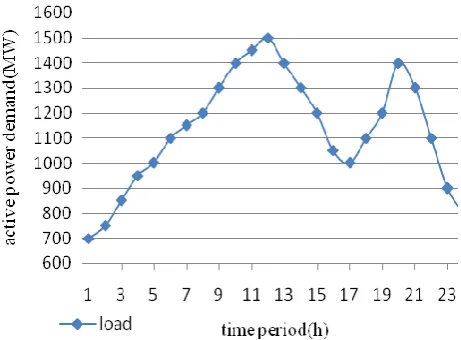
Unit ON and OFF status is indicated by 1 and 0 respectively. The binary number 1 indicated that unit is available for required time slots, while 0 indicates that unit is not generate any power for particular time periods. Unit 1 and 2 are consider as base load power plant, which is available at all time and unit 9 and 10 are costly unit, so it is ON over a peak time period at 12th hour respectively. These unit are able to supply for dynamic load demand The dynamic load demand over 24 time period is shown in fig(1) a different load at each time intervals. A maximum load is 1500 MW
Fig(1) Load curves for different time periods
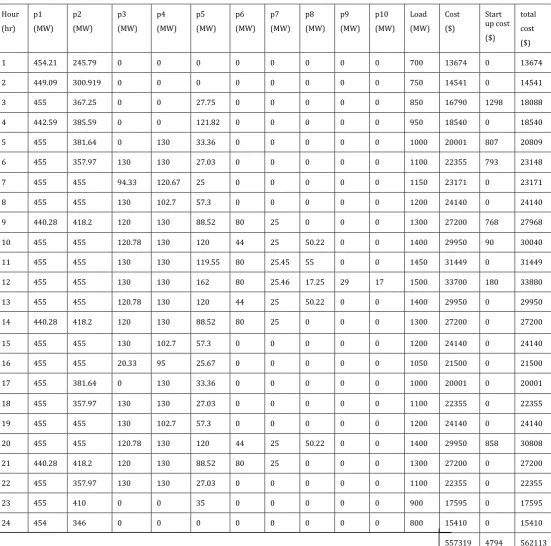
[image:3.595.311.542.225.395.2]© 2018, IRJET | Impact Factor value: 6.171 | ISO 9001:2008 Certified Journal | Page 346 Table -2: result of different generating unit over a different time period and total operating cost
Hour (hr)
p1 (MW)
p2 (MW)
p3 (MW)
p4 (MW)
p5 (MW)
p6 (MW)
p7 (MW)
p8 (MW)
p9 (MW)
p10 (MW)
Load (MW)
Cost ($)
Start up cost ($)
total cost ($)
1 454.21 245.79 0 0 0 0 0 0 0 0 700 13674 0 13674
2 449.09 300.919 0 0 0 0 0 0 0 0 750 14541 0 14541
3 455 367.25 0 0 27.75 0 0 0 0 0 850 16790 1298 18088
4 442.59 385.59 0 0 121.82 0 0 0 0 0 950 18540 0 18540
5 455 381.64 0 130 33.36 0 0 0 0 0 1000 20001 807 20809
6 455 357.97 130 130 27.03 0 0 0 0 0 1100 22355 793 23148
7 455 455 94.33 120.67 25 0 0 0 0 0 1150 23171 0 23171
8 455 455 130 102.7 57.3 0 0 0 0 0 1200 24140 0 24140
9 440.28 418.2 120 130 88.52 80 25 0 0 0 1300 27200 768 27968
10 455 455 120.78 130 120 44 25 50.22 0 0 1400 29950 90 30040
11 455 455 130 130 119.55 80 25.45 55 0 0 1450 31449 0 31449
12 455 455 130 130 162 80 25.46 17.25 29 17 1500 33700 180 33880
13 455 455 120.78 130 120 44 25 50.22 0 0 1400 29950 0 29950
14 440.28 418.2 120 130 88.52 80 25 0 0 0 1300 27200 0 27200
15 455 455 130 102.7 57.3 0 0 0 0 0 1200 24140 0 24140
16 455 455 20.33 95 25.67 0 0 0 0 0 1050 21500 0 21500
17 455 381.64 0 130 33.36 0 0 0 0 0 1000 20001 0 20001
18 455 357.97 130 130 27.03 0 0 0 0 0 1100 22355 0 22355
19 455 455 130 102.7 57.3 0 0 0 0 0 1200 24140 0 24140
20 455 455 120.78 130 120 44 25 50.22 0 0 1400 29950 858 30808
21 440.28 418.2 120 130 88.52 80 25 0 0 0 1300 27200 0 27200
22 455 357.97 130 130 27.03 0 0 0 0 0 1100 22355 0 22355
23 455 410 0 0 35 0 0 0 0 0 900 17595 0 17595
24 454 346 0 0 0 0 0 0 0 0 800 15410 0 15410
© 2018, IRJET | Impact Factor value: 6.171 | ISO 9001:2008 Certified Journal | Page 347 Result obtained by using approach method, it is found that
fuel cost for differenet generating unit and start up cost are $ 5,57,319 and $ 4794 repectively. Total operating cost for the generating unit is $ 5,62,113. A PSO convergence characteristic shown in fig(2), which shown that PSO is able
Fig(2) convergence of PSO
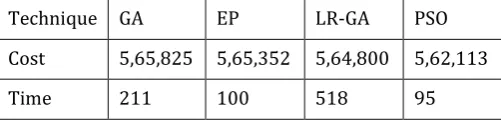
[image:5.595.45.284.164.355.2]to converge successfully at each iteration. Result of cost obtained are compared with other techniques, which used same data to obtain generation scheduling problems. PSO result are verify with genetic algorithm[16], evolutionary programming[17] and genetic algorithm based lagrangian[18], shown in table-3.
Table-3: Comparison of PSO result with GA and GA-LR
A comparison shows effectiveness of this method, which is roboust and efficient towards useful minimization of operating cost and time required for computational is less.
5. CONCLUSION
This paper solved optimal scheduling problem along with economic problem using PSO method. From experimental result, total operating cost obtained is $ 5,62,113 and best optimal generation for ten different unit is generated, which is found better than result obtained by using other techniques such as GA ,EP and LR-GA. Thus, it was concluded that this approach method is very useful for system operator to obtained short-term scheduling along with economic benefit for satisfying dynamic load over 24 hour time period.
REFERENCES
[1] Yamin, H. Y. (2004). Review on methods of generation scheduling in electric power systems. Electric Power Systems Research, 69(2-3),227-248.
[2] Cohen, A. I., & Wan, S. H. (1987). A method for solving the fuel constrained unit commitment problem. IEEE Transactions on Power Systems, 2(3), 608-614.
[3] Vemuri, S., & Lemonidis, L. (1992). Fuel constrained unit commitment. IEEE transactions on power systems, 7(1), 410-415.
[4] Wang, C., & Shahidehpour, S. M. (1995). Optimal generation scheduling with ramping costs. IEEE Transactions on Power Systems, 10(1), 60-67.
[5] Momoh, J. A., & Zhu, J. (2003). Optimal generation scheduling based on AHP/ANP. IEEE Transactions on Systems, Man, and Cybernetics, Part B(Cybernetics), 33(3), 531-535.
[6] Gaing, Z. L. (2003). Particle swarm optimization to solving the economic dispatch considering the generator constraints. IEEE transactions on power systems, 18(3), 1187-1195.
[7] R.C. Eberhart and Y. Shi, “Comparison between genetic algorithms and particle swarm optimization,” Proc. IEEE Int. Conf. Evol. Comput., pp.611-616, 1998.
[8] T.E. Bechert, H.G. Kwatny, On the optimal dynamic dispatch of real power,IEEE Trans. Power Apparatus Syst. PAS-91 (1972) 889–898.
[9] D.W. Ross, S. Kim, Dynamic economic dispatch of generation, IEEE Trans. Power Apparatus Syst. PAS-99 (6) (1980) 2060–2068.
[10] D.L. Travers, R.J. Kaye, Dynamic dispatch by constructive
dynamic programming, IEEE Trans. Power Syst. 13 (1) (1998) 72–78.
[11] K.S. Hindi, M.R. Ab Ghani, Multi-period economic
dispatch for large scale power systems, Proc. IEE Pt. C 136 (3) (1989) 130–136.
[12] Aiguo Zhang, Jianhua Zhang, Jingfu Shang, Jialin Qin,
"Security and economic dispatch of power system with environmental consideration "IEEE/PES Gen. Meet, 2009, pp.1-6.
[13] S.J. Wang, S.M. Shahidehpour, D.S. Kirschen, S. M.
Mokhtari, G.D.I Irisarri, Short-term generation scheduling with transmission and environmental constraints using an augmented Lagrangian relaxation IEEE Trans. Power Syst. 10 (3)(1995).
Technique GA EP LR-GA PSO
Cost 5,65,825 5,65,352 5,64,800 5,62,113
[image:5.595.32.283.485.546.2]© 2018, IRJET | Impact Factor value: 6.171 | ISO 9001:2008 Certified Journal | Page 348
[14] James kennedy and rusel Eberhart , particle swarm
optimization Purdue school of engineering and technology.(1995) vol:1000.
[15] Zhu, H., Ngah, S., Xu, Y., Tanabe, Y., & Baba, T. (2008). A
Random time-varying particle swarm optimization for local positioning system International Journal of Computer Science and Network security,8(6).
[16] S.A. Kazarlis, A. G. Bakirtzis, and V. Petridis, “ A Genetic
Algorithm Solution to the Unit Commitment Problem,” IEEE Trans. Power Systems, Vol. 11, No. 1, 1996, pp 83-92.
[17] K. A. Juste, H. Kita, E. Tanaka, and J. Hasegawa, “ An
evolutionary Programming solution to the unit commitment problem,” IEEE Trans.Power Syst., vol. 14, pp. 1452–1459, Nov. 1999.
[18] C. P. Cheng, C. W. Liu, and C. C. Liu, “ Unit Commitment
by Lagrangian Relaxation and Genetic Algorithms,” IEEE Trans. Power Systems, Vol. 15, pp. 707-714, 2000.
BIOGRAPHIES
Nitish R. Patel
M.Tech, Research scholar, Department of EE, SPCE, Visnagar,Gujarat,India.
Nilesh K. Patel Associate Professor, Department of EE, SPCE, Visnagar, Gujarat, India