A Language Model Approach to Keyphrase Extraction
Takashi Tomokiyo and Matthew Hurst
Applied Research Center Intelliseek, Inc. Pittsburgh, PA 15213
ttomokiyo,mhurst @intelliseek.com
Abstract
We present a new approach to extract-ing keyphrases based on statistical lan-guage models. Our approach is to use pointwise KL-divergence between mul-tiple language models for scoring both phraseness and informativeness, which can be unified into a single score to rank extracted phrases.
1 Introduction
In many real world deployments of text mining tech-nologies, analysts are required to deal with large col-lections of documents from unfamiliar domains. Fa-miliarity with the domain is necessary in order to get full leverage from text analysis tools. However, browsing data is not an efficient way to get an un-derstanding of the topics and events which are par-ticular to a domain.
For example, an analyst concerned with the area of hybrid cars may harvest messages from online fo-rums. They may then want to rapidly construct a hi-erarchy of topics based on the content of these mes-sages. In addition, in cases where these messages are harvested via a search of some sort, there is a re-quirement to obtain a rich and effective set of search terms.
The technology described in this paper is an ex-ample of a phrase finder capable of delivering a set of indicative phrases given a particular set of docu-ments from a target domain.
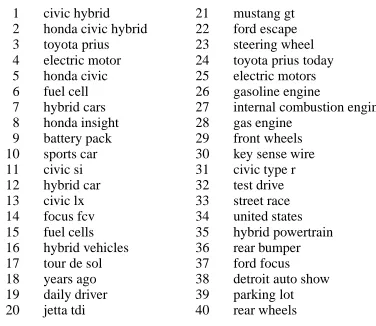
In the hybrid car example, the result of this pro-cess is a set of phrases like that shown in Figure 1.
1 civic hybrid 2 honda civic hybrid 3 toyota prius 4 electric motor 5 honda civic 6 fuel cell 7 hybrid cars 8 honda insight 9 battery pack 10 sports car 11 civic si 12 hybrid car 13 civic lx 14 focus fcv 15 fuel cells 16 hybrid vehicles 17 tour de sol 18 years ago 19 daily driver 20 jetta tdi
21 mustang gt 22 ford escape 23 steering wheel 24 toyota prius today 25 electric motors 26 gasoline engine 27 internal combustion engine 28 gas engine
[image:1.595.329.517.254.417.2]29 front wheels 30 key sense wire 31 civic type r 32 test drive 33 street race 34 united states 35 hybrid powertrain 36 rear bumper 37 ford focus 38 detroit auto show 39 parking lot 40 rear wheels
Figure 1: Top 40 keyphrases automatically extracted from messages relevant to “civic hybrid” using our system
In order to capture domain-specific terms effi-ciently in limited time, the extraction result should be ranked with more indicative and good phrase first, as shown in this example.
2 Phraseness and informativeness
The word keyphrase implies two features: phrase-ness and informativephrase-ness.
Phraseness is a somewhat abstract notion which describes the degree to which a given word sequence is considered to be a phrase. In general, phraseness is defined by the user, who has his own criteria for the target application. For instance, one user might want only noun phrases while another user might be interested only in phrases describing a certain set of products. Although there is no single definition of the term phrase, in this paper, we focus on colloca-tion or cohesion of consecutive words.
cap-tures or illustrates the key ideas in a set of docu-ments. Because informativeness is defined with re-spect to background information and new knowl-edge, users will have different perceptions of infor-mativeness. In our calculations, we make use of the relationship between foreground and background corpora to formalize the notion of informativeness.
The target document set from which representa-tive keyphrases are extracted is called the foreground corpus. The document set to which this target set is compared is called the background corpus. For example, a foreground corpus of the current week’s news would be compared to a background corpus of an entire news article archive to determine that cer-tain phrases, like “press conference” are typical of news stories in general and do not capture the par-ticulars of current events in the way that “national museum of antiquities” does.
Other examples of foreground and background corpora include: a web site for a certain company and web data in general; a newsgroup and the whole Usenet archive; and research papers of a certain con-ference and research papers in general.
In order to get a ranked keyphrase list, we need to combine both phraseness and informativeness into a single score. A sequence of words can be a good phrase but not an informative one, like the expres-sion “in spite of.” A word sequence can be informa-tive for a particular domain but not a phrase; “toy-ota, honda, ford” is an example of a non-phrase se-quence of informative words in a hybrid car domain. The algorithm we propose for keyphrase finding re-quires that the keyphrase score well for both phrase-ness and informativephrase-ness.
3 Related work
Word collocation Various collocation metrics have been proposed, including mean and variance (Smadja, 1994), the t-test (Church et al., 1991), the chi-square test, pointwise mutual information (MI) (Church and Hanks, 1990), and binomial log-likelihood ratio test (BLRT) (Dunning, 1993).
According to (Manning and Sch¨utze, 1999), BLRT is one of the most stable methods for col-location discovery. (Pantel and Lin, 2001) reports, however, that BLRT score can be also high for two frequent terms that are rarely adjacent, such as the word pair “the the,” and uses a hybrid of MI and
BLRT.
Keyphrase extraction Damerau (1993) uses the relative frequency ratio between two corpora to ex-tract domain-specific keyphrases. One problem of using relative frequency is that it tends to assign too high a score for words whose frequency in the back-ground corpus is small (or even zero).
Some work has been done in extracting keyphrases from technical documents treating keyphrase extraction as a supervised learning problem (Frank et al., 1999; Turney, 2000). The portability of a learned classifier across various unstructured/structured text is not clear, however, and the agreement between classifier and human judges is not high.1
We would like to have the ability to extract keyphrases from a totally new domain of text with-out building a training corpus.
Combining keyphrase and collocation Ya-mamoto and Church (2001) compare two metrics, MI and Residual IDF (RIDF), and observed that MI is suitable for finding collocation and RIDF is suitable for finding informative phrases. They took the intersection of each top 10% of phrases identified by MI and RIDF, but did not extend the approach to combining the two metrics into a unified score.
4 Baseline method based on binomial
log-likelihood ratio test
We can use various statistics as a measure for phraseness and informativeness. For our baseline, we have selected the method based on binomial log-likelihood ratio test (BLRT) described in (Dunning, 1993).
The basic idea of using BLRT for text analysis is to consider a word sequence as a repeated sequence of binary trials comparing each word in a corpus to a target word, and use the likelihood ratio of two hypotheses that (i) two events, observed times out
of total tokens and times out of total tokens
respectively, are drawn from different distributions and (ii) from the same distribution.
1e.g. Turney reports 62% “good”, 18% “bad”, 20% “no
The BLRT score is calculated with
(1)
where , , and
! " $#&% ('*) (2)
In the case of calculating the phraseness score of an adjacent word pair (+ -, ), the null hypothesis
is that + and
, are independent, which can be
ex-pressed as ,.
+
/ ,.10
+
. We can use Equation
(1) to calculate phraseness by setting:
2435 6+ -,7 8935 6+
:435 0 + -,; 93< ,; %=35 6+ -,7 935 0 + 9>@?A35 6B %35 6+
(3)
where 3< 6+ is the frequency of the word + and
35 6+ -,; is the frequency of, following+ .
For calculating informativeness of a wordB ,
293DCFE* 6B 9>@?A3DCFE* 6B
932GHE* 6B &9>@?A32GHE* 6B
(4)
where3DCFE* 6B and3DGHE* 6B are the frequency ofB in
the foreground and background corpus, respectively. Combining a phraseness score IJ and an
infor-mativeness scoreI into a single score value is not a
trivial task since the the BLRT scores vary a lot be-tween phraseness and informativeness and also de-pending on data (c.f. Figure 6 (a)).
One way to combine those scores is to use an ex-ponential model. We experimented with the follow-ing logistic function:
IK
#
#8=LNMOP $%&Q;I J %SRFI UT
(5)
whose parametersQ ,R , andT are estimated on a
held-out data set, given feedback from users (i.e. super-vised).
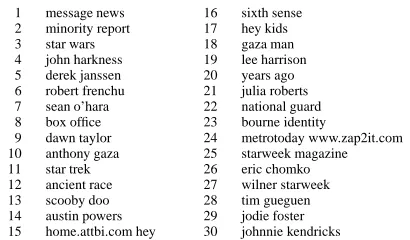
Figure 2 shows some example phrases extracted with this method from the data set described in Sec-tion 6.1, where the parameters,Q ,R ,T , are manually
optimized on the test data.
Although it is possible to rank keyphrases using this approach, there are a couple of drawbacks.
1 message news 2 minority report 3 star wars 4 john harkness 5 derek janssen 6 robert frenchu 7 sean o’hara 8 box office 9 dawn taylor 10 anthony gaza 11 star trek 12 ancient race 13 scooby doo 14 austin powers 15 home.attbi.com hey
16 sixth sense 17 hey kids 18 gaza man 19 lee harrison 20 years ago 21 julia roberts 22 national guard 23 bourne identity
[image:3.595.324.529.70.190.2]24 metrotoday www.zap2it.com 25 starweek magazine 26 eric chomko 27 wilner starweek 28 tim gueguen 29 jodie foster 30 johnnie kendricks
Figure 2: Keyphrases extracted with BLRT (a=0.0003, b=0.000005, c=8)
Necessity of tuning parameters the existence of
parameters in the combining function requires human labeling, which is sometimes an expen-sive task to do, and the robustness of learned weight across domains is unknown. We would like to have a parameter-free and robust way of combining scores.
Inappropriate symmetry BLRT tests to see if two
random variables are independent or not. This sometimes leads to unwanted phrases getting a high score. For example, when the background corpus happens to have many occurrences of phrase al jazeera which is an unusual phrase in the foreground corpus, then the phrase still gets high score of informativeness because the dis-tribution is so different. What we would like to have instead is asymmetric scoring function to test the loss of the action of not taking the target phrase as a keyphrase.
In the next section, we propose a new method try-ing to address these issues.
5 Proposed method
5.1 Language models and expected loss
A language model assigns a probability value to ev-ery sequence of wordsVW@B XB YFYFYXB
'
. The prob-abilityZ< 6V can be decomposed as
Z< 6V
'
[
]\
Z< 6B^ .B -B YFYFYXB^
)
Assuming B& only depends on the previous _
used. The following is the trigram language model case.
Z< 6V
'
[
]\ Z 6B^
.
B^
)
B^
)
Here each word only depends on the previous two words. Please refer to (Jelinek, 1990) and (Chen and Goodman, 1996) for more about N-gram models and associated smoothing methods.
Now suppose we have a foreground corpus and a background corpus and have created a language model for each corpus. The simplest language model is a unigram model, which assumes each word of a given word sequence is drawn indepen-dently. We denote the unigram model for the fore-ground corpus as
fgand for the background cor-pus as
bg. We can also train higher order models
fg and
bgfor each corpus, each of which is a_ -gram model, where_= #
is the order.
phraseness
%% informativeness%%
fg
bg
fg
[image:4.595.89.286.353.437.2]
bg
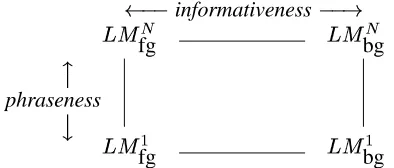
Figure 3:Phraseness and informativeness as loss between lan-guage models.
Among those four models,
fg will be the best model to describe the foreground corpus in the sense that it has the smallest cross-entropy or perplexity value over the corpus.
If we use one of the other three models instead, then we have some inefficiency or loss to describe the corpus. We expect the amount of loss between using
fg and
fg is related to phraseness and the loss between
fg and
bg is related to in-formativeness. Figure 3 illustrates these relation-ships.
5.2 Pointwise KL-divergence between models
One natural metric to measure the loss between two language models is the Kullback-Leibler (KL) diver-gence. The KL divergence (also called relative en-tropy) between two probability mass function 6+
and; 6+ is defined as
6+
] 6+ ; 6+
(6)
KL divergence is “a measure of the inefficiency of assuming that the distribution is when the true distribution is .” (Cover and Thomas, 1991)
You can see this by the following relationship:
6+
6+ % 6+
; 6+
6+
#
; 6+
%U
The first term >
6+
! #" %$
is the cross entropy and the second termU is the entropy of the
ran-dom variable , which is how much we could
com-press symbols if we know the true distribution .
We define pointwise KL divergence &(' )* to
be the term inside of the summation of Equation (6):
& ' ,+.-0/ 6V
6V
; 6V
(7)
Intuitively, this is the contribution of the phraseV to
the expected loss of the entire distribution.
We can now quantify phraseness and informative-ness as follows:
Phraseness ofV is how much we lose information
by assuming independence of each word by ap-plying the unigram model, instead of the _
-gram model.
& ' H
fg 8
fg (8)
Informativeness of V is how much we lose
in-formation by assuming the phrase is drawn from the background model instead of the fore-ground model.
&1' H
fg 8
bg or (9)
&1' H
fg 8
bg (10)
Combined The following is considered to be a
mix-ture of phraseness and informativeness.
&1' H
fg 8
Note that the KL divergence is always non-negative2, but the pointwise KL divergence can be a negative value. An example is the phraseness of the bigram “the the”.
the the
the the
the the
since thethe the the .
Also note that in the case of phraseness of a bi-gram, the equation looks similar to pointwise mutual information (Church and Hanks, 1990) , but they are different. Their relationship is as follows.
&1' 6+ -,7
6+
6+ -,;
6+
-,; 6+ ,7
pointwise MI
The pointwise KL divergence does not assign a high score to a rare phrase, whose contribution of loss is small by definition, unlike pointwise mutual infor-mation, which is known to have problems (as de-scribed in (Manning and Sch¨utze, 1999), e.g.).
5.3 Combining phraseness and informativeness
One way of getting a unified score of phraseness and informativeness is using equation (11). We can also calculate phraseness and informativeness separately and then combine them.
We combine the phraseness score IJ and
infor-mativeness score IP by simply adding them into a
single scoreI .
IK9IJ /I (12)
Intuitively, this can be thought of as the total loss. We will show some empirical results to justify this scoring in the next section.
6 Experimental results
In this section, we show some preliminary experi-mental results of applying our method on real data.
6.1 Data set
We used the 20 newsgroups data set3, which con-tains 20,000 messages (7.4 million words) be-tween February and June 1993 taken from 20
2
from Jensen’s inequality.
3http://www-2.cs.cmu.edu/afs/cs.cmu.edu/
project/theo-20/www/data/news20.html
Usenet newsgroups, as the background data set, and another 20,000 messages (4 million words) between June and September 2002 taken from rec.arts.movies.current-films newsgroup as the foreground data set. Each message’s subject header and the body of the message (including quoted text) is tokenized into lowercase tokens on both data set. No stemming is applied.
6.2 Finding key-bigrams
The first experiment we show is to find key-bigrams, which is the simplest case requiring combination of phraseness and informativeness scores. Figure 4 outlines the extraction procedure.
Inputs: foreground and background corpus.
1. create background language model from the back-ground corpus.
2. count all adjacent word pairs in the foreground cor-pus, skipping pre-annotated boundaries (such as HTML tag boundaries) and stopwords.
3. for each pair of words (x,y) in the count, calculate phraseness fromfgand fgfgand
in-formativeness fromfg andbg. Add
the two score values as the unified score. 4. sort the results by the unified score.
Output: a list of key-bigrams ranked by unified score.
Figure 4: Procedure to find key-bigrams
For this experiment we used unsmoothed count for calculating phraseness 6+ -,; 35 6+ -,; _ ,
6B 35 6B _ where _ >
35 6+
>
3< 6+ -,7 , and used the unigram model for
calculating informativeness with Katz smoothing (Chen and Goodman, 1996)4 to handle zero occur-rences.
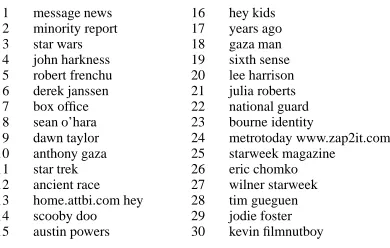
Figure 5 shows the extracted key-bigrams us-ing this method. Comparus-ing to Figure 2, you can see that those two methods extract almost identical ranked phrases. Note that we needed to tune three parameters to combine phraseness and informative-ness in BLRT, but no parameter tuning was required in this method.
The reason why “message news” becomes the top phrase in both methods is that it appears fre-quently enough in message citation headers such
4
1 message news 2 minority report 3 star wars 4 john harkness 5 robert frenchu 6 derek janssen 7 box office 8 sean o’hara 9 dawn taylor 10 anthony gaza 11 star trek 12 ancient race 13 home.attbi.com hey 14 scooby doo 15 austin powers
16 hey kids 17 years ago 18 gaza man 19 sixth sense 20 lee harrison 21 julia roberts 22 national guard 23 bourne identity
[image:6.595.89.284.70.194.2]24 metrotoday www.zap2it.com 25 starweek magazine 26 eric chomko 27 wilner starweek 28 tim gueguen 29 jodie foster 30 kevin filmnutboy
Figure 5:Key-bigrams extracted with pointwise KL
as John Smith [email protected] wrote in message
news:[email protected], which was not common in the 20 newsgroup dataset.5 A more sophisticated document analysis tool to remove citation headers is required to improve the quality further.
Figure 6 shows the distribution of phraseness and informativeness scores of bigrams extracted using the BLRT and pointwise KL methods. One can see that there is little correlation between phraseness and informativeness in both ranking methods. Also note that the range of x and y axis is very differ-ent in BLRT, but in the pointwise KL method they are comparable ranges. That makes combining two scores easy in the pointwise KL approach.
6.3 Ranking n-length phrases
The next example is ranking -length phrases. We
applied a phrase extension algorithm based on the APriori algorithm (Agrawal and Srikant, 1994) to the output of the key-bigram finder in the previous example to generate -length candidates whose
fre-quency is greater than 5, then applied a linguistic filter which rejects phrases that do not occur in valid noun-phrase contexts (e.g. following articles or pos-sessives) at least once in the corpus. We ranked re-sulting phrases using pointwise KL score, using the same smoothing method as in the bigram case.
Figure 7 shows the result of re-ranking keyphrases extracted from the same movie corpus. We can see that bigrams and trigrams are interleaved in natural order (although not many long phrases are extracted from the dataset, since longer NP did not occur more than five times). Figure 1 was another example of the result of the same pipeline of methods.
5a popular citation pattern in 1993 was “In article
[email protected], [email protected] (John Smith) writes:”
One question that might be asked is “what if we just sort by frequency?”. If we sort by frequency, “blair witch project” is 92nd and “empire strikes back” is 110th on the ranked list. Since the longer the phrase becomes, the lower the frequency of the phrase is, frequency is not an appropriate method for ranking phrases.
1 minority report 2 box office 3 scooby doo 4 sixth sense 5 national guard 6 bourne identity 7 air national guard 8 united states 9 phantom menace 10 special effects 11 hotel room 12 comic book 13 blair witch project 14 short story 15 real life 16 jude law 17 iron giant 18 bin laden 19 black people 20 opening weekend
21 bad guy 22 country bears 23 man’s man 24 long time 25 spoiler space 26 empire strikes back 27 top ten
28 politically correct 29 white people 30 tv show 31 bad guys 32 freddie prinze jr 33 monster’s ball 34 good thing 35 evil minions 36 big screen 37 political correctness 38 martial arts 39 supreme court 40 beautiful mind
Figure 7: Result of re-ranking output from the phrase exten-sion module
6.4 Revisiting unigram informativeness
An alternative approach to calculate informative-ness from the foreground LM and the background LM is just to take the ratio of likelihood scores,
fg 6V bg 6V . This is a smoothed version of
rela-tive frequency ratio which is commonly used to find subject-specific terms (Damerau, 1993).
Figure 8 compares extracted keywords ranked with pointwise KL and likelihood ratio scores, both of which use the same foreground and background unigram language model. We used messages re-trieved from the query Infiniti G35 as the foreground corpus and the same 20 newsgroup data as the back-ground corpus. Katz smoothing is applied to both language models.
As we can see, those two methods return very dif-ferent ranked lists. We think the pointwise KL re-turns a set of keywords closer to human judgment.
0 100000 200000 300000 400000 500000 600000 700000 800000
0 2000 4000 6000 8000 10000 12000 14000 16000 18000 20000
informativeness
phraseness blrt
-0.001 -0.0005 0 0.0005 0.001 0.0015 0.002
-0.0005 0 0.0005 0.001 0.0015 0.002
informativeness
phraseness pointKR
[image:7.595.89.528.72.240.2](a) BLRT (b) LM-pointKL
Figure 6: Phraseness and informativeness score of bigrams extracted with BLRT (a) and pointwise KL divergence between LMs (b).
point KL likelihood ratio rank freq term freq term
1 1599 g35 1599 g35 2 1145 car 156 330i 3 450 infiniti 117 350z 4 299 coupe 113 doo 5 299 nissan 90 wrx 6 383 bmw 76 is300 7 156 330i 47 willow
8 441 cars 39 rsx
9 248 sedan 37 6mt 10 331 originally 35 scooby 11 201 altima 35 s2000 12 117 350z 33 gt-r
13 113 doo 32 lol
14 235 sport 30 heatwave 15 172 maxima 28 g22
16 90 wrx 26 gtr
17 111 skyline 23 g21
18 76 is300 23 g17
19 186 honda 23 nsx 20 221 engine 22 tl-s
Figure 8:Top 20 keywords extracted using pointwise-KL and likelihood ratio (after stopwords removed) from messages re-trieved from the query “Infiniti G35”
foreground corpus and none in the background cor-pus does not seem to be a good keyword.
The following table shows statistics of those two words:6
token fg 6B bg 6B PKL LR 6mt 1.837E-4 8.705E-8 0.0020 2110 infiniti 2.269E-3 4.475E-6 0.0204 506
Since the likelihood of “6mt” with respect to the background LM is so small, the likelihood ratio of the word becomes very large. But the pointwise KL score discounts the score appropriately by
consider-6“infiniti” occurs 34 times in the “rec.autos” section of the
20 newsgroup data set.
ing that the frequency of the word is low. Likelihood ratio (or relative frequency ratio) has a tendency to pick up rare words as informative. Pointwise KL seems more robust in sparse data situations.
One disadvantage of the pointwise KL statistic might be that it also picks up stopwords or punctu-ation, when there is a significant difference in style of writing, etc., since these words have significantly high frequency. But stopwords are easy to define or can be generated automatically from corpora, and we don’t consider this to be a significant drawback. We also expect a better background model and better smoothing mechanism could reduce the necessity of the stopword list.
7 Discussion
Necessity of both phraseness and informativeness
Although phraseness itself is domain-dependent to some extent (Smadja, 1994), we have shown that there is little correlation between informativeness and phraseness scores.
Combining method One way to calculate a com-bined score is directly comparing
fg and
bg in Figure 3. We have tried both approaches and got a better result from combining separate phraseness and informativeness scores. We think this is due to data sparseness of the higher order ngram in the background corpus. Further investigation is required to make a conclusion.
[image:7.595.108.264.288.466.2]har-monic mean and geometric mean but they did not improve the result. We could also apply linear inter-polation to put more weight on one score value, or use an exponential model to combine score, but this will require tuning parameters.
Benefits of using a language model One bene-fit of using a language model approach is that one can take advantage of various smoothing techniques. For example, by interpolating with a character-based n-gram model, we can make the LM more robust with respect to spelling errors and variations. Con-sider the following variations, which we need to treat as a single entity: al-Qaida, al Qaida, al Qaeda, al Queda, al-Qaeda, al-Qa’ida, al Qa’ida (found in online sources). Since these are such unique spellings in English, character n-gram is expected to be able to give enough likelihood score to different spellings as well.
It is also easy to incorporate other models such as topic or discourse model, use a cache LM to capture local context, and a class-based LM for the shared concept. It is also possible to add a phrase length prior probability in the model for better likelihood estimation.
Another useful smoothing technique is linear in-terpolation of the foreground and background lan-guage models, when the foreground and background corpus are disjoint.
8 Conclusion
We have explained that phraseness and informative-ness should be unified into a single score to return useful ranked keyphrases for analysts. Our proposed approach calculates both scores based on language models and unified into a single score. The phrases generated by this method are intuitively very useful, but the results are difficult to evaluate quantitatively. In future work we would like to further explore evaluation of keyphrases, as well as investigate dif-ferent smoothing techniques. Further extensions in-clude developing a phrase boundary segmentation algorithm based on this framework and exploring applicability to other languages.
References
Rakesh Agrawal and Ramakrishnan Srikant. 1994. Fast algorithms for mining association rules. In Jorge B.
Bocca, Matthias Jarke, and Carlo Zaniolo, editors, Proc. 20th Int. Conf. Very Large Data Bases, VLDB, pages 487–499. Morgan Kaufmann, 12–15 .
Stanley F. Chen and Joshua T. Goodman. 1996. An empirical study of smoothing techniques for language modeling. In Proceedings of the 34th Annual Meeting of the ACL, pages 310–318, Santa Cruz, California, June.
Kenneth W. Church and Patrick Hanks. 1990. Word association norms, mutual information, and lexicog-raphy. In Computational Linguistics, volume 16.
K. Church, P. Hanks, D. Hindle, and W. Gale, 1991. Using Statistics in Lexical Analysis, pages 115–164. Lawrence Erlbaum.
Thomas M. Cover and Joy A. Thomas. 1991. Elements of Information Theory. John Wiley.
Fred J. Damerau. 1993. Generating and evaluating domain-oriented multi-word terms from texts. Infor-mation Processing and Management, 29(4):433–447.
Ted E. Dunning. 1993. Accurate methods for the statis-tics of surprise and coincidence. Computational Lin-guistics, 19(1):61–74.
Eibe Frank, Gordon W. Paynter, Ian H. Witten, Carl Gutwin, and Craig G. Nevill-Manning. 1999. Domain-specific keyphrase extraction. In IJCAI, pages 668–673.
Frederick Jelinek. 1990. Self-organized language mod-eling for speech recognition. In Alex Waibel and Kai-Fu Lee, editors, Readings in Speech Recognition, pages 450–506. Morgan Kaufmann Publishers, Inc., San Maeio, California.
Christopher D. Manning and Hinrich Sch¨utze. 1999. Foundations of Statistical Natural Language Process-ing. The MIT Press, Cambridge, Massachusetts.
Patrick Pantel and Dekang Lin. 2001. A statisti-cal corpus-based term extractor. In E. Stroulia and S. Matwin, editors, Lecture Notes in Artificial Intel-ligence, pages 36–46. Springer-Verlag.
Frank Z. Smadja. 1994. Retrieving collocations from text: Xtract. Computational Linguistics, 19(1):143– 177.
Peter D. Turney. 2000. Learning algorithms for keyphrase extraction. Information Retrieval, 2(4):303–336.