ABSTRACT
REL, Rapidly Extenslble Language System, permits a variety of
languages to coexist within a single computer system. Here the term
"language" is understood to include a particular data base. New lan- guages may be defined by constructing a new base language with its syntax and semantics, by extending the terminology from a given base level in order to reflect specific concepts, or by associating a given base language with a certain data base.
REL consists of an operating environment, a language processor,
and the set of currently defined languages. The structural properties
of these languages which determine the characterization and organization
of the language processor are described. In particular, representation
and manipulation of syntax and semantics are discussed, the mechanism of language extension is outlined, and the concept of a generator is
I. INTRODUCTION
Language plays a twofold role. For an individual, or a group of
individuals with some common interest, it establishes a framework within which to express the structuration of their experience and conceptuali-
zation of their environment. In a social organization it provides the
conventions through which these individuals or groups exchange and relate
their views. In this second role, language facilitates communication
between co--,unitles with divergent interests. In its first role lan-
guage supports the creative process within a given conununlty. St becomes
highly idiosyncratic and dynamic in nature as the community, or individual develops distinctive and specific concepts~ and continuously reconciles them with further observations of its environment.
In such a community, the computer functions as an external memory which allows efficient and rapid presentation end organization of its
stored information according to the various concepts developed. Since
these concepts are expressed in a highly specific language, one must be
able to converse with the computer in that very language. REL, a Rapidly
Extenslble Language System~ is a conversational computer system designed
for these purposes [1]. REL provides a community with a base language
suitable to its own interests. As the co~nunity develops the conceptual
structure which deals most efficiently with its environment, it constructs
r e c u r s i v e l y f r o m t h e b a s e l e v e l a h i e r a r c h y o f new t e r m s o r a d j u s t s t h e m . S i n c e t h e c o n c e p t u a l s t r u c t u r e i s d e t e r m i n e d by o b s e r v a t i o n s o f t h e e n v i r o n m e n t ( t h e " d a t a " ) , s o i s t h e l a n g u a g e . L a n g u a g e a n d d a t a t h u s b e c o m e c l o s e l y i n t e r r e l a t e d . I f c h o s e n a p p r o p r i a t e l y , t h e b a s e l a n g u a g e w i l l r e m a i n i n v a r l a n t a n d a l l c o n c e p t u a l c h a n g e s w i l l be r e f l e c t e d i n i t s e x t e n s i o n s .
REL i s d e s i g n e d t o s u p p o r t a l a r g e n u m b e r o f d i v e r s e g r o u p s . As a c o n s e q u e n c e , i t m u s t b e a b l e t o h a n d l e a l a r g e v a r i e t y o f l a n g u a g e s . E f f i c i e n c y c o n s i d e r a t i o n s , a s w e l l a s t h e n e c e s s i t y f o r e a s y f o r m a t i o n a n d e x t e n s i o n o f a p a r t i c u l a r l a n g u a g e s u g g e s t t h a t a s i n g l e p r o c e s s o r b e p r o v i d e d w h i c h d e a l s w i t h a l l t h e i m p l e m e n t e d l a n g u a g e s . I n o r d e r t o d e t e r m i n e t h e p r e c i s e n a t u r e o f t h e l a n g u a g e p r o c e s s o r we m u s t d e v e l o p a s t r u c t u r a l d e s c r i p t i o n o f l a n g u a g e . T h i s d e s c r i p t i o n , i n t u r n , w i l l s p e l l o u t t h e d e t a i l e d o r g a n i z a t i o n o f t h e l a n g u a g e p r o - c e s s o r . I t i s t h e s e q u e s t i o n s t h a t t h e p r e s e n t p a p e r w i l l c o n c e r n
2. LANGUAGES AND LANGUAGE PROCESSOR
We s h a l l b a s e o u r s t r u c t u r a l d e s c r i p t i o n o f a l a n g u a g e on t h e f o r m a l i s m p r e s e n t e d e a r l i e r by F. B. Thompson [ 2 , 3 ] . I t p o s t u l a t e s a o n e - t o - o n e c o r r e s p o n d e n c e b e t w e e n t h e s y n t a c t i c and s e m a n t i c a s p e c t s . A l a n g u a g e r e f e r s t o some domain o f d i s c o u r s e c o n s i s t i n g o f o b j e c t s
a n d relationships among them. One can order the objects and relation-
ships into a finite number of sets, or "semantic categories" according
to their structural properties. As a practical example, the ordering
may he with respect to representation within the computer memory. There exist certain "transformations" mapping categories to categories; these deal wlth the structural properties of the sets and apply to
any of their elements. On the syntactic level, the equivalent of
categories and transformations are the syntactic classes ("parts
of speech") and rewrite rules of the grammar. A particular composition
of rules in the graummr (a parsing tree) corresponds to a particular
composition of underlying transformations. The meaning of a sentence
is the effect of a given sequence of transformations on the domain of discourse.
The language processor is designed to handle these "formal languages". Even though the majority of the languages in the system can be expected to evolve from a relatively small set of base languages, the language
processor must provide for languages with diverse characteristics. Our
f r o m t h o s e t h a t a r e e a s y t o d e s c r i b e t o o t h e r s t h a t a r e d i f f i c u l t t o c h a r a c t e r i z e i n a c o n c i s e f a s h i o n . How m u c h o f t h i s s p e c t r u m s h o u l d b e c o v e r e d b y t h e l a n g u a g e p r o c e s s o r ? I n o t h e r w o r d s , how c o m p l e x s h o u l d i t s a r c h i t e c t u r e b e ? I f we p u s h i t s d e s i g n t o w a r d s accommo- d a t i n g t h e e n t i r e s p e c t r u m , t h e l a n g u a g e p r o c e s s o r w i l l b e v e r y i n e f f i - c i e n t i n d e a l i n g w i t h f o r m a l l y s i m p l e l a n g u a g e s b e c a u s e i t w o u l d c o n s t a n t l y h a v e t o t r e a t a s p e c t s p e r t i n e n t t o o n l y a few c o m p l e x l a n g u a g e s . I f we w e r e t o t a i l o r t h e p r o c e s s o r t o e f f i c i e n t m a n i p u l a t i o n o f l a n g u a g e s o f l i t t l e c o m p l e x i t y we w o u l d l i m i t t h e e x p r e s s i v e n e s s w h i c h a n y l a n g u a g e w i t h i n t h e s y s t e m c o u l d a t t a i n . We c h o s e a c o m p r o m i s e - - a s o l u t i o n i n w h i c h t h e l a n g u a g e p r o c e s s o r d e a l s w i t h t h o s e s t r u c t u r a l p r o p e r t i e s t h a t a r e common t o t h e m a j o r i t y o f w h a t we c o n s i d e r i n - t e r e s t i n g l a n g u a g e s , a n d w h i c h a r e s i m p l e t o f o r m a l i z e i n t e r m s o f t h e d e m a n d s o n c o m p u t e r m e m o r y , a n d c o m p l e x i t y o f p r o g r a m s . The r e m a i n d e r o f t h i s p a p e r s p e c i f i e s a n d d i s c u s s e s t h e s e p r o p e r t i e s . On t h e o t h e r h a n d , a l l i n f o r m a t i o n r e g a r d i n g t h e p r e s e n t s t a t e a n d h i s t o r y o f t h e s e n t e n c e a n a l y s i s i s made a v a i l a b l e t o a n y l a n g u a g e . L a n g u a g e s w i t h
specific characteristics are t h u s allowed to perform certain steps in
the analysis, and change the status of the analysis, on their own.
T h e c o m p o s i t e o f s y n t a c t i c r u l e s a n d u n d e r l y i n g t r a n s f o r m a t i o n s i s a " l a n g u a g e s t r u c t u r e " . L a n g u a g e i s t h e c o m b l n a t l o n o f t h e l a n g u a g e s t r u c t u r e a n d a p a r t i c u l a r d a t a b a s e w i t h o b j e c t s a n d r e l a t i o n s h i p s .
3. ANALYSIS OF A SENTENCE
The c l o s e c o r r e s p o n d e n c e b e t w e e n t h e s y n t a c t i c a n d s e m a n t i c a s p e c t s o f a l a n g u a g e s u g g e s t s a s y n t a x - d l r e c t e d a n a l y s i s . The s y n t a c t i c a n a l y s i s o f a s e n t e n c e p r o v i d e s c l u e s a s t o t h e s e m a n t i c t r a n s f o r m a t i o n s t o b e a p p l l e d ~ t h e i r c o m b i n a t i o n a n d s e q u e n c e . T h u s s e n t e n c e a n a l y s i s p r o c e e d s i n two m a j o r s t a g e s , s y n t a c t i c a n a l y s i s a n d s e m a n t i c i n t e r p r e t a t i o n .
g o v e r n i n g t h e s e q u e n c e o f a r i t h m e t i c a l o p e r a t i o n s on n u m b e r s . F e a t u r e s c a n s e r v e t h i s p u r p o s e a s well.
As a c o n s e q u e n c e , a r u l e o f g r a m m r i s e x p r e s s e d i n t e r m s o f p a r t s o f s p e e c h , and may b e a s s i g n e d s u b r u l e s o p e r a t i n g on f e a t u r e s . T h i s o f f e r s two d i s t i n c t a d v a n t a g e s . F i r s t , t h e number o f r u l e s , and w i t h i t t h e amount o f s e a r c h i n g n e c e s s a r y , i s r e d u c e d c o n s i d e r a b l y . S e c o n d , many r u l e s n e e d n o t d i s t i n g u i s h among a l l t h e c a t e g o r i e s i n a s e t s o t h a t t h e t o t a l n u m b e r o f grammar r u l e s and s u b r u l e s i s l e s s t h a n t h e n u m b e r o f r u l e s h a d no f e a t u r e s b e e n e m p l o y e d . I n many p r a c t i c a l
cases, subrules assume an extremely simple form. If a feature can be
expressed as a binary choice, then for all features being mutually independent the subrule may be formulated as "the grammar rule applies if, for each of its parts of speech, all features in a given llst hold
and all in a second llst do not hold." In other words, the subrule may
be expressed in form of two bit maps per part of speech, one identifying the features which must hold, the other specifying those which must not hold; features not referred to in either map are ignored.
A node in the phrase marker denotes either a "phrase" or a funetlon
symbol. A phrase consists of syntactic information (part of speech and
features), and a semantic i n t e r p r e t a t l o n w h i c h for the time being we assume to describe a particular element in the category denoted by the
syntax. In a string matched by a rule of grmmmar, the phrases constitute
the arguments of the corresponding rule while function symbols only serve
the purpose of identifying the rule. For example, in the string
N + N (N - part of speech "number") the N constitute the arguments of the rule N---->N + N I, and "+" is a function symbol. Thus syntax comple- tlon and semantic transformation are functions mapping categories to a
category, and individual objects to an obJect~ respectively. The syntax
completion furnishes the syntactic portion of the resulting phrase~ the transformation determines its interpretation.
In many languages, the rules will be context-free, that is, of
the form a---~bl...b n. For more interesting languages, we may expect
the granmmr to include general rewrite rules of the form al...am---~ bl...b n.
Since the combination of syntax completion and semantic transformation gives rise only to a single phrase, the language must provide an
This notation is referred to as "generative". In the remainder of
this paper the terms "left-hand side" and "right-hand side" refer to this form.
Indlvldual pair for each a i.
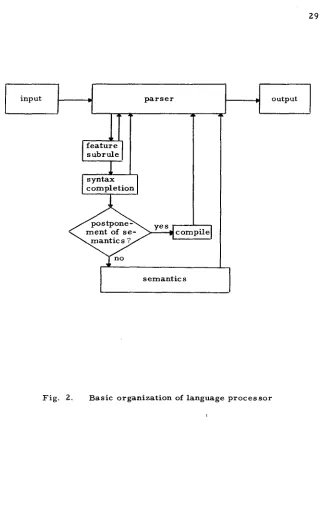
Sentence analysls consists of repeated applications of the four s t e p s : r e c o g n l t l o n of a rule (parsing), feature subrule, syntax comple-
tion, and semantic transformation. Since the language processor accepts
general rewrite rule grammars, the primary objective in parsing is to avoid any redundant analyses, that is, repetitions of portions of the analysis. This is achieved by means of a very elegant algorithm due to Martin Kay
and adapted to our purposes. Basically, parsing is slngle pass, right-to-
left 2, bottom-to-top; all analyses of a sentence allowed by the grammar
are produced.
The details of the algorlthm cannot be discussed here. Let us briefly indicate that it achieves its objectives by means of dummy nodes; the connections between these nodes carry the phrases or
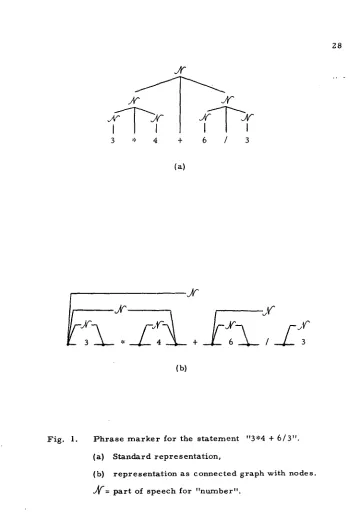
function symbols. This is shown in figure i. The analysis at any
stage is described in terms of a directed graph. The parser explores
all possible paths through the graph from a given node to its right before advancing to the next node to the left. The result of a rule is inserted as a new connection, or, in case of a general rewrite rule,
as a sequence of nodes and connections. If several phrase markers
develop they cannot be distinguished and are only recoEnlzed by the
fact that more than one successful analysis is observed. Likewise,
I
2
10
p a r s l n g s t h a t d i d n o t c o n t r i b u t e t o t h e f i n a l a n a l y s e s a p p e a r i n t h e g r a p h i n t h e same way a s t h o s e t h a t d i d c o n t r i b u t e .
So far we implied that syntax and semantics for a given rule are performed simultaneously; syntactic and semantic analysis proceed "in
parallel". A rule may not only fall to apply on syntactic grounds but on
semantic grounds as well. Its arguments may not map into any object; the
path matched by the rule is meaningless. As a consequence~ by simultaneously , considering the semantic aspects the size of the parsing graph may he
kept considerably below what it would otherwise he, with concomitant reduction in parsing time. On the other hand, spurious parsings m a y not be recognized i~mediately but only after they participated in the analysis
to considerable extent. The corresponding transformations may often be
complex end tlme-consumlng, especially when manipulating large-slze data bases. Many of these parsings are finally excluded on syntactic
grounds. Unnecessary execution of such transformations can be avoided
by postponing the semantic analysis until the syntactic analysis has been completed; in this case syntactic and semantic analyses are per-
formed "serially". The decision as to which alternative is the appropriate
one under given circumstances is made by the language itself; it notifies the language processor of its choice°
A statement entered into the system must be converted into a form
I I
r e t u r n e d t o t h e u s e r i n i n t e l l i g l b l e f o r m . N o s t l a n g u a g e s w i l l w i s h t o t r e a t some a s p e c t s o f i n p u t and o u t p u t i n a s p e c i f i c way. F o r e x a m p l e , p r e - e d £ t l n g o f t h e s t a t e m e n t , o r s u b s t i t u t i o n o f l e x l c a l i t e m s may be d e s i r e d p r i o r t o a n a l y s i s . On o u t p u t , t h e l a n g u a g e may e x a m i n e t h e p a r s i n g g r a p h f o r s u c c e s s f u l a n a l y s e s , t r e a t s t r u c t u r a l a m b i g u i t i e s a p p r o p r i a t e l y , o r i n i t i a t e t h e e x e c u t i o n o f p o s t p o n e d s e m a n t i c s . As a c o n s e q u e n c e , i n p u t and o u t p u t r o u t i n e s a r e p a r t o f a l a n g u a g e , a s i d e f r o m some b a s i c s e r v i c e s p r o v i d e d b y t h e s y s t e m .
12
4. COMPILATION AND LANGUAGE EXTENSION
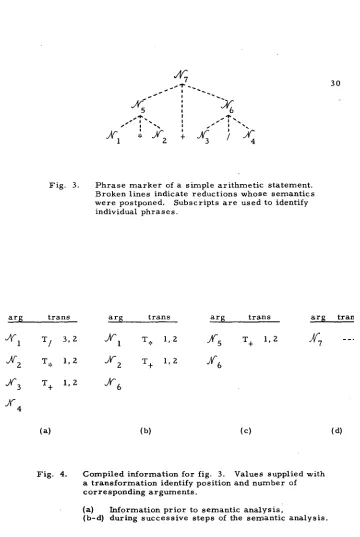
When postponing the semantic analysis, the language processor must "compile" information during the syntactic analysis which enables it to perform the appropriate semantic transformations in the correct sequence, Since the syntactic analysis reflects the individual transformatlonsD and the sequence in which they are to be combined, the compiled information contains a list of transformations in precisely the order in which their
corresponding rules applied. Transformations require arguments, hence
the compiled information must also contain a llst of those.
A list of transformations associated wlth a phrase marker repre-
sents that portion of it whose semantic analysis must still be performed.
In the example figure 3, this portion is marked by broken lines. Now
consider the phrase marker in terms of the semantic analysis alone.
By removing all broken lines and the nodes they connect to, one obtains
the present status of the semantic analysis. The remainder of the analysis
must, clearly, be performed on all those symbols which do not have an ancestor in the tree, excluding, of course, function symbols since they
do not participate as arguments. Because transformations expect their
argtunents in left-to-rlght order, the phrases are listed in that very
13
After a step in the semantic analysis has been carried out, the
compiled information m u s t reflect the new status of the analysis. Thus
in figure 4b transformation T/ has been executed, "adding" n o d e ~ to
the phrase marker. Correspondingly, T/ has been removed from the
l u f o ~ t l o , n i l e phrases ~3 and ~ have been substituted by phrase
~
Figures 4c,d illustrate this process through the subsequent two steps. The semantic analysis is completed when no transformation is left; the llst of arguments has been reduced to a single element, the result. The arguments of a particular transformation are identified by theirtotal number, and their position in the list of arguments. These
specifications remain unchanged during successive steps because of the strict rlght-to-left order of the analysis.
14
Our discussion so far did not distinguish between gr--,--r rules constituting the base level of the language and those which are its
extensions. The base level, being the invariant portion of the language,
cannot be changed in the conversational mode. Its syntax completions and
transformations are computer programs which determine the structural cate-
gories as well as the "primitive" operations on them. Extensions are
recursively constructed from the base level in conversational mode.
T h e r e a r e two e x t r e m e p o s i t i o n s f o r h a n d l i n g e x t e n s i o n s , (1) s t r i n g m a n i p u l a t i o n , o r (2) c o m p i l a t i o n i n t o some b a s i c n o t a t i o n , f o r e x a m p l e t h e b a s e l e v e l o f t h e l a n g u a g e . I n t h e f i r s t c a s e , a d e f i n e d s t r i n g o f s y m b o l s i s a l w a y s r e p l a c e d by t h e s t r i n g o f s y m b o l s w h i c h c o n s t i t u t e s i t s d e f i n i t i o n . R e d e f i n i t i o n o f a t e r m e f f e c t i v e l y p r o p a - g a t e s t o r e d e f i n e a l l t e r m s d i r e c t l y o r i n d i r e c t l y d e r i v e d f r o m i t . However~ i f t h e h i e r a r c h y o f compounded e x t e n s i o n s i s d e e p t h e r e i s e x c e s s i v e e x p a n s i o n o f t h e o r i g i n a l s t r i n g w i t h c o n c o m i t a n t c o s t i n p a r s i n g t i m e . I f p on t h e o t h e r h a n d , t h e e x t e n s i o n i s c o m p i l e d down t o t h e b a s e l e v e l a r e d e f i n i t i o n c a n n o t p r o p a g a t e . We h a v e c h o s e n a c o m p r o m i s e p o s i t i o n t h a t i n c o r p o r a t e s m o s t o f t h e a d v a n t a g e s o f b o t h : s y n t a c t i c a n a l y s i s i s c a r r i e d o u t w h i l e t h e s e m a n t i c s a r e p o s t p o n e d . Hence t h e s e m a n t i c a s p e c t s o f a new t e r m a r e d e t e r m i n e d by t h e t r a n s - f o r m a t i o n s o f t h e t e r m s w h i c h a r e d i r e c t l y r e f e r r e d t o i n i t s d e f i n i - t i o n , be t h e y b a s e l e v e l o r e x t e n s i o n t e r m s . At t h e same t i m e , t h i s c o m p r o m i s e p o s i t i o n i s i d e n t i c a l t o t h e c o m p i l a t i o n scheme i n t r o d u c e d a b o v e , p e r m i t t i n g u s e o f t h i s scheme f o r l a n g u a g e e x t e n s i o n a s w e l l .
15
The l a n g u a g e p r o c e s s o r s h o u l d t r e a t b a s e l e v e l a n d e x t e n s i o n r u l e s a 1 1 k e . I n d e e d , o n e c a n i d e n t i f y t h e s y n t a x c o m p l e t i o n r o u t i n e a n d s e m a n t i c t r a n s f o r m a t i o n f o r a n e x t e n s i o n r u l e . B o t h a r e o b t a i n e d b y a n a l y z l n g t h e d e f i n i n g e x p r e s s i o n . F o r e x a m p l e , i n t h e e x t e n s i o n
f ( x , y ) : x * x + 4 / y
t h e s y n t a x f o r t h e l e f t - h a n d s i d e o f t h e new r u l e i s g i v e n by t h e s y n t a x o f t h e p h r a s e d o m i n a t i n g t h e e x p r e s s i o n " x * x + 4 / y " ; s y n t a x c o m p l e t i o n s i m p l y r e p r o d u c e s t h i s p o r t i o n . The new t r a n s f o r m a t i o n c o i n c i d e s w i t h t h e c o m p i l e d i n f o r m a t i o n f o r t h e e x p r e s s i o n .
In general, an extension rule will again be a function on some
arguments w i t h given structural properties. In the example above, the
t r a n s f o z ~ m t i o n f o r f ( x , y ) o p e r a t e s o n a n y p a i r o f o b j e c t s f r o m t h e c a t e g o r i e s d e s c r i b e d b y x a n d y . H e n c e x a n d y a r e e n t i r e l y s y n t a c t i c i n n a t u r e ; t h e y r e p r e s e n t s p e c i f i c s t r u c t u r a l c a t e g o r i e s b u t h a v e no i n t e r p r e t a t i o n . T h e y a r e t h e " f r e e v a r i a b l e s " i n t h e d e f i n i t i o n . V a r i a b l e s s e r v e two p u r p o s e s i n a n e x t e n s i o n .
( i ) T h e y d e t e r m i n e t h e r i g h t - h a n d s i d e o f t h e new r u l e . The c a t e - g o r i e s t h e y r e p r e s e n t a r e d e s c r i b e d b y p a r t o f s p e e c h a n d f e a t u r e s . The p a r t o f s p e e c h d e t e r m i n e s t h e s e q u e n c e o f s y m b o l s i n t h e r u l e ; f o r e x a m p l e , i f x a n d y a r e n u m b e r
i
16
(2) I n t h e c o m p i l e d i n f o r m a t i o n , a r g u m e n t l i s t e l e m e n t s w h i c h c o r r e s p o n d t o v a r i a b l e s h a v e no i n t e r p r e t a t i o n . They r e c e i v e t h e i n t e r p r e t a t i o n on " d e f i n i t i o n e x p a n s i o n " , t h a t i s , b e f o r e t h e s e m a n t i c s a r e p e r f o r m e d on t h e g i v e n a r g u m e n t s . T h e r e f o r e , t h e y m u s t c o n t a i n some key which r e l a t e s them t o t h e c o r r e s - p o n d i n g a r g u m e n t . T h i s key i s p r o v i d e d by t h e v a r i a b l e s w h i c h may t h u s be c o n s i d e r e d a s " p l a c e m a r k e r s " . Suppose t h e p o s i t i o n
of the argument in the rule serves as key. Then ~i' ~2' and
in figure 4a have no interpretation and are labeled by i, i, and 2, respectively.
Certain decisions with regard to language extension, such as whether to reject certain definitions on the basis of their analysis, or how to deal with structural or other ambiguities, must be left to a
language itself. Consequently, each language includes a base level
rule which determines the result of an extension. The language pro-
cessor merely performs the compilation, ensures that the new rule is stored in standard form, and controls subsequent definition expansion. A language may also employ the extension mechanism if it wishes to avoid the use of a lexicon, and instead enter the referent words identifying
objects in its universe of discourse in the form of a grammar rule. In
17
5. GENERATORS
We n o t i c e t h a t g e n e r a l r e w r i t e r u l e s and d e f i n i t i o n e x p a n s i o n h a v e a p r o p e r t y i n common. I n e a c h c a s e a l l s t o f f u n c t i o n s i s g i v e n . Each f u n c t i o n i s e x e r c i s e d i n t u r n , and t h e r e s u l t o f e a c h s t e p i s u t i l i z e d i n a m a n n e r w h i c h d e p e n d s o n l y on t h e c r i t e r i o n g o v e r n i n g t h e l i s t . I n " t h e c a s e o f a g e n e r a l r e w r i t e r u l e t h e r e s u l t s e n t e r t h e p h r a s e m a r k e r
a s a s e q u e n c e o f p h r a s e s , w h i l e f o r d e f i n i t i o n e x p a n s i o n t h e y p a r t i c i p a t e i n s u b s e q u e n t s t e p s .
T h i s i s a n i n s t a n c e o f a phenomenon known i n l i s t - p r o c e s s i n g a s " g e n e r a t i o n " [ 5 ] . The g e n e r a l scheme o f g e n e r a t i o n i s shown i n f i g . 5. A g e n e r a t o r c a n be c o n s i d e r e d a r e l a t i o n b e t w e e n two s e t s , an o r d e r e d s e t ~ o f a r g u m e n t s , and a s e t ~ o f r e s u l t s . I n t h e c o u r s e o f c o n s t r u c t i n g t h e s e t ~ , t h e g e n e r a t o r r e p e a t e d l y s e l e c t s , a c c o r d i n g t o some i n t e r n a l c r i t e r i a , a n e l e m e n t f r o m a s e t o f p r o c e s s e s E , s u p p l i e s i t w i t h an o r d e r e d s e t ~ o f i n p u t a r g u m e n t s , and r e c e i v e s a n o u t p u t s e t , w h i c h i t may s i m p l y c o l l e c t , o r u t i l i z e i n f u r t h e r a c t i o n s . Two c a s e s a r e o f
special interest:
(z)
For each selection J, ~j © ~; each process operates on the sameset of elements, namely the set of arguments for the generator. Further, each successive selection of a process is independent of
l
previous ones; there is a llst of processes which are applied in
turn until the llst is exhausted. Generators of this kind will
be termed "operator generators".
18
(2)
T h e r e i s o n l y a s i n g l e p r o c e s s , t h a t i s , ~ = {p}. F o r e a c h s e l e c t i o n ( " p u l s i n g " ) , i t i s s u p p l i e d w i t h a s e t ~ w h i c h i s i d e n - t i c a l t o ~ , e x c e p t t h a t one and t h e same e l e m e n t I n ~ i s s u b s t i t u t e d on e a c h p u l s i n g . A g a i n , e a c h s u c c e s s i v e s e l e c t i o n i s i n d e p e n d e n t o f p r e v i o u s o n e s . G e n e r a t o r s o f t h i s t y p e w i l l b e d e n o t e d a s " o p e r a n d g e n e r a t o r s " .Under t h i s s c h e m e , g e n e r a l r e w r i t e r u l e s become an o p e r a t o r g e n e - r a t o r ; e a c h "elementary" syntax completion/transformatlon pair utilizes
the arguments of the rule. Definition expansion exhibits some aspects
of an operator generator, but the first condition (_ij = a) does not hold. However, it is the only generator of interest which does not fall into one of the two specified classes.
There is a variety of other phenomena in languages that may con- veniently and efficiently be represented by generators:
A m b i g u i t y . - - More complex l a n g u a g e s , and c e r t a i n l y n a t u r a l l a n g u a g e s , p e r m i t l o c a l a m b i g u i t i e s w i t h i n a s e n t e n c e ; u s u a l l y
19
since the same set of arguments is processed by a sequence of subrules,
syntax completions, and/or transformations. Syntactic operator ambiguities
can usually be resolved within limited contexts and on syntactic grounds. On the other hand, semantic operator ambiguity may render the meaning of the entire sentence ambiguous, and may be introduced deliberately in order
to compare different concepts in a variety of situations. Ambiguity also
arises when a transformation maps its arguments into more than one obJect~
thus associating various meanings with a given string. In the subsequent
analysis, such ambiguous interpretations of phrases will act as an operand
generator. On each pulsing, the transformation of an applying rule will
be provided with a new interpretation.
Numerical quantification. -- Central to many programming languages is the notion of a loop, often taking the form of a "do" or "for" state-
ment. A given sequence of expressions is repeatedly executed, each time
for a new value of one of its variables. Cumulative sum (~) and product
(~) are other examples of operand generators in arithmetic languages.
20
An o p e r a n d g e n e r a t o r t h u s r e f e r s t o a g g r e g a t e s o f o b j e c t s . The i n d i v i d u a l o b j e c t s a r e e v a l u a t e d i n t h e l a r g e r c o n t e x t o f a l l o r p a r t o f t h e s e n t e n c e , and t h e r e s u l t s s u m m a r i z e d i n a c c o r d a n c e w i t h t h e p a r t i c t t l a r p r i n c i p l e c h a r a c t e r i z e d by t h e g e n e r a t o r . E x c e p t i n t h e c a s e o f a m b i g u i t y , s u c h a p r i n c i p l e m u s t be e x p l i c i t l y e x p r e s s e d i n t h e l a n g u a g e . C o n s e - q u e n t l y , o p e r a n d g e n e r a t o r s e n t e r t h e a n a l y s i s t h r o u g h a r u l e o f grammar. The c o r r e s p o n d i n g s e m a n t i c t r a n s f o r m a t i o n s d i f f e r f r o m t h e o n e s d i s c u s s e d s o f a r i n t h a t t h e y r e s u l t i n a g g r e g a t e s r a t h e r t h a n s i n g l e e l e m e n t s w i t h i n a s e m a n t i c c a t e g o r y . However, t h e p r e v i o u s c o n s i d e r a t i o n s s t i l l h o l d i f we r e q u i r e a t r a n s f o r m a t i o n t o p r o d u c e a s i n g l e i n t e r p r e t a t i o n f o r t h e r e s u l t i n g p h r a s e . T h i s i n t e r p r e t a t i o n may now be o f a r b i t r a r y c o m p l e x i t y ; i n t h e c a s e o f a g e n e r a t o r , i t may l i s t a l l a l t e r n a t i v e s , o r a method t o c o n s t r u c t t h e m , and i d e n t i f y t h e p a r t i c u l a r g e n e r a t o r .
As a c o n s e q u e n c e , t h e i n t e r p r e t a t i o n o f a p h r a s e a l s o c o n v e y s s t r u c t u r a l p r o p e r t i e s o f a l a n g u a g e t o t h e l a n g u a g e p r o c e s s o r . I t may i d e n t i f y a s i n g l e e l e m e n t ( " d a t a " ) , a g e n e r a t o r , o r c o m p i l e d i n f o r m a t i o n , and s i m i l a r l y may d i f f e r e n t i a t e b e t w e e n t h e b a s e l e v e l and e x t e n s i o n s .
21
ambiguity does not summarize but excludes individual altern~tlves as they
become meaningless in a given context. Among the operator generators,
general rewrite rules add sequences of phrases to the phrase marker while
syntactic ambiguity may introduce structural ambiguity. Semantic operator
ambiguity, if not resolved, propagates through the subsequent analysis in form of an operand generator.
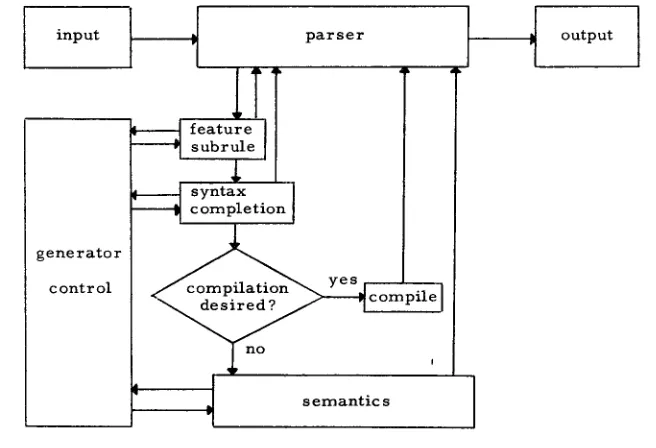
Detection of a generator indicates to the language processor that the present stage of the analysis is to apply separately to each of its
alternatives. On pulsing, the generator produces a new structural
des~rlptlon of the environment to which the analysis is reapplled. Pulsing will therefore cause the language processor to recurse at its
present stage. A separate portion of the language processor directs
pulsing, establishes the new environment, and controls recursion. Figure 6 shows the updated language processor organization.
A selected alternative may itself represent a generator; for example, on definition expansion or operator ambiguity a transformation
may again consist of compiled information. Hence recursion m a y continue
for several levels. Moreover, several generators may occur on a given
level, for example, when several arguments of a rule are generator
phrases. By accepting one generator at a time such cases are resolved
into a sequence of recurslons. Generators thus cause the language
22
The u s e o f g e n e r a t o r s r a i s e s a n u m b e r o f i n t r i c a t e i s s u e s w h i c h
we c a n n o t f u r t h e r p u r s u e h e r e . T h e i r t r e a t m e n t a n d i 1 1 u s t r a t l o n b y
6. LANGUAGE STRUCTURES
23
In order to be able to analyze a sentence in a given language, the language processor must have access to a standardized description of
the language. This description consists of two major components.
1. Grammar t a b l e . - - T h i s c o n t a i n s t h e r l g h t - h a n d s i d e s o f a l l r u l e s o f g r a m m a r . The r u l e s a r e o r g a n i z e d i n t h e f o r m o f a " s y m b o l t r e e " i n w h i c h a s y m b o l i s e i t h e r a p a r t o f s p e e c h o r a f u n c t i o n s y m b o l , a n o d e c a r r y i n g a s i n g l e s y m b o l . A r u l e c o r r e s p o n d s t o a p a t h s t a r t i n g f r o m t h e t o p ; t h e b i t maps i d e n t i f y i n g i t s f e a t u r e s u b r u l e s a r e
a t t a c h e d t o t h e l a s t n o d e i n t h e p a t h . The t r e e a r r a n g e m e n t m a t c h e s t h e p a r s i n g s t r a t e g y ; a s t h e p a r s e r a d v a n c e s o r b a c k t r a c k s i n t h e p a r s i n g g r a p h i t p e r f o r m s i d e n t i c a l a c t i o n s i n t h e s y m b o l t r e e .
S i n c e p a r s i n g and f e a t u r e t e s t i n g c o n s t i t u t e m a j o r f u n c t i o n s o f l a n g u a g e p r o c e s s o r , i t i s a d v a n t a g e o u s t o r e t a i n t h e grammar t a b l e i n h i g h - s p e e d memory d u r i n g t h e e n t i r e a n a l y s i s o f a s e n t e n c e . Even i f t h e gram~aar t a b l e i s o r b e c o m e s t o o e x t e n s i v e , b a s e l e v e l r u l e s
s h o u l d c o n t i n u e t o r e s i d e i n h i g h - s p e e d memory w h i l e e x t e n s i o n r u l e s may be r e l e g a t e d t o p e r i p h e r a l s t o r a g e s i n c e t h e y r a r e l y p a r t i c i p a t e i n t h e a n a l y s i s b e y o n d t h e l e v e l o f t h e i n p u t s t r i n g . I n s u c h a c a s e , h o w e v e r , s t o r a g e o r g a n i z a t i o n m u s t be s u c h a s t o m i n i m i z e t h e n u m b e r o f r e f e r e n c e s
I
24
2. Definitions. -- The remainder of a rule, syntax completion and semantic transformation, is generally too voluminous to be part of
the grammar table. Therefore, it is maintained separately on peripheral
storage, linked to the corresponding node in the grammar table. Defi-
nltlons are of two kinds:
(a) Base level rule. The definition, in principle, consists of the
programs for syntax completion and transformation. For rules
introducing generators into the analysis, it also includes the
pulser. Since operator generators cannot be introduced by a rule
of grammar, they are part of the language processor.
(b) Extension rule. The analysis of the defining expression determines
for the rule both the syntax of its result and its transformation. Entering a definition for an extension rule is not always trivial. Since we tolerate ambiguity, accept general rewrite rules, and permit deletion or replacement of deflnltlons~ considerable bookkeeping may be necessary to ensure that any new meaning pro-
pagates to terms based on the rule in question. Because defini-
tions must be in standard format, the bookkeeping is a function of the language processor.
I t f o l l o w s t h a t t h e l a n g u a g e p r o c e s s o r , d u r i n g s e n t e n c e a n a l y s i s , r e q u e s t s c o n s i d e r a b l e i n f o r m a t i o n from p e r i p h e r a l s t o r a g e , some o f i t p e r h a p s r e p e a t e d l y . T h i s s u g g e s t s page o r g a n i z a t i o n o f memory. How- e v e r , i t i s i m p o r t a n t t h a t t h e l a n g u a g e p r o c e s s o r be a b l e t o d e a l w l t h
25
pages explicitly in order to arrange the various components of a lan- guage in an optimal fashion with regard to page transfers.
Among the temporary configurations guiding the language processor
are the parsing graph, and the syntax and interpretations of its phrases.
Since t h e c o n f i g u r a t l o n s are described by lists~ the language processor
demands a llst-formatted work area in core memory. This area is also
used to describe the environment of generators, or control the recurslon.
Manipulation of data is a concern of the language of which they
are part. Data structures may cover a wide range, from simple f o r m a t s
such as single numbers to complex ones such as hierarchical file organiza-
tions or interconnected rings. If the data are transient in nature and
limited in size, they may be embedded in the list work area. In most
cases, however, they must be retained on peripheral storage. Again,
by Controlling their arrangement on memory pages a language may be
7 . CONCLUSIONS
26
Some o f t h e n o t i o n s u n d e r l y i n g t h e REL l a n g u a g e p r o c e s s o r w e r e f i r s t i n t r o d u c e d i n c o n n e c t i o n w i t h t h e DEACON p r o j e c t [ 2 ] . H o w e v e r , t h i s l a n g u a g e p r o c e s s o r e x h i b i t s v a s t l y i n c r e a s e d c a p a b i l i t i e s , e s p e - c l a l l y t h e f a c i l l t y o f a c c o m m o d a t i n g a w i d e v a r i e t y o f l a n g u a g e s , t h e i n c l u s i o n o f , a n d e m p h a s i s o n , l a n g u a g e e x t e n s i o n , a n d t h e t r e a t m e n t o f g e n e r a t o r s . A f i r s t v e r s i o n c o n t a i n i n g m o s t o f t h e d e s c r i b e d p r o - p e r t i e s h a s b e e n i n u s e u n d e r t h e C a l t e c h t i m e - s h a r i n g s y s t e m s i n c e s p r i n g o f 1 9 6 8 . S i n c e t h e n , i t h a s s e r v e d a s t h e b a s i s f o r t h e d e v e l o p m e n t o f a n e m b e r o f l a n g u a g e s , a n d p r o v i d e d u s w i t h m o r e i n s i g h t i n t o t h e i r s t r u c t u r a l d e s c r i p t i o n s . T h i s e x p e r i e n c e l e d t o t h e r e v i s e d v e r s i o n o f t h e l a n g u a g e p r o c e s s o r w h i c h c o n s t i t u t e s t h e s u b j e c t o f t h i s p a p e r . The p r o c e s s o r i s s u p p o r t e d b y a m u l t i p r o g r a m m i n g o p e r a t i n g s y s t e m g e a r e d t o t h e n e e d s o f REL [ I ] .
REFERENCES
27
[1]
Thompson, F. B., Lockemann, P. C., Dostert, B. H. and Deverill,R. S., REL: A Rapidly Extenslble Language System, to appear in Proc. 24th Natl. ACM. Conf. (1969)
[2] Thompson, F. B., English for the computer, Proc. AFIPS Fall Joint Comp. Conf. 29 (1966), 349-356
[3]
Thompson, F. B . , Man-machlne c o m m u n i c a t i o n , i n : Seminar on Computational Linguistics, Public Health Service Publ. No. 1716, 57-68[4] Chomsky, N., A s p e c t s of t h e theory of syntax, The MIT Press, 1965, 75ff.
3 * 4 + 6 / 3
(a)
28
X
3 ~ _ * + /
(b)
F i g . 1. P h r a s e m a r k e r f o r the s t a t e m e n t "3*4 + 6 / 3 " .
(a) S t a n d a r d r e p r e s e n t a t i o n ,
(b) r e p r e s e n t a t i o n as c o n n e c t e d g r a p h with nodes.
[image:28.612.132.484.118.643.2]29
input
parser
f
1
I syntax
completion J
~
yeSAcon ~ile]
~
n oI
semantic s
output
Fig. 2.
Basic organization of language processor
[image:29.612.127.460.145.661.2]$ I '~ ~
..'T..
. - T - .
30
F i g . 3. P h r a s e m a r k e r of a s i m p l e a r i t h m e t i c s t a t e m e n t . B r o k e n l i n e s i n d i c a t e r e d u c t i o n s w h o s e s e m a n t i c s w e r e postponed. S u b s c r i p t s a r e u s e d to i d e n t i f y i n d i v i d u a l p h r a s e s .
a r ~ t r a n s a r g t r a n s a r g
~ r I T / S,
Z
J~l
T , I,Z
-/~5
J~Z
T , I,2
J~'-2
T+ I,Z
jV"
6
.lC 3 T+ 1, 2 J ~ 6
X 4
trans
ar~
T+ I, 2
Y~7
---
(a)
(b)
(c)
(d)
t r a n s
F i g . 4. C o m p i l e d i n f o r m a t i o n f o r fig. 3. V a l u e s s u p p l i e d with a t r a n s f o r m a t i o n i d e n t i f y p o s i t i o n and n u m b e r of c o r r e s p o n d i n g a r g u m e n t s .
(a) I n f o r m a t i o n p r i o r to s e m a n t i c a n a l y s i s ,
[image:30.612.137.497.79.616.2]arguments
input
generator
i ]
output
0-
processes~o
I
Fig. 5.
Generator scheme
result
b
31
input
generator
control
parser
IT
~
feature I
subrule
syntax
completion I
I
"
~
s emantic s
output
I
[image:31.612.120.448.382.606.2]