Coordination Boundary Identification with Similarity and Replaceability
Hiroki Teranishi Hiroyuki Shindo Yuji Matsumoto Nara Institute of Science and Technology
{teranishi.hiroki.sw5, shindo, matsu}@is.naist.jp
Abstract
We propose a neural network model for coordination boundary detection. Our method relies on two common properties — similarity and replaceability in con-juncts — in order to detect both sim-ilar and dissimsim-ilar pairs of conjuncts. The model improves the identification of clause-level coordination using bidirec-tional recurrent neural networks incorpo-rating two properties as features. We show that our model outperforms existing state-of-the-art methods for the coordination an-notated Penn Treebank and Genia corpus without any syntactic information from parsers.
1 Introduction
Coordination is a common structure and one of major ambiguities in human languages. Although coordination gives a large amount of syntactic or semantic information of coordinated phrases, dis-ambiguating coordination still remains one of the difficult problems that state-of-the-art parsers can-not cope with.
Given a coordinator word, how can we find conjuncts? Coordinate structures are character-ized by two properties: (1) similar structures of-ten appear in conjuncts, and (2) one conjunct can be replaced with another conjunct without los-ing sentence consistency in syntax or semantics. However, many previous studies of coordination disambiguation rely only on the similarities be-tween conjuncts, despite the fact that similarities are not always helpful (Shimbo and Hara, 2007; Hara et al.,2009;Hanamoto,2012). For example, the sentence “[at least two commercial versions have been put on the U.S. market], and [an esti-mated 500 have been sold].” does not have
sim-ilar phrases around the coordinating conjunction “and.” Thus, existing methods sometimes fail to capture coordination. In addition to the case where there is a lack of similarities, many similarity-based methods use handcrafted features, heuristic rules, or external resources such as thesauri.
To overcome these problems, Ficler and Gold-berg(2016) proposed a neural network model with the replaceability feature as well as the similar-ity feature. Their model produces candidate pairs of conjuncts using probabilities assigned by the Berkeley Parser. All candidate pairs are scored on the basis of the similarity, replaceability and parser-derived features, and then the best scored pair is picked. Their approach outperforms ex-isting constituent parsers for the Penn Treebank and similarity-based coordination disambiguation methods such as those byShimbo and Hara(2007) andHara et al.(2009) for the Genia treebank. Al-though Ficler and Goldberg’s (2016) method im-proves performance significantly, it heavily de-pends on the syntactic parser. They use the outputs from the parser not only for candidates generation and the feature for scoring, but also for computa-tion of the similarities. The problems of propa-gated errors from the parser and dependencies on external resources still remain in their work.
In this work, we propose a neural network model for coordination disambiguation that does not require any external syntactic parser. Our model exploits both the similarity and replaceabil-ity properties to avoid suffering from an absence of these properties (Section2). We use bidirectional recurrent neural networks (RNNs) to obtain the contextual information of candidate conjuncts and then compute similarity and replaceability fea-tures without syntactic information (Section 3). We show that our model performs well for both types of coordination: NP coordination (whose conjuncts tend to be similar) and S coordination
(whose conjuncts make sense individually) and outperforms the methods byFicler and Goldberg (2016) andHara et al.(2009) in Section4.
The contributions of our work include the fol-lowing:
(i) Our model can capture dissimilar conjuncts as well as similar ones using the similarity and replaceability features.
(ii) Our model performs better than others with-out any thesauri, feature engineering, or syn-tactic parsers to extract conjunct features.
2 Coordinate Structure Analysis
2.1 Task Description
Coordination is a frequently occurring syntactic structure along with several phrases, known as conjuncts. The task of coordination disambigua-tion is identifying the boundaries of each conjunct with a single coordinator word as one coordinate structure instance. Given a coordinator word (e.g., “and,” “or,” or “but”), a system must return each conjunct span if the word actually plays the role of a coordinator; otherwise, NONEis output for the absence of coordination. The task sounds simple, yet is difficult because two complex phenomena appear in coordination.
1. A coordinator does not always connect two conjuncts. Sometimes, a coordinate structure consists of three or more consecutive con-juncts. For example1,
“It was not an unpleasant evening, certainly, thanks to [the high level of performance], [the compositional talents of Mr. Douglas],
and25[the obvious sincerity with which Mr. Stoltzman chooses his selection].”
2. Two or more coordinate structures can be found in the same sentence. In addition, one coordinate structure can be nested inside an-other. For example,
“Aside from [the Soviet economic plight]
and7 [talks on cutting (strategic) and12 (chemical) arms], one other issue the Sovi-ets are likely to want to raise is naval force reduction.”
1We write coordinator words with their position in a
[image:2.595.314.518.108.234.2]sen-tence in the form ofwordpositionto distinguish them.
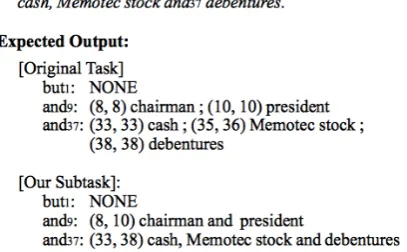
Figure 1: The coordination identification task and our subtask.
In this work, we solve this task by focusing on identifying the beginning and end of an entire co-ordinate structure. Figure1shows our task. We at-tempt to identify two conjuncts to the left and right sides of a conjunction. We call these conjuncts the preconjunct andpost-conjunct, respectively2. In
addition, we assume that the end of the precon-junct and the beginning of the post-conprecon-junct adjoin a coordinator word; thus it appears that we work on the subtask of coordinate structure span identi-fication. After identifying a coordination span, we recover individual conjuncts within the span.
2.2 Conjunct Properties
Coordination has many unique traits other than its structure. We focus on the key properties between conjuncts that can be helpful to disambiguate a co-ordination boundary.
(a) Similarity: Conjuncts in a coordination have
a similar structure or meaning.
(b) Replaceability: A conjunct can be replaced
with another conjunct in the same coordina-tion.
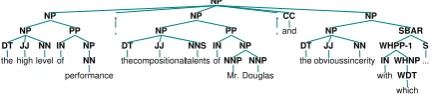
Conjuncts tend to have similar semantic or syn-tactic constituents. For example, the three con-juncts“the high level of performance,” “the com-positional talents of MR. Douglas,”and“the ob-vious sincerity with which Mr. Stolzman chooses his selection” have part-of-speech (POS) tag se-quences starting with “DT JJ NN(S) IN NN(P)
2If two or more conjuncts appear before a conjunction, we
NP NP NP DT the JJ high NN level PP IN of NP NN performance , , NP NP DT the JJ compositional NNS talents PP IN of NP NNP Mr. NNP Douglas , , CC and NP NP DT the JJ obvious NN sincerity SBAR WHPP-1 IN with WHNP WDT which S ...
(a) Similar structures between conjuncts
1.Aside from [the Soviet economic plight], one other . . . 2.Aside from [talks on cutting (strategic) arms], one other . . . 3.Aside from [talks on cutting (chemical) arms], one other . . .
(b) Replaceability
Figure 2: Characteristic of conjuncts
. . . ” in common. At a phrase level, they all are categorized as NP and have identical tree struc-tures (Figure2(a)). Many previous works exploit this characteristic to detect conjuncts (Shimbo and Hara,2007;Hara et al.,2009).
The replaceability of conjuncts is also often ob-served. A sentence is still consistent even if one conjunct is replaced with another one. For exam-ple, the coordination“Aside from [the Soviet eco-nomic plight] and [talks on cutting (strategic) and (chemical) arms]”can be transformed into“Aside from [talks on cutting (chemical) and (strategic) arms] and [the Soviet economic plight]” by ex-changing conjuncts. Using this property, we can expand a coordinate structure as one sentence by one conjunct (Figure2(b)). Replaceability has re-cently been used to capture conjuncts (Ficler and Goldberg,2016).
The two properties described above are essen-tial clues to identify conjunct spans; however, they are not always available. Coordination sometimes has different types of conjuncts or an ellipsis in conjuncts. For similarity, when conjuncts belong to the S type or are different types of syntactic categories, their semantic and syntactic structures can be apart from each other (e.g., “[We turned the trading system on]S, and [it did whatever it
was programmed to do]S.” ; “Bill is [in
trou-ble]PPand [trying to come up with an excuse]VP.”).
For replaceability, when words are omitted in a latter conjunct, we cannot replace one conjunct with another unless we supplement omitted words (e.g., “[Honeywell’s contract totaled $69.7 mil-lion], and [IBM’s$68.8 million].”). To cope with the case where there is a lack of similarity or replaceability, our proposed method incorporates both features.
3 Proposed Method
Our proposed model calculates the scores of all possible preconjunct and post-conjunct pairs. Given a sentence x = {x1, x2, x3, . . . , xN} and
coordinator word xk, the preconjunct and post-conjunct can be written as s1 = {xi, . . . , xk−1} (1 ≤ i ≤ k − 1) and s2 = {xk+1, . . . , xj}
(k+ 1≤j≤N), respectively. As we mentioned in Section2, we fix the end of the preconjunct at
k−1 and the beginning of the post-conjunct at
k+ 1. Thus, our model learns and predicts a set of spans (i, j), which indicate the two positions of the beginning and end of a coordination. We identify preconjuncts and post-conjuncts by pick-ing the highest scorpick-ing pairs as predicted conjunct spans.
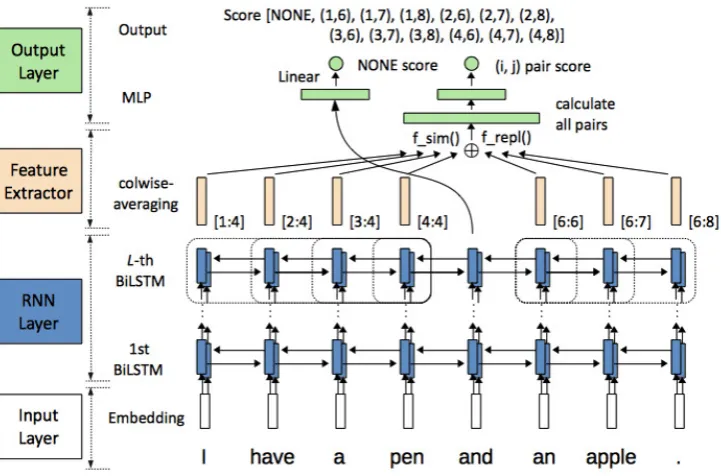
Figure3 shows an overview of our neural net-work architecture. This model consists of four components.
Input Layer: Map a sequence of one-hot words
and POS tags onto their representations from embeddings.
RNN Layer: Produce a sequence of
sentence-level representations based on contexts using a bidirectional RNN.
Feature Extractor: Generate the conjunct
phrase representations and feature vectors of possible pairs of conjuncts.
Output Layer: Calculate the scores of pairs of
conjuncts using MLP.
In the following subsections, we describe these components in detail.
3.1 Input Layer
The first step of our neural network model is to represent a sequence of words and POS tags in distributed vectors, known as embeddings (Ben-gio et al.,2003). Our model receives a sequence of one-hot encoded words and POS tags{xword
n }Nn=1, {xtagn }Nn=1 and then looks them up in the matri-cesEword ∈ Rdword×|vword|,Etag ∈Rdtag×|vtag|,
resulting in a sequence of real-valued vectors
hwordn ∈ Rd,htag
n ∈ Rd, respectively. These
[image:3.595.74.291.67.116.2]Figure 3: Overview of the architecture for coordination analysis.
next layer.
hwordt =Wwordxwordt htagt =Wtagxtag
t h(0)t = [hwordt ;htagt ]
h(0)=h(0)1 , . . . ,h(0)N
(1)
3.2 RNN Layer
A sequence of distributed vectors is transformed into hidden state vectors using stacked bidirec-tional RNNs. Bidirecbidirec-tional RNNs process a time series of inputs from the past to a future direc-tion and from the future to a past direcdirec-tion. We can make use of left-to-right (forward) and right-to-left (backward) contexts using these networks. The output of the `-th layer of stacked bidirec-tional RNNs at a time steptin the forward direc-tion, which is denoted ashf`,t, is computed as
hf`,t =f(hf`,t−1,h`−1,t) (2)
wherehf`,t−1is the hidden state vector of the same layer at the previous time stept−1in the same di-rection andh`−1,tis the hidden state vector of the
previous bidirectional layer at the same time step
t. The hidden vector of the `-th layer of stacked bidirectional RNNs at a time step t in the back-ward direction is also computed in the same way. The stacked bidirectional RNNs that we use in this work output hidden state vectors by concatenating
the vectors {hf`,t}T
t=1 from the forward direction and{hb
`,t}Tt=1from the backward direction at each time steptin every layer.
In general, an RNN has a function f(·) ex-pressed as
f(xt,ht−1) =g(Wxt+Uht−1)
whereg(·)is an arbitrary nonlinear function such as the hyperbolic tangenttanh(·)or rectified lin-ear unit (ReLU). We use the long short term mem-ory (LSTM) (Hochreiter and Schmidhuber,1997) as the functionf(·)to prevent backpropagated er-rors from vanishing or exploding, which arise in RNNs (Pascanu et al.,2013).
3.3 Feature Extractor
This component produces a feature vector based on a representation of a preconjunct and post-conjunct and a series of vectors{ht}Tt=1from bidi-rectional RNNs. We compute the preconjunct rep-resentationvprei and post-conjunctvpostj using the function g(·). In this work, we define element-wise averaging as the functiong(·).
g(hl:m) = average hl,hl+1, . . . ,hm−1,hm
(3) Thus,vprei andvpostj are expressed as
vprei =g(hi:k−1) (1≤i≤k−1)
Thenvprei andvjpostare fed into the following two feature extraction functions.
Similarity feature vector
In order to capture the similarity between the pre-conjunct and the post-pre-conjunct, the feature vector is computed as follows:
fsim(vprei ,vpostj ) =|vipre−vpostj |;viprevpostj
(5) where |vipre − vpostj | is the absolute value of element-wise subtraction, and vipre vjpost is element-wise multiplication. These subtraction and multiplication operations are intended to model the semantic distance and relatedness (Ji and Eisenstein,2013;Tai et al.,2015;Hashimoto et al.,2016).
Replaceability feature vector
We define a feature vector based on the conjunct replaceability as follows.
frepl(h1:N, i, j, k) =
|hi−1hi−hi−1hk+1|; |hj hj+1−hk−1hj+1|
(6)
wherehi−1 is the context vector that is linked to the heads of conjuncts andhj+1is the context vec-tor that is linked to the tails of conjuncts. The first subtraction|hi−1hi−hi−1hk+1|is the differ-ence between two context-conjunct connections at the beginning of coordination. The second sub-traction|hj hj+1−hk−1hj+1|is the differ-ence between two context-conjunct connections at the end of coordination. These distance measures can be interpreted as difficulty in replacing con-juncts. Note that the function frepl(h1:N, i, j, k)
returns a zero vector wheni= 0orj=N.
3.4 Output Layer
This layer computes the scores of pairs of con-juncts based on the similarity feature vectors and the replaceability feature vectors. The network is a multilayered perceptron (MLP) that consists of multiple layers of computational units intercon-nected in a feed-forward way. The score of a pre-conjunct (i, k −1) and post-conjunct(k+ 1, j) candidate pair is calculated as
Score(i, j) =
MLP fsim(vprei ,vpostj ); frepl(h1:N, i, j, k)
(7)
To cope with the absence of coordination against a coordinator, we also calculate the score for a candidate of NONE. The score NONEis sim-ply computed as the product of a weight vector and the sentence-level representation of the coordina-tor from the RNN layer.
Score(NONE) =w·hk+b (8)
Using these scoring functions, we assign scores to all possible pairs of conjuncts. Thus, when the length of a sentence is N and a coordinator ap-pears as thek-th word, we obtain(k−1)×(N −
k)+1candidates and choose the pair with the best score as the predicted conjuncts with the softmax function.
s= [Score(NONE); Score(1,k + 1);. . .;
Score(1,N);. . .; Score(k−1, N)] ˆ
pθ(y|x) = softmax(s)
ˆ
y= arg max
y pθˆ(y|x)
(9)
3.5 Learning
The loss function is the negative log-likelihood of the true pair of conjunctsy(k):
J(θ) =−XD
d=1
log ˆpθ(y(d)|x(d)) +λ2kθk2 (10)
where D is the number of occurrences of coor-dinator words in a training dataset, θ is a set of model parameters, and the hyperparameterλ ad-justs the regularization strength. The model pa-rameters are optimized by minimizing the loss us-ing the stochastic gradient descent (SGD).
4 Experiments
We evaluate our proposed model using the coor-dination annotated Penn Treebank (Ficler, 2016) and the Genia treebank beta (Kim et al.,2003). We present the number of occurrences of coordinator words and the number of sentences with coordina-tion in Table13.
3We consider “and,” “or,” “but,” “nor,” and “and/or” in the
# Coordinators # Sentences Penn Treebank 27903(24450) 21314(19095)
Training 22670(17893) 17282(13932) Development 953(848) 742(673) Testing 1282(1099) 985(873) Genia 3598(3598) 2508(2508)
Table 1: The number of coordinators in the datasets. (#count) indicates the number of actual presences of coordination.
4.1 Evaluation Using the Penn Treebank 4.1.1 Experimental Setup
We use the coordination annotated Penn Treebank and divide it into wsj 2-21 as the training set, wsj 22 as the development set, and wsj 23 as the test-ing set. We use pretrained 200-dimensional word embeddings from the New York Times section in English Gigaword (fifth edition) (Parker et al., 2011) using Word2Vec4with its default parameter.
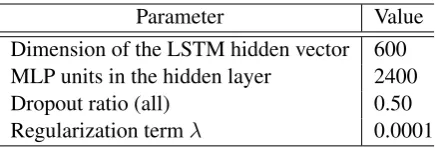
For the POS tags, we use 10-way jackknifing using the Stanford POS Tagger (Toutanova et al.,2003) and initialize the 50-dimensional embeddings with the uniform distribution within [−1,1]. We use three-layer bidirectional LSTMs as an RNN layer. The dimensionality of the LSTM hidden vectors in each direction is selected from{400, 600}. Our MLP consists of one hidden layer with ReLU ac-tivation, and an output layer. The number of the hidden layer units is selected from{1200, 2400}. The model parameters are optimized by the mini-batched SGD with a batch size of 20. The learning rate is automatically tuned by Adam (Kingma and Ba,2014). When training, we apply dropout (Sri-vastava et al.,2014) to the embeddings, input vec-tors of each LSTM in bidirectional LSTMs (except the first layer), and the hidden layer of the MLP. Dropout ratio is selected from{0.33, 0.50}. We choose the regularization strengthλfrom{0.0001, 0.0005, 0.001}. We train our model for 50 itera-tions and choose the model that achieves the best F1 score5 on the development set and evaluate it
with the testing set. We present the final hyperpa-rameters choice in Table2.
4.1.2 Evaluation Metrics
We evaluate our model on the basis of the abil-ity to predict the beginning and end of each
co-4https://code.google.com/archive/p/word2vec/
5This F1 score is measured for thewholecriterion, which
is mentioned later.
Parameter Value
Dimension of the LSTM hidden vector 600 MLP units in the hidden layer 2400
Dropout ratio (all) 0.50
[image:6.595.308.526.61.135.2]Regularization termλ 0.0001
Table 2: The final hyperparameters in the experi-ment for the Penn Treebank.
ordination (whole) with the precision, recall, and F1 measures. In another setup, we focus on NP coordination6. To compare the performance with
Ficler and Goldberg(2016), we also evaluate our model with two conjunct spans that are adjacent to the coordinator (inner), the first and last con-juncts (outer), and all complete conjuncts (exact). Furthermore, in order to investigate the effective-ness of our proposed features, we perform the ex-periment with a simple baseline model that uses two averaged vectors as features (Eq.3) and feeds them into the MLP instead of the similarity and replaceability features (Eq.7).
Note that our proposed model learns and pre-dicts the coordinate structure boundaries and not each conjunct; thus, when evaluating the inner, outer, and exact metrics, we simply divide the pre-conjuncts into subpre-conjuncts using the character “,” as the divider.
4.1.3 Results
We present the results in Table3. For all metrics, the recall values are low compared with the preci-sion values. Our model is likely to produce NONE for some coordinators by mistake. The proposed model suffers from a worse outer metric than the inner metric. Intuitively, this is because the pre-conjunct for the inner prediction is placed next to a coordinator and it is easier to identify its span, while outer conjuncts occur apart from the coordi-nators.
Table4 summarizes the performance of differ-ent uses of features. The similarity and replace-ability features work better than the baseline inde-pendently. However, the joint model performs the best by exploiting both features.
Table 5 presents a comparison with existing methods. For all coordination, our proposed method outperforms the state-of-the-art models with a test set F1 score of 72.81 (0.11 better than
6We consider that NP and NX are NP coordination as in
[image:6.595.72.293.62.148.2]All NP
P R F P R F
[image:7.595.307.527.60.189.2]whole 75.92 72.87 74.36 77.90 75.05 76.45 outer 72.48 69.57 70.99 76.24 73.45 74.82 inner 74.07 71.10 72.56 77.43 74.59 75.99 exact 72.11 69.22 70.63 75.77 72.99 74.35 Table 3: Performance difference by the metrics for the PTB development set.
All NP
P R F P R F
Baseline 70.83 68.75 69.77 74.27 72.87 73.57 fsim 71.79 69.92 70.84 74.76 73.22 73.98
frepl 74.29 71.58 72.91 76.12 73.68 74.88
[image:7.595.74.290.61.127.2]Both 75.92 72.87 74.36 77.90 75.05 76.45 Table 4: Performance of different sets of features for the PTB development set for the outer met-ric. “fsim,” “frepl,” and “Both” indicate the use
of similarity feature vectors, replaceability feature vectors, and both feature vectors, respectively.
the previously reported result). For NP coordina-tion, our model achieves competitive results, de-spite the rough extraction of conjuncts from pre-conjuncts, even for inner-conjunct prediction.
4.2 Evaluation Using Genia 4.2.1 Experimental Setup
We also evaluate our model with the Genia tree-bank beta to compare with the previous work of Hara et al.(2009) andFicler and Goldberg(2016). The settings of this experiment are based on those presented in Section4.1.1, except for the follow-ing hyperparameters: Word embeddfollow-ings are ini-tialized by the pretrained 200-dimensional repre-sentation that BioASQ (Tsatsaronis et al., 2012) provides. These embeddings are trained from biomedical abstracts by using Word2Vec. We use gold POS as inHara et al.(2009), and the dimen-sion of the POS embeddings is 50. For regulariza-tion, we setλ = 0.0005and train our model for 20 iterations.
4.2.2 Evaluation Metrics
As inHara et al.(2009), we measure the recall val-ues of coordinate structure boundary prediction, disregarding individual conjunct spans7. Thus, we
do not decode conjuncts because our model can be compared directly. Coordination phrases in the
7In the Genia corpus, all coordinator words are associated
with conjuncts; thus, there is no absence of coordination, as described in Table1.
Dev Test
P R F P R F
All Coordination
Berkeley 70.14 70.72 70.42 68.52 69.33 68.92 Zpar 72.21 72.72 72.46 68.24 69.42 68.82 Ficler16 72.34 72.25 72.29 72.81 72.61 72.7 Ours 74.07 71.10 72.56 73.46 72.16 72.81
NP Coordination
Berkeley 67.53 70.93 69.18 69.51 72.61 71.02 Zpar 69.14 72.31 70.68 69.81 72.92 71.33 Ficler16 75.17 74.82 74.99 76.91 75.31 76.1 Ours 77.43 74.59 75.99 75.87 74.76 75.31 Table 5: Performance of inner-conjunct prediction on all coordination and on NP coordination for the PTB. The results for the three methods other than our method are reported in Ficler16 : (Ficler and Goldberg,2016).
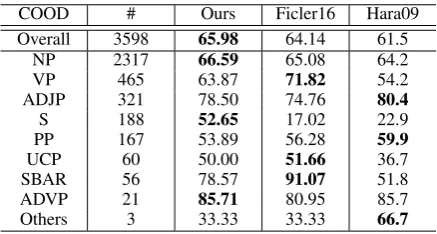
COOD # Ours Ficler16 Hara09
Overall 3598 65.98 64.14 61.5
NP 2317 66.59 65.08 64.2
VP 465 63.87 71.82 54.2
ADJP 321 78.50 74.76 80.4
S 188 52.65 17.02 22.9
PP 167 53.89 56.28 59.9
UCP 60 50.00 51.66 36.7
SBAR 56 78.57 91.07 51.8
ADVP 21 85.71 80.95 85.7
Others 3 33.33 33.33 66.7
Table 6: Recall with Genia treebank beta. The numbers in the columns “Ficler16” and “Hara09” are taken from their papers; Ficler16 : (Ficler and Goldberg,2016) ; Hara09 : (Hara et al.,2009).
Genia treebank are explicitly annotated with a spe-cial label (COOD). Making use of this label, we also measure the performance for each type of co-ordination, as reported in previous work. We eval-uate our model by five-fold cross-validation, as in Hara et al.(2009).
4.2.3 Results
[image:7.595.72.292.176.242.2] [image:7.595.307.526.279.396.2]of similarity between conjuncts. The results for NP coordination, which accounts for nearly 65% of all coordination, are fairly good for the Genia corpus; however, the model proposed by Ficler and Goldberg(2016) exhibits better performance than ours for the PTB for the inner metric.
5 Related Works
Approaches using the similarity property between conjuncts have been developed in previous works. Regarding the task of coordination identification in Japanese, Kurohashi and Nagao (1994) used a chart to compute the similarity between con-juncts and identify conjunct spans with a dy-namic programming technique. Shimbo and Hara (2007) proposed a sequence alignment model with dynamic programming to capture locally similar structures in two conjuncts on the basis of the set of features including word surfaces, POS tags, and morphological characteristics. The similar-ity score in their work is computed by a weighted linear combination (perceptron) of manually de-signed features asde-signed to edges and nodes in graphs, while the score in the work ofKurohashi and Nagao(1994) is calculated from a score func-tion that uses some rules based on the observa-tion of coordinaobserva-tion. Although the method of Shimbo and Hara(2007) could not handle nested coordinate structures,Hara et al.(2009) extended their work to cope with nested coordination as well as three or more than consecutive conjuncts. Their proposed method defined several production rules to build consistent coordination trees with discriminative functions based on the similarity score. Hanamoto (2012) used dual decomposi-tion to combine an HPSG parser with the model ofHara et al.(2009).
The method of use of the replaceability prop-erty has recently been adopted byFicler and Gold-berg(2016). They incorporated the replaceability property between conjuncts into the feature repre-sentations, as well as the similarity property. They made use of these properties to assign scores to candidate pairs of conjuncts. Their method con-sists of three components: a binary classifier to detect the presence of coordination, the parser ex-tended from the Berkeley Parser (Petrov et al., 2006) to generate candidate pairs, and a discrim-inative neural network to identify conjuncts. As similarity features, they compute the Euclidean distance between the two representations of
con-juncts, which are computed from syntactic trees generated by the parser, and this is more effi-cient with respect to the time complexity com-pared with the methods with graphs. The replace-ability feature vectors are produced from bidirec-tional LSTMs by processing two sentences that are produced by leaving out one of two conjuncts. Their model then scores all candidate pairs of con-juncts from feature vectors including similarities, replaceabilities, and additional three values de-rived from the probabilities assigned by the parser. The best scored pair is selected as the most prob-able conjuncts. For the Genia corpus, their model outperformed the method of Hara et al. (2009) which only relied on the similarity property. Us-ing neural networks, they overcame the problems of manually elaborated features and of access to external sources such as thesauri. However, their method heavily depends on their extension of the Berkeley Parser. Therefore, the problem of error propagation between components and the parser still remains.
Kawahara and Kurohashi(2008) tried to resolve coordination disambiguation without any similar-ities on the basis of the dependency relations and generative probabilities of phrases including con-juncts. Yoshimoto et al. (2015) extended the graph-based dependency parsing algorithm to han-dle coordinations.
6 Conclusions
We propose a neural network model to disam-biguate coordinate structure boundaries. Our method relies on two properties: (i) conjuncts tend to have a similar structure in syntax or semantics and (ii) conjuncts can be replaced with each other, maintaining sentence consistency. On the basis of these observations, we compute two feature vec-tors from a sequence of vecvec-tors produced by bidi-rectional RNNs. Our model can capture the con-nections between conjuncts and other parts of sen-tences and sentence-level coordination. As a re-sult, our model outperforms existing methods and achieves state-of-the-art performance. The biggest contribution of our work is resolving dependency on information from syntactic parsers.
Acknowledgments
This work was partly supported by JST CREST Grant Number JPMJCR1513, Japan. We are grate-ful to our colleagues in the NAIST Computa-tional Linguistics Laboratory and the anonymous reviewers for their helpful insights and comments.
References
Yoshua Bengio, R´ejean Ducharme, Pascal Vincent, and Christian Jauvin. 2003. A neural probabilistic lan-guage model. Journal of machine learning research, 3(Feb):1137–1155.
Jessica Ficler. 2016. Coordination Annotation Exten-sion in the Penn Tree Bank. Proceedings of the 54th Annual Meeting of the Association for Compu-tational Linguistics (ACL 2016), pages 834–842.
Jessica Ficler and Yoav Goldberg. 2016. A neural net-work for coordination boundary prediction. arXiv preprint arXiv:1610.03946.
Atsushi Hanamoto. 2012. Coordination Structure Analysis using Dual Decomposition. pages 430– 438.
Kazuo Hara, Masashi Shimbo, Hideharu Okuma, and Yuji Matsumoto. 2009. Coordinate Structure Analysis with Global Structural Constraints and Alignment-Based Local Features. 1(August):967– 975.
Kazuma Hashimoto, Caiming Xiong, Yoshimasa Tsu-ruoka, and Richard Socher. 2016. A joint many-task model: Growing a neural network for multiple nlp tasks.arXiv preprint arXiv:1611.01587.
Sepp Hochreiter and J¨urgen Schmidhuber. 1997. Long short-term memory. Neural computation, 9(8):1735–1780.
Yangfeng Ji and Jacob Eisenstein. 2013. Discrimina-tive improvements to distributional sentence similar-ity. InEMNLP, pages 891–896.
Daisuke Kawahara and Sadao Kurohashi. 2008. Co-ordination disambiguation without any similarities. InProceedings of the 22nd International Conference on Computational Linguistics-Volume 1, pages 425– 432. Association for Computational Linguistics.
J-D Kim, Tomoko Ohta, Yuka Tateisi, and Junichi Tsu-jii. 2003. Genia corpusa semantically annotated cor-pus for bio-textmining. Bioinformatics, 19(suppl 1):i180–i182.
Diederik Kingma and Jimmy Ba. 2014. Adam: A method for stochastic optimization. arXiv preprint arXiv:1412.6980.
Sadao Kurohashi and Makoto Nagao. 1994. A syntac-tic analysis method of long japanese sentences based on the detection of conjunctive structures. Compu-tational Linguistics, 20(4):507–534.
Robert Parker, David Graff, Junbo Kong, Ke Chen, and Kazuaki Maeda. 2011. English gigaword fifth edi-tion. LDC2011T07.
Razvan Pascanu, Tomas Mikolov, and Yoshua Bengio. 2013. On the difficulty of training recurrent neural networks. InInternational Conference on Machine Learning, pages 1310–1318.
Slav Petrov, Leon Barrett, Romain Thibaux, and Dan Klein. 2006. Learning accurate, compact, and inter-pretable tree annotation. InProceedings of the 21st International Conference on Computational Lin-guistics and the 44th annual meeting of the Associa-tion for ComputaAssocia-tional Linguistics, pages 433–440. Association for Computational Linguistics.
Masashi Shimbo and Kazuo Hara. 2007. A Discrimi-native Learning Model for Coordinate Conjunctions. (June):610–619.
Nitish Srivastava, Geoffrey E Hinton, Alex Krizhevsky, Ilya Sutskever, and Ruslan Salakhutdinov. 2014. Dropout: a simple way to prevent neural networks from overfitting. Journal of Machine Learning Re-search, 15(1):1929–1958.
Kai Sheng Tai, Richard Socher, and Christopher D Manning. 2015. Improved semantic representations from tree-structured long short-term memory net-works. arXiv preprint arXiv:1503.00075.
Kristina Toutanova, Dan Klein, Christopher D Man-ning, and Yoram Singer. 2003. Feature-rich part-of-speech tagging with a cyclic dependency network. InProceedings of the 2003 Conference of the North American Chapter of the Association for Computa-tional Linguistics on Human Language Technology-Volume 1, pages 173–180. Association for Compu-tational Linguistics.
George Tsatsaronis, Michael Schroeder, Georgios Paliouras, Yannis Almirantis, Ion Androutsopoulos, Eric Gaussier, Patrick Gallinari, Thierry Artieres, Michael R Alvers, Matthias Zschunke, et al. 2012. Bioasq: A challenge on large-scale biomedical se-mantic indexing and question answering. In AAAI fall symposium: Information retrieval and knowl-edge discovery in biomedical text.