Combining Lightly-Supervised Text Classification Models
for Accurate Contextual Advertising
Yiping Jin
Dept. of Mathematics & Computer Science Chulalongkorn university
Thailand 10300 Yiping.Ji@student
.chula.ac.th
Dittaya Wanvarie
Dept. of Mathematics & Computer Science Chulalongkorn university
Thailand 10300
Phu T. V. Le
Knorex Pte. Ltd. 2 Science Park Drive,
Singapore 118222 le [email protected]
Abstract
In this paper we propose a lightly-supervised framework to rapidly build text classifiers for contextual advertising. In contextual advertising, advertisers of-ten want to target to a specific class of webpages most relevant to their product, which may not be covered by a pre-trained classifier. Moreover, the advertisers are only interested in the target class. There-fore, it is more suitable to model as a one-class one-classification problem, in contrast to traditional classification problems where disjoint classes are defined a priori. We first apply two state-of-the-art lightly-supervised classification models, gener-alized expectation (GE) criteria (Druck et al.,2008) and multinomial na¨ıve Bayes (MNB) with priors (Settles,2011) to one-class one-classification where the user only provides a small list of labeled words for the target class. We fuse the two mod-els together by using MNB to automati-cally enrich the constraints for GE train-ing. We also explore ensemble method to further improve the accuracy. On a corpus of real-time bidding requests, the proposed model achieves the highest aver-ageF1 of 0.69 and closes half of the gap
between previous state-of-the-art lightly-supervised models to a fully-lightly-supervised MaxEnt model.
1 Introduction
Contextual advertising (or contextual targeting) is a technique to maximize the relevance of online advertisements by performing page analysis of the webpages. Contextual advertising is closely re-lated to text classification problem, which is
well-known to the NLP community. Underlying, the system classifies webpages into predefined Ads verticals (categories). Based on the classification result, the real-time bidding (RTB) system will de-cide whether to bid for a particular page to dis-play their Ads. Successful contextual advertising leads to lower advertising cost and higher click-through and conversion rate (Chatterjee et al., 2003;Broder et al.,2007).
Contextual targeting differs from traditional text classification in three ways. Firstly, with thou-sands of vastly different products coming to mar-ket every day, there are large number of categories (usually thousands of categories). Secondly, the advertisers often want to customize an existing category or create new categories to target a set of more relevant webpages. I.e. the classes are not static but evolving. It is therefore unrealistic to ask the advertisers to provide labeled webpages for each new or modified category they want to tar-get. Lastly, while the advertisers can provide prior knowledge for the class they want to target, they cannot accurately specify the irrelevant (or nega-tive) category because it likely covers broad topics in the wild. However, to train a classifier, usu-ally labeled instances for each class are required. Because of these constraints, prominent service providers such as Peer391 and Grapeshot2 build
their contextual targeting systems mainly using hand-crafted keywords instead of learning based approaches.
In this work, we model contextual targeting as lightly-supervised one-class classification prob-lem. The algorithm takes unlabelled documents3
DOCUand the user provided keywordsScfor the
1https://www.sizmek.com/peer39/ 2https://www.grapeshot.com/
3We classify only based on the text in the webpages. Henceforth we use “document” to refer to “webpage”, con-forming to the terminology commonly used in NLP.
target classc as input and returns a classifierMc
that can classify documents belonging to classc. It is lightly-supervised because we do not use any document labels , but labeled keywords instead. It is one-class classification because the users need to provide labeled keywords only for the class they want to target, not the negative class.
We apply two state-of-the-art lightly-supervised classification models, generalized expectation (GE) criteria (Druck et al.,2008) and multinomial na¨ıve Bayes (MNB) with priors (Settles,2011) in the one-class classification setting. Inspired by the relative strength and weakness of the two mod-els, we propose a novel approach to fuse them together where MNB is trained first. The salient words are read off from the posterior class-word distributions and automatically added to form ad-ditional constraints for GE. We also employ en-semble method to produce a final classifier that closed more than half of the gap between previ-ous state-of-the-art lightly-supervised models to a fully-supervised MaxEnt model.
The contributions of this paper are:
1. Extended state-of-the-art semi-supervised classifiers for one-class classification prob-lem.
2. Enriched expectation constraints for GE us-ing a MNB model trained usus-ing EM algo-rithm.
3. Successfully employed ensemble method to produce a final classifier that closed more than half of the gap between previous state-of-the-art semi-supervised models to a fully-supervised MaxEnt model.
The paper is organized as follows: Section 2 presents previous works in two related fields: semi-supervised classification and one-class clas-sification. We review the two previous state-of-the-art models we depend heavily on, generalized expectation (GE) criteria and multinomial na¨ıve Bayes (MNB) with priors in Section3and4, fol-lowed by applying them to one-class classification problem (Section5). Section6describes two dis-tinct approaches to combine these two models to-gether. In section7, we present our experimental results. Lastly, we present conclusions and sug-gest future directions.
2 Related Work
2.1 Semi-Supervised Text Classification
Supervised text classification methods were suc-cessfully applied to various tasks, such as senti-ment analysis (Pang et al.,2002;Wang and Man-ning, 2012), information extraction (Jin et al., 2013) and stance recognition (Hasan and Ng, 2014). The main problem of supervised classi-fication technique is that it requires sizeable set of labeled training documents for each predefined class.
Various semi-supervised classification methods have been proposed to address the lack of train-ing documents. We are particularly interested in lightly-supervised methods that exploit prior knowledge (usually in the form of labeled words for each class) and eliminate the need of any la-beled documents. Two main categories of ap-proaches are often employed to exploit the word labels. The first one is to build an initial weak classifier to obtain soft labels of the documents and then apply expectation maximization (EM) al-gorithm (Liu et al., 2004;Schapire et al., 2002). More recently, there is growing interest in meth-ods that incorporate labeled word features directly into the classification model, either as constraints in an objective function (Druck et al.,2008;Zhao et al.,2016) or as priors on model parameters (Set-tles,2011;Lucas and Downey,2013).
made use of word-level statistical constraints to preserve the class distribution on words, so that the classifier will not drift due to the extra (noisy) labels introduced by EM algorithm.
Labeled words can also provide priors for gen-erative models. Settles (2011) extended multino-mial na¨ıve Bayes model to allow labels for words by increasing their Dirichlet prior. His method consists of three steps: firstly to estimate the initial parameters using only the priors; secondly to ap-ply the induced classifier on unlabeled documents; lastly to re-estimate the model parameters using both labeled and probabilistically-labeled docu-ments. Using an interactive approach to query document and word labels from the user, the sys-tem can achieve 90% of state-of-the-art perfor-mance after a few minutes of annotation.
Dermouche et al. (2013) also exploited prior knowledge in a multinomial na¨ıve Bayes model. Instead of modifying the priors, their method ar-tificially modifies the occurrences of the terms in the right and wrong class. This method uses the full set of document labels and a large sentiment lexicon consisting of around eight thousand terms, making it less suitable for the lightly-supervised setting for contextual targeting.
2.2 One-Class Classification
Another area related to our work is one-class clas-sification problem (Moya and Hush,1996), where no labeled negative instance is available. One-class SVM (Sch¨olkopf et al., 2001) learns only from positive examples. The model classifies new instances as similar or different to the training set. Lee at al. (2003) observed that this approach is highly sensitive to the input representation and it did not perform well for text classification.
We highlight that one-class classification prob-lem is not restricted to using only positive labeled instances. When positive andunlabelleddata are available, a popular approach is to randomly as-sign the negative class to unlabelled instances in the beginning and iteratively refine the labels us-ing EM-like algorithms (Yu et al.,2002;Liu et al., 2003;Li et al.,2009).
Our task lies in the intersection of semi-supervised classification and one-class classifica-tion, yet it differs from both tasks in principled ways. Aforementioned semi-supervised classifi-cation algorithms were applied on corpora with predefined (two or more) classes. When the
ir-relevant (or negative) class refers to “everything else”, we cannot accurately provide prior knowl-edge for the irrelevant class using expert domain knowledge. On the other hand, previous one-class one-classification problems assumed the presence of labeled instances of the positive class, without which neither the similarity-based nor the EM-like algorithms can be applied directly.
3 Generalized Expectation (GE) Criteria
Generalized expectation (GE) criteria (Mann and McCallum, 2008) are constraint terms used to train discriminative linear models. GE provides a flexible framework for encoding prior knowl-edge to provide training signals for parameter es-timation. When applied to text classification, con-straint functionsGkare expressed as the reference
distribution of the feature labels. 4 For example
puck → {baseball : 0.1, hockey : 0.9} means 90% of documents containing the word “puck” should be labeled the class “hockey”. Each con-straint is translated into a term to add to the ob-jective function to encourage parameters that yield predictions conforming to the reference distribu-tion on unlabeled documents. Formally, the com-bined objective function can be written as:
C=−X
k∈K
D(ˆp(y|xk>0)||p˜(y|xk >0))−∆
wherepˆ(y|xk>0)is the reference distribution, ˜
p(y|xk > 0)is the empirical distribution andD
is a distance function. ∆is shorthand for a zero-meanσ2 -variance Gaussian prior on parameters.
GE does not require one-to-one correspondence between constraint functions Gk and model
fea-ture functions. The optimization problem for GE is always under-constrained, meaning the number of parameters to be estimated far exceeds the num-ber of constraints the user provides. To make the optimization tractable, the model updates the gra-dient for an unlabeled featurej based on how of-tenjco-occurs with a labeled featurek.5 Hence
Druck et al. (2009) commented that GE can also be interpreted as a bootstrapping method that esti-mates parameters using limited training signals.
4The features consist of word unigrams in both Druck et al. (2008) and in this paper.
4 Multinomial Na¨ıve Bayes (MNB) with Priors
Multinomial Na¨ıve Bayes is a generative classifi-cation algorithm making a strong assumption that each word wk occurs independent of each other
when conditioned on the class labelcj. Hence,
ˆ
y= argmax j∈ {1,...,J}P(cj)
nd
Y
k=1
P(wk|cj)
where P(cj) is the probability of class cj and
P(wk|cj)is the probability of generating wordwk
given classcj. P(wk|cj)is estimated using:
P(wk|cj) = mjk+
P
iP(cj|x(i))fk(x(i))
Z(fk)
wherefk(x(i))is the count of wordwkin theith
document in the training set andZ(fk) is a
nor-malization constant summing over all words in the vocabulary. Typically, a uniform Laplacian prior is used (all mjk have the same value 1). To
in-corporate the word labels, Settles (2011) increased the prior mjk by α if word wk is labeled with
class cj. To exploit unlabeled documents,
Set-tles (2011) used an initial model estimated with only the priors to probabilistically label the un-labeled documents. The probabilistically un-labeled documents are combined with the labeled words and documents to estimate the parameters for the final model using a single-iteration EM algorithm.
5 Applying GE and MNB to One-Class Classification
In Druck et al. (2009) and Settles (2011), the au-thors ran their models using human labeled key-words for each predefined class. Analogous to one-class classification, where the system takes only positive (and unlabelled) documents as input, We now try to train GE and MNB with priors us-ing onlyuser-providedpositive keywords and un-labelled documents as input.6
GE cannot cope with one-class classification by nature. If we only provide labeled words for the “+” class, the “+” label will be “propagated” to all the word features co-occurring with a labeled word. The trained classifier will predict “+” for 6We use positive/+ to denote the target class and negative/- to denote the irrelevant class.
all the unseen documents. In contrary, MNB with priors can be trained using only the “+” keywords. When we increase the prior for labeled words in class c+, it decreases P(wk0|c+) with respect to
P(w0
k|c−) for an unlabeled feature wk0 (the
nor-malization constantZ+ is greater thatZ− due to
the increased priors in the “+” class). This is desir-able because if a document only contains random unlabeled words, the model will predict “-”.
5.1 Labeling Words for the Target Class
Liu et al. (2004) observed that it is difficult for the user to come up with a set of representative words for each class independently because they usually can only provide a few words, which are insuffi-cient to train an accurate classifier. Therefore, it is critical that the system can assist the user by sug-gesting a good set of candidate words to label in-stead of asking them to come up with all the words by themselves. We use a hybrid candidate word suggestion method that asks the user to input a seed keyword (in most cases, it is merely the class name they want to target) and the system will sug-gest other words that are closely related to it. We make use of word vectors (Mikolov et al.,2013), pointwise mutual information (PMI) (Church and Hanks,1990) and Wikipedia.
Word vectors have been widely used to measure word similarities (Tang et al., 2014; Levy et al., 2015). We calculate cosine similarity using pre-trained GloVe word vectors 7 (Pennington et al.,
2014) to find similar words to the seed word. Word vectors can identify linguistically or semantically related words. E.g. “luxurious” and “lavish” are the nearest neighbours of “luxury”.
We use PMI to mine the words that tend to co-occur with the seed word. For example, “resort”, “BMW”, “Gucci” all receive high PMI scores with “luxury” while none of them are near the word “luxury” in the word vector space.
Lastly, we automatically extract the keywords and keyphrases from the Wikipedia page of the seed word (if the page exists). This method is aimed to cover the technical terms that are con-fident indicators but are rarely observed in the cor-pus. E.g. “Somniloquy” is a synonym of “sleep-talking” but it is thirty time less frequent than the latter.
We show the top 50 candidate words suggested by each of the three methods to the user, who will
select relevant words to add to the keyword list. Based on user study reported in Settles (2011), la-beling words takes on average 3.2 seconds. This suggests the total time for the user to complete la-beling is within 10 minutes.
5.2 Special Treatment for GE
As mentioned above, GE also requires labeled words for the “-” class to train. However, it is im-practical and time-consuming to ask the users to label a list of words irrelevant to the target class. We form the keyword list for the “-” class by sim-ply performing a multinomial sampling from the vocabulary, where each word is weighted by its log count in the unlabeled corpus. This assumes that a randomly sampled word is unlikely to be a keyword for the target class. Additionally, we useL2-based penalty instead of the default KL
di-vergence because previous work showed that it is more robust to label noises (Druck,2011).
The labeled words are translated into GE constraints using Schapire-distributions (Schapire et al.,2002). For the user labeled “+” keywords, We assignP+= 0.9 andP− = 0.1. I.e. if “puck”
is a labeled word for the class “hockey”, the cor-responding constraint will bepuck → {hockey : 0.9, others: 0.1}. For the “-” class, we randomly sample 20 times more keywords than the “+” class but use a more even distribution, where we set P+ = 0.25 and P− = 0.75. This is in the same
spirit with biased sparsityin Wang et al. (2016), which says the word distribution of the targeted topic only focuses on a small number of repre-sentative words and the word distribution of non-targeted topics contain almost all possible words. We do not use too many negative keywords (con-straints) because it significantly increases the com-putational cost to train GE.
We refer to this system as GE/Random be-cause it uses randomly sampled “-” keywords.
6 Combining GE and MNB
6.1 Using MNB to Enrich GE Constraints
Settles (2011) observed that MNB outperformed GE when the number of labeled words were be-tween five to 20. When the number of labeled key-words increased (with more prior knowledge), GE usually performed better. This inspired us to fuse the two models together, in which MNB’s role is to bootstrap more labeled words to train a more accurate GE classifier.
We first use the user labeled “+” words and un-labeled documents to train an MNB model. Then we obtain a list of salient words for the “+” class which are not already covered in the user labeled words. We use a simple rule that word wk will
be added to the set SMNB if PP((wwk|k|c+c−))> 10 (wk
appears 10 times more likely given the “+” class than given the “-” class) . 8 In this way, we
ex-ploit the strength of a generative model (MNB) to discover latent structure and topics from un-labeled data to augment a discriminative model (GE), which usually achieves higher accuracy for classification tasks.
Algorithm1summarizes the training procedure for the combined model GE/MNB. Line 2-4 are the procedure to train a MNB with priors model with EM algorithm. We obtain the list of salient words for the target class in line 5. All the words inSuser,SMNB andSrand are translated into GE
constraints to train the final GE/MNB model.
Algorithm 1:Train GE/MNB Classifier
1 train classifier (Suser,DOCU);
Input : User labeled features Suserand unlabeled
corpus DOCU
Output: Trained GE/MNB classifier
2 MMNB/P riors= train(Suser);
3 DOCprob=MMNB/P riors.classify(DOCU);
4 MMNB/P riors+EM1= train(Suser, DOCprob); 5 SMNB=MMNB/P riors+EM1.getSalientWords(); 6 Srand= randomlySampleWords();
7 MGE/MNB= train([Suser, SMNB, Srand], DOCU);
8 returnMGE/MNB;
6.2 Using Ensemble Approach
Another intuitive way to combine GE and MNB is to train the two classifiers independently and use ensemble approach (Dietterich,2000) to combine the prediction results of the two classifiers. GE and MNB behave quite differently although they make use of the same labeled keywords. The va-riety they introduce is a critical condition for the success of ensemble approach (Dietterich,2000).
We first group the aforementioned classifiers into two families based on the algorithm to train their final classifier. The GE family includes GE/Random and GE/MNB. The MNB family in-cludes MNB/Priors and MNB/Priors+EM1. We
used a simple ensemble rule: the classifier ensem-ble outputs “+” if and only if at least one GEand
8We also tried to replace the randomly sampled “-” key-words with key-words that have high P(wk|c−)
P(wk|c+). However, the
one MNB classifier output “+”. We denote this classifier ensemble as GE1∧MNB1. We used this
heuristic rule instead of stacking or other more so-phisticated techniques because it does not require any labeled documents to train the ensemble.
7 Evaluation
7.1 Baselines and Datasets
We compared the proposed GE/MNB and GE1∧ MNB1 with various baselines. For GE,
we experimented with GE/Random, which uses user provided keywords for the target class and randomly sampled negative keywords to train. For MNB with priors, we ran two configurations following Settles (2011), MNB/Priors+EM1, the
full model using EM algorithm and MNB/Priors, the initial model using only user labeled priors. We also compared with a keyword voting baseline and a fully-supervised MaxEnt model trained using labeled documents. The results of the MaxEnt model is for reference purpose, as our goal is not to beat a supervised model, but to improve from previous lightly-supervised models. We use the GE implementation in the MALLET toolkit9and the implementation of MNB with
pri-ors provided by Settles (2011) 10, which also
ex-tends from MALLET. All the classifiers share the same standard preprocessing pipeline.
We made use of two datasets for evaluation. The first dataset is sampled from the actual real-time bidding (RTB) requests. The second one is the well-known 20 Newsgroups corpus (Lang,1995). The results on the first corpus is more relevant and indicative while the results on the 20 Newsgroups allows to benchmark the models beyond the appli-cation of RTB.
7.2 Evaluations on RTB Dataset
We created the real-time bidding (RTB) dataset from a database of 30 million historical re-quests. We used open-source Boilerpipe li-brary (Kohlsch¨utter et al.,2010) to extract the tex-tual content from the webpages and we obtained the category labels for the webpages from a lead-ing Ad Exchange platform (in total 2,200 cate-gories).11
9http://mallet.cs.umass.edu
10https://github.com/burrsettles/dualist
11The dataset is available at
https://sites.google.com/site/jinyipingnus/research for future works to reproduce our results.
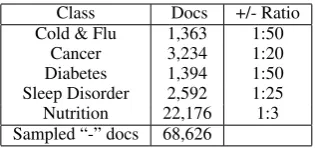
Class Docs +/- Ratio Cold & Flu 1,363 1:50
Cancer 3,234 1:20
Diabetes 1,394 1:50 Sleep Disorder 2,592 1:25 Nutrition 22,176 1:3 Sampled “-” docs 68,626
Table 1: Number of documents for each class and relevant/irrelevant class ratio.
We randomly selected five categories in the “Health” domain to carry out evaluation. For each experiment, the documents labeled with one of the selected categories were assigned to be the “+” class. We uniformly sampled from all other cat-egories to use as the “-” class. We hide the docu-ment labels during training for all models except for MaxEnt.
Table 1 shows the number of documents for each class and the rounded +/- ratio. We can see that the +/- classes are very imbalanced, which is to be expected in real-world RTB requests. In practice, we cannot simply perform up- or down-sampling without the labels of the documents. Therefore, we did not try to modify the class ratio to make it more balanced. For each set of exper-iment, we used the same 9:1 split of training and testing set.
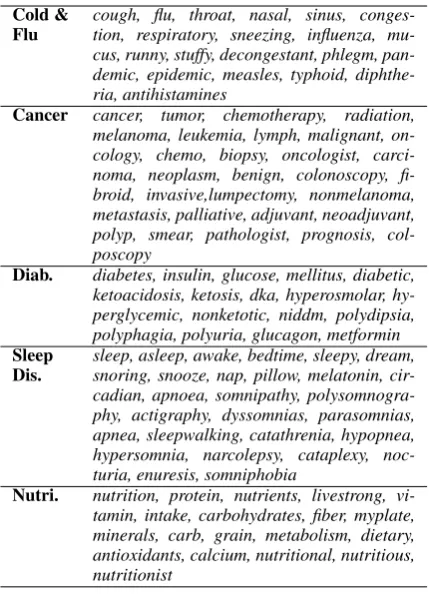
One author of this paper composed the labeled keywords with the assistance of the hybrid key-word suggestion method described in Section5.1. The keywords for each class were composed in-dependently. He was not allowed to add words not suggested by the system so that we can vali-date the utility of the keyword suggestion method. Table2shows the keywords for each category he composed. The labeling stopped when either he finished reviewing all the suggested words or the time reached 10 minutes.
Table 3 shows the P/R/F1 scores of each
clas-sifier for each class. We did not use the accuracy measure because the ratio of +/- classes is strongly imbalanced. We used the same set of user labeled keywords for system 0-5. For GE and MNB with priors, we used the parameter setting proposed in the original papers (GE: Gaussian Prior=1; MNB: α=50).
sys-Cold &
Flu cough, flu, throat, nasal, sinus, conges-tion, respiratory, sneezing, influenza, mu-cus, runny, stuffy, decongestant, phlegm, pan-demic, epipan-demic, measles, typhoid, diphthe-ria, antihistamines
Cancer cancer, tumor, chemotherapy, radiation, melanoma, leukemia, lymph, malignant, on-cology, chemo, biopsy, oncologist, carci-noma, neoplasm, benign, colonoscopy, fi-broid, invasive,lumpectomy, nonmelanoma, metastasis, palliative, adjuvant, neoadjuvant, polyp, smear, pathologist, prognosis, col-poscopy
Diab. diabetes, insulin, glucose, mellitus, diabetic, ketoacidosis, ketosis, dka, hyperosmolar, hy-perglycemic, nonketotic, niddm, polydipsia, polyphagia, polyuria, glucagon, metformin
Sleep
Dis. sleep, asleep, awake, bedtime, sleepy, dream,snoring, snooze, nap, pillow, melatonin, cir-cadian, apnoea, somnipathy, polysomnogra-phy, actigrapolysomnogra-phy, dyssomnias, parasomnias, apnea, sleepwalking, catathrenia, hypopnea, hypersomnia, narcolepsy, cataplexy, noc-turia, enuresis, somniphobia
Nutri. nutrition, protein, nutrients, livestrong, vi-tamin, intake, carbohydrates, fiber, myplate, minerals, carb, grain, metabolism, dietary, antioxidants, calcium, nutritional, nutritious, nutritionist
Table 2: Labeled words for each class
tem using the same prior knowledge.
Secondly, GE/Random and MNB/Priors+EM1
performed comparably, with GE/Random per-forming slightly better.
The combined GE/MNB classifier improved re-call by 4% from GE/Random. This is mainly due to the additional keywords we obtained from the MNB model. On average, 53 new keywords were added for each classifier, doubling the number of the original user labeled words.
The average precision dropped slightly due to the decreased precision of “ColdFlu” and “Can-cer” class. After error analysis, we identified that for these two classes, some common words fre-quently co-occurring with user labeled keywords were introduced by MNB as new constraints. E.g. for “ColdFlu”: cold, congestion, swine; for “can-cer”: breast, prostate. Such words are not real indicators of the target class and likely cause the precision to drop. Table4shows the top 10 auto-matically added keywords for each class.
The performance of the classifier ensemble GE1∧MNB1was impressive, improving a further
4% from GE/MNB and reaching macro average F1 score of 0.69. The system achieved the
high-est or close to the highhigh-est F1 for all the classes
among the lightly-supervised models. ItsF1score
is only 3% lower than the fully-supervised Max-Ent model. This is particularly encouraging be-cause the MaxEnt model was trained using many thousands of labeled training documents.
7.3 Evaluations on 20 Newsgroups Corpus
We also applied the systems on the well-known 20 Newsgroups corpus (Lang, 1995) to facilitate future comparisons. The corpus contains 20 dif-ferent newsgroups having 1,000 documents each. We used the documents with file name ending with “0” for testing (roughly 10% of the corpus) and the rest for training.
Following Druck at al. (2008), we used mutual information of the candidate words with the or-acle document labels to mine the keywords for each class. This simulates the scenario where a domain expert can suggest and label relevant key-words. We further removed the keywords that ap-pear in more than two classes. While keywords that appear in many classes can be “balanced out” in multi-class classification setting. We find that including them will usually harm the performance for one-class classification. We used in total 262 keywords (on average 13.1 per class).
We ran 20 experiments using each newsgroup as the target class at a time. We differentiate from Druck at al. (2008) and Settles (2011) mainly in that for each experiment, we only take the words for the target class as input, but not the key-words for other classes. We made this decision in order to be consistent with the one-class classifica-tion problem. We can think of this experiment as more lightly-supervised than Druck at al. (2008) and Settles (2011). Table5shows the performance of various systems.
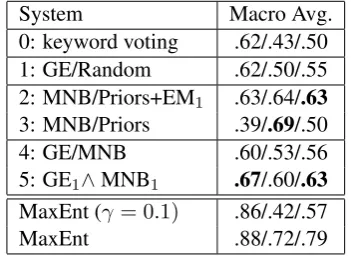
We were not surprised that GE performed worse that the MNB counterpart given the small list of la-beled words. By bootstrapping lala-beled words us-ing MNB, the GE/MNB model improved recall by 3% at the sacrifice of 2% precision, which is sim-ilar to the result on the RTB dataset.
The classifier ensemble GE1∧MNB1still
man-aged to achieve the highest precision and F1score
(tie with MNB/Priors+EM1), showing its
robust-ness despite the lackluster performance of individ-ual classifiers.
System Cold Flu Cancer Diabetes Sleep Dis. Nutrition Macro Avg. 0: keyword voting .44/.63/.52 .60/.59/.60 .65/.61/.63 .53/.65/.58 .64/.44/.52 .57/.59/.58 1: GE/Random .56/.63/.59 .78/.56/.65 .77/.56/.65 .72/.65/.68 .78/.45/.57 .72/.57/.64 2:MNB/Priors+EM1 .59/.56/.57 .66/.53/.59 .62/.56/.59 .72/.60/.66 .58/.86/.67 .63/.62/.63
3: MNB/Priors .37/.81/.50 .51/.76/.61 .56/.84/.67 .33/.79/.47 .62/.70/.66 .48/.78/.59 4: GE/MNB .50/.65/.57 .67/.67/.67 .80/.59/.68 .73/.62/.67 .80/.53/.63 .70/.61/.65 5: GE1∧MNB1 .54/.72/.62 .71/.66/.68 .73/.77/.75 .74/.64/.69 .84/.55/.66 .71/.67/.69
MaxEnt .75/.65/.70 .71/.66/.68 .70/.70/.70 .76/.71/.73 .83/.76/.79 .75/.69/.72
Table 3: Precision/Recall/F1scores on RTB dataset. The best score for each measure is bolded. The last
line shows the performance of a fully-supervised MaxEnt model for reference purpose.
Cold &
Flu lisinopril, colds, congestion, neti, vaporub,sinusitis, swine, nostril, throat, runny
Cancer lymphoma, metastatic, colorectal, humira, cancerous, ovarian, prostate, hpv, metas-tases, xeloda
Diab. hypoglycemia, diabetics, prediabetes, lisino-pril, glycemic, hyperglycemia, ckd, pancreas, catspyjamas, retinopathy
Sleep
Dis. zaps, ryu, insomnia, cpap, urara, rem, naps,toranosuke, rls, lucid
Nutri. carbs, ldl, whey, folate, amino, creatine, niacin, potassium, fats, antioxidant
Table 4: Top 10 automatically added constraints in GE/MNB for each class
System Macro Avg.
0: keyword voting .62/.43/.50 1: GE/Random .62/.50/.55 2: MNB/Priors+EM1 .63/.64/.63
3: MNB/Priors .39/.69/.50 4: GE/MNB .60/.53/.56 5: GE1∧MNB1 .67/.60/.63
MaxEnt (γ = 0.1) .86/.42/.57 MaxEnt .88/.72/.79 Table 5: Macro average Precision/Recall/F1
scores for each classifier on 20 Newsgroups cor-pus.
lightly-supervised models. Based on the user ex-periments in Settles (2011), annotating documents takes 10.8s on average. Therefore the estimated time to annotate the training data for this model is 6 hours, roughly 25 times the time needed to label 262 keywords. The last line shows the result of the MaxEnt model using the full training set. Its aver-age F1score is 16% higher than GE1∧MNB1.
The larger gap is likely because the keywords used on the 20 Newsgroups Corpus are automat-ically extracted from the corpus, while the key-words used on the RTB dataset exploited ex-ternal resources (pre-trained word vectors and Wikipedia) and they are curated by a human an-notator. In the real-world scenario, the keywords will be composed by non-technical users, instead of researchers in NLP who are familiar with the al-gorithm. Therefore, we cannot make assumptions of the quality of the keywords the user composes. However, this further confirms the importance of a good keyword suggestion method to assist the user to compose high-quality keywords.
8 Conclusions and Future Works
This paper proposed a framework to build lightly-supervised one-class text classifiers by applying generalized expectation (GE) criteria (Druck et al., 2008) and multinomial na¨ıve Bayes (MNB) with priors (Settles, 2011). The classification meth-ods make use of user-labeled words for the target class as the form of supervision and do not require any labeled documents. Motivated by the relative strengths of the two models, we merged them by using MNB to enrich the set of GE constraints.
average of 0.69 F1 score on a dataset of
web-pages from real-time bidding requests. It is 5% or 6% higher than previous state-of-the-art lightly-supervised models and 3% lower than a lightly-supervised MaxEnt model.
The framework has been deployed into an on-line advertising platform where advertisers can build customized classifiers to target their Ads to the most relevant webpages.
A direction for future work is to further improve the classification accuracy and to match the per-formance of not just a MaxEnt model, but a more recent fully-supervised deep neural network mod-els such as Lai et al. (2015). This would likely require a more complex non-linear model and a novel method to train such model in a lightly-supervised manner.
In ongoing research, we are exploring to build multi-modal classifiers by exploiting information in the webpages beyond the textual content, such as URLs and images. We are also exploring trans-fer learning methods which can use the predictions for existing classes to improve the accuracy for new classes.
References
Andrei Broder, Marcus Fontoura, Vanja Josifovski, and Lance Riedel. 2007. A semantic approach to con-textual advertising. InProceedings of the 30th an-nual international ACM SIGIR conference on Re-search and development in information retrieval, pages 559–566. ACM.
Patrali Chatterjee, Donna L Hoffman, and Thomas P Novak. 2003. Modeling the clickstream: Implica-tions for web-based advertising efforts. Marketing Science, 22(4):520–541.
Kenneth Ward Church and Patrick Hanks. 1990. Word association norms, mutual information, and lexicog-raphy.Computational linguistics, 16(1):22–29. Mohamed Dermouche, Leila Khouas, Julien Velcin,
and Sabine Loudcher. 2013. Ami&eric: How to learn with naive bayes and prior knowledge: an ap-plication to sentiment analysis. Atlanta, Georgia, USA, page 364.
Thomas G. Dietterich. 2000. Ensemble Methods in Machine Learning. Multiple Classifier Systems, 1857:1–15.
Gregory Druck. 2011. Generalized expectation cri-teria for lightly supervised learning. Ph.D. thesis, University of Massachusetts Amherst.
Gregory Druck, Gideon Mann, and Andrew McCal-lum. 2008. Learning from labeled features using
generalized expectation criteria. In Proceedings of the 31st annual international ACM SIGIR confer-ence on Research and development in information retrieval, pages 595–602. ACM.
Gregory Druck, Burr Settles, and Andrew McCallum. 2009. Active learning by labeling features. In Pro-ceedings of the 2009 Conference on Empirical Meth-ods in Natural Language Processing: Volume 1-Volume 1, pages 81–90. Association for Computa-tional Linguistics.
Yufan Guo, Roi Reichart, and Anna Korhonen. 2015. Unsupervised declarative knowledge induction for constraint-based learning of information structure in scientific documents. Transactions of the Associa-tion for ComputaAssocia-tional Linguistics, 3:131–143.
Kazi Saidul Hasan and Vincent Ng. 2014. Why are you taking this stance? identifying and classifying reasons in ideological debates. In EMNLP, pages 751–762.
Yiping Jin, Min-Yen Kan, Jun-Ping Ng, and Xiangnan He. 2013. Mining scientific terms and their defini-tions: A study of the acl anthology. In Proceed-ings of the 2013 Conference on Empirical Methods in Natural Language Processing, pages 780–790.
Ben King and Steven P Abney. 2013. Labeling the lan-guages of words in mixed-language documents us-ing weakly supervised methods. In HLT-NAACL, pages 1110–1119.
Christian Kohlsch¨utter, Peter Fankhauser, and Wolf-gang Nejdl. 2010. Boilerplate detection using shal-low text features. InProceedings of the third ACM international conference on Web search and data mining, pages 441–450. ACM.
Siwei Lai, Liheng Xu, Kang Liu, and Jun Zhao. 2015. Recurrent Convolutional Neural Networks for Text Classification. Twenty-Ninth AAAI Conference on Artificial Intelligence, pages 2267–2273.
Ken Lang. 1995. Newsweeder: Learning to filter net-news. InProceedings of the 12th international con-ference on machine learning, pages 331–339.
Wee Sun Lee and Bing Liu. 2003. Learning with Posi-tive and Unlabeled Examples Using Weighted Lo-gistic Regression. Algorithmic Learning Theory, 348(1):71–85.
Omer Levy, Yoav Goldberg, and Ido Dagan. 2015. Im-proving distributional similarity with lessons learned from word embeddings. Transactions of the Associ-ation for ComputAssoci-ational Linguistics, 3:211–225.
Bing Liu, Yang Dai, Xiaoli Li, Wee Sun Lee, and Philip S Yu. 2003. Building text classifiers using positive and unlabeled examples. In Data Mining, 2003. ICDM 2003. Third IEEE International Con-ference on, pages 179–186. IEEE.
Bing Liu, Xiaoli Li, Wee Sun Lee, and Philip S Yu. 2004. Text classification by labeling words. In
AAAI, volume 4, pages 425–430.
Michael Lucas and Doug Downey. 2013. Scaling semi-supervised naive bayes with feature marginals. In
Proceedings of the 51st Annual Meeting of the Asso-ciation for Computational Linguistics, pages 343– 351.
Gideon S Mann and Andrew McCallum. 2008. Gener-alized expectation criteria for semi-supervised learn-ing of conditional random fields.
Tomas Mikolov, Ilya Sutskever, Kai Chen, Greg S Cor-rado, and Jeff Dean. 2013. Distributed representa-tions of words and phrases and their compositional-ity. InAdvances in neural information processing systems, pages 3111–3119.
Mary M Moya and Don R Hush. 1996. Network con-straints and multi-objective optimization for one-class one-classification. Neural Networks, 9(3):463– 474.
Bo Pang, Lillian Lee, and Shivakumar Vaithyanathan. 2002. Thumbs up?: sentiment classification using machine learning techniques. InProceedings of the ACL-02 conference on Empirical methods in natural language processing-Volume 10, pages 79–86. As-sociation for Computational Linguistics.
Jeffrey Pennington, Richard Socher, and Christopher D Manning. 2014. Glove: Global vectors for word representation. InEMNLP, volume 14, pages 1532– 1543.
Robert E Schapire, Marie Rochery, Mazin Rahim, and Narendra Gupta. 2002. Incorporating prior knowl-edge into boosting. InICML, volume 2, pages 538– 545.
Bernhard Sch¨olkopf, John C Platt, John Shawe-Taylor, Alex J Smola, and Robert C Williamson. 2001. Es-timating the support of a high-dimensional distribu-tion. Neural computation, 13(7):1443–1471.
Burr Settles. 2011. Closing the loop: Fast, interac-tive semi-supervised annotation with queries on fea-tures and instances. In Proceedings of the confer-ence on empirical methods in natural language pro-cessing, pages 1467–1478. Association for Compu-tational Linguistics.
Duyu Tang, Furu Wei, Nan Yang, Ming Zhou, Ting Liu, and Bing Qin. 2014. Learning sentiment-specific word embedding for twitter sentiment clas-sification. InACL (1), pages 1555–1565.
Shuai Wang, Zhiyuan Chen, Geli Fei, Bing Liu, and Sherry Emery. 2016. Targeted Topic Modeling for Focused Analysis. Proceedings of the 22nd ACM SIGKDD International Conference on Knowledge Discovery and Data Mining - KDD ’16, pages 1235– 1244.
Sida Wang and Christopher D Manning. 2012. Base-lines and bigrams: Simple, good sentiment and topic classification. In Proceedings of the 50th Annual Meeting of the Association for Computational Lin-guistics: Short Papers-Volume 2, pages 90–94. As-sociation for Computational Linguistics.
Hwanjo Yu, Jiawei Han, and Kevin Chen-Chuan Chang. 2002. Pebl: positive example based learn-ing for web page classification uslearn-ing svm. In Pro-ceedings of the eighth ACM SIGKDD international conference on Knowledge discovery and data min-ing, pages 239–248. ACM.