Greening Geographical Load Balancing
Thesis by
Zhenhua Liu
In Partial Fulfillment of the Requirements for the Degree of
Master of Science
California Institute of Technology Pasadena, California
2011
c
2011
Acknowledgements
I feel extremely fortunate to be co-advised by Prof. Steven Low and Prof. Adam Wierman. I would like to express my utmost gratitude to them, for their enormous guidance and help. Their patience and encouragement accompanied me to hurdle all the obstacles during the past two years. I really learned a lot from both of them.
I am also grateful to my collaborators, Lachlan Andrew and Minghong Lin. They have always provided insightful discussions and constructive suggestions. The atmosphere and environment of the RSRG, Computer Science department and Caltech are amazing and helpful. It is really a pleasure to work and study here.
Abstract
Energy expenditure has become a significant fraction of data center operating costs. Recently, “geographical load balancing” has been suggested to reduce energy cost by exploiting the electricity price differences across regions. However, this reduction of cost can paradoxically increase total energy use. This work explores whether the geographical diversity of internet-scale systems can additionally be used to provide environmental gains.
We first focus on geographical load balancing, which is modeled as a convex optimization prob-lem. We derive two distributed algorithms for achieving optimal geographical load balancing and characterize the optimal solutions.
Then we continue to use the framework and algorithms to investigate whether geographical load balancing can encourage use of “green” renewable energy and reduce use of “brown” fossil fuel energy. Here we consider two approaches, namely, dynamic pricing and local renewables.
Contents
Acknowledgements iii
Abstract iv
1 Introduction 1
2 Geographical Load Balancing 5
2.1 Model and Notation . . . 5
2.1.1 The workload model . . . 5
2.1.2 The data center cost model . . . 5
2.1.3 The geographical load balancing problem . . . 7
2.1.4 Practical considerations . . . 9
2.2 Characterizing the optima . . . 9
2.2.1 Uniqueness of optimal solution . . . 9
2.2.2 Sparsity of routing . . . 10
2.3 Algorithms . . . 11
2.3.1 Algorithm 1: Gauss-Seidel iteration . . . 11
2.3.2 Algorithm 2: Distributed gradient projection . . . 13
2.4 Case study . . . 15
2.4.1 Experimental setup . . . 15
2.4.2 Performance evaluation . . . 17
3 Exploring Renewables 21 3.1 Dynamic pricing . . . 21
3.1.1 Experimental setup . . . 21
3.1.2 The importance of dynamic pricing . . . 24
3.2 Local renewables . . . 25
3.2.1 Experimental setup . . . 25
4 Concluding remarks 34
Bibliography 35
Appendices 40
A Proofs for Chapter 2.2 40
A.1 Optimality conditions . . . 40 A.2 Characterizing the optima . . . 42
B Proofs for Chapter 2.3 45
Chapter 1
Introduction
Increasingly, web services are provided by massive, geographically diverse “internet-scale” distributed systems, some having several data centers each with hundreds of thousands of servers. Such data centers require many megawatts of electricity and so companies like Google and Microsoft pay tens of millions of dollars annually for electricity [45].
The enormous, and growing energy demands of data centers have motivated research both in academia and industry on reducing energy usage, for both economic and environmental reasons. Engineering advances in cooling, virtualization, multi-core servers, DC power, etc. have led to sig-nificant improvements in the Power Usage Effectiveness (PUE) of data centers; see [8, 51, 26, 28]. Such work focuses on reducing theenergy use of data centers and their components.
A different stream of research has focused on exploiting the geographical diversity of internet-scale systems to reduce theenergy cost. Specifically, a system with clusters at tens or hundreds of locations around the world can dynamically route requests/jobs to clusters based on proximity to the user, load, and local electricity price. Thus, dynamic geographical load balancing can balance the revenue lost due to increased delay against the electricity costs at each location.
In recent years, many papers have illustrated the potential of geographical load balancing to provide significant cost savings for data centers, e.g., [32, 42, 45, 46, 48, 53] and the references therein. The goal of the current thesis is different. Our goal is to explore the social impact of geographical load balancing systems. In particular, geographical load balancing aims to reduce energy costs, but this can come at the expense of increased total energy usage: by routing to a data center farther from the request source to use cheaper energy, the data center may need to complete the job faster, and so use more service capacity, and thus energy, than if the request was served closer to the source.
be balanced by demand (i) instantaneously and (ii) locally (due to transmission losses), renewable sources pose a significant challenge. A key technique for handling the unpredictability of renewable sources is demand-response, which entails the grid adjusting the demand by changing the electric-ity price [3]. However, demand response entails a local customer curtailing use. In contrast, the demand of internet-scale systems is flexible geographically; thus traffic can be routed to different regions to “follow the renewables”, providing demand-response without service interruption. Since data centers represent a significant and growing fraction of total electricity consumption, and the IT infrastructure is already in place, geographical load balancing has the potential to provide an extremely inexpensive approach for enabling large scale, global demand-response.
The key to realizing the environmental benefits above is for data centers to move from the fixed price contracts that are now typical toward some degree of dynamic pricing, with lower prices when green energy is available. The demand response markets currently in place provide a natural way for this transition to occur, and there is already evidence of some data centers participating in such markets [3].
On the other hand, data centers are often powered by a “green” portfolio of energy already [30, 35, 37]. However, most studies of powering data centersentirely with renewable energy have focused on powering individual data centers, e.g., [19, 20]. These have shown that it is challenging to power a data center using only local wind and solar energy without large-scale storage, due to the intermittency and unpredictability of these sources.
Our goal here is to illustrate that the geographical diversity of internet-scale services significantly improves the efficiency of the usage of renewable energy. This numerical study complements testbeds such as [40]. Further, we illustrate that algorithmic solutions can play a vital role in reducing the necessary capacity of renewable energy installed.
Specifically, we perform numerical experiments using real traffic workloads and real data about the availability of renewables combined with an analytic model for a geographically distributed system. Using this setup, we investigate issues related to the feasibility of powering an internet-scale system (nearly) completely with renewable energy.
We have three major contributions in this work. (1) We develop distributed algorithms for geographical load balancing with provable optimality guarantees. (2) We use the proposed algorithms to explore the feasibility and consequences of using geographical load balancing for demand response in the grid. (3) We study the case where data center is (nearly) completely powered by local renewables.
center). The geographical load balancing algorithm must then dynamically define both how requests should be routed to data centers and how to allocate capacity in each data center (i.e., how many servers are kept in active/energy-saving states).
In Chapter 2.2, we characterize the optimal geographical load balancing solutions and show that they have practically appealing properties, such as sparse routing tables. Then, in Chapter 2.3, we use the previous characterization to give two distributed algorithms which provably compute the optimal routing and provisioning decisions, and which require different types of coordination of computation. Finally, we evaluate the distributed algorithms in a trace-driven numeric simulation of a realistic, distributed, internet-scale system (Chapter 2.4). The results show that a cost saving of over 40% during light-traffic periods is possible.
Contribution (2): In Chapter 3.1 we evaluate the feasibility and benefits of using geographical load balancing to facilitate the integration of renewable sources into the grid. We do this using a trace-driven numeric simulation of a realistic, distributed internet-scale system in combination with models for the availability of wind and solar energy over time.
When the data center incentive is aligned with the social objective or reducing brown energy by dynamically pricing electricity proportionally to the fraction of the total energy coming from brown sources, we show that “follow the renewables” routing ensues (see Figure 3.1), causing significant social benefit. In contrast, we also determine the wasted brown energy when prices are static, or are dynamic but do not align data center and social objectives.
Contribution (3): Our study in Chapter 3.2 yields three key insights.
First, GLB significantly reduces the capacity of renewables needed to move toward a “green” system, since GLB allows the system to use “follow the renewables” routing, which reduces both the financial cost and the “brown” non-renewable energy usage. However, we also show the importance of using a fast control time-scale for GLB. If routing and capacity decisions are made only once an hour, then significantly more brown energy is consumed than if the adjustments are made every ten minutes. Unfortunately, adjustments at this faster time-scale may not be feasible due to server wear-and-tear and other concerns.
Second, we investigate the value of storage when using renewable energy. Often large-scale storage is viewed as essential for moving toward a completely renewable energy portfolio. However, our study shows that small-scale storage in combination with GLB is sufficient in moving to a portfolio of nearly completely renewable energy sources. This is particularly exciting since the UPSs in use at data centers today could be used to provide small-scale storage with few engineering changes.
Chapter 2
Geographical Load Balancing
In this section, we introduce the geographical load balancing problem. We first model the problem as a convex optimization problem, then characterize the optimal solutions and use the optimal properties to design two distributed algorithms. We also provide numeric results for the performance evaluation.
2.1
Model and Notation
We now introduce the workload and data center models, followed by the geographical load balancing problem.
2.1.1
The workload model
We consider a discrete-time model whose timeslot matches the timescale at which routing decisions and capacity provisioning decisions can be updated. There is a (possibly long) interval of interest
t∈ {1, . . . , T}. There are|J| geographically concentrated sources of requests, i.e., “cities”, and the mean arrival rate from source j at time tis Lj(t). Job interarrival times are assumed to be much shorter than a timeslot, so that provisioning can be based on the average arrival rate during a slot. In practice, T could be a month and a slot length could be 1 hour. Our analytic results make no assumptions onLj(t); however to provide realistic estimates we use real-world traces to defineLj(t) in Chapters 2.4 and 3.
2.1.2
The data center cost model
at data centeri. The system seeks to chooseλij(t) andmi(t) in order to minimize cost during [1, T]. Depending on the system design these decisions may be centralized or decentralized. Algorithms for these decisions are the focus of Chapter 2.3.
Our model for data center costs focuses on the server costs of the data center.1 We model
costs by combining the energy cost and the delay cost (in terms of lost revenue). Note that, to simplify the model, we do not include the switching costs associated with cycling servers in and out of power-saving modes; however the approach of [32] provides a natural way to incorporate such costs if desired.
Energy cost. To capture the geographic diversity and variation over time of energy costs, we let gi(t, mi, λi) denote the energy cost for data center i during timeslot t given mi active servers and arrival rate λi. For every fixed t, we assume thatgi(t, mi, λi) is continuously differentiable in bothmi andλi, strictly increasing inmi, non-decreasing inλi, and convex inmi. This formulation is quite general, and captures, for example, the common charging plan of a fixed price per kWh plus an additional “demand charge” for the peak of the average power used over a sliding 15 minute window [41]. Additionally, it can capture a wide range of models for server power consumption, e.g., energy costs as an affine function of the load, see [16], or as a polynomial function of the speed, see [54, 6].
Defining λi(t) =Pj∈Jλij(t), the total energy cost of data center i during timeslott, Ei(t), is simply
Ei(t) =gi(t, mi(t), λi(t)). (2.1)
Delay cost. The delay cost captures the lost revenue incurred because of the delay experienced by the requests. To model this, we definer(d) as the lost revenue associated with a job experiencing delayd. We assume thatr(d) is strictly increasing and convex ind.
To model the delay, we consider its two components: the network delay experienced while the request is outside of the data center and the queueing delay experienced while the request is at the data center.
To model the network delay, we let dij(t) denote the network delay experienced by a request from source j to data centeriduring timeslot t. We make no requirements on the structure of the
dij(t).
To model the queueing delay, we letfi(mi, λi) denote the queueing delay at data centerigiven
mi active servers and an arrival rate of λi. We assume thatfi is strictly decreasing inmi, strictly increasing in λi, and strictly convex in both mi and λi. Further, for stability, we must have that
fi(mi, λi) =∞forλi≥miµi. Elsewhere, we assumefi is finite, continuous and differentiable. Note that these assumptions are satisfied by most standard queueing formulae, e.g., the mean delay under M/GI/1 Processor Sharing (PS) queue and the 95th percentile of delay under the M/M/1. Further, the convexity offi in mi models the law of diminishing returns for parallelism.
Combining the above gives the following model for the total delay cost Di(t) at data center i during timeslott:
Di(t) = X
j∈Jλij(t)r(fi(mi(t), λi(t)) +dij(t)). (2.2)
2.1.3
The geographical load balancing problem
Given the cost models above, the goal of geographical load balancing is to choose the routing policy
λij(t) and the number of active servers in each data center mi(t) at each timet in order minimize the total cost during [1, T]. This is captured by the following optimization problem:
min
m(t),λ(t)
XT t=1
X
i∈N(Ei(t) +Di(t)) (2.3a)
s.t. X
i∈Nλij(t) =Lj(t), ∀j∈J (2.3b)
λij(t)≥0, ∀i∈N,∀j∈J (2.3c)
0≤mi(t)≤Mi, ∀i∈N (2.3d)
mi(t)∈N, ∀i∈N (2.3e)
To simplify (2.3), note that Internet data centers typically contain thousands of active servers. So, we can relax the integer constraint in (2.3) and round the resulting solution with minimal increase in cost. Also, because this model neglects the cost of turning servers on or off, the optimization decouples into independent sub-problems for each timeslot t. For the analysis we consider only a single interval and omit the explicit time dependence.2 Thus (2.3) becomes
min
m,λ X
i∈N
gi(mi, λi) + X
i∈N X
j∈J
λijr(dij+fi(mi, λi)) (2.4a)
s.t.X
i∈Nλij=Lj, ∀j∈J (2.4b)
λij≥0, ∀i∈N,∀j∈J (2.4c)
0≤mi ≤Mi, ∀i∈N, (2.4d)
We refer to this formulation as GLB. Note that GLB is jointly convex in λij and mi and can be efficiently solved centrally. However, a distributed solution algorithm is usually required, such as
2Time-dependence ofL
those derived in Chapter 2.3.
In contrast to prior work studying geographical load balancing, it is important to observe that this paper is the first, to our knowledge, to incorporate jointly optimizing the total energy cost and the end-to-end user delay with consideration of both price diversity and network delay diversity.
GLB provides a general framework for studying geographical load balancing. However, the model ignores many aspects of data center design, e.g., reliability and availability, which are central to data center service level agreements. Such issues are beyond the scope of this paper; however our designs merge nicely with proposals such as [50] for these goals.
The GLB model is too broad for some of our analytic results and thus we often use two restricted versions.
Linear lost revenue. This model uses a lost revenue function r(d) = βd, for constant β. Though it is difficult to choose a “universal” form for the lost revenue associated with delay, there is evidence that it is linear within the range of interest for sites such as Google, Bing, and Shopzilla [15]. GLB then simplifies to
min
m,λ X
i∈N
gi(mi, λi)+β
X
i∈N
λifi(mi, λi) + X
i∈N X
j∈J
dijλij
(2.5)
subject to (3.4a)–(3.4c). We call this optimization GLB-LIN.
Queueing-based delay. We occasionally specify the form of f andg using queueing models. This provides increased intuition about the distributed algorithms presented.
If the workload is perfectly parallelizable, and arrivals are Poisson, thenfi(mi, λi) is the average delay of mi parallel queues, each with arrival rate λi/mi. Moreover, if each queue is an M/GI/1 Processor Sharing (PS) queue, thenfi(mi, λi) = 1/(µi−λi/mi). We also assumegi(mi, λi) =pimi, which implies that the increase in energy cost per timeslot for being in an active state, rather than a low-power state, ispi regardless of λi.
Under these restrictions, the GLB formulation becomes:
min
m,λ X
i∈N
pimi+β X
j∈J X
i∈N
λij
1
µi−λi/mi +dij
(2.6a)
subject to (3.4a)–(3.4c) and the additional constraint
λi≤miµi ∀i∈N. (2.6b)
We refer to this optimization as GLB-Q.
Additional Notation. Throughout the paper we use |S| to denote the cardinality of a set S
from sourcej, and λ−j = (λik)i∈N,k∈J\{j} denotes the tuples of the remainingλik, which forms a matrix. Similarlym= (mi)i∈N andλ= (λij)i∈N,j∈J.
We also need the following in discussing the algorithms. Define Fi(mi, λi) = gi(mi, λi) +
βλifi(mi, λi), and defineF(m,λ) =Pi∈NFi(mi, λi) + Σijλijdij. Further, let ˆmi(λi) be the uncon-strained optimalmiat data centerigiven fixedλi, i.e., the unique solution to∂Fi(mi, λi)/∂mi = 0.
2.1.4
Practical considerations
Our model assumes there exist mechanisms for dynamically (i) provisioning capacity of data centers, and (ii) adapting the routing of requests from sources to data centers.
With respect to (i), many dynamic server provisioning techniques are being explored by both academics and industry, e.g., [5, 13, 18, 52]. With respect to (ii), there are also a variety of protocol-level mechanisms employed for data center selection today. They include, (a) dynamically generated DNS responses, (b) HTTP redirection, and (c) using persistent HTTP proxies to tunnel requests. Each of these has been evaluated thoroughly, e.g., [14, 34, 44], and though DNS has drawbacks it remains the preferred mechanism for many industry leaders such as Akamai, possibly due to the added latency due to HTTP redirection and tunneling [43]. Within the GLB model, we have implicitly assumed that there exists a proxy/DNS server co-located with each source.
Our model also assumes that the network delays, dij can be estimated, which has been studied extensively, including work on reducing the overhead of such measurements, e.g., [49], and mapping and synthetic coordinate approaches, e.g., [29, 39]. We discuss the sensitivity of our algorithms to error in these estimates in Chapter 2.4.
2.2
Characterizing the optima
We now provide characterizations of the optimal solutions to GLB, which are important for proving convergence of the distributed algorithms of Chapter 2.3. They are also necessary because, a priori, one might worry that the optimal solution requires a very complex routing structure, which would be impractical; or that the set of optimal solutions is very fragmented, which would slow convergence in practice. The results here show that such worries are unwarranted.
2.2.1
Uniqueness of optimal solution
A first result is that for the GLB-LIN formulation, under weak conditions on fi andgi, we have that λi is common across all optimal solutions. Thus, the input to the data center provisioning optimization is unique.
Theorem 1. Consider the GLB-LIN formulation. Suppose that for alli,Fi(mi, λi)is jointly convex
inλi andmi, and continuously differentiable in λi. Further, suppose thatmˆi(λi)is strictly convex.
Then, for eachi,λi is common for all optimal solutions.
The proof is in the Appendix. Theorem 1 implies that the server arrival rates at each data center, i.e.,λi/mi, are common among all optimal solutions.
Though the conditions onFi and ˆmiare weak, they do not hold for GLB-Q. In that case, ˆmi(λi) is linear, and thus not strictly convex. Although theλi are not common across all optimal solutions in this setting, the server arrival rates remain common across all optimal solutions.
Theorem 2. For each data centeri, the server arrival rates,λi/mi, are common across all optimal
solutions to GLB-Q.
2.2.2
Sparsity of routing
It would be impractical if the optimal solutions to GLB required that traffic from each source was divided up among (nearly) all of the data centers. In general, eachλij could be non-zero, yielding
|N| × |J|flows of traffic from sources to data centers, which would lead to significant scaling issues. Luckily, there is guaranteed to exist an optimal solution with extremely sparse routing. Specifically:
Theorem 3. There exists an optimal solution to GLB with at most(|N|+|J| −1)of theλij strictly
positive.
Though Theorem 3 does not guarantee that every optimal solution is sparse, the proof is con-structive. Thus, it provides an approach which allows one to transform an optimal solution into a sparse optimal solution.
The following result further highlights the sparsity of the routing: any source will route to at most one data center that is not fully active, i.e., where there exists at least a server in power-saving mode.
Theorem 4. Consider GLB-Q where power costspi are drawn from an arbitrary continuous
distri-bution. If any sourcej∈J has its traffic split between multiple data centersN0 ⊆N in an optimal
2.3
Algorithms
We now focus on GLB-Q and present two distributed algorithms that solve it, and prove their convergence.
Since GLB-Q is convex, it can be efficiently solved centrally if all necessary information can be collected at a single point, as may be possible if all the proxies and data centers were owned by the same system. However there is a strong case for Internet-scale systems to outsource route selection [53]. To meet this need, the algorithms presented below are decentralized and allow each data center and proxy to optimize based on partial information.
These algorithms seek to fill a notable hole in the growing literature on algorithms for geographical load balancing. Specifically, they have provable optimality guarantees for a performance objective that includes both energy and delay, where route decisions are made using both energy price and network propagation delay information. The most closely related work [46] investigates the total electricity cost for data centers in a multi-electricity-market environment. It contains the queueing delay inside the data center (assumed to be anM/M/1 queue) but neglects the end-to-end user delay. Conversely, [53] uses a simple, efficient algorithm to coordinate the “replica-selection” decisions, but assumes the capacity at each data center is fixed. Other related works, e.g., [46, 48, 42], either do not provide provable guarantees or ignore diverse network delays and/or prices.
2.3.1
Algorithm 1: Gauss-Seidel iteration
Algorithm 1 is motivated by the observation that GLB-Q is separable in mi, and, less obviously, also separable in λj := (λij, i ∈N). This allows all data centers as a group and each proxy j to iteratively solve for optimalmandλjin a distributed manner, and communicate their intermediate results to each other. Though distributed, Algorithm 1 requires each proxy to solve an optimization problem.
To highlight the separation between data centers and proxies, we reformulate GLB-Q as:
min λj∈Λj
min mi∈Mi
X
i∈N
pimi+ βλi
µi−λi/mi
+βX
i,j
λijdij (2.7)
Mi := [0, Mi] Λj := {λj |λj≥0,X
i∈N
λij=Lj} (2.8)
Since the objective and constraintsMi and Λj are separable, this can be solved separately by data centersiand proxiesj.
variablesmi:
min mi∈Mi
pimi+
βλi(τ)
µi−λi(τ)/mi
(2.9)
In phasej of iterationτ, proxyj minimizes (2.7) over its own variable by settingλj(τ+ 1) as the best response to m(τ+ 1) and the most recent values of λ−j := (λk, k 6=j). This works because proxyj depends onλ−j only through their aggregate arrival rates at the data centers:
λi(τ, j) := X
l<j
λil(τ+ 1) + X
l>j
λil(τ) (2.10)
To computeλi(τ, j), proxy j need not obtain individual λil(τ) or λil(τ + 1) from other proxiesl. Instead, every data center imeasures its local arrival rate λi(τ, j) +λij(τ) in every phasej of the iterationτ and sends this to proxyj at the beginning of phasej. Then proxyj obtains λi(τ, j) by subtracting its own λij(τ) from the value received from data center i. When there are fewer data centers than proxies, this has less overhead than direct messaging.
In summary, the algorithm is as follows (noting that the minimization (2.9) has a closed form). Here, [x]a := min{x, a}.
Algorithm 1. Starting from a feasible initial allocationλ(0) and the associatedm(λ(0)), let
mi(τ+ 1) := "
1 + p1
pi/β !
·λi(τ)
µi #Mi
(2.11)
λj(τ+ 1) := arg min λj∈Λj
X
i∈N
λi(τ, j) +λij
µi−(λi(τ, j) +λij)/mi(τ+ 1)
+X
i∈Nλijdij. (2.12)
Since GLB-Q generally has multiple optimalλ∗j, Algorithm 1 is not guaranteed to converge to one optimal solution, i.e., for each proxyj, the allocationλij(τ) of jobj to data centersimay oscillate among multiple optimal allocations. However, both the optimal cost and the optimal per-server arrival rates to data centers will converge.
Theorem 5. Let (m(τ),λ(τ)) be a sequence generated by Algorithm 1 when applied to GLB-Q. Then
(i) Every limit point of(m(τ),λ(τ))is optimal. (ii) F(m(τ),λ(τ))converges to the optimal value.
(iii) The per-server arrival rates (λi(τ)/mi(τ), i ∈ N) to data centers converge to their unique
The proof of Theorem 5 follows from the fact that Algorithm 1 is a modified Gauss-Seidel iteration. This is also the reason for the requirement that the proxies update sequentially. The details of the proof are in Appendix B.
Algorithm 1 assumes that there is a common clock to synchronize all actions. In practice, updates will likely be asynchronous, with data centers and proxies updating with different frequencies using possibly outdated information. The algorithm generalizes easily to this setting, though the convergence proof is more difficult.
The convergence rate of Algorithm 1 in a realistic scenario is illustrated numerically in Chap-ter 2.4.
2.3.2
Algorithm 2: Distributed gradient projection
Algorithm 2 reduces the computational load on the proxies. In each iteration, instead of each proxy solving a constrained minimization (2.12) as in Algorithm 1, Algorithm 2 takes a single step in a descent direction. Also, while the proxies compute their λj(τ + 1) sequentially in |J| phases in Algorithm 1, they perform their updates all at once in Algorithm 2.
To achieve this, rewrite GLB-Q as
min λj∈Λj
X
j∈J
Fj(λ) (2.13)
where F(λ) is the result of minimization of (2.7) over mi ∈ Mi given λi. As explained in the definition of Algorithm 1, this minimization is easy: if we denote the solution by (cf. (2.11)):
mi(λi) := "
1 + p1
pi/β !
·λi
µi #Mi
(2.14)
then
F(λ) :=X i∈N
pimi(λi) +
βλi
µi−λi/mi(λi)
+βX
i,j
λijdij.
We now sketch the two key ideas behind Algorithm 2. The first is the standard gradient projection idea: move in the steepest descent direction
−∇Fj(λ) :=−
∂F(λ)
∂λ1j
,· · ·,∂F(λ) ∂λ|N|j
and then project the new point into the feasible set Q
jΛj. The standard gradient projection algorithm will converge if ∇F(λ) is Lipschitz over our feasible setQ
jΛj. This condition, however, does not hold for our F because of the term βλi/(µi−λi/mi). The second idea is to construct a compact and convex subset Λ of the feasible set Q
algorithm starts in Λ, it stays in Λ; (ii) Λ contains all optimal allocations; (iii)∇F(λ) is Lipschitz over Λ. The algorithm then projects into Λ in each iteration instead of Q
jΛj. This guarantees convergence.
Specifically, fix a feasible initial allocation λ(0) ∈ Q
jΛj and let φ := F(λ(0)) be the initial objective value. Define
Λ := Λ(φ) :=Y j
Λj ∩ λ
λi≤
φMiµi
φ+βMi
, ∀i
. (2.15)
Even though the Λ defined in (2.15) indeed has the desired properties (see Appendix B), the pro-jection into Λ requires coordination of all proxies and is thus impractical. In order for each proxyj
to perform its update in a decentralized manner, we define proxyj’s own constraint subset:
ˆ
Λj(τ) := Λj∩ λj
λi(τ,−j) +λij ≤
φMiµi
φ+βMi
,∀i
where λi(τ,−j) :=Pl=6 jλil(τ) is the arrival rate to data centeri, excluding arrivals from proxy j. Even though ˆΛj(τ) involvesλi(τ,−j) for alli, proxyjcan easily calculate these quantities from the measured arrival rates λi(τ) it is told by data centers i, as done in Algorithm 1 (cf. (2.10) and the discussion thereafter), and does not need to communicate with other proxies. Hence, givenλi(τ,−j) from data centersi, each proxy can project into ˆΛj(τ) to compute the next iterateλj(τ+ 1) without the need to coordinate with other proxies.3 Moreover, ifλ(0)∈Λ thenλ(τ)∈Λ for all iterations
τ. In summary, Algorithm 2 is as follows.
Algorithm 2. Starting from a feasible initial allocation λ(0) and the associated m(λ(0)), each proxyj computes, in each iterationτ:
zj(τ+ 1) := [λj(τ)−γj(∇Fj(λ(τ)))]Λˆj(τ) (2.16)
λj(τ+ 1) :=
|J| −1
|J| λj(τ) +
1
|J|zj(τ+ 1) (2.17)
whereγj>0 is a stepsize and ∇Fj(λ(τ))is given by
∂F(λ(τ))
∂λij
=β dij+
µi
(µi−λi(τ)/mi(λi(τ)))2 !
.
Implicit in the description is the requirement that all data centersicomputemi(λi(τ)) according to (2.14) in each iteration τ. Each data center i measures the local arrival rate λi(τ), calculates
mi(λi(τ)), and broadcasts these values to all proxies at the beginning of iteration τ + 1 for the proxies to compute theirλj(τ+ 1).
3The projection to the nearest point in ˆΛ
Algorithm 2 has the same convergence property as Algorithm 1, provided the stepsize is small enough.
Theorem 6. Let (m(τ),λ(τ))be a sequence generated by Algorithm 2 when applied to GLB-Q. If, for allj,0< γj <mini∈Nβ2µ2iMi4/(|J|(φ+βMi)3), then
(i) Every limit point of(m(τ),λ(τ))is optimal. (ii) F(m(τ),λ(τ))converges to the optimal value.
(iii) The per-server arrival rates (λi(τ)/mi(τ), i ∈ N) to data centers converge to their unique
optimal values.
Theorem 6 is proved in Appendix B. The key novelty of the proof is (i) handling the fact that the objective is not Lipshitz and (ii) allowing distributed computation of the projection. The bound onγj in Theorem 6 is more conservative than necessary for large systems. Hence, a larger stepsize can be choosen to accelerate convergence. The convergence rate is illustrated in a realistic setting in Chapter 2.4.
2.4
Case study
The remainder of the paper evaluates the algorithms presented in the previous section under a realistic workload. This section considers the data center perspective (i.e., cost minimization) and Chapter 3.1 considers the social perspective (i.e., brown energy usage).
2.4.1
Experimental setup
We aim to use realistic parameters in the experimental setup and provide conservative estimates of the cost savings resulting from optimal geographical load balancing. The setup models an Internet-scale system such as Google within the United States.
12 24 36 48 0
0.05 0.1 0.15 0.2
time(hour)
arrival rate
(a) Original trace
12 24 36 48
0 0.05 0.1 0.15 0.2
time(hour)
arrival rate
[image:22.612.112.525.63.256.2](b) Adjusted trace
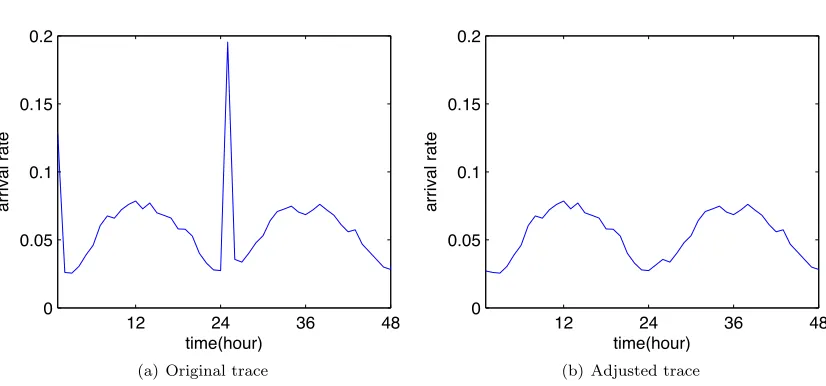
Figure 2.1: Hotmail trace used in numerical results.
with the spike removed (as illustrated in Figure 2.1(b)) because this leads to a more conservative estimate of the cost savings.
Building on this trace, we construct our workload by placing a source at the geographical center of each mainland US state, co-located with a proxy or DNS server (as described in Chapter 2.1.4). The trace is shifted according to the time-zone of each state, and scaled by the size of the population in the state that has an Internet connection [1].
Data center description To model an Internet-scale system, we have 14 data centers, one at the geographic center of each state known to have Google data centers [24]: California, Washington, Oregon, Illinois, Georgia, Virginia, Texas, Florida, North Carolina, and South Carolina.
We merge the data centers in each state and set Mi proportional to the number of data centers in that state, while keeping Σi∈NMiµi twice the total peak workload, maxtΣj∈JLj(t). The network delays,dij, between sources and data centers are taken to be proportional to the distances between the centers of the two states and comparable to queueing delays. This lower bound on the network delay ignores delay due to congestion or indirect routes.
0 100 200 300 400 500 0
5 10 15
x 104
iteration
cost
Algorithm 1 Algorithm 2 Optimal
(a) Static setting
1000 2000 3000 4000 5000 6000 7000 0
5 10 15x 10
4
phase
cost
Algorithm 1 Optimal
[image:23.612.117.529.74.262.2](b) Dynamic setting
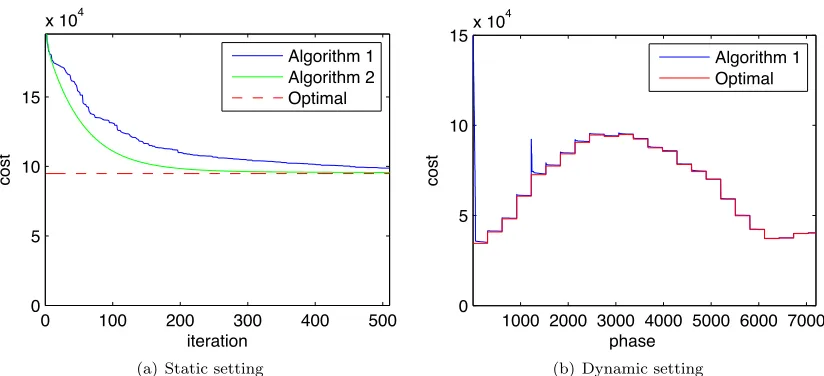
Figure 2.2: Convergence of Algorithm 1 and 2.
Algorithm benchmarks To provide benchmarks for the performance of the algorithms presented here, we consider three baselines, which are approximations of common approaches used in Internet-scale systems. They also allow implicit comparisons with prior work such as [46]. The approaches use different amounts of information to perform the cost minimization. Note that each approach must use queueing delay (or capacity information); otherwise the routing may lead to instability.
Baseline 1 uses network delays but ignores energy price when minimizing its costs. This demon-strates the impact of price-aware routing. It also shows the importance of dynamic capacity provi-sioning, since without using energy cost in the optimization, every data center will keep every server active.
Baseline 2 uses energy prices but ignores network delay. This illustrates the impact of location aware routing on the data center costs. Further, it allows us to understand the performance im-provement of Algorithms 1 and 2 compared to those such as [46, 48] that neglect network delays in their formulations.
Baseline 3 uses neither network delay information nor energy price information when performing its cost minimization. Thus, the traffic is routed so as to balance the delays within the data centers. Though naive, designs such as this are still used by systems today; see [4].
2.4.2
Performance evaluation
1 1.5 2 2.5
x 105 4
5 6 7 8 9x 10
4
delay
energy cost
[image:24.612.225.425.66.253.2]t=7am t=8am t=9am
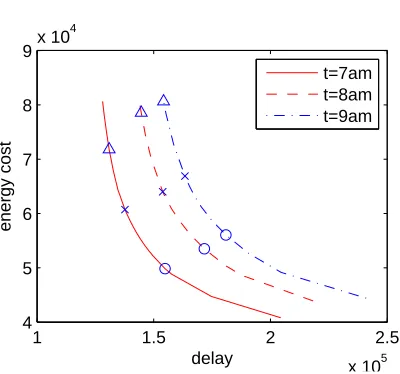
Figure 2.3: Pareto frontier of the GLB-Q formulation as a function of β for three different times (and thus arrival rates), PDT. Circles, x-marks, and triangles correspond to β = 0.4, 1, and 2.5, respectively.
Convergence We start by considering the convergence of each of the distributed algorithms. Figure 2.2(a) illustrates the convergence of each of the algorithms in a static setting for t = 11am, where load and electricity prices are fixed and each phase in Algorithm 1 is considered as an iteration. It validates the convergence analysis for both algorithms. Note here Algorithm 2 used a step size
γ= 10; this is much larger than that used in the convergence analysis, which is quite conservative, and there is no sign of causing lack of convergence.
To demonstrate the convergence in a dynamic setting, Figure 2.2(b) shows Algorithm 1’s response to the first day of the Hotmail trace, with loads averaged over one-hour intervals for brevity. One iteration (51 phases) is performed every 10 minutes. This figure shows that even the slower algorithm, Algorithm 1, converges fast enough to provide near-optimal cost. Hence, the remaining plots show only the optimal solution.
Energy versus delay tradeoff The optimization objective we have chosen to model the data center costs imposes a particular tradeoff between the delay and the energy costs,β. It is important to understand the impact of this factor. Figure 2.3 illustrates how the delay and energy cost trade off under the optimal solution asβchanges. Thus, the plot shows the Pareto frontier for the GLB-Q formulation. The figure highlights that there is a smooth convex frontier with a mild ‘knee’.
the state of the art, studied in recent papers such as [46, 48].
To understand where the benefits are coming from, let us consider separately the two components of cost: delay and energy. Figures 2.4(c) and 2.4(d) show that the optimal algorithm performs well with respect to both delay and energy costs individually. In particular, Baseline 1 provides a lower bound on the achievable delay costs, and the optimal algorithm nearly matches this lower bound. Similarly, Baseline 2 provides a natural bar for comparing the achievable energy cost. At periods of light traffic the optimal algorithm provides nearly the same energy cost as this baseline, and (perhaps surprisingly) during periods of heavy-traffic the optimal algorithm provides significantly lower energy costs. The explanation for this is that, when network delay is considered by the optimal algorithm, if all the close data centers have all servers active, a proxy might still route to them; however when network delay is not considered, a proxy is more likely to route to a data center that is not yet running at full capacity, thereby adding to the energy cost.
12 24 36 48 0
1 2 3 4 5 6
x 105
time(hour)
total cost
Baseline 3 Baseline 2 Baseline 1 Optimal
(a) Total cost
12 24 36 48
0 20 40 60 80 100
time(hour)
% total cost improvement
Baseline 2 Baseline 1 Optimal
(b) Total cost (% improvement vs. Baseline 3)
12 24 36 48
0 1 2 3 4
x 105
time(hour)
delay cost
Baseline 3 Baseline 2 Baseline 1 Optimal
(c) Delay cost
12 24 36 48
0 5 10 15
x 104
time(hour)
energy cost
Baseline 3 Baseline 2 Baseline 1 Optimal
[image:26.612.118.529.190.575.2](d) Energy cost
Chapter 3
Exploring Renewables
We now shift focus from the cost savings of the data center operator to the social impact of geo-graphical load balancing. We first focus on the impact of geogeo-graphical load balancing on the usage of “brown” non-renewable energy by Internet-scale systems, and how this impact depends on pricing. Then we investigate the case of local renewable supply.
3.1
Dynamic pricing
Intuitively, geographical load balancing allows the traffic to “follow the renewables”; thus providing increased usage of green energy and decreased brown energy usage. However, such benefits are only possible if data centers forgo static energy contracts for dynamic energy pricing (either through demand-response programs or real-time markets). The experiments in this section show that if dynamic pricing is done optimally, then geographical load balancing can provide significant social benefits.
3.1.1
Experimental setup
To explore the social impact of geographical load balancing, we use the setup described in Chap-ter 2.4. However, we add models for the availability of renewable energy, the pricing of renewable energy, and the social objective.
The availability of renewable energy To model the availability of renewable energy we use standard models of wind and solar from [17, 27]. Though simple, these models capture the average trends for both wind and solar accurately. Since these models are smoother than actual intermit-tent renewable sources, especially wind, they conservatively estimate the benefit due to following renewables.
avail-ability given by these models is shown in Figure 3.1(a). Setting (i) is motivated by studies such as [25]. Setting (ii) is motivated by the possibility of on-site or locally contracted solar, which is increasingly common.
Building on these availability models, for each location we let αi(t) denote the fraction of the energy that is from renewable sources at time t, and let ¯α = (|N|T)−1PT
t=1
P
i∈Nαi(t) be the “penetration” of renewable energy. We take ¯α = 0.30, which is on the progressive side of the renewable targets among US states [12].
Finally, when measuring the brown/green energy usage of a data center at timet, we use simply P
i∈Nαi(t)mi(t) as the green energy usage andPi∈N(1−αi(t))mi(t) as the brown energy usage. This models the fact that the grid cannot differentiate the source of the electricity provided.
Demand response and dynamic pricing Internet-scale systems have flexibility in energy usage that is not available to traditional energy consumers; thus they are well positioned to take advantage of demand-response and real-time markets to reduce both their energy costs and their brown energy consumption.
To provide a simple model of demand-response, we use time-varying pricespi(t) in each time-slot that depend on the availability of renewable resourcesαi(t) in each location.
The way pi(t) is chosen as a function ofαi(t) will be of fundamental importance to the social impact of geographical load balancing. To highlight this, we consider a parameterized “differentiated pricing” model that uses a pricepb for brown energy and a pricepg for green energy. Specifically,
pi(t) =pb(1−αi(t)) +pgαi(t).
Note that pg =pb corresponds to static pricing, and we show in the next section thatpg = 0 corresponds to socially optimal pricing. Our experiments varypg∈[0, pb].
The social objective To model the social impact of geographical load balancing we need to formulate a social objective. Like the GLB formulation, this must include a tradeoff between the energy usage and the delay users of the system experience, because purely minimizing brown energy use requires allmi= 0. The key difference between the GLB formulation and the social formulation is that thecostof energy is no longer relevant. Instead, the environmental impact is important, and thus the brown energy usage should be minimized. This leads to the following simple model for the social objective:
min
m(t),λ(t)
T X
t=1
X
i∈N
(1−αi(t))
Ei(t)
pi(t)
+ ˜βDi(t)
12 24 36 48 0 0.2 0.4 0.6 0.8 1 1.2 1.4 time(hour) renewable availability high wind high solar
(a) Renewable availability
12 24 36 48
0 1000 2000 3000 4000 5000 6000 7000 time(hour) active servers West Coast East Coast
(b) High solar penetration
12 24 36 48
0 1000 2000 3000 4000 5000 6000 time(hour) active servers West Coast East Coast
(c) High wind penetration
12 24 36 48
0 1000 2000 3000 4000 5000 6000 time(hour) active servers West Coast East Coast
[image:29.612.112.531.77.444.2](d) Static pricing
Figure 3.1: Geographical load balancing “following the renewables” under optimal pricing. (a) Availability of wind and solar. (b)–(d) Capacity provisioning of east coast and west coast data centers when there are renewables, high solar penetration, and high wind penetration, respectively.
whereDi(t) is the delay cost defined in (2.2),Ei(t) is the energy cost defined in (2.1), and ˜β is the relative valuation of delay versus energy. Further, we have imposed that the energy cost follows from the pricing ofpi(t) cents/kWh in timeslot t. Note that, though simple, our choice ofDi(t) to model the disutility of delay to users is reasonable because lost revenue captures the lack of use as a function of increased delay.
An immediate observation about the above social objective is that to align the data center and social goals, one needs to set pi(t) = (1−αi(t))/β˜, which corresponds to choosing pb = 1/β˜ and
20 40 60 80 100 0
5 10 15
weight for brown energy usage
% social cost improvement
pg=0
p
g=0.25 pb
pg=0.50pb
pg=0.75pb
(a) High solar penetration
20 40 60 80 100
0 0.5 1 1.5 2
weight for brown energy usage
% social cost improvement
pg=0
pg=0.25 pb
p
g=0.50pb
p
g=0.75pb
[image:30.612.116.530.74.255.2](b) High wind penetration
Figure 3.2: Reduction in social cost from dynamic pricing compared to static pricing as a function of the weight for brown energy usage, 1/β˜, under (a) high solar penetration and (b) high wind penetration.
3.1.2
The importance of dynamic pricing
To begin our experiments, we illustrate that optimal pricing can lead geographical load balancing to “follow the renewables.” Figure 3.1 shows this in the case of high solar penetration and high wind penetration for ˜β= 0.1. By comparing Figures 3.1(b) and 3.1(c) to Figure 3.1(d), which uses static pricing, the change in capacity provisioning, and thus energy usage, is evident. For example, Figure 3.1(b) shows a clear shift of service capacity from the east coast to the west coast as solar energy becomes highly available and then back when solar energy is less available. Similarly, Figure 3.1(c) shows a shift, though much smaller, of service capacity toward the evenings, when wind is more available. Though not explicit in the figures, this “follow the renewables” routing has the benefit of significantly reducing the brown energy usage since energy use is more correlated with the availability of renewables. Thus, geographical load balancing provides the opportunity to aid the incorporation of renewables into the grid.
Figure 3.1 assumed the optimal dynamic pricing, but currently data centers negotiate fixed price contracts. Although there are many reasons why grid operators will encourage data center operators to transfer to dynamic pricing over the coming years, this is likely to be a slow process. Thus, it is important to consider the impact of partial adoption of dynamic pricing in addition to full, optimal dynamic pricing.
Figure 3.2 focuses on this issue. To model the partial adoption of dynamic pricing, we can consider
only diurnal variation, because the availability of solar energy is much more correlated with the traffic peaks. Specifically, the three hour gap in time zones means that solar on the west coast can still help with the high traffic period of the east coast, but the peak average wind energy is at night. However, wind is vastly more bursty than this model predicts, and a system which responds to these bursts will still benefit significantly.
Another interesting observation about the Figure 3.2 is that the curves increase faster in the range when ˜βis large, which highlights that the social benefit of geographical load balancing becomes significant even when there is only moderate importance placed on energy. Whenpg is higher than
pb, which is common currently, the cost increases, but we omit the results for brevity.
3.2
Local renewables
Now we continue to investigate the case of the local renewable supply. Our numeric experiments combine analytic models with real traces for workload and renewable availability, to allow controlled experimentation but provide realistic findings. We now explain the setup, which extends that of [33].
3.2.1
Experimental setup
The workload Our workload model considers a setJ of sources of requests, with one source at the center of each of the 48 continental states in the US.
We consider one hour time slots for a week. At the start of each slot, the routing and capacity of each data center are updated. We use a slot length of 1 hour so that servers are not turned on and off too frequently given the significant wear-and-tear costs of power-cycling. Let Lj(t) denote the mean arrival rate from sourcej at time t.
To provide realistic estimates, we use real-world traces to define Lj(t). The workload of each source is scaled proportionally to the number of internet users in the corresponding state. The workload is taken from a trace at Hewlett-Packard Labs [20] and is shifted in time to account for time zone of each state. The workload per internet user used in this paper is shown in Figure 3.3.
0 24 48 72 96 120 144 168 0 2 4 6 8 hour workload
(a) One week workload
0 6 12 18 24
0 2 4 6 8 hour workload
[image:32.612.108.525.70.484.2](b) Tuesday workload
Figure 3.3: HP workload trace.
0 6 12 18 24 30 36 42 48
0 10 20 30 40 50 60 hour
wind power generation (kW)
CA TX IL NC average (a) Wind
0 6 12 18 24 30 36 42 48
0 1 2 3 4 5 hour
PV generation (kW)
CA TX IL NC average (b) Solar
Figure 3.4: Renewable generation for two days.
These figures illustrate two important features of renewable energy: spatial variation and tem-poral variation. In particular, we see that wind energy does not exhibit a clearly predictable pattern throughout the day and that there is little correlation across the locations considered. In contrast, solar energy has a predictable peak during the day and is highly correlated across the locations.
[image:32.612.111.527.295.487.2]10 15 20 25 30 0
2 4 6 8 10
energy consumption
energy cost
[image:33.612.225.424.71.242.2]100% solar, no storage 67% solar, no storage 33% solar, no storage 0% solar, no storage perfect storage
Figure 3.5: Energy cost as a function of total energy consumption, when the average renewable energy in a one-hour slot is 20.
The internet-scale system We model the internet-scale system as a setN of 10 data centers, placed at the centers of states known to have Google data centers [36], namely California, Washing-ton, Oregon, Illinois, Georgia, Virginia, Texas, Florida, North Carolina, and South Carolina. Data center i ∈N contains Mi homogeneous servers, whereMi is twice the minimal number of servers required to serve the peak workload of i under a scheme which routes traffic to the nearest data center. Further, the renewable availability at each data center is defined by the trace from a nearby location; this was usually within the same state, but in five cases it was a different trace from a nearby state.
The two key control decisions of geographical load balancing are (i) determining λij(t), the amount of traffic routed from sourcej to data center i; and (ii) determiningmi(t)∈ {0, . . . , Mi}, the number of active servers at data centeri. The objective is to chooseλij(t) andmi(t) to minimize the “cost” of the system. The cost is the sum of theenergy cost and thedelay cost (lost revenue), below. We neglect the cost of altering the number of active serversmi(t); this can be incorporated using an approach similar to that of [32].
Delay cost The delay cost captures the lost revenue incurred because of the delay experienced by the requests, where the delay includes both the network delay from source j to data center
model in [33].
Energy cost To capture the effect of integrating renewable energy, we model the energy cost as the number of active servers excluding those that can be powered by renewables. Note that this assumes that data centers operate their own wind and solar generations and pay no marginal cost for renewable energy. Further, it ignores the installation and maintenance costs of renewable generation. Quantitatively, if the renewable energy available at data center iat timetis ri(t), measured in terms of number of servers that can be powered, then the energy cost is
pi(mi(t)−ri(t))+ (3.2)
Thepi for each data center is constant, and equals to the industrial electricity price of each state in May 2010 [25]. This contrasts with the total power pimi used typically, e.g., in [33]. Although data center could instead sell the renewable supply to the grid, this will have only a small effect on
piin a future dominated by renewable energy; when the renewable supply is high at the data center location, the local spot price of power is also likely to be low.
Storage The above formula for the energy cost is simplistic because it assumes the cost is zero if fewer servers are provisioned than theaverage renewable generation in a time slot. While this is true if one can do “perfect” smoothing of the renewables using storage, it is not necessarily true in practice. Note that the fluctuations in available power are usually considerably less than the total power draw. For our traces, “perfect” smoothing can be achieved using the amount of storage that can support the whole data center for several minutes. This is feasible, since this amount of storage is provided by currently deployed Uninterruptible Power Supplies (UPSs).
Without storage, there will be some cost incurred due to the variability of renewable availability within a time slot. Here the actual energy cost becomes
Eτ
h
pi(mi(t)−ri(t, τ))
+i
(3.3)
Total cost Combining the discussions above, we can now write the total cost for an internet-scale system. In particular, for the case where the data centers have small-internet-scale storage, the cost optimization that the system seeks to solve at timetbecomes:
min
m(t),λ(t)
βX
i∈N
pi(mi(t)−ri(t))
+
+X
j∈J X
i∈N
λij(t)
1
µi−λi(t)/mi(t) +dij
s.t. X i∈N
λij(t) =Lj(t), ∀j∈J (3.4a)
λij(t)≥0, ∀i∈N, j∈J (3.4b)
0≤mi(t)≤Mi, ∀i∈N (3.4c)
λi(t)≤mi(t)µi ∀i∈N. (3.4d)
Hereβdetermines the relative importance of energy and delay to the system. In the simulationsβ
is set to 1 by default, but we also varyβ∈[1,10] in Figure 3.7 to show its impact. Measurements [2] show that a 500 ms increase in delay reduces revenue by 20%, or 0.04%/ms. In a system where energy expenditure is 10% of the revenue, β= 1 or 10 corresponds to the more conservative values of 0.5 or 0.05%/ms, respectively.
When data center ican cheaply serve data from many sources, the upper bound mi(t)≤Mi in (3.4c) can become binding, thenλij(t) is strictly between 0 andLj(t).
When data centers have no energy storage, only the energy cost component of the optimization changes from (3.2) to (3.3). However, we cannot write the optimization in closed form for that case because the energy cost curves are determined by the renewable energy traces, as shown in Figure 3.5. To formulate and solve the optimization in this case we use a piecewise-linear approximation of the curves in Figure 3.5.
Geographical load balancing The above sections describe the cost optimization that the internet-scale system seeks to solve; however they do not describe how the system actually performs geo-graphical load balancing to solve the optimization. In [33], decentralized algorithms are presented, which can be used to achieve the optimal cost in the setting described above. Thus, in this paper we present as “GLB” the routing and capacity provisioning decisions which solve the cost optimiza-tion problem. Note that the results do not rely on the algorithms in [33]; they simply consider the optimal allocation.
0 0.2 0.4 0.6 0.8 1 0 2 4 6 8 solar capacity wind capacity 15% 20% 25% 30%
(a) LOCAL for different brown energy targets
0 0.2 0.4 0.6 0.8 1
0 2 4 6 8 solar capacity wind capacity LOCAL
GLB β=1
GLB β=10
(b) LOCAL and GLB for 15% brown energy target
0 0.2 0.4 0.6 0.8 1
0 2 4 6 8 solar capacity wind capacity 3hours 2hours 1hour 10min
[image:36.612.114.541.67.189.2](c) GLB with different control time-scales and 15% brown energy target
Figure 3.6: Wind and solar capacity required to reduce brown energy usage to 15–30% of the baseline, as a function of solar capacity. The dashed line is the same setting except with storage.
1 2 3 4 5 6 7 8 9 10 0
0.5 1 1.5 2 2.5x 10
10
β
brown energy consumption
GLB LOCAL
(a) Brown energy consumption
1 2 3 4 5 6 7 8 9 10 0 0.5 1 1.5 2 2.5 3
x 1013
β
total cost
GLB LOCAL
(b) Total cost
1 2 3 4 5 6 7 8 9 10
0 10 20 30 40 50 60 β average delay GLB LOCAL
(c) Average delay
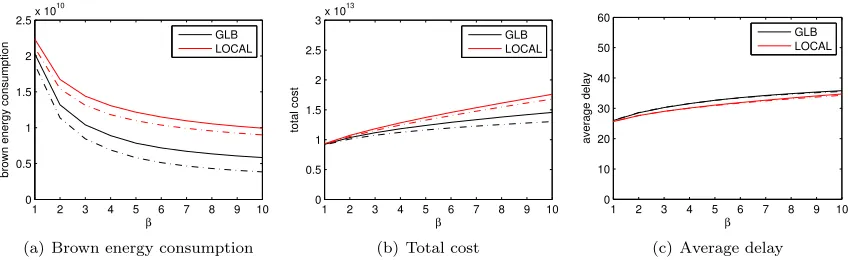
Figure 3.7: Comparison of GLB and LOCAL as a function ofβ. The renewable capacity is 2. The dashed line is the same setting except with storage.
from using geographical load balancing.
3.2.2
Results
With the setup described in the previous section, we have performed a number of numerical exper-iments to evaluate the feasibility of moving toward internet-scale systems powered (nearly) entirely by renewable energy. We focus on three issues: (i) the impact of geographical load balancing, (ii) the role of storage, and (iii) the optimal mix of wind and solar.
[image:36.612.110.534.263.393.2]0 1 2 3 4 5 0 1 2 3 4
5x 10
10
renewable capacity
brown energy consumption
GLB LOCAL
(a) Brown energy consumption
0 1 2 3 4 5
0 1 2 3 4
x 1013
renewable capacity
total cost
GLB LOCAL
(b) Total cost
0 1 2 3 4 5
0 10 20 30 40 50 60 renewable capacity average delay GLB LOCAL
[image:37.612.111.527.61.209.2](c) Average delay
Figure 3.8: Comparison of GLB and LOCAL with different renewable capacities andβ = 10. The dashed line is the same setting except with storage.
illustrates that the reduction in brown consumption is significantly larger even than the reduction in cost, and that it is significant even when energy is cheap (β is small).
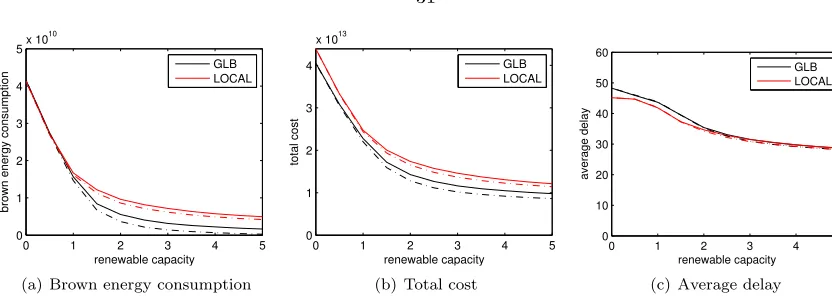
Next, we consider Figure 3.8, which illustrates the differences between LOCAL and GLB as a function of the capacity of renewable energy. Interestingly, Figure 3.8 highlights that when there is little capacity of renewables, both GLB and LOCAL can take advantage of it, but that as the capacity of renewables increases GLB is much more efficient at using it. This is evident because of the significantly lower brown energy consumption of GLB that emerges at capacities>1.5. Figure 3.8 also illustrates that increased capacity provides significant reductions in both the total cost and the average delay under both GLB and LOCAL.
Finally, let us consider the effect that GLB has on capacity provisioning of renewable energy. Figure 3.6 illustrates the capacity of solar and wind necessary to achieve certain brown energy reduction targets. We see in (a) that, under LOCAL, the capacity of renewables necessary to hit an 85% reduction of brown energy is extreme. However, in (b) we see that the use of GLB can provide significant reductions due to its more efficient use of the renewable capacity. If energy is expensive (β= 10), then the required capacity is nearly viable.
The role of storage In addition to GLB, another important tool to aid the incorporation of renewable energy into internet-scale systems is storage, such as UPSs. In this paper, we limit our consideration to small-scale storage, which is only able to power the data center over the time-scale of a few minutes. We consider small-scale storage due to the opportunity provided by the UPSs already available in data centers today, and due to the fact that the cost of large scale storage is prohibitive at this point.
Throughout Figures 3.7, 3.8, 3.6(a), 3.6(b), and 3.9, the impact of storage can be seen through the difference between the corresponding dashed and solid lines. A few trends that are evident in these plots are the following: (i) storage becomes more valuable with either higher capacities of renewables, i.e., > 1.5, or larger β; and (ii) storage plays a more significant role under GLB than under LOCAL. Both points are clearly illustrated in Figures 3.7 and 3.8, and Figure 3.8 also highlights that storage allows brown energy consumption to be almost completely eliminated when using GLB.
The optimal renewable portfolio We now move to the question of what mix of solar and wind is most effective for internet-scale systems. A priori, it seems that solar may be the most effective, since the peak of solar availability is closely aligned with that of the data center workload. However, the fact that solar is not available during the night is a significant drawback. Also, once GLB is used, it becomes possible to aggregate wind availability across geographical locations. This provides significant benefits because wind availability is not correlated across large geographical distances, and so when aggregated, the availability smoothes considerably, as illustrated in Figure 3.4(a). As a result, it seems that wind should be quite valuable to internet-scale systems.
Our results lend support to the discussion above. As illustrated in Figures 3.6 and 3.9, the optimal renewable portfolio for brown energy reduction is around 80% wind, and extra solar capacity provides little benefit beyond that point, in keeping with the findings of [21]. More specifically, Figure 3.9 shows the brown energy usage as a function of the fraction of energy coming from wind, for three values of total generating capacity, c. Keepingc fixed implicitly assumes that the cost per kWh of solar and wind installation are equal.
0 20 40 60 80 100 1
2 3 4 5x 10
10
% of wind
brown energy consumption
c = 1 c = 2 c = 3
(a) Brown energy consumption
0 20 40 60 80 100
7 8 9 10 11 12
x 1012
% of wind
total cost
c = 1
c = 2 c = 3
(b) Total cost
0 20 40 60 80 100
25 25.5 26 26.5 27
% of wind
average delay
c = 1 c = 2 c = 3
[image:39.612.108.535.72.208.2](c) Average delay
Figure 3.9: Impact of the mix of renewable energy used under GLB with β = 1 when the total renewable capacity isc= 1,2,3. The dashed line is the same setting except with storage.
Chapter 4
Concluding remarks
Bibliography
[1] US Census Bureau, http://www.census.gov. [2] The cost of latency. James Hamilton’s Blog, 2009.
[3] Server and data center energy efficiency, Final Report to Congress, U.S. Environmental Pro-tection Agency, 2007.
[4] V. K. Adhikari, S. Jain, and Z.-L. Zhang. YouTube traffic dynamics and its interplay with a tier-1 ISP: An ISP perspective. InACM IMC, pages 431–443, 2010.
[5] S. Albers. Energy-efficient algorithms. Comm. of the ACM, 53(5):86–96, 2010.
[6] L. L. H. Andrew, M. Lin, and A. Wierman. Optimality, fairness and robustness in speed scaling designs. InProc. ACM Sigmetrics, 2010.
[7] C. L. Archer and M. Z. Jacobson. Supplying baseload power and reducing transmission require-ments by interconnecting wind farms. J. Applied Meteorology and Climatology, 46:1701–1717, Nov. 2007.
[8] A. Beloglazov, R. Buyya, Y. C. Lee, and A. Zomaya. A taxonomy and survey of energy-efficient data centers and cloud computing systems, Technical Report, 2010.
[9] D. P. Bertsekas. Nonlinear Programming. Athena Scientific, 1999.
[10] D. P. Bertsekas and J. N. Tsitsiklis.Parallel and Distributed Computation: Numerical Methods. Athena Scientific, 1989.
[11] S. Boyd and L. Vandenberghe. Convex Optimization. Cambridge University Press, 2004. [12] S. Carley. State renewable energy electricity policies: An empirical evaluation of effectiveness.
Energy Policy, 37(8):3071–3081, Aug 2009.
[14] M. Conti and C. Nazionale. Load distribution among replicated web servers: A QoS-based approach. InProc. ACM Worksh. Internet Server Performance, 1999.
[15] A. Croll and S. Power. How web speed affects online business KPIs. http://www.watchingwebsites.com, 2009.
[16] X. Fan, W.-D. Weber, and L. A. Barroso. Power provisioning for a warehouse-sized computer. InProc. Int. Symp. Comp. Arch., 2007.
[17] M. Fripp and R. H. Wiser. Effects of temporal wind patterns on the value of wind-generated electricity in california and the northwest. IEEE Trans. Power Systems, 23(2):477–485, May 2008.
[18] A. Gandhi, M. Harchol-Balter, R. Das, and C. Lefurgy. Optimal power allocation in server farms. InProc. ACM Sigmetrics, 2009.
[19] D. Gmach, J. Rolia, C. Bash, Y. Chen, T. Christian, and A. Shah. Capacity planning and power management to exploit sustainable energy. InProc. of CNSM, 2010.
[20] D. Gmach, YuanChen, A. Shah, J. Rolia, C. Bash, T. Christian, and R. Sharma. Profiling sustainability of data centers. InProc. ISSST, 2010.
[21] D. Heide, L. von Bremen, M. Greiner, C. Hoffmann, M. Speckmann, and S. Bofinger. Advances in solar thermal electricity technology. Renewable Energy, 35(11):2483–2489, 2010.
[22] http://rredc.nrel.gov. 2010. [23] http://wind.nrel.gov. 2010.
[24] http://www.datacenterknowledge.com, 2008. [25] http://www.eia.doe.gov.
[26] S. Irani and K. R. Pruhs. Algorithmic problems in power management. SIGACT News, 36(2):63–76, 2005.
[27] T. A. Kattakayam, S. Khan, and K. Srinivasan. Diurnal and environmental characterization of solar photovoltaic panels using a PC-AT add on plug in card. Solar Energy Materials and Solar Cells, 44(1):25–36, Oct 1996.
[29] R. Krishnan, H. V. Madhyastha, S. Srinivasan, S. Jain, A. Krishnamurthy, T. Anderson, and J. Gao. Moving beyond end-to-end path information to optimize CDN performance. InProc. ACM Sigcomm, 2009.
[30] M. LaMonica. Google data center to get boost from wind farm. CNET News, 21 April 2011. [31] K. Le, R. Bianchini, T. D. Nguyen, O. Bilgir, and M. Martonosi. Capping the brown energy
consumption of internet services at low cost. InProc. IGCC, 2010.
[32] M. Lin, A. Wierman, L. L. H. Andrew, and E. Thereska. Dynamic right-sizing for power-proportional data centers. InProc. IEEE INFOCOM, 2011.
[33] Z. Liu, M. Lin, A. Wierman, S. H. Low, and L. L. H. Andrew. Greening geographic load balancing. InProc. ACM Sigmetrics, 2011.
[34] Z. M. Mao, C. D. Cranor, F. Bouglis, M. Rabinovich, O. Spatscheck, and J. Wang. A precise and efficient evaluation of the proximity between web clients and their local DNS servers. In
USENIX, pages 229–242, 2002.
[35] C. Miller. Solar-powered data centers. Datacenter Knowledge, 13 July 2010. [36] R. Miller. Google data center FAQ. Datacenter Knowledge, 27 March 2008.
[37] R. Miller. Facebook installs solar panels at new data center. Datacenter Knowledge, 16 April 2011.
[38] D. Mills. Advances in solar thermal electricity technology. solar Energy, 76:19–31, 2004. [39] E. Ng and H. Zhang. Predicting internet network distance with coordinates-based approaches.
InProc. IEEE INFOCOM, 2002.
[40] K. K. Nguyen, M. Cheriet, M. Lemay, B. St. Arnaud, V. Reijs, A. Mackarel, P. Minoves, A. Pastrama, and W. Van Heddeghem. Renewable energy provisioning for ICT services in a future internet. InFuture Internet Assembly. LNCS 6656, pages 419–429. 2011.
[41] S. Ong, P. Denholm, and E. Doris. The impacts of commercial electric utility rate structure elements on the economics of photovoltaic systems. Technical Report NREL/TP-6A2-46782, National Renewable Energy Laboratory, 2010.
[42] E. Pakbaznia and M. Pedram. Minimizing data center cooling and server power costs. InProc. ISLPED, 2009.
[44] M. Pathan, C. Vecchiola, and R. Buyya. Load and proximity aware request-redirection for dynamic load distribution in peering CDNs. InProc. OTM, 2008.
[45] A. Qureshi, R. Weber, H. Balakrishnan, J. Guttag, and B. Maggs. Cutting the electric bill for internet-scale systems. InProc. ACM Sigcomm, Aug. 2009.
[46] L. Rao, X. Liu, L. Xie, and W. Liu. Minimizing electricity cost: Optimization of distributed internet data centers in a multi-electricity-market environment. InINFOCOM, 2010.
[47] R. T. Rockafellar. Convex Analysis. Princeton University Press, 1970.
[48] R. Stanojevic and R. Shorten. Distributed dynamic speed scaling. InProc. IEEE INFOCOM, 2010.
[49] W. Theilmann and K. Rothermel. Dynamic distance maps of the internet. In Proc. IEEE INFOCOM, 2001.
[50] E. Thereska, A. Donnelly, and D. Narayanan. Sierra: a power-proportional, distributed storage system. Technical Report MSR-TR-2009-153, Microsoft Research, 2009.
[51] O. S. Unsal and I. Koren. System-level power-aware deisgn techniques in real-time systems.
Proc. IEEE, 91(7):1055–1069, 2003.
[52] R. Urgaonkar, U. C. Kozat, K. Igarashi, and M. J. Neely. Dynamic resource allocation and power management in virtualized data centers. InIEEE NOMS, Apr. 2010.
[53] P. Wendell, J. W. Jiang, M. J. Freedman, and J. Rexford. Donar: decentralized server selection for cloud services. InProc. ACM Sigcomm, pages 231–242, 2010.
Appendix A
Proofs for Chapter 2.2
We now prove the results from Chapter 2.2, beginning with the illuminating Karush-Kuhn-Tucker (KKT) conditions.
A.1
Optimality conditions
As GLB-Q is convex and satisfies Slater’s condition, the KKT conditions are necessary and sufficient for optimality [11]; for the other models they are merely necessary.
GLB-Q: Let ωi ≥0 and ¯ωi ≥0 be Lagrange multipliers corresponding to (3.4c), and δij ≥0,
νj andσi be those for (3.4b), (3.4a) and (3.4d). The Lagrangian is then
L=X
i∈N
<