Analyzing the Dynamics of Research by
Extracting Key Aspects of Scientific Papers
Sonal Gupta
Department of Computer Science Stanford University
Christopher D. Manning Department of Computer Science
Stanford University
Abstract
We present a method for characterizing a research work in terms of its focus, do-main of application, and techniques used. We show how tracing these aspects over time provides a novel measure of the in-fluence of research communities on each other. We extract these characteristics by matching semantic extraction patterns, learned using bootstrapping, to the depen-dency trees of sentences in an article’s abstract. We combine this information with pre-calculated article-to-community assignments to study the influence of a community on others in terms of tech-niques borrowed and the ‘maturing’ of some communities to solve other prob-lems. As a case study, we show how the computational linguistics community and its sub-fields have changed over the years with respect to their foci, methods used, and domain problems. For instance, we show that part-of-speech tagging and parsing have increasingly been adopted as tools for solving problems in other do-mains. We also observe that speech recog-nition and probability theory have had the most seminal influence.
1 Introduction
The evolution of ideas and the dynamics of a re-search community can be studied using the sci-entific articles published by the community. For instance, we may be interested in how methods spread from one community to another, or the evo-lution of a topic from a focus of research to a problem-solving tool. We might want to find the balance between technique-driven and domain-driven research within a field. Establishing such a rich insight of the development and progress
of scientific research requires an understanding of more than just the “topics” of discussion or cita-tion links between articles, which have been used in the previous work to study trend and impact of articles. As an example, to determine whether technique-driven researchers have greater or lesser impact, we need to be able to identify styles of work. To achieve this level of detail and to be able to connect together how methods and ideas are be-ing pursued, it is essential to move beyond bag-of-words topical models. This requires an under-standing of sentence and argument structure, and is therefore a form of information extraction.
To study the application domains, the tech-niquesused to approach the domain problems, and thefocusof scientific articles in a community, we propose to extract the following concepts from the articles
FOCUS: an article’s main contribution TECHNIQUE: a method or a tool used in an
article, for example, expectation maximiza-tion and condimaximiza-tional random fields
DOMAIN: an article’s application domain,
such as speech recognition and classification of documents.
For example, if an article concentrates on reg-ularization in support vector machines and shows improvement in parsing accuracy, then itsFOCUS
and TECHNIQUE are regularization and support
vector machines, and its DOMAIN is parsing. In
contrast, an article that focuses on lexical features to improve parsing accuracy and uses support vec-tor machines to train the model hasFOCUSas
lex-ical features and parsing, the TECHNIQUE being
lexical features and support vector machines, and its DOMAIN still is parsing.1 In this case, even
thoughTECHNIQUEs andDOMAINof both papers
1A community vs. aDOMAIN: a community can be as
broad as computer science or statistics, whereas aDOMAINis a specific application such as Chinese word segmentation.
are very similar, the FOCUS phrases distinguish
them from each other. Note that aDOMAINof one
article can be aTECHNIQUEof another, and
vice-versa. For example, an article that shows improve-ments in named entity recognition (NER) hasDO -MAINas NER, however, an article that uses named
entities as an intermediary tool to extract relations has NER as one of itsTECHNIQUEs.
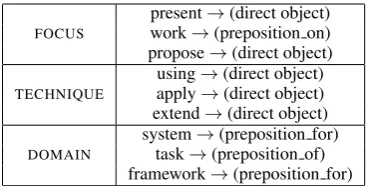
Our work uses information extraction patterns to extract the above three category phrases from articles. The phrases are extracted by matching se-mantic patterns in dependency trees of sentences. The input to the extraction system are some seed patterns (see Table 1 for examples) and it learns more patterns using a bootstrapping approach. Us-ing a bag-of-words based approach, such as topic models, for this problem is not straightforward; true to their name, topic models generally only identify the topic or area of a paper (such as ‘pars-ing’ or ‘speech recognition’), and neither provide nor label different cross-cutting aspects like tech-niques used or the application domain of the paper. As a case study, we examine the articles pub-lished in the computational linguistics commu-nity. We study the influence of the community’s sub-fields, such as parsing and machine trans-lation, using the FOCUS, TECHNIQUE, and DO -MAIN phrases extracted from the articles. We use
the document collection from the ACL Anthology dataset2 (Bird et al., 2008; Radev et al., 2009), since it has full text of papers available. To get the the sub-fields of the community, we use latent Dirichlet allocation (Blei et al., 2003) to find top-ics and label them by hand.3 However, our general approach can be used to study any case of the in-fluence of academic communities, including look-ing more broadly at the influence of statistics or economics across the social sciences.
We study how communities influence each other in terms of techniques that are reused, and show how some communities ‘mature’ so that the results they produce get adopted as tools for solv-ing other problems. For example, the products of the part-of-speech tagging (POS) community have been adopted by many other communities that use POS tagging as an intermediary step, which is also confirmed in our results.
We also show the timeline of influence of com-munities. For example, our results show that
2http://www.aclweb.org/anthology
3In this paper, we use the terms communities,
sub-communities and sub-fields interchangeably.
formal computational semantics and unification-based grammars had a lot of influence in the late 1980s. The speech recognition and probability theory fields showed an upward trend of influence in the mid-1990s, and even though it has decreased in recent years, they still have a lot of influence on recent papers mainly due to techniques like ex-pectation maximization and hidden Markov mod-els. Therefore, our results show that overall they have been the most influential fields in the last two decades. Probability theory, unlike speech recog-nition, is traditionally not a separate sub-field of computational linguistics, but it is an important topic since many papers use and work on proba-bilistic approaches. We also show that the study of influence is different from studying popularity or hotness of communities, such as in (Griffiths and Steyvers, 2004; Hall et al., 2008), which is based on the expected number of papers published in the community in a given year.
ContributionsWe introduce a new categoriza-tion of key aspects of scientific articles, which is (1) FOCUS: main contribution, (2) TECHNIQUE:
method or tool used, and (3)DOMAIN: application
domain. We extract the aspects by matching se-mantic patterns to dependency trees and learn the patterns using bootstrapping. We propose a new definition of influence of a research community in terms of its key aspects adopted as techniques by the other communities. We present a case study on the computational linguistics community using the the three aspects extracted from its articles, both for verifying the results of our system, and for showing novel results for the dynamics and the overall influence of computational linguistics sub-fields. We introduce a dataset of abstracts labeled with the three categories.4
2 Related Work
While there is some connection to keyphrase selection in text summarization (Radev et al., 2002), extracting FOCUS, TECHNIQUE and DO -MAINphrases is fundamentally a form of
informa-tion extracinforma-tion, and there has been a wide variety of prior work in this area. Some work, including the seminal (Hearst, 1992), identified patterns (IS-A relations) using hand-written rules, while other work has learned patterns over dependency graphs (Bunescu and Mooney, 2005). This work builds
4The dataset is available athttp://cs.stanford.
on previous successful use of bootstrapping learn-ing techniques in NLP (Yarowsky, 1995; Collins and Singer, 1999; Riloff and Jones, 1999); in its use of dependency patterns it is perhaps especially close to (Yangarber et al., 2000).
Topic models have been used to study popular-ity of communities (Griffiths and Steyvers, 2004), the history of ideas (Hall et al., 2008), and schol-arly impact of papers (Gerrish and Blei, 2010). However, topic models do not extract detailed in-formation from text as we do. Still, we use topic-to-word distributions from topic models as a way of describing sub-fields.
Demner-Fushman and Lin (2007) used hand written knowledge extractors to extract informa-tion, such as population and interveninforma-tion, in their clinical question-answering system to improve ranking of relevant abstracts. Our categorization of key aspects is applicable for broader range of communities, and we learn the patterns by boot-strapping. Li et al. (2010) used semantic meta-data to create a semantic digital library for chem-istry and identified experimental paragraphs using keywords features. Xu et al. (2006) and Ruch et al. (2007) proposed systems, in clinical-trials and biomedical domain, respectively, to classify sentencesof abstracts corresponding to categories such as introduction, purpose, method, results and conclusion to improve article retrieval by using either structured abstracts,5 or hand-labeled sen-tences. Some summarization systems also use ma-chine learning approaches to find ‘key sentences’. The systems built in these papers are complimen-tary to ours since one can find relevant paragraphs or sentences and then extract the key aspects from them. Note that a sentence can have multiple phrases corresponding to our three categories, and thus classification of sentences will not be enough.
3 Approach
In this section, we explain how to extract phrases for each of the three categories (FOCUS, TECH -NIQUEandDOMAIN) and how to compute the
in-fluence of communities.
3.1 Pattern Matching and Learning
From an article’s abstract and title, we use the de-pendency trees of sentences and a set of seman-tic extraction patterns to extract phrases in each of
5Structure abstracts, which are used by some journals,
have multiple sections such asPURPOSEandMETHOD.
FOCUS
present→(direct object) work→(preposition on) propose→(direct object)
TECHNIQUE
using→(direct object) apply→(direct object) extend→(direct object)
DOMAIN
system→(preposition for) task→(preposition of) framework→(preposition for) Table 1: Some examples of semantic extraction patterns that extract information from dependency trees of sentences. A pattern is of the formT →(d), whereTis the trigger word anddis the dependency that the trigger word’s node has with its successor.
Figure 1: The dependency graph for ‘We work on extract-ing information usextract-ing dependency graphs’. Our semantic patterns (shown in Table 1) will extract ‘extracting informa-tion using dependency graphs’ asFOCUS, and ‘dependency graphs’ asTECHNIQUE.
FOCUS, TECHNIQUE and DOMAINcategories. A
dependency tree of a sentence is a parse tree that gives dependencies (such as direct-object, subject) between words in the sentence. Figure 1 shows the dependency graph for the sentence ‘We work on extracting information using dependency graphs.’ Each semantic pattern is of the form T → d,
whereT is a trigger word (such as ‘use’, ‘present’)
and d is a dependency (such as ‘direct-object’). We start with a few handwritten patterns (some shown in Table 1) and learn more patterns au-tomatically using a bootstrapping approach. We run an iterative algorithm that extracts phrases us-ing semantic patterns and then learns new patterns from the extracted phrases. The details of each step are described below.
Extracting Phrases from Patterns A depen-dency tree matches a pattern T → (d), if (1) it
contains T, and (2) the trigger word’s node has
a successor (dependent or granddependent upto 4 levels) whose dependency with its parent is
d. In the rest of the paper, we call the subtree
headed by the successor as the matched phrase-tree. We extract the phrase corresponding to the matched phrase-tree and label it with the pattern’s category. For example, the dependency tree in Figure 1 matches the FOCUS pattern [work →
(preposition on)] and theTECHNIQUEpattern [
by ‘extracting’, which is ‘extracting information using dependency graphs’, with the categoryFO -CUS, and similarly labels the phrase ‘dependency
graphs’ asTECHNIQUE.
We have special rules for paper titles since au-thors usually include the main contribution of the paper in the title. We label the whole title asFO -CUS if we are not able to extract aFOCUS phrase
using the patterns. For titles from which we can extract a TECHNIQUEphrase, we label rest of the
words (except for the trigger words) with DO -MAIN. For example, for title ‘Studying the history
of ideas using topic models’, our system extracts ‘topic models’ as TECHNIQUE using the pattern
[using→(direct-object)], and then labels
‘Study-ing the history of ideas’ asDOMAIN.
Learning Patterns from Phrases After ex-tracting phrases with patterns, we want to be able to construct and learn new patterns. For each sen-tence whose dependency tree has a subtree corre-sponding to one of the extracted phrases, we con-struct a patternT → (d) by considering the
an-cestor (parent or grandparent) of the subtree as the trigger wordT, and the dependency between the
head of the subtree and its parent as the depen-dencyd. The weighting of newly constructed
pat-terns is done as follows. For a set of phrases (P)
that extract a pattern (q), the weight of the pattern q for the category FOCUS isPp∈P z1
pcount(p ∈ FOCUS), where zp is the total frequency of the phrase p. Similarly, we get weights of the
pat-tern for the other two categories. Note that we do not need smoothing since the phrase-category ra-tios are aggregated over all the phrases from which the pattern is constructed. After weighting all the patterns that have not been selected in the pre-vious iterations, we select the top k patterns in
each category (k=2 in our experiments). Table 3
shows some patterns learned through the iterative method.
3.2 Communities and their Influence
We define communities as fields or sub-fields that one wishes to study. To study communities us-ing the articles published, we need to know which communities each article belongs to. The article-to-community assignment can be computed in sev-eral ways, such as by manual assignment, using metadata, or by text categorization of papers. In our case study, we use the topics formed by apply-ing latent Dirichlet allocation (Blei et al., 2003) to
the text of the papers by considering each topic as one community. In recent years, topic modeling has been widely used to get ‘concepts’ from text; it has the advantage of producing soft, probabilis-tic arprobabilis-ticle-to-community assignment scores in an unsupervised manner. We combine these soft as-signment scores with the phrases extracted in the previous section to score a phrase for each com-munity and each category as follows. The score of a phrasep, which is extracted from an articlea,
for a communitycand the category TECHNIQUE
is calculated as
tScore(c, p, a) = (1)
1
zpcount(p∈TECHNIQUE|a)P(c|a, θ)
where the functionP(c |a, θ)gives the
probabil-ity of a communprobabil-ity (i.e., a topic) for the articlea
given the topic modeling parameters θ. The
nor-malization constant for the phrase, zp, is the fre-quency of the phrase in all the abstracts.
We define influence such that communities re-ceive higher scores if they use techniques ear-lier than other communities do or produce tools that are used to solve other problems. For exam-ple, sincehidden Markov modelintroduced by the speech recognition community andpart-of-speech taggingtools built by the part-of-speech commu-nity have been widely used as techniques in other communities, these communities should receive higher scores than the nascent or not-so-widely-used ones. Thus, we define influence of a com-munity based on the number of times itsFOCUS, TECHNIQUE or DOMAIN phrases have been used
as aTECHNIQUEin other communities. To
calcu-late the overall influence of one community on an-other, we first need to calculate influence because of individual articles in the community, which is calculated as follows. The influence of community
c1on another communityc2because of a phrasep extracted from an articlea1is
tInf l(c1, c2, p, a1) = (2)
allScore(c1, p, a1) X
a2∈D ya2>ya1
tScore(c2, p, a2)C(a2, a1)
where the functionallScore(c, p, a) is computed
the same way as in Eq. 1, but by usingcount(p∈ ALL |a), where ALLmeans the union of phrases
extracted in all three categories. The variableD
is the set of all articles, and ya2 means year of
from the articlea1on all the articles from the com-munityc2 published at a later date. The function
C(a2, a1) is a weighting function based on cita-tions, whose value is 1 if a2 citesa1, and λ oth-erwise. Ifλis 0, the system calculates influence
based on just citations, which can be noisy and in-complete. In our experiments, we used λ as 0.5
since we want to study the influence even when an article does not explicitly cite another article. The technique-influence score of communityc1on communityc2 in yearyis computed by summing up the previous equation for all phrases (P) and
for all articles inD. It is computed as
tInf l(c1, c2, y) =Pp∈P X
a∈D ya1=y
tInf l(c1, c2, p, a) (3)
Straightforwardly, the overall influence of com-munity c1 on the community c2 and on all other communities is calculated as
tInf l(c1, c2) =PytInf l(c1, c2, y) (4)
tInf l(c1) =Pc2=c6 1tInf l(c1, c2) (5)
Next, we present a case study over the sub-fields of computational linguistics using the influence scores described above.
4 Experimental Setup
DatasetWe studied the computational linguistics community from 1965 to 2009 using titles and ab-stracts of 15,016 articles from the ACL Anthology Network and the ACL Anthology Reference cor-pus (Bird et al., 2008; Radev et al., 2009). We found 52 pairs of abstracts that had more than 80% of words in common with each other, and thus while calculating the influence scores, we ig-nored the influence of earlier-published paper on the later-published paper in the pairs. We used the Stanford Parser (Marneffe et al., 2006) to gen-erate dependency trees of sentences. For testing, we hand labeled 474 abstracts with the three cate-gories to measure the precision and recall scores. For each abstract and each category, we compared the unique non-stop-words extracted from our al-gorithm to the hand labeled dataset. We calculated precision, recall measures for each abstract and averaged them to get the results for the dataset.
When extracting phrases from the matched phrase trees, we ignored tokens with part-of-speech tags as pronoun, number, determiner, punc-tuation or symbol, and removed all subtrees in
the matched phrase trees that had either relative-clause-modifier or clausal-complement depen-dency with their parents since, even though we want full phrases, including these sub-trees intro-duced extraneous phrases and clauses. We also added phrases from the subtrees of the matched phrase trees to the set of extracted phrases.
We used 13 seed patterns for FOCUS, 7 for TECHNIQUE and 15 for DOMAIN. When
con-structing a new pattern, we ignored the ancestors that were not a noun or a verb since most trig-ger words are a noun or a verb (such asuse, con-straints). We also ignored conjunction, relative-clause-modifier, dependent (most generic depen-dency), quantifier-modifier, and abbreviation de-pendencies6 since they either are too generic or introduced extraneous phrases and clauses.
Learning new patterns did not help in improv-ing theFOCUScategory phrases when tested over
a hand labeled test set. It got relatively high scores when using just the seed patterns and the titles, and hence learning new patterns reduced the pcision without any significant improvement in re-call. Thus, we learned new patterns only for the
TECHNIQUE andDOMAIN categories. We ran 50
iterations for both categories, which was chosen as a reasonable trade-off between pattern preci-sion and recall based on some earlier pilot exper-iments. After extracting all the phrases, we re-moved common phrases that are frequently used in scientific articles, such as ‘this technique’ and ‘the presence of’, using a stop words list of 3,000 phrases. The list was created by taking the top most occurring 1 to 3 grams from 100,000 ran-dom articles with an abstract in the ISI web of knowledge database7. We ignored phrases that were either one character or more than 15 words long. In a step towards finding canonical names, we automatically detected abbreviations and their expanded forms from the full text of papers by searching for text between two parentheses, and considered the phrase before the parentheses as the expanded form (similar to (Schwartz and Hearst, 2003)). We got a high precision list by picking the top most occurring pairs of abbreviations and their expanded forms and created groups of phrases by merging all the phrases that use same abbrevia-tion. We then changed all the phrases in the ex-tracted phrases dataset to their canonical names.
Paper Title FOCUS TECHNIQUE DOMAIN Studying the history
of ideas using topic models
studying the history of ideas
using topic latent dirichlet allocation; topic; topic;unsupervised topic; historical trends; that all three conferences are converg-ing in the topics
studying the history of ideas; topic; model of the diver-sity of ideas , topic entropy; probabilistic
A Bayesian Hybrid Method For Context-Sensitive Spelling Correction.
new hybrid method , based on bayesian classifiers; bayesian hybrid method for context-sensitive spelling correction
decision lists; bayesian; bayesian clas-sifiers; ambiguous; part-of-speech tags; methods using decision lists; single strongest piece of evidence; spelling
context-sensitive spelling correction; for context-sensitive spelling correction; spelling
Table 2: Extracted phrases for some papers. The word ‘model’ is missing from the end of some phrases as it was removed during post-processing.
We also removed ‘model’, ‘approach’, ‘method’, ‘algorithm’, ‘based’, ‘style’ words and their vari-ants when they occurred at the end of a phrase.
Baseline To compare against a non-information-extraction based baseline, we extracted all noun phrases, along with phrases from the sub-trees of the noun phrase trees, from the abstracts and labeled them with all the three categories. In addition, we labeled the titles (and their sub-trees) with the categoryFOCUS. We then
scored the phrases with a tf-idf inspired measure, which was the ratio of the frequency of the phrase in the abstract and the sum of the total frequency of the individual words, and removed phrases that had the tf-idf measure less than 0.001 (best out of many experiments). We call this approach as ‘Baseline tf-idf NPs’.8
To get communities in the computational lin-guistics literature, we considered the topics gen-erated using the same ACL Anthology dataset by Bethard and Jurafsky (2010) as communities. They ran latent Dirichlet allocation on the full text of the papers to get 100 topics. We hand labeled the topics and used 72 of them in our study; the rest of them were about common words. When calculating the scores in Eq. 1, we considered the value ofP(c|a, θ)to be 0 if it was less than 0.1.
5 Results and Discussion Extraction
The total numbers of phrases extracted were 25,525 for FOCUS, 24,430 for TECHNIQUE, and
33,203 forDOMAIN. The total numbers of phrases
after including the phrases extracted from subtrees of the matched phrase trees were 64,041, 38,220 and 46,771, respectively. Examples of phrases ex-tracted from some papers are shown in Table 2.
8As discussed in Section 1, using an unsupervised
or weakly-supervised bag-of-words based approach is not straightforward for identifyingFOCUS,TECHNIQUEand DO-MAINof an article, and hence we do not compare against one.
TECHNIQUE DOMAIN
model→(nn) improve→(direct-object) rules→(nn) used→(preposition for) extracting→(direct-object) evaluation→(nn) identify→(direct-object) parsing→(nn) constraints→(amod) domain→(nn)
based→(preposition on) applied→(preposition to) Table 3: Examples of patterns learned using the iterative ex-traction algorithm. The dependency ‘nn’ is the noun com-pound modifier dependency.
Approach F1 Precision Recall
FOCUS
Baseline tf-idf NPs 35.60 24.36 66.07
Seed Patterns 55.29 44.67 72.54
Inter-Annotator Agreement 53.33 50.80 56.14 TECHNIQUE
Baseline tf-idf NPs 26.65 17.87 52.41
Seed Patterns 20.09 23.46 21.72
Iteration 50 36.86 30.46 46.68
Inter-Annotator Agreement 72.02 66.81 78.11 DOMAIN
Baseline tf-idf NPs 30.13 19.90 62.03
Seed Patterns 25.27 30.55 26.29
Iteration 50 37.29 27.60 57.50
Inter-Annotator Agreement 72.31 75.58 69.32 Table 4: The precision, recall, and F1scores of each category for the different approaches. Note that the inter-annotator agreement is calculated on a smaller set.
Figure 2: The F1 scores forTECHNIQUE and DOMAIN cate-gories after every five iterations. For reasons explained in the text, we do not learn new patterns forFOCUS.
Table 4 compares precision, recall, and micro-averaged F1 scores for the three categories when we use: (1) only the seed patterns, (2) the com-bined set of learned and seed patterns, (3) the base-line, and (4) the inter-annotator agreement. We calculated inter-annotator agreement for 30 ab-stracts, where each abstract was labeled by 2 an-notators,9and the precision-recall scores were cal-culated by randomly choosing one annotation as gold and another as predicted for each article. We 9The first author annotated 30 abstracts and two doctoral
(a) The influence of communities in each year.
(b) Popularity of communities in each year. Figure 3: The first figure shows influence scores of commu-nities in each year. The second figure shows the popularity of each community in each year (see (Hall et al., 2008)), which is measured by summing up the article-to-topic scores for the articles published in that year. The scores are smoothed with weighted scores of 2 previous and 2 next years, and L1-normalized for each year. The scores are lower for all communities in late 2000s since the probability mass is more evenly distributed among many communities.
can see in the table that both precision and re-call scores increase forTECHNIQUEbecause of the
learned patterns, though for DOMAIN, precision
decreases but recall increases. The recall scores for the baseline are higher as expected but the pre-cision is very low. Three possible reasons ex-plain the mistakes made by our system: (1) au-thors sometimes use generic phrases to describe their system, which were not annotated with any of the three categories in the test set but were ex-tracted by the system (such as ‘simple method’, ‘faster model’, ‘new approach’); (2) the depen-dency trees of some sentences were wrong; and (3) some of the patterns learned for TECHNIQUE
and DOMAIN were low-precision but high-recall.
Figure 2 shows the F1scores forTECHNIQUEand
DOMAINafter every 5 iterations. Influence
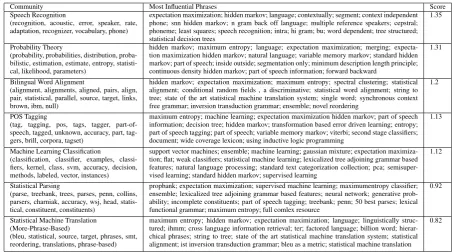
Table 5 shows the most influential communities overall (computed using Eq. 5) and their respective influential phrases that have been widely adopted as techniques by other communities. We can see that speech recognition is the most influen-tial community because of the techniques like hid-den Markov models and other stochastic methods it introduced in the computational linguistics liter-ature, which shows that its long-term seeding in-fluence is still present despite the limited recent
(a) The influence of communities in each year.
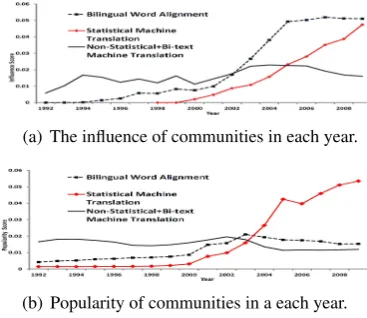
(b) Popularity of communities in a each year. Figure 4: Comparing machine translation related communi-ties in the same way as in Figure 3. The statistical machine translation community, which is a topic from the topic model, is more phrase-based.
popularity. Probability theory also gets a high score since many papers in the last decade have used stochastic methods. The communities part-of-speech tagging and parsing get high scores be-cause they adopted some techniques that are used in other communities, and because other commu-nities use part-of-speech tagging and parsing in the intermediary steps for solving other problems.
Figure 3(a) shows the change in a community’s influence over time, and Figure 3(b) shows the change in its popularity. The popularity of a com-munity is the sum of article-to-topic scores for the community topic and for all articles published in a given year.10 The scores in both figures are nor-malized such that the total score for all commu-nities in a year sum to one. Compare the relative scores of communities in Figure 3(a) with the rel-ative scores in Figure 3(b). We can see influence of a community is different from the popularity of a community in a given year. As mentioned be-fore, we observe that although influence score for speech recognition has declined in recent years, it still has a lot of influence, though the popular-ity of the communpopular-ity in recent years is very low. Machine learning classification has been both pop-ular and influential in recent years. Named en-tity recognition’s popularity has decreased since 2003, though its influence has either increased or remained same. Figure 4 compares the ma-chine translation communities in the same way as we compare other communities in Figure 3. We can see that statistical machine translation (more phrase-based) community’s popularity has steeply increased in the last 5 years, however, its
influ-10See (Hall et al., 2008) for more analysis. Note that this
Community Most Influential Phrases Score Speech Recognition
(recognition, acoustic, error, speaker, rate, adaptation, recognizer, vocabulary, phone)
expectation maximization; hidden markov; language; contextually; segment; context independent phone; snn hidden markov; n gram back off language; multiple reference speakers; cepstral; phoneme; least squares; speech recognition; intra; hi gram; bu; word dependent; tree structured; statistical decision trees
1.35
Probability Theory
(probability, probabilities, distribution, proba-bilistic, estimation, estimate, entropy, statisti-cal, likelihood, parameters)
hidden markov; maximum entropy; language; expectation maximization; merging; expecta-tion maximizaexpecta-tion hidden markov; natural language; variable memory markov; standard hidden markov; part of speech; inside outside; segmentation only; minimum description length principle; continuous density hidden markov; part of speech information; forward backward
1.31
Bilingual Word Alignment
(alignment, alignments, aligned, pairs, align, pair, statistical, parallel, source, target, links, brown, ibm, null)
hidden markov; expectation maximization; maximum entropy; spectral clustering; statistical alignment; conditional random fields , a discriminative; statistical word alignment; string to tree; state of the art statistical machine translation system; single word; synchronous context free grammar; inversion transduction grammar; ensemble; novel reordering
1.2
POS Tagging
(tag, tagging, pos, tags, tagger, part-of-speech, tagged, unknown, accuracy, part, tag-gers, brill, corpora, tagset)
maximum entropy; machine learning; expectation maximization hidden markov; part of speech information; decision tree; hidden markov; transformation based error driven learning; entropy; part of speech tagging; part of speech; variable memory markov; viterbi; second stage classifiers; document; wide coverage lexicon; using inductive logic programming
1.13
Machine Learning Classification
(classification, classifier, examples, classi-fiers, kernel, class, svm, accuracy, decision, methods, labeled, vector, instances)
support vector machines; ensemble; machine learning; gaussian mixture; expectation maximiza-tion; flat; weak classifiers; statistical machine learning; lexicalized tree adjoining grammar based features; natural language processing; standard text categorization collection; pca; semisuper-vised learning; standard hidden markov; supersemisuper-vised learning
1.12
Statistical Parsing
(parse, treebank, trees, parses, penn, collins, parsers, charniak, accuracy, wsj, head, statis-tical, constituent, constituents)
propbank; expectation maximization; supervised machine learning; maximumentropy classifier; ensemble; lexicalized tree adjoining grammar based features; neural network; generative prob-ability; incomplete constituents; part of speech tagging; treebank; penn; 50 best parses; lexical functional grammar; maximum entropy; full comlex resource
0.92
Statistical Machine Translation (More-Phrase-Based)
(bleu, statistical, source, target, phrases, smt, reordering, translations, phrase-based)
maximum entropy; hidden markov; expectation maximization; language; linguistically struc-tured; ihmm; cross language information retrieval; ter; factored language; billion word; hierar-chical phrases; string to tree; state of the art statistical machine translation system; statistical alignment; ist inversion transduction grammar; bleu as a metric; statistical machine translation
0.82
Table 5: The top most influential communities, along with the top most words that describe the communities obtained by the topic model, and the corresponding most influential phrases that have been widely used as techniques. The third column is the score of the community computed by Eq. 5.
Community Communities that have influenced most (descending order)
Named Entity Recognition Chunking/Memory Based Models; Discriminative Sequence Models; POS Tagging; Machine Learning Classification; Coherence Relations; Biomedical NER; Bilingual Word Alignment
Statistical Parsing Probability Theory; POS Tagging; Discriminative Sequence Models; Speech Recognition; Parsing; Syntactic Theory; Clustering+DistributionalSimilarity; Chunking/Memory Based Models
Word Sense Disambiguation Clustering + DistributionalSimilarity; Machine Learning Classification; Dictionary Lexicons; Collocations/Compounds; Syntax; Speech Recognition; Probability Theory
Table 6: The community in the first column has been influenced the most by the communities in the second column. The scores are calculated using Eq. 4
ence has increased at a slower rate. On the other hand, the influence of bilingual word alignment (the most influential community in 2009) has in-creased during the same period, mainly because of its influence on statistical machine translation. The influence of non-statistical machine transla-tion has been decreasing recently, though slower than its popularity. Table 6 shows the communi-ties that have the most influence on a given com-munity (the list is in descending order of scores by Eq. 4).
6 Future Directions
We are working towards incorporating the date of publication of the articles to learn better patterns to increase precision and recall of the system. We are also exploring ways to use our system for study-ing citation and co-authorship networks. We plan to study the dynamics and impact of broader com-munities like biology, statistics and the social sci-ences. The approach can also be used to study innovation in interdisciplinary research, since we
can track if interdisciplinary research results in applying old techniques from one community to solve problems in other community, or if it results in the evolution of better suited techniques.
7 Conclusions
References
Steven Bethard and Dan Jurafsky. 2010. Who should I cite: learning literature search models from cita-tion behavior. InProceedings of the Conference on Information and Knowledge Management.
Steven Bird, Robert Dale, Bonnie J. Dorr, Bryan Gib-son, Mark T. Joseph, Min yen Kan, Dongwon Lee, Brett Powley, Dragomir R. Radev, and Yee Fan Tan. 2008. The ACL anthology reference corpus: A ref-erence dataset for bibliographic research in compu-tational linguistics. In Proceedings of the Confer-ence on Language Resources and Evaluation.
David M. Blei, Andrew Y. Ng, and Michael I. Jordan. 2003. Latent Dirichlet allocation. Journal of Ma-chine Learning Research.
Razvan C. Bunescu and Raymond J. Mooney. 2005. A shortest path dependency kernel for relation ex-traction. In Proceedings of the Human Language Technology Conference and Conference on Empiri-cal Methods in Natural Language Processing.
Michael Collins and Yoram Singer. 1999. Unsuper-vised models for named entity classification. In Pro-ceedings of the Joint SIGDAT Conference on Empir-ical Methods in Natural Language Processing and Very Large Corpora.
Dina Demner-Fushman and Jimmy Lin. 2007. An-swering clinical questions with knowledge-based and statistical techniques. Computational Linguis-tics.
Sean M. Gerrish and David M. Blei. 2010. A language-based approach to measuring scholarly impact. In Proceedings of the International Con-ference on Machine Learning.
T. L. Griffiths and M. Steyvers. 2004. Finding scien-tific topics. Proceedings of the National Academy of Sciences.
David Hall, Daniel Jurafsky, and Christopher D. Man-ning. 2008. Studying the history of ideas using topic models. InProceedings of the Conference on Empirical Methods in Natural Language Process-ing.
Marti A. Hearst. 1992. Automatic acquisition of hy-ponyms from large text corpora. InProceedings of the Conference on Computational linguistics.
Na Li, Leilei Zhu, Prasenjit Mitra, Karl Mueller, Eric Poweleit, and C. Lee Giles. 2010. OreChem ChemXSeer: a semantic digital library for chem-istry. In Proceedings of the Joint Conference on Digital libraries.
Marie-Catherine De Marneffe, Bill MacCartney, and Christopher D. Manning. 2006. Generating typed dependency parses from phrase structure parses. In
Proceedings of the Conference on Language Re-sources and Evaluation.
Dragomir R. Radev, Eduard Hovy, and Kathleen McK-eown. 2002. Introduction to the special issue on summarization.Computational Linguistics.
Dragomir R. Radev, Pradeep Muthukrishnan, and Va-hed Qazvinian. 2009. The acl anthology network corpus. In Proceedings of the 2009 Workshop on Text and Citation Analysis for Scholarly Digital Li-braries.
Ellen Riloff and Rosie Jones. 1999. Learning dic-tionaries for information extraction by multi-level bootstrapping. InProceedings of the National Con-ference on Artificial Intelligence (AAAI).
Patrick Ruch, Clia Boyer, Christine Chichester, Imad Tbahriti, Antoine Geissbhler, Paul Fabry, Julien Gobeill, Violaine Pillet, Dietrich Rebholz-Schuhmann, Christian Lovis, and Anne-Lise Veuthey. 2007. Using argumentation to extract key sentences from biomedical abstracts. International Journal of Medical Informatics.
Ariel S. Schwartz and Marti A. Hearst. 2003. A simple algorithm for identifying abbreviation definitions in biomedical text.
Rong Xu, Kaustubh Supekar, Yang Huang, Amar Das, and Alan Garber. 2006. Combining text classifi-cation and hidden markov modeling techniques for categorizing sentences in randomized clinical trial abstracts. Proceedings of the Association of Moving Image Archivists Annual Symposium.
Roman Yangarber, Ralph Grishman, Pasi Tapanainen, and Silja Huttunen. 2000. Unsupervised discovery of scenario-level patterns for information extraction. InProceedings of the Conference on Applied Natu-ral Language Processing.