Summarization by Analogy:
An Example-based Approach for News Articles
Megumi Makino and Kazuhide Yamamoto
Dept. of Electrical Engineering, Nagaoka University of Technology 1603-1 Kamitomioka, Nagaoka, Niigata 940-2188 Japan
{makino,ykaz}@nlp.nagaokaut.ac.jp
Abstract
Automatic summarization is an important task as a form of human support technology. We propose in this paper a new summariza-tion method that is based on example-based approach. Using example-based approach for the summarization task has the following three advantages: high modularity, absence of the necessity to score importance for each word, and high applicability to local con-text. Experimental results have proven that the summarization system attains approxi-mately 60% accuracy by human judgment.
1 Introduction
The example-based approach generates language by imitating instances, which originated in the machine translation method based on the analogy (Nagao, 1984). The idea is derived from the observation that a human being translates according to past transla-tion experiences. In the machine translatransla-tion task, this approach has been implemented, and has so far achieved efficient results (Sumita, 1998; Imamura, 2004).
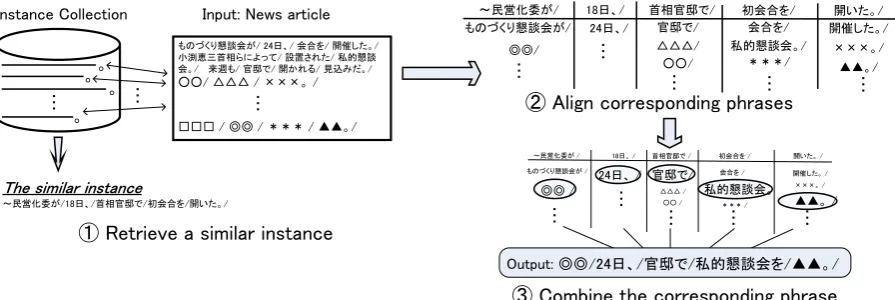
In summarization, a human being also summa-rizes with his own knowledge and experiences. For this reason, we focus on a summarization method which is based on analogy, example-based summa-rization. The example-based method summarizes the input text in three steps. First, it retrieves a simi-lar instance to the input text. Second, it links equiv-alent phrases between the input text and the similar instance. Finally, a summary is acquired with com-bination of some corresponding phrases. Here, we employed a Japanese news article as the input text and utilized news headlines as the instances. The
news headline consists of one brief sentence which describes the main point.
We assert that the example-based summarization has the following advantages:
(1)High modularity
Easy improvement and maintenance are required to formulate a useful system in general. An example-based framework makes it easy for us to improve a system by only adding instances. Besides, the addition of instances causes few side-effects. (2)Use of similarity rather than importance
Almost all previous work on summarization has focused on a sentence extraction. These works com-pute importance for each word to extract a sentence. However, it is difficult to compute the importance which correlates with human sense. Example-based summarization means there is no need to measure the importance, and it computes the similarity in-stead. We think it is easier to assess the similarity between two expressions rather than the importance of one expression.
(3)High applicability to local context
The statistical method, in general, attempts to compute the probability of each word appearing in the summary corpus (Knight and Marcu, 2002; Wit-brock and Mittal, 1999). This may increase difficul-ties in maintaining local context, since the statistical approach focuses on the global probability. How-ever, the example-based approach attempts to find most locally similar instance out of the instance col-lection, which may increase the fitness of input con-texts.
As related work, Nguyen et al. (2004) have pro-posed an example-based sentence reduction model. They deal with the compression of one sentence, while we summarize some sentences into a one-sentence summary. Thus, our summarization ratio is inevitably lower than theirs, as it is considered to be more difficult as a summarization task.
Many studies have summarized some sentences, such as a news article, into a one-sentence summary. Most of them extract the important sentence and contract it. In contrast, our method generates a one-sentence summary by combining phrases in some sentences. Consequently, we can obtain high com-pression summaries that include information from many positions of the source.
2 Instance Collection
Our example-based summarization regards news headlines as the instance collection. A news head-line is a short sentence in which the primary point is written. The following example is Japanese news headlines:
Example (1) :
(Mitsubishi Motors Corp. produces passenger cars in China.)
We use Japanese news headlines, like the above examples, as instances. Besides, as we have noted, only news headlines are used as instances; that is, the pairs formed by an original sentence and its sum-marized sentence are not used.
3 Example-based Summarization
3.1 Overview
Our example-based summarization system summa-rizes a lengthy news article into a one-sentence sum-mary by using instances. The overall process is il-lustrated in figure 1. The system is composed of the following three processes in this order:
1. Retrieve a similar instance to an input news ar-ticle from the instance collection.
2. Align corresponding phrases between the input news article and the similar instance.
3. Combine the corresponding phrases to form a summary.
Detail of each process is described hereafter.
3.2 Retrieval of Similar Instance
The system measures a similarity between the input and each instance in the instance collection when it retrieves a similar instance. If many words are shared between two expressions, we regard two ex-pressions as similar. Hence, the similarity is calcu-lated on basis of the overlaps of content words be-tween the input news article I and the instance E, defined as follows:
Sim(E,I)=
n
∑
i=1
Score(i)· {w· ||T v1(E)∩T vi(I)||
+||To1(E)∩Toi(I)||} (1)
where,
- n : the number of sentences in input,
- T vi(·): the verbs set in the last phrase of the i-th
sentence,
- Toi(·) : the set of content words in the i-th
sen-tence,
- ||T v1(E)∩T vi(I)|| : the number of overlaps
be-tween T v1(E)and T vi(I).
In the equation, Score(i)and w are designed to give a higher score if words indicating the main topic of the input article are matched with words in the in-stance. We have found that words have different contributions, depending on the sentence position, to the main topic. Therefore, we apply Score(i) which depends on the sentence position i, and we use the following experimentally-determined score as Score(i).
Score(i) =
5.15 if i=1
2.78/i0.28 otherwise (2)
The score indicates an agreement rate of content words depending on the sentence position, which is calculated by using 5000 pairs of newspaper’s body and its title1 We have also found that the verbs in the last phrase are appropriate for the main topic of the input article. For that reason, we determine the weight w=3 by our experiment.
Example 2 shows the similar instance obtained by measuring the similarity.
Example (2) : Input news article
24 (skip the
1We used the same kind of newspaper as data set in section
Figure 1: Overview of example-based summarization
rest.)
(The Manufacturing Council held a meeting on the 24th, which discusses the hard-hitting strategy for quality management. ...)
Obtained similar instance 18
(The committee for the privatization of the Public Roads Administration held the first meeting on the 18th at the prime minister’s office.)
3.3 Phrase Alignment
We compare the phrases in the input with those in the similar instance, and the system aligns the corre-sponding phrases. Here, the correspondence refers to the link of the equivalent phrases between the in-put and its similar instance. The detail of phrase alignment procedures are shown in the following.
To begin with, sentences both in the input and in the similar instance are analyzed using a Japanese syntactic parser CaboCha1). The sentences are split into phrases and named entities (NEs), such as PER-SON, LOCATION, DATE, are recognized by the tool.
Then the adnominal phrases in the similar in-stance are deleted. This is because the adnomi-nal phrases are of many types, depending on the modified noun; accordingly, the adnominal phrase should be used only if the modified nouns are ex-actly matched between the input and the similar in-stance.
Finally, the system links the corresponding phrases. Here, phrase correspondence is one-to-many, not one-to-one, and therefore a phrase in a
similar instance has some corresponding phrases in the input. In order to compare phrases, the following four measures are employed: (i) agreement of gram-matical case, (ii) agreement of NE, (iii) similarity with enhanced edit distance, and (iv) similarity by means of mutual information. The measure of (i) focuses on functional words, whereas the measures of (ii)-(iv) note content words. Let us explain the measures using example 2.
(i) Agreement of Grammatical Case
If there is a phrase which has the same grammati-cal case2in the input and in the similar instance, we regard the phrase as the corresponding phrase. In example 2, for example, the phrases “
(the hard-hitting strategyobj3), (the meet-ingobj)” in the input corresponds the phrase “
(the first meetingobj)” in the similar instance.
(ii) Agreement of Named Entity
Provided the input has the same NE tag as the sim-ilar instance, the phrase involving its tag links the corresponding phrase. For example, in example 2, the phrase “24 [DATE] (on the 24th.)” in the in-put corresponds the phrase “18 [DATE] (on the 18th.)” in the similar instance.
(iii) Similarity with Enhanced Edit Distance
We adopt the enhanced edit distance to link phrases including the same characters, because Japanese ab-breviation tends to include the same characters as the original. For example, the abbreviation of “
2Comma is also regarded as grammatical case (i.e., null
case) here.
(Bank of Japan)” is “ ”. The enhanced edit distance is proposed by Yamamoto et al. (2003). The distance is a measure of similarity by counting matching characters between two phrases. More-over, the distance is assigned a different similarity weight according to the type of matched characters. We apply 1.0 to the weight only if Chinese-derived characters (Kanji) are matched. We link phrases as corresponding phrases, where the phrases are the top three similar to a phrase in the similar instance.
(iv) Similarity with Mutual Information
We finally compute the similarity with mutual in-formation to link syntactically similar phrases. For example, given the following two expressions: “
(to hold a meeting)” and “ (to hold a convention)”, we regard (a meeting) and (a convention) as similar. We use the similar-ity proposed by Lin (1998). The method uses mu-tual information and dependency relationships as the phrase features. We extend the method to Japanese by using a particle as the dependency relationships. We link phrases as corresponding phrases, where the phrases are the top three similar to a phrase in the similar instance.
3.4 Combination of the Corresponding Phrases
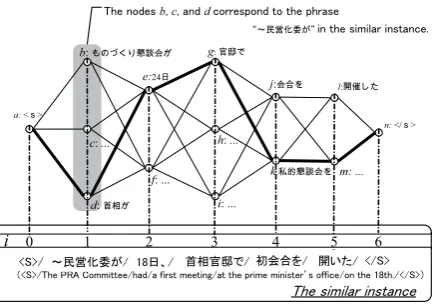
Our system forms the one-sentence summary by combining the corresponding phrases. Let us ex-plain this process by using figure 2. We arrange the phrase of the input on the node, where the phrases is judged as the correspondence to the phrase in the similar instance. For example, in figure 2, the sec-ond nodes e and d denote the correspsec-onding phrases in the input, which correspond to the second phrase had in the similar instance.
We assign the similarity between corresponding phrases as the weight of node. In addition to this, we employ phrase connection score to the weight of edge. The score indicates the connectivity of con-secutive two phrases, e.g. two nodes such as node d and node e in figure 2. If you want to obtain a fine summary, i.e., a summary that contains similar phrases to the similar instance, and that is correct grammatically, you have to search the best path ˆWp
for path sequence Wp={w0,w1,w2,···,wm}, where
the best path maximizes the score.
ˆ
Wp=Wp s.t. argmax p
Scorep(Wp) (3)
Figure 2: Optimal path problem that depends on combination of the corresponding phrases4.
The best path ˆWp is a one-sentence summary which
is generated by our system. Take the case of the thick line in figure 2, ˆWp is indicated as ˆWp =
{a,d,e,g,k,m,n}, namely, generated summary is formed the phrases {a,d,e,g,k,m,n}. In eq.3, Scorep(Wp)is given by
Scorep(Wp)=α m
∑
i=0
N(wi)+(1−α) m
∑
i=1
E(wi−1,wi) (4)
where α is the balancing factor among the weights of node and edge. We score α =0.6 by our experiment. m indicates the last number of the phrase in the similar instance, N(wi)is given as
fol-lows:
N(wi)=max
0.5 if (grammatical case or NE tag is matched)
1/rank otherwise (5)
where, rank indicates the rank order of the similarity with the enhanced edit distance or mutual informa-tion to the phrase wi. N(wi) illustrates the
similar-ity between corresponding two phrases. The node score, shown above, is determined by the prelim-inary experiment. The edge score E(wi−1,wi) is
given by
E(wi−1,wi) =
1
|loc(wi−1)−loc(wi)|+1
(6)
where, loc(wi) denotes where the location of the
sentence contains the phrase wi in the input. The
edge score means that if wi−1 and wi are located
closely to each other, a higher score is given, since a good connection is expected in this case.
4The nodes, a, b, c,···, n, indicate the corresponding
4 Evaluation and Discussion
4.1 The Corpus
We used 26,784 news headlines as instances, which were collected from the Nikkei-goo mail service2) for 2001-2006. In order to adjust the weight w in the eq.1 and the balancing parameterα in eq.4, 150 in-put news articles were used as the tuning set. A dif-ferent group of 134 news articles were used for eval-uation. We used Nihon Keizai Shimbun, a Japanese newspaper3), from 1999 through 2000 as tuning and test data.
4.2 Summarization Ratio
To calculate summarization ratio, we have compared the number of characters in the input news articles with that in the output summary. As the result, we obtained a summarization ratio of 5%; namely, 95% characters in the input were reduced. From the summarization ratio, our approach made it possible to summarize sentences into one-sentence summary with high compression.
4.3 Sectional Evaluation
We evaluated each part of our system by human judgment5. We first evaluated the process by retriev-ing similar instance. Next, we evaluated the pro-cesses of phrase alignment and the combination by assessing whether the output summaries were appro-priate.
·Retrieving Process
An examinee evaluated the similar instances ob-tained. Given an input news article and the similar instance to the input, the examinee rates the follow-ing scale from one to four, based on how similar the similar instance obtained is to the summary which the examinee generated from the input news article:
1) quite similar 2) slightly similar 3) not very similar 4) not similar
Out of 134 input articles, 77 inputs were ranked either 1) quite similar or 2) slightly similar. As a consequence, the accuracy of similar instance ob-tained is approximately 57%, which indicates that the similarity calculation for obtaining similar in-stance is feasible.
5One examinee judged the parts of our system.
·Phrase Alignment and Combination
We also evaluated parts of phrase alignment and the combination by human judgment. The exami-nee compared 77 output summaries with their input. Here, we limited 77 outputs judged as good similar instances in evaluation of the process of retrieving similar instance, because we evaluate specifically the parts of phrase alignment and combination.
The examinee categorized them based on how proper the output summary is to the input news arti-cle:
1) quite proper 2) slightly proper 3) not very proper 4) not proper
As a result of judgment, 48 outputs out of 77 are evaluated either 1) quite proper or 2) slightly proper. Both a statistical method by Knight and Marcu (2002) and an example-based method by Nguyen et al. (2004) contracted one-sentence with a summarization ratio of approximately 60-70%. Both papers indicated that a score of 7-8 on a scale from one to ten was obtained. They deal with the compression of one sentence, while we summarize some sentences into a one-sentence summary. Thus, our summarization ratio is lower than theirs, as it is considered to be more difficult as a summarization task. Despite this, we obtained the ratio that 62% (48 out of 77 results) were judged proper. Although direct comparison of the performance is impossible, it is considered that our proposed method obtains a competitive accuracy.
4.4 Discussions
·Examples of Output Summary
Figure 3 shows some examples of the output sum-mary.
From figure 3, we can see that the similar in-stances were effectively used, and the appropriate summaries to the input are generated. For example, the second summary in the figure is judged as a fine summary contracting information of two sentences according to the similar instance.
·Analysis of Summarization Errors
Input news article
(skip the rest.) (The prosecution made Kawano’s closing arguments on the 21st in the trial at the Yokohama District Court. The ex-sergeant Suguru Kawano is accused of gang-bashing by Atsugi Police Station’s patrol group in a string of scandals of Kanagawa Pre-fectural Police. The prosecutors demanded one and half year in a prison. ...)
Obtained similar instance
22 8
(The prosecution made Takuma’s closing arguments on the 22nd in the trial at the Osaka District Court, and asked for the death penalty.)
Output summary
(The prosecution made Kawano’s closing arguments on the 21st in the trial and demanded one and half years in prison.)
Figure 3: The examples of generated summary
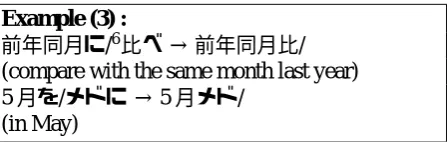
one, and we thus can not deal with many-to-one cor-respondences.
Example (3) :
/6 /
(compare with the same month last year)
5 / 5 /
(in May)
We expect that this kind of phenomenon can be solved by paraphrasing an input summary as well as summary instance. Recently, several works on paraphrasing techniques have been proposed in Japanese, hence such pre-processing before align-ment would be feasible.
5 Conclusion and Future Work
We have presented an example-based technique that has been applied to the summarization task. The essence of the proposed method is to generate a one-sentence summary by combining instances each of which imitates the given input.
As the result of human judgment, the retrieval process of a similarity sentence attained 57% accu-racy. And our method generated summary in which 62% were judged proper. We have confirmed by our observation that the summaries were generated by combining the phrases in many positions of the input, while those summaries are not given just by
6“/” indicates a phrase boundary.
common methods such as sentence extraction meth-ods and sentence compression methmeth-ods.
The sectional evaluation and the inspection of example output show that this system works well. However, larger scale evaluation and comparison of its accuracy remain to be future work.
Tools and language resources
1) CaboCha, Ver.0.53, Matsumoto Lab., Nara Institute of Science and Technology.
http://chasen.org/˜taku/software/cabocha/ 2) Nikkei News Mail, NIKKEI-goo,
http://nikkeimail.goo.ne.jp/
3) Nihon Keizai Shimbun Newspaper Corpus, years 1999– 2000, Nihon Keizai Shimbun, Inc.
References
Kenji Imamura. 2004. Automatic Construction of
Trans-lation Knowledge for Corpus-based Machine Transla-tion. Ph.D. thesis, Nara Institute of Science and
Tech-nology.
Kevin Knight and Daniel Marcu. 2002. Summariza-tion Beyond Sentence ExtracSummariza-tion: A Probabilistic
Ap-proach to Sentence Compression. Artificial
Intelli-gence, 139(1):91–107.
Dekang Lin. 1998. Automatic Retrieval and Clustering of Similar Words. In Proceedings of COLING-ACL98, pages 768–773.
Makoto Nagao. 1984. A Framework of a Mechanical Translation Between Japanese and English By Anal-ogy Principle. In Artificial and Human Intelligence, pages 173–180.
Minh Le Nguyen, Susumu Horiguchi, Akira Shimazu,
and Bao Tu Ho. 2004. Example-Based Sentence
Reduction Using the Hidden Markov Model. ACM
Transactions on Asian Language Information Process-ing, 3(2):146–158.
Eiichiro Sumita. 1998. An Example-Based Approach
to Transfer and Structural Disambiguation within Ma-chine Translation. Ph.D. thesis, Kyoto University.
Michael J. Witbrock and Vibhu O. Mittal. 1999. Ultra-Summarization: A Statistical Approach to Generat-ing Highly Condensed Non-Extractive Summaries. In
Research and Development in Information Retrieval,
pages 315–316.
Eiko Yamamoto, Masahiro Kishida, Yoshinori Takenami, Yoshiyuki Takeda, and Kyoji Umemura. 2003. Dy-namic Programming Matching for Large Scale Infor-mation Retrieval. In Proceedings of the 6th