Automatic Prosodic Labeling with Conditional Random Fields and Rich
Acoustic Features
Gina-Anne Levow University of Chicago Department of Computer Science
1100 E. 58th St. Chicago, IL 60637 USA [email protected]
Abstract
Many acoustic approaches to prosodic la-beling in English have employed only lo-cal classifiers, although text-based classifi-cation has employed some sequential mod-els. In this paper we employ linear chain and factorial conditional random fields (CRFs) in conjunction with rich, contextually-based prosodic features, to exploit sequential de-pendencies and to facilitate integration with lexical features. Integration of lexical and prosodic features improves pitch accent pre-diction over either feature set alone, and for lower accuracy feature sets, factorial CRF models can improve over linear chain based prediction of pitch accent.
1 Introduction
Prosody plays a crucial role in language understand-ing. In addition to the well-known effects in tone languages such as Chinese, prosody in English also plays a significant role, where pitch accents can indicate given/new information status, and bound-ary tones can distinguish statements from yes-no questions. However, recognition of such prosodic features poses significant challenges due to differ-ences in surface realization from the underlying form. In particular, context plays a significant role in prosodic realization. Contextual effects due ar-ticulatory constraints such maximum speed of pitch change (Xu and Sun, 2002) from neighboring sylla-bles and accents can yield co-articulatory effects at the intonational level, analogous to those at the seg-mental level. Recent phonetic research (Xu, 1999;
Sun, 2002; Shen, 1990) has demonstrated the im-portance of coarticulation for tone and pitch accent recognition. In addition context affects interpreta-tion of prosodic events; an accent is viewed as high or low relative to the speaker’s pitch range and also relative to adjacent speech.
Some recent acoustically focused approaches (Sun, 2002; Levow, 2005) to tone and pitch accent recognition have begun to model and exploit these contextual effects on production. Following the Par-allel Encoding and Target Approximation (PENTA) (Xu, 2004), this work assumes that the prosodic tar-get is exponentially approached during the course of syllable production, and thus the target is best ap-proximated in the later portion of the syllable. Other contextual evidence such as relative pitch height or band energy between syllables has also been em-ployed (Levow, 2005; Rosenberg and Hirschberg, 2006). Interestingly, although earlier techniques (Ross and Ostendorf, 1994; Dusterhoff et al., 1999) employed Hidden Markov Models, they did not ex-plicitly model these coarticulatory effects, and re-cent approaches have primarily employed local clas-sifiers, such as decision trees (Sun, 2002; Rosenberg and Hirschberg, 2006) or Support Vector Machines (Levow, 2005).
(CRFs)(Gregory and Altun, 2004) more recently. The systems often included features that captured lo-cal or longer range context, such as n-gram probabil-ities, neighboring words, or even indicators of prior mention. (Chen et al., 2004; Rangarajan Sridhar et al., 2007) explored the integration of based prosodic and lexico-syntactic evidence in GMM-based and maximum entropy models respectively.
Here we explore the use of contextual acous-tic and lexical models within a sequence learning framework. We analyze the interaction of differ-ent feature types on prediction of prosodic labels us-ing linear-chain CRFs. We demonstrate improved recognition by integration of textual and acoustic cues, well-supported by the sequence model. Finally we consider the joint prediction of multiple prosodic label types, finding improvement for joint modeling in the case of feature sets with lower initial perfor-mance.
We begin by describing the ToBI annotation task and our experimental data. We then discuss the choice of conditional random fields and the use of linear chain and factorial models. Section 4 de-scribes the contextual acoustic model and text-based features. Section 5 presents the experimental struc-ture and results. We conclude with a brief discussion of future work.
2 Data
We employ a subset of the Boston Radio News Cor-pus (Ostendorf et al., 1995), employing data from speakers f1a, f2b, m1b, and m2b, for experimen-tal consistency with (Chen et al., 2004; Rangara-jan Sridhar et al., 2007). The corpus includes pitch accent, phrase and boundary tone annotation in the ToBI framework (Silverman et al., 1992) aligned with manual transcription and manual and automatic syllabification of the materials. Each word was also manually part-of-speech tagged. The data com-prises over forty thousand syllables, with speaker f2b accounting for just over half the data. Fol-lowing earlier research (Ostendorf and Ross, 1997; Sun, 2002), we collapse the ToBI pitch accent labels to four classes: unaccented, high, low, and down-stepped high for experimentation, removing distinc-tions related to bitonal accents. We also consider the binary case of distinguishing accented from
unac-cented syllables, (Gregory and Altun, 2004; Rosen-berg and HirschRosen-berg, 2006; Ananthakrishnan and Narayanan, 2006). For phrase accents and bound-ary tones, we consider only the binbound-ary distinction between phrase accent/no phrase accent and bound-ary tone/no boundbound-ary tone.
All experiments evaluate automatic prosodic la-beling at the syllable level.
3 Modeling with Linear-Chain and Factorial CRFs
Most prior acoustically based approaches to prosodic labeling have used local classifiers. How-ever, on phonological grounds, we expect that cer-tain label sequences will be much more probable than others. For example, sequences of multiple high accents are relatively uncommon in contrast to the case of an unaccented syllable preceding an ac-cented one. This characteristic argues for a model which encodes and exploits inter-label dependen-cies. Furthermore, under the ToBI labeling guide-lines, the presence of a boundary tone dictates the co-occurrence of a phrase accent label. To capture these relations between labels of different types, we also consider factorial models.
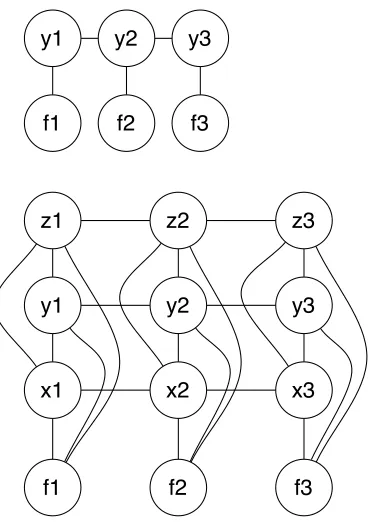
Conditional Random Fields (Lafferty et al., 2001) are a class of graphical models which are undirected and conditionally trained. While they can repre-sent long term dependencies, most applications have employed first-order linear chains for language and speech processing tasks including POS tagging, sen-tence boundary detection (Liu et al., 2005), and even text-oriented pitch accent prediction(Gregory and Altun, 2004). The models capture sequential label-label relations, but unlike HMMs, the condi-tionally trained model can more tractably support larger text-based feature sets. Factorial CRFs (Sut-ton, 2006; McCallum et al., 2003) augment the lin-ear sequence model with additional cotemporal la-bels, so that multiple (factors) labels are predicted at each time step and dependencies between them can be modeled. Examples of linear-chain and fac-torial CRFs appear in Figure 1. In the linear chain example, thefiitems correspond to the features and
theyito labels to be predicted, for example prosodic
y1 y2 y3
f1 f2 f3
z1 z2 z3
y1 y2 y3
x1 x2 x3
[image:3.612.81.265.73.334.2]f1 f2 f3
Figure 1: Linear-chain CRF (top) and Two-level Factorial CRF (bottom).
between the features and labels; the horizontal lines indicate the dependencies between the labels in se-quence. In the factorial CRF example, thefi again
represent the features, while thexi,yi, andzi
repre-sent the boundary tone, phrase accent, and pitch ac-cent labels that are being predicted. The horizontal arcs again model the sequential bigram label-label dependencies between labels of the same class; the vertical arcs model the dependencies between both the features and labels, and bigram dependencies be-tween the labels of each of the different pairs of fac-tors. Thus, we jointly predict pitch accent, phrase accent, and boundary tone and, the prediction of each label depends on the features, the other labels predicted for the same syllable, and the sequential label of the same class. So, pitch accent prediction depends on the features, pitch accent predicted for the neighboring syllable, and phrase and boundary tone predictions for the current syllable.
We employ the Graphical Models for Mallet (GRMM) implementation (Sutton, 2006), adapted to also support the real-valued acoustic features re-quired for these experiments; in some additional contrastive experiments on zero order models, we
also employ the Mallet implementation (McCallum, 2002). We employ both linear chain and three-level factorial CRFs, as above, to perform prosodic label-ing.
4 Feature Representation
We exploit both lexical and prosodic features for prosodic labeling of broadcast news speech. In par-ticular, in contrast to (Gregory and Altun, 2004), we employ a rich acoustic feature set, designed to cap-ture and compensate for coarticulatory influences on accent realization, in addition to word-based fea-tures.
4.1 Prosodic Features
Using Praat’s (Boersma, 2001) ”To pitch” and ”To intensity” functions and the phoneme, syllable, and word alignments provided in the corpus, we extract acoustic features for the region of interest. This re-gion corresponds to the syllable nucleus in English. For all pitch and intensity features, we compute per-speaker z-score normalized log-scaled values.
Recent phonetic research (Xu, 1997; Shih and Kochanski, 2000) has identified significant effects of carryover coarticulation from preceding adjacent syllable tones. To minimize these effects consistent with the pitch target approximation model (Xu et al., 1999), we compute slope features based on the sec-ond half of this region, where this model predicts that the underlying pitch height and slope targets of the syllable will be most accurately approached.
For each syllable, we compute the following local features:
• pitch values at five points evenly spaced across the syllable nucleus,
• mean and maximum pitch values,
• slope based on a linear fit to the pitch contour in the second half of the region, and
• mean and maximum intensity.
syllables as well as the nearest pitch points from the adjacent syllables. These features extend the mod-eled tone beyond the strict bounds of the syllable segmentation. A second set of contextual features, termed ”difference features”, captures the change in feature values between the current and adjacent syl-lables. The resulting feature set includes:
• mean, maximum, and last two pitch values from preceding syllable,
• mean, maximum, and first value from follow-ing syllable, and
• differences in pitch mean, pitch maximum, pitch of midpoint, pitch slope, intensity mean, and intensity maximum between the current syllable and the preceding syllable, and be-tween the current syllable and the following syllable.
Finally, we also employ some positional and du-rational features. Many prosodic phenomena are af-fected by phrase or sentence position; for example, both pitch and intensity tend to decrease across an utterance, and pitch accent realization may also be affected by cooccurring phrase accents or bound-ary tones. As syllable duration typically increases under both accenting and phrase-final lengthening, this information can be useful in prosodic labeling. Finally, pause information is also associated with prosodic phrasing. Thus, we include following fea-tures:
• two binary features indicating initial and fi-nal in a pseudo-phrase, defined as a silence-delimited interval,
• duration of syllable nucleus, and
• durations of pause preceding and following the syllable.
In prior experiments using support vector ma-chines (Levow, 2005), variants of this representa-tion achieved competitive recognirepresenta-tion levels for both tone and pitch accent recognition.
4.2 Text-based Features
We employ text-based models similar to those em-ployed by (Sun, 2002; Rangarajan Sridhar et al.,
2007). For each syllable, we capture the following manually annotated features:
• The phonetic form of the current syllable, the previous two syllables, and the following two syllables,
• binary values indicating whether each of the current, previous, and following syllables are lexically stressed,
• integer values indicating position in a word of the current, previous, and following syllables,
• the current word, the two previous words, and the two following words, and
• the POS of the current word, of the two previ-ous words, and of the two following words.
These features capture information about the current syllable and its lexico-syntactic context, that have been employed effectively in prosodic labeling of pitch accent, phrase accent, and boundary tone.
5 Experiments
We explore a range of issues in the experiments reported below. We hope to assess the impact of feature set and acoustic and text-based fea-ture integration in the Conditional Random Field models. We compare their individual effective-ness as well as the effect of combined feature sets on labeling. In particular, we consider both the binary accented/unaccented assignment task for pitch accent and the four way - high/downstepped high/low/unaccented - contrast to compare effective-ness in problems of different difficulty. We further consider the effect of sequence and factorial model-ing on pitch accent recognition. All experiments are conducted using a leave-one-out evaluation proce-dure following (Chen et al., 2004), training on all but one speaker and then testing on that held-out speaker, reporting the average across the tests on held-out data. Because speaker f2b contributes such a large portion of the data, that speaker is never left out.
recognition of boundary status (Rangarajan Srid-har et al., 2007). For syllable-level recognition on this dataset, results for speaker-independent models reach slightly over 80% for binary pitch accent tection and 88% for boundary detection. Speaker de-pendent models have achieved very high accuracy; over 87% on speaker f2b was reported by (Sun, 2002) for the four-class task.
5.1 Explicit Prosodic Context Features and Sequence Models
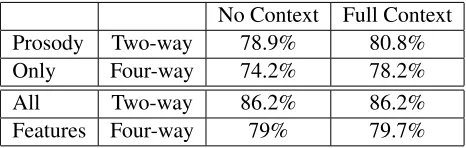
We first assess the role of contextual prosodic fea-tures for pitch accent recognition and their action with sequence models. To minimize inter-action effects, we concentrate on recognition with prosodic features alone on the challenging four-way pitch accent problem. As described above, we aug-mented the local syllable-based prosodic features with contextual features associated with the preced-ing and followpreced-ing syllables. We ask whether the use of contextual features improves recognition, and, if so, which type of context, preceding or follow-ing, has the greatest impact. We also ask whether the CRF models provide further improvements or can partially or fully compensate for the lack of explicit context features. To evaluate this impact, we compute four-way pitch accent recognition ac-curacy with no context features, after adding preced-ing context, after addpreced-ing followpreced-ing context, and with both. We also contrast zero order and first order lin-ear chain CRFs for these conditions. We find that modeling preceding context yields the greatest im-provement. This finding is consistent with findings in recent phonetic research that argue for a larger role of carryover coarticulation from preceding syl-lables than of anticipatory coarticulation with fol-lowing syllables. Furthermore, sequence modeling in the CRF also improves results, across the explicit context feature conditions, with improvements being most pronounced in cases with less effective explicit prosodic contextual features. Results for prosodic features alone appear in Table 1. In a side exper-iment with these prosodic features, we also briefly explored higher-order models, but no improvement was observed.
We also assess the impact of this richer contex-tualized prosodic feature set both alone and in con-junction with the full text-based feature set, in the
[image:5.612.313.546.71.145.2]No Context Full Context Prosody Two-way 78.9% 80.8% Only Four-way 74.2% 78.2% All Two-way 86.2% 86.2% Features Four-way 79% 79.7%
Table 2: Impact of context prosodic features with prosody alone and all features
full factorial CRF framework. We compare results for pitch accent identification in both the two-way and four-way conditions with no context and with the full ensemble of prosodic features. We find no difference for the two-way, all features condition for which text-based features perform well alone. How-ever, for the prosody only cases and the more chal-lenging four-way task with all features, contextual information yields improvements, demonstrating the utility of this richer, contextualized prosodic feature representation. These contrasts appear in Table 2.
5.2 Prosodic and Text-based Features
We continue by contrasting effectiveness of differ-ent feature sets in the basic linear-chain CRF case for pitch accent recognition. Table 3 presents the results for prosodic, word-based, and combined fea-tures sets in both the two-way and four-way classifi-cation conditions. Overall accuracy is quite good; in all cases, results are well above the 65% most common class assignment level, and the best re-sults (86.2%) outperform any previously published speaker independent syllable-based results on this dataset. Overall results and contrasts are found in Table 3.
No Context Preceding Following Both Zero order 70.5% 75.2% 71.8% 76.4% First order 74.2% 75.5% 73.7% 77.1%
Table 1: Prosodic Context Features and CRFs
Acoustic Text Text&Acoustic Linear-Chain Two-way 79.48% 84.88% 86.1%
Four-way 77.06% 76.21% 79.65% Factorial CRF Two-way 80.76% 84.74% 86.2%
[image:6.612.164.444.73.118.2]Four-way 78.22% 77.46% 79.71%
Table 3: Pitch Accent Classification with Linear-Chain (top) and factorial CRFs (bottom) , using Acoustic-only, Text-based-Acoustic-only, and Combined Features. Results for two- and four-way pitch accent prediction are shown.
best determined by acoustic contrast, since accent type is closely linked to pitch height, and the local context and acoustic features serve to identify which accentable words are truly accented. Thus, in the binary task, the text-based features combine most effectively with the evidence from the acoustic fea-tures.
To contrast local classifiers with the linear chain model with text-based features, we trained a zero or-der classifier for the pitch accent prediction case and contrasted it with a comparable first-order linear-chain CRFs. Here for the binary accent recognition case, using only text-based information, we reach an accuracy of 84.3% for the history-free model, con-trasted with an 85.4% level obtained with a compa-rable first-order model.1
5.3 Factorial CRF Framework
Finally we consider the effect of joint classification using the factorial CRF framework. Here, beyond just pitch accent assignment, we perform simultane-ous assignment of pitch accent, phrase accent and boundary tone, where each label type corresponds to a factor, implementing the desired dependencies.2
1
This comparison was computed using the original Mallet CRF package rather than GRMM, due to simpler zero order model support. This results in a small difference in the resulting scores.
2
The features have not been tuned specifically for phrase ac-count and boundary prediction, as explicit punctuation or sen-tence boundary features would have been useful but obvious giveaways. However, our goal is to assess the potential impact of combined classification, without excessive tuning.
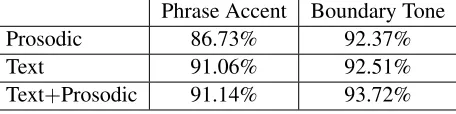
The contrasts with the linear-chain model in terms of pitch accent prediction accuracy appear in Table 3. For the binary pitch accent condition, results are somewhat mixed. While there is a small but not sig-nificant decrease in accuracy for the text-only binary classification condition, the combined case shows little change and the prosodic case increases mod-estly. We note in one case that joint accuracy has risen when the pitch accent accuracy has dropped; we speculate that some additional compensation is needed to manage the effects of the severe class imbalance between the dominant ”no-label” classes for phrase accent and boundary tone and other la-bels. For the four-way contrast between pitch accent types, we see small to modest gains across all feature sets, with the prosodic case improving significantly
(p < 0.025). The best results for all but the two-way text-based classification task are found with the factorial CRF model.
Phrase Accent Boundary Tone
Prosodic 86.73% 92.37%
Text 91.06% 92.51%
[image:7.612.75.303.73.130.2]Text+Prosodic 91.14% 93.72%
Table 4: Accuracy for phrase accent and boundary tone with prosodic, text-based, and combined fea-tures
6 Conclusion and Future Work
The application of linear-chain and factorial Con-ditional Random Fields for automatic pitch accent recognition and other prosodic labeling facilitates modeling of sequential dependencies as well as inte-gration of rich acoustic features with text-based ev-idence. We plan to further investigate the model-ing of dependencies between prosodic labels and the sequential modeling for acoustic features. Finally, we will also integrate prior work on subsyllable seg-mentation to identify the best approximation of the prosodic target with the CRF framework to produce a fine-grained sequence model of prosodic realiza-tion in context.
7 Acknowledgments
The author would like to thank Charles Sutton for providing the GRMM implementation, Andrew Mc-Callum for the Mallet CRF implementation, and Si-wei Wang and Sonja Waxmonsky for the modifica-tions supporting real-valued features.
References
Sankaranarayanan Ananthakrishnan and Shrikanth Narayanan. 2006. Combining acoustic, lexical, and syntactic evidence for automatic unsupervised prosody labeling. InProceedings of ICSLP 2006.
P. Boersma. 2001. Praat, a system for doing phonetics by computer. Glot International, 5(9–10):341–345.
K. Chen, M. Hasegawa-Johnson, and A. Cohen. 2004. An automatic prosody labeling system using ANN-based syntactic-prosodic model and GMM-ANN-based acoustic-prosodic model. InProceedings of ICASSP.
K. Dusterhoff, A. Black, and P. Taylor. 1999. Using de-cision trees within the tilt intonation model to predict f0 contours. InProc. Of Eurospeech ’99.
Michelle Gregory and Yasemin Altun. 2004. Using ditional random fields to predict pitch accents in con-versational speech. InProceedings of the 42nd Meet-ing of the Association for Computational LMeet-inguistics
(ACL’04), Main Volume, pages 677–683, Barcelona,
Spain, July.
John Lafferty, Andrew McCallum, and Fernando Pereira. 2001. Conditional random fields: Probabilistic mod-els for segmenting and labeling sequence data. In Pro-ceedings of the International Conference on Machine
Learning (ICML-2001).
Gina-Anne Levow. 2005. Context in multi-lingual tone and pitch accent prediction. In Proc. of Interspeech 2005.
Yang Liu, Andreas Stolcke, Elizabeth Shriberg, and Mary Harper. 2005. Using conditional random fields for sentence boundary detection in speech. In Proceed-ings of the 43rd Annual Meeting of the Association for
Computational Linguistics (ACL’05), pages 451–458,
Ann Arbor, Michigan, June. Association for Compu-tational Linguistics.
Andrew McCallum, Khashayar Rohanimanesh, and Charles Sutton. 2003. Dynamic conditional ran-dom fields for jointly labeling multiple sequences. In
NIPS*2003 Workshop on Syntax, Semantics, Statistics.
Andrew Kachites McCallum. 2002.
Mal-let: A machine learning for language toolkit. http://mallet.cs.umass.edu.
M. Ostendorf and K. Ross. 1997. A multi-level model for recognition of intonation labels. In Y. Sagisaka, N. Campbell, and N. Higuchi, editors, Computing
Prosody, pages 291–308.
M. Ostendorf, P. J. Price, and S. Shattuck-Hufnagel. 1995. The Boston University radio news corpus. Technical Report ECS-95-001, Boston University.
Shimei Pan and Kathleen McKeown. 1998. Learning intonation rules for concept to speech generation. In
Proceedings of ACL/COLING-98, pages 1003–1009.
Vivek Kumar Rangarajan Sridhar, Srinivas Bangalore, and Shrikanth Narayanan. 2007. Exploiting acoustic and syntactic features for prosody labeling in a maxi-mum entropy framework. InHuman Language Tech-nologies 2007: The Conference of the North American Chapter of the Association for Computational Linguis-tics; Proceedings of the Main Conference, pages 1–8, Rochester, New York, April. Association for Compu-tational Linguistics.
K. Ross and M. Ostendorf. 1994. A dynamical system model for generating f0 for synthesis. In
Proceed-ings of the ESCA/IEEE Workshop on Speech Synthesis,
pages 131–134.
Xiao-Nan Shen. 1990. Tonal co-articulation in Man-darin. Journal of Phonetics, 18:281–295.
C. Shih and G. P. Kochanski. 2000. Chinese tone model-ing with stem-ml. InProceedings of the International Conference on Spoken Language Processing, Volume 2, pages 67–70.
K. Silverman, M. Beckman, J. Pitrelli, M. Osten-dorf, C. Wightman, P. Price, J. Pierrehumbert, and J. Hirschberg. 1992. ToBI: A standard for labelling English prosody. In Proceedings of ICSLP, pages 867–870.
Xuejing Sun. 2002. Pitch accent prediction using ensem-ble machine learning. InProceedings of ICSLP-2002.
Charles Sutton. 2006. Grmm: A graphical models toolkit. http://mallet.cs.umass.edu.
Yi Xu and X. Sun. 2002. Maximum speed of pitch change and how it may relate to speech. Journal of the Acoustical Society of America, 111.
C.X. Xu, Y. Xu, and L.-S. Luo. 1999. A pitch tar-get approximation model for f0 contours in Mandarin.
In Proceedings of the 14th International Congress of
Phonetic Sciences, pages 2359–2362.
Yi Xu. 1997. Contextual tonal variations in Mandarin.
Journal of Phonetics, 25:62–83.
Y. Xu. 1999. Effects of tone and focus on the formation and alignment of f0 contours - evidence from Man-darin. Journal of Phonetics, 27.