IJEDR1602002
International Journal of Engineering Development and Research (www.ijedr.org)7
Comprehensive Study on DWT-OFDM and
FFT-OFDM using 64-DAPSK Modulation Technique
Chelsy Joy
M.Tech in Communication Engineering SCMS School of Engineering and Technology
Ernakulam, Kerala, India
________________________________________________________________________________________________________ Abstract- Orthogonal Frequency Division Multiplexing (OFDM) that has high performance over multipath environments is a multicarrier modulation scheme which is used in many wireless applications. Data transmission and reception is through orthogonally separated narrow-band sub-carriers. it is implemented using Discrete Fourier transform (DFT) and IDF T.OFDM usually adopts binary phase shift keying (BPSK), quadrature amplitude modulation (QAM) or quadrature phase shift keying (QPSK) as the modulation scheme. In this paper a MATLAB simulation for the comparison of a discrete wavelet transform (DWT) based OFDM with DFT based system with differential amplitude phase shift keying (DAPSK) as its modulation scheme is presented. The performance in multipath fading as channel impairments in the presence of Additive white Gaussian noise (AWGN) was evaluated and explained in terms of bit error rate (BER) and peak average power ratio (PAPR). The results shows that DWT based OFDM systems are superior to a DFT based system with 64-DAPSK modulation. Also 64-DAPSK reduced the implementation complexity of the receiver, as it doesn’t need channel estimation or equalization and compensates the channel effect on the signal without the need of any previous knowledge of the channel.
Index Terms—OFDM, DAPSK, BER, PAPR, DWT-OFDM
________________________________________________________________________________________________________ I. INTRODUCTION
Orthogonal frequency division multiplexing (OFDM) as a concept was first introduced for military applications in 1957 as a parallel transmission system. In 1971, S. B. Weinstein and P. M. Ebert made a huge contribution in OFDM history when they introduced multiplexing using discrete Fourier transform (DFT) to improve the implementation complexity. Since then OFDM became the interest of many research institutes as they became focused on developing OFDM based systems. But still the use of OFDM in commercial communication systems was limited due to the high costs associated with the requirements for implementation. The use of OFDM has experienced a breakthrough in the 1990s with advancements in digital signal processing (DSP) hardware.
OFDM is a frequency division multiplexing (FDM) based multicarrier modulation technique .This was introduced to overcome the drawbacks of the single carrier modulation techniques. Basically OFDM spreads the data over narrow band subcarriers that are orthogonally separated to carry the data stream. As the sub-carriers are orthogonal to each other an overlap between them can occur unlike in the FDM where all the sub-carriers must be completely separated. Conventionally orthogonal sub-carriers are practically implemented using fast Fourier transform (FFT) algorithms. The main advantages of the system are high bandwidth and power efficiency due to the narrowband orthogonal sub-carriers, it is robust against inter symbol interference (ISI) and frequency selective fading caused by multipath and sever channel impairments. Hence it is widely used in many digital communication applications such as digital audio broadcasting (DAB), digital video broadcasting (DVB), wireless local area networks (WLAN), worldwide interoperability for microwave access (WIMAX), 4G long term evolution (LTE), asymmetric digital subscriber line (ADSL) and very high bit rate digital subscriber line (VDSL).
IJEDR1602002
International Journal of Engineering Development and Research (www.ijedr.org)8
compared to the conventional OFDM system over fading channels [10]. As the high PAPR is one of the major disadvantages of conventional OFDM, [11], [12] and [13] presented WOFDM systems as a solution for the PAPR problem. [11] and [13] both used WPT to reduce the PAPR and compare it with the conventional OFDM. [12] used DWT based OFDM system and compared the results with the conventional OFDM, also the PAPR was calculated for different wavelet families. All the three authors concluded that the PAPR in the Wavelet based OFDM (WOFDM) systems is significantly less than in the conventional OFDM systems and that the Haar wavelet family results in the least PAPR.Also, A simulation was carried out on DVB-T system but instead of using the conventional OFDM as the modulator WOFDM was used. The BER was calculated in the presence of AWGN at different SNR and for different wavelet families. The results showed a better performance in term of BER for the WOFDM based DVB-T system and that the haar wavelet family gives the best performance. The results were obtained in the presence of AWGN only which is not enough as it is impractical. The system has to be evaluated over a fading channel [14].DAPSK as a concept for OFDM systems was introduced in for DVB-T application. As explained the modulation technique and then simulates a conventional OFDM system adopting 64-DAPSK as the modulation technique in the presence of AWGN and Rayleigh channel. The results were compared with similar OFDM systems but adopting 64-QAM and 64-DPSK as the modulation technique over the exact same channel for fair comparison. The results showed that the BER in case of the 64-DAPSK system is better than the 64-DPSK but worse than 64-QAM, but this comparison is incomplete as the 64-64-DAPSK might be better in terms of implementation complexity as it doesn’t need channel estimation or equalization. A two dimensional demodulation algorithm for differential modulation in general, and applied it on DAPSK and DPSK to evaluate and compare the performance of the new algorithm. The authors concluded that the new algorithm offers better computational complexity that can reach up to 85% less[15].Extensive work on DAPSK as an OFDM modulation technique is presented in [16],the error probability is evaluated and the optimum ring ratio and detection thresholds are determined. In addition to a comparison between 64-QAM and 64-DAPSK OFDM systems over different high frequency (HF) channels. Both Systems gave approximately the same BER results over different channels.
II. CONVENTIONAL OFDM SYSTEM
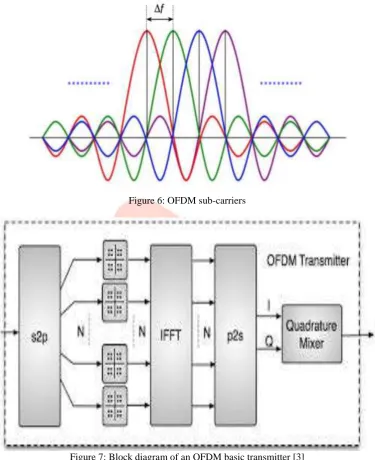
The basic concept of OFDM is based on FDM which is simply an early form of OFDM. FDM divide the stream of data into N smaller streams and then modulates them onto N narrow-band sub-carriers, instead of using the whole frequency band like in the case of single carrier modulation. The sub-carriers almost experience flat fading in a frequency selective channel as they are narrow band. The sub-carriers are separated by guard intervals so the carriers don’t interfere with each other as shown in figure 3.1, data can be recovered at the receiver using filters. The guard interval consumes a part of the frequency band affecting the bandwidth efficiency. OFDM improves the bandwidth efficiency and removes the guard intervals between sub-carriers. Sub-carriers in OFDM overlap but don’t interfere with one another as they are orthogonal as shown in figure 1. Two signals are said to be orthogonal over the period T if:
v u C v u dt t v t u v u T , , 0 ) ( ). ( , 0 (1)Figure1:Concept of OFDM Signal Equation below represents the mathematical equivalence of an OFDM signal:
T
t
t
v
N k
0
,
e
X
)
(
1 0 f k j2k (2)
where N is the number of sub-carriers, Xk is the data symbol transmitted on the kth sub-carrier and ∆f is the spacing between the
sub-carriers. For orthogonality ∆f must be equal to 1/2T.
IJEDR1602002
International Journal of Engineering Development and Research (www.ijedr.org)9
0
2 1
0
nf j N
n n
k
x
e
X
(3)0
2 1
0
1
N j nfn k
n
X
e
N
x
(4)The path between the transmitter and the receiver or the channel distorts the transmitted OFDM symbols causing ISI and ICI which affects the sub-carriers orthogonality, hence cannot be correctly demodulated at the receiver. Fig 2 shows the effect of the channel on one OFDM symbol and effect of the channel distortion on adjacent symbols and fig 3 shows how they can interfere with one another. Guard intervals where no information is sent are inserted between symbols to overcome ISI caused by the channel distortion as shown in fig 4. Still the ICI problem exists after adding the guard time. To get rid of ICI cyclic prefix is used instead of the guard intervals. For cyclic prefix the guard interval is replaced by a number of samples from the end of the OFDM symbol, this part added information and so it is ignored at the receiver. An OFDM signal with cyclic prefix is shown in fig 5.
Figure 2: Effect of channel on OFDM symbol [2]
Figure 3: Effect of channel on OFDM signal [2]
Figure 4: OFDM signal with guard intervals [2]
Figure 5: OFDM signal with cyclic prefix [2]
IJEDR1602002
International Journal of Engineering Development and Research (www.ijedr.org)10
to parallel and the cyclic prefix is eliminated. As the received data is still in time domain FFT is applied to convert it back to frequency domainFinally the data are mapped back to the original bits if possible; some bits are not mapped correctly due to the effect of the channel.
Figure 6: OFDM sub-carriers
IJEDR1602002
International Journal of Engineering Development and Research (www.ijedr.org)11
Figure 8: Block diagram of an OFDM basic receiver [3]III. DWT-OFDM SYSTEM
Wavelet refers to a small wave with limited duration. Wavelets form the basis of DWT. Unlike sine waves which form the basis of the Fourier transform, the wavelets are irregular, asymmetric and have limited durations. Wavelet transform provides variations in time-frequency resolutions due to the variation in it basis function in terms of frequency and scale as shown in fig 9 which is a major advantage over Fourier transform. The wavelet basis function divides the data into different frequency components and chooses the component that relates to its scale. It is clear from fig 9 that the wavelet basis function is divided into windows with variable sizes at different frequencies which causes the variation in time-frequency resolution, unlike the Fourier basis function that is divided into square windows of fixed sizes which doesn’t provide variation in time-frequency resolution as shown in fig 10
Figure 9: Wavelet basis function [4]
The variation in time-frequency resolution provides an infinite number of basis functions for wavelet transform but only one basis function for Fourier transform.
Figure 10: Fourier basis function [4]
IJEDR1602002
International Journal of Engineering Development and Research (www.ijedr.org)12
10
)
2
(
)
(
Nk
k
d
k
k
n
D
(5))
2
(
)
(
0 0
n
k
D
k
d
m n
k
(6)where
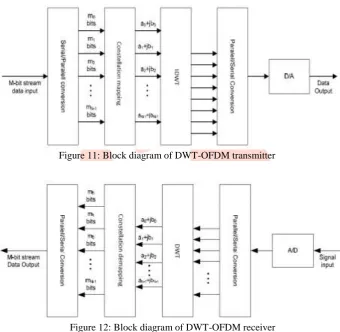
is the wavelet kernel and is selected according to the mother wavelet chosen. To practically implement DWT only two filter banks are required a low pass filter and a high pass filter; which makes the implementation simple in terms of complexity. The description of the DWT implementation is provided in chapter four. The only difference in the block diagram between DFT-OFDM and DWTDFT-OFDM is that the IDFT and DFT blocks in fig 7 and 8 respectively are replaced by IDWT and DWT as shown in fig 11 and 12 respectively. It is also clear that there is no cyclic prefix used in DWT-OFDM systems due to the overlapping properties of DWT; as well as that the side lobes in case of DWT contains very low data and that most of the data is carried in the main lobe, hence the amount of interference is very low .Figure 11: Block diagram of DWT-OFDM transmitter
Figure 12: Block diagram of DWT-OFDM receiver
IV. DIFFERENTIAL AMPLITUDE PHASE SHIFT KEYING
In this section the mapping scheme or the modulation scheme that is used in this paper is explained. DAPSK is a multilevel modulation technique. DAPSK is chosen as the modulation scheme as it doesn’t require any channel estimation or equalization at the receiver, which improves the complexity of the receiver compared to other modulation schemes. As any differential modulation technique DAPSK can be represented as follows:
k i k i k
i
B
S
S
,
,.
1, (7)IJEDR1602002
International Journal of Engineering Development and Research (www.ijedr.org)13
going to be referred to as b0, b1, b2, b3, b4 and b6. The first four bits are responsible for the phase modulation while the last two bits will be responsible for the amplitude part along with the previous modulated symbol as shown in equation 7.B
i,k in equation7 can be represented as shown in equation 8 for 64-DAPSK
q jk
i
a
e
B
,.
(8)q = 0 ...3 n = 0 ...15
=22.5where
a
q represents the four possible amplitude levels ande
j represents the sixteen possible phase states as shown from the constellation diagram presented in fig 13Figure 13: 64-DAPSK constellation diagram [5]
V.RESULTS
To evaluate the performance of the 64-DAPSK DWT-OFDM system and compare it to DFT-OFDM and DCT-OFDM systems, two evaluation parameters were used.
The first parameter is the bit error rate (BER), BER refers to the number of bits in error in the received signal compared to the transmitted signal. BER is measured at different SNRs, it is used to investigate the robustness of the signal to the channel impairments. The measured BER is then plotted against the SNR that it was calculated at to show the relationship between them. The BER is calculated by comparing the received signal with the transmitted signal and then dividing the number of bits in error by the number of total bits in the signal. The second parameter is the peak to average power ratio (PAPR); PAPR is a measurement of the variations in the signal’s envelope. PAPR is calculated as follows:
22
10
)
(
)
(
max
log
10
t
S
E
t
S
PAPR
db (9)where S(t) is the signal of interest. The PAPR is calculated for the transmitted and the received signal. The complementary cumulative distribution function (CCDF) was used to investigate the performance in terms of PAPR; the CCDF of PAPR can be defined as follows:
P(PAPR(dB) > PAPRth(dB)) (10) where PAPRth is the threshold value in dB
IJEDR1602002
International Journal of Engineering Development and Research (www.ijedr.org)14
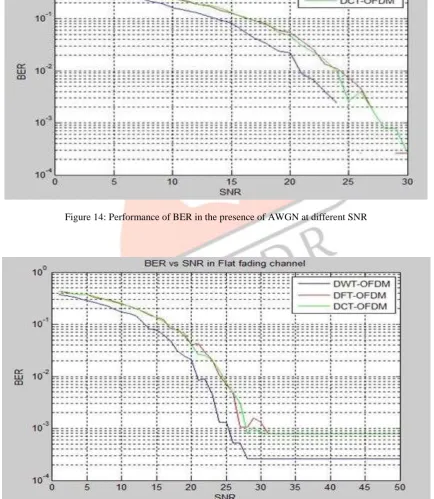
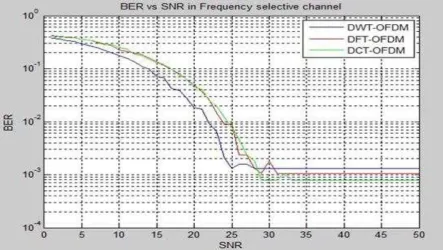
It is clear that in case of the presence of AWGN only the DWT-OFDM system outperforms the DFT-OFDM and DCT-OFDM systems by 5 dB at BER of 0.0001.The figure also demonstrates that both DFT-OFDM and DCT-OFDM systems have similar performance. The BER was also observed over a Rayleigh flat fading channel in the presence of AWGN in fig 15. The DWT-OFDM outperforms both the DFT-OFDM and the DCT-DFT-OFDM systems by about for 4 dB at BER of 0.001. Again DFT-DFT-OFDM and DCT-DFT-OFDM shows similar performance as each other. The performance over a Rayleigh multipath frequency selective channel in the presence of AWGN was also simulated. . Figure 16 shows the performance curves in terms of BER for the DWT-OFDM, DFT-OFDM and DCT-OFDM systems over the frequency selective channel.
It is observed that the DWT-OFDM system again outperforms both the DFT-OFDM and the DCT-OFDM systems by 3dB at BER of 0.001.
Figure 14: Performance of BER in the presence of AWGN at different SNR
IJEDR1602002
International Journal of Engineering Development and Research (www.ijedr.org)15
The performance curves of the DFT-OFDM and DCT-OFDM systems were almost the same at different SNRs.It is clear from that the DWT-OFDM over flat fading channel slightly outperforms the DWT-OFDM system over the frequency selective channel, it can be concluded that in case of flat fading the BER reaches the target of 0.001 at a SNR of 26 dB and at SNR of 28 dB in case of the frequency selective channel. This demonstrates the superiority of the DWT-OFDM system over flat fading channel when compared to frequency selective channel by approximately 2 dB
PAPR analysis for the the DWT-OFDM system is done by comparing the PAPR of the transmitted signal and the received signal for DWT-OFDM, DFT-OFDM and DCT-OFDM systems. In addition to demonstrating the effect of channel impairments at different SNR on the PAPR of the received signal. Figure (17) shows the CCDF of the PAPR for the DWT-OFDM, DFT-OFDM and DCT-DFT-OFDM transmitted signal. Figure (18) shows the CCDF of the PAPR for the DWT-DFT-OFDM, DFT-DFT-OFDM and DCT-OFDM received signal.For the transmitted signal the PAPR of the DWT-OFDM system is 5 dB lesser than in the DFT-OFDM system and 6 dB lesser that in the DCT-DFT-OFDM system. As for the received signal the PAPR of the DWT-DFT-OFDM system is 3 dB lesser than in the DFT-OFDM system and 3.5 dB lesser that in the DCT-OFDM system at a SNR of 10 dB. It is also clear that as the SNR decreases the PAPR increases.
Figure 16: Performance of BER over frequency selective channel in the presence of AWGN
IJEDR1602002
International Journal of Engineering Development and Research (www.ijedr.org)16
Figure 18: Comparison of PAPR for the DWT-OFDM, DFT-OFDM and DCTOFDM received signal at SNR of 10 dB.VI. DISCUSSIONS
The performance of the DWT-OFDM system adopting 64-DAPSK as the modulation scheme was evaluated using BER and PAPR. The results for both parameters were presented above.
The BER result shows that the DWT-OFDM system outperforms both DFTOFDM and DCT-OFDM systems over different channels. In the presence of AWGN the DWT-OFDM outperformed the DFT-OFDM system by 5 dB at BER of 0.0001. Over the flat fading channel and the frequency selective which are more practical than AWGN only the DWT-OFDM system also outperformed both DFT-OFDM and DCT-OFDM by 4 dB and 3dB at BER of 0.001 respectively. The reason for that is that the side lobes of the sub-carriers generated by DWT are much lower than those generated by DFT which makes it more immune to ISI.
The BER curves also showed that over flat fading channel the DWT-OFDM system has a better performance than when compared to the frequency selective channel by 2 dB at BER of 0.001 dB. In addition to the improved performance the DWT OFDM system is more bandwidth efficient as it does not need any cyclic prefix or guard intervals when compared to DFT-OFDM and the DCT-OFDM systems, Since the DWT sub-carriers overlap in both frequency and time domain. The BER results over the flat fading channel is very close to that in the frequency selective channel as the sub-carriers are narrow-band, so each sub-carrier in case of the frequency selective channel experience flat fading. The results proved that DWT-OFDM are more robust to channel impairment than DFT-OFDM and DCT-OFDM systems.
High PAPR is one of the main disadvantages of DFT-OFDM systems. The results show that DWT-OFDM systems have lower PAPR when compared to the DFTOFDM and the DCT-OFDM systems. The PAPR of the transmitted signal was lower in the DWT-OFDM system by 5 dB and 6 dB than in the DFT-OFDM and DCT-OFDM systems respectively. As for the received signal at SNR of 10 dB and after passing through a flat fading channel the DWT-OFDM gives a PAPR lower than that of the DFT-OFDM and the DCT-OFDM systems by 3 dB and 3.5 dB respectively. DWT based OFDM system adopting 64-DAPSK modulation proved that it outperformed DFT based OFDM systems in terms of BER and PAPR and that it can be a viable option to be considered instead of the conventional OFDM systems.
Using the 64-DAPSK reduced the implementation complexity of the receiver, as it doesn’t need channel estimation or equalization. DAPSK is a differential modulation and demodulation technique that compensates the channel effect on the signal without the need of any previous knowledge of the channel.
VII. CONCLUSION
The main aim of the paper was to evaluate the performance of a DWT based OFDM system adopting 64-DAPSK as the modulation scheme, given that no extensive work has been carried out on this specific topic. A literature review of existing material that is relevant to the topic of interest as well as a background overview on conventional OFDM, DWT-OFDM and DAPSK was presented.
IJEDR1602002
International Journal of Engineering Development and Research (www.ijedr.org)17
The BER results showed the superiority of the DWT-OFDM system over the DFT-OFDM system. In the presence of AWGN the DWT-OFDM outperformed the DFT-OFDM system by 5 dB at BER of 0.0001. Over the flat fading channel and the frequency selective which are more practical than AWGN only the DWT-OFDM system also outperformed the DFT-OFDM by 4 dB and 3 dB at BER of 0.001 respectively.The results of the PAPR showed that DWT-OFDM systems have lower PAPR when compared to the DFT-OFDM system. The PAPR of the transmitted signal was lower in the DWT-OFDM system by 5 dB than in the DFT-OFDM system. As for the received signal at SNR of 10 dB and after passing through a flat fading channel the DWT-OFDM gives a PAPR lower than that of the DFT OFDM system by 3 dB.
It was concluded that DWT-OFDM system with 64-DAPSK modulation is practical alternative to the DFT-OFDM system and can be considered in future wireless communication system.
ACKNOWLEDGMENT
First and foremost, I would like to thank The Almighty God who blessed me to overcome all the obstacles I came across while proceeding with this topic. I would also like to thank all other faculty members of Electronics and Communication Engineering Department for their support in this endeavour.I would like to express my heartfelt thanks to my beloved parents for their blessings, my friends for their help and wishes for the successful completion of this paper. Finally, yet importantly, I would like to thank the authors of various research articles and books that I referred to.
REFERENCES
[1] N. Neurohr and M. Schilpp, “Comparison of trans multiplexers for modulation multicarrier,” IEEE International Conference on Signal Processing (ICSP ’98), pp. 35–38, Oct. 1998.
[2]R. R. V. Rao, “Ofdm receiver synchronization for a dvb-h system,” Master’sthesis, San Diego State University, USA, 2010. [3] F. M. Gutierrez, “Implementation of a tx/rx ofdm system in a fpga,” Master’s thesis, Universitat Politecnica de Catalunia, Spain, 2009.
[4] A. Graps, “An introduction to wavelets,” IEEE Computational Sciences and Engineering, vol. 2, pp. 50–61, 1995. [5] V. E. H. Rohling, “Differential amplitude phase shift keying (dapsk)- a new modulation method for dtvb,” International Broadcasting Convention, pp. 102–108, Sep. 1995.
[6] A. Z. S. K. Abdullah and Z. M. Hussain, “On the DWT- and WPT-OFDM versus FFT-OFDM,” GCC Conference and Exhibition, IEEE, pp. 1–5, Mar. 2009.
[7] A. Deshmukh and S. Bodhe, “Comparison of DCT and wavelet based OFDM system working in 60 GHZ band,” International Journal of Advancements in Technology, vol. 3, pp. 74–83, Apr. 2012.
[8] M. Oltean and M. Nafornita, “Wavelet OFDM performance in frequency selective fading channels,” International Conference on Communications (COMM), pp. 343–346, Jun. 2010
[9] T. Nawaz and S. Baig, “Wavelet OFDM-a solution for reliable communication in a frequency selective rayleigh fading channel,” International Bhurban Conferenceon Applied Sciences and Technology (IBCAST), pp. 413–417, Jan. 2012.
[10] V. Kumbasar and O. Kucur, “Performance comparison of wavelet based and conventional OFDM systems in multipath rayleigh fading channels,” Digital SignalProcessing, vol. 22, pp. 841–846, Feb. 2012.
[11] V. Kumbasar and O. Kucur, “Better wavelet packet tree structures for papr reduction in wofdm systems,” Digital Signal Processing, pp. 885–891, 2008.
[12] S. Khalid and S. I. Shah, “Papr reduction by using discrete wavelet transform,” International Conference on Emerging Technologies (ICET), pp. 179–182, 2006.
[13] Y. H. X. L. Miao Liu, Ke Wang, “Reducing papr by selecting optimal wavelet tree structure in wofdm,” Computers and Electrical Engineering, pp. 253–260, 2011.
[14] S. L. Linfoot, “A study of different wavelets in orthogonal wavelet division multiplex for dvb-t,” IEEE Transactions on Consumer Electronics, vol. 54, pp. 1042–47, Aug. 2008
[15] C. Z. X. L. M. Gonga, H. Hana, “A low complexity two dimensional differential demodulation for ofdm systems,”
International Journal of Electronics andCommunications, vol. 65, pp. 893–900, 2011
![Figure 2: Effect of channel on OFDM symbol [2]](https://thumb-us.123doks.com/thumbv2/123dok_us/8331477.1380841/3.595.76.521.262.650/figure-effect-channel-ofdm-symbol.webp)
![Figure 10: Fourier basis function [4]](https://thumb-us.123doks.com/thumbv2/123dok_us/8331477.1380841/5.595.110.483.62.272/figure-fourier-basis-function.webp)
![Figure 13: 64-DAPSK constellation diagram [5]](https://thumb-us.123doks.com/thumbv2/123dok_us/8331477.1380841/7.595.98.542.228.527/figure-dapsk-constellation-diagram.webp)