University of South Carolina
Scholar Commons
Theses and Dissertations
2017
Assessment of Patient Satisfaction with the
Provision of Fertility Information in Women with
Lynch Syndrome
Rachel Elizabeth Hickey University of South Carolina
Follow this and additional works at:https://scholarcommons.sc.edu/etd
Part of theGenetic Processes Commons
This Open Access Thesis is brought to you by Scholar Commons. It has been accepted for inclusion in Theses and Dissertations by an authorized administrator of Scholar Commons. For more information, please [email protected].
Recommended Citation
Assessment of Patient Satisfaction with the Provision of Fertility Information in Women with Lynch Syndrome
by
Rachel Elizabeth Hickey
Bachelor of Science
University of Illinois at Urbana-Champaign, 2014
Submitted in Partial Fulfillment of the Requirements
for the Degree of Master of Science in
Genetic Counseling
School of Medicine
University of South Carolina
2017
Accepted by:
Emily Jordon, Director of Thesis
Travis Bray, Reader
Cristi Radford, Reader
Kristin N. Smith, Reader
Dedication
Acknowledgements
First and foremost, I would like to thank my parents for their unwavering support
and constant encouragement. Throughout my life, you have challenged me to reach my
full potential. There are not enough ways that I can express my appreciation of all that
you have done for me. Thank you for providing the support on which I built myself.
Thank you to my grandmother, Barbara Hickey. Without you, this document
would be riddled with grammatical errors and never-ending run-on sentences.
I would also like to thank my thesis advisor, Emily Jordon, and my committee
members, Cristi, Kristin, and Travis. I would not have reached this milestone
achievement without all your revisions, guidance, and commentary. I would also like to
thank Crystal Hill-Chapman for all of her support, advice and expertise in statistics.
Finally, thank you to Janice Edwards and the entire USC faculty for laying the
foundation for my genetic counseling career. Your dedication to my progress and success
has enabled me to thrive. And to my classmates, thank you for sharing your friendship,
devoted support, and impeccable comedic timing throughout these past two years- I will
Abstract
Lynch Syndrome (LS), one of the most common hereditary cancer syndromes, is
primarily known for its substantially increased risks for colorectal cancer. The incidence
of gynecologic cancers (endometrial and ovarian cancers) equals or exceeds the incidence
of colorectal cancers in female patients with LS. The prevention and treatment methods
for these cancers can drastically affect fertility and reproduction. Previous studies with
cancer patients have revealed challenges in acquiring information related to these topics;
thus far, no research has assessed whether there is an informational gap regarding fertility
information for women in the LS population. The purpose of this study was to identify
the amount of information received related to fertility and reproduction, assess patient
satisfaction, and characterize current practices of this information delivery within our
target patient population.
Data was collected from 154 women with LS. Likert scales were used to quantify
the amount of information provided about major themes pertaining to fertility in LS:
effects of cancer treatment, risk-reducing surgeries, fertility preservation and family
planning. Overall, participants were more satisfied when they received more information
about certain topics within these themes. There was a distinct lack of individualization in
patient care, and lack of uniformity regarding the provision of this information among
healthcare providers. Participant opinions indicate that genetic counselors may be an
untapped resource in the provision of fertility and reproduction information to this
Table of Contents
Dedication ... iii
Acknowledgements ... iv
Abstract ...v
List of Tables ... viii
List of Figures ...x
Chapter 1. Background ...1
1.1 Lynch Syndrome ...1
1.2 Implications of Lynch Syndrome on Fertility ...7
1.3 Informational Exchange between Healthcare Providers and Patients ...11
1.4 Fertility-Related Informational Needs in Hereditary Cancer Syndromes ...13
Chapter 2. Assessment of Patient Satisfaction with the Provision of Fertility Information in Women with Lynch Syndrome ...16
2.1 Abstract ...16
2.2 Introduction ...17
2.3 Materials and Methods ...23
2.4 Results ...27
2.5 Discussion ...40
2.6 Conclusions ...51
Chapter 3. Conclusions ...61
Appendix A. Invitational Flyer ...69
Appendix B. Facebook Post ...70
Appendix C. Survey Questionnaire ...71
List of Tables
Table 2.1 Participant Demographic Information ...53
Table 2.2 Additional Participant Characteristics ...53
Table 2.3 Amount of Information Provided and Participant Satisfaction: Cancer Risks and the Effects of Cancer Treatment ...54
Table 2.4 Information Provision between Individuals Affected with Cancer vs. Presymptomatic Carriers: Cancer Risks and the Effects of Cancer Treatment ...54
Table 2.5 Information Provision between Individuals who have Completed their Family vs. Individuals who have not Completed their Family: Cancer Risks and Effects of Cancer Treatment ...55
Table 2.6 Amount of Information Provided and Participant Satisfaction: Risk-Reducing Surgery ...55
Table 2.7 Information Provision between Individuals Affected with Cancer vs. Presymptomatic Carriers: Risk-Reducing Surgery ...56
Table 2.8 Information Provision between Individuals who have Completed their Family vs. Individuals who have not Completed their Family: Risk-Reducing Surgery ..56
Table 2.9 Amount of Information Provided and Participant Satisfaction: Fertility Preservation...57
Table 2.10 Information Provision between Individuals Affected with Cancer vs. Presymptomatic Carriers: Fertility Preservation ...57
Table 2.11 Information Provision between Individuals who have Completed their Family vs. Individuals who have not Completed their Family: Fertility Preservation ...57
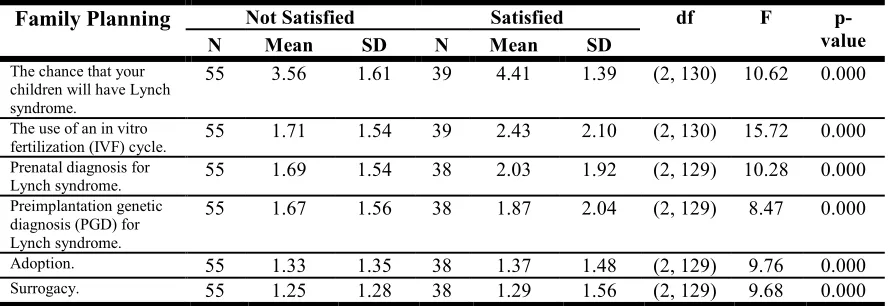
Table 2.12 Amount of Information Provided and Participant Satisfaction: Family Planning ...58
List of Figures
Figure 2.1 Healthcare Providers: Cancer Risk and Effects of Cancer Treatment ...59
Figure 2.2 Healthcare Providers: Risk-Reducing Surgery ...59
Figure 2.3 Healthcare Providers: Fertility Preservation ...59
Figure 2.4 Healthcare Providers: Family Planning ...60
Chapter 1. Background
1.1 Lynch Syndrome
A hereditary cancer syndrome is characterized by the inheritance of a genetic
variant that predisposes its carrier to the development of cancers. Distinguishing features
of hereditary cancer syndromes include an early onset of cancers, the occurrence of
multiple primaries in a single individual, and several generations of affected individuals
within a family. These syndromes account for 5-10% of all cancer diagnoses, and
contribute to significant morbidity and mortality rates in the populations affected (Nagy,
2004). In order to reduce the clinical consequences, it is important to identify carriers
through appropriate screening programs and genetic testing (Robson, 2003).
Confirmation of a positive genetic diagnosis will detect at-risk individuals, justify
increased surveillance, aid in medical management, and help in the decision-making
concerning family planning and prophylactic interventions (Giardiello, 2014).
Lynch Syndrome (LS) is one of the most common hereditary cancer syndromes,
with an estimated population prevalence of 1 in 400 (Nagy, 2004). It is characterized by a
predisposition to a spectrum of cancers, but primarily known for its substantially
increased risks for colorectal and endometrial cancer. The history of this syndrome began
in the early 1900s when Dr. Aldred Warthin, a renowned pathologist, observed a pattern
of gastrointestinal and uterine cancers occurring frequently in a large family [“Family
G”] (Warthin, 1913). The medical records and family pedigrees in his study provided
the time was still under scrutiny. In the 1960s, Dr. Henry T. Lynch encountered two
families [“Family N” and “Family M”] that featured an extensive, multi-generational
history of early onset colorectal cancer, among other cancers; this cancer burden was
similar to the family described by Warthin (Lynch, 1966). After studying the collective
data from the three families, Lynch proposed that the presence of a syndromic disorder
was responsible for the cancer manifestation observed (Sehgal, 2014) and coined the
name ‘Cancer Family Syndrome’ in 1971. Due to the increased risk for colorectal cancer,
the condition was renamed Hereditary Nonpolyposis Colorectal Cancer (HNPCC) in
1984, which differentiated it from the other major inherited colorectal cancer syndrome,
Familial Adenomatous Polyposis. However, HNPCC was deemed a misnomer, as there is
a wide variety of extracolonic cancers associated with this syndrome, and was
subsequently renamed Lynch Syndrome (Cohen, 2014).
LS is an autosomal dominant condition that increases lifetime risks for colonic
and extracolonic cancers; the proposed risk values depend on the genetic variant inherited
in a family, and the sex and age of the affected individual (Tiwari, 2016). LS accounts for
2-4% of all colorectal cancers (CRC) (Barrow, 2013), and affected individuals have as
high as a 75% lifetime risk of developing CRC. The median age of diagnosis is between
44-61 years of age, with approximately 50% of all CRC tumors occurring below the age
of 50. This age of onset is 20-25 years earlier than the onset in sporadic cases of CRC,
which is typically at age 70 (Cohen, 2014). The progression of these CRC tumors exhibit
an accelerated carcinogenesis: small adenomas will develop into carcinomas within 2-3
CRC in LS include the presence of synchronous and metasynchronous tumors, and an
increased incidence of tumors in the proximal colon (Lynch, 2009).
While CRC is a major clinical consequence in LS, affected individuals also have
substantial risks for extracolonic tumors. Female carriers of LS have a 15-61% risk for
developing endometrial cancer, which is much higher than the 1.7% risk of the general
population (Cohen, 2014; ACOG Practice Bulletin, 2014). The large risk range is due to
the fact that different genes confer differing risk values. Endometrial cancer in LS also
has an earlier age of onset at approximately 47-62 years, younger than the general
population’s typical age of onset at 70 (Cohen, 2014). LS accounts for 2% of all new
ovarian cancer diagnoses (Malander, 2006). The incidence of ovarian cancer in the
general population is 1.4%, but females with LS are at an increased risk for ovarian
cancer (approximately 6.7-12%), manifesting between the ages of 41-51 years (Cohen,
2014). Both male and female carriers have a 0.7-13% risk of developing gastric cancer,
which follows the trend of early onset. The lifetime risk for cancer of the urinary tract
(including the bladder, renal pelvis and ureter) ranges from 1.9-11.2%, again depending
on the genotype (Barrow, 2013). Individuals with LS are also at an elevated risk for
cancers of the hepatobiliary tract, small bowel, pancreas and CNS tumors. Furthermore,
there are variants of LS that are associated with specific cancer manifestations.
Muir-Torre syndrome was originally identified as a separate and distinct condition, but genetic
testing has proven its place on the LS spectrum. Muir-Torre syndrome is characterized by
a 9% risk for sebaceous neoplasms in addition to the other cancer risks in LS (South,
2008). The Turcot variant of LS features CNS tumors, particularly glioblastomas, in
LS is caused by a germline mutation in one of the genes involved in the DNA
mismatch repair (MMR) pathway: MLH1, MSH2, MSH6, PMS2, or EPCAM. The
function of the MMR proteins is to proofread the DNA for the presence of base-pair
mismatches or small insertions or deletions introduced by replication error, and repair the
mistakes. A compromised MMR system will result in the accumulation of somatic
mutations, eventually leading to carcinogenesis (Cohen, 2014). In particular, defective
MMR will cause variations within the microsatellites of the DNA. Microsatellites are
short repetitive sequences within the genome; microsatellite instability (MSI) is a
hallmark of LS tumors and is frequently used for patient evaluation (Umar, 2004). It is
estimated that 80-90% of all LS cases are caused by deleterious mutation in MLH1 and
MSH2, and the remaining 10-20% of cases are due to MSH6 and PMS2 mutations
(Giardiello, 2014). Approximately 3% of cases are caused by mutations in the EPCAM
gene. Although EPCAM is not an MMR protein, certain mutations of EPCAM can lead to
epigenetic silencing of the MSH2, resulting in a LS phenotype (Kempers, 2011).
Genotype-phenotype correlations have been elucidated in LS. Individuals with
MLH1 and MSH2 mutations have the highest incidence risks and the widest array of
possible cancer manifestations. Mutations in MSH2 also has the highest risk for ovarian
cancer, approximately 8-12% lifetime risk (Chen, 2007; Bonadona, 2011). Carriers of the
MSH6 mutation have the highest risk for endometrial cancer, at 16-61% lifetime risk
(ACOG Practice Bulletin, 2014). The cancer risks for the PMS2 mutation carriers fall at
the lower end of the previously listed ranges, at 15% (Cohen, 2014). Due to the close
interaction between EPCAM and MSH2, individuals with an EPCAM mutation have
For healthcare providers, it is important to note that LS features differing rates of
penetrance depending on the genotype, and variable expressivity of cancers between
family members with the same mutation (Cohen, 2014).
Genetic testing for LS is recommended for individuals who meet specific clinical
and pathological guidelines. The original Amsterdam Criteria stipulated that in order to
qualify for a clinical diagnosis of LS, an individual would need to have at least three
family members affected with CRC, two successive generations of affected individuals,
and at least one diagnosis of CRC before the age of 50 (Vasen, 1991). However, this
criterion did not account for the extracolonic manifestations of LS and was later revised
to require a family history of “LS-associated cancers” instead of just CRC (Vasen, 1999).
The Revised Bethesda Guidelines were developed to identify patients at risk for LS who
did not meet the Amsterdam Criteria, and included a MSI evaluation and
immunohistochemical staining (IHC) the individual’s CRC or endometrial tumor. If a
biopsy was found to have a high load of MSI, it would raise suspicion for the presence of
a germline MMR mutation. An IHC assay screens for the present or absence of MMR
proteins in the tumor biopsies, which can indicate the presence of a germline mutation
(Umar, 2004).
Identification of individuals at-risk for LS through these screening modalities and
subsequent cascade testing is extremely important, as screening and preventative
measures can be taken to improve overall morbidity and mortality. At-risk individuals are
referred to genetic counseling for education about the medical, psychological, and
familial implications of the disorder, the commencement of genetic testing, and the
detailed management protocols that can be implemented. The National Comprehensive
Cancer Network (NCCN) guidelines recommend increased surveillance for CRC through
annual colonoscopies. The commencement age for the colonoscopy does not differ by the
culprit gene: MLH1, MSH2, MSH6, PMS2 and EPCAM mutation carriers should begin at
20-25 years. Colonoscopies should begin 2-5 years prior to the earliest diagnosed CRC in
the family, and be repeated every 2-3 years. Screening for endometrial and ovarian
cancer can include annual endometrial sampling, serum CA-125 assays and transvaginal
ultrasound; however, there is no clear evidence supporting this screening, as the available
modalities do not have sufficient sensitivity or specificity. A prophylactic total abdominal
hysterectomy and bilateral salpingo-oophorectomy (TAH-BSO) is recommended as a
risk-reducing option after the completion of childbearing. There is no evidence
supporting screening for gastric and small bowel cancers, but select individual or families
may consider an esophagogastroduodenoscopy every 3-5 years beginning at 30-35 years.
An annual urinalysis beginning at 30-35 years will screen for cancers of the urinary tract.
A neurologic examination for CNS tumors can begin at 25-30 years. There are no
screening recommendations for cancers of the hepatobiliary tract and pancreas. Finally,
patients of reproductive age should be advised about options for prenatal diagnosis of LS
and assisted reproductive technologies (ART), as well as the risk for Constitutional
Mismatch Repair Deficiency syndrome (CMMRD) in offspring (NCCN, Version
1.2 Implications of Lynch Syndrome on Fertility
A diagnosis of LS can have significant implications on an individual’s fertility
and reproductive options. Individuals with LS are at a substantially increased risk for
developing early onset colorectal cancers. Treatment for CRC can include chemotherapy,
radiation therapy and surgical resection of the tumor. Different chemotherapeutic agents
will have different levels of gonadotoxicity. For example, adjuvant therapy with
fluorouracil (5-FU) will have little effect on fertility, but treatment with oxaliplatin may
cause irreversible premature ovarian failure (POF). Radiation therapy is commonly used
to treat rectal cancers, often given neoadjuvantly. The ovaries are extremely sensitive to
radiation, and the conventional cumulative dose of radiation will cause POF in most
women (Zbuk, 2009). Pelvic radiation can have obstetrical and neonatal consequences,
most notably increased rates of miscarriage, preterm labor, placental abnormalities and
low birthweight. These adverse outcomes are due to myometrial fibrosis, uterine
vasculature damage and endometrial injury (Wo, 2009). There may be inherent risks for
infertility associated with surgery for CRC. Postoperative adhesion formation in the
pelvis can alter the normal anatomic relationship between the uterine tubes and ovaries,
resulting in difficulties to conceive (Olsen, 2012).
A study conducted by Stupart et al. (2015) assessed the fertility rates of
unaffected MMR mutations carriers and affected carriers with a CRC diagnosis. For the
purposes of this study, “total fertility rates” was defined as the average number of
children a hypothetical cohort of affected women would have if they had children at the
population age-specific rate during their entire life. Total fertility for women with a CRC
appears to be a large reduction, the authors noted that the decision to have children is
influenced by many psychosocial factors. Nevertheless, cancer-related mortality and
morbidity, and effects of surgery and therapy can all be expected to play a role in the
decrease of fertility observed in women with CRC. It is also important to note that, while
fertility concerns may be incorporated as deciding factors, the exact management of CRC
should be tailored to each patient’s presentation, with the pros and cons of the chosen
treatments weighed accordingly (Zbuk, 2009).
The incidence of gynecologic cancers equals or exceeds the incidence of
colorectal cancers in female patients with LS (Mills, 2014). LS is responsible for a high
proportion of endometrial cancer cases diagnosed below the age of 45, approximately
9-12% (Dorais, 2011). In the treatment of gynecologic malignancies in young adults, the
interventions to spare fertility are concentrated on less radical surgery or a lower dose of
drug therapy to spare the reproductive organs as much as possible for subsequent fertility
(Lee, 2006). The standard treatment for endometrial cancer is a total abdominal
hysterectomy and bilateral salpingo-oophorectomy (TAH-BSO) with a retroperitoneal
lymphadenectomy (Dorais, 2011). Young women can pursue fertility-sparing options,
which entail a dilation and curettage of the lesion followed by non-gonadotoxic
chemotherapy or hormone management. The conservative approach to cancer treatment
is only available for low-grade tumors that are confined to the endometrium; any patient
who chooses this option must be informed of the risk of an undiagnosed synchronous or
metasynchronous endometrial tumor, and the increased risk for relapse (Bovicelli, 2012;
Hahn 2009). Alternately, immediate hysterectomy with ovarian conservation is another
the rate of concurrent ovarian cancer in patients with premenopausal women with
endometrial cancer is approximately 11-29% (Evans-Metcalf, 1998). This is likely
exacerbated in women with Lynch Syndrome, whose baseline risk of ovarian cancer
increased above the general population. The type of treatment will depend on the type of
ovarian cancer, but the main treatment is surgery with debulking, with or without
chemotherapy. The feasibility of fertility sparing surgery as a treatment for ovarian
cancer is still hotly debated; this is especially due to the fact that ovarian cancer is the
most lethal gynecologic malignancy and the majority of women present in advanced
stages (Ditto, 2014; Raja, 2012).
While endometrial surveillance may be effective, the value of surveillance for
ovarian cancer is still under debate (Helder-Woolderink, 2016). The sensitivity and
specificity of CA-125 screening is known to be poor, and ultrasound detection has many
limitations, including the variation in result interpretation (Rauh-Hain, 2011). The most
effective means of reducing cancer mortality is through risk-reducing surgery (RRS).
Women with Lynch Syndrome are recommended to consider a total abdominal
hysterectomy and bilateral salpingo-oophorectomy (TAH-BSO) upon the completion of
childbirth (NCCN, Version 2.2016; Chapman, 2015). However, the temporal pressure to
pursue RSS has been shown to be a cause of anxiety in women of reproductive age. A
study by Donnelly et al. (2013) assessed reproductive decision-making in young women
who were carriers of a BRCA1/2 mutation; these mutations will predispose individuals to
increased risk for breast and ovarian cancer. That study found that these perceived
pressures caused distress in the patients and complicated social relationships. In addition,
increased risk of cardiovascular disease, loss of bone density, vaginal dryness, mood
disturbances, and reduced libido (Chapman, 2015).
The field of fertility preservation is rapidly expanding to include multiple
experimental and non-experimental options for female patients. Gonadal shielding during
radiation or ovarian transposition (oophoropexy) away from the radiation field can be
executed to reduce the amount of radiation damage to the ovaries. This technique,
however, does not protect the uterus from radiation damage. Embryo and oocyte
cryopreservation are established fertility preservation methods. These techniques require
ovarian stimulation and harvesting, which can delay therapy, and involve expensive costs
based on insurance coverage (Lee, 2006). Ovarian tissue cryopreservation is an
experimental option that does not require ovarian stimulation, but does involve a
laparoscopic procedure; it is a potential option for patients who need to urgently undergo
aggressive therapy (ASRM, 2014). Fertility preservation options each come with risks,
advantages and disadvantages. Interdisciplinary cooperation between surgeons,
oncologists, gynecologists, reproductive endocrinologists and other healthcare providers
is necessary for at-risk patients so that individualized options can be offered in advance
of or concurrently with surgery or adjunctive treatment (Spanos, 2008). Some individuals
may be concerned about the familial transmission of LS; due to the genetic nature of the
condition, patients have a 50% chance of passing on their MMR mutation to their
offspring. Prenatal diagnosis can be offered to expectant couples to determine the
mutation status of a pregnancy. Preimplantation genetic diagnosis (PGD), offered in
1.3 Informational Exchange between Healthcare Providers and Patients
Providing patients and their families with adequate information concerning
treatment and care is an ongoing challenge in most healthcare organizations. Kullberg et
al. (2015) sought to evaluate patients’ opinions on information provision in oncology
wards. This study used patient satisfaction to measure the quality of care as perceived by
the patients. Researchers concluded that there are deficits in the information exchange
between hospitalized cancer patients and healthcare staff, and that adequate information
is a prerequisite for patient participation in their own care. The issue of insufficient
information exchange can therefore affect many areas of a patient’s care. Finney Rutten
et al. (2016) found that individuals affected with cancer report challenges acquiring
information for decision-making throughout their care. This study found that information
seeking among cancer patients has increased from 66.8% in 2003 to 80.8% in 2013, and
is likely to continue increasing. Another important finding was that the most frequently
listed first sources of information were healthcare providers and the Internet. Deficits in
information exchange may be due to providers not rising to meet the increased
information needs of their patients. It has been previously observed that communication
difficulties exist in regards to fertility in cancer. In a recent study, participants reported
that oncology care and fertility care were provided independently of each other, leading
to fragmentation in both care and information provision (Goossens, 2015).
The American Society of Clinical Oncology (ASCO) states that oncologists are
responsible to inform patients about the possible risks for impaired fertility associated
with their cancer treatment and refer interested patients to reproductive specialists (Lee,
reproductive age, and discovered that a least half have no memory of a discussion of
fertility at the commencement of their treatment. In the participants that did recall an
infertility discussion, most were dissatisfied with the quality and amount of information
provided. Another study by Strong et al. (2007) echoes a similar sentiment. This study
sought to quantify the incidence of fertility counseling in women of reproductive age
prior to treatment for colorectal cancer. Based on medical records, less than 20% of
women of reproductive age had documentation of counseling for post-treatment fertility.
An ASCO special article hypothesized reasons why oncologists may not disclose fertility
information: physicians are likely to prioritize discussions about immediate
complications of a cancer diagnosis instead of discussing the potential for infertility (Lee,
2006). If oncologists are not disclosing this information, it creates a knowledge gap for
patients. In some centers, a nurse specialist is able to fill this gap. Kelvin et al. (2016)
compared satisfaction with the amount of fertility-related information received between
reproductive-aged patients who did and did not receive counseling from a fertility clinical
nurse specialist. The study found that patients benefited from additional in-depth
counseling and education about fertility-related information. While the above evidence
listed is not specific to Lynch Syndrome, it is applicable to the care of patients with LS
due to their risk for early onset cancers that can influence their fertility. Oncologists and
other healthcare providers may be providing fertility-based information to LS patients
affected with cancer, but are likely not even in contact with presymptomatic carriers.
Genetic counseling is a recommended platform for the discussion of the cancer
risk and management options for patients diagnosed with a hereditary cancer syndrome.
of Lynch Syndrome with both at-risk patients and newly diagnosed cancer patients. Few
other healthcare providers are involved with the discussion of risks for presymptomatic
carriers as well as those affected with an LS cancer. Presymptomatic carriers are a
population that can take advantage of increased surveillance, RRS and family planning.
Genetic counselors are also involved with conversations related to reproductive concerns
for this population, including the risk of transmission to offspring and the option of PGD
(Biesecker, 2001). Previous research has revealed that cancer genetic counselors consider
discussions of fertility preservation to be a part of their role (Volk, 2012). Goetsch et al.
(2016) found that reproductive endocrinologists utilize genetic counselors for the care of
individuals with an inherited cancer syndrome in regards to fertility preservation and
PGD. Therefore, genetic counselors have a role in the fertility-related care of individuals
with an inherited cancer syndrome, and may be the best resource to bridge the knowledge
gap in regard to fertility for patients with LS.
1.4 Fertility-Related Informational Needs in Hereditary Cancer Syndromes
Another common hereditary cancer syndrome is the Hereditary Breast and
Ovarian Cancer Syndrome (HBOC), a condition that is caused by mutations in the
BRCA1 and BRCA2 genes. Mutation carriers have greater than an 80% lifetime risk for breast cancer and 40% risk for ovarian cancer by age 70 (Metcalfe, 2000). There have
been several studies that have evaluated fertility-related information concerns in the
and a need for better presentation of available fertility options. Another study by Kim et
al. (2015) evaluated patient knowledge of the clinical impact of a BSO and views of
fertility consultations in this patient population. It was noted that patients would benefit
from additional emphasis on fertility in all of their appointments with healthcare
providers, including genetic counseling. Studies in HBOC maybe generalizable to other
hereditary cancer syndromes, including LS. It may be a trend in hereditary cancer
syndromes that carriers need more accessible information regarding their fertility.
However, because there are different cancer risks between individuals with HBOC and
LS, there are different fertility concerns between these two populations. A practice
guideline released by the National Society of Genetic Counselors (NSGC) states that the
genetic counselor should include a provision of extensive client resources, including
information concerning fertility and reproductive choices, when counseling an individual
with a BRCA1/2 mutation (Berliner, 2012). There has not been a similar guideline released in regards to LS.
In comparison to the extensive amount of data collected on the informational
needs of BRCA1/2 carriers, very few studies have investigated the needs of patients with
LS. It can be expected that a deficit of information also exists in LS, but there is little
research available on this topic. Using data collected from support groups for LS, a study
by Corines et al (2016) advocated that increased knowledge empowers patients with LS
to take a proactive role in their own health management. A previous study by Bannon et
al. (2014) examined the educational and information needs of individuals with LS, but
this assessment did not explore the informational needs related to fertility and
population in order for adequate information provision. Of note, a study by Burton-Chase
et al. (2017) found that LS CRC survivors reported lower levels of satisfaction with their
healthcare providers than sporadic CRC survivors, particularly in regard to
communication. This noted lack of satisfaction may exist broadly for individuals with LS.
Current studies regarding fertility and reproduction in patients with LS have only
examined the attitudes towards reproductive decision-making for childbearing, prenatal
genetic testing and assisted reproductive technologies (ART). Dewanwala et al. (2011)
compared patient attitudes towards childbearing and prenatal testing before and after
genetic testing for LS. This study’s findings suggest that individuals with LS are
interested in prenatal testing and PGD, and would consider having children earlier to
allow for earlier RRS. Duffour et al. (2015) reported distress among MMR mutation
carriers in regards to reproductive-decisions making, and increased interest in ART a year
after genetic testing. These two studies prove that women with Lynch Syndrome are
interested in the topics of fertility and reproduction, but they do not identify how and
when these topics are being presented to patients. Thus far, there have not been any
studies conducted that assess the need for information pertaining to the fertility
Chapter 2. Assessment of Patient Satisfaction with the Provision of Fertility Information in Women with Lynch Syndrome
2.1 Abstract
Lynch Syndrome (LS), one of the most common hereditary cancer syndromes, is
primarily known for its substantially increased risks for colorectal cancer. The incidence
of gynecologic cancers (endometrial and ovarian cancers) equals or exceeds the incidence
of colorectal cancers in female patients with LS. The prevention and treatment methods
for these cancers can drastically affect fertility and reproduction. Previous studies with
cancer patients have revealed challenges in acquiring information related to these topics;
thus far, no research has assessed whether there is an informational gap regarding fertility
information for women in the LS population. The purpose of this study was to identify
the amount of information received related to fertility and reproduction, assess patient
satisfaction, and characterize current practices of this information delivery within our
target patient population.
Data was collected from 154 women with LS. Likert scales were used to quantify
the amount of information provided about major themes pertaining to fertility in LS:
effects of cancer treatment, risk-reducing surgeries, fertility preservation and family
planning. Overall, participants were more satisfied when they received more information
about certain topics within these themes. There was a distinct lack of individualization in
patient care, and lack of uniformity regarding the provision of this information among
untapped resource in the provision of fertility and reproduction information to this
population.
2.2 Introduction
Lynch Syndrome (LS) is one of the most common hereditary cancer syndromes,
with an estimated population prevalence of 1 in 400 (Nagy, 2004). LS accounts for 2-4%
of all colorectal (CRC) cancers (Barrow, 2013) and affected individuals have as high as a
75% lifetime risk of developing CRC (Cohen, 2014). The median age of diagnosis is
between 44-61 years of age, with approximately 50% of all CRC tumors occurring below
the age of 50. Female carriers of LS have a 15-61% risk for developing endometrial
cancer, which is much higher than the 1.7% risk of the general population (Cohen, 2014;
ACOG Practice Bulletin, 2014). The incidence of ovarian cancer in the general
population is 1.4%, but females with LS are at an increased risk for ovarian cancer
(approximately 6.7-12%). Similar to CRC, both the endometrial and ovarian cancers in
LS manifest at earlier ages than the general population. Additional cancers associated
with Lynch Syndrome include the risk for gastric, urinary tract, hepatobiliary, pancreatic
and CNS.
The risk values for the colonic and extracolonic cancers depend on the genetic
variant inherited in a family, and the sex and age of the affected individual (Tiwari,
2016). LS is caused by a germline mutation in one of the genes involved in the DNA
mismatch repair (MMR) pathway: MLH1, MSH2, MSH6, PMS2, or EPCAM (Lynch,
2015). Individuals with MLH1 and MSH2 mutations have the highest incidence risks and
highest risk for ovarian cancer, approximately 8-12% lifetime risk (Chen, 2007;
Bonadona, 2011). Carriers of MSH6 mutations have the highest risk for endometrial cancer, at 16-61% lifetime risk (ACOG Practice Bulletin, 2014). The cancer risks for the
PMS2 mutation carriers fall at the lower end of the previously listed ranges, at 15%
(Cohen, 2014). Due to the close interaction between EPCAM and MSH2, individuals with
an EPCAM mutation have similar CRC risks as MSH2, but a reduced risk for endometrial cancer (Kempers, 2011). For healthcare providers, it is important to note that LS features
differing rates of penetrance depending on which gene is mutated, and variable
expressivity of cancers between family members with the same mutation (Cohen, 2014).
A diagnosis of Lynch Syndrome can have significant implications on a woman’s
fertility and reproductive options, particularly due to the incidence and early onset of
CRC, endometrial and ovarian cancers. Treatment for CRC can include chemotherapy,
radiation therapy and surgical resection of the tumor, all of which can disrupt the fertility
of a patient (Zbuk, 2009; Wo, 2009; Olsen, 2012). There are inherent risks for infertility
associated with surgery for CRC, as postoperative adhesion formation in the pelvis can
alter the normal anatomic relationship between the uterine tubes and ovaries, resulting in
difficulties to conceive (Olsen, 2012). A study conducted by Stupart et al. (2015)
assessed the fertility rates of unaffected MMR mutations carriers and affected carriers
with a CRC diagnosis: total fertility for women with a CRC diagnosis decreased by
almost 40% in comparison to the unaffected group. While there are many factors that
influence the decision to have children, the effects of surgery and therapy for CRC are
The incidence of gynecologic cancers equals or exceeds the incidence of
colorectal cancers in female patients with LS (Mills, 2014). In the treatment of
endometrial malignancies in young women, the interventions to spare fertility are
concentrated on less radical surgery or a lower dose of drug therapy to spare the
reproductive organs as much as possible for subsequent fertility (Lee, 2006). Fertility
sparing options may be available for ovarian cancer, but its feasibility is still debated as
ovarian cancer is the most lethal gynecologic malignancy and the majority of women
present in advanced stages (Ditto, 2014; Raja, 2012).
While endometrial surveillance may be effective, the value of surveillance for
ovarian cancer is still disputed (Helder-Woolderink, 2016). The most effective means of
reducing gynecologic cancer mortality is through risk-reducing surgery (RRS), and
women with LS are recommended to consider a total abdominal hysterectomy with
bilateral salpingo-oophorectomy (TAH-BSO) upon the completion of childbirth (NCCN,
Version 2.2016). Choosing a TAH-BSO does come an array of disadvantages, including
the early onset of menopause (Chapman, 2015). Donnelly et al (2013) studied
reproductive decision-making in young patients with another hereditary cancer syndrome,
Hereditary Breast and Ovarian Cancer (HBOC), and found that the temporal pressures to
pursue RSS cause an increase in distress and social complications for the patient,
particularly in women who have not yet completed childbearing.
The field of fertility preservation can provide options for women in the LS
population; these options can offered in advance of or concurrently with surgery or
adjunctive treatment (Spanos, 2008). These options include gonadal shielding during
Women with LS also have options for reproductive decision-making. Prenatal diagnosis
can be offered to expectant couples to determine the mutation status of a pregnancy.
Preimplantation genetic diagnosis (PGD), offered in conjugation with an in vitro
fertilization (IVF) cycle, allows for the identification of embryos lacking the familial
mutation to be selected for implantation (Simpson, 2016).
Interdisciplinary cooperation between healthcare providers is necessary to offer
individualized options to at-risk patients, but providing patients with adequate
information concerning treatment and care is an ongoing challenge. Finney Rutten et al.
(2016) found that individuals affected with cancer report challenges acquiring
information for decision-making throughout their care. These communication difficulties
certainly exist in regard to fertility and cancer. In a recent study, participants reported that
oncology care and fertility care were provided independently of each other, leading to
fragmentation in both care and information provision (Goossens, 2015). Kelvin et al.
(2016) compared satisfaction with the amount of fertility-related information received
between reproductive-aged patients who did and did not receive additional counseling
about fertility options. The study found that patients benefited from additional in-depth
counseling and education about fertility-related information.
The American Society of Clinical Oncology (ASCO) states that oncologists are
responsible to inform patients about the possible risks for impaired fertility associated
with their cancer treatment and refer interested patients to reproductive specialists (Lee,
2006). However, Partridge et al. (2004) surveyed male and female cancer survivors of
reproductive age, and discovered that a least half have no memory of a discussion of
infertility discussion, most were dissatisfied with the quality and amount of information
provided. Another study by Strong et al. (2007) sought to quantify the incidence of
fertility counseling in women of reproductive age prior to treatment for colorectal cancer.
Based on medical records, less than 20% of women of reproductive age had
documentation of counseling for post-treatment fertility. An ASCO special article
hypothesized reasons why oncologists may not disclose fertility information: physicians
are likely to prioritize discussions about immediate complications of a cancer diagnosis
instead of discussing the potential for infertility (Lee, 2006). This hypothesis may be true
of other providers as well, such as gynecologists, reproductive endocrinologists, etc. If
healthcare providers are not disclosing this information, it creates an informational
disparity for patients.
Genetic counselors may be the best resource to bridge the knowledge gap in
regard to fertility for patients with LS. While oncologists and other healthcare providers
may be providing fertility-based information to LS patients affected with cancer, these
providers are likely not in contact with presymptomatic carriers, another group that
would benefit greatly by a discussion of the fertility risks in LS. Genetic counseling is a
recommended platform for the discussion of the cancer risk and management options for
patients diagnosed with a hereditary cancer syndrome, including presymptomatic carriers
and diagnosed cancer patients. They are equipped to manage conversations related to
reproductive concerns for this population, including the risk of transmission to offspring
and the option of preimplantation genetic diagnosis (PGD) (Biesecker, 2001). Previous
research has revealed that cancer genetic counselors consider discussions of fertility
reproductive endocrinologists utilize genetic counselors for the care of individuals with
an inherited cancer syndrome in regards to fertility preservation and PGD. Increased
emphasis by genetic counselors on topics related to fertility may benefits patients.
However, there is a lot unknown about the current practices in fertility information
provision; characterization of current practices is necessary in order to consider the
implementation new techniques.
The available research regarding informational needs about fertility and
reproduction in LS is limited. However, there have been several studies that have
evaluated the fertility-related information concerns of individuals in the HBOC
population. Quinn et al. (2010) found a strong desire for assistance with decision-making
and a need for better presentation of available fertility options. Another study by Kim et
al. (2015) evaluated patient knowledge of the clinical impact of a prophylactic BSO and
views of fertility consultations in the HBOC population. It was noted that patients would
benefit from additional emphasis on fertility in all of their appointments with healthcare
providers, including genetic counseling. These studies indicate that, overall, there needs
to be a more focused provision of fertility information to mutation carriers in HBOC. It
can be expected this fertility-related information deficit also exists for patients with LS.
Current studies regarding fertility and reproduction in patients with LS have only
examined the attitudes towards reproductive decision-making for childbearing, prenatal
genetic testing and assisted reproductive technologies (Dewanwala, 2011; Duffour,
2015). The available research indicates that women with LS are interested in the topics of
fertility and reproduction, but thus far, no research has assessed the information gap
sought to evaluate the current practices of information delivery by identifying the amount
of information received on specific topics related to fertility and reproduction, assess
patient satisfaction of the disclosure of this information, and identify ways to establish a
more comprehensive care regimen for women with LS.
2.3 Materials and Methods
Study Population
This research study collected quantitative and qualitative data from women with
LS. From this population, both presymptomatic women and women affected with cancer
were invited to participate. However, individuals were required to meet specific
eligibility criteria in order to proceed with the questionnaire. The eligibility criteria
ensured that only the opinions of the targeted patient population would be captured by the
study. Participants must have been diagnosed with LS at a reproductive age, which for
the purposes of this study is defined as between the ages of 18-45. Participants were also
required to have a known pathogenic mutation in an MMR gene; pathogenic mutations
are clinically actionable, and would therefore warrant the initiation of an appropriate
management protocol. Additionally, there was specific exclusionary criteria: participants
with a recent diagnosis who have not returned for a follow-up appointment with their
healthcare provider were excluded from this study, as their initial appointment may not
have covered all of the relevant information to pertaining to their diagnosis with LS.
Males were also excluded from participating in the questionnaire, as the fertility concerns
for LS differ between men and women. Eligibility and ineligibility were determined by a
ineligible were skipped out of the questionnaire using the branch logic function of the
survey programming software provided by SurveyMonkey.com.
Survey Distribution
Participants were recruited by an invitational flyer (Appendixes A and B) to take
the online survey. The principle investigator contacted different online support
organizations for individuals with cancer via e-mail to request participation. The e-mail
request explained the purpose of the research study and asked for assistance in
distributing the invitation and link for the online survey to its members. The invitation
was distributed through the following organizations: the Hereditary Colon Cancer
Foundation, I Have Lynch Syndrome, Inc., Lynch Syndrome International, and the
Oncofertility Consortium. The participating organizations circulated the invitations
through e-mailing lists, websites, Facebook pages, Twitter, and other mediums of
communication. The survey link was issued between September and October 2016, and
was available for completion through December 15, 2016.
Instrumentation
For this research study, an original online survey was developed through
SurveyMonkey.com. The principle investigator constructed the questionnaire (Appendix
C), which was comprised of both quantitative and qualitative questions, following a
mixed methods research model. Quantitative questions were used to measure categorical
information about the participants, while the qualitative questions were used to provide
deeper insight into the participants’ experience in regard to fertility and LS. The
questionnaire consisted of a series of multiple choice, Likert scale, and free response
information given to them by their healthcare provider(s) upon or after their diagnosis of
LS. Within the questionnaire, definitions were provided for some of the terminology used
in order to promote participant comprehension. The consent agreement was provided on
the first page of the questionnaire (Appendix D); in order to move forward in the
questionnaire, participants needed to indicate their consent.
Standard demographic information obtained related to the participant’s current
age, gender, level of education, relationship status, country and region of residency, and
ethnicity. The survey also included questions specific to LS in order to further categorize
the participants: age at diagnosis, relationship status at the time of diagnosis, familial
MMR gene, and whether or not the participant was affected with cancer at the time of
their diagnosis. The demographic and categorical data provided variables for correlation
studies during the statistical analysis.
The rest of the questionnaire was divided into four sections, which each focused
on a different aspect of fertility concerns in LS: effects of cancer treatment, prophylactic
surgery, fertility preservation, and family planning. All four sections had a similar
composition of questions. Each section had a Likert scale, which aimed at assessing the
amount information provided about specific topics related to the section heading. Other
questions in the sections evaluated additional features of information provision, such as
the timing of the information provision and the healthcare provider involved. The final
question in each section assessed the participant’s overall satisfaction with the
information provided for the topics; this part of the questionnaire format was adapted
from a previous study by Kelvin et al. (2016). For this question, participants could select
that section. Participants also had the option of providing additional comments at the end
of every section. The last series of questions in the survey focused on the utility of
genetic counseling for fertility-related information provision for women with LS.
Data Analysis
Statistical analysis for the quantitative data was conducted using Statistical
Package for the Social Sciences 24.0 (SPSS). While the four main sections of the
questionnaire were analyzed independently of each other, the same analyses were
conducted for each section. The primary assessment focused on how the amount of
information provided about specific topics modified the satisfaction of the participants;
this analysis was conducted via one-way ANOVA. The amount of information provided
was quantified by calculating the average response to each item in the Likert scale
questions; the response of each item was coded 1 (“I received no information about this
topic”) through 5 (“I received a lot of information about this topic”).
A series of additional one-way ANOVAs were conducted to assess for association
between the amount of information provided and other modifying variables. The
variables were dichotomous to allow for comparisons: individuals affected with cancer
vs. presymptomatic carriers, individuals who had completed childbearing vs. those that
had not completed childbearing, and a comparison between the gene implicated in the
family. Chi-Square for association tests were conducted to assess overall satisfaction
between difference groups of participants. Pearson’s correlation and descriptive statistics
were used to evaluate the rest of the data, including demographic information, and
information collected about healthcare providers, and topics discussed by genetic
Responses to the open-ended questions were analyzed through inductive analysis,
and organized based on common themes. The themes were coded by the principle
investigator and reviewed by all authors. Participants’ responses to these questions were
brief and covered a limited range of topics; however, they offered valuable insight into
the personal experience of the participants.
In order to maximize the amount of data collected in this study, partially
completed surveys were included in the data analysis. Participants needed to have
completed at least two out of the four sections to be included in the analysis
2.4 Results
Eligibility
Of the 274 individuals that began the questionnaire, 172 met the eligibility
criteria. Ineligible participants included men (N=2), minors (N=2), individuals diagnosed
with LS after the age of 45 (N=62), individuals without a known pathogenic variant in an
MMR gene (or EPCAM) (N=14), and individuals who did not return to their healthcare
provider after their diagnosis (N=9). Of the 172 participants who met the eligibility
criteria, 18 individuals did not complete at least two of the four major sections within the
questionnaire. This resulted in a total of 154 participants who were both within our target
population and had completed at least half of the questionnaire.
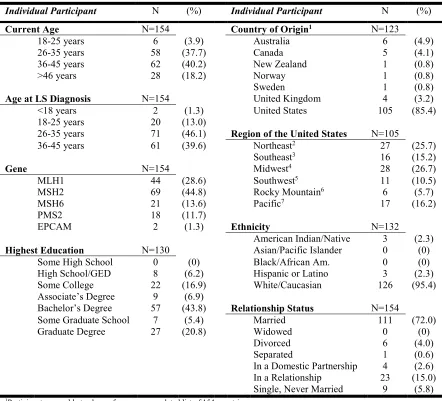
Demographics
The demographic information for the participants in this study is depicted in
Table 2.1. The majority of women who participated in this study were between the ages
living in the United States (85.4%). Almost half (46.1%) were diagnosed with LS
between the ages of 26-35. Participants were asked to report which gene was responsible
for their LS: MLH1 was reported by 28.6%, MSH2 by 44.8%, MSH6 by 13.6%, PMS2 by
11.7%, and EPCAM by 1.3%.
Most of the participants (61.7%, N=95) were presymptomatic at the time of their
diagnosis with LS, indicating that they had pursued predictive genetic testing (referred to
in this study as “presymptomatic carriers”). The remaining 38.3% (N=59) were
diagnosed with cancer before they were found to have LS (Table 2.2). Participants were
asked to report which cancer(s) they were diagnosed with: 58.8% reported colorectal
cancer, 19.1% reported endometrial cancer, 8.8% reported ovarian cancer, and 13.2%
selected “Other.” Those that selected “Other” reported a variety of cancers, including
breast, thyroid, and sebaceous carcinoma. Of note, many individuals reported multiple
cancers at early ages of onset, which is not unexpected within this patient population.
Participants were asked to report their status in family planning at the time of their
diagnosis with LS. Individuals who had completed their family prior to their diagnosis
accounts for 48.7% (N=75). The remaining 51.3% (N=79) had not yet completed their
family (Table 2.2).
Cancer Risks and Effects of Cancer Treatment
This section of the questionnaire collected data on the amount of information
provided to the participants about cancers risks and the effects of cancer treatment on
fertility. Skip logic was used to identify participants who have spoken with their
healthcare provider about the potential impacts of cancer treatment on fertility. Only
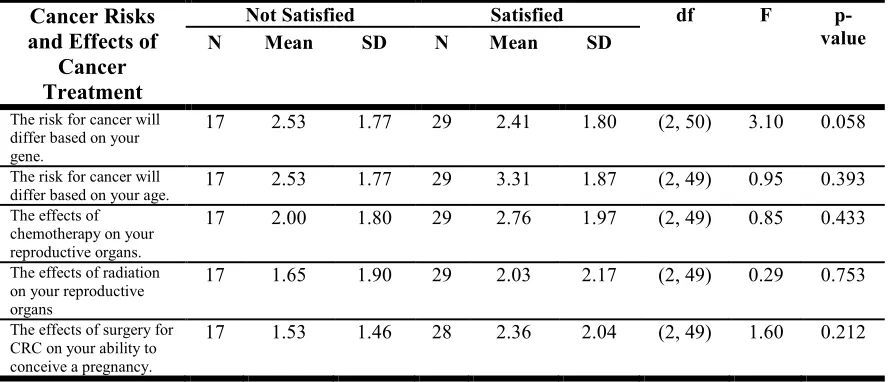
A one-way ANOVA was conducted to determine if the satisfaction status of the
participants was altered depending on the amount of information provided about a given
topic relating to cancer risks in LS and the effects of cancer treatment on fertility (Table
2.3). There was a trend towards statistical significance (p≤.05) for one topic (“The risk
for cancer will differ based on your gene”) [F(2, 50)=3.010, p=.058]: individuals who
received more information about this topic reported satisfaction with their experience.
A one-way ANOVA was conducted to identify whether or not there is a
difference in the amount of information provided about the topics in this section to
individuals that were affected with cancer at the time of their diagnosis with LS and
presymptomatic carriers with LS (Table 2.4). Statistically significant differences were
observed for one topic: “The risk for cancer will differ based on your gene” [F(1,
52)=4.828, p=.032]. Additionally, a trend toward statistical significance was noted for
“The effects of radiation on your reproductive organs” [F(1, 51)=3.513, p=.067]. For
these two topics, presymptomatic carriers received more information than individuals
affected with cancer.
A one-way ANOVA was conducted to establish whether there was a difference in
the amount of information provided between individuals who had completed their family
and those who had not completed their family at the time of their diagnosis with LS
(Table 2.5). There were no statistically significant findings observed.
A one-way ANOVA was conducted to examine whether or not there was a
difference in LS. There were no statistically significant findings observed.
In order to identify the healthcare providers involved in the provision of this
the provider(s) who discussed with them information about cancer risk and the effects of
cancer treatment (Figure 2.1). The majority of participants selected oncologist (33.0%,
N=29), and the second most frequently selected provider was genetic counselor (24.0%,
N=21). Only 2.0% of participants (N=5) reported that no healthcare provider discussed
the information with them. Next, the participants were asked to select the healthcare
provider was most effective at discussing this information: 43.0% of individuals selected
oncologist and 26% selected genetic counselor.
Pearson’s correlation was run to assess the relationship between the timing of the
information and participant satisfaction. There was a statistically significant negative
correlation (r2=-.386, p=.004) between these variables: individuals who received
information about these topics greater than 6 months after their diagnosis with LS were
less satisfied.
Finally, participants were asked to share any comments they had about this
section of the survey. Many participants reported that the treatment of their cancer took
precedence over every other concern (N=8). One participant stated:
“I was more overwhelmed with my cancer diagnosis and cancer treatment.
(Treatment) was a priority, but more information (about the effects) would have
been nice.”
Others participants revealed that they would have preferred a more focused discussion
about the effects on cancer treatment on fertility (N=5):
“I would have preferred to have had more of a conversation about my options
with a specialist in fertility. I also would have liked follow up appointment/s
Risk-Reducing Surgery
This section of the questionnaire collected data on the amount of information
provided to the participants about the risk-reducing surgical options for women with LS.
Skip logic was used to identify participants who have spoken with their healthcare
provider about risk-reducing surgeries. The majority of participants, 85.7% (N=132),
completed this part of the questionnaire. More than half (51.5%, N=68) reported that they
had some type of prophylactic surgery at the time of this questionnaire, and 58.8%
(N=40) of those participants were presymptomatic carriers.
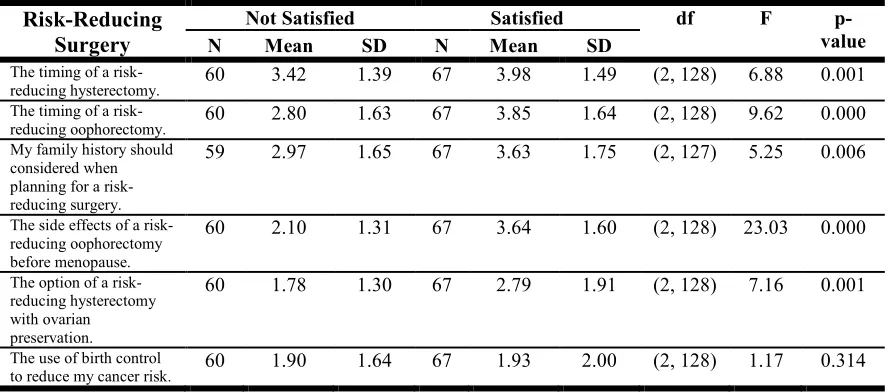
A one-way ANOVA was conducted to determine if the satisfaction status of the
participants was altered depending on the amount of information provided about a given
topic relating to risk-reducing surgery options (Table 2.6). Statistically significant
differences were observed for five of six topics: “The timing of a risk-reducing
hysterectomy” [F(2, 128)=6.875, p=.001], “The timing of a risk-reducing oophorectomy”
[F(2,128)=9.617, p=.000], “My family history should be considered when planning for a
risk-reducing surgery” [F(2,127)=5.247, p=.006], “The side effects of a risk-reducing
oophorectomy before menopause” [F(2,128), p=.000], and “The option of a risk-reducing
hysterectomy with ovarian preservation” [F(2,128)=7.160, p=.001]. For these topics,
individuals who received more information about this topic reported satisfaction with
their experience.
A one-way ANOVA was conducted to identify whether or not there is a
difference in the amount of information provided about the topics in this section to
individuals that were affected with cancer at the time of their diagnosis with LS and
observed for two topics: “The option of a risk-reducing hysterectomy with ovarian
preservation” [F(1, 130)=4.828, p=0.32], and “The use of birth control to reduce my
cancer risk” [F(1, 130)=4.183, p=.043]. For these two topics, presymptomatic carriers
received more information than individuals affected with cancer.
A one-way ANOVA was conducted to establish whether there was a difference in
the amount of information provided between individuals who had completed their family
and those who had not competed their family (Table 2.8). Statistically significant findings
were observed for two of the six topics: “The side effects of a risk-reducing
oophorectomy before menopause” [F(1, 130)=5.861, p=.017], and “The use of birth
control to reduce my cancer risk [F(1, 130)=9.473, p=.003]. For these topics, individuals
who had completed their families received more information than individuals who had
not completed their family.
A one-way ANOVA was conducted to examine whether or not there was a
difference in the amount of information provided to the participant based on the gene that
caused their LS. There were no statistically significant findings observed.
Participants were provided a list of healthcare providers and asked to select the
provider(s) who discussed with them information about risk reducing surgeries (Figure
2.2). The majority of participants selected gynecologist (35.0%, N=77), and the second
most frequently selected provider was genetic counselor (33.0%, N=73). Only 1% of
participants (N=3) reported that no healthcare provider discussed the information with
them. Next, the participants were asked to select the healthcare provider was most
effective at discussing this information: 41.0% of individuals selected gynecologist, while
Pearson’s correlation was run to assess the relationship between the timing of the
information provision about risk-reducing surgeries and participant satisfaction. There
were no statistically significant findings.
Participants were asked to share any comments they had about this section of the
survey. One theme that emerged is that, prior to having a risk-reducing surgery, there was
very little discussion about post-surgery quality of life (N=11). Many individuals
reported that they felt that the symptoms of surgical menopause had not been adequately
communicated to them.
“I did not feel like I had enough information on menopause (or) hormone
replacement options instead (of surgery).”
Another theme was the pressure to pursue surgery (N=8). One participant shared:
“I guess I was made to feel that I didn't have much of a choice if I wanted to avoid
cancer. It was presented along the lines that there was no "reason to keep those
organs" since I was finished having children. I was made to feel that I was lucky
to have not been diagnosed with cancer so far, so (I should) have everything
removed immediately.”
Another participant said:
“I did not have cancer but consulted with a gynecologic oncologist. I could tell
she was unhappy with my decision to keep one ovary.”
Fertility Preservation
This section of the questionnaire collected data on the amount of information