Theses and Dissertations
2018
Why Is No One Getting A Weave Of An Afro:
Examining Culture, Economy, And Domestic
Human Hair Consumption By African American
Women
Brittani Young
University of South Carolina
Follow this and additional works at:https://scholarcommons.sc.edu/etd Part of theGeography Commons
This Open Access Thesis is brought to you by Scholar Commons. It has been accepted for inclusion in Theses and Dissertations by an authorized administrator of Scholar Commons. For more information, please [email protected].
Recommended Citation
by
Brittani Young
Bachelor of Arts
Sam Houston State University, 2016
Submitted in Partial Fulfillment of the Requirements
For the Degree of Master of Arts in
Geography
College of Arts and Sciences
University of South Carolina
2018
Accepted by:
Conor Harrison, Director of Thesis
Jason Cummings, Reader
Amy Mills, Reader
ABSTRACT
The market for human hair, in the form of wigs and hair weaves, has grown
exponentially, with African American women comprising a significant portion of
consumers in the United States. Similar to other markets, the structure and patterns of
hair consumption by African American women is the result of a variety of historical and
geographical factors. In this thesis I investigate the role of African American women in
the global human hair trade, and consider the implications of contemporary discourses
around ‘good’ and ‘black’ hair in order to better understand trade in human hair. In
particular, I use a combination of interviews with African American women – exploring
what I term hair journeys – with observations in beauty salons and document analysis as
a way of connecting the dynamic spaces of production and consumption in the human
TABLE OF CONTENTS
ABSTRACT ... iii
INTRODUCTION ...1
CHAPTER 1: THE HUMAN HAIR TRADE ...14
CHAPTER 2: BRONNER BROTHERS ...29
CHAPTER 3: BEAUTY IN THE STRUGGLE ...44
CONCLUSION ...72
INTRODUCTION
Mary told me about her hair journey in a Starbucks on a hot Sunday afternoon
after her church service in August 2017. As a Black women, she told me, “professionally,
you have to worry about your hair, personally, you have to worry about your hair,
whether it’s like dating or just for you or working out.” As Mary, an African American
woman in her mid-twenties, described it, hair becomes wrapped up into the key social
experiences of all women. However, for Black women, having kinky and curly locks has
long been a source of tension, and the conversation surrounding black hair is often rooted
in popular discourses that deem black hair unacceptable and unpolished. Common biases
view natural black hair as unprofessional or less beautiful, especially when compared to
fine straight hair. This view is pervasive. A report by NPR (2017) used data from the
“Good Hair Study” that indicates there is still implicit bias against black hair that comes
from both whites and blacks. In general, it is more likely that lighter skinned Black
women with looser curls and finer hair are celebrated because their hair is seen as more
desirable or pleasant. In short, they have “good” hair.
Celebrating good hair comes at a cost. Over the years, the representation of kinky
and curly hair textures in the media has been associated with Black rights advocates or
someone who can be seen as militant. Further, various television series, movies, and
commercials depict darker skinned Black women as unaccepting of their natural hair
texture, preferring to either straighten their hair or wear wigs and weaves. Portrayals of
which Black women are allowed to wear their hair in either the workplace or in
their personal life. Recently, however, “naturalistas”, that is, women who wear their hair
in ways that are unaltered, have begun taking back what it means to have Black hair and
are starting to be represented in higher numbers in the media, thus influencing the Black
beauty market.
Yet the Black beauty market represents a multi-billion dollar industry that
remains largely predicated on helping women attain what has historically been viewed as
good hair. In general, there are two types of consumers that define the Black beauty
market: the consumer who buys into natural hair care, and the consumer who spends their
money on human hair extensions for the purpose of weaving and wigs, many of which
are made from human hair. This second market is the primary focus of this thesis. The
United States is one of the largest global consumers of human hair, with African
American women comprising a significant part of the group of human hair consumers
(Berry, 2008). My research investigates why this is the case. In particular, in this thesis I
examine why a market for human hair exists in African American communities, and
further, what cultural, social and economic processes influence the geographies of the
human hair trade both domestically and globally.
The question of identity is central to the human hair trade, and is therefore central
to this thesis. Through processes of racism and exclusion, African American women have
long been forced to conform to the dominate perceptions of beauty through various
modification has given rise not only to a demand for raw hair typically sourced from
India, but also, as I demonstrate in this thesis, a thriving domestic economy of hair
importers, stylists, and African American female entrepreneurs.
In the remainder of this introduction I will provide additional background on
some previous work on Black hair. I then provide an overview of my theoretical
approach (which are further developed in each chapter), which draws on scholarship in
economic geography on commodity chains as well as research on the cultural and social
networks that drive the consumption of commodities. I then end with a brief description
of the chapters that comprise this thesis.
Black Hair
Much of the previous scholarship on hair examines the cultural and societal
dynamics that play a part in the construction of the identity of Black Americans, and
particularly women (Banks, 2000; Byrd & Tharps, 2001; Caldwell 1991). In this work,
interviews and ethnographic work with African American women provide important
insights into the ways in which hair can be a personal and emotional aspect of their lives.
This work demonstrates the deep relationship Black women have with their hair, and
more importantly, how this relationship is reflected and influenced by the day to day
reality of their lives.
Black hair – because of the physical characteristics that defines it - has long been
an important historical actor. Carney (2001), for example, captures stories of slave
women hiding rice grains in their hair that they would later cultivate as rice crops in the
Americas. In another account, Byrd & Tharps (2001) trace the history of Black hair from
the way people perceive Black hair in society. For example, in Africa, Black hair was
used as a marker for tribal status. As Europeans enslaved Africans, their capturers often
shaved their head for sanitary measures, but in doing so stripped Africans of their tribal
status. Over time, Black hair grew increasingly subordinate to White textured hair. In the
Americas, as racial mixing arose and new mixed textures of hair proliferated, a
continuum of what good hair is developed. What Byrd & Tharps’ (2001) work makes
clear is the way in which historic incidents shape contemporary perceptions of Black hair.
In addition, these historic experiences with Black hair are central to the ways in which
Blacks learned to manage their locks during periods of enslavement and in the years of
segregation that followed.
Harris & Johnson (2001) provide a collection of hair stories that tells the tale of
what hair means to Black women, men, and for society. This work encapsulates the
diversity in the relationships that Black women (and men) have with their hair, often
described as a love-hate tug of war, each of the personal accounts highlight some of the
internal conflict that is experienced by Black individuals. Harris & Johnson use
qualitative approaches to investigate personal perceptions of Black hair as well as to
highlight the cultural contexts by which hair is shaped in African American communities,
most often in relation to dominant perceptions of Eurocentric beauty. In this thesis I draw
on interviews from a group of Black women to better understand the black beauty
economy and the global human hair trade.
In another study, King & Niabaly (2013) follow 12 African and African American
women who vary in their hair care to understand the motivations behind the way in which
management, and ethnicity influenced hair choices. As the chapters that follow show,
many of the same conclusions emerge from my own interviews.
In sum, the perceptions of natural hair by Black women is in many ways
contingent upon the way White people have disapproved of Black hair, which in large
part stems from the capture and colonization of their African ancestors. In addition, hair
has become ritualized in the Black community. This ritualization has put a cultural
emphasis on Black hair that ties hair to identity. Hair therefore is a conscious component
of the everyday for Black women that affects both personal and professional experiences,
and that influences the way that women chose to style their hair.
The geography of commodities
More than simply a product that is produced or consumed, Hopkins and
Wallerstein (1994) suggest that commodities, in their final state, are a product of both
human and non-human actors connected across space. Geographic studies of commodity
chains aim to trace the processes by which commodities acquire value as they move
through space, thereby aiming to unveil the conditions of production, labor, and
exploitation at each stop. The interest among critical geographers in studying commodity
chains originates in part from attempts to understand what Marx calls the commodity
fetish. Commodity fetishism is the idea that the conditions of production and labor
become masked by the exchange process and consumption of commodities. Masking
production thereby allows commodities to exist without knowledge of the social relations
that are consistently reproduced by the consumption of a product (Goldman, Heath, &
In introducing the concept of the commodity fetish, Marx first suggests that a
commodity is composed of two types of values, a use value and an exchange value. The
use value is the usefulness of a commodity, the value that exists before it gets looped into
a process of exchange. The exchange value, on the other hand, emerges as the product
acquires monetary significance through its literal exchange. While the use value of the
commodity remains clear after the exchange, what becomes an illusion at the point of
exchange are the conditions of production and labor that created the commodity. Where
the commodity fetish obscures the conditions of labor and treatment of the environment,
a commodity chain analysis attempts to explore and critically assess these conditions
(Bair, 2008; Cook et al., 2004).
There are numerous examples of commodity chain research. Mintz (1985), for
example, conducted an empirical study of sugar that illuminated the very conditions of
production and labor that helped produce and sustain the sugar economy. It was through
an investigation of the production and labor that Mintz analyzed the social conditions that
influenced the sugar trade, which in turn revealed various conditions of power and
cultural shifts that have structured sugar’s role in modern day society. Mintz’s work is
most significant for my thesis in the way it links conditions of production and
consumption, as his work assesses the implications sugar had on culture by continuing
the analysis beyond the point of purchase. In Mintz’s account, sugar had already existed
as a product for high-class individuals and was then globalized in order to produce larger
amounts for global consumption, reflecting a shift in the cultures of consumption around
global commodity whose exchange and meaning is in part produced through historical
and contemporary contexts of hair in African American communities.
In another example of commodity chain research, Cook et al. (2004) analyze the
commodity chain of the papaya and its movements across the globe. Their analysis
highlights the key points of trade through a series of brief occurrences that structure the
overlapping and larger narrative of how the papaya moves. Through Cook et al.’s
commodity centered analysis it become apparent that the papaya connects “those
unknowing of each other through international trade” (Cook et al., 2004, pg. 1). Cook et
al.’s work helps in thinking through social processes that chug the papaya chain along,
demystifying and connecting the global connections between those actors involved in
producing the papaya commodity chain.
What both Mintz and Cook et al.’s analysis highlights are the insights gained
through a detailed study of commodities. While both Mintz and Cook et al. focus on
food, their core ideas and questions are a frame for my research. In short, who is
producing the hair that enters the human hair trade? What kinds of social relations frame
this production? How do these social relations construct a consumer identity, and for
who? And how does consumer identity feedback into the commodity chain and shape the
conditions of production?
In addition to analyzing and linking the social conditions of consumption and
production at each site in a commodity chain, it is also important to understand the
dynamics within a particular chain. Understanding these dynamics requires an
2008). That is to say, we need to uncover and assess the power and agency that moves
along the chain as the commodity itself moves.
The focus of my research is to illuminate some of the social and geographic
processes of labor, production, and consumption that exist along the global trade of
human hair. As the previous section describes, some of this work has already occurred.
Yet as Bair (2008, pg. 19) states, “the most careful operationalization of the chain
concept and the most rigorous empirical analysis will yield only a partial perspective on
the dynamics of production and exchange.” This holds true for three empirical studies
that focus specifically on the global human hair trade (Berry 2008; Nahavandi, 2016;
Tarlo 2016).
Berry’s (2008) work researches the transnational trade of human hair, and is one
of the very few studies that have analyzed the conditions of production and labor in the
human hair trade. In this account, Berry connects first world consumers with third world
producers by tracing a Rome, Italy-based company called Great Lengths International
that distributes 100 percent human hair extensions to 50 different countries. Berry’s
research digs into the origins of human hair, and follows it as it is shipped from the floor
of Indian hair temples, as she calls them, to processing factories in China hair is stripped
of its black color and dyed to various lighter shades (blondes, browns, etc.). However,
while Berry works to unveil the trade of what she terms the ‘zombie commodity’, her
work stops short of examining why a market for human hair exists, and particularly, an
investigation of the market in the United States. While Berry (2008, p. 67) states that “A
large portion [of women] are black, particularly in North America, where extensions are
devoted to the consumption of hair by mainly white Europeans, and therefore does not
address the social and historical contexts in which African American women consume
human hair.
In a second key analysis of the human hair trade, Nahavandi (2016) argues that
human hair, extracted from the Global South, should be perceived as a resource. She
examines the demand for hair, noting that human hair is being used for the production of
wigs, and emphasizes the marginal difference in price collected by those producing the
hair and those consuming the hair. In her chapter on the transnational hair trade,
Nahavandi argues that the consumption of human hair is exploitive to Indian women who
are the source of supply. The price of hair in the market is multiple times the rate at
which Indian women are paid, if they are paid at all, for their hair. In addressing the
culture of black hair, Nahavandi notably cites an advertisement from Kacolema, a hair
wig company, which states: “If people of color decide to use hair relaxers, for example,
then serious health implications can result such as permanent hair damage. If people of
color decide to go natural, then they are subject to being stereotyped as too left of center
politically, socially or both. We empower our clients to escape this dilemma by being the
best at our craft and offering a healthy medium” (Kacolema, 2013). While this insight
illuminates some of the cultural reasons African American’s consume human hair,
Nahavandi (2016) does not detail and provide literature that supports the claims made by
Kacolema. Nahavandi, like Berry, hints at the significance of human hair for African
American women, but in this short chapter fails to expand on what social and historical
Finally, Tarlo (2016) provides an ethnographic analysis of the global trade of
human hair, traveling to understand the journey hair takes as a global commodity. Her
work touches on unique aspects of the commodity trade that had yet to have been
accounted in detail. Illuminating the individual cultural dynamics that hair globally
embodies, Tarlo brings forward the “secret life” hair lives through the various avenues
hair dominates as a commodity for gifts, cosmetics, extensions and others. In her work,
Tarlo seeks to understand the global hair chain by immersing herself into the networks
that move the chain along. Tarlo (2016) shares stories of her encounters, some in which
she visits factories that process human hair and witnesses the manual work of the trade,
while others speak with merchants of the trade to understand some of the reasoning
behind the business. In addition Tarlo provides a history of the buying and selling of
human hair as well as a background on the uses and value of hair in certain cultures, one
of them being Black hair. In sum, Tarlo’s (2016) research works well at uncovering
harvesting and manufacturing details of the trade that are important to understanding, in
part, my examination of consumption of human hair by Black Americans.
Research Questions
In this thesis, I seek to answer, at least in part, the following research questions in
order to assess African American women’s role in the human hair trade, the social and
dynamics that are within the trade, and the link between consumption and production of
the hair trade:
1. What factors influence the way African American women choose to style their hair?
2. How do African American entrepreneurs in the hair industry fit into the overall
Methods
This thesis draws on data obtained by interviews, observations, and secondary
source data conducted from July to December 2017. The interview data comes from 15
semi-structured interviews I conducted with African American women in Columbia,
South Carolina. Participant population was sampled from women who are affiliated with
the University of South Carolina either as employees or as undergraduate or graduate
students. Participants were selected through a convenience sampling method, and were
aware of the basic interests of my research before consenting to interviews. These
interviews focused on how African American women define their identity in relation to
hair and hair weaves, thus highlighting the themes and structures that construct identities.
Further, these interviews helped me to develop a deeper understanding of the
complexities typical to the formation of identities, and to understand the connections
between physical appearance, race, identity, and notions of beauty that may be
manipulated by hair weaves and wigs. Interviews lasted from 45 minutes to an hour and
were conducted at the location of the participants choosing, most often in public settings
like coffee shops around the University campus. This environment was conducive to the
ambiance of the interview, which was relaxed and conversational. It is important to note
that class and education play a large part in the identity of these women. The social lens
through which they construct their views and interpret the world is based upon their class
status, which is also influenced by education levels. Given the population sample, my
research is limited by the lack of diversity in class and social status amongst these
In addition to the interviews, I draw on data from observations I conducted at the
Bronner Brothers International Beauty Show in Atlanta, Georgia. Bronner Brothers is the
largest domestic beauty show in the United States. Founded by Black Americans, the
international beauty show hosts hundreds of entrepreneurs of the Black beauty business
in Atlanta, Georgia. These observations provided insight into questions around the
commodity chain of human hair, and particularly the crucial question of why African
American women play a large part in the composition of the human hair trade in North
America. Observation data was also used to understand Black beauty entrepreneurship in
relation to recent cultural economic geography scholarship.
Lastly, I draw on secondary data drawn from industry databases (IBISWorld,
Passport, and Business Monitor International) in order to perform in-depth research of
companies that are a part of the human hair trade. Additional data is derived from global
trade databases (e.g., UN Comtrade Database) to analyze human hair trade statistics and
to reconstruct, at least in part, the global flows of the hair trade.
Chapter Outlines
My research investigates the global human hair trade with a particular focus on
the consumption of human hair, and with the goal of illuminating questions of identity,
spaces of belonging, and ethnic entrepreneurship that surround the consumption end of
the global human hair trade. This empirical analysis detangles the bundle of social
relations that shape the consumption of an unruly and certainly tangled up resource.
Chapter One draws on previous research on the hair commodity chain while also
using secondary data sources to reconstruct the broad contours of the human hair
and its key players. I then scale the focus down to look at domestic examples of the hair
trade, highlighting themes of informality and invisibility that shape the industry.
The second chapter centers on the observations recorded at the Bronner Brothers
International Beauty Show in order to highlight both Black beauty entrepreneurship and
scholarship on cultural economy. In this chapter I examine the ways in which production
networks are produced as a part of a cultural commonsense, and how the proliferation of
the Black beauty market has been sustained through this by using the international hair
show as an example.
Chapter Three provides insights into the way hair structures the identity of
Blacks. In this chapter I use 15 semi-structured interviews with African American women
to understand how these women understand their identity and life through hair in what I
call hair journeys. Key findings in this chapter are the temporal structure of participant’s
hair journeys. This temporal structure help understand how participants’ consciousness
about their hair evolves throughout their lives.
In the conclusion I end with a discussion of the contributions and limitations of
my research and additionally, what can be done to further the research on understanding
CHAPTER 1
THE HUMAN HAIR TRADE
Faith began crafting and selling wigs made of human hair for women across the
United States and the world in 2016. When asked how she began her business she
replied:
I posted a video, on Facebook, of one of the wigs I made myself and it went viral. I had 76 shares in a matter of minutes and over 100 in a day. I started to get direct messages from people asking about my wigs, asking if I would make them one.
This quote from Faith highlights the market for human hair and how the trade is moving
from its traditional storefront space to an online market that depends on advertising on
social media accounts like Facebook and Instagram. The majority of the human hair
trade, however, remains a decidedly a mass market. As of 2017, 38.4 percent of wig and
hairpiece manufactured in the United States were constructed from human hair, rather
than from blended material (human and animal hair) or synthetic wigs and hairpieces
(Peters, 2017). This makeup of 38.4 percent of the market for wigs and hairpieces is a
larger percentage because human hair wigs are more expensive to produce and sell at a
higher market value.
Popular and in demand, human hair has become largely a commodity shaped by
aesthetics and purchased for the intention of extension services and for the production of
wigs. Consumption is driven by human behavior and factors that shape human thought.
products to different types of consumers. These dynamics of market and trade are
apparent in all types of commodities. As they are shaped by the cultural, political, and
social processes that make up the world, commodities become a necessity for specific
individuals whether we examine where our food or clothes come from. Today, there is a
growing consciousness to know where your things come from, especially when it
involves your physical consumption like food (Mardsen & Arce, 1993; Guthman, 2003).
As such, commodities are more than just merely a material or a good and not
unlike humans, commodities have social lives. There is a beginning and an end to the life
of a commodity, and this life cycle is narrated through a commodity chain analysis.
Commodity chains are connected through various segments and along the chain, these
points are shaped by social, political, and economic relationships that are maintained as
the production of the chain moves. I outline the commodity chain of the human hair
industry below after giving an overview of the global hair industry.
The Hair Industry: An Overview
From 2012 to 2017, the wig and hairpiece manufacturing industry generated a
total of $473.6 million USD domestically, with 38.4% of this generated from human hair
wigs and hairpieces alone. Human hair wigs are an expensive commodity, as human hair
is considered better quality than synthetic fibered wigs because it can be altered with hair
dyes and hair tools. Prices for wigs made from human hair in the United States range
from $200 USD to over $1000 USD depending on volume, length, and style. The primary
source of the raw human hair used for the wigs is China and India, with this hair the most
commonly sought out types of human hair due to their higher supply and their quality.
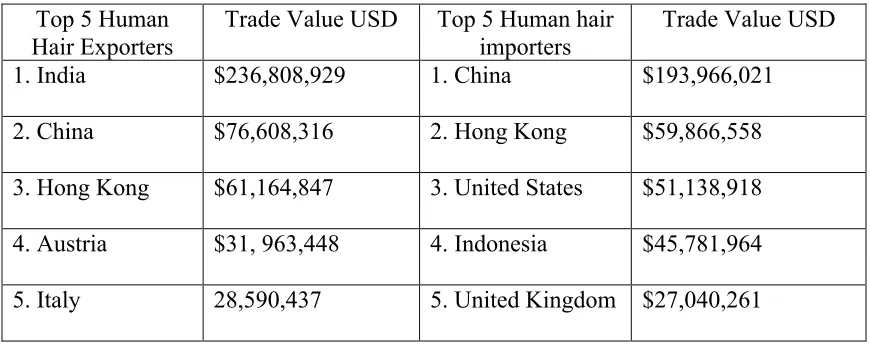
by the United Nations, in 2016 China exported $76,608,316 USD, India exported
$236,808,929 USD, while the Unites States imported $51,138,918 USD worth of human
hair (see Figure 1.1). Though the data acquired from the UN does not trace where the hair
was imported from or exported to, it can be safely assumed that a majority of the hair
exported from India proceeds to China and Hong Kong for processing before ultimately
arriving in the United States, and to a lesser extent Europe, for final consumption
(“Market Research Hair Trade”, 2011;Peters, 2017; UNCOMTRADE World
Merchandise Exports and Imports Statistics, 2017; Varmundy, 2011).
Top 5 Human Hair Exporters
Trade Value USD Top 5 Human hair
importers
Trade Value USD
1. India $236,808,929 1. China $193,966,021
2. China $76,608,316 2. Hong Kong $59,866,558
3. Hong Kong $61,164,847 3. United States $51,138,918
4. Austria $31, 963,448 4. Indonesia $45,781,964
5. Italy 28,590,437 5. United Kingdom $27,040,261
Figure 1.1. Top 5 importers and exporters of commodity code 6703. (Human hair, dressed, thinned, bleached or otherwise worked; wool or other animal hair or other textile materials, prepared for use in making wigs or the like) Data retrieved from UNCOMTRADE Database, January 2018
Data from the IBISWorld an online database that produces market reports for a
number of different industries, on the wig and hairpiece manufacturing industry in the
United States, written by Ingrid Peters (2017), defines the industry’s purpose as the
manufacture of hairpieces for both aesthetic and medical reasons. For the purpose of this
thesis, I am interested in examining the market for human hair for aesthetic reasons.
The first is import penetration into the manufacturing sector, that is, the amount of
demand for a particular product that is fulfilled by imports, calculated as a ratio. The
second factor is the per capita disposable income of people in the location of
consumption. In short, as disposable income increases, consumers are more likely to
purchase personal care products, including extensions and wigs made from human hair.
The third factor driving the industry is the trade weighted index, which considers the
exchange rates in the importing and exporting countries. Finally, Peters (2017) identifies
the median age of the population as being a driving factor in the human hair market, as
aging populations often have health conditions that may generate hair loss and thus
necessitating hairpieces.
The primary points of consumption for wigs and hairpieces are pharmacies and
drugstores, for costume wigs and hairpieces for resale, hair and nail resale and extension
services, hair loss treatment and removal, bought and resold by hair loss treatment
centers, and lastly, at beauty, cosmetics, and fragrance stores, purchasing hair for resale.
Beauty, cosmetics, and fragrance stores make up 22.3% of the hair care industry (Peters,
2017).
As previously mentioned, manufacturing for human hair largely occurs abroad,
and largely in China and Hong Kong. As such, the human hair trade is an increasingly
global industry, in part driven by the availability of ample resources (raw hair) in India,
and the presence of low cost labor in China. Due to the low skill labor this industry
requires, foreign manufactures are able to source low cost labor to produce wigs and
Though human hair wigs are sourced primarily from China and India, there is
competition between companies that sell the wigs. The competition is based on price,
quality, current trends, and marketing. Based on revenue, companies that sell higher
quality hair do better on the market compared to lower quality hair. Additionally,
companies who associate their products with celebrities do better than those who do not.
Celebrity partnerships help to establish credibility with consumers, making the company
more reputable and well known. Furthermore, companies have the advantage in the
industry if they are in sync with the emerging styles that are determined by social aspects
of their consumer pool (Peters, 2017).
Due to the presumably nonhazardous and toxic nature of hair extraction and
distribution, the wig and hairpiece industry has minor regulation standards outside of the
criteria established by US wage laws. As a result of several high profile robberies
occurring within the industry, there may be an increase in regulation of the trade,
specifically for Remy (Indian) hair. Manufactures are seeking measures to prevent
robberies to this degree in the future (Peters, 2017).
Hair Trade: From Temple to Market
Tracing a commodity’s movement globally requires many steps. First you must
understand where the raw material derives from. In the human hair trade there is a
demand for ‘Remy’ hair, that is, hair of Indian origin that is 100% human and still has the
hair cuticles attached. This makes Remy hair the most raw and most natural, and as a
result, the most valuable in the hair industry. The reputation of Remy hair has made India
Within the category of Remy hair are three types of hair harvested from India:
temple hair, village hair, and barber hair. Temple hair is the most abundant, valuable, and
is regarded as highest in quality. However, as described below, the origins of temple hair
is somewhat unusual in the world of raw materials. Village hair is collected from the
homes of Indians who collect the hair from brushes and combs, and is considered lower
quality than temple hair. Barber hair, collected from the sweepings from the floors of
barbershops, is another low quality hair type.
Temple hair is extracted from the heads of Indian peoples, but importantly, its
extraction is not for the purpose of providing hair for the human hair trade. In Hindu
religion, tonsuring is form of sacrifice to the gods that involves head shaving. The
Tonsure ceremony is an act of self-sacrifice, offering hair as a gift during a five-minute
hair removal process that takes place in tonsure halls located within Hindu temples.
However, in many cases the hair is collected and auctioned off to various parts of the
world. While data on these auctions and trade are limited, the Balaji Temple in Tirumala,
the second busiest temple in the world, collects massive amounts of hair each week that,
when auctioned, are reported to produce a weekly average income of $10,000
(Jagannathan & Panchanatham, 2018). The temple administration at the Balaji Temple
manages the hair auctions, and the rights to the temple hair are sold to a manufacturer
that hires supervisors and sweepers to retrieve and store the hair in locked safes (Tarlo,
2016). According to an interview done by Chris Rock in his documentary Good Hair
(2009), one hair trade expert reported that temple hair is worth more than gold.
It is crucial to note here that because hair is sacrificed voluntarily at tonsure
human hair trade. In fact, tonsure costs women 10 rupees. It is reported that women
engaging in tonsure do not know where their hair goes after the ceremony nor how much
the hair is worth, thus highlighting the important role of unpaid labor at the very origins
of this global chain. As popular and abundant as temple hair is, the presence of lower
grades of human hair are evidence that the hair collected from these temples cannot
solely satisfy the demands of the hair trade. Even more, there are reports that women’s
hair has been cut off in their sleep, in effect stolen from their bodies and inserted into the
circuits of the global hair trade (Rock & Stilson, 2009).
After extraction, human hair is auctioned off to the highest bidder and processed
in factories across the globe. In India there are thousands of hair processors, with the city
of Chennai recognized as one of the largest hubs for processing and manufacturing hair.
The second largest export of Indian temple hair is to China, due to the large number of
processing industries that exist there (Jagannathan & Panchanatham, 2018). It is
important to note that China is the number one exporter of human hair partly from their
business with India and partly due to the manufacturing and processing of Chinese
human hair. There are, however, perceived quality differences in Indian and Chinese hair.
Indian hair has the reputation of being void of chemical alteration and resembles
European hair in texture, thus making it the most desirable. In hair processing factories
the hair is separated and combed out, with pests and unwanted strands picked out. The
hair is then washed and sewn into bundles and packaged. Each bundle is made up of hair
fibers from many different heads but through processing is homogenized and noted only
Processed bundles of hair are shipped globally to businesses for resale, but in
many cases, still needs further processing into weaves and wigs. Much of this happens in
California, with Chris Rock declaring Los Angeles as the “weave capital of the world”
(Rock & Stilson, 2009) and Indian exporters reporting that Hollywood is one of the
biggest consumers of human hair (Jagannathan & Panchanatham, 2018). Data from the
United States supports this. In the US wig and hairpiece manufacturing industry, 19.8%
of manufacturing establishments are concentrated in the western part of the country, with
14.9% of all these establishments located in California alone (Peters, 2017). California’s
access to both large seaports and a large consumer population makes this region ideal for
hair imports. Socially, there may also be some business relationships, familial ties, and
high rates of demand that encourage hair manufacturing establishments to concentrate in
this area.
Once hair has been shipped and handled for resale in the US, consumers purchase
the hair from domestic websites, stores, and hair service companies, like salons. Human
hair is purchased by individuals who will use the hair in a variety of ways. Some
purchase the hair in order to have the bundles installed by licensed hair technicians, while
other purchase with the intention of installing the hair themselves. Others purchase hair
bundles for the purpose of creating wigs/weaves for a third party, or purchase the hair for
resale in a salon. After bundles have been sewn into a wig or onto the heads of consumers
as weaves, the hair is maintained by the consumer of the hair service, living out the
remainder of its commodified life as an accessory.
While the forgoing presents a relatively smoothly operating supply chain, the
human hair trade in actual operation can be described as fragmented at best. There is no
single dominant player within the wig and hairpiece industry that has a significant
amount of control of the revenue (Peters, 2017). Major portions of the raw materials are
imported to the United States where the wig manufacturing and weave services are
performed domestically despite far higher labor costs. The supply chain is also marked by
informality, what Tarlo (2016) describes as the notion of invisibility in her analysis on
the human hair trade. Informality and invisibility is evident starting with the process of
raw material extraction. Hair is collected from temples without providing compensation
to those who provided their hair. Once the hair is collected there is no formal data on how
much the hair is auctioned for nor who specifically it is being auctioned to. In Tarlo’s
(2016) study, an Indian hair manufacturer expresses his invisibility within the trade,
detailing his experiences in the business and how he is merely a background actor in the
larger scheme of things. This actor has no direct interaction with the way in which hair is
sold abroad; he is simply a pawn in a larger game of chess.
Not only is the hair wrapped up in the informalities of production and trade, but
also as is described in more detail in Chapter Two, the consumption of human hair is
immersed into informal markets such as the hair service industry. There are various
unlicensed consumers of human hair that perform these hair services from their home.
Faith, an unlicensed hair technician whose story opens this chapter, owns her own
business making and installing wigs and weaves for her customers both domestically and
globally. Faith purchases hair bundles from a vendor based out of Atlanta, Georgia
The process for my product is simple; I have a consultation with clients either
over the phone or in person, depending on their location. This is the time we
discuss what kinds of texture, length, color…all of what they want in their hair. I
then get head measurements, they make a deposit on their wig, which is what I
use to purchase the hair from my vendor. They ship what hair is need (between
3-5 business days) and I make the wigs. I will send them videos and pictures
throughout the process and when it’s done I send them their wig.
Faith performs all the work of manufacturing a wig far from a factory setting. In her
apartment she assembles the wigs, moisturizes and braids hair, and installs the wigs for
her local customers. As an unlicensed technician, Faith is limited in a series of ways. She
has to charge less than a licensed technician, and it affects her ability to work in a salon.
Being unlicensed decreases her opportunities as a business owner in this line of work by
not being able to provide “how to classes”, or as described in Chapter Two, to take these
classes from experts in the field because these classes are usually only open to licensed
individuals. Faith is likely indicative of many other individuals around the globe and in
particular the United States that performs these services from their home.
The informality of the industry and low barrier to entry is further highlighted by
the various self-starter books and blogs detailing the secrets of the hair trade and how to
monopolize on the multimillion-dollar hair importation industry that, as told by the
authors of these blogs and books, has been cornered by primarily Asian immigrants to the
United States. An example is Alix Moore, a Black woman entrepreneur, and author of
The Truth about the Human Hair Industry - Wake Up Black America! a self-help book
industry” (2013). Describing herself as “the first African American female human hair
manufacturer in the US” (Moore, 2013, p. 297), Moore opened first store in 1995 in Los
Angeles, California. Moore recounts her struggles in the human hair industry in order to
provide insights into the struggles African Americans face in starting up business in the
beauty product industry due to the intercultural networks that help Asian immigrants to
corner the market of the beauty trade. Moore laments that although black women make
up the largest group of consumers within the black hair industry, they are highly
underrepresented behind the scenes making decisions about product development.
Moore’s personal account of her life in the human hair trade reveals some details
about the human hair industry, specifically about finding and securing a supplier. In
Moore’s account, it is very difficult to find a supplier and build their trust, and in the
book, never reveals her supplier’s identity. This furthers the notion of invisibility that the
merchants along the trade feel and encounter. So, as Moore pushes the argument that
African Americans need to find ways to penetrate the Black beauty market, she at the
same time conceals her own network of trade with her supplier.
Advertising Discourses: An Analysis
Guthman (2002) argues that a key element of commodity marketing is making the
consumer see themselves using or buying a product, in effect making the consumer what
they buy. In terms of the online human hair market, however, it is not only that the
consumer relates to and can identify with the product. Rather, key in product marketing is
the way in which hair advertisements unveil the hidden part of the trade, most notably
Knowledge of hair production is an important driver of the digital market for
human hair, which is based not only a price, but also quality. In the hair market, length,
the absence of chemical treatment, and its ability to mimic European texture are target
marketing points. For example, manufactures emphasize the fact that Remy hair is
obtained from a religious site, and it is also marketed as “ethically sourced” or “organic”
to enhance its value on the western market (Tarlo, 2016 pg. 65).
The use of these terms carries across much of the human hair marketing language,
operating as devices of communication that are imperative to building trust between
the product and consumer (Guthman, 2002). In an account centered on organic food,
Guthman (2002) describes the purchase of organic foods as telling of consumer identity,
and allows others to infer that those who buy organic care more about the environment
and their health. This identity is constructed due to the way in which organic foods are
marketed. The relevance to food with human hair is in the language that is used to sell the
hair.
While the physical market for human hair also exists as a traditional storefront,
the sale of human hair has made its way onto the web through social media outlets. This
new method of product marketing has developed a series of tangled digital and physical
networks, operating as an infrastructure – that is, as matter than enables the movement of
other matter (Larkin, 2013). Social media outlets like Instagram enable the global
movement of hair, expanding the market for hair while at the same time revealing a
before concealed social infrastructure that blanketed the production of human hair along
the commodity chain. For example, Figure 1.2 depicts what sources refer to as “bundles
worn as a weave. As noted, these bundles are considered raw hair, meaning it is 100%
real human hair. In another example, Figure 1.3 depicts the global human hair commodity
chain. In this image socialite and entrepreneur Miracle Watts is posing with individuals
who have cut their hair to produce the raw hair product for Watts’ company, The Miracle
Tresses.
Figure 1.3. Miracle Tresses. Post from Miracle Watts Instagram page. Retrieved from Instagram March 2017.
Both of these posts use the word raw to describe the hair as unprocessed and unaltered
chemically. However, even though Figures 1.2 & 1.3 use the same platform to speak the
same message, there are differences in the way in which one may interpret or
make meaning of each post. Figure 1.3 aims to communicate hair as a pure entity: “True,
Watts clothed fully in black sitting with a group of Indian women. While it is unclear if
these women have just donated their hair from the trade or are workers in the distribution
center, the post sends a powerful message by allowing consumers to validate claims that
the hair is true, pure and raw.
These are just several of the thousands of posts similar to Figures 1.2 & 1.3 in
which the identity of the producers is revealed and is perceived as authentication of the
material aspects of the hair, as well as validating the legitimacy of the US-based
distributor. This authentication is verified by the visualization provided
in Instagram posts, and reveals anxieties about the portrayal of hair. The language used to
marked human hair (natural, raw, 100%) effects consumers in a similar way the language
used to sell raw and organic foods. Consuming the hair that is marketed as natural, raw,
and pure expresses anxieties about how real the hair will be perceived. Social anxieties
about how to look contribute to how the human hair needs to look in order to gain certain
treatment an opportunities.
Though the players that move the human hair trade along are not always visible,
the trade is very much real. There are a few stops along the chain as the hair moves
globally, arriving in the Unites States where is then becomes tousled into a very different
cultural ambiance than where is once was a part of. In the chapter that follows I examine
the Bronner Brothers International Beauty Show as an example of the hair trade in a
domestic backdrop. Additionally, in this chapter, I show how cultural, economic, and
CHAPTER 2
BRONNER BROTHERS
The market for human hair is overwhelmingly targeted at Black Americans, who
make up a vast percentage of the consumption of human hair in the United States (Berry,
2008). However, the human hair trade should be viewed as a recent iteration in the long
history of products marketed at African American women. The Black beauty market was
first cornered by white-owned companies that marketed skin-bleaching and hair care
products to African Americans in advertisements portraying Black women as inferior and
unattractive. These advertisements were typically accompanied by guarantees of the
product’s ability to fix the “ problem” presented by black hair and skin (Gill, 2010).
Gill (2010) explores Black beauty entrepreneurship by Black women from the
twentieth to early twenty-first centuries, examining the ways in which the beauty industry
was a major player in the construction of identity for Black women. These economic
advancements through entrepreneurship in the beauty industry created a platform for
Black females to “assert leadership in their communities and in the larger political arena”
(Gill, 2010 pg. 2). Not only did successful Black women entrepreneurs help shape the
political arena during these times, but they also used beauty spaces such as salons as a
network for the spread and expansion of political knowledge to clientele and customers.
What Gill highlights in Beauty Shop Politics is the heavily overlooked history of Black
female entrepreneurship. The historical analysis of African American beauty worker
leader. Gill situates together this historically adversarial identity by
“problematize[ing] some of the terms used to discuss key concepts and define differing
constituencies in business history” (2010, pg. 4).
Gill’s (2010) work therefore serves as a foundation for conceptualizing the
identity of Black female entrepreneurship in the beauty industry. Gill (2010) notes that it
was the work of Black men to first attempt to produce beauty products for African
Americans. For example, Overton Hygienic Company, a pharmaceutical and cosmetics
company established by Anthony Overton in 1898, produced a brown face powder for
African Americans. Though Overton did not produce a hair product, his product
contributed to the shift in advertisement imagery used to market products to Black
women. It was instead the work of two African American women that helped to lay a
foundation in Black beauty hair care within the United States. The most popular narrative
conveyed in research on black beauty business examines Madame CJ Walker’s
introduction of the hot comb to the black beauty market, which made it easier for African
Americans to maintain their hair in a presentable manner. It was in fact Madame CJ
Walker and Annie Turnbo’s hair care products that “diversified the black beauty industry
to include not only selling the products, but also the selling of beauty, independence, and
financial success” (Gill, 2010, p. 19). Walker and Turnbo’s success helped to pave the
way for black beauty business in the United States within the African American
community.
In this chapter I investigate the Black beauty market using the Bronner Brothers
International Hair Show to illustrate the ways in which the extensive production network
women’s hair is in need of alteration. In this chapter I draw on scholarship from cultural
economic geography on racial enclave economies to highlight how the realization of
value and exchange in markets is interwoven with racial and gendered discourses around
good hair.
Nearly 35 years after Madame C.J. Walker traveled the U.S teaching women how
to sell her products (Gill, 2010; Rooks, 1996), the original Bronner Brothers, Nathanael
and Arthur, along with their sister Emma Bronner, began their business in 1947 by
teaching aspiring cosmetologists in Atlanta, Georgia at a local YMCA. The stated
purpose of their business was three-fold: to improve the beauty industry, to educate, and
notably, to empower Blacks.Their meetings at the local YMCA grew and led to the
development of the first Bronner Brothers International Beauty Show with 300 attendees.
Over time, the show has moved to larger venues due to the increase in attendees and is
now hosted annually at the Georgia World Congress Center and reports over 30,000
attendees. It claims to be the largest multi-cultural beauty event in the United States
(Bronner Bros, 2018; Kiley, 2017).
The Bronner Brothers International Beauty Show is typically held in August each
year and hosts hundreds of vendors. The show has also become a popular networking
opportunity for beauty students and business owners. The convention is also widely
known for its hair competitions, with the most popular event being the annual hair battle.
In the hair battle, select celebrity stylists compete in front of celebrity stylist judges for
bragging rights, entry into next year’s battle, and a cash prize. While the show is
consumers are allowed into the convention though they do not have access to some of the
events and pricing specials that are designated for licensed professionals.
It was important to investigate the consumer space of the Bronner Brothers show
in order to illustrate the ways in which networks of consumption emerge not just as a
result of a spatial optimization exercise, but rather as a result of dominant cultural and
social expectations and norms of what good hair is for African American women. In the
course of the 20th century economic geographers have shifted their approaches in order to
better understand the role of culture in economic processes.
Economic geography as a “spatial economic phenomena” first began with an
approach that Barnes (2001, pg. 546) describes as, “the belief that the central task of
theorizing is to develop abstract vocabularies that mirror an external and independent
reality.” This approach to economic geography is associated with what Barnes has termed
the first wave theory in which scholars used “representational maps” (e.g., Von Thünen’s
concentric model, Weber’s locational triangle, and Christaller’s central place hierarchy)
to describe and explain the locations and distribution of economic activity across space
(Barnes, 2001 pg. 554). The late 20th century, however, saw a shift towards what Barnes
(2001) terms new wave theory, a set of approaches that turn away fixed meanings and
definitions of economic activity in the world and opens up room for new interpretations.
Reassessing the role of culture in economic activity is central to this shift.
While the relationship between economy and culture has long been of interest,
Barnes argues that new wave theories changed how geographers began to understand
economic processes through cultural ones. This new conceptualization links markets, the
thought of as a cultural space (James, Martin, and Sunley 2006). In short, scholars have
shifted their research to understanding economic practices as ones that are not purely
economic in nature, but rather tangled up in cultural ones and especially around matters
of gender, race, and class.
The links between cultural and economic processes are particularly evident in the
realm of consumption. James et al. (2006, p. 11), for example, discuss the emergence of
“cultural industries”, what they describe as the production and consumption of physical
commodities and services by specific cultures that are “deliberately inscribed with
particular cultural meanings, lifestyle associations, emotional values or symbolic
content.” The link between culture and commodity consumption is particularly evident in
food networks. Guthman’s (2003) work on the organic food industry, and in particular
salad mix, suggests that the success of this industry has been rooted in social and political
processes from its beginning. The organic food industry has proliferated and thrived
based off of social anxieties about ethics in food that are specific to a very distinctive
racial and economic class that emerged with the ‘yuppies’ (Guthman, 2003), the group of
young individuals who merged upward social mobility, consumerism, politics, and
culture in San Francisco during the 1960s. Organic salad mix, a niche product in the
1960s, was considered a specialty food that was accessible by the privileged (Guthman,
2003), an association of class and food that highlights the very aspects of cultural
economy that James et al. (2006) identify.
There are similarities in the way the organic food industry continues to prosper
from class-based social anxieties and the ways in which the Bronner Brothers
therefore an important example of the type of cultural industry that emerges from the
economic and social networks that have forced the production and consumption of
cultural symbolic physical commodities and services by this specific racial group.
Bronner Brothers convention
The Bronner Brothers convention was held from Saturday to Monday, August 19
to 22, 2017. I attended the beauty show on Saturday and Sunday. As I entered the
Georgia World Congress Center that Saturday morning, I traveled down the escalators
leading to a rather large area for registration and checked into the event. The path from
the registration area to the convention floor doors was lined with promotions of the show,
a schedule of all events, and food vendors. I waited in line to have my bag checked,
recorder in hand, and was waved through to enter the convention hall. As the cool air hit
my face and hip-hop music filled my ears, I saw that the convention had just opened, and
several people were setting up their booths. As I walked through the rows of vendors,
tables and booths were full of various types of hair products, health and beauty products,
salon and barber tools, hair extensions, clothing, and magazines. There were also booths
for service companies like AT&T, which sponsored several hair competitions. Occupying
the booths were business owners and representatives eager to promote their products and
foster business relationships with both other companies and customers – including me.
As I moved across the convention floor browsing various products and services
available for this specific economy, I began to observe the demographics of individuals
selling products, buying products, and others that were there to socialize and observe the
scene. While the composition of patrons was almost exclusively African American, there
Black beauty industry. In the next section I will discuss these racial and gender dynamics
within the larger literature that considers gendered and racial economic geographies.
Racial enclave economies
One purpose of attending the hair show was to examine how beauty products,
ranging from Madame CJ Walker’s hot comb to the beauty products marketed to African
Americans at events like the Bronner Brothers beauty show, become part of African
American identities and the creation of what Wingfield (2009) refers to as a racial
enclave economy. A racial enclave economy is like an ethnic enclave economy where the
makeup of the economy, including owners, customers, and employees, is primarily
fellow minority group members. The businesses in an ethnic and/or racial enclave
economy may be located in a concentrated area. Unlike an ethnic enclave economy,
however, racial enclave economies are rooted in the recognition of the “role of systemic
gendered racism as a preeminent factor shaping the experiences of minority
entrepreneurs” (Wingfield, 2009, pg. 20). Wingfield (2009) argues that African American
women who do business in the beauty industry have encountered systemic gendered
racism that has necessitated the creation of a space for this racial enclave economy to
emerge.
Based on imagery from past shows, I expected there to be predominantly African
American women at the Bronner Brothers convention, both as stylists and to be running
businesses selling hair products, hair tools for beauty shops, and hair extensions. When I
arrived on the convention floor, however, I was surprised at the patron makeup. As
expected, in booths and walking the floor were both African American female and male
hair care, many also had products for barbering. This is not entirely surprising. Similar to
the beauty shop, barbershops hold an important cultural and communal value in the Black
community. In purely spatial terms, barbershops and beauty shops share the same
building but may be divided by a boundary.
More unexpected was the significant number of Asians attending the show, and
the working relationship between Asian and African American workers. At some of the
hair extension booths, there was an Asian individual, male or female, taking inventory
and counting money, but the ones promoting, selling hair, or interacting with customers
were Black men and women. As the face of the company, African American men and
women shared a common hair culture with potential consumers. Yet as is described in
Chapter One, production networks originating in Asia, and particularly China, play a
significant part in the transformation of raw human hair into hair weaves and wigs. Not
surprisingly, then, Asian hair entrepreneurs are found at trade shows and in beauty supply
stores that sell beauty accessories specifically marketed to the Black community.
Lee (1999) has examined the Asian immigrant entrepreneur experience in the
United States and notes their domination of African American markets. While the large
number of Asians in African American markets is linked to factors like low rent and
higher profitability rates, Lee also points to the importance of intra-cultural networks of
supply that are accessible strictly by Asian immigrants. These intra-cultural networks
make it more challenging for African Americans to tap into their own market – like that
of human hair - as Asian immigrants have cultural ties and often direct access to products
that are sold in the United States (Lee, 1999). While Lee finds that the lack of access to
Americans at a disadvantage in the retail beauty market, Black’s have shown dominance
in areas of service, like hair care (Lee, 1999).
Lee (1999, pg. 1404) outlines that hair care services thrive on “coethnic tastes and
preferences”, and thus require little start-up money. These hair care services are
considered labor-intensive markets that Asian immigrants do not care to enter, some
because the license requirements take time and money, while others do not wish to “do
black hair” (Lee, 1999, pg. 1404). Thus, while Asians played an important role in the
behind the scenes labor at the show, the composition of the hairstylists at the Bronner
Brothers show was largely African American.
It is worth noting that the Bronner Brothers business is aspirational for many
African American hair entrepreneurs. While the Bronner Brothers business was created to
teach cosmetologists the trade, as their capital grew they were able to penetrate the
beauty supply market and now offer a few popular lines of black hair care. Yet as the
next section demonstrates, it is important to note that the realization of value in the
African American hair industry is in many ways contingent upon the cultural discourses
of good hair put forth by the dominant white culture.
Taming the unruly:
As I moved through the convention floor, booth owners and workers noticed me
observing their products and often initiated conversations with me about their products,
assuming I was there as a patron to buy or sell my own goods. Immediately notable in
these conversations, and literally plastered all over the booths, were phrases like “all
natural”, “virgin hair”, and “100% real” – marketing language used to advertise and grasp
being natural, at root of the entire show is the notion that products and stylists are needed
to able to tame unruly Black hair. Nowhere is this more evident than at one of the most
anticipated events each day: the hair battle.
The hair battle is a contest that pits stylists against each other to demonstrate their
abilities in front of a panel of celebrity stylists and crowds. At the 2017 convention, the
Hair Battle event began at 8:00 pm with four contestants ready for battle. The event was
to take place in a boxing ring, marking the event as one of conquest and combat, with the
winner possessing the greatest ability to tame the hair of their models.
Not simply a hair cut, the hair battle is a collection of performances from the
contestants, with themes to each performance. The first contestant used a circus theme,
and featured models dressed intricately as circus animals and characters. In this
performance, a lion – played by a model - crawled out with an “untamed mane”, and it
was the job of the ringmaster – the stylist - to tame this lion’s mane and thus expose the
lion’s face. After taming the lion’s mane, the first contestant then cut her own hair, in
effect taking control of her own body and identity through hair.
The second contestant, a biracial woman of Chinese and African American
heritage performed a show called The Revenge of the Black Orchard. In this performance
the stylist entered the stage as men preformed a traditional Chinese New Year dragon
dance within the crowd. Then, the contestant performed as a ninja, demonstrating her
abilities to combat or fight the rebellious hair strands of her opponents. The selection of
orchids in the performances title is no accident: orchids in Chinese culture are first
associated with elegance, but secondly with virtue and refinement (Welch, 2013). In
black orchid, followed by the term revenge, highlights notions of control, dominance, and
grace in the management of hair.
The third contestant was the only male stylist entered in the battle. His
performance stood out from the others for the lack of visuals and props that were present
in the other three contestant’s performances. This minimalist approach demanded the
crowd to focus on the abilities of the contestant, which demonstrates dominance over the
crowd and judges. However, clothed in all white, contestant three cut and styled hair
while suspended in the air. Such a feet is meant not only to demonstrate a mastery of
cutting - “I cut hair so well, watch me do it upside down” – it demonstrates a supremacy
over hair.
Lastly, contestant four’s performance was themed as a Brazilian carnival.
Carnival is known for its vibrant colors, lively music, citywide parade, and intricate
embellished costumes. Making her entrance riding on a camel, contestant four
immediately demonstrated power over nature – including hair - through the process of
domestication. Brazilian Carnival stems from a European Catholic food festival, denoting
the start of 40 days of Lent, but the mix of Portuguese and African cultures had
transformed the food fest into an effervescent festival.
The hair battle was a performance of each of the contestant’s ability to cut and
style hair. Judges based score off of creativity and ability to create styles using the short
time offered. After each contestant performed, there were comments and scoring. After
all contestants performed, all of the contestants came on stage and the winner, contestant