Nutrition and Dietary Supplements
Dovepress
O r i g i N A L r e S e A r c h
open access to scientific and medical research
Open Access Full Text Article
Use of dietary supplements among US adults
with asthma
Jun Ma Lan Xiao
Department of health Services research, Palo Alto Medical Foundation research institute, Palo Alto, cA, USA
correspondence: Jun Ma
Department of health Services research, Palo Alto Medical Foundation research institute, 795 el camino real, Palo Alto, cA, USA
Tel +1 650 853 4809 Fax +1 650 327 8309 email [email protected]
Background: Little is known about dietary supplement use among people with asthma, especially on a national level. We examined the prevalence and type of supplement use and demographic and health-related characteristics of users among US adults with asthma.
Methods: Data from the 2005–2006 National Health and Nutrition Examination Survey were analyzed. Asthma was defined by self-report of ever receiving a diagnosis and still having asthma currently. Dietary supplements were collected by direct inspection of products where possible (88% of the time), and were transcribed by trained nutritionists. Multivariate logistic procedure was performed to determine independent associations of supplement use with participant characteristics.
Results: The prevalence of using a dietary supplement in the past month was similar between adults with asthma (50.2%, 8.6 million) and those without asthma (54%, 104.3 million). Among asthmatic adults, multivitamins/multiminerals (40.1%) were the most commonly used supplements, followed by vitamin B12 (23.3%), vitamin C (19.9%), calcium (15.2%), vitamin E (14.7), folic acid (12.7%), vitamin B6 (11.2%), thiamin (10.8%), niacin (10.8%), B complex vitamins (10.4%), and riboflavin (10.3%). Asthma adults who were supplement users tended to be older (50.2 ± 19.2 versus 45.2 ± 18.0 years for supplement users versus nonusers, respectively, P = 0.009), white/Hispanic, women, and had excellent/very good self-reported health. Forty-three percent of supplement users took only one supplement. Middle-aged and older asthma adults were more likely to use multiple supplements concurrently.
Conclusion: Use of dietary supplements is popular in US adults with asthma, similar to the general adult population. It is important to take supplement use into account in clinical care for asthma patients and in the design and analysis in epidemiological and intervention studies of nutrition and asthma.
Keywords: asthma, dietary supplements, minerals, nutrition, vitamins
Introduction
Asthma is a serious global health problem affecting about 300 million people worldwide.1 Asthma clearly has a strong genetic component.2,3 However, the dramatic
increase in asthma prevalence in westernized countries in recent decades, and the development of asthma in susceptible individuals who have migrated to a western country,4,5 signal a dominant role of the environment in affecting the complex genetics
and developmental pathophysiology of this disease. As a hallmark of westernization, rapid changes in diet, including adoption of a more processed and “convenience-oriented” diet, have resulted in a chronic metabolic surplus and a relative reduction in the intake of complex carbohydrates and micronutrients.6
Nutrition and Dietary Supplements downloaded from https://www.dovepress.com/ by 118.70.13.36 on 25-Aug-2020
For personal use only.
Number of times this article has been viewed
This article was published in the following Dove Press journal: Nutrition and Dietary Supplements
Dovepress Ma and Xiao
Observational studies have shown encouraging evidence of a protective effect of a wide range of nutrients on asthma prevalence and symptoms; however, evidence from dietary intervention trials has been far less consistent or conclusive.7,8
The nutrients most extensively investigated for the effects in asthma comprise the following main groups: vitamins (antioxidant vitamins A, C, E, and D), minerals (sodium, selenium, and magnesium), and fatty acids (omega-3 and omega-6 polyunsaturated fatty acids). Currently, not enough evidence exists to recommend that any of these nutrients should be consumed or avoided to affect asthma.9
Over half of US adults use some type of vitamin, mineral, or other dietary supplements.10–12 Individuals with medical
conditions are more likely to use supplements, presumably because they believe that supplements can prevent or treat chronic diseases, despite limited scientific support for the effi-cacy of such use and, in some instances, evidence of potential harm.13,14 It has been documented that the use of
comple-mentary and alternative medicine is popular in asthma.15,16
However, no nationally representative data have specifically examined dietary supplement use among people with asthma. This information is needed to improve clinical care of asthma patients and to inform future investigation of the therapeutic or preventive role of diet and nutrition in asthma.
The current study presents data from the 2005– 2006 National Health and Nutrition Examination Survey (NHANES) on the prevalence and type of supplement use and characteristics of users among US adults with asthma specifically, on a national level.
Methods
Data source
The NHANES is a national survey involving household interviews and clinical examinations conducted by the National Center for Health Statistics. The NHANES uses a stratified, multistage probability cluster sampling design and weighting methodology that allows unbiased national estimates to be produced for the civilian, noninstitutionalized US population. NHANES sample weights adjust for unequal probabilities of selection, nonresponse, and planned oversampling (of young children, the elderly, persons with low income, and ethnic minorities). Detailed documentation of the NHANES survey and public use data files can be found at http://www.cdc.gov/nchs/nhanes.htm.
Study population
A total of 10,348 individuals of all ages was included in NHANES 2005–2006. The overall response rates were 80.5%
for the household interviews and 77.3% for the examinations. In this study, we focused on the sample of all 4979 adults 20 years of age or older who had been randomly selected for household interviews.
Measurements
AsthmaConsistent with previous NHANES reports,17–19 the diagnosis
of asthma was based on the questions “Has a doctor or other health professional ever told you that you have asthma?” and “Do you still have asthma?” in the medical conditions questionnaire.
Dietary supplement outcomes
In NHANES 2005–2006, dietary supplement use data were self-reported and recorded by interviewers using Computer-Assisted Personal Interview technology. Survey participants were asked whether they had taken any vitamins, minerals or other dietary supplements, including prescription and nonprescription supplements, in the past 30 days. Those reported using any dietary supplements were asked to provide the containers of all the products used. NHANES interviewer recorded the name and manufacturer of each supplement as they appeared on the label of the supplement container. If the participant could not provide the container (12% of the time), the interviewer asked for the exact name of the product or, if not known, the supplement type, for example, multivitamin, vitamin C. Up to 20 supplements could be recorded. For the purpose of quality assurance, data extracted from the dietary supplement use questionnaire were routinely examined by trained nutritionists for discrepancies and erroneous entries. Efforts were made to ensure as much accuracy as possible in finding the label information for the exact product taken, and providing exact ingredient information for this product.
Any dietary supplement use was identified using the question “Have you used or taken any vitamins, minerals or other dietary supplements in the past 30 days?” Use of specific supplements was identified based on ingredients of the products reported and was categorized according to previously published definitions.11
covariates
Demographic and socioeconomic characteristics
The variables included age, gender, race/ethnicity, education, annual family income, and marital status.
health status
Height and weight was measured by trained technicians using standardized protocols and calibrated equipment. Body mass
Nutrition and Dietary Supplements downloaded from https://www.dovepress.com/ by 118.70.13.36 on 25-Aug-2020
Dovepress Dietary supplement use and asthma
index (BMI) was calculated and rounded to the nearest tenth. BMI categories were defined using widely accepted cutpoints, ie, BMI ,18.5 kg/m2 for underweight, BMI 18.5–24.9 kg/m2
for normal weight, 25.0–29.9 kg/m2 for overweight, and BMI
$30.0 kg/m2 for obesity.20 Self-rated health status was
clas-sified as excellent/very good, good, or fair/poor. Number of chronic conditions referred to the total number of medical conditions that a respondent had ever been told by a doctor or other health professional that they had or clinical diagnosis. The list of conditions included asthma, diabetes, arthritis, coronary heart disease, angina, myocardial infarction, con-gestive heart failure, stroke, emphysema, chronic bronchitis, any kind of cancer (excluding nonmelanoma skin cancer), any thyroid problem, any kind of liver condition, hypertension, and hyperlipidemia. In addition to a self-reported doctor diagnosis, hypertension was also defined by either a measured systolic blood pressure $140 mmHg or diastolic blood pres-sure $90 mmHg, consistent with current Joint National Com-mittee guidelines,21 or self-reported use of antihypertensive
medication. Similarly, the definition of hyperlipidemia also included either a total cholesterol concentration $240 mg/dL or fasting low-density lipoprotein cholesterol concentration
$160 mg/dL, consistent with current Adult Treatment Panel-III guidelines,22 or self-reported use of lipid-lowering therapy.
The number of chronic conditions was categorized as 0, 1–2, and 3+ conditions.
Lifestyle behavior
Physical activity was assessed by self-report and, as previously defined,11 included vigorous activity causing
heavy sweating, or large increases in breathing or heart rate and of moderate activity causing only light sweating or a slight to moderate increase in breathing or heart rate for at least 10 minutes in the past 30 days. We categorized smoking status as nonsmoker, current smoker, or former smoker; and alcohol use as never drinker, occasional drinker, moderate drinker (#one drink/day for females or #two drinks/day for males), or heavy drinker (.two drinks/day for females or .three drinks/day for males).
Statistical analysis
All analyses were conducted in the SAS Enterprise Guide 4.1 (SAS Institute, Cary, NC) and took account of the complex sampling design and sample weights of the NHANES. Prevalence estimates for use of any dietary supplement and of specific supplements among adults with asthma were generated using the SURVEYMEANS procedure. Standard errors for the estimates were calculated according to the
NHANES analytical guidelines, and estimates with a relative standard error .30% were considered unreliable.23 Chi-square
tests (PROC SURVEYFREQ) examined isolated associations between supplement use and demographic and health-related characteristics. Adjusted odds ratios (ORs) with 95% confidence intervals (CIs) and associated Wald χ2 statistics
from the logistic procedure (PROC SURVEYLOGISTIC) were used to determine the significance of independent associations of supplement use with each demographic or health-related characteristic of interest while simultaneously controlling for the other characteristics. Geometric means with 95% CIs of the number of supplements taken were used to account for the skewed distribution. Statistical significance was set at two-sided P , 0.05.
Results
The study sample included 390 adults with asthma and 4589 adults without asthma, representative of 17 million asth-matic adults and 193 million nonasthasth-matic adults in the general US population. Their characteristics are shown in Table 1.
Adults with asthma did not differ from the rest of the US adult population in terms of prevalence of use for any dietary supplement or for specific supplements (Table 2). About 8.6 million (50.2%) adults with asthma and 104.3 million (54%) adults without asthma reported taking a dietary supplement in the past 30 days. Among adults with asthma, multivitamin/multiminerals (40.1%) were the most commonly used kind of supplements, followed by vitamin B12 (23.3%), vitamin C (19.9%), calcium (15.2%), vitamin E (14.7), folic acid (12.7%), vitamin B6 (11.2%), thiamin (10.8%), niacin (10.8%), B complex vitamins (10.4%), and riboflavin (10.3%). Use of calcium supplements doubled (30.7%) when calcium-containing antacids not reported as dietary supple-ments were included. Other relatively common supplesupple-ments included magnesium (9.6%), iron (9.3%), vitamin A (9.3%), zinc (8.9%), selenium (7.7%), and chromium (7.4%), and fish oils/omega-3 fatty acids (6.7%), each reported by more than one million adults with asthma.
Tables 3 and 4 enumerate the prevalence of use of any dietary supplement, and of specific supplements by demographic and health-related characteristics, among US adults with asthma. Bivariate analyses assessed associations between participant characteristics and use of any supplement and of the most commonly taken supplement, multivitamin/ multiminerals. We did not test associations of use of other specific supplements with participant characteristics because of concern about spurious findings due to the numerous comparisons possible. Also, previous studies of
Nutrition and Dietary Supplements downloaded from https://www.dovepress.com/ by 118.70.13.36 on 25-Aug-2020
Dovepress Ma and Xiao
dietary supplement use in the general US adult population did not suggest systematic differences in associations of demographic or health-related characteristics with specific supplements.11 Tables 3 and 4 show consistent patterns by
characteristics across specific supplements among adults with asthma as well.
Use of any supplement and multivitamin/multiminerals among US adults with asthma was higher for women than for men (P = 0.01), for non-Hispanic Whites and Hispanics versus non-Hispanic Blacks, for individuals with a college education or above versus those with less education, for those who were separated, divorced, or widowed versus others, for normal or overweight individuals versus obese individuals, and for those who reported at least good health
versus fair/poor health (P , 0.05 for all). In addition, use of any supplement was greater with age (P for trend = 0.03), and use of multivitamin/multiminerals was greater for asthma adults reporting moderate or vigorous versus no physical activity (P = 0.04).
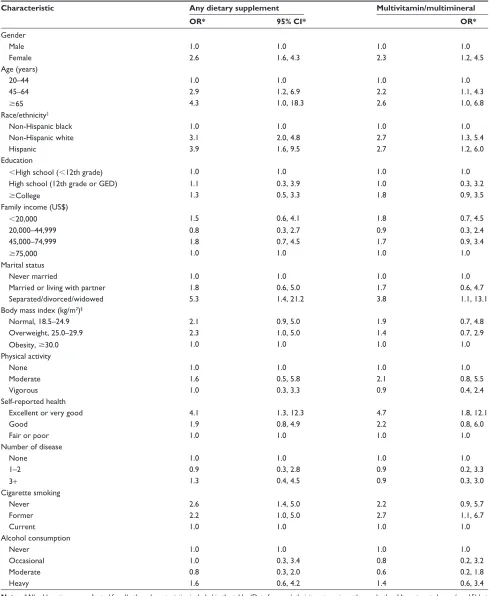
After controlling for all the other demographic and health-related characteristics among US adults with asthma, women had greater than two times the odds for men of reporting use of any supplement (OR = 2.6, 95% CI 1.6, 4.3) and multivitamin/multiminerals (OR = 2.3, 95% CI 1.2, 4.5, Table 5). Non-Hispanic Whites and Hispanics were more likely to take a supplement in general (OR = 3.1, 95% CI 2.0, 4.8 for Whites; OR = 3.9, 95% CI 1.6, 9.5 for Hispanics), as well as more likely to take multivitamin/multiminerals Table 1 Demographic and socioeconomic characteristics of the study population, by asthma status, National health and Nutrition examination Survey, US, 2005–2006
Characteristic Survey respondents (n)*
Estimated population (n, in millions)
All
participants, %†
Asthma, %† Nonasthma, %† P value
Asthma status
Yes 390 17 8 N/A N/A
No 4589 193 92 N/A N/A
gender ,0.0001
Female 2387 101 48 37 49
Male 2592 109 52 63 51
ethnicity/race 0.008
Non-hispanic White 2495 151 72 76 71
Non-hispanic Black 1123 24 11 13 11
hispanic 1157 24 11 6 12
Other race 204 11 5 5 5
Age (years) 0.808
20–44 2359 102 49 49 48
45–64 1431 72 34 35 34
$65 1189 36 17 15 17
Marital status 0.170
Never married 790 32 15 16 15
Married or living with partner 3095 137 65 61 66
Separated/divorced/widowed 1087 40 19 23 19
education 0.062
,high school (,12th grade) 1394 37 18 15 18
high school (12th grade or geD) 1181 52 25 23 25
$college 2395 120 57 63 57
income (US$) 0.295
,20,000 1167 35 17 21 17
20,000–44,999 1560 59 29 27 30
45,000–74,999 1007 49 24 24 24
$75,000 1018 59 29 28 29
BMi category ,0.0001
Underweight, ,18.5 79 4 2 2 2
Normal, 18.5–24.9 1350 62 31 24 32
Overweight, 25.0–29.9 1604 65 33 25 33
Obesity, $30.0 1647 69 34 49 33
Notes: *Numbers do not always add up to the total n = 4979 due to missing data; †column percentages.
Abbreviations: BMi, body mass index; N/A, not available.
Nutrition and Dietary Supplements downloaded from https://www.dovepress.com/ by 118.70.13.36 on 25-Aug-2020
Dovepress Dietary supplement use and asthma
(OR = 2.7, 95% CI 1.3, 5.4 for Whites; OR = 2.7, 95% CI 1.2, 6.0 for Hispanics). Older age, being separated, divorced, or widowed, and excellent or very good self-reported health also remained positively associated with both use of any supplement and of multivitamin/multiminerals. An inde-pendent association with smoking status was detected, with never smokers having greater odds of taking any supplement (OR = 2.6, 95% CI 1.4, 5.0) and former smokers having greater odds of taking multivitamin/multiminerals (OR = 2.7, 95% CI 1.1, 6.7), compared with current smokers.
Among adults with asthma who reported taking a dietary supplement in the past 30 days, 42.8% (49.8% of men, 39.7%
of women) had taken only one supplement, and the mean number taken was similar between genders (1.7 for men and 1.9 for women, Table 6). More middle-aged (72.2%) and older adults (67.3%) than young adults (35.4%) with asthma took more than one supplement (P , 0.001). The mean number taken was significantly higher for middle-aged (2.2, 95% CI 1.8, 2.7) and older adults (2.0, 95% CI 1.7, 2.4) than for young adults (1.4, 95% CI 1.2, 1.7, P = 0.004).
Discussion
Large population-based surveys, including previous NHANES surveys, have consistently reported widespread use Table 2 Frequencies and prevalence, percentage (standard error) of dietary supplement* use in the past 30 days among US adults aged 20 years or older, by asthma status, National health and Nutrition examination Survey, US, 2005–2006
Dietary supplements Asthma Nonasthma P value
Number in thousands
Percent (standard error)
Number in thousands
Percent (standard error)
Any dietary supplements 8614 50.2 (2.6) 104312 54.0 (1.3) 0.16
Multivitamin/multimineral 6870 40.1 (2.2) 82925 43.0 (1.4) 0.20
Vitamin B12 3999 23.3 (2.2) 43174 22.4 (0.8) 0.66
Vitamin c 3410 19.9 (2.1) 37369 19.4 (0.8) 0.74
calcium 2603 15.2 (2.4) 33931 17.6 (0.6) 0.32
calcium/antacids 5255 30.7 (3.3) 57022 29.5 (0.8) 0.73
Vitamin e 2529 14.7 (1.7) 29528 15.3 (0.5) 0.72
Folic acid 2181 12.7 (1.8) 24711 12.8 (0.5) 0.96
Vitamin B6 1926 11.2 (1.9) 23907 12.4 (0.5) 0.55
Thiamin 1847 10.8 (2.4) 21102 10.9 (0.6) 0.94
Niacin 1851 10.8 (2.5) 21547 11.2 (0.7) 0.87
B complex vitamins 1789 10.4 (2.3) 22096 11.4 (0.6) 0.65
Riboflavin 1766 10.3 (2.2) 20727 10.7 (0.6) 0.84
Magnesium 1637 9.6 (2.6) 19654 10.2 (0.7) 0.79
iron 1601 9.3 (2.2) 15116 7.8 (0.5) 0.43
Vitamin A 1588 9.3 (2.5) 19441 10.1 (0.4) 0.75
Zinc 1530 8.9 (2.1) 20824 10.8 (0.5) 0.41
Selenium 1312 7.7 (2.1) 15549 8.1 (0.4) 0.85
chromium 1275 7.4 (1.8) 14952 7.7 (0.5) 0.86
Fish oils/omega-3 fatty acids 1145 6.7 (1.8) 12394 6.4 (1.0) 0.88
Note:*Any dietary supplement and specific supplements with more than a 5% prevalence of usage and combined calcium supplements plus calcium-containing antacids not taken as dietary supplements.
Table 3 Prevalence, percentage (standard error) of dietary supplement* use in the past 30 days among US adults with asthma aged 20 years or older, by gender and age, National health and Nutrition examination Survey, US, 2005–2006
Characteristic Adults (n) Any dietary supplements
Multivitamin/ multimineral
Vitamin B12 Vitamin C Calcium Calcium/ antacids
Total 390 50.2 (2.6) 40.1 (2.2) 23.3 (2.2) 19.9 (2.1) 15.2 (2.4) 30.7 (3.3)
gender
Male 153 41.7 (4.2) 31.1 (3.1) 16.0 (4.3) 14.8 (2.4) 10.2 (2.2) 22.5 (3.4)
Female 237 55.2 (3.2) 45.3 (3.1) 27.5 (3.6) 22.8 (2.7) 18.1 (3.0) 35.3 (4.1)
Age (years)
20–44 186 39.0 (6.1) 33.3 (4.8) 18.0 (3.3) 15.8 (3.2) 9.7 (2.0) 25.6 (4.8)
45–64 118 59.5 (4.9) 47.5 (4.7) 27.2 (4.9) 26.3 (5.2) 20.5 (4.8) 36.7 (5.6)
$65 86 64.9 (7.9) 44.6 (4.9) 31.4 (5.1) 18.3 (6.4)† 20.5 (2.8) 32.9 (3.1)
Notes: *Any dietary supplement and specific supplements with more than a 15% prevalence of usage and combined calcium supplements plus calcium-containing antacids not taken as dietary supplements; †estimate does not meet the minimum standard of statistical reliability (relative standard error .30%).
Nutrition and Dietary Supplements downloaded from https://www.dovepress.com/ by 118.70.13.36 on 25-Aug-2020
Dovepress Ma and Xiao
Table 4 Prevalence, percentage (standard error) of dietary supplement* use among US adults with asthma aged 20 years or older, by demographic and lifestyle characteristics, National health and Nutrition examination Survey, US, 2005–2006
Characteristic Adults (n)† Any dietary supplements
Multivitamin/ multimineral
Vitamin B12 Vitamin C Calcium Calcium/ antacids
Total 390 50.2 (2.6) 40.1 (2.2) 23.3 (2.2) 19.9 (2.1) 15.2 (2.4) 30.7 (3.3)
race/ethnicity‡
Non-hispanic Black
109 24.9 (3.4) 17.9 (3.2) 8.3 (2.7)§ 8.1 (2.7)§ 3.5 (1.7)§ 11.5 (3.5)§
Non-hispanic White
216 53.0 (2.6) 43.2 (2.4) 26.4 (3.2) 21.5 (3.1) 16.4 (3.4) 34.5 (4.2)
hispanic 50 44.0 (8.7) 33.2 (7.7) 21.8 (5.5) 30.7 (8.3) 20.6 (5.2) 24.9 (5.1)
education ,high school
(,12th grade)
96 42.6 (5.8) 27.3 (4.4) 17.8 (6.3)§ 12.7 (4.8)§ 10.9 (3.7)§ 17.9 (4.5)
high school (12th grade or geD)
84 42.7 (5.9) 30.5 (4.8) 22.3 (4.0) 13.3 (5.0)§ 11.4 (2.6) 28.3 (5.1)
$college 209 54.9 (3.2) 46.6 (2.4) 25.1 (2.9) 24.0 (3.3) 17.6 (2.8) 34.6 (4.2)
Family income (US$)
,20,000 110 46.9 (5.7) 34.0 (4.7) 28.9 (5.0) 14.3 (3.5) 15.5 (4.7)§ 30.5 (7.1)
20,000–44,999 114 45.1 (6.5) 36.3 (7.5) 16.6 (3.9) 12.9 (3.6) 10.6 (3.1) 24.8 (3.2) 45,000–74,999 72 58.8 (6.6) 47.7 (5.7) 30.5 (7.1) 33.4 (7.6) 23.5 (5.8) 37.7 (6.3)
$75,000 78 51.5 (6.5) 43.3 (4.2) 21.9 (4.9) 20.9 (4.3) 11.0 (4.3)§ 27.8 (6.1)
Marital status
Never married 67 31.0 (6.4) 27.3 (5.5) 13.0 (6.2)§ 9.5 (2.5) 11.1 (3.5)§ 21.3 (7.0)§
Married or living with partner
218 47.9 (3.4) 38.4 (3.7) 22.9 (2.9) 18.0 (3.2) 13.7 (3.1) 30.8 (4.6)
Separated/divorced/ widowed
104 69.8 (4.5) 53.3 (7.1) 31.7 (7.6) 31.9 (5.4) 21.9 (4.3) 36.9 (4.4)
Body mass index (kg/m2)¶
Normal, 18.5–24.9 80 59.8 (5.4) 51.1 (7.2) 30.2 (6.4) 19.4 (4.6) 16.3 (4.4) 37.8 (7.3) Overweight, 25.0–29.9 94 61.9 (7.2) 46.9 (5.6) 27.0 (5.7) 33.9 (4.9) 21.3 (5.1) 25.9 (5.3) Obesity, $30.0 184 41.7 (4.0) 33.2 (3.1) 20.5 (3.4) 14.5 (2.6) 11.5 (3.0) 29.9 (4.2) Physical activity
None 153 42.3 (5.9) 29.5 (3.6) 16.6 (4.1) 14.0 (2.2) 10.8 (2.7) 25.3 (4.6)
Moderate 120 59.6 (5.7) 50.6 (5.4) 29.0 (6.0) 23.1 (3.6) 16.0 (3.6) 33.3 (4.3) Vigorous 117 49.3 (6.3) 40.5 (5.9) 24.5 (4.9) 22.4 (4.0) 18.5 (6.8)§ 33.2 (6.5)
Self-reported health excellent or
very good
102 59.6 (2.8) 52.4 (3.0) 28.0 (4.6) 21.0 (3.3) 18.2 (3.0) 32.7 (3.8)
good 130 51.6 (5.2) 40.2 (6.0) 26.2 (6.3) 23.4 (4.6) 16.4 (5.2)§ 31.5 (6.1)
Fair or poor 114 39.2 (7.1) 25.9 (5.6) 15.3 (4.4) 16.5 (3.6) 10.1 (3.1)§ 24.8 (5.8)
Number of disease
None 106 43.9 (7.4) 39.6 (8.2) 21.5 (5.2) 20.2 (4.7) 12.6 (3.8)§ 27.6 (6.0)
1–2 119 48.1 (5.2) 41.3 (5.6) 23.6 (4.2) 18.8 (4.3) 14.8 (3.1) 32.8 (6.2)
3+ 165 56.1 (4.4) 39.5 (3.2) 24.4 (4.2) 20.5 (3.4) 17.2 (3.0) 31.2 (5.3)
cigarette smoking
Never 190 53.3 (2.8) 42.6 (3.9) 29.4 (3.3) 22.4 (2.9) 17.6 (2.9) 33.4 (5.2)
Former 110 52.5 (5.2) 43.8 (4.3) 14.6 (3.0) 19.1 (3.9) 16.8 (4.4) 32.0 (4.2)
current 90 39.9 (5.7) 29.2 (5.9) 17.9 (5.3) 14.4 (4.2) 7.2 (3.5)§ 21.9 (4.1)
Alcohol consumption
Never 119 54.4 (4.1) 44.0 (3.0) 28.4 (4.0) 17.8 (3.8) 14.5 (4.4)§ 27.8 (4.4)
Occasional 30 53.1 (11.7) 42.3 (13.2)§ 31.4 (11.1)§ 25.0 (8.8)§ 19.5 (8.1)§ 35.3 (10.4)
Moderate 93 42.3 (5.8) 29.0 (6.6) 13.4 (3.5) 20.5 (4.6) 9.4 (3.1)§ 23.7 (4.9)
heavy 101 53.3 (5.0) 47.9 (6.1) 25.4 (4.9) 22.1 (3.0) 20.7 (6.0) 35.5 (7.9)
Notes: *Any dietary supplement and specific supplements with more than a 15% prevalence of usage and combined calcium supplements plus calcium-containing antacids not taken as dietary supplements; †numbers do not always add up to the total n = 390 due to missing data; ‡data for race/ethnicity categories. Other and other hispanic not
shown (n = 15) but are included in the total; §estimate does not meet the minimum standard of statistical reliability (relative standard error .30%); ¶data for body mass index
categories underweight (,18.5 not shown [n = 8] but are included in the total).
Nutrition and Dietary Supplements downloaded from https://www.dovepress.com/ by 118.70.13.36 on 25-Aug-2020
Dovepress Dietary supplement use and asthma
Table 5 Odds ratios and 95% confidence intervals from multivariable analyses of demographic and lifestyle characteristic associated with dietary supplement use by US adults with asthma, National health and Nutrition examination Survey, US, 2005–2006
Characteristic Any dietary supplement Multivitamin/multimineral
OR* 95% CI* OR*
gender
Male 1.0 1.0 1.0 1.0
Female 2.6 1.6, 4.3 2.3 1.2, 4.5
Age (years)
20–44 1.0 1.0 1.0 1.0
45–64 2.9 1.2, 6.9 2.2 1.1, 4.3
$65 4.3 1.0, 18.3 2.6 1.0, 6.8
race/ethnicity‡
Non-hispanic black 1.0 1.0 1.0 1.0
Non-hispanic white 3.1 2.0, 4.8 2.7 1.3, 5.4
hispanic 3.9 1.6, 9.5 2.7 1.2, 6.0
education
,high school (,12th grade) 1.0 1.0 1.0 1.0
high school (12th grade or geD) 1.1 0.3, 3.9 1.0 0.3, 3.2
$college 1.3 0.5, 3.3 1.8 0.9, 3.5
Family income (US$)
,20,000 1.5 0.6, 4.1 1.8 0.7, 4.5
20,000–44,999 0.8 0.3, 2.7 0.9 0.3, 2.4
45,000–74,999 1.8 0.7, 4.5 1.7 0.9, 3.4
$75,000 1.0 1.0 1.0 1.0
Marital status
Never married 1.0 1.0 1.0 1.0
Married or living with partner 1.8 0.6, 5.0 1.7 0.6, 4.7
Separated/divorced/widowed 5.3 1.4, 21.2 3.8 1.1, 13.1
Body mass index (kg/m2)§
Normal, 18.5–24.9 2.1 0.9, 5.0 1.9 0.7, 4.8
Overweight, 25.0–29.9 2.3 1.0, 5.0 1.4 0.7, 2.9
Obesity, $30.0 1.0 1.0 1.0 1.0
Physical activity
None 1.0 1.0 1.0 1.0
Moderate 1.6 0.5, 5.8 2.1 0.8, 5.5
Vigorous 1.0 0.3, 3.3 0.9 0.4, 2.4
Self-reported health
excellent or very good 4.1 1.3, 12.3 4.7 1.8, 12.1
good 1.9 0.8, 4.9 2.2 0.8, 6.0
Fair or poor 1.0 1.0 1.0 1.0
Number of disease
None 1.0 1.0 1.0 1.0
1–2 0.9 0.3, 2.8 0.9 0.2, 3.3
3+ 1.3 0.4, 4.5 0.9 0.3, 3.0
cigarette smoking
Never 2.6 1.4, 5.0 2.2 0.9, 5.7
Former 2.2 1.0, 5.0 2.7 1.1, 6.7
current 1.0 1.0 1.0 1.0
Alcohol consumption
Never 1.0 1.0 1.0 1.0
Occasional 1.0 0.3, 3.4 0.8 0.2, 3.2
Moderate 0.8 0.3, 2.0 0.6 0.2, 1.8
heavy 1.6 0.6, 4.2 1.4 0.6, 3.4
Notes: *All odds ratios were adjusted for all other characteristics included in the table; ‡Data for race/ethnicity categories, other and other hispanic not shown (n = 15) but
are included in the total; §data for body mass index categories underweight (,18.5 not shown [n = 8] but are included in the total).
Abbreviations: OR, odds ratio; CI, confidence interval.
Nutrition and Dietary Supplements downloaded from https://www.dovepress.com/ by 118.70.13.36 on 25-Aug-2020
Dovepress Ma and Xiao
of dietary supplements among US adults, although estimates of prevalence have varied depending on the survey.10–12
Among the groups that are more likely to take supplements are individuals with chronic conditions.13,14 Very little is
known about dietary supplement use among people with asthma, especially on a national level. Using the most recent nationally representative data available from the NHANES 2005–2006 on comprehensive dietary supplement use, we found that use of any dietary supplement and of specific supplements, multivitamin/multiminerals in particular, was equally popular among US adults with asthma, as compared with those without the disease. As reported in previous studies of the general US adult population,10–12 asthma adults who
were supplement users tended to be older, White/Hispanic, women, and have good self-reported health. Middle-aged and older asthma adults were also more likely to use multiple supplements concurrently.
Our finding of the popularity of dietary supplements among adults with asthma is consistent with reports24,25 of
prevalent use of complementary and alternative medicine approaches in this patient population. We were not able to assess whether the supplements were used for asthma versus for some other purpose, because the NHANES did not collect this information. However, previous research has shown that supplement users often use these products with, or instead of, conventional therapies for treating or preventing illness or health conditions, frequently in spite of limited evidence of efficacy and/or safety of such use.12,14 And only a minority
disclose this use to their conventional health care provider.12,26
There also exists evidence that asthma patients frequently use complementary and alternative medicine, in conjunction with or substitution for their prescribed medications, to treat their asthma, and that many do so without the knowledge of
their health care provider.24,27 Most cited reasons by asthma
patients for using complementary and alternative medicine are the beliefs that the therapy can help asthma and that it is natural or safe, followed by other reasons such as recom-mendation by a family member or friend, the desire for greater self-control of their asthma management, and dis-satisfaction with and/or concerns about conventional asthma treatment.27
Contrary to popular belief, therapeutic efficacy has not been established for any of the complementary and alternative medicine approaches in asthma.25,28 Similarly, despite some
promising hypotheses and epidemiologic and mechanistic study findings, the trial evidence available to date is insuf-ficient to recommend that people with asthma supplement or modify their intake of any specific dietary constituents to improve their asthma control.8,9 There are also unresolved
safety concerns about many complementary and alternative medicine remedies. Dietary supplements are not devoid of side effects, and the likelihood of risk is greater among people who use supplements with or in place of prescription drugs to treat or prevent a health condition.12
In conjunction with the documented limited disclosure about supplement use by patients, the lack of therapeutic effi-cacy, and the concern for side effects and interferences with use of standard medical therapies, the specific information from this study about the prevalence and type of supplement use and characteristics of users among adults with asthma is likely to be helpful for health care professionals working in the field of asthma management. These findings suggest that health care providers should proactively elicit informa-tion from their asthma patients about dietary supplement use, the reasons why they choose to do so, the ways they are using the product in relation to their prescription asthma Table 6 Percent distribution and mean number of supplements* taken by supplement users among US adults with asthma, by gender and age, National health and Nutrition examination Survey, US, 2005–2006
Characteristic Supplement users (n)
Supplements taken (n) % (standard error)
Geometric mean
1 2 3 $4 (95% CI)
Total 192 42.8 (4.4) 29.1 (3.9) 12.6 (2.4) 15.5 (2.4) 1.8 (1.6, 2.1)
gender
Male 61 49.8 (6.3) 31.3 (8.8) 9.8 (6.2)† 9.0 (5.0)† 1.7 (1.3, 2.2)
Female 131 39.7 (5.4) 28.2 (5.4) 13.8 (2.6) 18.3 (4.5) 1.9 (1.6, 2.3)
Age (years)‡,§
20–44 79 64.6 (6.2) 22.4 (5.0) 2.7 (2.2)† 10.3 (3.7)† 1.4 (1.2, 1.7)
45–64 62 27.8 (7.6) 33.1 (6.9) 20.0 (5.3) 19.1 (4.5) 2.2 (1.8, 2.7)
$65 51 32.7 (7.9) 33.8 (7.5) 15.8 (5.8)† 17.7 (7.4)† 2.0 (1.7, 2.4)
Notes: *calcium-containing antacids not taken as dietary supplements were not included; †estimate does not meet the minimum standard of statistical reliability (relative
standard error .30%); ‡P= 0.0006, χ2 test, only one supplement versus more than one; §P = 0.004, F test of mean number of supplements.
Abbreviation: CI, confidence interval.
Nutrition and Dietary Supplements downloaded from https://www.dovepress.com/ by 118.70.13.36 on 25-Aug-2020
Dovepress Dietary supplement use and asthma
medications, and their treatment preferences and outcome expectations. Shared medical decision-making has been shown to improve adherence and outcomes in adults with poorly controlled asthma.29
The high prevalence of supplement use and the strength of some of the associations with demographic/lifestyle variables seen in our analyses of US adults with asthma also have implications for epidemiologic and intervention stud-ies of nutrition and asthma. Dietary supplement use needs to be adequately accounted for in the designs as well as the analyses of these studies, because failure to do so may lead to erroneous conclusions about nutrient effects (or lack thereof) on asthma outcomes. Uncontrolled variations in nutrient intake from dietary supplements might have contributed to disparate findings in the field of research on diet and asthma, and may also help explain some of the negative findings. For example, as Feary and Britton hypothesized,30 it may
be that dietary supplementation only works in nutritionally deplete populations and that no additional beneficial effect will occur in well-fed and consequently oversupplemented individuals.
In NHANES, dietary supplement data are collected by direct inspection of products used during in-person household interviews, except where that is not feasible (12% of the time in 2005–2006), and the data are transcribed and categorized by nutritionists based on standardized classification rules regarding the product name and ingredients. This method has been used as the reference method to assess the validity of self-reported dietary supplement use in other studies.31,32
The definition of asthma was based on self-report, which is subject to recall bias and misclassification. However, it is not feasible for large epidemiological studies such as NHANES to validate all self-reported medical histories. The two-part definition of asthma used in this analysis (ever diagnosed plus still have asthma) is consistent with other NHANES asthma reports.17–19 To gauge the risk of bias and misclassification,
we performed sensitivity analyses using more stringent asthma case definitions, ie, ever diagnosed by a doctor and still have asthma plus chest wheezing/whistling in the past year plus asthma medication use in the past month. With each added criterion, the prevalence decreased (from 8% to 5% to 3%) but with relatively little change in the direction and magnitude of the observed association with use of any supplement and specific supplements.
Because our analyses are cross-sectional, we cannot determine the temporal relationship between supplement use and asthma diagnosis, nor can we assess whether people were using supplements to treat their asthma. The results of
this study are intended to document the prevalence and type of supplement use and characteristics of users among adults with asthma specifically, on a national level. As detailed above, this information has important implications for clini-cal care for asthma patients and for the design and analysis in epidemiological and intervention studies of nutrition and asthma.
Disclosure
The authors declare that they have no financial, research, organizational, or other interests to disclose that are relevant to the execution of this research or this publication. This research was supported by internal funding from the Palo Alto Medical Foundation Research Institute, Palo Alto, CA.
References
1. Masoli M, Fabian D, Holt S, Beasley R. The global burden of asthma: executive summary of the GINA Dissemination Committee report.
Allergy. 2004;59(5):469–478.
2. Skadhauge LR, Christensen K, Kyvik KO, Sigsgaard T. Genetic and environmental influence on asthma: a population-based study of 11,688 Danish twin pairs. Eur Respir J. 1999;13(1):8–14.
3. Sandford AJ, Pare PD. The genetics of asthma. The important questions.
Am J Respir Crit Care Med. 2000;161(3 Pt 2):S202–S206.
4. Gibson PG, Henry RL, Shah S, et al. Migration to a western country increases asthma symptoms but not eosinophilic airway inflammation.
Pediatr Pulmonol. 2003;36(3):209–215.
5. Tedeschi A, Barcella M, Bo GA, Miadonna A. Onset of allergy and asthma symptoms in extra-European immigrants to Milan, Italy: possible role of environmental factors. Clin Exp Allergy. 2003; 33(4):449–454.
6. Kant AK, Schatzkin A. Consumption of energy-dense, nutrient-poor foods by the US population: effect on nutrient profiles. J Am Coll Nutr. 1994;13(3):285–291.
7. McKeever TM, Britton J. Diet and asthma. Am J Respir Crit Care Med. 2004;170(7):725–729.
8. Kim JH, Ellwood PE, Asher MI. Diet and asthma: looking back, moving forward. Respir Res. 2009;10:49.
9. National Asthma Education and Prevention Program. Expert Panel Report 3 (EPR 3): Guidelines for the Diagnosis and Management of Asthma. Bethesda, MD: National Institutes of Health; 2007. 10. Millen AE, Dodd KW, Subar AF. Use of vitamin, mineral, nonvitamin,
and nonmineral supplements in the United States: the 1987, 1992, and 2000 National Health Interview Survey results. J Am Diet Assoc. 2004;104(6):942–950.
11. Radimer K, Bindewald B, Hughes J, et al. Dietary supplement use by US adults: data from the National Health and Nutrition Examination Survey, 1999–2000. Am J Epidemiol. 2004;160(4):339–349. 12. Timbo BB, Ross MP, McCarthy PV, Lin CT. Dietary supplements in
a national survey: prevalence of use and reports of adverse events.
J Am Diet Assoc. 2006;106(12):1966–1974.
13. Bender MM, Levy AS, Schucker RE, Yetley EA. Trends in prevalence and magnitude of vitamin and mineral supplement usage and correlation with health status. J Am Diet Assoc. 1992;92(9):1096–1101. 14. Satia-Abouta J, Kristal AR, Patterson RE, et al. Dietary supplement
use and medical conditions: the VITAL study. Am J Prev Med. 2003; 24(1):43–51.
15. Blanc PD, Trupin L, Earnest G, et al. Alternative therapies among adults with a reported diagnosis of asthma or rhinosinusitis: data from a population-based survey. Chest. 2001;120(5):1461–1467.
Nutrition and Dietary Supplements downloaded from https://www.dovepress.com/ by 118.70.13.36 on 25-Aug-2020
Nutrition and Dietary Supplements
Publish your work in this journal
Submit your manuscript here: http://www.dovepress.com/nutrition-and-dietary-supplements-journal
Nutrition and Dietary Supplements is an international, peer-reviewed, open access journal focusing on research into nutritional requirements in health and disease, impact on metabolism and the identification and optimal use of dietary strategies and supplements necessary for nor-mal growth and development. The journal welcomes papers covering
original research, basic science, clinical & epidemiological studies, reviews and evaluations, guidelines, expert opinion and commentary, case reports and extended reports. The manuscript management system is completely online and includes a very quick and fair peer-review system, which is all easy to use.
Dovepress
Dovepress
Ma and Xiao
16. Shenfield G, Lim E, Allen H. Survey of the use of complementary medicines and therapies in children with asthma. J Paediatr Child
Health. 2002;38(3):252–257.
17. McHugh MK, Symanski E, Pompeii LA, Delclos GL. Prevalence of asthma among adult females and males in the United States: results from the National Health and Nutrition Examination Survey (NHANES), 2001–2004. J Asthma. 2009;46(8):759–766.
18. Arif AA, Delclos GL, Lee ES, et al. Prevalence and risk factors of asthma and wheezing among US adults: an analysis of the NHANES III data.
Eur Respir J. 2003;21(5):827–833.
19. Ford ES, Mannino DM, Redd SC, et al. Body mass index and asthma incidence among USA adults. Eur Respir J. 2004;24(5): 740–744. 20. NHLBI. Practical Guide to the Identification, Evaluation and Treatment
of Overweight and Obesity in Adults: Public Health Service. Bethesda, MD: US Department of Health and Human Services; 2000.
21. US Department of Health and Human Service. Seventh report of the Joint National Committee on prevention, detection, evaluation, and treat-ment of high blood pressure. NIH Publication No. 03-5233; 2003. http:// www.nhlbi.nih.gov/guidelines/hypertension/express.pdf. Accessed December 22, 2010.
22. NIH. Third report of the expert panel on detection, evaluation, and treat-ment of the high blood cholesterol in adults (Adult Treattreat-ment Panel III): Executive summary. NIH Publication No. 01-3670. http://www.nhlbi. nih.gov/guidelines/cholesterol/atp3xsum.pdf. Accessed December 22, 2010.
23. National Center for Health Statistics Centers for Disease Control and Prevention. Analytic and Reporting Guidelines, the National Health and Nutrition Examination Survey (NHANES); 2006. http://www. cdc.gov/nchs/data/nhanes/nhanes_03_04/nhanes_analytic_guide lines_dec_2005.pdf. Accessed December 22, 2010.
24. Slader CA, Reddel HK, Jenkins CR, et al. Complementary and alternative medicine use in asthma: who is using what? Respirology. 2006;11(4):373–387.
25. Passalacqua G, Bousquet PJ, Carlsen KH, et al. ARIA update: I – Systematic review of complementary and alternative medicine for rhinitis and asthma. J Allergy Clin Immunol. 2006;117(5): 1054–1062.
26. Mehta DH, Gardiner PM, Phillips RS, McCarthy EP. Herbal and dietary supplement disclosure to health care providers by individuals with chronic conditions. J Altern Complement Med. 2008;14(10): 1263–1269.
27. Shaw A, Noble A, Salisbury C, et al. Predictors of complementary therapy use among asthma patients: results of a primary care survey.
Health Soc Care Community. 2008;16(2):155–164.
28. Markham AW, Wilkinson JM. Complementary and alternative medicines (CAM) in the management of asthma: an examination of the evidence.
J Asthma. 2004;41(2):131–139.
29. Wilson SR, Strub P, Buist AS, et al. Shared treatment decision making improves adherence and outcomes in poorly controlled asthma. Am J
Respir Crit Care Med. 2010;181(6):566–577.
30. Feary J, Britton J. Dietary supplements and asthma: another one bites the dust. Thorax. 2007;62(6):466–468.
31. Patterson RE, Kristal AR, Levy L, et al. Validity of methods used to assess vitamin and mineral supplement use. Am J Epidemiol. 1998;148(7):643–649.
32. Satia-Abouta J, Patterson RE, King IB, et al. Reliability and validity of self-report of vitamin and mineral supplement use in the vitamins and lifestyle study. Am J Epidemiol. 2003;157(10):944–954.
Nutrition and Dietary Supplements downloaded from https://www.dovepress.com/ by 118.70.13.36 on 25-Aug-2020