O R I G I N A L R E S E A R C H
Genetic Effects
of DISC1
and
G72 (DAOA)
on
Visual Learning of Patients with Schizophrenia
This article was published in the following Dove Press journal:
Neuropsychiatric Disease and Treatment
Jane Pei-Chen Chang1,*
Kuo-Hao Huang 1,*
Chieh-Hsin Lin 2,3
Hsien-Yuan Lane 1,3,4
1Department of Psychiatry & Brain
Disease Research Center, China Medical University Hospital, Taichung, Taiwan;
2Kaohsiung Chang Gung Memorial
Hospital, Chang Gung University College of Medicine, Kaohsiung, Taiwan;
3Graduate Institute of Biomedical
Sciences, China Medical University, Taichung, Taiwan;4Department of
Psychology, College of Medical and Health Sciences, Asia University, Taichung, Taiwan
*These authors contributed equally to this work
Background: Visual learning plays an important role in general populations and patients with schizophrenia. Genetic influences on visual learning remain unknown. Two functional single nucleotide polymorphisms (SNPs), Ser704Cys of the DISC1 gene and M24 (rs1421292) of theG72gene, are strongly associated with pathogenesis and pathophysiology of schizophrenia. This study examined these two SNPs’ effects on visual learning in schizophrenia patients.
Methods:Two hundred seventy-one patients (mean age, 37.0 years [SD = 9.3]; 159 men) with chronic schizophrenia were genotyped for theDISC1Ser704Cys andG72M24 SNPs and assessed for visual learning with Visual Reproduction II (delayed reproduction) of Wechsler Memory Scale–III (WMS-III). For comparison, verbal learning (using Word list II of WMS-III) and attention (by Continuous Performance Test) were also measured.
Results:TheDISC1Ser carriers excelledDISC1Cys/Cys homozygotes in visual learning (p=0.004, effect size: 0.43), but not in other cognitive functions.G72M24 A-allele carriers and G72 M24 T/T homozygotes performed similarly (effect size: 0.07). In SNP-SNP interaction analysis, the patients with Ser carrier_T/T had better visual learning than those with Cys/Cys_T/T (p=0.004, effect size: 0.70) and those with Cys/Cys_A-allele carrier (p=0.003, effect size: 0.65). Education had a positive effect (p=0.007), while negative symptoms had a negative effect (p<0.001) on visual learning.
Conclusion: The findings suggest that genetic variations in DISC1Ser704Cys and G72
M24 affect visual learning in schizophrenia patients. The effect sizes of SNP-SNP interaction surpassed the sum (0.50) of effect sizes from two individual genes, suggesting synergistic
DISC1-G72interaction.
Keywords:attention,DISC1,G72, visual and verbal learning, schizophrenia
Introduction
Visual learning plays an important role in daily life,1 while schizophrenia is
a debilitating disorder with significant visual learning dysfunction.2Visual learn-ing, one of the seven cognitive domains (speed of processlearn-ing, attention/vigilance, working memory, verbal learning, visual learning, reasoning and problem solving, and social cognition) of NIMH-recommended MATRICS (Measurement and
Treatment Research to Improve Cognition in Schizophrenia),3has gained growing
attention for search of endophenotypes of schizophrenia.4–10 Three stages of
visual learning/memory include encoding of visual perception, visual memory consolidation, and visual memory retrieval. Episodic visual memory encoding, involving visual attention and elaboration, relies heavily on the frontal lobes and
visual association cortices.11Visual memory consolidation depends mainly on the
Correspondence: Chieh-Hsin Lin Department of Psychiatry, Kaohsiung Chang Gung Memorial Hospital, No. 123, Dapi Road, Niaosong District, Kaohsiung 833, Taiwan
Tel +886-7-7317123 ext. 8753 Fax +886-7-7326817 Email [email protected]
Hsien-Yuan Lane
Department of Psychiatry, China Medical University Hospital, No. 2, Yuh-Der Road, Taichung 404, Taiwan
Tel +886-4-22062121 ext. 1074 Fax +886-4-2236-1230 Email [email protected]
Neuropsychiatric Disease and Treatment
Dove
press
open access to scientific and medical research
Open Access Full Text Article
Neuropsychiatric Disease and Treatment downloaded from https://www.dovepress.com/ by 118.70.13.36 on 24-Aug-2020
right medial-temporal lobe (MTL), particularly the
hippocampus.11 The right MTL recapitulates the visual
learning associated activation pattern and strengthens
connections across the relevant lateral cortices.11 MTLs
and lateral cortices are necessary for retrieving
unconso-lidated and consounconso-lidated visual memories, respectively.11
Visual memory impairments, mediated by organizational
deficits,5 reflect prefrontal cortex mediated executive
dysfunction in patients with schizophrenia;12 while defi
-cits of visual perception are related with their premorbid
social functioning,13 illness severity and chronicity.2
Whereas visual memory deficits reflect organization
skill deficits,5 memory encoding and consolidation act
as prognostic predictors of the illness.2,5 Of note, in
patients with schizophrenia, visual memory declines
with duration of illness.5 In addition, both verbal and
visual memory abnormalities are well-established fea-tures of the schizophrenia spectrum, such as schizotypal
personality disorder.6 Interestingly, visual memory and
verbal memory show distinct generational trajectories and visual memory may offer a better potential than verbal memory to predict future risk of developing the disease.9Further, visual memory deficits are related with anhedonia in schizophrenia patients, but not with that in
psychotic bipolar patients or healthy controls.10However,
studies exploring visual learning/memory have been far less extensive and consistent than the studies on verbal memory.14–16
The disrupted-in-schizophrenia (DISC1) gene, dis-rupted by the chromosome 1 breakpoint of a balanced t (1;11) translocation,17,18andG72(also known asD-amino acid oxidase activator, DAOA) gene15,19,20have both been strongly associated with schizophrenia and hippocampal
dysfunction.DISC1is expressed in neurons and glial cells,
and greatly impacts the neurodevelopmental processes including neuritic outgrowth, neuronal migration,
synapto-genesis, and glutamatergic transmission.18 Glutamate
synapse activation leads to N-methyl-D-aspartic acid receptor (NMDAR) triggered long-term potentiation.
Reduced expression of DISC1 binding patterns in
post-mortem frontal and parietal cortices and hippocampus of
schizophrenia patients further implicates the role ofDISC1
in schizophrenia pathogenesis.21 Altered DISC1
expres-sion in orbitofrontal cortex, linking to dorsolateral prefron-tal cortex (DLPFC) and verbal working memory, has been
reported in schizophrenia.14 DISC1 genetic variance was
associated with neurocognitive dysfunctions, such as def-icits in the P300 event-related potential, verbal working
memory, verbal attention,4 and verbal memory,14 but not
yet visual learning/memory in schizophrenia. One study
reported the association betweenDISC1haplotype, HEP3
(containing two SNPs, T-A allele at rs751229 and rs3738401), and poor short-term visual attention and
visual working memory.4 A common DISC1
nonsynon-ymous SNP at amino acid 704 (Ser704Cys, rs821616) leading to a serine-to-cystine substitution is associated with altered hippocampal structure and function, impaired
verbal working memory, and increased risk for
schizophrenia.22 DISC1-Cys allele was also associated
with reduced hippocampal grey matter volume23 and
impaired cognitive ability in women.24Since visual
mem-ory consolidation depends mainly on the right MTL, par-ticularly the hippocampus,11the potential influence of the DISC1SNP at amino acid 704 on visual memory deserves study too.
Another susceptibility gene, G72, modulates NMDAR
neurotransmission via activating D-amino acid oxidase
(DAAO) to oxidize D-serine, a potent NMDAR agonist,25
to hydroxy-pyruvate.26Hence,G72expression with DAAO
activation results in decreased NMDAR neurotransmission
and schizophrenia phenotype presentation.25However, G72
regulation for DAAO activity requires further elucidation.26 Schizophrenia is strongly associated with markers in the 3ʹ
region ofG72, especially marker M24 (rs1421292).19 G72
genetic abnormalities lead to altered D-serine metabolism
and NMDAR neurotransmission.26G72regulates prefrontal
synaptic dopamine and is upregulated in postmortem
DLPFC of schizophrenia patients.21 T-allele of M24
com-pared to A-allele predicts cognitive impairments and altered
cortical activity.19 T/T genotype ofG72 M24 genetic
var-iance has been associated with decreased hippocampal acti-vation, increased frontal lobe activation during episodic
memory encoding and retrieval,19 verbal fluency tasks16
and verbal sentence completion tasks15 in both healthy
and high-risk individuals.G72M24 genetic variances also
affect hippocampal complex and prefrontal cortex function in high-risk individuals.15 As aforementioned, since visual
memory consolidation depends mainly on the
hippocampus,11the potential influence ofG72M24 genetic
variance on visual memory deserves study too.
Structural and functional studies have converged on the
potential regulatory effects of DISC1 and G72 on verbal
learning/memory.14,19 DISC1 genetic variances, not
including the Ser704Cys SNP, have been associated with visual attention,4while there is no study onG72and visual
learning/memory. Hence, whether DISC1 and G72
Neuropsychiatric Disease and Treatment downloaded from https://www.dovepress.com/ by 118.70.13.36 on 24-Aug-2020
influence visual learning/memory in schizophrenia patients
deserves further study. To our knowledge, this is the first
genetic study on visual learning in humans, aiming to investigate the role of Ser704Cys SNP (rs821616) of DISC1and M24 SNP (rs1421292) ofG72in neurocogni-tion, with emphasis on visual learning/memory, of patients with schizophrenia.
Methods
Subjects
The study was approved by institutional review board of China Medical University Hospital, Taiwan and conducted in accordance with the current revision of the Declaration of Helsinki.
Han Chinese schizophrenia patients were recruited with the inclusion criteria of 1) having sufficient education to communicate effectively and complete the assessments of the study; 2) being interviewed by experienced research psychiatrist with the Structured Clinical Interview for
DSM-IV27 to confirm the diagnosis of schizophrenia and
exclude other psychiatric disorders, including personality
disorders and mental retardation; 3) aged 18–65; 4)
phy-sically healthy determined by physical examination and laboratory tests (normal blood routine and biochemical tests); and 5) keeping stable dosages of antipsychotic treatment for at least 2 months before enrollment. Patients were excluded when they currently 1) presented with other comorbid psychiatric disorders, substance use disorder or mental retardation; 2) had other existing phy-sical or neurological illnesses; and 3) failed to cooperate with the study.
The participants were 271 unrelated patients with chronically stable schizophrenia, 159 men and 112 women, with a mean age of 37.0 years (SD = 9.3), a mean education level of 11.2 years (SD = 2.4), and a mean duration of illness of 162.0 months (SD = 102.2). After complete description, all participants provided writ-ten informed consent.
Clinical Assessments
The Positive and Negative Syndrome Scale (PANSS)28
was used to assess the clinical symptoms. Clinical ratings were performed by trained and experienced research psy-chiatrists. Inter-rater reliability was analyzed with the ANOVA test. Only raters reaching intra-class correlation
coefficients of ≥0.90 during pre-study training were
allowed for rating. Raters met at least once a month for
training and reliability re-testing to maintain high interra-ter reliability and prevent rainterra-ter drift.
Measurement of Neurocognitive Function
Patients’ cognitive functions, including verbal learning,
visual learning, and attention were measured. Word listing
II of Wechsler Memory Scale–III (WMS-III)29was applied
to measure“verbal learning”; Visual Reproduction II of the WMS-III was used for“visual learning”; and the d’value of
Continuous Performance Test (CPT)30 was employed to
assess“sustained attention.”
In “Word list I” of WMS-III, the subjects recalled
immediately after a word list of 12 items was read to them each time for four times, and the Word list I score was the number of items correctly recalled after four
repeats of the 12 items. A second“interfering” word list
without any of the previous 12 items was introduced to the subjects and subjects needed to recall the words from the first word list. In “Word list II,” the subjects recalled as much of thefirst word list after a 30-min interval since the first list had been initially introduced, and the Word list II score was the number of items correctly recalled after the 30-min interval.
In “Visual Reproduction I,”subjects drew a figure 10
s after thefigure was shown to them. Subjects were shown
a total of 7figures. Thefirst 3figures were shown with
a onefigure per page display and the remaining 4figures
with a 2 figures per page display. In the “Visual
Reproduction II or delayed visual reproduction,”the
sub-jects recalled and drew thefigures 30 mins later.
Genotyping
For determining the genotype of DISC1-Ser704Cys SNP
(rs821616) from venous blood samples, polymerase chain reaction (PCR)-restriction fragment length polymorphism
(RFLP) analysis procedures17 were applied with DISC1-F
(AGGCCATGTGAAAAGGACAG) andDISC1-R (GTCTC
AGCTGCAAGTGTCCA). PCR conditions were: 95ºC for 4 min initial heating, followed by 35 cycles of 95ºC for 30 sec,
61ºC for 30 sec, and 72ºC for 30 sec; andfinally, 72ºC for
7 min. Subjects with Cys/Cys-DISC1allele gave rise bands
of 294 base pairs (bp); Ser/Ser allele, 225 bp and 69 bp; and Ser/Cys allele, 294 bp, 225 bp and 69 bp.
The G72 M24 SNP genotyping was performed using the Taqman SNP genotyping assay (ABI: Applied Biosystems Inc., Foster City, CA, USA). The primers and probes of SNPs were from ABI Company. The PCR reaction was
conducted in 15μL reaction volume, containing 0.4 μL
Neuropsychiatric Disease and Treatment downloaded from https://www.dovepress.com/ by 118.70.13.36 on 24-Aug-2020
DNA sample (50 ng), 7.5μL Master mix (Roche), and 0.4
μL 40x primer pairs and probes. A pre-incubation at 95°C
for 10 min was employed to activate the Hot-Start DNA polymerase and denature DNA and was followed by 40
amplification cycles of 92°C denaturation for 15 sec, and
60°C for 60 sec. The probe fluorescence signal detection
was performed using the ABI Prism 7500 Real-Time PCR System. The results were analyzed with SDS software 2.0 using the allelic discrimination assay program.
Data Analysis
All statistical analysis was carried out with Statistical Package for the Social Science (SPSS), version 22.0 for windows.
Deviation of the genotype counts from the Hardy–Weinberg
equilibrium was tested using a Chi-square goodness-of-fit test. Demographic and clinical characteristics and cognitive func-tion of patients among genotypes were compared by Chi-square test, Fisher’s exact test, independent samplet test or one-way ANOVA where appropriate. Here, since the number of subjects homozygous for Ser allele was small (n= 5), we
grouped Ser carriers together; that is, DISC1-Ser/Ser and
DISC1-Ser/Cys patients were combined asDISC1-Ser carriers
to compare withDISC1-Cys/Cys homozygotes.24Meanwhile,
A-allele carriers ofG72M24 (A/A and A/T) were combined
and compared toG72M24-T/T homozygotes.16
Multiple regressions were used to compare
neurocog-nitive functions between DISC1-Ser carrier and DISC1
Cys/Cy homozygotes, between G72 M24-A carriers and
G72 M24-T/T homozygotes, and among four diplotype
groups (1.DISC-Ser carrier withG72-M24 T/T, 2.
DISC1-Ser carrier with G72 M24-A carrier, 3. DISC1-Cys/Cys
with G72 M24-T/T, and 4. DISC1-Cys/Cys with G72
M24-A carrier) while controlling confounding factors, such as age, onset age, typical/atypical antipsychotics, education years, PANSS-Positive subscale score and
PANSS-Negative subscale score. Age,31 onset age,32
ill-ness duration,33typical/atypical antipsychotic,34education
years35 and active symptoms2 have been associated with
effects on cognitive function and visual learning/memory.
Results
Genotype Distribution
The genotype distribution of theDISC1-Ser704Cys SNP was
Cys/Cys in 212 patients and Ser carrier in 59 patients (includ-ing 54 Ser/Cys and 5 Ser/Ser 59 patients). The distribution was in accordance with Hardy–Weinberg equilibrium (χ2= 0.66, d. f.= 1, p > 0.05). The frequency (98%) of Cys allele was similar
to those of other Han Chinese studies,17,36but higher than that (69.2%) in Caucasian populations.22
Regarding the genotype distribution of G72 M24 SNP,
there were 161 A-allele carriers (48 AA and 113 TA) and 110 TT homozygotes. The A allele frequency (59%) was lower than that of the Japanese population (75%),37but higher than that (44%) in Caucasian populations.38This is thefirst study
exploring G72 M24 SNP on Han Chinese patients with
schizophrenia.
Cognitive Functions Among Genotype
Groups
As shown inFigure 1, the threeDISC1genotypes showed an
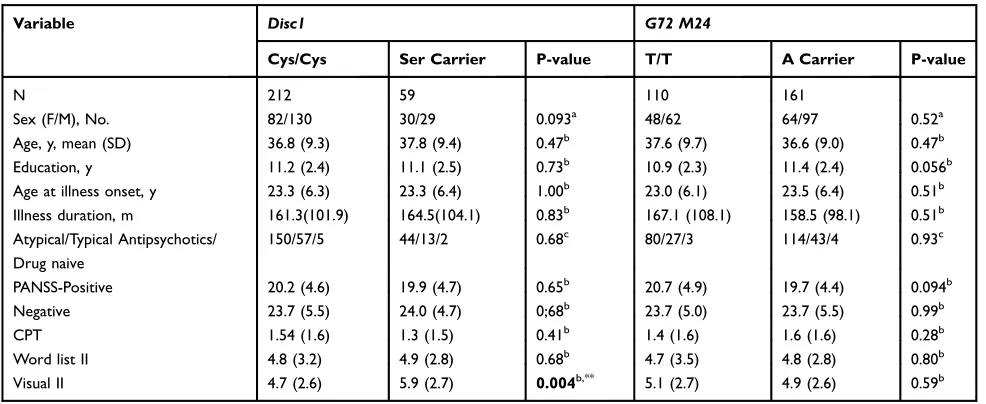
allele-dose effect on Visual Reproduction II performance, while the threeG72M24 genotypes had no significant infl u-ence. Univariate regression was used for comparison among the three genotype groups: compared to the performance (4.7 ±2.6) of the patients who carried no Ser allele (Cys/Cys homo-zygotes), those who carried 1 Ser allele (Ser/Cys heterozy-gotes) had better visual learning ability (5.8±2.7, t=2.593, P=0.010) and those who carried 2 ser alleles (Ser/Ser homo-zygotes) also tended to perform better (6.8±3.9, t=1.735, P=0.084), albeit insignificantly perhaps due to the very small sample size of the Ser/Ser group (n=5). We, therefore, grouped
Ser carriers (DISC1Ser/Ser andDISC1Ser/Cys patients) as
a group to compare with DISC1 Cys/Cys homozygotes;24
meanwhile, A-allele carriers of G72 M24 (A/A and A/T)
were combined and compared toG72M24 T/T homozygotes
(Table 1).16
Demographic characteristics, clinical manifestations, CPT,
and Word list II betweenDISC1genotypes (Cys homozygotes
vs Ser carriers) and betweenG72M24 genotypes (TT
homo-zygotes vs A carriers) were similar (Table 1). Of note, the Ser carriers excelled Cys homozygotes in Visual Reproduction II performance (t= 2.912, p=0.004), while TT homozygotes and A carriers performed similarly (Table 1).
Cognitive Functions Among Diplotype
Groups
Demographic characteristics, clinical manifestations, CPT, and Word list II among the 4 diplotype groups (Ser carrier_TT, Ser carrier_A carrier, Cys/Cys_TT, Cys/Cys_A carrier) were simi-lar (Table 2). However, the four diplotype groups differed
significantly in Visual Reproduction II performance
(F= 3.621, p=0.014) (Table 2).
Moreover, Cys/Cys_T/T group (4.7±2.5, p=0.004) and Cys/Cys_A carrier group (4.8±2.7, p=0.003), yet not Ser
Neuropsychiatric Disease and Treatment downloaded from https://www.dovepress.com/ by 118.70.13.36 on 24-Aug-2020
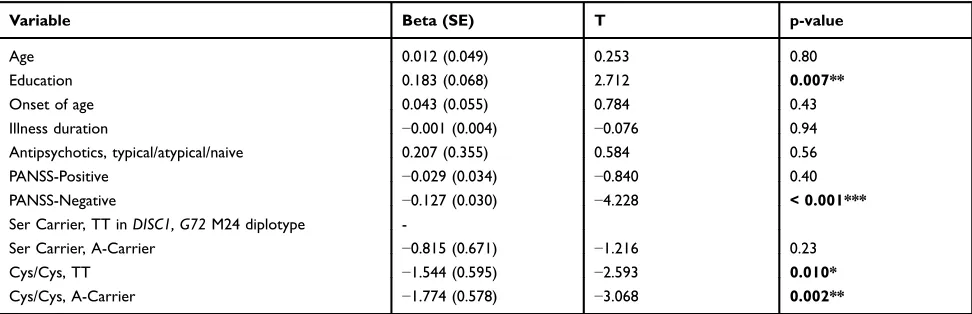
carrier_A carrier group (5.5±2.3, p=0.125), had poorer Visual Reproduction II scores when compared to Ser carrier_T/T group (6.6±3.1) by univariate regression (Figure 1). Furthermore, after controlling demographic and clinical variables (Table 3) using multiple regression, education duration had positive effect (p=0.007), while negative symptoms (p< 0.001), Cys/Cys_T/T (p=0.010) diplotype, and Cys/Cys_A carrier (p=0.002) diplotype
had negative effects on Visual Reproduction II scores (Table 3).
Synergistic Effect of DISC1Ser704Cys and
G72 M24 SNP on Visual Learning
We then evaluated genetic effects on delayed visual mem-ory by the effect size of the two SNPs and their combina-tion on delayed visual memory. The effect size on delayed
Table 1Demographic Characteristics, Clinical Features, and Cognitive Functions of Schizophrenia Patients withDISC1Ser704Cys and G72M24 Genotypes
Variable Disc1 G72 M24
Cys/Cys Ser Carrier P-value T/T A Carrier P-value
N 212 59 110 161
Sex (F/M), No. 82/130 30/29 0.093a 48/62 64/97 0.52a
Age, y, mean (SD) 36.8 (9.3) 37.8 (9.4) 0.47b 37.6 (9.7) 36.6 (9.0) 0.47b Education, y 11.2 (2.4) 11.1 (2.5) 0.73b 10.9 (2.3) 11.4 (2.4) 0.056b Age at illness onset, y 23.3 (6.3) 23.3 (6.4) 1.00b 23.0 (6.1) 23.5 (6.4) 0.51b Illness duration, m 161.3(101.9) 164.5(104.1) 0.83b 167.1 (108.1) 158.5 (98.1) 0.51b Atypical/Typical Antipsychotics/
Drug naive
150/57/5 44/13/2 0.68c 80/27/3 114/43/4 0.93c
PANSS-Positive 20.2 (4.6) 19.9 (4.7) 0.65b 20.7 (4.9) 19.7 (4.4) 0.094b Negative 23.7 (5.5) 24.0 (4.7) 0;68b 23.7 (5.0) 23.7 (5.5) 0.99b CPT 1.54 (1.6) 1.3 (1.5) 0.41b 1.4 (1.6) 1.6 (1.6) 0.28b Word list II 4.8 (3.2) 4.9 (2.8) 0.68b 4.7 (3.5) 4.8 (2.8) 0.80b Visual II 4.7 (2.6) 5.9 (2.7) 0.004b,** 5.1 (2.7) 4.9 (2.6) 0.59b
Notes:Bold values indicate statistical significance, **P<0.01.a
Chi-square test,b
Independent sampleTtest (T-Test),c
Fisher’s exact test
Abbreviations:PANSS-Positive, Positive and Negative Syndrome Scale-Positive subscale; PANSS-Negative, Positive and Negative Syndrome Scale-Negative subscale; CPT, Continuous Performance Test (d’value); Word list II, Word list II of Wechsler Memory Scale–III (WMS-III) (standardized score); Visual II, Visual Reproduction II of WMS-III (standardized score).
DISC1 G72 DISC1-G72
Ser/Ser
Cys/Cys Ser/Cys
TA
AA TT
Ser carrier / TT
Ser carrier / A carrier
Cys/Cys TT Cys/CysA carrier
Figure 1Influences of DISC1 Ser704Cy genotypes, G72 M24 (rs1421292) genotypes, and DISC1 Ser704Cys_G72 M24 interactions on visual learning, represented by means of Visual Reproduction II of Wechsler Memory Scale–III. **p< 0.01.
Neuropsychiatric Disease and Treatment downloaded from https://www.dovepress.com/ by 118.70.13.36 on 24-Aug-2020
visual memory for DISC1Ser704Cys SNP was 0.43 and
forG72M24 SNP was 0.07 (Figure 2). The additive effect
size of both SNPs was 0.50 (= 0.43 + 0.07). Effect sizes of Cys/Cys_T/T (0.70) and Cys/Cys_A-allele (0.65) on delayed visual memory were greater than the additive effect size (0.50) (Figure 2). This implicated that the effect ofDISC1Ser704Cys and G72on visual learning appeared to be synergistic.
Discussion
Thefirst majorfinding of this study is thatDISC1-Ser carriers
performed better thanDISC1-Cys/Cys homozygotes in visual
learning (as represented by delayed visual reproduction), but not in verbal learning or attention. Secondly, the patients with
the diplotype ofDISC1-Ser carrier_G72M24-T/T surpassed
DISC1-Cys/Cys_G72 M24-T/T or DISC1-Cys/Cys_G72 M24-A carrier in visual learning, with a larger effect size
Table 2 Demographic Characteristics, Clinical Features, and Cognitive Functions of Schizophrenia Patients with Different DISC1 Ser704Cys andG72M24 Diplotypes
DISC1, G72M24 Diplotype
Variable Ser Carrier, TT Ser Carrier, A Carrier Cys/Cys, TT Cys/Cys, A Carrier p-value
N 22 37 88 124
Sex (F/M), No. 14/8 16/21 34/54 48/76 0.16a
Age, y, mean (SD) 38.2(10.4) 37.5 (8.9) 37.4 (9.6) 36.4 (9.1) 0.75b Education, y 11.2 (2.7) 11.0 (2.4) 10.8 (2.2) 11.5 (2.5) 0.12b* Age at illness onset, y 23.8 (7.6) 22.9 (5.7) 22.7 (5.7) 23.6 (6.6) 0.72b Illness duration, m 152.6 (121.3) 171.6 (93.5) 170.7 (105.0) 154.5 (99.5) 0.62b Atypical/Typical Antipsychotics/
Drug naive
19/3/0 25/10/2 61/24/3 89/33/2 0.60c
PANSS-Positive 19.7 (4.7) 20.0 (4.7) 20.9 (4.9) 19.7 (4.4) 0.25b Negative 23.6 (5.2) 24.2 (4.5) 23.8 (4.9) 23.6 (5.8) 0.93b
CPT 1.0 (1.3) 1.6 (1.7) 1.5 (1.6) 1.6 (1.6) 0.38b
Word list II 5.0 (3.0) 4.9 (2.8) 4.7 (3.6) 4.8 (2.8) 0.97b Visual II 6.6 (3.1) 5.5 (2.3) 4.7 (2.5) 4.8 (2.7) 0.014b,*
Notes:Bold values indicate statistical significance, *P<0.05.a
Chi-square test,b
Analysis of variance (ANOVA),c
Fisher’s exact test.
Abbreviations:PANSS-Positive, Positive and Negative Syndrome Scale-Positive subscale; PANSS-Negative, Positive and Negative Syndrome Scale-Negative subscale; CPT, Continuous Performance Test (d’value); Word list II, Word list II of Wechsler Memory Scale–III (WMS-III) (standardized score); Visual II, Visual Reproduction II of WMS-III (standardized score).
Table 3Clinical and Genetic Variables Affecting Visual Learning, Represented by Standardized Score of Delayed Visual Reproduction of Wechsler Memory Scale–III
Variable Beta (SE) T p-value
Age 0.012 (0.049) 0.253 0.80
Education 0.183 (0.068) 2.712 0.007**
Onset of age 0.043 (0.055) 0.784 0.43
Illness duration −0.001 (0.004) −0.076 0.94
Antipsychotics, typical/atypical/naive 0.207 (0.355) 0.584 0.56
PANSS-Positive −0.029 (0.034) −0.840 0.40
PANSS-Negative −0.127 (0.030) −4.228 < 0.001***
Ser Carrier, TT inDISC1, G72M24 diplotype
-Ser Carrier, A-Carrier −0.815 (0.671) −1.216 0.23
Cys/Cys, TT −1.544 (0.595) −2.593 0.010*
Cys/Cys, A-Carrier −1.774 (0.578) −3.068 0.002**
Notes:Bold values indicate statistical significance, *P<0.05, **P<0.01, ***P<0.001. Multiple regression was utilized to compare visual learning among schizophrenia patients with differentDISC1Ser704Cys_G72M24 diplotypes. Education duration had a positive effect on visual learning (p= 0.007), while negative symptoms (p <0.001), Cys/Cys_T/T diplotype (p=0.010), and Cys/Cys_A-carrier diplotype (p=0.002) showed negative associations with visual learning.
Abbreviations:Typical, typical antipsychotics; atypical, atypical antipsychotics; naïve, antipsychotics naïve; PANSS-Positive, Positive and Negative Syndrome Scale-Positive subscale; PANSS-Negative, Positive and Negative Syndrome Scale-Negative subscale.
Neuropsychiatric Disease and Treatment downloaded from https://www.dovepress.com/ by 118.70.13.36 on 24-Aug-2020
than the sum of the effect sizes of DISC1 and G72 M24 individually, implying that the interactive gene effect of DISC1-G72 was additive (Figure 2). The finding, therefore,
lends support to the notion that both DISC1 and G72 are
involved in visual learning and suggest that the two genes interact synergistically.
Visual memory/learning has not yet been widely inves-tigated in schizophrenia patients. Hennah et al are the first
to report the significance of visual attention and visual
working memory in the pathogenesis of schizophrenia,4
while others emphasized on verbal memory/learning.14,15,19 Visual learning involves the ability to store and retrieve previously experienced visual sensations and perceptions when the stimuli that originally evoked them are no longer
present.11And one, with intact memory encoding and
con-solidation, should be able to place in and retrieve memory information that resembles objects, places, animals or
peo-ple in sort of a mental image from “the mind’s eye.”11
Moreover, visual perception and memory often perceive image as a whole and not in pieces, and group images according to six features: proximity, similarity, closure,
symmetry, common fate and continuity.39 It is sensitive in
ensembling characteristics of complex objects such as face,39 and its impairments are associated with poor social functioning13and illness severity2in schizophrenia.
Furthermore, visual learning deficits, mediated by organi-zation skill deficits5and poor memory encoding,5contribute to poor planning skills5 and executive dysfunction.12 Patients with schizophrenia often use a piecemeal approach and have difficultly processing the gestalt of a complex visual stimulus in visual learning evaluation.7Hence, impaired processing of global features in a local-global paradigm in these patients40 often results in overemphasis on non-critical features and depletion of available attention resources before they can pro-cess the critical features or interpret wholes as meaningful gestalts;40which further implies their inefficient organizational strategy.7Deficits in visual perception, visual memory encod-ing and consolidation all contribute to visual learnencod-ing deficits. Li et al also found that Cys-allele carriers have less efficient information transfer than Ser homozygotes.41Cys-allele car-riers had a significantly lower global efficiency of their brain networks and decreased white matter integrity.41
Animal genetic study has demonstrated a close association of DISC1, cognitive functions, and hippocampal function/ structure.18Human studies have also shown an association of
several DISC1 haplotypes, such as HEP1 (rs6675821,
rs1000731, rs3890280), HEP2/HEP3 segment (rs1615409, rs766288, rs751229, rs3738401), with altered cognitive function.4,14,24Cys allele has been associated with impaired verbal learning/long-term memory in schizophrenia and
nor-mal controls;14,24 while a few DISC1 haplotypes, but not
including the SNP of the current study, for example, HEP2/ HEP3 segment (rs1615409, rs766288, rs751229, rs3738401), HEP3 (rs751229, rs3738401) and hCV1650649 were asso-ciated with visual attention/search, visual working memory, and visuospatial memory.4,14On the other hand,G72M24-TT homozygotes were associated with decreased hippocampal activation and increased prefrontal activation in fMRI during episodic memory encoding and retrieval, working memory and verbal completion tasks.15,19,20We are thefirst group to report
the association of genetic effects betweenDISC1Ser704Cys
SNP andG72M24 SNP and delayed visual memory/learning
impairment. Interaction of the SNPs on visual memory was supported by a greater effect size of SNP combination (0.70,
0.65) than the sum of each SNP (0.50) (Figure 2). Unlike
previous studies,22,24 no association was shown between
DISC1Ser704Cys SNP andG72M24 SNP, and verbal learn-ing/memory. This may be due to different neuropsychological assessment tools used between ours and other studies.4,14In addition, verbal memory rather than visual memory might be more susceptible to antipsychotic (dopamine) effects.42
Finding of poorer visual learning and delayed visual memory in Cys allele carriers are consistent with previous
1 2 3 4
DISC1 (Cys vs. Ser)
G72 (A carrier vs. TT)
DISC1-G72
(vs. Ser, TT)
Cys,TT Cys,A carrier Ser, A carrier
Figure 2 Effect sizes of the DISC1 genotype, G72 genotype, and DISC1_G72 interactions on visual learning, represented by Visual Reproduction II Wechsler Memory Scale–III. The dotted lines represent the sum of the effect sizes of the DISC1 and G72 individually. The DISC1 Ser carriers excelled DISC1 Cys/Cys homozygotes in visual learning (p=0.004, effect size: 0.43). Meanwhile, G72 M24 A-allele carriers and G72 M24 T/T homozygotes performed similarly (effect size: 0.07). In interaction analyses, the patients with Ser carrier_T/T had better visual learning than those with Cys/Cys_T/T (p= 0.004, effect size: 0.70) and those with Cys/Cys _A-allele carrier (p= 0.003, effect size: 0.65). Therefore, the effect sizes (0.70 and 0.65) of the DISC1_G72 interactions were larger than the sum (0.50 = 0.43 + 0.07) of the effect sizes of DISC1 and G72 individually, suggesting that the interactive gene effect of DISC1-G72 was more than addition.
Neuropsychiatric Disease and Treatment downloaded from https://www.dovepress.com/ by 118.70.13.36 on 24-Aug-2020
frontal-parietal network (insular cortex) disruption studies in schizophrenia patients,43where the insular cortex of the temporal cortex is implied for general consolidation of
visual recognition memories.43 Association of DISC1
Ser704Cys SNP and G72M24 SNP and visual memory/
learning impairment is further supported by the impact of the DISC1 Ser704Cys SNP on visual memory associated
brain structural changes44and the impact of theG72M24
SNP on memory task associated brain activations.19 Cys
allele has been associated with reduced supramarginal gyrus volume, which is part of inferior parietal lobe
responsible for enactment effect specific for visual
mem-ory encoding.45
Visual memory recall predominantly activates the left superior frontal gyrus and the intraparietal cortex, whereas recall of visually learned locations activates the bilateral super-ior parietal cortices.11DISC1andG72genetic variances are closely associated with these visual memory-associated brain areas including insular cortex, medial superior frontal and prefrontal gyri, and hippocampus.14,19,23Ser/Ser homozygote with schizophrenia had similar or larger medial superior frontal gyrus and insular cortex volumes when compared with Cys carriers.44Moreover,DISC1Ser allele homozygotes compared to Cys allele carriers had greater hippocampal gray matter volume,23which further supported the possible concept that schizophrenia patients with Cys allele had poorer visual mem-ory (Figure 1).
The study also found that longer education duration benefited visual learning (Table 3). Thisfinding is consis-tent with previous studies implying that higher Intelligent Quotient (IQ) favors better delayed visual memory
performance.35This study also found that negative
symp-toms had detrimental effects on visual learning. Negative symptoms have been associated with visual memory
impairment in patients with schizophrenia.2
Limitations
This study has several limitations. Firstly, the distribution of
Cys and Ser allele is different from the previous study.22
Frequency of Cys homozygotes is higher, while Ser homozy-gotes is lower in our study. This may be explained by the Han Chinese ethnicity of the subjects. However, the distribution of the DISC1 genotype is similar to the report of NCBI.36 Moreover, there is no control group for this study. The reported effects of the studied SNPs on visual memory may be general effects for any subject, which would mean that they are not specific to schizophrenia. Inclusion of a control group in future replication study is needed. Thirdly, we used Word List of
WMS-III rather than California Verbal Test to assess verbal memory due to the limited availability of the Chinese version of the California Verbal Test. However, the measures from the two tests were highly correlated.46Fourthly, the use of a single neuropsychological test to assess visual learning may be con-sidered a shortcoming of the paper.
Conclusions
The present study is thefirst genetic study of visual memory in humans. It is also thefirst to investigateG72M24 SNP in
Han Chinese patients with schizophrenia and the first to
explore the relationship between DISC1 Ser 704Cys and
G72M24 genetic effects and visual memory in schizophrenia
patients. Studyfindings indicated that schizophrenia patients with the Cys/Cys_T/T or Cys/Cys_A carrier had poorer visual learning. The combination of the two SNPs also supported an additive effect of the individual SNPs, suggesting thatDISC1
andG72might interact synergistically and thereby
account-ing for variance in hippocampal structure, function, and activation.19,23Callicot also suggested that the risk of devel-oping schizophrenia and associated cognitive deficits may be due to haplotypes monitored by Ser704Cys rather than the SNP itself.22 Thus, investigating the roles of other genetic variants ofDISC4,17,22and their interactions withG72genetic variances15,19,20may further help search for the endopheno-type and subtyping of schizophrenia patients and develop-ment of targeted treatdevelop-ments.
Acknowledgments
This work was funded by Ministry of Science and Technology, Taiwan (MOST 108-2314-B-039-002), National Health Research Institutes (NHRI-EX108-1073NI), China Medical University Hospital, Taiwan (DMR-106-102), and Taiwan Ministry of Health and Welfare Clinical Trial and Research Center of Excellence (MOHW108-TDU-B-212-133004).
Author Contributions
All authors contributed to data analysis, drafting or revising the article, gavefinal approval of the version to be published, and agree to be accountable for all aspects of the work.
Funding
The aforementioned institutes had no further role in study design; in the collection, analysis and interpretation of data; in the writing of the report; and in the decision to submit the paper for publication.
Neuropsychiatric Disease and Treatment downloaded from https://www.dovepress.com/ by 118.70.13.36 on 24-Aug-2020
Disclosure
All authors declare that they have no conflicts of interest in this work.
References
1. Ko PC, Ally BA. Visual cognition in Alzheimer’s disease and its functional implications. In: The Clinical Spectrum of Alzheimer’s
Disease-The Charge Toward Comprehensive Diagnostic and
Therapeutic Strategies. IntechOpen;2011.
2. O’leary DS, Flaum M, Kesler ML, Flashman LA, Arndt S, Andreasen NC. Cognitive correlates of the negative, disorganized, and psychotic symptom dimensions of schizophrenia.J Neuropsychiatry Clin Neurosci.2000;12:4–15. doi:10.1176/jnp.12.1.4
3. Lo CH, Tsai GE, Liao CH, et al. Emotional management and 5-HT2A receptor gene variance in patients with schizophrenia.Biol
Psychol.2010;83:79–83. doi:10.1016/j.biopsycho.2009.11.002
4. Hennah W, Tuulio-henriksson A, Paunio T, et al. A haplotype within the DISC1 gene is associated with visual memory functions in families with a high density of schizophrenia. Mol Psychiatry. 2005;10:1097–1103. doi:10.1038/sj.mp.4001731
5. Seidman LJ, Lanca M, Kremen WS, Faraone SV, Tsuang MT. Organizational and visual memory deficits in schizophrenia and bipolar psychoses using the Rey-Osterrieth complex figure: effects of duration of illness. J Clin Exp Neuropsychol.2003;25:949–964. doi:10.1076/jcen.25.7.949.16482
6. McClure MM, Romero MJ, Bowie CR, Reichenberg A, Harvey PD, Siever LJ. Visual-spatial learning and memory in schizotypal person-ality disorder: continued evidence for the importance of working memory in the schizophrenia spectrum. Arch Clin Neuropsychol. 2007;22:109–116. doi:10.1016/j.acn.2006.11.004
7. Kim MS, Namgoong Y, Youn T. Effect of organizational strategy on visual memory in patients with schizophrenia.Psychiatry Clin
Neurosci.2008;62:427–434. doi:10.1111/j.1440-1819.2008.01821.x
8. Girard TA, Christensen BK, DeGroote MG, Rizvi S. Visual-spatial episodic memory in schizophrenia: a multiple systems framework.
Neuropsychology.2010;24:368–378. doi:10.1037/a0018313
9. Maziade M, Rouleau N, Merette C, et al. Verbal and visual memory impairments among young offspring and healthy adult relatives of patients with schizophrenia and bipolar disorder: selective genera-tional patterns indicate different developmental trajectories.
Schizophr Bull.2011;37:1218–1228. doi:10.1093/schbul/sbq026
10. Bodapati AS, Jenkins LM, Sharma RP, Rosen C. Visual memory uniquely predicts anhedonia in schizophrenia but not bipolar disorder.
J Neuropsychol.2019;13:136–146. doi:10.1111/jnp.2019.13.issue-1
11. Brewer JB, Zhao Z, Desmond JE, Glover GH, Gabrieli JD. Making memories: brain activity that predicts how well visual experience will be remembered. Science. 1998;281:1185–1187. doi:10.1126/ science.281.5380.1185
12. Kim JJ, Kwon JS, Park HJ, et al. Functional disconnection between the prefrontal and parietal cortices during working memory proces-sing in schizophrenia: a[15(O)]H2O PET study. Am J Psychiatry. 2003;160:919–923. doi:10.1176/appi.ajp.160.5.919
13. Silverstein SM, Knight RA, Schwarzkopf SB, West LL, Osborn LM, Kamin D. Stimulus configuration and context effects in perceptual organization in schizophrenia.J Abnorm Psychol.1996;105:410–420. doi:10.1037/0021-843X.105.3.410
14. Cannon TD, Hennah W, van Erp TG, et al. Association of DISC1/ TRAX haplotypes with schizophrenia, reduced prefrontal gray mat-ter, and impaired short- and long-term memory.Arch Gen Psychiatry. 2005;62:1205–1213. doi:10.1001/archpsyc.62.11.1205
15. Hall J, Whalley HC, Moorhead TW, et al. Genetic variation in the DAOA (G72) gene modulates hippocampal function in subjects at high risk of schizophrenia. Biol Psychiatry. 2008;64:428–433. doi:10.1016/j.biopsych.2008.03.009
16. Krug A, Markov V, Krach S, et al. Genetic variation in G72 corre-lates with brain activation in the right middle temporal gyrus in a verbal fluency task in healthy individuals. Hum Brain Mapp. 2011;32:118–126. doi:10.1002/hbm.v32.1
17. Hwu HG, Liu CM, Fann CS, Ou-yang WC, Lee SF. Linkage of schizophrenia with chromosome 1q loci in Taiwanese families.Mol
Psychiatry.2003;8:445–452. doi:10.1038/sj.mp.4001235
18. Johnstone M, Thomson PA, Hall J, McIntosh AM, Lawrie SM, Porteous DJ. DISC1 in schizophrenia: genetic mouse models and human genomic imaging.Schizophr Bull.2011;37:14–20. doi:10.1093/ schbul/sbq135
19. Goldberg TE, Straub RE, Callicott JH, et al. The G72/G30 gene complex and cognitive abnormalities in schizophrenia.Neuropsychopharmacology. 2006;31:2022–2032. doi:10.1038/sj.npp.1301049
20. Jansen A, Krach S, Krug A, et al. Effect of the G72 (DAOA) putative risk haplotype on cognitive functions in healthy subjects. BMC
Psychiatry.2009;9:60. doi:10.1186/1471-244X-9-60
21. Rastogi A, Zai C, Likhodi O, Kennedy JL, Wong AH. Genetic association and post-mortem brain mRNA analysis of DISC1 and related genes in schizophrenia. Schizophr Res. 2009;114:39–49. doi:10.1016/j.schres.2009.06.019
22. Callicott JH, Straub RE, Pezawas L, et al. Variation in DISC1 affects hippocampal structure and function and increases risk for schizophrenia. Proc Natl Acad Sci U S A. 2005;102:8627–8632. doi:10.1073/pnas.0500515102
23. Di Giorgio A, Blasi G, Sambataro F, et al. Association of the SerCys DISC1 polymorphism with human hippocampal formation gray mat-ter and function during memory encoding. Eur J Neurosci. 2008;28:2129–2136. doi:10.1111/j.1460-9568.2008.06482.x 24. Thomson PA, Harris SE, Starr JM, Whalley LJ, Porteous DJ,
Deary IJ. Association between genotype at an exonic SNP in DISC1 and normal cognitive aging.Neurosci Lett.2005;389:41–45. doi:10.1016/j.neulet.2005.07.004
25. Lane HY, Lin CH, Huang YJ, Liao CH, Chang YC, Tsai GE. A randomized, double-blind, placebo-controlled comparison study of sarcosine (N-methylglycine) and D-serine add-on treatment for schizophrenia. Int J Neuropsychopharmacol. 2010;13:451–460. doi:10.1017/S1461145709990939
26. Sacchi S, Bernasconi M, Martineau M, et al. pLG72 modulates intracellular D-serine levels through its interaction with D-amino acid oxidase: effect on schizophrenia susceptibility.J Biol Chem. 2008;283:22244–22256. doi:10.1074/jbc.M709153200
27. Association AP. Diagnostic and Statistical Manual of Mental
Disorders (DSM-IV). American Psychiatric Pub;1994.
28. Kay SR, Fiszbein A, Opler LA. The positive and negative syndrome scale (PANSS) for schizophrenia.Schizophr Bull.1987;13:261–276. doi:10.1093/schbul/13.2.261
29. Lo AH, Humphreys M, Byrne GJ, Pachana NA. Test-retest reliability and practice effects of the Wechsler memory scale-III.J Neuropsychol. 2012;6:212–231. doi:10.1111/j.1748-6653.2011.02023.x
30. Chen WJ, Liu SK, Chang CJ, Lien YJ, Chang YH, Hwu HG. Sustained attention deficit and schizotypal personality features in nonpsychotic relatives of schizophrenic patients.Am J Psychiatry. 1998;155:1214–1220. doi:10.1176/ajp.155.9.1214
31. Kennedy KM, Rodrigue KM, Head D, Gunning-dixon F, Raz N. Neuroanatomical and cognitive mediators of age-related differences in perceptual priming and learning.Neuropsychology.2009;23:475–491. doi:10.1037/a0015377
32. Bellino S, Rocca P, Patria L, et al. Relationships of age at onset with clinical features and cognitive functions in a sample of schizophrenia patients. J Clin Psychiatry. 2004;65:908–914. doi:10.4088/JCP. v65n0705
33. Cuesta MJ, Peralta V, Zarzuela A. Illness duration and neuropsycho-logical impairments in schizophrenia. Schizophr Res. 1998;33:141–150. doi:10.1016/s0920-9964(98)00068-1
Neuropsychiatric Disease and Treatment downloaded from https://www.dovepress.com/ by 118.70.13.36 on 24-Aug-2020
34. Kertzman S, Reznik I, Grinspan H, Weizman A, Kotler M. Antipsychotic treatment in schizophrenia: the role of computerized neuropsychological assessment. Isr J Psychiatry Relat Sci. 2008;45:114–120.
35. Skelley SL, Goldberg TE, Egan MF, Weinberger DR, Gold JM. Verbal and visual memory: characterizing the clinical and intermedi-ate phenotype in schizophrenia. Schizophr Res. 2008;105:78–85. doi:10.1016/j.schres.2008.05.027
36. NCBI. Reference SNP (rs) Report: rs821616.2019.
37. Ohi K, Hashimoto R, Yasuda Y, et al. Association study of the G72 gene with schizophrenia in a Japanese population: a multicenter study.
Schizophr Res.2009;109:80–85. doi:10.1016/j.schres.2009.01.019
38. Schumacher J, Jamra RA, Freudenberg J, et al. Examination of G72 and D-amino-acid oxidase as genetic risk factors for schizophrenia and bipolar affective disorder. Mol Psychiatry. 2004;9:203–207. doi:10.1038/sj.mp.4001421
39. Bruce V, Green P, Georgeson M. Visual Perception: Physiology,
Psychology, and Ecology. East Sussex, UK: Psychology Press;1996.
40. Johnson SC, Lowery N, Kohler C, Turetsky BI. Global-local visual processing in schizophrenia: evidence for an early visual processing
deficit. Biol Psychiatry. 2005;58:937–946. doi:10.1016/j.
biopsych.2005.04.053
41. Li Y, Liu B, Hou B, et al. Less efficient information transfer in Cys-allele carriers of DISC1: a brain network study based on diffusion MRI.Cereb
Cortex.2013;23:1715–1723. doi:10.1093/cercor/bhs167
42. Chen PS, Yang YK, Lee YS, et al. Correlation between different memory systems and striatal dopamine D2/D3 receptor density: a single photon emission computed tomography study. Psychol Med.2005;35:197–204. doi:10.1017/S0033291704003101
43. Nagai M, Kishi K, Kato S. Insular cortex and neuropsychiatric disor-ders: a review of recent literature.Eur Psychiatry.2007;22:387–394. doi:10.1016/j.eurpsy.2007.02.006
44. Takahashi T, Suzuki M, Tsunoda M, et al. The disrupted-in-Schizophrenia-1 Ser704Cys polymorphism and brain morphology in schizophrenia. Psychiatry Res. 2009;172:128–135. doi:10.1016/j. pscychresns.2009.01.005
45. Russ MO, Mack W, Grama CR, Lanfermann H, Knopf M. Enactment effect in memory: evidence concerning the function of the supramar-ginal gyrus.Exp Brain Res.2003;149:497–504. doi:10.1007/s00221-003-1398-4
46. McDowell BD, Bayless JD, Moser DJ, Meyers JE, Paulsen JS. Concordance between the CVLT and the WMS-III word lists test.
Arch Clin Neuropsychol. 2004;19:319–324.
doi:10.1016/S0887-6177(03)00023-4
Neuropsychiatric Disease and Treatment
Dove
press
Publish your work in this journal
Neuropsychiatric Disease and Treatment is an international, peer-reviewed journal of clinical therapeutics and pharmacology focusing on concise rapid reporting of clinical or pre-clinical studies on a range of neuropsychiatric and neurological disorders. This journal is indexed on PubMed Central, the‘PsycINFO’database and CAS, and
is the official journal of The International Neuropsychiatric Association (INA). The manuscript management system is comple-tely online and includes a very quick and fair peer-review system, which is all easy to use. Visit http://www.dovepress.com/testimo-nials.php to read real quotes from published authors.
Submit your manuscript here:https://www.dovepress.com/neuropsychiatric-disease-and-treatment-journal
Neuropsychiatric Disease and Treatment downloaded from https://www.dovepress.com/ by 118.70.13.36 on 24-Aug-2020