VISUAL SEMIOTICS: A STUDY OF IMAGES IN JAPANESE ADVERTISEMENTS
RUMIKO OYAMA
THESIS SUBMIITED TO THE UNIVERSITY OF LONDON iN FULFILMENT OF THE REQUIREMENTS OF THE DEGREE OF DOCTOR OF PHILOSOPHY
INSTITUTE OF EDUCATION UNIVERSITY OF LONDON
NOVEMBER 1998
BIL LONDON
ABSTRACT 14
ACKNOWLEDGEMENTS 15
Chapter 1 INTRODUCTION 16
1.1 THE PURPOSE OF THE RESEARCH 16
1.2 DEVELOPMENT OF RESEARCH INTERESTS 16
1.3 LANGUAGE VERSUS VISUALS AS A SEMIOTIC MODE 20 1.4 THE ASPECT OF VISUAL SEMIOTICS TO BE FOCUSED ON:
Lexis versus Syntax 23
1.5 CULTURAL VALUE SYSTEMS IN VISUAL SYNTAX:
A challenge to the notion of universality 24
Chapter Ii THEORETICAL FRAMEWORK 26
2.1 INTRODUCTION 26
2.2 LITERATURE SURVEY ON STUDIES OF IMAGES 27
2.2.1 What is an image? 27
2.2.2 Art history/Art theories 29
2.2.3 Sociological approaches to visual images 36
2.2.4 Cultural approaches to visual images 44
2.2.4.1 Visual images as cultural products 45
2.2.4.2 Visual images from linguistic perspectives 50
2.2.5 Semiotic approaches to visual images 54
2.2.5.1 Saussure, Barthes (traditional semiology I semiotics) 54
2.2.5.3 Social Semiotics 61
2.2.6 Reflection on the literature survey 66
2.3 A THEORY FOR A SEMIOTIC ANALYSIS OF THE VISUAL 71 2.3.1 Visual semiotics and the three metafunctions 72
2.3.1.1 The Ideational melafunction 73
2.3.1.2 The Textual metafunction 75
2.3.1.3 The Interpersonal metafunction 78
2.4 VERBAL TEXT IN VISUAL COMPOSITION: Critical Discourse Analysis 80 23 INTEGRATED APPROACH FOR A MULTI-MODAL ANALYSIS OF
VISUAL AND VERBAL TEXTUAL OBJECTS 84
2.6 CONCLUSION 91
Chapter III METHODOLOGY 93
3.1 INTRODUCTION 93
3.2 DATA 93
3.2.1 Why use advertisement? 94
3.2.2 Type of advertisements used in the thesis 96
3.2.3 The range ofprinted advertisements used 97
3.2.3.1 Textual sources 97
3.2.3.1.1 Newspapers
3.2.3.1.2 Women's magazines -Japanese
-British
3.2.3.1.3 Magazines for the general reader -Japanese
3.2.3.2 Types of commodities advertised 103
3.3 THEORY iN USE 105
3.3.1 Key descriptive/analytic concepts and terms 107 3.3.1.1 Text and discourse 107
3.3.1.2 Types ofparticipants 107
3.3.1.3 Visual lexis/ Visual syntax 109
3.3.2 Descriptive categories for visual semiosis 109 3.3.2.1 Visual Lexis: what/who is depicted in the text (the Ideational
metafunction) 110
3.3.2.2 Visual Syntax: transitivity relations of represented participants
(the Ideational metafunction) 111 3.3.2.3 Visual Syntax: the positioning of represented participants
in the texts (the Textual metafunction) 112
3.3.2.3.1 Left/Right 3.3.2.3.2 Top/Bottom 3.3.2.3.3 Centre/Margins 3.3.2.3.4 Salience
3.3.2.4 Visual Syntax: how represented participants interact with the viewer (the Interpersonal metafunction) 115 3.3.2.4.1 The system of Contact
3.3.2.4.2 The system of Social Distance 3.3.2.4.3 The system of Attitude
3.3.2.4.4 Use of Colour 3.3.2.4.5 Contextualisation
3.3.3 Integrated theory for the visual and the verbal modes of semiosis 121
3.4 A SCHEMA FOR TEXTUAL ANALYSIS 124
Chapter IV VISUAL LEXIS: Ideational Function of Represented Participants 126
4.2 THE REPRESENTATION OF 'BRITISHNESS' AND 'WESTERNESS' IN
JAPANESE ADVERTISEMENTS 127
4.2.1 'Britishness' 128
4.2.1.1 Represented participants 128
4.2.1.2 Visual lexis that represent 'Britishness' 128
4.2.2 'Weslerness' in general 130
4.2.2.1 Represented participants 130
4.2.2.2 Visual lexis that represents 'Westerness' in general 131
4.3 THE REPRESENTATION OF 'JAPANESENESS' IN JAPANESE
ADVERTISEMENTS IN BRITAIN 134
4.3.1 'Japaneseness' and cultural stereotypes 135 4.3.1.1 Human represented participants 135 4.3.1.2 Non-human represented participants 135
4.3.1.3 Verbal represented participants 136
4.3.2 'Japaneseness' in the aesthetic domain 137
4.3.2.1 Represented participants 137
4.3.2.2 Verbal elements as visual lexis that represents 'Japaneseness' 138
4.4 CONCLUSION 140
Chapter V VISUAL SYNTAX 1: Directionality and Use of Space 145
5.1 INTRODUCTION 145
5.2 WRITING SYSTEMS 147
5.3 DIRECTIONALITY: The Ideational Metafunction 150
5.3.1 Inherent directionality 151
5.3.2 Vectorial directionality 154
5.3.2.2 Forward (positive) directionality in British advertisements 156
5.3.3 Summary 157
5.4 USE OF SPACE: The Textual Metafunction 159
5.4.1 Left/Right 162
5.4.1.1 Left/Right as temporal sequence 162
5.4.1.2 Left/Right and the degree of salience 164
5.4.1.3 Left/Right as distribution of knowledge 165 5.4.1.4 Left/Right and scriptorial visual directionality 168
5.4.2 Top/Bottom 169
5.4.2.1 Top/Bottom as Abstractness/Spec jficness 170
5.4.2.2 Top/Bottom as PotentiaL' Reality 170
5.4.2.3 Top/Bottom as Positive/Negative 171
5.4.3 Centre/Margins 172
5.4.3.1 Vertical centrality 173
5.4.3.1.1 Human participants and images of products 5.4.3.1.2 Images of products
5.4.3.1.3 Balance created by Vertical centrality
5.4.3.2 Circular centrality 176
5.4.3.2.1 Circular images in the domain of Centre 5.4.3.2.2 Empty centrality
5.4.3.2.3 Balance created by Circular centrality
5.4.4 Summary 181
5.5 CONCLUSION 183
Chapter VI VISUAL SYNTAX 2: Social Interactions 185
6.1 INTRODUCTION 185
6.2.1 TextualAnalysis 187 6.2.1.1 Interpersonal meaning making through human participants
187
6.2.1.1.1 The system of Contact. Social Distance and Attitude
in three beverage advertisements
6.2.1.1.2 The system of Contact. Social Distance and Attitude
in a campaign for wedding services
6.2.1.2 Interpersonal meaning making through non-human
participants 194
6.2.1.2.1 The system of Contact 6.2.1.2.2 The system of Attitude
6.2.1.3 Use of colour and Contextualisation 199
6.2.1.3.1 Beverage advertisements 6.2.1.3.2 Car advertisements
6.2.2 Summa,y 203
6.3 INTERPERSONAL MEANING MAKING ACROSS CULTURES:
A COMPARISON OF JAPAN AND BRITAIN 205
6.3.1 TextualAnalysis 206
Example 1 Organics
Example 2 De Beers Diamond Ring
6.3.1.1 Human represented participants 206 6.3.1.1.1 The system of Contact
6.3.1.1.2 The system of Social Distance 6.3.1.1.3 The system of Attitude
6.3.1.2 Non-human represented participants 212 6.3.1.2.1 The system of Contact
6.3.1.2.2 The system of Social Distance 6.3.1.2.3 The system of Attitude
6.3.1.3 Use of Colour and Contextualisation 215 6.3.1.3.1 Use of Colour
6.3.1.3.2 Contextualisation
6.3.2 Summary 218
Chapter VII INTEGRATED ANALYSIS OF VISUAL LEXIS AND
VISUAL SYNTAX 222
7.1 INTRODUCTION 222
7.2 THE REPRESENTATION OF 'BRITISHNESS' AND 'WESTERNESS' IN
JAPANESE ADVERTISEMENTS 222
7.2.1 'Britishness' 223
7.2.1.1 Visual directionality: the Ideational metafunction 223 7.2.1.2 Use of space: the Textual metafunction 224 7.2.1.3 Social interactions: the Interpersonal metafunction 225
7.2.2 'Westerness' in general 227
7.2.2.1 Visual directionality: the Ideational metafunction 227 7.2.2.2 Use of space: the Textual metafunction 228
7.2.2.3 Social interactions: the Interpersonal metafunction 230
7.3 THE REPRESENTATION OF 'JAPANESENESS' IN JAPANESE
ADVERTISEMENTS IN BRITAIN 231
7.3.1 Revisiting Figure 4-4: Kirin Lager Beer advertisement 232 7.3.1.1 Visual directionality: the Ideational metafunction 232 7.3.1.2 Use of space: the Textual metafunction 233
7.3.1.3 Social interactions: the Interpersonal ,netafunction 234
7.3.2 Revisiting Figure 4-7: Asahi Super Dry Beer advertisement 236
7.3.2.1 Visual directionality: the Ideational metafunction 236
7.3.2.2 Use of space: the Textual metafunction 237
Chapter VIII INTEGRATED ANALYSIS OF THE VISUAL AND VERBAL ASPECTS OF TEXTUAL OBJECTS/ADVERTISEMENTS
242
8.1 INTRODUCTION 242
8.2 FUNCTIONAL LOADS OF THE ViSUAL AND THE VERBAL MODES
AND TEXTUAL INTEGRATION 242
8.2.1 Simply structured examples 242
8.2.1.1 The isotype 244
8.2.1.2 Advertisements 245
8.2.2 Functional loads in dfferent textual composite types 249
8.2.2.1 Left/Right 249
8.2.2.2 Top/Bottom 256
8.2.2.3 Centre/Margins 263
8.3 FUNCTIONAL LOADS OF THE VISUAL AND THE VERBAL MODES IN
A CROSS-CULTURAL SEMIOTIC PERSPECTIVE 266
8.3.1 Textual analysis 267
8.3.1.1 De Beers Diamond Ring advertisement 267
8.3.1.2 Cup soup advertisements 276
8.3.1.3 Pain killers advertisements 280
8.4 CONCLUSION 284
Chapter IX FURTHER DIRECTIONS FOR VISUAL SEMIOTICS 286
LIST OF FIGURES
Figure 2-1 Tree diagram of 'Images' (Mitchell 1986:10)
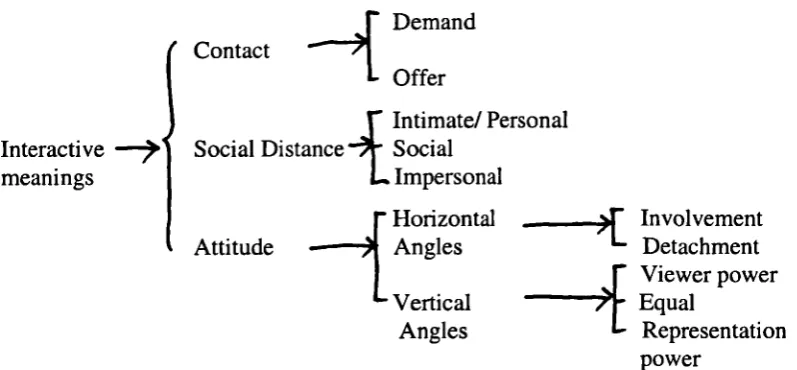
Figure 2-2 The Dimensions of Visual Space in Western Visual Semiotic Figure 2-3 Interactive meanings (Kress and van Leeuwen 1996:154)
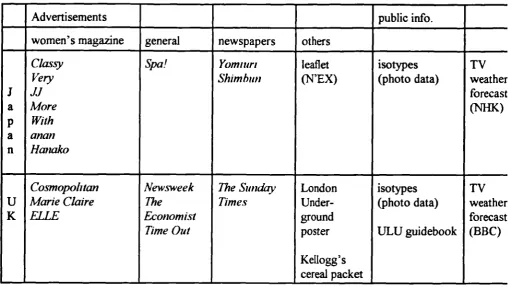
Figure 3-1 Sources of Data
Figure 3-2 Types of commodities advertised in data Figure 3-3 Represented participants
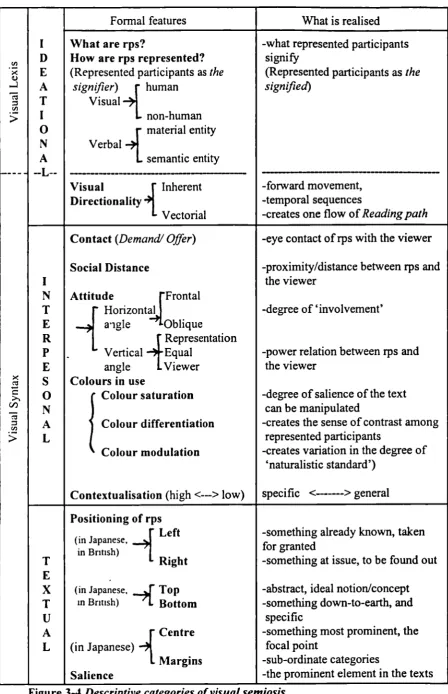
Figure 3-4 Descriptive categories for the analysis of visual semiotics
Figure 3-5 Descriptive categories for functional loads of the visual and verbal modes
Figure 4-1 Laceby Hall Tea Figure 4-2 Toshimaen, Tokyo
Figure 4-3 The system of signification in Figure 4-2
Figure 4-4 Kirin Lager Beer Figure 4-5 Kirin Lager Beer Figure 4-6 Kirin Lager Beer Figure 4-7 Asahi Super Dry Beer
Figure 4-8 The system of signification m Figure 4-7 Figure 4-9 The signifier of "Japaneseness"
Figure 5-5 photo data "watch your step" Figure 5-6 photo data "No parking"
Figure 5-7 University of London Union Student Guidebook 1996 Figure 5-8 Narita Express
Figure 5-9 Keikyu Department Store opening campaign Figure 5-10 Sumitomo Bank
Figure 5-11 Evening Standard Figure 5-12 Evening Standard
Figure 5-13 Underlying spatial semiotic systems
Figure 5-14 Abstract representation of Vertical! Circular Centrality Figure 5-15 Svenson Japan
Figure 5-16 Pountney Clinic
Figure 5-17 Given!New distribution in Japanese/British examples Figure 5-18 Bionsen
Figure 5-19 Thicker Fuller Hair products
Figure 5-20 Abstract representation of a shot from NHK weather forecast Figure 5-21 Abstract representation of a shot from BBC weather forecast Figure 5-22 Twining Tea
Figure 5-23 Kellogg's Fruit 'n Fibre
Figure 5-24 from Kress and van Leeuwen (1996:196) Figure 5-25 London Transport Night bus service Figure 5-26 Suntory Oolong Tea
Figure 5-29 Scotch Whisky
Figure 5-30 Hagoromo Fruit dessert Figure 5-31 JR East
Figure 5-32 NEC multi media
Figure 5-33 Use of Space in Japanese and British visual space
Figure 6-1 Happoen Wedding services Figure 6-2 Minolta Camera
Figure 6-3 AIWA Hi-Fi Figure 6-4 Yakult (British) Figure 6-5 Subaru Forester Figure 6-6 Toyota Starlet Figure 6-7 Organics (Japanese) Figure 6-8 Organics (British)
Figure 6-9 De Beers Diamond Ring (Japanese) Figure 6-10 De Beers Diamond Ring (British)
Figure 7-1 Visual Directionality in Figure 4-4
Figure 7-2 The distribution of Japanese English copy in Figure 4-7 Figure 7-3 Given/New distribution in Figure 4-7
Figure 8-5 Vectors in Figure 6-9 and Figure 6-10 Figure 8-6 Nichirei Cup Soup
Figure 8-7 Batchelor 's Cupa Soup Figure 8-8 Naron Ace
ABSTRACT
The thesis begins an exploration of the way in which Japanese visual semiotics works. In this it focuses on the formal representations of visual elements: visual
syntax. Specifically, this thesis examines the way in which visual representations are realisations of three types of semiotic metafunctions: the Ideational, Textual and Interpersonal. In order to gain a clear idea about Japanese visual semiotics, I compare them with British counterparts in a relatively minor way. There is some consideration of Japanese and British cultural value systems as revealed through an analysis of the visual.
It is widely accepted that language is rule-governed, and that the rules of this system are closely related to the social and cultural environment in which they are produced. This is the basis of most work in sociolinguistics, of a very wide variety. The same assumption, however, is not normally made of other semiotic
modes such as the visual.
This study uses advertisements as the data; and it is through that data that the issue of visual semiotics is considered. Advertisements are examples par
excellence of the connection of cultural values and visual semiotics; they are also a rich source for the study of visual communication, and are widely available and comparable across Japanese and British cultures. To some small extent it shows how similarly and differently they are manifested in Japanese and British examples.
ACKNOWLEDGEMENTS
I could never have begun let alone finish this thesis without the support and love of my parents, Kimiko and Hiroshi Oyama.
I am greatly indebted to Professor Gunther Kress for his generous supervision, intellectual guidance and concern for my professional future.
I thank Paul Mercer for his incisive readings of draft chapters and constant support and friendship.
I wish to express my gratitude to Mary Scott for her valuable comments and criticism.
Thanks go to my friends in 'The Text Group', who discussed and probed my ideas in the most positive way; Anton Franks, Kieran McGuillicuddy, Nancy Lee, Sonia Pimenta, Maria Alice Descardeci, Mary Wolfe, Denise Newfield and Nick Groom.
I would also like to thank Judy Demaine, Patricia Kelly and Ulrike Baechle for their patience and help, and Lindsay Whittome for solving my computer problems.
I am grateful to my close friends Elif Toprak, Sheila Robbie and Tern Kim, for their moral support.
From miles away in Japan: Professor Tomoko Honjo and Professor Kazuhito Hayashi of Kobe College; and Professor Miho Shimada and Professor Hisao Kakehi have all encouraged me during the long journey of my degree.
Rumiko Oyama
Chapter I INTRODUCTION
1.1 THE PURPOSE OF THE RESEARCH
The purpose of my research is to begin to explore some aspects of Japanese visual semiotics, with particular emphasis on visual syntax: the formal features of visual images. I do this by describing in detail a range of Japanese advertisements. In order to gain a sharper focus, I compare Japanese visual semiotics, in part, with the visual semiotics of some British advertisements. On the basis of what I have described and with respect to the two semiotic systems, I then consider the realisation of some aspects of the respective value systems through the visual semiotics of each culture: to what extent the account of two different visual semiotic systems can demonstrate how value systems are represented in specific cultures.
1.2 DEVELOPMENT OF RESEARCH INTERESTS
'literary' and 'non-literary'.
The awareness and recognition of language as a 'carrier' of ideology in the domain of 'literary works' ('literary canons') brought me to explore the same issue in a different domain: language in everyday-life contexts, such as the language of newspapers and advertisements (Leech, 1966; Carter and Nash, 1990; Bell, 1991; Cook, 1992; Fairciough, 1989, 1 995a, 1 995b; Fowler, 1991). However, when one looks at language use in these 'texts', one notices that there is more than just language involved in the meaning making. Many newspaper articles, for example, consist not only of language but also of visual images such as photographs and forms of illustration. When it comes to advertising, it is often the case that visual images play a primary role, more significant than language: most advertisements make considerable use of visual images along with language, both in printed advertisements and television commercials. The generic structure of these 'texts' makes it necessary to consider visuals as a carrier of meaning along with language: the visual as meaningful. These 'texts' become ideological in the process of production and reading within socio-cultural contexts.
notion of Orientalism in that it gave me a new way of looking at representations of the East and Eastern cultures as constructed by the West, as a manifestation of the power relations between them.
Occidentalism (Creighton, 1992) is the concept through which the West is perceived by the Orient. Counter-orientalism is what Moeran considers as a particular 'counter-response' to the age-old concept of Orientalism, which Said claims has been realised across various forms such as literature, philosophy, history and representations in art.
These ideological concepts are often manifested in the form of what is called 'cultural stereotypes'. The notions of Orientalism, Occidentalism and Counter-orientalism are useful in the sense that they provide the foundation for analysing cultural representations in visual images. More importantly, the representation of these ideological concepts can be explored not just through language but also through other modes of representations such as visual images.
Said (1978) focused exclusively on the domain of high culture, such as canonical literature, plays and paintings, as the forms of representation of what has been defined as 'the Orient' by 'the West'. My view is that ideology can be manifested not only through the forms of representation known as 'high culture' but also through 'popular culture' that exists in everyday-life contexts, such as television programmes and advertisements (Bell, 1991; Hartley, 1982; Fiske, 1978; Morley, 1992; Williamson, 1978; Leiss et al, 1990; Dyer, 1982; Goldman, 1992; Goldman and Papson, 1996).
Cultural representations are materialised and produced with different semiotic modes (or different resources of communication), such as language and visual images. Language as a means for cultural representation (or language as a means for representation of ideology) has been explored in a great number of studies in the field of linguistics (Hodge and Kress 1988, 1993; Kress 1983, 1986, 1987, 1996a; Fowler, Hodge and Kress, 1979; Fowler, 1991; Fairclough, 1989, 1992, 1995a; van Dijk 1985; Simpson, 1993; Birch, 1989, 1996; Bourdieu, 1991; Moeran, 1984; Gumperz, 1982). Whereas visual images as a means of cultural representation have been studied most notably in the domain of anthropology (Bateson and Meads, 1947) and have recently emerged as the focus of sociological research. (Goffman, 1979; Dingwall et al, 1991, Berger, 1972, 1980; Ball and Smith, 1992; Becker, 1981; Chaplin, 1994; Cooke and Wollen, 1995; Sontag, 1979; Loftus, 1988).
visual has led me to semiotics, as the major approach to analysing visual images, I draw on visual semiotics to illustrate how a 'visual grammar' works. The consideration of the visual as carrier of ideology in specific social circumstances also leads to the question of cultural specificness in visual representations and to what extent an account of visual semiotics can 'reveal' the fundamental value systems of a given culture.
1.3 LANGUAGE VERSUS VISUALS AS A SEMIOTIC MODE
It is widely accepted that language is rule-governed, and that the rules of this system are closely related to the social and cultural environment in which they are produced: this is language as a manifestation of ideology (Ilodge and Kress, 1988, 1993; Kress, 1983, 1986, 1987, 1996; Fowler, Hodge and Kress, 1979; Fowier, 1991; Fairclough, 1989, 1992, 1995a; van Dijk, 1985; Simpson, 1993). Among semiotic modes, language has been treated as the dominant mode of communication (Crystal and Davy, 1969; Carter and Nash, 1990; Leech, 1966; Tanaka, 1994; Vestergaard and Schroder, 1985; Halliday,
1978; Fowler, 1991; Fairciough, 1989, 1992, 1995a, 1995b; van Dijk 1985; Simpson 1993; Birch, 1989, 1996). Considering the increasing use of the visual mode (Kress and van Leeuwen, 1990, 1996; van Leeuwen and Kress, 1992; Andrews, 1998; Raney, 1997; Jenks, 1995; Lewis, 1996; Margolin, 1989; Mitchell, 1980, 1995; Moeran, 1991, 1996;
Tufte, 1990, 1997; Skov and Moeran, 1995) and other modes such as actions, sound and music (Barthes, 1977; Cook, 1992; van Leeuwen, 1987), however, it can be said that for a full understanding of meaning making, not onLy language but also the visual mode, has to be considered in a more systematic way.
to language, there has been a codification which regulates its various uses. This is 'grammar' as a description of a code. The codification refers to a 'grammar' as a set of legitimated regulations such as grammar taught in the classroom, which is mainly represented in the form of school textbooks. It also exists in the context of social 'conventions' that have been socially and culturally reinforced and become regularised. There is another use of the term 'grammar'. For example, native users of English have an intuitive knowledge of how to use their language without referring to the codjjIed grammar. This is a 'grammar in use'. 'Grammar in use' is related to 'grammar as a code' in the way that some aspects of 'grammar in use' have the potential to become 'grammar as a code' as the result of reinforcement in a social and cultural contexts.
Likewise, as 'grammar' in language can be viewed from at least two different aspects ('grammar as a code' and 'grammar in use'), I wish to consider 'grammar' in visuals, in
terms of the two different functions of 'grammar', parallel to that of language: grammar as a code and grammar in use. The definition of visual grammar as a code can be a set of regulations that the user of the visual mode is expected to follow (in the same manner as English speakers must follow various grammatical regulations; for example, the third person pronoun is followed by a main verb with s)' Visual grammar in use, by contrast, is likely to be realised in the way in which a given individual communicates through the use of visual forms structured in particular ways with others and in which they make use of the visual in his/her everyday life context. Just as a codified grammar in language emerges from 'grammar in use', 'visual grammar in use' marks one stage of the
development of 'visual grammar as a code'.
Children, before they start writing, first draw pictures and they do this without referring to the structure of forms in any particular 'grammar book' for the visual (Kress, 1996b). They learn to use and understand various visual images as information. Not only children but also adults are exposed to all sorts of visual information in their everyday life context and they understand what is visually realised as relevant information. Both adult and child users produce texts using the visual mode (such as visual instructions and notes with pictures) in order to exchange information with others. These exemplify the cases where visual 'grammar in use' is at work, which is concerned with an individual's ability to make use of the visual mode of communication, seemingly without the restriction of regulations in the visual.
Visual images have been studied from various perspectives, such as aesthetics (Gombrich, 1984; Baxandall, 1972), art history (Baxandall, 1972; Gombrich, 1984), art theories (Arnheim, 1969, 1974, 1988; Gombrich, 1960, 1982; Panofsky, 1970, 1972; Bryson, 1990; Mitchell, 1980, 1986), sociology of art (Fyfe and Law, 1988; Wolff, 1993; Chaplin, 1994), and culture (Barthes, 1964, 1977, 1984; Williamson, 1978; Messaris, 1997; Moeran, 1991, 1996), which are discussed in Chapter II. Regularities of visuals, the way in which visual images work, in this way, have been established in a diverse manner across different disciplines. Visual images are no less systematised than language, however this has gone unrecognised except for a small number of Art theorists (Arnhem, 1969, 1974, 1988 and Gombrich, 1960, 1982, 1984).
(such a regulation as, for example, 'something important is always placed on the right hand side or in the centre or in the background of the given space'). Adults as well as children encounter a flow of visual images in everyday life environments; through work, social activities and personal hobbies. They make use of the visual without particularly conscious reflection, as though visuals are there to be used, understood and to be created as a rule-free mode of communication: that the visual is something 'transparent'. (This leads to the notion of universality of the visual that suggests that there is no systematic regulation at work in visual communication, so that it can be understood and also produced in the same manner, regardless of the contexts in which it is located.) Looking at the use of the visual in a systematic way, as a code, is a domain in which little research has been done; and in part this has led me to investigate the way in which the visual operates, in other words, to investigate the domain of 'visual grammar'.
1.4 THE ASPECT OF VISUAL SEMIOTICS TO BE FOCUSED ON: Lexis versus Syntax
In relation to the notion of 'visual grammar', the primary concern of this research is on the 'formal' and 'syntactical' structures of visuals: what I (and Kress and van Leeuwen, 1990, 1996) call "visual syntax", as opposed to the way of looking at visuals in terms of its content: what I call (and Kress and van Leeuwen, Ibid) "visual lexis" (for a detailed
contribute to interaction between the text and the viewer.
While visual lexis is concerned with the units of visual elements as they are, visual syntax has to do with the relationship between one element and another. It is in no way my intention to dismiss the role of visual lexis in meaning making, but my primary concern, with respect to the establishment of visual grammar, is with visual syntax. The way in which visual elements are structured gives rise to various meanings and this is, to me, where a 'visual grammar' comes to play a significant role. By attempting a detailed description of visual syntax, 'as a carrier of ideological meanings' (Hodge and Kress, 1993:208), I hope to demonstrate how visuals can be looked at in a systematic manner, as a code.
1.5 CULTURAL VALUE SYSTEMS IN VISUAL SYNTAX: a challenge to the notion of universality
With respect to the issue of visual images as cultural and ideological realisation, I want to question the notion of universality of the visual: that is to claim that visuals can be a culturally transparent medium of communication (Neurath, 1937, 1948; Lupton, 1989) as well as language; 'universality in language' (Greenberg, 1963, 1966, 1971; Hockett, 1966). Cultural specificness in relation to language has been dealt with by a number of scholars (Halliday, 1978; Sapir, 1921; Whorf, 1956; Penn, 1972), that is to see language as a production of a given culture and the way that language is used is greatly determined by the culture that conditions its linguistic system.
is assumed that visuals can operate as a mode of communication regardless of a given culture and without any problems that are caused by cultural difference. In other words, visuals are considered to be a culturally transparent medium of communication, and that people understand information carried by the visual mode 'equally' regardless of cultural differences. This stance, as this thesis hopes to demonstrate, overlooks the significant impact of cultures on 'visual grammar' (when difference in language grammar has been described in detail), and it implicitly maintains the higher status of language over other modes of communication.
Chapter II THEORETICAL FRAMEWORK
2.1 INTRODUCTION
In this chapter I survey the literature in relevant fields of studies, involving visual images and visual communication; and I set out the theoretical framework on which the work of my thesis is based.
Section 2.2 draws on studies of visual images from various perspectives: art history (Gombrich, 1980; Baxandall, 1972; Berger 1972); art theories (Arnheim, 1988, 1974 1969; Gombrich, 1960, 1982; Panofsky, 1970, 1972), sociology of art (Chaplin, 1994; Wolff, 1993; Goffman, 1979; Dingwall Ct al, 1991); visual images as cultural product, with particular reference to the studies of advertisements (Willamson, 1978; Barthes, 1977; Messaris, 1997; Cook, 1992; Forceville, 1996; O'Toole, 1994; Tanaka, 1994; Myers, 1994; Vestergaard and Schroder, 1985; Moeran, 1991, 1996); semiotics (Saussure, 1974; Barthes, 1967, 1977, 1982, 1984; Williamson, 1978; Metz, 1974, 1977,
1982; Hodge and Kress, 1988; O'Toole, 1994; Kress and van Leeuwen, 1990, 1996). Building on my discussion in section 2.2, section 2.3 will outline a theory for visual semiotics, which is directly relevant to my descriptive analysis of data. I will provide a basis of descriptive analytical categories to be drawn on in Chapter III, which is mainly based on Kress and van Leeuwen (1990, 1996), Halliday (1978, 1985), Thibault (1997), O'Toole (1994).
function of language in a given text is explored and described. There I will introduce Critical Discourse Analysis 2 as a theoretical framework that provides a theory and a
descriptive position from which messages conveyed through language can be analysed (Fairclough, 1989; 1992, 1995; Fowler, 1986, 1991; Fowler, Hodge, Kress and Trew, 1979; Hodge and Kress, 1993).
Finally, in section 2.5, I will attempt to outline an integrated approach towards visual and verbal modes of meaning making, which I hope will enable me to look at any text
which consists of visual and verbal elements as an integrated phenomenon rather than as containing two different, separate entities.
2.2 LITERATURE SURVEY ON STUDIES OF VISUAL IMAGES 2.2.1 What is an image?
This thesis is a contribution to a study of visual communication; it focuses on visual representations through images. The term 'images' is one of the most taken-for-granted words in everyday life. There is a necessity to clarify in what sense I deal with images, in other words, what I mean by images in my research. Therefore, I want to begin with
the questions: "what is an image?", "how can an image be defined?"
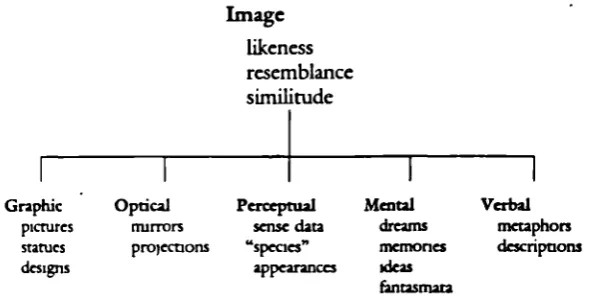
Mitchell (1986:10) proposes a typology of images in the form of a family tree (Figure 2-1). It is divided into five different categories: Graphic (pictures, statues, designs);
2Critical Discourse Analysis is related to Halliday's systemic functional
Optical (mirrors, projections); Perceptual (sense data, "species" appearances); Mental (dreams, memones, ideas, fantasmata); Verbal (metaphors, descriptions). He argues that the first two categories are "called by that name in a strict, proper, or literal sense" (Ibid: 12) and the last two categories "involve some extended, figurative, or improper use of the term"(Ibid:12). Although his assertion of a dichotomy of "proper" versus "improper" of these 'different' types of images lacks accuracy as ar irgument in the sense that it is not argued for in detail, his consideration of images in relation to intellectual disciplines helps to analyse images in a systematic way:
mental imagery belongs to psychology and epistemology; optical imagery to physics; graphic, sculptural, and architectural imagery to the art historian; verbal imagery to the literary critic; perceptual images occupy a kind of border region where physiologists, neurologists, psychologists, art historians, and students of optics find themselves collaborating with philosophers and literary critics (Ibid: 10)
It is what Mitchell defines as Graphic (pictorial representation) that is the primary concern of my research. Images in this sense therefore means visual images as opposed
to other types of images which I refer to as visual representations. In the following section, I review some significant discussions in the literature around the treatment of visual images.
Image
likeness resemblance similitude
Graphic Optical Perceptual pictures mirrors sense data statues prolections "species"
designs appearances
Mcntal Verbal dreams metaphors memones descriptions
e2s fantasmata
2.2.2 Art theory/art history
First of all, I will focus on some ways of looking at images in the domain of art theory and art history. O'Toole (1994: 169) points to "three typical ways of discussing art":
The kind of art history which concerns itself with the circumstances of a work's original commission; the 'iconographic' approach which tries to trace the origins of a work's subject matter through literary and philosophical sources; and the study of pure composition, usually unrelated to either of the other two approaches.
Baxandall (1972) is an example of the first approach, where he discusses fifteenth century Italian Renaissance paintings in the light of social history. His study exemplifies the use of works of art for the illustration of social historical aspects in relation to the manner in which these works were produced. He focuses on the "style of pictures [paintings" from which he draws social historical evidence of fifteenth century Italy, which shows common ground between social history and art history.
What does 'style' actually mean in the work of Baxandall? To him, the term refers to the 'concept' or 'theme' of a given painting which art theorists in the period used. 'Concept' or 'theme' is represented in each visual element or in the combination of several elements, and understanding of them requires background knowledge in its social, cultural and religious environment.
For example, in his reading of Botticelli's Primavera, he points out, with respect to its central figure of Venus, the significance of the viewer's recognition of a distinction between a religious theme and something that is secular:
the central figure of Venus is not beating time to the dance of the Graces but inviting us with hand and glance into her kingdom. We miss the point of the picture if we mistake the gesture. We also miss something if we lack the sense of a certain distinction between religious and profane gesture. (Ibid:70)
conventional or rather a fixed set of meaning for certain gestures in a religious context, which is crucial for the grasp of the 'right' meanings of the painting. Baxandall's "reading of social history out of the style of pictures" involves deciphering a symbolic representation in the painting. This is the level of analysis Panofsky (1970:6 1) calls 'iconography':
It [iconographic analysis] presupposes a familiarity with specific themes or concepts as transmitted through literary sources, whether acquired by purpose-full reading or by oral tradition.
Panofsky's (1970) concern is, like that of Baxandall's, "the subject matter or meaning of works of art", as opposed to the fom. Panofsky's conceptualisation of meaning consists of three strata: pre-icono graphic description; icono graphic analysis; iconological interpretation. These are not separate practices but work simultaneously as three aspects that forms the overall meaning of a given work of art. Panofsky makes a distinction between iconographic analysis and iconological interpretation (Ibid:58):
Iconology, then is a method of interpretation which arises from synthesis rather than analysis. And as the correct identification of motifs is the prerequisite of their correct iconographic analysis, so is the correct analysis of images, stories and allegories the prerequisite of their correct iconological interpretation.
In my view, both iconographic analysis and iconological interpretation certainly give a reading of a work of art a deeper insight, and they are useful approaches for the understanding the work in a 'full' macro (not only micro) context. Both approaches are concerned with, as it were, existing 'concepts' or 'themes', within which a work is supposed to be produced.
'concepts' and 'themes' for the account of visual representations 3 . That is, he is concerned to show how that human perception of visual representations is connected to the recognition of specific concepts in the work. Gombrich (1960) uses a wide range of visual material and not only what is considered as 'high art', such as canonical painting, sculpture and architecture but also other textual objects such as posters and advertisements that, in Gombrich's term, "arouse" the viewer's attention. In his Art and illusion (1960) Gombrich recognises a 'grammar' of visual representations; "something like a language of pictorial representation", which can refer to systematic regularities (although in his study of 1960, Gombrich does not propose a specific and systematic language of visual images) that allows the viewer a specific reading of perception and conceptualisation.
A famous mosaic from Pompeii, Cave Canem, is one of his examples in his later study (1972) that explores the role of visual images. Here the image of a ferocious-looking dog is, according to Gombrich, recognised as a warning "with a knowledge of social customs and conventions", which takes a view that interpretation of visual images is something socially conditioned and something to be learned; therefore it leads to a concept of "something like language of pictorial representation".
Gombrich's departure from a stance of taking visual images as something socially conditioned and conventionalised can be seen in his later work Image and Code (1981).
Here Gombrich asserts in relation to the same example of Cave Canem (Jbid:285):
The picture of the dog is not meant to teach but to warn. It will do its job best if it looks menacing. I am convinced that we do not have to acquire knowledge about teeth and claws in the same way in which we learn a language.
This proposition is rather ambiguous in that he neither denies nor admits the existence of a "language of pictorial representation" and this can have a further implication (regardless of Gombrich's intention) that visual perception is almost instinctive and innately programmed rather than something to be learned. In fact he continues in the latter part of the book (thid: 287):
Recognising an image is certainly a complex process and draws on many human faculties, both inborn and acquired. But without a natural starting-point we could never have acquired that skill.
Although the question remains as to what Gombrich means by "a natural starting-point", this proposition still appears to indicate the shift of his stance regarding what brings human perception of visual representations that leads to recognition of various concepts: to emphasise the significance of human perception (which is for him psychologically orientated rather than socially conditioned) for the understanding of visual representations.
It is on these grounds that Bryson (1983) in his critique of Gombrich, labels him as a "perceptualist". In other words, this stance of Gombrich, which gives primacy to perception (although it has to be noted that this is the case particularly with relation to his later work in 1981, rather than his earlier work like Art and illusion) has given Biyson
an opportunity to argue the validity of a semiotic approach as opposed to what Bryson calls "perceptualism":
and the viewer's mind. It is as though understanding in mathematics had been reduced to the occurrence of 'Now I see it!' experiences, or the test of whether or not someone read aright were whether he or she experiences a 'Now I can read!' sensation. The point is that mathematics and reading are activities of the sign, and that painting is, also. My ability to recognise an image neither involves, nor makes necessary inference towards, the isolated perceptual field of the image's creator. It is rather, an ability which presupposes competence within social, that is, socially constructed, codes of recognition. And the crucial difference between the term 'perception' and the term 'recognition' is that the latter is social (Ibid:65).
Bryson's criticism of Gombrich stems from the seemingly incompatible approaches towards visual images: visual images as non-social perception versus social signs. Bryson's point against Gombrich is clearly focused on Bryson's understanding of Gombrich's approach which he regards as failing to take account of social and historical conditioning of visual images and it "tends to discuss visual representations as if it were constituted by ashistorical constants based either an human perception or in the universal conditions of human experience (Ibid:2)".
Bryson's critique of Gombrich, however, overlooks his analysis of art works in the light of social and historical settings (The Story of Art, 1984) and reduces his studies a single-sided stance, which Bryson labels as 'perceptualism'. In spite of Gombrich's increasing emphasis on perception, or the innate psychological conditioning of humans in his study (1981), Gombrich does not completely deny the significance of a knowledge of social conventions, namely what Bryson means by "social construction".
discusses along with various types of visual representations which he draws from children's drawings, from paintings, sculpture and architecture. One could argue that Arnheim discusses these examples primarily in relation to human perception with its application of Gestalt psychology 4; it is rather form-centred and "the language of this kind of theory is, for the most part, formalistic, and grounded in the psychology of perception" (Kress and van Leeuwen 1996:47). It does not mean, however, that he excludes other elements involving the understanding of a given visual representation, such as iconographic data (Amheim 1969).
For example, Arnheim's account (1969) of Rembrandt's Christ at Emmaus shows his
integrated analysis of formal structures (and what it does to perception) and iconographic data. In the painting, there are four figures, including Christ. Arnheim points out, first of all, a triangular arrangement in which the figure of Christ forms an apex and he reads this formal structure in the light of "the traditional hierarchy of religious pictures": the trinity. Next Arnheim draws attention to another triangular arrangement which positions the figure of Christ "no longer dominant but fitted into the sloping edge", making the figure of a servant a culminating point. This combines formal analysis (based on the psychology of perception) with an iconographic (and semiotic) account:
Rembrandt's thinking strikingly envisages, in the basic form of the painting, the Protestant version of the New Testament. The humility of the Son of God is expressed compositionally not only in the slight deviation of the head from the central axis of the otherwise symmetrical pyramid of the body; Christ appears also as subservient to another hierarchy, which has its high point in the humblest figure of the group, namely, the servant....What matters here, however,
is that the basic compositional scheme, often considered a purely formal device for pleasant arrangement, is in fact the carrier of the central subject (269-270).
This type of analysis, which explores concepts or themes of a visual representation within formal structures, shows the possibility of looking at visual forms in the light of meanings that are derived from a macro-level context (in the case of Arnheim's analysis of Rembrandt's painting, the macro-level context is that of the religious themes of Christianity). In this respect, Arnheim's formal accounts of visual representations, which are grounded in psychology of perception, particularly in his Art and Visual Perception (1974) and The Power of the Centre (1982) deserve to be recognised as more than a mere
study of visual structures in terms of human perception; his account combines analytic perspectives (with an emphasis on the formal aspect of visual representations) with other disciplines like iconography, whose concern is what visual elements symbolise within a certain socio-cultural context.
2.2.3 Sociological approaches to visual images
In this section, I will focus on approaches from a sociological perspective of visual representations, which take a different angle towards visual images from that of art theories and histoiy. As Bryson (1983) has pointed out, historical and social conditions have to be taken into consideration for a full understanding of visual representations. Sociological approaches view visual images as a manifestation of social phenomena rather than seeing them purely in the aesthetic or perceptual domain.
Wolff (1993) discusses the positioning of 'art' in general 5 in a sociological context and rejects the conventional view (which she claims is conventionalised by some art theoreticians and historians) that art is divine inspiration which is exclusively distributed to those who are considered 'geniuses'. Wolff argues:
against the romantic and mystical notion of art as the creation of 'genius', transcending existence, society and time, and argues that it is rather the
complex construction of a number of real, historical factors... .1 take a different starting point, and work towards a demonstration that art and literature have to be seen as historical, situated and produced, and not as descending as divine inspiration to people of innate genius (Ibid:1)
Wolff's stance is clear in her positioning of art in social context: the role of art in relation to sociological and ideological factors is central to the analysis of any works of art. Considering works of art as the production of society entails her interest in a dynamic relationship of the reader (perception), the writer (production) and text of works (product) in a given society at a give time.
Berger's (1961 in 1972) account of Impressionist paintings in Paris in the 1870s -1920s somehow goes against Wolff s notion of art as 'social production' in that he views
Wolff does not deal with a specific type of work of art: "art' in its generic
that "the great pioneering works of Cezanne, Picasso, Braque, Juan Gris, etc., were all produced in an atmosphere of social isolation (Ibid:217)". Berger in his paper Problems of Socialist Art compares these Impressionist painters with political revolutionaries in
post-Stalinist USSR, arguing that the former has less impact as "effective means of propaganda" than the latter, which he attributes to the type of social contexts in which paintings were produced in relation to the possible shift of the position of art in society because of newly developed media that provide other types of art forms:
In the past only a privileged few or the unusually gifted have been in a position to appreciate painting in this way [as the means of extending and sharpening the meaning of our sense of sight]. In a classless society every man has the right to develop his senses beyond the demands of necessity to the point of full self-consciousness. Thus the fact that other media have taken over some of the functions of painting does not mean the end of painting.... in an expanding classless culture painting will probably become a more contemplative art, and that in our present bourgeois cultures painting has already inevitably ceased to be a directly effective means of propaganda. How many people can look at painting compared with the number of people who can read a book, or see a film? (Ibid:219).
Changes in society and the development of media technology have given rise to the re-consideration of the role of art. Susan Sontag (1979) focuses on the role of a newly emerged medium for visual representations: photography. Sontag rejects the idea of photographs as "mimesis of reality"6, that is that photographs directly "mirror reality". Sontag adopts a rather critical tone about the role of photographs, by arguing that photographic images "hide rather than disclose" (Ibid:23). She also points out as an example of 'non-mimesis of reality' that photographs have been used to represent particular aspects in photographed objects, such as 'beauty' rather than the 'ugly'. This gives ground to her claim that the camera lies and that "The news that the camera could
lie made getting photographed much more popular (Ibid:86)".
While denying the 'transparency' of photographic images as a means of representing reality: "Instead ofjust recording reality, photographs have become the norm for the way things appear to us, thereby changing the very idea of reality, and of realism (Jbid:87)", Sontag recognises the "camera's twin capacities": "to subjectivize reality and to objectify it" (Ibid:178). She relates the former to 'art' and the latter to 'document', although she does not place any significance on separating them:
To us, the difference between the photographer as an individual eye and the photographer as an objective recorder seems fundamental, the difference often regarded, mistakenly, as separating photography as art from photography as document. But both are logical extensions of what photography means: note-taking on, potentially, everything in the world, from every possible angle (Thid: 176).
It can be argued that Sontag's stance is sometimes rather ambivalent about photographic images either as aesthetic productions or as social production, compared to Wolff's (1993), who firmly believes in the significance of the social conditioning of production of art works. This may be due to the fact that Sontag is dealing with one specific type of visual representations while Wolff's argument is aimed at art in general, in a broader sense.
Sontag's arguments on photography also question specific characteristics of photographs which are different from other types of visual representations such as paintings: photographs reflect reality in a way that paintings cannot, and yet are not fully mimetic. Paintings and photographs are two types of visual representations which are often compared, and yet are not unrelated in terms of impact on contemporary capitalist societies (Berger 1 972). It is the domain of photographic images as 'document' rather
than that as 'art' that some sociologists and anthropologists started drawing attention to for their explorations of a given society; this goes against Sontag's position about photography, in which she regards them as two aspects in one photographic
representation.
The use of photographs for anthropological and sociological research is based,
according to Smith and Ball (1992:4):
The powerful claim to realism represented by photography has made it an attractive tool for the anthropologist and sociologist: It appears to permit the rapid and faithful recording of visual phenomena.
Although as Sontag points out, the question remains as to the issue of "realism represented by photography", there have been a number of anthropological and sociological studies that treat photographic images as a major source of representing 'the seen world'.8 For example, Bateson and Mead (1947) illustrate Balinese culture using photographic images; by looking at the way in which Balinese 'ethos' is visually represented in those photographs. Goffman (1979) also makes considerable use of photographs in order to illustrate the representation of gender issues and the display of cultural codes in Western society. His study has demonstrated that visual images from everyday life contexts are a useful source of data for sociological research. His approach is in contrast to those of art theorists who used canonical images and as such widens the scope of visual analysis. Dingwall et al (1991) explore the way in which the notion of parenthood is represented and how it is differently realised in Japan and Britain through
commercial photographs (like advertisements).
visual representations in public and private parenthood literature.
Goffman's, and Dingwall et al's use of photographs are different from that of Bateson and Mead. While Goffman uses visual images from advertising campaigns, Bateson and Mead use photographs taken by them as a private record. Both types of research, in their use of photographs with a commercial purpose and photographs as a personal record, are worth mentioning in the sense that they make use of visual images as "topics of investigation" rather than as having peripheral, secondary "illustrative functions" (Ball and Smith Ibid: 14). The photographs that Bateson and Mead use as data were of Balinese parents' interacting with their children in domestic circumstances as evidence of how Balinese culture conditions the development of personality. I will give a detailed account particularly of Goffman (1979) and Dingwall et al (1991) on the grounds that my research deals with advertisements: types of visual representations with a commercial purpose, rather than photographs taken by the researcher.
Goffman (1979) draws attention to several formal categories of visual elements in advertisements, such as the relative size of depicted participants and the positioning of
female hands. Goffman argues that men as against women, or adults as against children tend to be depicted relatively bigger, and this is a realisation of the position of these different gender / age groups of people in society. The placement of participants also manifests social relations. For example, women and children are more likely represented on beds or floors, lying down instead of standing or sitting on a chair: "high physical place symbolising high social place (Ibid:43)". Goffman reads a particular posture or a
taken as an expression of 'inferiority'.
Goffman also points out that women tend to be depicted with more explicit feelings than men which "remove them [women] psychologically from the social situation at large (Ibid:57)". What Goffman calls "anchored drift" is another characteristic which is likely to be the case of the depiction of women, where women are allowed to 'drift away' from the reality but this is after all under men's control, therefore 'anchored' instead of 'free' drift.
With respect to the way in which one participant is related to another in a given advertisement, Gofthian points out that it tends to be women who "apparently have license to use more of a man's body in this utilitarian way than the reverse (Ibid:80)", which is illustrated by the way in which women are depicted leaning against men, or resting their head on men's shoulders in advertisements. Goffman reads this type of visual structure, the way in which female participants are related to male participants, as a visualisation of the position of women: they need protection from men.
Gofflnan's visual analysis is schematic and precise in relation to the representation in advertisement of gender roles in society, but the question arises: to what extent do these images count as a representation of gender relations in everyday life, in other words, how far are these photographic images valid as visual data for a sociological account of gender display. He never forgets to remind us of the particularity of these images for commercial purposes: what he calls "hyper-rituaization":
The standardization, exaggeration, and simplification that characterize rituals in general are in commercial posing found to an extended degree, often rekeyed as babyiness, mockery, and in other forms of unseriousness.... So both in
auspices of its characterizing the way things really are... .Advertisers
conventionalize our conventions, stylize what is already a stylization, make frivolous use of what is already something considerably cut off from contextual controls. Their hype is hyper-ritualization (Ibid:84).
Gofflnan, while being aware of the 'hyper-ritualization' characteristic of visual representations in advertisements, believes that advertising photographs make useful resources for 'documenting' social aspects.
Gofflnan's illustration of gender roles in society using advertising photographs exemplifies social aspects of visual images, but his concern with the human body, with postures and facial expressions as formal features of visual participants in Gender Advertisements certainly has potential for the further use of visual images from a
verbal data.
Goffman uses an extensive range of photographic images in advertisements. Dingwall et al (1991)by contrast, focus exclusively on four visual images, three of which are taken from Japanese parenthood literature, the other being their British equivalent. Their aim is to explore how the concept of parenthood is visualised in the cultural value systems of Japan and Britain. Central to their argument in terms of cultural difference in visual representation of parenthood is their recognition of different modes through which visual images are conveyed. They argue that Japanese examples are more likely to use cartoon drawings (for the depiction of parents and a baby) instead of photographic images, which is rarely the case in British examples. They apply their findings to a broader cultural comparison: the use of cartoon drawing in Japanese examples represents Japanese parents and their babies as more general figures, and the use of photographic images in British examples indicates individual differences. Japanese examples emphasise a sense of 'collectiveness': an individual within the society as opposed to the British emphasis on 'individuality'. This study is particularly valuable as it draws attention to cultural values through the use of visual representations.
Dingwall et al also point out that the visual data illustrates the difference in the degree of parental participation in childbirth. In Japanese examples, childbirth is visually represented as an "exclusively female experience 9" (Ibid:438), where the role of men is marginalised, although there is a difference in the degree of male participation between official and private literature: private sources are more likely to "give much more
prominence to fathers" (Ibid:436). On the other hand, British examples represent childbirth as an event in which both men and women are involved. A British example also shows the very moment of birth clearly using a photographic image. This is not the case in the Japanese example:
Part of the reason for the lack of graphic photographs of childbirth, for example, is likely to be the extent to which these would impinge on national sensibilities about the relationship between the natural and the cultural (442). Thus what is not accepted in a culture when depicted visually may be represented in writing. This suggests that the choice of semiotic mode is determined by cultural values. This sociological research of visual representations carried out by Dingwall et al not only confirms the validity and use of photographic images that Goffman (1979) already illustrated but also the significance of the choice of the type of visual representation (such as photographic as opposed to cartoon images) and the choice between two different modes of communication (the visual and the verbal), which is closely related to the underlying cultural value systems.
2.2.4 Cultural approaches to visual images
In this section, I will draw attention to studies that focus on cultural aspect of visual
2.2.4.1 Visual images as cultural products
Berger (1972) argues that some of the contemporary visual images such as advertisements ('publicity' in Berger's term) make reference to traditional art works such as paintings and sculptures which are considered as canonical. Values that these canonical works carry are transferred to another type of visual representations (e.g. advertisements) and are used in a different context from that in which these works were originally produced.'° In this respect, the transformation of the value of art works to advertisements are to "sell the past to the future" (Ibid:139).
Berger points out examples of the use of canonical visual images in advertisements
(Ibid: 138):
The gestures of models (mannequins) and mythological figures.
The romantic use of nature (leaves, trees, water) to create a place where innocence can be refound.
The poses taken up to denote stereotypes of women: serene mother (Madonna), free-wheeling secretary (actress, king's mistress), perfect hostess (spectator-owner's wife), sex-object (Venus, nymph surprised), etc.
Berger focuses on the connection between visual images in advertisements and their reference to canonical art works in Western cultures. These diachronic views of different
types of visual representations ("publicity" and art works), each of which is produced under different socio-cultural contexts, shares the same ground with iconographic approaches to visual images (Panofsky, 1972; Gombrich, 1984).
While Berger considers contemporary visual representations such as advertisements particularly in relation to traditional works of art, Fowles (1996) and Messaris (1997) focus on visual images in advertisements from a different angle: visual images in relation to the value systems of contemporary culture.
Fowles points out a tendency of contemporary American advertisements namely that they make frequent use of the "solitary human": the depiction of a lone man or a woman in advertisements, in relation to its cultural value:
The solitary human is the most prevalent image in American advertising, one that addresses these times' most insistent personal concern: the development of a sure self-identity (200).
Fowles says that visual images in advertisements also have references to culturally accepted or acknowledged gender roles (in this case those of the United States). Women tend to be depicted "indoors protected", and less active than the depiction of men. Men are often "active" and "more likely on their feet".
Fowles's argument about visual depiction has something in common with Goffhian's study on gender display in advertisements (1979) in that both attempt to 'read' gender roles in visual images. Fowles is less concerned with the formal categorisation of depicted visual participants than Goffman. For Fowles, it is visual lexis rather than visual syntax that matters: who is depicted in what kind of environment rather than who is depicted in relation to others and how this constructs the formal structure of the visual. Messaris (1997), unlike Fowles, who focuses on the relationship between contemporary American cultural value systems and visual representations in advertisements, puts an emphasis on the cross-cultural issue of visual representations: "Can pictures bridge cultures?"
Does the iconicity of visual communication make it a vehicle for the sharing of meaning between people who are separated by linguistic or cultural differences? There are at least two aspects of advertising to which these questions are
(Ibid:90-9 1).
Messaris (1997) is concerned with the persuasive functions of advertisements, which is exemplified in the use of visual images: "what is the distinctive contribution that visual images make to persuasive communication?; "What are the fundamental characteristics that distinguish visual images from other modes of communication?". Most notably, he draws attention to the significance of cultural specificness in persuasive functions of advertisements; referring to the difference in the interpretation of visual representations, he suggests that this depends on how the viewer is culturally conditioned. Messaris argues that a cultural context in which certain visual images are produced and cultural knowledge of the viewer are crucial to the understanding the message of visual images in advertisements.
As examples that show the culture-bound aspect of visual representation, Messaris refers to a printed advertisement for a film called Spring Break that is a parody of the Iwo
Jima battle between the United States and Japan during the second world war and a Cutty Sark whisky advertisement that depicts a close interaction between a father and his son. In an interpretation of the Spring Break advertisement, cultural and historical knowledge of the viewer is required for a full understanding of the advertiser's intention. Messaris argues that the depiction of a close (friend-like) father-son relationship, as is seen in the Cutty Sark whisky advertisement, does not necessarily represent universal cultural value, but "the conventions of pictorial representation are culture-bound (Ibid: 92)I I
Although Messaris's analysis of visual representation does not go beyond the level of visual lexis (that is what and who is depicted in relation to a cultural context) and how
each visual element is semantically related' 2, his discussion of these advertisements illustrates how visual images can manifest culturally determined values and it presents a counter-argument for the cultural 'transparency' of visual communication.
Moeran (1991, 1996) closely examines visual images in advertisements as a representation of cultural stereotypes, with particular reference to Japanese culture and its visual representation within a Western context. Moeran's (1991) analysis of visual images have a reference point in Said's notion of Orientalism (1972), and Moeran points out some traces of 'orientalist discourse" 3 in the way in which these visual images construct a certain Japaneseness. As examples, Moeran argues that these visual images often emphasise: physical smallness of oriental people in comparison to Westerners; their 'primitive' culture in contrast to 'advanced' and 'civilised' culture in the West; 'emotional' and 'sentimental' mentality as opposed to Westerner's 'rational' way of thinking; the use of 'incomprehensible' languages, mainly due to their writing systems which are different from the ones that use the Roman alphabet; different religious, philosophical and ethical value systems from those in Western cultures.
Moeran demonstrates, by referring particularly to visual images in Japanese advertisements, how far these conventionalised 'Orientalist discourses' have been going through change because of contemporary political economic power relationships between Japan and the West. With the economic growth of Japan after the World War II, Moeran argues that there is a phenomenon that he names "Counter-Orientalism" which is
'2 Messis points out four type of relationships in which one visual element is connected to another: Causal connections; Contrasts; Analogies; Generalisation.
represented in visual images in contemporary Japanese advertisements, as one of the manifestations of a backlash against existing Orientalist discourse. Moeran uses this term that describes the dynamic of a Japanese way of dealing with conventionally negative concepts about Japanese people, culture and society, which is, he argues, a counter-product in response to Orientalism.
The discourse of"Counter-.orientalism", which Moeran believes originates in the time of Japonisme' 4 in the late nineteenth century, "makes use of essentially negative orientalist ideas, turns them into positive images, and throws them back at the West" (Moeran 1991:12). For instance, physical smallness can be transformed into a positive trait in products with 'compactness' or 'easy to carry', as is often seen in visual images in Japanese advertisements for cars, camera and hi-fl sets (c.f. Minolta Camera advertisement, Figure 6-2).
Moeran's approach has strength in that it views visual images in terms of the ideological manifestation of a given culture. The visualisation of culture is determined by ideology; visual images are therefore never the result of 'natural' processes, but motivated by social relations of their producers. Moeran (1996) focuses specifically on the way in which a visual context in which a given commodity is placed makes use of representations of Japanese culture. One example is a Japanese car advertisement for European viewers, which shows a commodity (a car) placed in the middle of a Zen garden. Moeran argues that this well-raked Zen garden is used for the advertiser to realise a sense of 'perfect achievement' not only technologically but also aesthetically.
14
In the late nineteenth century, French impressionists like Monet, Degas, Bonnard and Gogh were influenced mainly by Japanese ukiyo-e woodblock prints by Japanese artists such as Hokusai, Hiroshige and Utamaro.
49