Running Head: PROBLEM VIDEO GAME PLAYING, SELF ESTEEM AND SOCIAL SKILL
Problem Video Game Playing, Self Esteem and Social Skills: An Online
Study
Daniel Loton
An Honours thesis submitted to the Department of Psychology, Victoria University, as an assessment for the Bachelor of Psychology (Honours).
Abstract
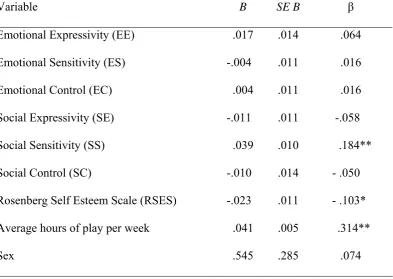
This study investigated relationships between problem video game playing, self-esteem and social skills in an adult sample. Via the internet, 621 (560 male) primarily Australian participants completed three scales: the Rosenberg Self-Esteem Scale, the multidimensional Social Skills Inventory and Problem Video Game Playing Scale. Hypotheses were: that problem video game playing would be related to social skills and self esteem; that time spent playing online games would be related to social skills; and that social skills and self esteem would predict problematic play. Online game time commitment was not significantly related to social skills or self esteem, suggesting online environments are not distinctly socially enriching or erosive. Resonating with past studies that found links between gaming, introversion, and social anxiety, a pattern of significant (p < .001) correlations emerged between 3
social skills subscales, together representing social hesitancy, and problem video game playing; however the magnitude of relationships was minute. To explore whether problematic play is impelled by social difficulties, a multiple regression analysis was used to predict problematic playing scores with scores on the social skills and self esteem scales. A significant model was found: F (9, 611) = 15.051, p <
.001, accounting for 16.9% of variance. Time commitment (β = .314, p < .001), one
social skill subscale (β = .184, p < .001) and self esteem (β = -.103, p = .03) emerged
as significant predictors. Results suggest a very small proportion of problematic play is related to social skills and self esteem, but considering the magnitude of
DECLARATION
I, Daniel Loton, declare that this report does not incorporate any materials previously written by another person except where due reference is made in the text.
I further declare that this study has adhered to the ethical principles as established by the Psychology Ethical Committee of Victoria University.
………. Daniel Loton
ACKNOWLEDGEMENTS
This thesis would not have been possible without the support, which took many forms, of my family and friends. I need not identify you individually, you are many and few, and you know who you are. I am grateful to have these people in my life.
Additionally, I’d like to thank those who took the time to participate in the study – please know I have tried my best to report the findings accurately and with balance.
Further thanks go to all psychology staff who, without requirement, gave me their time and advice; and Ronald Riggio who provided me with permission to use the Social Skills Inventory.
Last but not least a note to future students: I have tried to be aware, as much as one can be, of the competitive advantages I’ve had during my studies from the
TABLE OF CONTENTS
Page No. TITLE PAGE i
ABSTRACT ii-iii DECLARATION iv ACKNOWLEDGEMENTS v TABLE OF CONTENTS vi-ix LIST OF TABLES ix LIST OF APPENDICES ix 1.0 INTRODUCTION AND LITERATURE REVIEW 1-33
1.16 Two-factor theory of problematic play 24-25 1.17 Computer mediated communication 25-26 1.18 Cross-cultural studies on problematic online gaming 26-28 1.19 Problematic Play Review 28-30 1.20 Social skills 30-31 1.21 Research Rationale 31-32 2.0 METHOD 33-44
2.0 Participants 33-35 2.1 Materials 35-41 2.1 Problem Video Game Playing 35-36 2.2 Social Skills 36-40 2.3 Self Esteem 40 2.4 Procedure and Implementation 41-43 3.0 RESULTS 44-52
3.0 Statistical Methods Used in Analysis of Data 44 3.1 PVP means and relationships with gender and age 44 3.2 PVP item endorsement 44-45 3.3 PVP validity 45-46 3.4 RSES and SSI subscale validity 46 3.5 Relationships Between Problem Video Game Play, Social Skills 46-47 and Self Esteem
3.6 Relationships Between Problem Video Game Play and 47-48 Dimensions of Social Skills
3.8 Relationships Between Time Spent Playing Online Games 49-50 and Self Esteem and Social Skills
3.9 Genre Comparison 50
3.10 Post-hoc hours of play per week analysis 51
3.11 Post-hoc PVP mean scores analysis 51
3.12 Post-hoc age analysis 51
3.13 Age, and Age First Played Electronic Games 52
4.0 DISCUSSION 53-66 4.0 Hypothesis 1 : Relationships Between Problem Video Game 53
Playing, Social Skills and Self Esteem 4.1 Emergent Relationships 54
4.2 Interpretation Using Subscale Descriptions 54-55 4.3 Hypothesis 2: Predicting Problem Play with Self Esteem and 56
Social Skills 4.4 Understanding Social Sensitivity: Convergent Constructs and 56-57 Previous Findings 4.5 The inverse relationship between SS and psychosocial health 57-58 variables 4.6 Personality variables and SS 58
5.0 LIMITATIONS AND FUTURE SUGGESTIONS 62 5.0 Sample Bias 62-63 5.1 Problem Video Game Playing Scale 63 5.2 Research Collaboration 63-64 6.0 CONLCLUSION 64-65 REFERENCES 66-74
APPENDICES 75-104
LIST OF TABLES
Table 1: Item Endorsement of the PVP in Order of Endorsement 45 Table 2: Summary of Enter Multiple Regression Analysis 49 Predicting PVP Total Score
LIST OF APPENDICES
Appendix A: Extended Demographics 75-77
Appendix B: Scales 78-83
Appendix C: Internet as Laboratory – Advertising the Study 84-92 and Gathering Data
1.0 Introduction and Literature Review
Electronic games are the medium of the 21st century. They constitute a growing industry, which had a peak in the 1980’s, temporarily slumped, and is now larger than ever (Provenzo, 1991). Contemporary analyses place the global industry size at US$ 28.5 billion in 2005, which is expected to overtake the global music industry by 2010 (Berger, 2002; BusinessWire, 2005; Provenzo, 1991). Constantly advancing in technology and capability, the latest
transmutation takes the form of online role playing games, involving the
maintenance of persistent worlds populated by millions of players. Some of these games have spawned virtual economies, where game items and real estate can be traded for ‘real’ money, with sales out grossing the economy of some small nations (Dibbel, 2003). One can even build a virtual life in some online games, where the goal is to obtain the staples of a modern lifestyle in a first world country, including gaining employment, obtaining a partner and even raising pets ("The Sims 2: Pets", 2006). The advent of electronic games has had significant cultural repercussions, capacitating new art forms like Machinima ("Machinima", 2006), influencing film, literature and pop culture ("Penny Arcade", 2006), and leading to a push to introduce network gaming competition, already extensively sponsored and international, as an Olympic sport (Morris, 2006, May 31).
media attention, research thus far is disproportionately negative and has
investigated deleterious relationships between electronic games and aggression (Anderson, 2004; Anderson, Funk, & Griffiths, 2004; Chambers & Ascione, 1987), dependence and excessive playing behaviour (Fisher, 1994; Griffiths & Hunt, 1998), and social withdrawal (Colwell, Grady, & Rhaiti, 1995; Colwell & Payne, 2000; Selnow, 1984).
Of the few studies conducted, different game systems that represent qualitatively different gaming experiences (e.g., home video games compared to arcade parlour games) have been ramped together posing threats to
generalisability and theory development (Colwell & Payne, 2000; Douse & McManus, 1993; Fisher, 1994; Griffiths, Davies, & Chappell, 2004).
Additionally the majority of studies are survey based, investigating a plethora of ‘negativities’ that correlate with game play (Barnett, Vitaglione, Harper,
Quackenbush, Steadman & Valdez, 1997; Colwell & Payne, 2000). Although partially necessitated by the exploratory approach of early research, this
methodology poses the limitations of determining causality and directionality of observed relationships, and the elucidation of etiology.
cognitive decline by providing benefits including memory enhancement, however this is yet to be clinically validated (Mehta, 2006). Games have also been used as a clinical tool to successfully aid therapy (Griffiths, 1997).
1.1 Are Electronic Games Bad For You?
Although electronic game studies are etiologically and topically diverse1, one broad overarching theory has emerged from research in the field. Research indicates that the resulting effects of play, along with effects of engagement with other communication modalities and modern technologies, do not seem to be universal to all users, and instead are the result of a negotiation of internal and external factors (Colwell, Grady, & Rhaiti, 1995; Fisher, 1994; Griffiths & Hunt, 1998; Yee, 2002). These internal factors, or factors that are within the user, can comprise such variables as demographics, reasons and gratifications of use and pre-existing pathology. External factors can take forms of the characteristics of the modality, such as operant conditioning random reward paradigms, collapse of physical space, lack of facial cues, and even overarching geopolitical or
economic variables like affordability or availability of the technology. The above theory is validated by the absence of strong and universal relationships between video game play and deleterious variables, instead
highlighting the importance of factors aside from one-way effects exerted by the medium onto the user, such as diverse motivations for play (Colwell, Grady, & Rhaiti, 1995; Durkin & Barber, 2002; Lo, Wang, & Fang, 2005; Yee, 2006c).
1 For the purposes of this study, when terms such as ‘games’, ‘gamers’, and ‘game play’ are used
Reiteration of the heterogeneous effects of electronic game use is necessitated by media demonisation of new technologies, as well as anecdotal accusations from Surgeon-Generals and policy makers that video games cause aggression and social withdrawal, which has led to a push to find universal effects (Appendix 4-b. violence in the media and its effect on youth violence., 2001; Miller, 1993)
Assessing the “effects of electronic games” is complex, they do not influence everyone in the same way, and it is the task of research to investigate
determinant variables and interrelationships that mediate potential outcomes.
1.2 Demographics
It is logical to start an inquiry into electronic gaming by first determining who plays them. Judging by reported experience of play in many adolescent school based samples, it seems that almost everyone has experienced electronic games, although males play more. Rates of experience playing electronic games centre around 90%, with many reporting 100% of participants having
experienced play (Barnett et al., 1997; Chambers & Ascione, 1987; Colwell, Grady, & Rhaiti, 1995; Colwell & Payne, 2000; Salguero & Moran, 2002; Wood, Gupta, Derevensky, & Griffiths, 2004). It is safe to conclude that electronic gaming is a normalised and common activity among adolescents, with very high proportions of the population having experienced play.
twenties, with Griffiths, Davies & Chappell (2004) finding M = 27.9 with N =
540, and Yee (2006) finding M = 26.57 with N = 4705. Of these, approximately
50% worked full time, with the remaining studying full or part time (Yee, 2006). Prominent market research companies, through point-of-sale data, locate the mean age of American gamers at 33 ("Top ten industry facts", 2006). However, for action or first-person shooter PC games, some preliminary evidence suggests the mean age of players is around 21 (Griffiths, Davies, & Chappell, 2004).
Due to fears of negative developmental and psychosocial effects, the vast majority of game studies have focused on adolescents (Colwell, Grady, & Rhaiti, 1995; Barnett et al., 1997), although this recent data suggests that children and teenagers may not be the key gamer demographic, at least for some game types.
1.3 A boys club?
Demographic explorations into electronic game engagement have revealed a consistent and significant gender difference in the amount of play, with males playing more often and for longer periods of time across a range of ages and nationalities (Barnett et al., 1997; Chiu, Lee, & Huang, 2004; Colwell, Grady, & Rhaiti, 1995; Colwell & Payne, 2000; Durkin & Barber, 2002; Fisher, 1994; Griffiths & Hunt, 1998; McClure & Mears, 1984; Salguero & Moran, 2002; Wood, Gupta, Derevensky, & Griffiths, 2004).
(Barnett et al., 1997), with females selecting the game categories
intellectual/creative and action/fantasy as their preferred more than males (χ2 (3,
N = 206) = 73.48, p <. 001), who selected sports and violence most often.
Additionally, resonating with the findings of Kafai (1996), females also rated the game characteristics for artistic/self expression as appealing and easy, compared to males who preferred difficult, fast-moving, and violent variety and network games that can be played by friends (Barnett et al, 1997).
Through an exploration of needs fulfilled while playing MMORPG games, it was found males scored significantly higher on all achievement factors than females, pertaining to advancing the game character, mastering game mechanics and competing with others (t’s (3035) > 9.5, p < .001, two tailed); while females
scored higher on relationship components (t (3035) = -14.31, p < .001, two
tailed), pertaining to communicating and collaborating with other players, particularly in the sub-component of increasing self-disclosure and forming supportive relationships (Yee, in press).
This research suggests that males and females often have distinct tastes and motivations for play, which underpins the discrepancy in engagement, and that these differences are likely to manifest in any effects associated with play. Indeed, research into the social implications of games has reproduced these gender differences.
1.4 Social Aspects
and social withdrawal, there has been some academic research into the topic, leading to mixed results. The following section will outline the psychological literature salient to the social aspects of electronic gaming.
1.5 ‘Electronic friend theory’.
Electronic gaming and social withdrawal was first explored in the 1980’s, when (Dominick, 1984) found a small inverse relationship between arcade game playing, but not home video game playing, and Rosenberg’s Four Item Self Esteem Scale (r = -.14, N = 250, p < .05). Dominick interpreted this as evidence
for arcade games substituting social interaction. Selnow (1984) further explored this idea, coining the term ‘electronic friendship’. Selnow proposed the
possibility of electronic games, through active-participation and immersion, replacing friends and leading to social deprivation of heavy players, a concept echoed anecdotally by many (Brightman, 2006). Using a modified gratification of needs scale for television viewing, Selnow (1984) factor-analysed responses about needs fulfilled while playing arcade games and found five factors. The amount of play (represented by a formula of frequency of visits multiplied by duration of visits multiplied by money spent) was then correlated with these factors in a sample of 244 adolescents. The factors were asserted to represent playing preferred to socialising with friends (r = .219, N = 244, p < .001), games
allowing the player to learn about people (r = .148, N = 244, p < .019), providing
companionship (r = .267, N = 244, p < .001), action (r = .215, N = 244, p < .001)
and solitude/escape (r = .267, N = 244, p < .001). For a breakdown of the
gamers, 74% of which played alone, which is unusual in light of the social nature of arcade parlours in the United States and Britain (Provenzo, 1991).
These results suggest that arcade gamers who commit more time are likely to perceive play to provide gratifications akin to companionship and friendship, and it was concluded that games may be impacting on the
socialisation of heavier players. The study has been criticised on the basis of arcade parlours being social spaces, thus providing obvious extraneous variables that could have influenced the relationships found between gaming and social gratifications (Provenzo, 1991).
1.6 Social implications for female players.
These factors were revisited more recently by Colwell, Grady and Rhaiti (1995) in a sample of 120 adolescents, and home video games were included in the analysis. Levels of game play (frequency multiplied by duration) did correlate with the factors of friendship (r = .36, N = 120, p < .001), learning
about others (r = .22, N = 120, p < .05), and companionship (r = .22, N = 120, p
< .05) in both genders. Additionally, these needs factors correlated significantly and negatively with scores on Battle’s Culture Free Self Esteem Inventory in girls, to the degree of friendship (r = -.43, n = 52, p < .01), learning (r = -.33, n =
52, p < .01), companionship (r = -.41, n = 52, p < .01) and escape (r = -.44, n =
52, p < .01), but not in boys. It was suggested this could be the result of the
electronic game play substituting friendships, although the directionality is indeterminable.
Interestingly, for boys it was found that playing correlated positively with friends seen outside of school (r = .20, n = 68, p < .05), diametrically refuting
electronic friend theory. In light of the absence of a relationship between self-esteem and needs factors in boys, it was proposed that some girls with
comparatively lower self-esteem may have turned to games as a replacement to, and escape from, their social situation.
1.7 Social implications for male players.
Even more recently Selnow’s (1984) gratification of needs items were tested with home video games. Using the original items, Colwell and Pain (2000) found two factors instead of five that both relate to friendship. These factors correlated with frequency and duration of video game play, but no relationship between these factors and self-reported number of friends was found, again providing little support for electronic friend theory. However, amount of play correlated negatively with self-reported number of good friends in boys (r = -.22, n = 91, p < .05), but not girls. Additionally, scores on the Rosenberg Self Esteem
Scale were negatively correlated with frequency of play in boys only (r = -.21, n
= 91, p < .05). The authors concluded that game play may be related to
variables related to exposure to electronic game play, rather than measuring frequency or duration of play independently.
1.8 Introversion, escape and conscientiousness.
A similar focus on gratifications was taken towards studying electronic games by Barnett et al. (1997), who investigated the relationship between play behaviour (including compulsiveness), to attitudes, gender and personality. In a sample of 229 late adolescents, no differences were found between frequent (one or more hours of play per week) and infrequent players on allocation of time to leisure activities, including socialising; and measures of self-esteem, empathy, conscientiousness and introversion, providing little support for social withdrawal theories.
However, when relationships were examined instead of differences between the conservatively defined “frequent” and infrequent players, a pattern of correlations emerged. Introversion was positively associated with a preference for videogames over friends (r = .22, N = 229, p < .001), as well as a desire to
play video games to fantasise (r = .24, N = 229, p < .001), and to ‘escape’ from
daily concerns (r = .31, N = 229, p < .001). Furthermore, self esteem was
negatively correlated with tendency to perceive video games as companions (r =
-.26, N = 229, p < .001), and conscientiousness was negatively related to the
importance/compulsiveness of play (r = -.24, N = 229, p < .001).
meaningful relationships, may turn to game worlds to escape their difficulties, or even complement anxieties or shortcomings through fantasy play. The authors acknowledged that their discriminant function analysis between frequent and infrequent players was too insensitive to detect a sub-group of excessive players, and they recommended that purposive sampling may help to investigate a
potential minority of excessive players.
1.9 Arousal.
In a related area of investigation, Wood, Gupta, Derevensky and Griffiths (2004), investigated the relationship between electronic game playing and
gambling, including in their analysis motivations for play, dissociative states and risk taking behaviour. In a sample of 996 (549 females and 441 males) 10-17 year olds in Montreal, high frequency players (at least five days of play per week) reported more : trance like states while playing (χ2(2, N = 441) = 67.54, p
< .001), losing track of time (χ2(2,
N = 441) = 95.37, p < .001), experiencing
blackouts while playing (χ2(2, N = 441) = 7.75, p < .001), feeling “outside of
yourself” while playing (χ2(2, N = 441) = 40.37, p < .001), and feeling like a
different person while playing (χ2(2, N = 441) = 57.93, p < .001) than low
frequency players (two days of play or less per week).
players (M = 49.59): t(378) = -3.792, p = .001 (two tailed). However, no
differences were found in reported reasons for play of making new friends or to alleviate depression between the high and low frequency player groups, and no relationship was found between play and increased substance abuse, as distinct from the consistent relationship found between gambling and substance abuse (Pallanti, Rosi, & Hollander, 2006).
Notably, video game playing was linked to gambling in many ways, illuminating the possible risk of adolescents familiar with video games having a salience with gambling machines, and attempting to transfer video game playing skills to purely chance based machines. Langer (1975) speculates that
misapplication of skill orientation (video game playing) to chance situations (gambling) results in augmented levels of illusion of control beliefs. According to her theoretical framework, skilled and experienced video game players may be particularly vulnerable for developing problem gambling especially if they misinterpret poker machines as games of skill.
1.10 Conflicting evidence.
Although a cluster of weak correlations has emerged between electronic game play and psychosocial and personality variables, many studies have found no relationship between a plethora of variables and game play, and some have found positive relationships. Gibb, Bailey, Lambirth and Wilson (1983) found no association between amount of arcade game play and the self esteem subscale of the Bipolar Psychological Inventory in 208 primarily adolescent participants. McClure and Mears (1986) investigated whether there is a link between video game playing and psychopathology in a sample of 290 adolescents. They found no significant relationships between playing and a host of items, including the MMPI dimension of psychopathic deviance and neuroticism, drug taking, smoking, alcohol use, speeding tickets, school expulsions, cutting classes, home life happiness, single parenthood, escaping bad family situations, and running away from home. Contrary to other studies it was found that higher players were more extraverted than low players (F(4,281) = 2.6, p = .03), and low players
were more achievement oriented (F(2,281) = 3.12, p = .01).
Through content analysis, some scholars have recently asserted that MMORPG environments can provide spaces of informal sociability, and help to diversify world views, possibly increasing sociability (Steinkuehler & Williams, 2006). This resonates with studies finding higher scores on measures of
2002). Archived academic school records were also incorporated in the analysis. Players were divided into no play, low play and high play groups to facilitate comparisons. It was found self concepts of intelligence, mechanical skills and computer skills, self esteem, family closeness, attachment to school, academic friendship group size, grade point average and club membership were all significantly higher in playing groups than non players, some of which being significantly highest in the high playing group, such as family closeness. Additionally, non players had significantly higher scores on measures of
disobedience, substance abuse and risky friendship network size than the playing groups. However, high players had significantly higher depressed mood scores (M = 4.18, SD = 1.21) than low players (M = 3.95, SD = 1.17), F(2, 1014) = 4.19, p < .05, which came close to the non-playing group mean (M = 4.16, SD = 1.30).
High players also had the highest aggression score, however computer game play was just slight of reaching significance as a predictor of aggression scores in a MANOVA analysis.
scales were not reported. Additionally, the maximum category of computer game use was ‘daily’, which, as the authors also acknowledged, would not have been sensitive enough to detect an excessive subgroup of players.
These results depart from the usual pathological focus on electronic gaming and show promise for future exploration into the role electronic games occupy in many gamers lives. However, electronic games have advanced in complexity and popularity exponentially since the eighties, which may exert changes on these results were the study to be re-run today.
1.11 Overview
In summary, studies into electronic games causing social withdrawal have yielded little support, indicating play does not cause hermitry nor withdrawal from society. However, the pattern of relationships emerging from research into the social implications of games has raised concerns of a possible subgroup of excessive players who have social difficulties. The consistent and moderate inverse relationships found between game play and self-esteem in both genders, as well as the relationships between playing motivation and self-esteem,
introversion, conscientiousness, loneliness and a desire to escape, may represent characteristics of this minority (Barnett et al., 1997; Colwell & Payne, 2000; McClure & Mears, 1984). It is also worth noting that relationships between play and self esteem seem to be increasing in magnitude chronologically.
Alternatively, some studies have found no relationship between electronic game play and self esteem, and some have found positive indicators of
(Chambers & Ascione, 1987; Durkin & Barber, 2002; McClure & Mears, 1986). These mixed results are currently inexplicable, although using a ‘total dose’, or hours per week approach to measure play may increase research consistency. To further explore this possible minority of excessive players, researchers have used a behavioural addiction framework, leading to the concept some call video game addiction.
1.12 Problem Video Game Play/Video Game Addiction
Dubbed ‘kiddie cocaine’ by comedian Robin Williams, the notion of video games being addictive has a plethora of anecdotal support, including qualitative reports, expressions of concern from surgeon-generals and
governmental imposed video game curfews (Allison, Von Wahlde, Shockley, & Gabbard, 2006; Egli & Meyers, 1984; Soper & Miller, 1983). In response researchers have explored whether game playing can represent video game addiction, likening it to gambling addiction and categorising it within the contemporary subset of technological disorders, their defining feature being human-machine interaction (Griffiths & Hunt, 1998; Soper & Miller, 1983; Young, 2004).
Video game addiction is yet to be established as a discrete disorder from other behavioural addictions and generic impulse control disorders, and little is known of co-morbidities and negative consequences of the construct, thus it is not yet recognized in the Diagnostic and Statistical Manual (Diagnostic and statistical manual of mental disorder (4th ed.), 2000; Shaffer, Hall, & Vander
used to denote it, such as problematic, intemperate and dependence forming play (Salguero & Moran, 2002; Shaffer, Hall & Vander Bilt, 2000). A detailed
exploration of the discriminant validity for this potential disorder is beyond this paper. Notwithstanding, studies using a behavioural addiction framework have shown that a small minority of players gaming mimics the criterion of
behavioural addiction and can cause significant disturbances with social, family and work life (Fisher, 1994; Griffiths & Hunt, 1998; Salguero & Moran, 2002; Yee, 2006c). Additionally, some gamers play to such excess that concerns have been raised over potential developmental and psychosocial impacts (Griffiths, 2000).
Little is known of the co-morbidities accompanying dependence like play, but explorations into problematic usage have suggested potential mediating variables may be game characteristics, excitement and relaxation, risk taking behaviour, dissociative states, flow experience, self-esteem, locus of control, depression and escaping negative feelings and thoughts (Griffiths & Dancaster, 1995; Griffiths & Hunt, 1998; Wan & Chiou, 2006; Wood, Gupta, Derevensky, & Griffiths, 2004; Yee, 2006c). However many of these relationships await empirical vindication, and some await even initial investigation.
Research on the topic is still too limited to have produced a
should also be noted that these explanations fit comfortably within the etiology of behavioural addiction. Jacob’s General Theory of Addiction (Jacobs, 1986) emphasises arousal modification, particularly through excitement, relaxation and dissociative states; which are inclusive of an empowerment against a negative reality, often characterised by depression and low self esteem. Concerns over dependant play share clear similarities to the abovementioned investigations into the social implications of electronic games; it can even be argued that the notion of dependant play, and particularly associated co-mordibities, is an alternative manifestation of the notion that electronic games may cause social withdrawal.
1.13 Arcade game addiction.
First explored by Egli and Meyers (1984) and Soper and Miller (1983), qualitative accounts of compulsive arcade game playing revealed a small
to finance play), conflict (relationship or school problems due to play), and financial bail out which was found to be inapplicable.
A factor analysis on the items revealed two factors, the first explaining 30.4% of the variance, and encompassing escape, salience, chasing and stealing to play. The author concluded this could represent a “subjectively experienced overwhelming and ever-present need to play” (Fisher, 1994, p. 549). The second factor accounted for 11.4% of variance and included items on withdrawal, lying and conflict. The author suggested this factor may represent the negative
consequences of excessive play. However, withdrawal resonates more with the description of factor one than two, and stealing to play with factor two than one, rather than vice versa, resulting in questionable face validity for this factor explanation.
Six percent, or 28 of 467 children aged between 11 and 16 answered yes to four or more criteria, and were regarded as “pathological”. Non-parametric comparisons between the pathological group and social players (scores between zero and three) revealed some significant differences and potential construct validity. Compared to the social group, pathological players played arcades more frequently (Yates’ corrected χ2(4, N = 467) = 41.65, df = 4, p < .0001) and for
longer periods of time, they spent more money on arcade games each week (Yates’ corrected χ2(4, N = 467) = 28.15, df = 4, p < .0001), they borrowed more
money (Yates’ corrected χ2 = (4,
N = 467) 43.04, df = 2, p < .0001), sold more
possessions in order to play (Yates’ corrected χ2 = 19.65, df = 2, p < .0001), and
perceived themselves as playing to excess more (Yates’ corrected χ2 = 19.4, df =
Interestingly, despite males playing casually much more than females, there were no significant gender differences in the pathological group.
Alarmingly the author reported that 50% of pathological players stole from the family home to fund playing. However, items on the scale required dichotomous answers, and the item concerning illegal acts did not specify which act of three actually occurred (i.e. – misuse of school dinner/fare money, or theft from home or elsewhere), ergo this reported prevalence is dubious and displays a weakness of dichotomous scales in exploring the dimensions and severity of unexplored technological disorders.
1.14 Video game addiction.
Griffiths and Hunt (1998) later explored whether home game playing was dependence forming using modified diagnostic criterion for pathological
gambling. Three hundred and eighty seven children aged between 12 and 16 years completed an eight-item questionnaire concerning video game playing behaviour, which included the components: Salience (“Do you frequently play most days?”), tolerance (“Do you frequently play for longer periods of time?”), euphoria (“Do you play for excitement or a ‘buzz’?”), chasing (“Do you play to beat your personal high score?”), relapse (“Do you make repeated efforts to stop or decrease playing?”), withdrawal (“Do you become restless if you cannot play?”) and conflict (“Do you play instead of attending to school related activities?” and “Do you sacrifice social activities to play?”) (p. 476-477).
were not investigated, the scale overall score correlated with play frequency (r =
.53, N = 387, p < .001), mean play time per session (r = .42, N = 387, p < .001),
the longest single playing time (r = .43, N = 387, p < .001), sex, with boys
playing more often (r = -.21, N = 387, p < .001), and starting age (r = -.42, N =
387, p < .001). Affective states were also significantly related, with dependent
players reporting to be in a bad mood and excited before, during and after play, and also more likely to be in a good mood before and during play, hinting at the importance of arousal. Dependent players also reported significantly more often not wanting to stop playing, and wishing they were still playing when they stopped. Dependent players were also significantly more likely to report aggressive feelings as a direct result of play.
However, dependent players were unexpectedly not more likely to report truancy or having bad schoolwork marks due to play, or stealing to buy new games. This lack of negative consequences of excessive play raises the question of whether the scale measures a distinct addiction or merely preoccupation. However, the variance not accounted for in the correlations between the scale and measures of game play suggest that time spent playing games does not wholly explain positive responses to scale items, suggesting that time
1.15 Massively multiplayer online role playing games addiction.
The most recent investigations of problematic video game play have focused on MMORPGs. Through online surveys, large sample sizes have been obtained; and using purposive sampling some alarming results have emerged from Asia. In the most detailed and extensive base of studies on electronic games, Nicholas Yee (Yee, 2006b) has investigated problematic MMORPG playing through a behavioural addiction framework both quantitatively and qualitatively (Yee, 2002, October).
Through numerous online surveys, many utilising five-point Likert-type scales as opposed to dichotomous, 3,989 MMORPG players completed questions on problematic play (Yee, 2002, October, , 2006a, in press). It was found that 15% of respondents agreed or strongly agreed that they became angry and irritable if unable to play; 30% that they continue to participate in the
environment even when they are frustrated with it or not enjoying the experience; and 18% that their usage patterns had caused them academic, health, financial or relationship problems. Agreement with these statements was positively and significantly correlated with average weekly use of MMORPGs. Strikingly, 50% of respondents (n = 3,166) considered themselves addicted to an MMORPG in a
dichotomous question.
esteem and feelings of control, and positively related to daily stress (Yee, 2002, October).
Further, Yee investigated relationships between problematic play and gender, age and play motivations (Yee, in press). Using scores on a modified version of Kimberley Young’s Internet Addiction questionnaire to suit
MMORPG playing (Young, 2004), a prediction was attempted with a scale that maps motivations of play. The internet addiction questionnaire included seven items equating to dependence, withdrawal and the negative impact on real life obligations and relationships.
A significant model with three predictors emerged. The motivational subcomponent escapism, described as “using the online environment to avoid thinking about real life problems” (Yee, in press, p. 4), showed the highest standardised correlation coefficient at b = .31, p < .001, followed by hours of
play per week (b = .30, p < .001), and finally the advancement component,
pertaining to rapidly advancing the game character and acquiring in-game wealth, power and status (b = .17, p = .01). The model explained 34% of
variance in problematic scores. These results suggest that problematic players spend more time playing than less problematic gamers, and that escape from a negative reality is seminal to problematic play. Further, the advancement component, akin to building status and power through character advancement, suggests that the feelings of agency provided by the MMORPG environment are also predictive of problematic play.
social withdrawal arising from excessive involvement in an MMORPG (Yee, 2002, October). This resonates with case studies from clinicians who have treated adolescents and adults who play excessively, and have highlighted co-morbidities of depression, low self esteem, social difficulties and feelings of inadequacy (Allison, Von Wahlde, Shockley, & Gabbard, 2006).
1.16 Two-factor theory of problematic play.
In light of these relationships between problematic play, self esteem, locus of control, stress and escapism; and drawing on theories of behavioural addiction, Yee conceptualised problematic play as two-factor, composed of both motivating factors and attraction factors (Yee, 2002, October). Motivating factors, synonymous with risk factors or co-morbidities in studies of other addictions (Jacobs, 1986), are those that exist within the player that may compel them to intemperate and damaging play, including low esteem, poor self-image, difficulty in making and sustaining relationships and stress. Attraction factors are those that exist within the medium, in this case MMORPG’s, which draw people into play, including operant conditioning random reward paradigms and the potential for communication, entertainment and immersion.
should exert effects universally. Convergent studies by Yee suggest that MMORPG environments are also deeply salient and important to players, harkening to what may be a crucial element in problematic play: hyper-personal computer mediated communication.
1.17 Computer mediated communication.
Research on computer mediated communication through interactive internet functions and Multi User Dungeons (or MUDS, online textual
environments in which users communicate and role-play), suggest an important attraction is their ability to make communication hyper-personal, and that may apply to online games (Bartle, 1996; Parks & Roberts, 1998; Turkle, 1994). The qualities of communication via the internet differ from face to face
communication in important ways (McKenna & Bargh, 2000). Internet communication is mostly anonymous, and studies have highlighted that
anonymity increases the degree of self-disclosure in comparison to face-to-face, therefore those communicating online are more likely to self-disclose. Nonverbal communication is almost completely nullified via the internet, and it has been theorised that this allows for a reallocation of cognitive resources to focus on the message, increasing the salience of the words. Additionally, internet
shown to be quantitatively and qualitatively related to problematic game play, further highlighting social difficulties as a potential predictor of uptake and maintenance of this behaviour, and suggesting games that capacitate online communication may encourage more problematic play than games that do not.
1.18 Cross-cultural studies on problematic online gaming.
Recently the Chinese government, in conjunction with service providers, have initiated a fatigue system designed to reduce the duration of game playing by capping the advancement online players can achieve in one sitting (Dickie, 2005, August 23). Recent studies conducted in China and Taiwan have provided some justification for these concerns, tying problematic online video game play to escape from dissatisfaction, negative life events, social anxiety and the deterioration in quality of gamers’ interpersonal relationships (Lo, Wang, & Fang, 2005; Wan & Chiou, 2006; Yang, 2005).
Wan and Chiou (2006) investigated relationships between “online game addiction”, flow time and humanistic needs theory. The online game addiction scale used was a modified internet addiction scale for adolescents. The scale showed some positive psychometric validity and included categories of compulsive use, withdrawal, tolerance, and related social, work and financial problems. It was found that flow time was slightly negatively correlated with online game addiction scores, suggesting it plays little role in problematic play, contradicting arousal-based explanations (Wood, Gupta, Derevensky, &
However, when two-factor humanistic needs were applied to game playing, they were able to discriminate addicts from non addicts. This theory distinguishes between dissatisfaction needs, concerned with reducing
dissatisfaction, and satisfaction needs, pertaining to increasing satisfaction. It was found addicts had significantly higher dissatisfaction scores (M = 154.48, SD =
96.76) than satisfaction scores (M = 130.04, SD = 107.58) : F(1, 83) = 5.72, p < .001); and non addicts had significantly higher satisfaction scores (M = 162.46, SD = 91.87) than dissatisfaction scores (M = 112.97, SD = 83.86) : F(1, 97) = 33.04, p < .001), suggesting problematic play is driven by reducing
dissatisfaction rather than increasing satisfaction.
If problematic play is conceptualised as a behavioural addiction, this finding resonates with the components of tolerance and withdrawal by suggesting an avoidance of negative feelings that surface with abstinence of game play. More broadly, it provides further evidence of problematic play including an escape from a negative reality. However, like other preliminary studies, the online game addiction scale used is yet to be thoroughly validated. There may be components of compulsive play not measured by the scale, and it is possible high scores may be expressing an underlying disorder.
Another study conducted in Taiwan emphasised the social aspects behind amount of online game usage, as distinct from online game addiction (Lo, Wang & Fang, 2005). Participants consisted of 174 (89 female) students of a college in Northern Taiwan, with mean age M = 19 and SD = 1.25. After discriminating
authors concluded that excessive time spent playing games can lead to less satisfying social relationships, and higher social anxiety. However, direction of causality is not beyond question, and it may be that those with social difficulties are drawn to play excessively, as theorised by others, and this excessive play may then exacerbate social difficulties present (Barnett et al., 1997; Yee, 2002, 2006c).
1.19 Problematic Play Review
The epidemiology of studies on problematic play suggests pathological players make up a small proportion of all gamers. In each study, affirmations to questions mirroring behavioural addiction diagnostic criteria were significantly related to increased play and concerns over playing. As far as self-reported diagnostic criteria indicate, this subgroup experience life interruptions as well as work and social problems resulting from excessive play. Although there are consistent dovetails between theories of behavioural addiction and research on problematic game play, video game addiction is yet to be distinguished as a subclass of behavioural addictions, as little is known of its exact dimensions and negative consequences. For instance, qualitative accounts of compulsive game play have indicated that when a new game comes out, commitment to play is high, impacting other life activities, but when the novelty wears off play decreases, which contradicts notions of tolerance and withdrawal (Salguero & Moran, 2002).
suggested, including low self esteem and social anxiety, what exactly is being escaped from is yet to be determined (Lo, Wang & Fang, 2005; Wan & Chiou, 2006; Yee, in press). Further scale development is required as current research has been restricted by using modified diagnostic criterion which is usually dichotomous, and epidemiological research is needed to determine the prevalence, negative consequences, longitudinal fluctuations and behavioural pathways underpinning problematic play.
There is a discrepancy between the concerns over electronic game play and research on the topic. Topically and geographically diverse studies have indicated electronic game play may sometimes be excessive and problematic. The available psychological literature has indicated problematic play can take the form of a behavioural addiction or impulse control disorder. Through
self-reported symptomatology, components of this behaviour may be life interruption, arousal modification and dissociative states, leading to feelings of escapism and coping with a negative reality and associated real life problems (Griffiths & Hunt, 1998; Soper & Miller, 1983; Wood, Gupta, Derevensky, & Griffiths, 2004; Yee, in press).
Furthermore, studies of electronic game playing have revealed relationships with some personality characteristics suggestive of difficulty in establishing relationships (i.e. - introversion, conscientiousness, social-anxiety), as well as with low self-esteem, leading to the notion that a subgroup of
have focused on adolescents, yet for some game genres often associated with problematic play, adults are the most prominent demographic (Griffiths, Davies, & Chappell, 2003).
Alternatively, some longitudinal studies have found moderate and high game playing groups to be rated more positively on psychosocial health
measures than non-gamers, indicating less risky behaviour and higher self esteem (Durkin & Barber, 2002). Other studies have failed to produce a strong and consistent link between deleterious variables and gaming (Chambers & Ascione, 1987; McClure & Mears, 1986; Steinkuehler & Williams, 2006). Some
preliminary studies have even postulated that playing online games may increase sociability and social skills (Steinkuehler & Williams, 2006).
Possible interpretations of these conflicting findings are compounded by a scarcity of research with adults, and particularly within Australia. In order to increase the present understanding of the social aspects behind engagement with an extremely popular form of entertainment, further study is warranted into the possible predictors and associated variables of problematic electronic game play in adults.
1.20 Social skills.
order to facilitate positive and adaptive social interactions (Riggio, 1986). In past studies social skills have extensively predicted important markers of
psychosocial health, such as the size of interpersonal and social support networks, self esteem, personal adjustment and psychopathology (Riggio, Watring, & Throckmorton, 1993).
1.21 Research Rationale
If indeed there is a subgroup of electronic gamers who have difficulty with self-esteem and establishing meaningful relationships, and who develop problematic play to cope with or escape from these difficulties, then it is possible that a lack of social skills may underpin this relationship. Accordingly, a measure of social skills and self-esteem may effectively predict game playing problems. Moreover, by investigating the relationship between a range of social skills and problematic game play, insight may be gained as to the social characteristics of devoted gamers.
The primary aim of this study is to identify and explore potential relationships between problematic electronic game play and a range of social skills and self esteem in an adult sample. An extension of this aim is to attempt a prediction of the magnitude of problematic play with the aforementioned
variables. Hence the first hypothesis of this research is that significant
relationships will be present between social skills, self esteem and problematic play; and the second is that social skills and self esteem will predict problematic play.
In light of the paucity of research on the topic, the secondary aim is to contribute knowledge to this under-researched field. As it is possible that time spent communicating online may bolster social skills, the third hypothesis is that significant relationships will be present between time spent playing online games and social skills and self esteem. Further exploration will include the analysis of differences between game genres on all variables measured, as well as
relationships between problematic play, age and gender. The only specific hypotheses for this aim arise from theories that games capacitating socialisation with others may be more attractive, as well as the contemporary research focus on MMORPGs. Thus, more problematic play and time commitment is expected by those who play online compared to offline games, and MMORPGs compared to other genres.
2.0 Method
2.0 Participants
A total of 621 participants fully completed the study. Participants were recruited via the internet, responding to advertisements for the study placed on multi-system, multi-genre video game forums. The sample consisted of 560 males (90.2%) and 61 females (9.8%). Their ages ranged from 18 to 60, with a mean of 23.84 (SD = 6.70), and a mode of 18 (21.9% of the sample). Notably,
70.9% of the sample were between 18 and 25, and 50.6% between 18 and 21. Geographically, the sample was located in English-speaking developed countries, with the majority of participants residing in Australia (64.7%). A further 22.5% resided in the USA, 4% in Canada, 3.5% in the UK and 1.6% in New Zealand. These five countries represent 96.3% of the sample, the remaining countries are listed in Appendix A.
In response to employment status, 41.1% worked full time, 21.7% studied full time, 9.2% studied full time and worked part time, and 7.7% did not work or study. The remaining choices to describe employment status, including
combinations of the above, are listed in Appendix A.
82.8% played computer games, possibly attributable due to the study being advertised on the internet. The remaining proportion is presented in Appendix A.
Participants were also asked which genre of game they primarily played, from a choice of action, strategy, simulation, adventure, mmorpg and not
applicable. Despite recommendations to use complex genre systems in previous studies (Griffiths & Hunt, 1998), the hybridity of extensive genre systems inhibited a clear delineation between genres, and the resultant ability to analyse differences between gamers who played them. Hence, a simple approach was taken and the category “not applicable” included for those who believed the games they played didn’t fit any available selection. The genre system used allowed for the assimilation of other popular genres such as first person shooters equating to action, resource management games equating to strategy, sports and racing games equating to simulation and persistent state world games referring to MMORPGs. The top genres played by the sample are as follows: 47.5% played action games, 29.1% played MMORPGs, 10% played strategy, 6.6% simulation, 5.3% adventure, 1.3% selected Not Applicable and 1 participant did not select a genre.
The mean age at which participants first reported playing video games was 8.69 with SD = 4.95. In line with previous studies, a ‘total dose’ approach to
time commitment was taken, and participants were asked to report the average hours of play per day, and per week. The mean daily hours of play reported was 3.42, with SD = 2.48, and mean weekly hours of play 23.78 with SD = 16.88.
mean percentage of time spent playing games in the physical presence of friends was 16.06%, with SD = 25.04, and with friends online 51.85%, with SD = 39.72.
In relation to online gaming, 68.8% played games primarily online, leaving 31.2% who played primarily offline.
2.1 Materials
2.1 Problem Video Game Playing
Problematic and dependence forming electronic game play was assessed with the Problem Video Game Playing Scale, or PVP. Developed in Spain with adolescents, and based on diagnostic criterion for substance dependence and pathological gambling from the DSM IV, this dichotomous scale consists of nine questions relating to problematic video game play (Salguero & Moran, 2002). The scores range from zero to nine, and mirror the criterion of preoccupation, tolerance, loss of control, withdrawal, escape, lies and deception, disregard for the physical or psychological consequences, and family, school and work disruption.
Displaying factorial validity, Salguero and Moran (2002) found the scale was psychometrically univariate and internally consistent (α = 0.69), with all 9 items contributing to the alpha score. Construct validity was drawn from correlations with PVP total scores and playing frequency (r = .64, N = 223, p <
.001), duration (r = .52, N = 223, p < .001), and longest play time per session (r =
.56, N = 223, p < .001). Additionally, the scale distinguished between
who did not. T-tests revealed significantly higher PVP scores for those who answered affirmatively to the questions ‘I think I play videogames too much’ (t(220) = -4.59, p < .001, two tailed), and ‘I think I have some type of problem
with my video game playing’ (t(221) = -3.43, p < .001, two tailed), than those
who answered negatively.
The nine PVP items can be summed to provide an indication of problems associated with video game play. Some very slight grammatical modifications were made to the items to increase clarity, as the authors translation into English from Spanish resulted in some minor grammatical errors (Salguero & Moran, 2002). A full list of the original items, and alterations made, is in Appendix B. Although the scale is not available for purchase, permission for use was still was sought from the authors of the scale, but was not obtained as they were
unreachable through various means.
2.2 Social Skills
To measure social skills, a multidimensional self-report scale was chosen in order to facilitate an exploration of what particular social skills may be
appropriateness), and spanning both social (verbal) and emotional (non-verbal) communication domains.
All sub-scales have a large base of discriminant and convergent validity with numerous communication skills scales and personality scales, allowing for the identification of similar constructs to any sub-scales that emerge as important in the present study. SSI scores have predicted laboratory tests of emotional recognition, measures of psychopathology, and interrater scores of role playing and social skills (Riggio, Throckmorton, & DePaola, 1990; Riggio, Watring, & Throckmorton, 1993). The SSI sub scales have shown acceptable test-retest reliability, with scores ranging from .81 to point .96, and Cronbach’s alpha coefficients ranging from .65 to .88 (Riggio & Carney, 2003).
To help overcome validity threats inherent to a self-report measure of social skills, including the possible response bias of social desirability, some questions are asked from both a self-perspective (i.e. – ‘I am…’ or ‘I’ve been…’) and a social feedback perspective (i.e. ‘I’ve been told that…’), and many items are reverse scored. It also has a large amount of convergent and discriminant validity, showing predictable relationships to numerous skill based emotional and personality measures. The SSI is published by Mindgarden and available for purchase, therefore permission to use the SSI was obtained via email from one of the authors, Ronald Riggio.
descriptions and example questions paraphrased from Riggio (1986, p. 651) are as follows :
Emotional Expressivity (or EE) : Emotional expressivity refers to general skill in
nonverbal sending…this dimension reflects individuals’ ability to express, spontaneously and accurately, felt emotional states as well as the ability to nonverbally express attitudes and cues of interpersonal orientation.
Example Items – “I often laugh out loud”, and “My facial expression is generally neutral” (reverse scored).
Emotional Sensitivity (or ES) : Emotional sensitivity refers to general skill in
receiving and decoding the nonverbal communication of others. As such, it is closely related to nonverbal sensitivity as defined by Rosenthal (Rosenthal, Hall, DiMatteo, Rogers, & Archer, 1979)…Individuals high in ES are concerned with and vigilant in observing the nonverbal emotional cues of others.
Example Items – “I am easily able to give a comforting hug or touch someone who is distressed”, and “I am often told that I am a sensitive, understanding person”
Emotional Control (or EC) : The general ability to control and regulate
use conflicting emotional cues to mask felt emotional states (i.e. laughing appropriately at a joke; putting on a cheerful face to cover sadness).
Example Items – “I am very good at maintaining a calm exterior even if I am upset”, and “I usually adapt my ideas and behaviour to the group I happen to be with at the time”.
Social Expressivity (or SE) : Social expressivity refers to a general verbal
speaking skill and an ability to engage others in social interaction. Persons high in SE appear outgoing and gregarious because of their ability to initiate
conversations with others.
Example Items – “I love to socialize” and “I always mingle at parties”
Social Sensitivity (or SS) : The ability to decode and understand verbal
communication and general knowledge of the norms governing appropriate social behaviour is termed SS. Socially sensitive individuals are attentive to others (i.e., good watchers and listeners). Because of their knowledge of social norms and rules, persons high in SS may become over concerned with the appropriateness of their own behaviour and the behaviour of others.
Social Control (or SC) : Social control refers to a general skill in social
presentation. Individuals high in SC are tactful, socially adept, and
self-confident. Persons high in SC are skilled at acting…Consequently they are able to adjust personal behaviour to fit with what they consider to be appropriate to any given social situation.
Example Items – “I can be comfortable with all types of people - young and old, rich and poor”, and “When I’m with a group of friends, I am often the
spokesperson for the group”
2.3 Self Esteem
Global self esteem refers to one’s attitude towards oneself, and
particularly how favourable or unfavourable this attitude is (Rosenberg, 1967). Measures of global self esteem have been related to many psychological constructs, including psychosocial health, mood disorders and quality of life, across time and a range of cultures (Choi, Meininger & Robers, 2006). To measure global self esteem the Rosenberg 13 Item Self Esteem Scale (or RSES) was employed (Rosenberg, 1967). The RSES was developed in America in the 1960’s, is widely used in research and has well established validity and
2.4 Procedure and Implementation
Human Research Ethics approval was acquired from the Victoria University Board of Ethics (HRETH 028/04) prior to commencement, and all guidelines stipulated within were adhered to. The internet was the chosen medium of the study, as it allows many participants to be reached conveniently and quickly, in comfortable and private settings, helping to reduce social-desirability, and is salient with video gamers as they are shown to be adept internet users (Wood, Griffiths, & Eatough, 2004).
A website was created introducing and explaining the study, adhering to ethical guidelines as well as guidelines for online research with gamers (Wood, Griffiths, & Eatough, 2004). These guidelines included the listing of contact details for the researcher, a photo of the researcher, a debriefing page with helpful links, increasing legitimacy through acknowledging the institution overseeing the research, and notification that the results of the research will be made public on the website upon completion. The website is copied in full in Appendix C. After participants verified their age (18 or over), and agreed to a voluntary consent form, they were taken to the full online survey, which was created using the online survey creation tool, Survey Monkey
("Surveymonkey"). To reduce attrition participants were provided with their progress (i.e. how many questions remained) throughout the survey.
To increase the honesty of responses and reduce the response bias of social desirability, participants remained completely anonymous and
Participants were informed of this anonymity on the website and in the voluntary consent form. However, IP addresses were collected to reduce duplicate and false responses. At all possible times, social skills were referred to as ‘communication styles’, to further reduce socially desirable response bias (Riggio & Carney, 2003). The inclusion of a social desirability scale was considered, but as past research has indicated many of the SSI subscales are unaffected by social desirability (Riggio, 1986), as well the anonymous and private nature of internet participation further reducing social desirability, it was deemed unnecessary.
Forums catering to the fullest gamut of video game systems and genres were utilised in order to target the widest range of gamers possible. In the great majority of forums, invitations to participate were posted in the ‘general’ or ‘chat’ section, which were always the most populated, and allowed for a range of gamers to be exposed to the invitation without having to duplicate posts in each different forum sub-section (i.e. Playstation, X-Box, PC, etc.). All forums utilized are listed in Appendix C. Any questions posted on forums or emailed to the researchers were answered as fully as possible, in order to maintain a rapport with the community involved in the research.
The data collection system was tested with a pilot study of 30
participants, which confirmed that data collection was successful, and also led to the addition of the verification question ‘work status’. The dataset was then formatted from Microsoft Excel into the Statistical Package for the Social Sciences (SPSS) and then analysed. On top of the 621 fully completed
participants, a further 250 began the survey but did not complete all questions, and were excluded from the data. Invalid age selections (including blank
status selections, including responses of “do not work or study” with another response such as “work full time” (n = 7).
Participants with large unexplained discrepancies between their average daily hours of play, and average weekly hours of play were removed from the data (n = 3). Some participants put in a range of hours in these sections, for
example, 15-20 hours of play per week. For these responses a median between the two figures was used. For participants who did not complete the hours of play per week section, but did complete the hours of play per day (with some noting to multiply the previous question by seven), the daily hours of play was
multiplied to obtain the weekly figure.
IP addresses were scanned for duplicates to ensure that many surveys did not come from the same IP address in a close proximity of time. Twenty-seven duplicates emerged, the largest of which was five records from one IP address. These duplicates had dispersed start dates and times, they all indicated the same country of residence, many showed different ages and genders, suggesting that the same computer was used by different people legitimately. No duplicates appeared identical in survey responses, therefore no records were removed based on duplicate IP addresses.
3.0 Results
3.0 Statistical Methods Used in Analysis of Data
All assumptions of the statistical methods used were checked and met, with normality checks and Cronbach’s Alpha calculated where applicable. These are reported in Appendix D, along with relevant SPSS output. Statistical tests used were Pearson Product-Moment correlations, Multiple Regression, ANOVAs and t-tests.
3.1 PVP means and relationships with gender and age.
The mean score of the PVP was 4.17, with SD = 2.19. Although the
discrepancy in sample size across gender is inhibitive of detailed comparisons such as running two separate multiple regressions, it was found that the PVP total score and hours of play per week were not significantly different across genders according to independent groups t-tests. Age was not related to PVP scores.
3.2 PVP item endorsement.
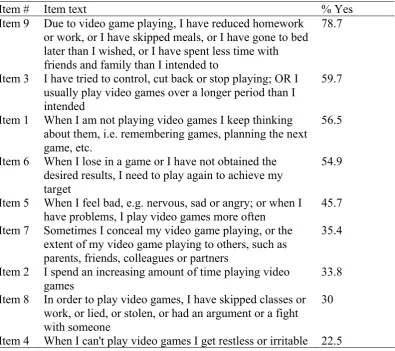
endorsed, although 45.7% of the sample played games more when they felt bad or had problems. The item with many different forms of loss of control showed the highest endorsement, but the question is unable to distinguish which exact problem (from six) was endorsed.
Table 1
Item Endorsement of the PVP in Order of Endorsement
Item # Item text % Yes
Item 9 Due to video game playing, I have reduced homework or work, or I have skipped meals, or I have gone to bed later than I wished, or I have spent less time with friends and family than I intended to
78.7
Item 3 I have tried to control, cut back or stop playing; OR I usually play video games over a longer period than I intended
59.7
Item 1 When I am not playing video games I keep thinking about them, i.e. remembering games, planning the next game, etc.
56.5
Item 6 When I lose in a game or I have not obtained the desired results, I need to play again to achieve my target
54.9
Item 5 When I feel bad, e.g. nervous, sad or angry; or when I have problems, I play video games more often
45.7 Item 7 Sometimes I conceal my video game playing, or the
extent of my video game playing to others, such as parents, friends, colleagues or partners
35.4
Item 2 I spend an increasing amount of time playing video games
33.8 Item 8 In order to play video games, I have skipped classes or
work, or lied, or stolen, or had an argument or a fight with someone
30
Item 4 When I can't play video games I get restless or irritable 22.5
3.3 PVP validity.