Influence of reversal with sugammadex or neostigmine on post-operative quality of recovery following a single bolus dose of rocuronium: a prospective, randomised, double-blinded, controlled study
Sun-Joon Bai1, Ki-Young Lee1, Sung Soo Kim2,Jung Hwa Hong3, Hoon Jae Nam1, Jae Chul Koh4,*, Na Young Kim1,*
1Department of Anaesthesiology and Pain Medicine, Anaesthesia and Pain Research Institute, Yonsei University College of Medicine, 50-1 Yonsei-ro, Seodaemun-gu, Seoul 03722, Republic of Korea; [email protected] (S.J.B.); [email protected] (K.Y.L.); [email protected] (H.J.N.); [email protected] (N.Y.K.)
2Institute of Vision Research, Department of Ophthalmology, Yonsei University College of Medicine, 50-1 Yonsei-ro, Seodaemun-gu, Seoul 03722, Republic of Korea; [email protected]
3Department of Policy Research Affairs National Health Insurance Service Ilsan Hospital, Goyang, Gyeonggi-do, Republic of Korea; [email protected]
4Department of Anaesthesiology and Pain Medicine, Korea University Anam Hospital, Korea University College of Medicine, 73, Inchon-ro, Seongbuk-gu, Seoul 02841, Republic of Korea.; [email protected]
Corresponding author: *Jae Chul Koh, MD, PhD
Department of Anaesthesiology and Pain Medicine, Korea University Anam Hospital,
Korea University College of Medicine, 73, Inchon-ro, Seongbuk-gu, Seoul 02841, Republic of Korea. Tel: (+82) 2 920 5632; Fax: (+82) 2 2227 6517; E-mail: [email protected]
*Na Young Kim, MD, PhD
Department of Anaesthesiology and Pain Medicine, Anaesthesia and Pain Research Institute, Yonsei University College of Medicine, 50-1 Yonsei-ro, Seodaemun-gu, Seoul 03722, Republic of Korea. Tel: (+82) 2 2228 4435; Fax: (+82) 2 2227 7897; E-mail: [email protected]
Abstract
There is a lack of data comparing sugammadex with anticholinesterase for the quality of
anaesthesia recovery, especially following a single bolus dose of rocuronium. Thus, we
evaluated the influence of reversal with sugammadex or neostigmine on post-operative
quality of recovery by using the Post-operative Quality Recovery Scale (PQRS). A total of 86
patients undergoing trans-pars plana vitrectomy (TPPV) under general anaesthesia were
intubated following a single bolus dose of rocuronium (0.6 mg/kg). At the end of surgery,
patients were received either neostigmine or sugammadex. The quality of recovery was
assessed using the PQRS at 15 minutes and 40 minutes after surgery, and on post-operative
day 1. The recovery rate in the physiological domain was higher in the sugammadex group at
15 minutes after surgery (P = 0.02). Though there were no significant differences in the
overall cognitive recovery domain, patients in the sugammadex group could recall more
numbers in reverse order. However, there were no significant differences between the groups
in the other domains of the PQRS. The use of sugammadex may increase the quality of the
post-operative physiological recovery at early post-operative periods compared with
neostigmine use following a single bolus dose of rocuronium in patients undergoing TPPV
with general anaesthesia.
Key words: anaesthesia, general; anaesthesia recovery period; single dose of rocuronium;
sugammadex; neostigmine
Introduction
The quality of recovery is a crucial factor that must be evaluated in patients subjected to
surgery under general anaesthesia. [1] Unlike the past, which focused exclusively on
evaluating the outcome of surgery, postoperative quality of recovery has recently become an
important issue. [1] Protracted and poor recovery after surgery can lead to delayed hospital
discharge, increased costs, and delayed resumption of daily activity. [2] Particularly, in recent
years, surgical procedures are increasingly being performed under outpatient settings rather
than during hospitalization. [3] Therefore, anaesthetic goals have evolved focusing on early
and explicit postoperative recovery.
Sugammadex, a γ-cyclodextrin derivative, has been approved as the first targeted agent
to remove steroid neuromuscular (NM) blocking agents by forming a chemical compound. [4]
This agent has contributed to anaesthesia protocols by enabling effective and complete
reversal of NM blockade. [5,6] Besides the fast reversibility of NM blockade, advantageous
effects of this agent on recovery components after anaesthesia such as consciousness,
nausea/vomiting, or physiologic factors have been reported. [7-9] Nonetheless, controversial
results on the superiority of sugammadex over conventional NM blockade reversal agents
have been reported. [10,11]
The Post-operative Quality Recovery Scale (PQRS) assesses the quality of
post-operative recovery over time using six domains of recovery. [12] This scale has been
translated into different languages and has been used successfully to assess the quality of
recovery after surgery. [13,14] So far, there is a lack of data comparing sugammadex with
anticholinesterase for the quality of anaesthesia recovery, especially following a single bolus
dose of rocuronium.
post-operative quality of recovery following a single bolus dose of rocuronium by using the
Materials and Methods
Study design
The study was designed as a prospective, double blind, randomised controlled trial. This
study was approved by the Institutional Review Board and Hospital Research Ethics
Committee of Severance Hospital (ref: 4-2015-0641) and registered at clinicalTrials.gov (ref:
NCT03108989, April 11, 2017). Between February and July 2017, 90 patients aged over 60
years with an American Society of Anaesthesiologists (ASA) physical status of I or II who
were scheduled to undergo TPPV under general anaesthesia, were enrolled in this study after
providing written informed consent. The patients were free to withdraw from the study
whenever they wished. Patients with the following conditions were excluded: known NM
disease, significant renal or hepatic dysfunction, history of malignant hyperthermia, allergic
reaction to sugammadex or rocuronium, on medication which can affect NM blockade such
as anti-convulsants, magnesium, or a body mass index >30 kg m-2. Patients with
psychological or language problems that might impede assessment of the PQRS were also
excluded from this study.
Randomisation and allocation
The patients were randomized to either the neostigmine group (group N, n = 45) or the
sugammadex group (group S, n = 45) using a computer-generated randomization table
without performing blocks. A total of 3 mg of study drug was prepared for the patients. For
patients in group N, a solution of neostigmine methylsulfate 1 mg (0.5 mg/mL in a 1 mL-vial;
Daihan Pharm, Seoul, Korea) and glycopyrrolate 0.2 mg (0.2 mg/mL in a 1 mL-vial; Reyon
Pharm, Seoul, Korea) was prepared, while a solution of sugammadex sodium 2 mg/kg (100
mg/mL in a 2 mL-vial; MSDKOREA, Seoul, Korea) and normal saline was prepared for
was blinded to the randomisation list. Both groups received study drugs intravenously at the
end of surgery after confirmation of a train of four (TOF) ratio of 0.5 or greater. Three
anaesthesiologists participated in the process, one, who was the aware of the patient
assignment, prepared the drugs according to the assigned group. The others were
investigators who were blinded to the group assignment and collected data and investigated
patient outcomes only. The surgeons, recovery nurses, and patients were all blinded to the
group assignment as well.
Procedure
Following the patient’s arrival to the operating room, non-invasive blood pressure,
electrocardiogram, pulse oxymetry, and bispectral index (Aspect A-2000®; Aspect Medical
System Inc., Newton, MA) were monitored. Acceleromyography (TOF-Watch® SX; Organon
Ltd, Dublin, Ireland) was monitored at the adductor pollicis muscle of the left arm for NM
activity.
General anaesthesia was induced by an anaesthesiologist blinded to the group
assignment. For loss of consciousness, propofol 1.5 mg/kg bolus and continuous infusion of
remifentanil at 0.2 μg/kg/minwere administered. After confirmation of loss of consciousness,
rocuronium 0.6 mg/kg was injected for NM blockade. Patients were manually ventilated
using a laryngeal mask when spontaneous breathing disappeared. Endotracheal intubation
was performed when the twitch response to TOF stimulation was absent. Mechanical
ventilation was performed with 50% oxygen; tidal volume of 8 mL/kg of predicted body
weight, respiratory rate was adjusted to maintain end-tidal carbon dioxide between 30–35
mmHg, and positive end-expiratory pressure of 5 mmHg. Anaesthesia was maintained with
desflurane (0.7–1.0 age-adjusted minimal alveolar concentration) and continuous remifentanil
and arterial pressure/heart rate within 20% of the baseline values. Temperature was
maintained at 36–37°C with an air-warming blanket.
The surgeon performing the surgery was blinded to the group assignment. During the
surgery, any agents for NM blockade were not administered. Twenty minutes before the end
of surgery, propacetamol 2 g and ramosetron 0.3 mg was administered for prevention of
post-operative pain and nausea/vomiting (PONV). On termination of the procedure, both
desflurane and remifentanil administration were stopped and TOF stimulation was performed.
After confirmation of a train of four (TOF) ratio of 0.5 or greater, the NM blockade was
reversed with the prepared study drug.
In the post-anaesthesia care unit (PACU), patients were monitored for oxygen saturation,
heart rate, and blood pressure. The PQRS consisted of 6 domains of post-operative recovery
(physiologic, nociceptive, emotive, cognitive, activities of daily living, and overall patient
perspective). Each domain was assessed using the Korean version of the PQRS, which has
been translated from previous publications of the PQRS. [12] For each patient, the following
data were recorded: age, sex, height, weight, past medical history including hypertension,
diabetes mellitus, cerebrovascular attack, pulmonary disease, and chronic kidney disease, and
ASA physical status classification. Patients were assessed for baseline PQRS in 1-day before
surgery, and then at 15 minutes, 40 minutes, and 1-day post-operatively. For each time point,
the recovery was defined as “return to baseline values or better”. The patient’s response rate
on overall patient perspective was assessed only at post-operative day 1.
Statistical analysis
The primary endpoint of the current study was the evaluation of the effects of sugammadex
compared with neostigmine on the recovery rate in physiological domain in patients who
sample size requirement was calculated to be at least 37 patients in each group with alpha of
0.05 and power of 0.9 to detect a 10.82 difference in odds ratio for the recovery rate of the
physiologic domain between the two groups. [7] Considering a dropout rate of 20%, 45
patients in each group were assessed for eligibility. Continuous demographic and study
variables were expressed as mean (SD) or median (interquartile range) according to the
Komogorov-Smirnov normality test. For categorical data, variables were expressed as
proportion or number (percentage). Comparisons of continuous variables between groups
were performed with the independent two-sample t-test and the Mann-Whitney U-test for
parametric and non-parametric data, respectively. Categorical variables were compared using
the chi-square test (χ2) or the Fisher’s exact test when appropriate. Data were analysed with
SAS 9.4 (SAS Institute, Cary, NC, USA) and R software version 3.1.0. A P-value < 0.05 was
Results
Overall, 92 patients were assessed for eligibility, 2 patients declined to participate and 90
patients were ultimately enrolled and randomly assigned into 2 groups; 84 patients completed
the study. One and 3 patients in groups N and S, respectively, dropped out of the study
because of the unexpected change in anaesthesia method, respectively. In group S, one patient
cancelled approval to participate after surgery and the other had a severe arrhythmic event
and was dropped from the analysis. Therefore, 44 and 40 patients were ultimately analyzed in
groups N and S, respectively (Figure 1).
Comparison of patient characteristics and perioperative drug use are presented in Table 1.
There were more patients with ASA class II and the time from administration of study drug to
extubation was significantly higher in group N than in group S. Differences in other variables
were not found.
Table 1 Patients’ characteristics and perioperative drug use.
Characteristics group N, n=44 group S, n=40 P-value
Age (year) 63.5 (60.5–66) 64 (61.5–67) 0.581
Height (cm) 161.1 (7.9) 160.8 (7.4) 0.842
Weight (kg) 64.4 (10.4) 63.8 (7.0) 0.742
Sex female 26 (59%) 26 (65%) 0.578
Past medical history
Hypertension 23 (52%) 12 (30%) 0.039*
Diabetes mellitus 10 (23%) 4 (10%) 0.118
Cerebrovascular attack 3 (7%) 1 (3%) 0.618
Pulmonary disease 1 (2%) 1 (3%) >.999
Chronic kidney disease 4 (9%) 0 (0) -
ASA class 0.032*
I 14(32%) 22(55%)
II 30(68%) 18(45%)
Perioperative drug use
Rocuronium dose (mg) 40 (36–50) 40 (36.5–50) 0.598
Total remifentanil used (sg) 178 (139–225) 159 (125–193.2) 0.129
Time to extubation (sec) 476.5 (420–518.5) 365 (330–433.5) <0.001*
Total anaesthesia time (min) 92.2 (26.8) 87.4 (23.4) 0.387
Values are mean (SD), median (range) or number (%). group N, neostigmine group; group S, sugammadex group; sec, second; min, minutes. ASA, American Society of Anaesthesiologists. *P<0.05 between groups.
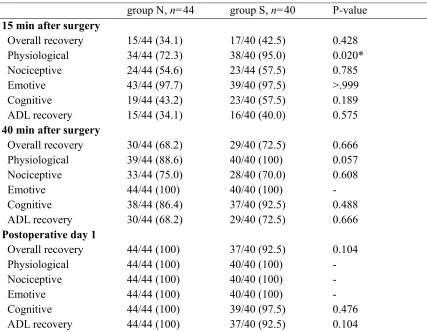
each domain of the PQRS at different time points. When compared with baseline values,
there were no significant differences in the overall recovery of PQRS between the 2 groups at
all time points post-operatively. As for the different domains of the PQRS, a significantly
higher number of patients in group S showed recovery of the physiological domain 15
minutes after surgery than those in group N (95% vs 72%, P = 0.02). No significant
associations were found in the other PQRS domains between groups.
Table 2 Recovery rates of the Postoperative Quality Recovery Scale at different time points.
group N, n=44 group S, n=40 P-value
15 min after surgery Overall recovery Physiological Nociceptive Emotive Cognitive ADL recovery 15/44 (34.1) 34/44 (72.3) 24/44 (54.6) 43/44 (97.7) 19/44 (43.2) 15/44 (34.1) 17/40 (42.5) 38/40 (95.0) 23/44 (57.5) 39/40 (97.5) 23/40 (57.5) 16/40 (40.0) 0.428 0.020* 0.785 >.999 0.189 0.575 40 min after surgery
Overall recovery Physiological Nociceptive Emotive Cognitive ADL recovery 30/44 (68.2) 39/44 (88.6) 33/44 (75.0) 44/44 (100) 38/44 (86.4) 30/44 (68.2) 29/40 (72.5) 40/40 (100) 28/40 (70.0) 40/40 (100) 37/40 (92.5) 29/40 (72.5) 0.666 0.057 0.608 - 0.488 0.666 Postoperative day 1
Overall recovery Physiological Nociceptive Emotive Cognitive ADL recovery 44/44 (100) 44/44 (100) 44/44 (100) 44/44 (100) 44/44 (100) 44/44 (100) 37/40 (92.5) 40/40 (100) 40/40 (100) 40/40 (100) 39/40 (97.5) 37/40 (92.5) 0.104 - - - 0.476 0.104
Values are recovered patients/total patients (%).group N, neostigmine group; group S, sugammadex group; ADL, Activities of daily living. * P < 0.05 between groups.
Table 3 shows percentages of recovered patients in each category of the physiological
and nociceptive domains at 15 and 40 minutes after surgery in both groups. However, no
domains
Table 3 Percentages of recovered patients in each category of the physiological and nociceptive domains at 15 and 40 minutes after surgery.
group N, n=44 group S, n=40 P-value
15 minutes after surgery
Physiological
Blood pressure Heart rate Temperature Respiration
Oxygen use to maintain SpO2
Airway Agitation Consciousness Activity on command
84.1 93.2 97.7 97.7 100 100 97.7 95.5 95.5 95 100 100 100 100 100 100 100 100 0.160 0.243 >0.999 >0.999 - - >0.999 0.495 0.495 Nociceptive Pain intensity
Nausea and vomiting
56.8 97.7 60.0 97.5 0.768 >0.999
40 minutes after surgery Physiological
Blood pressure Heart rate Temperature Respiration
Oxygen use to maintain SpO2
Airway Agitation Consciousness Activity on command
95.5 95.5 100 100 100 100 100 97.7 97.7 97.5 100 100 100 100 100 100 100 100 >0.999 0.495 - - - - - >0.999 >0.999 Nociceptive Pain intensity
Nausea and vomiting
75.0 100 70.0 100 0.633 -
Values are percentage of recovered patients. group N, neostigmine group; group S, sugammadex group; SpO2, oxygen saturation.
No statistical differences were identified in the emotional and cognitive domain at 15
of the cognitive domain, patients in group S showed significantly higher percentages of
recovery in the ‘digits backward’ category 15 minutes after surgery than in group N (67.5%
vs. 43.2%, P = 0.02). With the exception of the latter, no other categories showed significant
differences in cognitive domains between the two groups (Table 4).
Table 4 Percentages of recovered patients in each category of the emotional and cognitive domains at 15 and 40 minutes after surgery.
group N, n=44 group S, n=40 P-value
15 minutes after surgery Emotional Depression Anxiety 100 97.7 97.5 100 0.476 >0.999 Cognitive Orientation Digits forward Digits backward Word generation Recall 93.2 68.2 43.2 72.7 70.5 100 80 67.5 82.5 75 0.243 0.219 0.025* 0.282 0.641 40 minutes after surgery
Emotional Depression Anxiety 100 100 100 100 - - Cognitive Orientation Digits forward Digits backward Word generation Recall 95.5 86.4 84.1 95.5 90.9 97.5 97.5 97.5 100 92.5 >0.999 0.112 0.060 0.495 >0.999 Values are percentage of recovered patients. group N, neostigmine group; group S, sugammadex group. * P < 0.05 between groups.
Patients’ ratings on global perspective on post-operative day 1 are shown in Table 5. The
patients’ global perspective on post-operative day 1 showed no significant differences in
terms of daily activities, working capacity, and clarity of thought. More patients in group S
were completely satisfied with the anaesthetic care, although this was not statistically
Table 5 Patients’ rating on global perspective and satisfaction regarding anaesthetic care on the post-operative day 1.
group N, n=44 group S, n=40 P-value
Daily activities 38 (86%) 38 (95%) 0.269
Working capacity 44 (100%) 44 (100%) -
Clarity of thought 44 (100%) 44 (100%) -
Satisfaction with anaesthetic care 1/19/24 0/14/26 0.438
Discussion
We performed a prospective, double-blinded, randomized, controlled assessment to
demonstrate the influence of reversal with sugammadex or neostgmine on the quality of
post-operative recovery using PQRS following a single bolus dose of rocuronium in patients
undergoing TPPV with general anaesthesia. In the present study, sugammadex could
contribute to favourable initial post-operative recovery in the physiological domains
evaluated with the PQRS in patients undergoing day-surgery such as TPPV, as compared with
neostigmine.
In a previous retrospective study regarding recovery assessed using PQRS following
neostigmine and sugammadex administration, the recovery of the physiological domain at 40
minutes after surgery was significantly higher in group S, which was statistically relevant
with the percentage of patients who were fully awake. [7] However, in the present study, even
though there was a statistical difference between the 2 groups in the recovery of the
physiological domain at 15 minutes after surgery, no single responsible factor was found for
this difference in each category of the physiological domain.
Instead, almost every patient in group S had a complete recovery in the categories that
consisted of the physiological domain, while there were some patients with no recovery in
group N. Thus, these results suggest that sugammadex may be associated with a better
post-operative recovery than neostigmine.
Sugammadex has been reported to be superior at preserving haemodynamic stability
than anticholinesterases, which have been the most commonly used NM blockade reversal
agent to date. [15,16] Due to the fear of adverse effects from cholinesterase inhibitors, these
have been associated with concomitant used of anticholinergic agents such as atropine or
glycopyrrolate. [17,18] However, the combination of these 2 agents having different
effects nor maximize their desired effect. In contrast, as a selective antidote of NM blocking
agents, sugammadex may theoretically be better at preserving haemodynamic stability.
Conversely, there were no differences in the physiological domain between the two groups 40
minutes after surgery.
These discrepancies of the faster recovery of PQRS between the present study and the
previous by Amorim and colleagues might be caused due to the differences in the study
design as follows; the degree of NM blockade when reversal agents were given, the doses of
administered NM blocking agents, different kinds of NM blocking agents, and various types
of surgery such as open or laparoscopy vs sing type-TPPV, which is rarely accompanied by
bleeding or systemic complications.
The nociceptive domain in the PQRS includes an assessment of post-operative pain and
PONV at different time points. [12] Previous reports have described post-operative pain relief
and the use of sugammadex. [19,20] However, according to these reports, differences in pain
relief may have resulted from the effects of neostigmine on gastrointestinal motility, which
may cause additional pain after gastrointestinal surgery, and to the use of succinylcholine,
which may be associated with more myalgia because of fasciculation. In this study, neither
gastrointestinal surgery nor succinylcholine use was relevant. Therefore, consistent with the
result of other studies on post-operative quality of recovery, there was no difference in pain
recovery between the two groups across all time points. [7,21]
An advantage of sugammadex for PONV has also been reported by several
studies. [8,22,23] Cholinergic effects from the use of cholinesterase inhibitors can cause a
decrease in oesophageal tone, and an increase in secretion and intestinal movement that might
be associated with the increased PONV. However, due to the fear of these potential side
effects, anticholinergic agents have been used to compensate for these unwanted cholinergic
increased after surgery when a cholinesterase inhibitor was used concomitantly with the
anticholinergic agents. [24,25] Although certain types of surgery may worsen PONV, TPPV
does not appear to be a procedure that aggravates PONV. [26] In the current study, the
incidence of PONV was very low in both groups (2.3% and 2.5% in groups N and S,
respectively). This low incidence could be a potential reason for the decreased power of
detecting differences in PONV between the 2 groups. Therefore, a clinical trial evaluating
PONV from high-risk surgery might provide additional information to clarify the potential
protective effects of sugammadex on PONV.
A correlation between sugammadex and a faster recovery of consciousness has been
reported. [7,9] However, studies using electroencephalogram-based indices have shown that
there were no significant changes after the administration of sugammadex. [11,27] Of the
categories of the physiological domain in the PQRS, the recovery of consciousness was also
evaluated separately in this study. Our results show there was no significant difference in the
recovery of consciousness between the 2 groups across time points. This might be interpreted
as sugammadex not having any advantage on improving recovery of consciousness compared
with neostigmine. However, the recovery rate of consciousness was very high in both groups
as soon as 15 minutes after surgery in this study (95.5% and 100% in groups N and S,
respectively). As we reversed the NM blockade after confirmation of a TOF ratio at 0.5 or
greater (shallow block status), the patients in our study may have been more prone to fully
recover 15 minutes after surgery. However, the time to extubation was significantly shorter in
group S than in group N according to the results of this study. Because we only extubated
patients who had complete recovery from both consciousness and neuromuscular blockade,
sugammadex might be associated with the faster recovery of consciousness in the immediate
post-operative period. Further study using different time points of reversal or surgery types
use of sugammadex.
The association between the use of sugammadex and the recovery of cognitive function
has been demonstrated. [10,28] Previous studies showed no advantage of using sugammadex
over cholinesterase inhibitors for NM blockade reversal on cognitive function after surgery.
Consistent with previous reports, there were no significant differences in the post-operative
recovery of overall cognitive domain in the present study. However, patients in the group S
could recall more numbers in reverse order at 15 minutes after surgery. As can be deduced
from the lowest recovery rate, the backward digit span is the most difficult test among the
tests used to evaluate the cognitive domain of the PQRS. Thus, this test may be the most
sensitive for detecting differences in the recovery of cognitive function. Acetylcholine has
been reported to be closely associated with cognitive function [29] and improvements in
cognitive function have been reported altering levels of brain acetylcholine levels. [30] Both
cholinesterase inhibitors and sugammadex alter acetylcholine levels not only at the peripheral
NM junction, but also centrally. Further research focusing on differences in cognitive
function may provide additional clarification.
Unfortunately, there are some limitations to the present study. First, there is the short
observation period; the assessment of PQRS was not performed after post-operative day 1.
Thus, differences in long-term recovery between the two groups could not be assessed.
However, the assessment result after post-operative day 1 would have been similar, as most
patients were fully recovered and showed no differences between the groups already on
post-operative day 1. Another limitation is the surgery type. Because the surgery we evaluated was
minimally invasive, recovery rates for every PQRS domains were very high in both groups
across all time points. Such a high recovery rate in both groups was not very helpful for
detection of differences in post-operative recovery between the two groups. So, surgical
majority of patients were relatively healthy patients with ASA 1-2 in present study, the results
may have other outcomes in patients with several underlying disease. Therefore, further study
Conclusions
In conclusion, reversal with sugammadex following a single bolus dose of rocuronium
may be helpful to improve post-operative physiological recovery in the early post-operative
period, as assessed by the PQRS in patients undergoing TPPV under general anaesthesia
compared with neostigmine. However, further randomised controlled studies with different
Author Contributions: Conceptualization, S.-J. B, J.C.K and N.Y.K ; Data Curation, K.Y.L; Formal analysis, J.H.H; Investigation, K.Y.L , S.-S. K, and H.J.N; Resource, J.H.H; Supervision, J.C.K and N.Y.K; Validation, K.Y.L and S.-S. K; Writing-original draft, S.-J. B ; Writing-review & editing, J.C.K and N.Y.K All authors read and approved the final manuscript.
Funding: The authors have no financial relationships relevant to this article to disclose.
Acknowledgments: The authors thank Dong-Su Jang, MFA (medical illustrator, Medical Research Support Section, Yonsei University College of Medicine) for his help with the figures.
References
1. Poitras, S.; Beaule, P.E.; Dervin, G.F. Validity of a short-term quality of life questionnaire in patients undergoing joint replacement: The quality of recovery-40. J. Arthroplasty 2012, 27, 1604-1608.e1601.
2. Van Herck, P.; Vanhaecht, K.; Deneckere, S.; Bellemans, J.; Panella, M.; Barbieri, A.; Sermeus, W. Key interventions and outcomes in joint arthroplasty clinical pathways: A systematic review. J. Eval Clin. Pract. 2010, 16, 39-49.
3. Cullen, K.A.; Hall, M.J.; Golosinskiy, A. Ambulatory surgery in the united states, 2006.
Natl. Health Stat. Report 2009, 1-25.
4. Donati, F. Sugammadex: A cyclodextrin to reverse neuromuscular blockade in anaesthesia. Expert Opin. Pharmacother. 2008, 9, 1375-1386.
5. Loupec, T.; Frasca, D.; Rousseau, N.; Faure, J.P.; Mimoz, O.; Debaene, B. Appropriate dosing of sugammadex to reverse deep rocuronium-induced neuromuscular blockade in morbidly obese patients. Anaesthesia 2016, 71, 265-272.
6. Rex, C.; Bergner, U.A.; Puhringer, F.K. Sugammadex: A selective relaxant-binding agent providing rapid reversal. Curr. Opin. Anaesthesiol. 2010, 23, 461-465.
7. Amorim, P.; Lagarto, F.; Gomes, B.; Esteves, S.; Bismarck, J.; Rodrigues, N.; Nogueira, M. Neostigmine vs. Sugammadex: Observational cohort study comparing the quality of recovery using the postoperative quality recovery scale. Acta Anaesthesiol. Scand. 2014,
58, 1101-1110.
8. Yagan, O.; Tas, N.; Mutlu, T.; Hanci, V. Comparison of the effects of sugammadex and neostigmine on postoperative nausea and vomiting. Braz. J. Anesthesiol. 2017, 67, 147-152.
9. Chazot, T.; Dumont, G.; Le Guen, M.; Hausser-Hauw, C.; Liu, N.; Fischler, M. Sugammadex administration results in arousal from intravenous anaesthesia: A clinical and electroencephalographic observation. Br. J. Anaesth. 2011, 106, 914-916.
10. Batistaki, C.; Riga, M.; Zafeiropoulou, F.; Lyrakos, G.; Kostopanagiotou, G.; Matsota, P. Effect of sugammadex versus neostigmine/atropine combination on postoperative cognitive dysfunction after elective surgery. Anaesth Intensive Care 2017, 45, 581-588. 11. Illman, H.; Antila, H.; Olkkola, K.T. Reversal of neuromuscular blockade by
sugammadex does not affect eeg derived indices of depth of anesthesia. J. Clin. Monit. Comput. 2010, 24, 371-376.
Hurtado, I.; Hannallah, R.; Yu, B. et al. Development and feasibility of a scale to assess postoperative recovery: The post-operative quality recovery scale. Anesthesiology 2010,
113, 892-905.
13. Jildenstal, P.; Eriksson, J.; Warren Stomberg, M.; Jakobsson, J.G. Evaluation of the postoperative quality of recovery scale test and re-test in swedish among healthy volunteers. F1000Res. 2016, 5, 2549.
14. Naito, Y.; Tanaka, Y.; Sasaoka, N.; Iwata, T.; Fujimoto, Y.; Okamoto, N.; Inoue, S.; Kawaguchi, M. Feasibility, reliability, and validity of the japanese version of the postoperative quality of recovery scale: A first pilot study. J. Anesth. 2015, 29, 463-466. 15. Kizilay, D.; Dal, D.; Saracoglu, K.T.; Eti, Z.; Gogus, F.Y. Comparison of neostigmine
and sugammadex for hemodynamic parameters in cardiac patients undergoing noncardiac surgery. J. Clin. Anesth. 2016, 28, 30-35.
16. Park, E.S.; Lim, B.G.; Lee, W.J.; Lee, I.O. Sugammadex facilitates early recovery after surgery even in the absence of neuromuscular monitoring in patients undergoing laryngeal microsurgery: A single-center retrospective study. BMC Anesthesiol. 2016, 16, 48.
17. Arsura, E.L.; Brunner, N.G.; Namba, T.; Grob, D. Adverse cardiovascular effects of anticholinesterase medications. Am. J. Med. Sci. 1987, 293, 18-23.
18. Mirakhur, R.K.; Briggs, L.P.; Clarke, R.S.; Dundee, J.W.; Johnston, H.M. Comparison of atropine and glycopyrrolate in a mixture with pyridostigmine for the antagonism of neuromuscular block. Br. J. Anaesth. 1981, 53, 1315-1320.
19. Castro, D.S., Jr.; Leao, P.; Borges, S.; Gomes, L.; Pacheco, M.; Figueiredo, P. Sugammadex reduces postoperative pain after laparoscopic bariatric surgery: A randomized trial. Surg. Laparosc. Endosc. Percutan. Tech. 2014, 24, 420-423.
20. Saricicek, V.; Sahin, L.; Bulbul, F.; Ucar, S.; Sahin, M. Does rocuronium-sugammadex reduce myalgia and headache after electroconvulsive therapy in patients with major depression? J. ECT 2014, 30, 30-34.
21. Baumuller, E.; Schaller, S.J.; Chiquito Lama, Y.; Frick, C.G.; Bauhofer, T.; Eikermann, M.; Fink, H.; Blobner, M. Postoperative impairment of motor function at train-of-four
ratio ≥0.9 cannot be improved by sugammadex (1 mg kg-1). British journal of
anaesthesia 2015, 114, 785-793.
Sessler, D.I.; Turan, A. Comparison of sugammadex and conventional reversal on postoperative nausea and vomiting: A randomized, blinded trial. J. Clin. Anesth. 2015,
27, 51-56.
23. Lee, O.H.; Choi, G.J.; Kang, H.; Baek, C.W.; Jung, Y.H.; Woo, Y.C.; Oh, J.; Park, Y.H. Effects of sugammadex vs. Pyridostigmine-glycopyrrolate on post-operative nausea and vomiting: Propensity score matching. Acta Anaesthesiol. Scand. 2017, 61, 39-45.
24. Braun, G.G.; Schywalsky, M.; Wölfel, L.; Müller, H.; Danner, U.; Albert, R. [a comparison of the two anticholinergic agents atropine and glycopyrrolate during antagonism of a muscle relaxation with pyridostigmine]. Anaesthesiologie und Reanimation 1993, 18, 120-122, 125-127.
25. Cheng, C.R.; Sessler, D.I.; Apfel, C.C. Does neostigmine administration produce a clinically important increase in postoperative nausea and vomiting? Anesth. Analg. 2005,
101, 1349-1355.
26. Myklejord, D.J.; Yao, L.; Liang, H.; Glurich, I. Consensus guideline adoption for managing postoperative nausea and vomiting. WMJ 2012, 111, 207-213.
27. Fassoulaki, A.; Chondrogiannis, K.; Staikou, C. Sugammadex at both high and low doses does not affect the depth of anesthesia or hemodynamics: A randomized double blind trial. J. Clin. Monit. Comput. 2017, 31, 297-302.
28. Piskin, O.; Kucukosman, G.; Altun, D.U.; Cimencan, M.; Ozen, B.; Aydin, B.G.; Okyay, R.D.; Ayoglu, H.; Turan, I.O. The effect of sugammadex on postoperative cognitive function and recovery. Braz. J. Anesthesiol. 2016, 66, 376-382.
29. Giovannini, M.G.; Lana, D.; Pepeu, G. The integrated role of ach, erk and mtor in the mechanisms of hippocampal inhibitory avoidance memory. Neurobiol. Learn. Mem.
2015, 119, 18-33.