Supply Chain Performance Evaluation Models: A Study
V.R.Sirsath* Dr. R.S.Dalu**
* Ministry of MSME, GoI ,
** Mechanical Engineering Dept., Govt. College of Engineering, Amravati
Abstract
Performance measurement is an essential element of effective planning and control, as well as decision making. To identify the weak links in Supply Chain and improve its performance, evaluation of supply chain is important. It can provide necessary feedback information to reveal progress. The objectives of this paper are to study the various available Supply Chain evaluation models/frameworks and identify their limitations.
Key Words: SCM, Supply Chain performance evaluation, framework study
1. Introduction
SCM encompasses the planning and management of all activities involved in sourcing, procurement conversion and logistics management activities that include coordination and collaboration with channel partners. Through an efficient and effective supply chain management, a business organization could get the right goods and services to the place needed at the right time, in proper quantity and at acceptable cost. Recently, SCM has become one of the most important strategic aspect of any business entity and increasingly important in a global economy [3]. The supply chain process is complex, composite business process comprising a hierarchy of different levels of value delivering business processes. Designing a high performance supply chain is a very challenging task due to the complex structure of the supply chains and ever changing business. Some of the important reasons for the complexity of the decision making process are large scale nature of the supply chain networks, hierarchical structure of decision, randomness of various inputs and operations and dynamic nature of interactions among supply chain elements.
To improve the performance of supply chain, it is essential to identify the parameters (criteria’s) and sub-parameters (sub- criteria’s) affecting the performance; appropriate measures for parameters and sub-parameters. Researchers have developed different supply chain evaluation models. The objectives of this paper are to identify imperatives of supply chain performance measurement, and present review of available models and their limitations.
2. Imperatives of Supply Chain Performance Measurement
Performance measurement plays a vital role in identifying the behavior that impacts the performance of supply chains. Measuring supply chain helps organizations in meeting greater customer demands by maintaining lower cost. It also helps the organization in assessing the supply chain and realizing whether their chain has improved or degraded. Supply chain measurement directly impacts the controlling behavior and indirectly, it impacts and improves the performance [1].
Performance measurement is an essential element of effective planning and control, as well as decision making. It can provide necessary feedback information to reveal progress, enhance motivation and communication, and diagnose problems. In supply chain context, performance measurement can further facilitate inter understanding and integration among the supply chain members. The measurement reveals the effect of strategies and potential opportunities in SCM [2].
The goals of supply chain management are to reduce uncertainty and risks in the supply chain, thereby positively affecting inventory levels, cycle time, processes, and ultimately, end customer service levels. Effective supply chain administration requires a proactive management style focused on long-term continuous improvement of the supply chain. Performance measures that accurately reflect supply chain operations are required to support continuous improvement within a supply chain.
Performance measurement supports strategy planning and goal setting. Without the ability to measure performance and progress, the process of developing strategic plans and goals is less meaningful. Performance measurement improves internal accountability. Measuring performance gives decision makers a significant tool to achieve accountability. Employees at all levels are accountable to upper level managers for their performance or that of their crew, and upper level managers are accountable to executives.
3. Supply Chain Performance Evaluation Models
Different supply chain performance evaluation models/ frameworks had been suggested by researchers. Brief description of some has been presented in table 1. The prominent models are explained below
3.1 SCOR Model
SCOR model was developed and endorsed by the Supply Chain Council (SCC) as the cross industry standard for Supply Chain Management. The SCOR version- 8 has been released in 2007 by SCC.
The SCOR model (fig.1) is the first model that can be used to configure the supply chain based on business strategy by providing standard descriptions for the activities within supply chain. It also identifies the performance measurements and supporting tools suitable for each activity
Hierarchically, the SCOR model contains three levels of process detail as illustrated in fig.1. Level 1 is the top level that deals with the process types and defines the supply chain using five key processes Plan; Source; Make; Deliver and Return (PSMDR). The SCOR model level 1 metrics characterize performance from customer-facing and internal-facing perspectives. At this level, basis of competition is defined and broad guidelines are provided to meet competition.
Level 2 is the configuration level and deals with process categories. It defines different categories within the level 1 process. At this level, processes are configured in line with supply chain strategy in which internal redundancies can be identified and eliminated. The goal at level
2 is to simplify the supply chain and enhance its overall flexibility. At level 2, the SCOR model provides a tool kit of different process categories. At level 2, market constraints, product constraints, and company constraints are considered to configure the inter and intra-company process categories.
Level 3 is the process element level and is the lowest level in the scope of the SCOR model. Implementation levels that are below level 3 in which we decomposes process elements into tasks and further activities in classical hierarchical manner, are not in the scope of the SCOR model. Level 3 allows businesses to define in detail the processes identified, as well as performance metrics and best practice for each activity. Performance levels and practices are defined for these process elements. Benchmarks and the required attributes for the enabling software are also noted at this level. At level 3, inputs, outputs, and basic logic flow of process elements are captured.
At level 4, implementation of supply chain processes takes place. This level describes the detailed tasks within each of the level 3 activities needed to implement and manage the supply chain on a day to day basis.
3.2 Gunasekaran’s framework (2004)
This framework is based in part on a theoretical framework by Gunasekaran et.al. (2001) and on the empirical analysis. It is based largely on metrics. Individual firms will certainly have to develop its own measures to reflect their unique needs. This framework should be regarded as a starting point for an assessment of supply chain performance measurement.
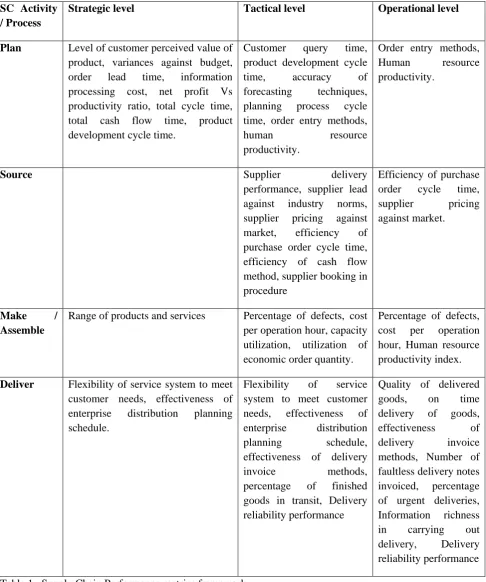
A framework for performance measures and metrics is presented in table 1. Considering the four major supply chain activities (plan, source, make/assemble, and deliver).These metrics were classified at Strategic, Tactical and Operational level to clarify the appropriate level of management authority and responsibility for performance.
Measures are grouped in cells at the intersection of the supply chain activity and planning level. For example, Supplier delivery performance can be found at the intersection of the Source activity and Tactical planning level indicating that it pertains to sourcing activities (source) and the tactical planning level. Supplier delivery performance would thus be a measure useful in analyzing the performance of mid-level managers as they undertake sourcing activities. The items in each cell are listed in the order of importance based on percentage importance ratings. Some measures appear in more than one cell, indicating that measures may be appropriate at more than one management level.
SC Activity / Process
Strategic level Tactical level Operational level
Plan Level of customer perceived value of product, variances against budget, order lead time, information processing cost, net profit Vs productivity ratio, total cycle time, total cash flow time, product development cycle time.
Customer query time, product development cycle time, accuracy of forecasting techniques, planning process cycle time, order entry methods,
human resource productivity.
Order entry methods, Human resource productivity.
Source Supplier delivery
performance, supplier lead against industry norms, supplier pricing against market, efficiency of purchase order cycle time, efficiency of cash flow method, supplier booking in procedure
Efficiency of purchase order cycle time, supplier pricing against market.
Make / Assemble
Range of products and services Percentage of defects, cost per operation hour, capacity utilization, utilization of economic order quantity.
Percentage of defects, cost per operation hour, Human resource productivity index.
Deliver Flexibility of service system to meet customer needs, effectiveness of enterprise distribution planning schedule.
Flexibility of service system to meet customer needs, effectiveness of enterprise distribution planning schedule, effectiveness of delivery
invoice methods, percentage of finished
goods in transit, Delivery reliability performance
Quality of delivered goods, on time delivery of goods, effectiveness of delivery invoice methods, Number of faultless delivery notes invoiced, percentage of urgent deliveries, Information richness in carrying out delivery, Delivery reliability performance
Table 1. Supply Chain Performance metrics framework
3.3 Rajat Bhagwat et al. SC Evaluation Model (2007)
The model has been developed for SMEs. The overall Performance Measurement System (PMS) of SCM is decided by three performance criteria in the hierarchy, i.e., strategic, tactical and operational levels. These have further performance measures sub-criteria for different decision levels in the hierarchy. At the lowest level the four BSC perspectives have been kept as alternatives.
Figure 2 Pictorial representation of the problem hierarchy
The three performance levels are considered so as to evaluate the performance from the overall performance measurement view and provide SCM operators with a comprehensive PMS. Based on literature and the experiences of practitioners, measures for the performance evaluation of SCM identified. The model with weight of criteria and sub- criteria is given in table 2. AHP ranking has been done in this model on the basis of a survey conducted from the SME sector in India.
Sr. Criteria’s Weight Sub- Criteria’s Weight
1 P-strategic 0.755 Total Cash flow time 0.0477
Rate of return 0.056
Flexibility to meet particular customer needs
0.168
Delivery lead time 0.216
Total cycle time 0.131
Buyer Supplier partnership level 0.254
Customer query time 0.127
2 P- tactical 0.067 Extent of cooperation to improve
quality
0.402
total transportation cost 0.052
truthfulness of demand predictability/forecasting methods
0.149
product development cycle time 0.397
3 P- operational 0.178 Manufacturing cost 0.251
Capacity utilization 0.495
Information carrying cost 0.119
Inventory carrying cost 0.135
Table 2. Rajat Bhagwat et al. SC Evaluation Model
4. Comparison of SC Models:
The three models have been compared on the basis of evaluation criteria’s and presented in table 3.
SC Model Can evaluate
Overall SC performance
Can compare similar SCs
Can identify weak part of
SC
Can evaluate MSMEs
SCORE Model (1998-2007)
x √ √ √
Gunasekaran et. al Model (2004)
x x x x
Rajat Bhagwat et. al. Model (2008)
√ x x √
Table 3. Comparison of SC Evaluation Model
5. Limitation of SC Evaluation Model
The limitations of three models are presented in table 4.
Model Limitations
SCORE
(1998-2007)
• It did not indicate whether the metrics were suitable for all types of industries
• Customization is required
• Qualitative parameters like customers satisfaction is not considered
• Overall SC performance evaluation is not possible.
Gunasekaran et. al. Model
(2004)
• Measure of sub- criteria’s has not been given
• Frame- work is the only starting point to evaluate SC • Overall approach to evaluate SC is not suggested
Rajat Bhagwat
(2008)
• Applicable to SMEs
Table 4. Limitation of SC Evaluation Model
Researchers Year Brief Description
Kaplan and Norton
1996 Four different types of performance metrics : Finance, Customer, Internal Business and Training has been suggested with five to six control variables for each type of metrics
Benita M. Beamon
1998 Identified SC performance measures and categorized them as qualitative or quantitative
Benita M.Beamon
1999 Resource, Output and flexibility are identified as necessary components in any supply chain performance measurement system. Flexibility measures for supply chains are developed.
Gunasekaran et al. 2001 SC performance measures are classified in to strategic, tactical and operational level and as financial and Non financial measures. A list of key performance measures identified.
Felix T.S. Chan 2003 Fuzzy number based concept has been suggested to evaluate SC performance
Gunasekaran et al. 2004 Measures are grouped in cells at the intersection of the supply chain activity (PSMDR) and planning level (Strategic, Tactical and Operational)
Bradley Hulls 2004 Developed a mathematical model that describes the performance of SC based on their elasticity (Flexibility) of supply and demand
SCC’s SCOR
1996-2007
Defines the SC using five key processes : Plan, Source, Make, Deliver and Return (PSMDR). SCOR model integrates business process reengineering, benchmarking, and process measurement into cross functional framework
Rajat Bhagwat 2008 Developed Supply Chain performance evaluation model for SME using AHP
Feng Yangs 2009 Existing SC is compared with virtual production possibility set SC to find inefficiency of SC
Table 1. Supply chain performance evaluation criteria’s/ models/frameworks
CONCLUSION
Performance measurement supports strategy planning and goal setting. Without the ability to measure performance and progress, the process of developing strategic plans and goals is less meaningful. Measurement improves accountability. SC includes lot of entity from supplier’s supplier to customers. From the literature review, it seems that SCOR Model of SC evaluation is practically more useful than other available models. Very few works has been done to assess the supply chain in MSMEs. This study will help to develop SC performance evaluation model for MSME.
REFERENCES
.
1. “performance measures and performance models for supply chain decision making” by y. narahari and shantanu biswas, Supply chain performance measurement and improvement; edited by venkata nimeesha posa, The Icfai University press; Hyderabad, first edition 2006 ISBN : 81-314-0583-4; pp 99-121
2. “ A conceptual model of performance measurement for supply chain”, Felix T S Chan, H.J.Qi, H.K.Chan, Henry C.W.Lau, Ralph W.L. Lp, , Management Decisio 41/7 [2003]n pp 635-642
3. “Performance evaluation of supply chain using SCOR model : The case of Pt. Yuasa, Indonesia”, Sudaryanto and Rudiana Bahri, International seminar on Industrial Engineering and Management; Menara Peninsula; Jakarta, August 29-30 2007, ISSN:1978-774x, pp C49-C55.
4. “ A framework for supply chain performance measurement”, A. Gunasekaran; C. Patel; Ronald E. McGaughey, International journal of production economics 87 (2004), pp 333- 347
5. “The role of elasticity in supply chain performance” ,Bradley Hull International journal of production economics, 98 pp 301-314
6. “Performance measurement model for supply chain management in SMEs”, Rajat Bhagwat, Felix T.S.Chan, Milind Kumar Sharma, International Journal of Globlisation and small Business, vol. 2 No. 4,2008 pp 428-443
7. “Performance metrics in supply chain management”, Jack PC Kleijnen; Martin T Smits, Journal of Operation research society;vol.2; no.2, PP 1-8
8. Sarika Kulkarni, Ashok Sharma; (2005) “Supply Chain Management” Tata McGraw Hill Publishing Company, New Delhi; ISBN 0-07-058135-5; INDIA. (66-70, 343-347)
9. “Performance measures and metrics in supply chain environment”, A. Gunasekaran;
C.Patel; E.Tirtiroglu,
10. Benita M. Beamon, University of Washington Industrial Engineering “Supply Chain Design and Analysis: Models and Methods”, International Journal of production Economics, Vol. 55 No. 3 , 281-294.
11. “Measuring supply chain performance”, Benita M. Beamon
12.C.Hicks; O. Heidrich; T McGovern; T Donnelly. “A Functional Model of Supply Chain and Waste.” International Journal of Production Economics 89(2004) 165 – 174.
13.Small Scale Industries – Performance and challenges, edited by keka lahiri, The Icfai University press; Hyderabad, first edition 2007,ISBN : 81-314-0607-5; pp 251-293
14.Supply chain performance management- conceots and cases, edited by S. Jaya krishna, The Icfai University press; Hyderabad, first edition 2004,ISBN : 81-7881-308-4; pp 54-86.
15.Benita M. Beamon & Tonja M.Ware “ Process Quality Model for Analysis, improvement and Control of Supply Chain System”Logistic Information Management Vol. II, No. 2, pp. 105-113
16.Beamon, Benita M., “Performance Measures In Supply Chain Management” ,Proceedings of the Conference on Agile and Intelligent Manufacturing Systems,Troy, NY.
17.”Supply chain modeling: Past, Present and Future”, Hokey Min, Gengui Zhou, Logistic and distribution institute , University of Louisville, suite 437, lutz hall, Louisville KY 40292, USA PERGAMON,Elsevier Science Ltd., Computer & Industrial engineering. 43, 231 - 249
18. A.Gunasekaran,C.Patel,E.Tiortiroglu “Performance measure and matrices in supply chain environment” international journal of operation and production management. Vol. 21 No.1/2, 71-87