Linear codes with few weights from weakly regular bent
functions based on a generic construction
Sihem Mesnager∗
Abstract
We contribute to the knowledge of linear codes with few weights from special polyno-mials and functions. Substantial efforts (especially due to C. Ding) have been directed towards their study in the past few years. Such codes have several applications in secret sharing, authentication codes, association schemes and strongly regular graphs. Based on a generic construction of linear codes from mappings and by employing weakly reg-ular bent functions, we provide a new class of linearp-ary codes with three weights given with its weight distribution. The class of codes presented in this paper is different from those known in literature. Also, it contains some optimal codes meeting certain bound on linear codes.
KeywordsLinear codes, weight distribution, p-ary functions, bent functions, weakly reg-ular bent functions, vectorial functions, cyclotomic fields.
1
Introduction
Error correcting codes are widely studied by several researchers and employed by engineers. They have long been known to have applications in computer and communication systems, data storage devices (starting from the use of Reed Solomon codes in CDs) and consumer electronics. A lot of progress has been made on the constructions of linear codes with few weights. Such codes have applications in secret sharing [1],[6],[37],[9],[10],[19],[12], authen-tication codes [22], association schemes [2], and strongly regular graphs [3]. Interesting two-weight and three-two-weight codes have been obtained in several papers. A non-exhaustive list dealing with codes with few weights is [8], [13],[20],[36],[21],[23],[30],[38],[39],[18],[19],[33], [35],[34],[27] and [17].
Certain special types of functions over finite fields and vector spaces over finite fields are closely related to linear or nonlinear codes. Two generic constructions (say, of ”type
∗
I” and of ”type II”) of linear codes involving special functions have been isolated and next investigated in literature. Linear codes obtained from the generic construction of type II are defined via their defining set while those obtained from the generic construction of type I are defined as the trace function of some functions involving polynomials which vanish at zero. Recently, based on the generic construction of type II, several approaches for constructing linear codes with special types of functions were proposed, and a lot of linear codes with excellent parameters were obtained. A very nice survey devoted to the con-struction of binary linear codes from Boolean functions based on the generic concon-struction of type II is given by Ding in [17].
Bent functions are maximally nonlinear Boolean functions. They were introduced by Rothaus [32] in the 1960’s and initially studied by Dillon as early as 1974 in this Thesis [15]. The notion of bent function has been extended in arbitrary characteristic by Kumar et al. [29]. For their own sake as interesting combinatorial objects, but also for their relations to coding theory (e.g. Reed-Muller codes, Kerdock codes, etc.), combinatorics (e.g. difference sets), design theory, sequence theory, and applications in cryptography (design of stream ciphers and of S-boxes for block ciphers), bent functions have attracted a lot of research for the past four decades as shown in a jubilee survey paper on bent functions [7] and a book [31] devoted especially to bent functions and containing a complete survey (including variations, generalizations and applications). It is well-known that Kerdock codes are con-structed from bent functions. Very recently, it has been shown in a few papers [16, 40, 33] that bent functions lead to the construction of interesting linear codes with few weights based on the generic construction of type II.
In this paper, we focus on the construction of linear codes from bent functions in arbitrary characteristic based on the generic construction of type I. The paper is organized as follows. In Section 2, we fix our main notation and recall the necessary background. In Section 3, we present the two generic constructions of binary codes from functions which have been highlighted by Ding in [17] and focus on one of them. In Section 4, we study codes from mappings based on the first generic construction and present general results in a very general context. Finally, in Section 5, we derive a new class of linear codes with three weights from weakly regular bent and present its weight distribution. Such a class contains some optimal codes meeting certain bound on linear codes. The reader will notice that the general idea of the construction of our codes is a classical one since it has been already employed in [4, 5] in the binary case and in [6, 36] in odd characteristic. Nevertheless, our specific choice of the function employed for designing our code is new.
2
Notation and preliminaries
2.1 Some notation fixed throughout this paper
Throughout this paper we adopt the following notations unless otherwise stated.
• For any setE,E? =E\ {0} and #E will denote the cardinality ofE;
• pis a prime;
• his a positive integer divisor of m. Setm=hr;
• q=ph;
• Fn is the Galois field of ordern;
• Zbe the rational integer ring, Qthe rational field andC the complex field;
• (ap) be the Legendre symbol for 1≤a≤p−1;
• p∗= (−p1)p= (−1)(p−1)/2p. Note that pm = (−p1)m√p∗2m;
• ξp=e
2π√−1
p be the primitivep-th root of unity.
2.2 Some background related to coding theory
Definition 1. A linear [n, k, d]q code C over Fq is a k-dimensional subspace of Fnq with
minimum Hamming distance d.
The support of a vector ¯a = (a0,· · · , an−1) ∈ Fnq denoted by supp(¯a) is defined by supp(¯a) :={0≤i≤n−1 :ai 6= 0}. The Hamming weight of a vector ¯a∈Fnq denoted by wt(¯a) is the cardinality of its support, that is,wt(¯a) := #supp(¯a).
2.3 Cyclotomic field Q(ξp)
In this subsection we recall some basic results on cyclotomic field. The ring of integers in
Q(ξp) isOK =Z(ξp). An integral basis ofOQ(ξp)is{ξ
i
p|1≤i≤p−1}. The field extension Q(ξp)/Qis Galois of degreep−1 and the Galois groupGal(Q(ξp)/Q) ={σa|a∈Z/pZ∗},
where the automorphism σa of Q(ξp) is defined by σa(ξp) = ξpa. The field Q(ξp) has a
unique quadratic subfield Q(
√
p∗) with p∗ = (−1
p )p where ( a
b) is the Legendre symbol
for 1 ≤ a ≤ p−1. For 1 ≤ a ≤ p−1, σa(
√
p∗) = (a p)
√
p∗. Hence, the Galois group Gal(Q(
√
2.4 Some background related to p-ary functions
The trace functionT rqr/q :Fqr →Fq is defined as:
T rqr/q(x) :=
r−1
X
i=0
xqi =x+xq+xq2 +· · ·+xqr−1.
The trace function fromFqr to its prime subfield is called the absolute trace function. Recall that the trace functionT rqr/q is Fq-linear and satisfies the transitivity property in a chain of extension fields (m=hr): T rpm/p(x) =T rph/p(T rpm/ph(x)) for allx∈Fqr.
Given two positive integers s and r, the functions from Fsq to to Frq will be called
(s, r)-q-ary functions or (if the values sand r are omitted) vectorialq-ary functions. The component functions ofF are the q-ary functionsl◦F, wherelranges over the set of all the nonzero linear forms over Frq. Equivalently, they are the linear combinations of a non-null
number of their coordinate functions, that is, the functions of the formv·F, v∈Frq\ {0}
, where ”·” denotes the usual inner product inFrq (or any other inner product). The vector
spaces Fsq and Frq can be identified with the Galois fields Fqs and Fqr of orders qs and qr
respectively. Hence, (s, r)-q-ary functions can be viewed as functions from Fqs toFqr. In this case, the component functions are the functions T rqr/q(vF(x)) where T rqr/q is the trace function fromFqr toFq.
Letf :Fpm −→Fp be a p-ary function. The Walsh transform off is given by:
c
χf(λ) =
X
x∈Fpm
ξpf(x)−T rpm/p(λx), λ∈
Fpm
where ξp = e
2π√−1
p is a complex primitive pth root of unity and the elements of Fp are considered as integers modulop.
Function f can be recovered fromχcf by the inverse transform:
ξpf(x)= 1
pm
X
b∈Fpm c
χf(b)ξ
−T rpm/p(bx)
p . (1)
2.5 Bent functions and (weakly) regular bent functions
Ap-ary functionf :Fpm −→Fp is calledbent if all its Walsh-Hadamard coefficients satisfy
|χcf(b)|2 =pm. A bent function f is called regular bent if for every b ∈Fpm, p− m
2
c
χf(b) = ξpf?(b) for some p-ary function f? : Fpm → Fp ([29], [definition 3]). The bent function f is called weakly regular bent if there exists a complex numberu with |u|= 1 and a p-ary functionf? such that up−n2
c
χf(b) =ξ f?(b)
p for allb∈Fpm. Such functionf∗(x) is called the
dual off(x). From [24, 25], a weakly regular bent functionf(x) satisfies that
c
χf(b) =
p
Bent functions m p
Pbm/2c
i=0 T rpm/p(aixp i+1
) arbitrary arbitrary
Ppk−1
i=0 T rpm/p(aixi(p k−1)
) +T rpl/p(δx pm−1
e ),e|pk+ 1 m= 2k arbitrary
T rpm/p(ax 3m−1
4 +3 k+1
) m= 2k p= 3
T rpm/p(xp
3k+p2k−pk+1
+x2) m= 4k arbitrary
T rpm/p(ax 3i+1
2 );iodd,gcd(i, m) = 1 arbitrary p= 3
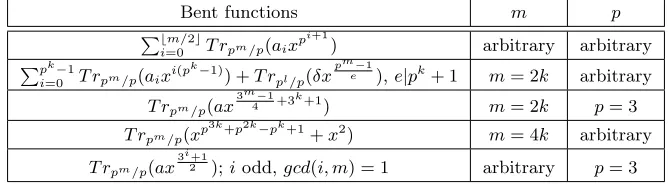
Table 1: Known weakly regular bent functions overFpm,podd
where=±1 is called the sign of the Walsh transform off(x) andp∗ equals (−p1)pwhere (ab) is the Legendre symbol for 1≤a≤p−1. Note that from Equation (1), for the weakly regular bent functionf(x), we haveP
b∈Fpmξ
f∗(b)−T rpm/p(bx)
p =pmξfp(x)/
√
p∗m. Moreover,
Walsh-Hadamard transform coefficients of ap-ary bent functionf with oddp satisfy
p−m2
c
χf(b) = (
±ξpf?(b), ifm is even or m is odd andp≡1 (mod 4),
±iξpf?(b), ifm is odd and p≡3 (mod 4),
(3)
where i is a complex primitive 4-th root of unity. Therefore, regular bent functions can only be found for even m and for odd m with p ≡ 1 (mod 4). Moreover, for a weakly regular bent function, the constantu (defined above) can only be equal to ±1 or±i.
We summarize in Table 1 all known weakly regular bent functions over Fpm with odd characteristicp.
3
Two generic constructions of linear codes from functions
Boolean functions or more generallyp-ary functions have important applications in cryp-tography and coding theory. In coding theory, they have been used to construct linear codes. Historically, the Reed-Muller codes and Kerdock codes have been -for a long time-the two famous classes of binary codes derived from Boolean functions. Next, a lot of progress has been made in this direction and further codes have been derived from more general and complex functions. Nevertheless, as highlighted by Ding in his very recent survey [17], despite the advances in the past two decades, one can isolate essentially only two generic constructions of linear codes from functions.
The first generic construction of linear codes from functions is obtained by considering a codeC(f) over Fp involving a polynomialf from Fq toFq (where q=pm) defined by
C(f) ={c= (T rq/p(af(x) +bx))x∈F∗
q |a∈Fq, b∈Fq}.
for instance [17]), this generic construction has a long history and its importance is sup-ported by Delsarte’s Theorem [14]. In the binary case (that is, when q = 2), the first generic construction allows us to provide a kind of a coding-theory characterization of spe-cial cryptographic functions such as APN functions, almost bent functions and semi-bent functions (see for instance [5], [4] and [28]).
The second generic construction of linear codes from functions is obtained by fixing a set D={d1, d2,· · · , dn} in Fq (where q = pm) and by defining a linear code involving D
as follows:
CD ={(T rq/p(xd1), T rq/p(xd2),· · ·, T rq/p(xdn))|x∈Fq}.
The set D is usually called the defining set of the code CD. The resulting code CD is of lengthnand of dimension at mostm. This construction is generic in the sense that many classes of known codes could be produced by selecting the defining set D⊆Fq. The code quality (good or optimal parameters or the contrary) is closely related to the choice of the setD.
4
On the first generic construction of linear codes from
map-pings over finite fields
For anyα, β∈Fpm, defined as:
fα,β : Fqr −→ Fq
x 7−→ fα,β(x) :=T rqr/q(αΨ(x)−βx) where Ψ is a mapping from Fqr toFqr such that Ψ(0) = 0.
We now define a linear code CΨ overFq as :
CΨ:={¯cα,β = (fα,β(ζ1), fα,β(ζ2),· · · , fα,β(ζqr−1)), α, β∈Fqr} whereζ1,· · ·, ζqr−1 denote the nonzero elements of Fqr.
Proposition 1. The linear code CΨ is of length qr−1. If the mapping Ψ has no linear
component then CΨ is of dimensionk= 2hm = 2r. Otherwise, k is less than 2r. Proof. It is clear thatCΨ is of length qr−1. Now, let compute the cardinality of C
Ψ. Let
¯
cα,β be a codeword of CΨ. We have
¯
cα,β = 0 ⇐⇒ T rqr/q(αΨ(ζi)−βζi) = 0,∀i∈ {1,· · · , qr−1}
⇐⇒ T rqr/q(αΨ(x)−βx) = 0,∀x∈F?qr
⇒T rqr/p(αΨ(x)−βx) = 0,∀x∈F?qr
⇒T rqr/p(αΨ(x)−βx) = 0,∀x∈Fqr
Hence, ¯cα,β = 0 implies that the mapping fromFqr toFq component of Ψ associated with
α 6= 0 is linear (or null) and coincides with x 7→ T rqr/p(βx). Therefore, it suffices that no component function of Ψ not be identically equal to 0 or linear to ensure that the only null codeword appears only one time at α =β = 0. Furthermore, it implies that all the codewords ¯cα,β are pairwise distinct. In this case, the size of the code is q2r and the
dimension of the code is thus equals 2r.
The following statement shows that the weight distribution of the code CΨ of length
qr−1 can be expressed by means of the Walsh transform of some absolute trace functions overFpm involving the map Ψ.
Proposition 2. We keep the notation above. Let a∈Fpm. Let us denote by ψ a mapping
fromFpm to Fp defined as:
ψa(x) =T rpm/p(aΨ(x)).
Forc¯α,β ∈ CΨ, we have:
wt(¯cα,β) =pm−1
q
X
ω∈Fq
[ χψωα(ωβ).
Proof. Note that Ψ(0) = 0 implies that fα,β(0) = 0. Now, let ¯cα,β be a codeword of CΨ
then,
wt(¯cα,β) = #{x∈Fq?r |fα,β(x)6= 0} = #{x∈Fqr |fα,β(x)6= 0} =pm−#{x∈Fqr |fα,β(x) = 0}
=pm− X
x∈Fqr 1
q
X
ω∈Fq
ξpT rq/p(ωfα,β(x)).
The latter equality comes from the fact that the sum of characters equalsq iffα,β(x) = 0
wt(¯cα,β) =pm−
1
q
X
ω∈Fq X
x∈Fqr
ξpT rq/p(ωfα,β(x))
=pm− 1
q
X
ω∈Fq X
x∈Fqr
ξpT rq/p(ωT rqr /q(αΨ(x)−βx))
=pm− 1
q
X
ω∈Fq X
x∈Fqr
ξpT rq/p(T rqr /q(ωαΨ(x)−ωβx))
=pm− 1
q
X
ω∈Fq X
x∈Fqr
ξpT rqr /p(ωαΨ(x)−ωβx)
=pm− 1
q
X
ω∈Fq X
x∈Fqr
ξpT rqr /p(ωαΨ(x))−T rqr /p(ωβx)
=pm− 1
q
X
ω∈Fq X
x∈Fqr
ξpψωα(x)−T rqr /p(ωβx)
=pm− 1
q
X
ω∈Fq
[ χψωα(ωβ).
In the following, we denote by Sψ(α, β) the sum 1qPω∈Fqχ[ψωα(ωβ). We compute the sum of all the values ofSψ(α, β) when α (resp. β) ranges the field Fqr.
Proposition 3. Keeping the same notation as above, setSψ(α, β) := 1q
P
ω∈Fqrχ[ψωα(ωβ).
we have
1. P
α∈FqrSψ(α, β) =q
r−1qr+q+ #{x∈
Fqr |ψ(x) =T rqr/q(βx) = 0} −#{x∈Fqr |
ψ(x) = 0}.
2. P
β∈FqrSψ(α, β) =q
2r−1+qr−qr−1.
Proof. Let compute the sumP
α∈FqrSψ(α, β).
X
α∈Fqr
Sψ(α, β) =
1
q
X
ω∈Fq X
x∈Fqr X
α∈Fqr
ξpT rqr /p(ωαψ(x)−ωβx)
= q
r
q
X
ω∈Fq
X
x∈Fqr|ωψ(x)=0
In the second equality we have used the fact thatP
α∈Fqrξp
T rqr /p(ωαψ(x)) equals pm = qr ifωψ(x) = 0 and equals 0 otherwise. Now, let separate the case when ω = 0 andω 6= 0.
X
α∈Fqr
Sψ(α, β) = qr
q
X
x∈Fqr
1 + X
ω∈F?q
X
x∈Fqr|ψ(x)=0
ξp−T rqr /p(ωβx)
= q
r
q
qr+ X
ω∈Fq
X
x∈Fqr|ψ(x)=0
ξp−T rqr /p(ωβx)−#{x∈Fqr |ψ(x) = 0}
= q
r
q
qr+ X
x∈Fqr|ψ(x)=0 X
ω∈Fq
ξp−T rq/p(T rqr /q(βx)ω)−#{x∈Fqr |ψ(x) = 0}
= q
r
q
qr+q#{x∈Fqr |ψ(x) =T rqr/q(βx) = 0} −#{x∈Fqr |ψ(x) = 0}
.
Now, let us compute the sumP
β∈FqrSψ(α, β).
X
(β∈Fqr
Sψ(α, β) =
1
q
X
ω∈Fq X
x∈Fqr
X
β∈Fqr
ξpT rqr /p(ωαψ(x)−ωβx)
= q
r
q
X
ω∈Fq
X
x∈Fqr|ωx=0
ξpT rqr /p(ωαψ(x))
=qr−1
X
x∈Fqr
1 + X
ω∈F? q 1
.
=qr−1
qr+q−1
.
5
A new family of linear codes with few weights from weakly
regular bent functions based on the first genetic
construc-tion
In this section we study a particular subclass of the previous family of linear codes con-sidered in the previous section. We shall fix h = 1 and assume α ∈ Fp. Let then gα,β
be the p-ary function from Fpm to Fp given by gα,β(x) = αT rpm/p(Ψ(x))−T rpm/p(βx). Note thatgα,β(x) =αψ1(x)−T rpm/p(βx) whereψa is defined as in Section 4 by ψa(x) =
T rpm/p(aΨ(x)).
Now let us define a subcodeC of CΨ as follows:
whereζ1,· · ·, ζpm−1 denote the nonzero elements ofFpm.
According to Proposition 2 (whereT rq/p is the identity function),
wt(˜cα,β) =pm−
1
p
X
ω∈Fp
[ χψωα(ωβ)
=pm−pm−1− 1
p
X
ω∈F?p
[ χψωα(ωβ)
=pm−pm−1− 1
p
X
ω∈F?p X
x∈Fpm
ξpψωα(x)−T rpm/p(ωβx)
=pm−pm−1− 1
p
X
ω∈F? p
X
x∈Fpm
ξpT rpm/p(ωαΨ(x)−ωβx)
=pm−pm−1− 1
p
X
ω∈F? p
X
x∈Fpm
ξpωT rpm/p(αΨ(x)−βx)
=pm−pm−1− 1
p
X
ω∈F? p
σω(χdψα(β)).
But χψdα(β) =σα(χψd1( ¯αβ)) where ¯α satisfies ¯αα= 1 inFp. Indeed,
σα(χdψ1( ¯αβ)) =σα
X
x∈Fpm
ξψp1(x)−T rpm/p( ¯αβx)
= X
x∈Fpm
ξpαψ1(x)−T rpm/p(βx)
=χ[αψ1(β) =χdψα(β).
Consequently,
wt(˜cα,β) =pm−pm−1−1
p
X
ω∈F?p
σω(σα(χψd1( ¯αβ))).
Note that if α= 0 then wt(˜cα,β) =pm−pm−1−p1Pω∈F?pσω(χc0(β)) (where 0 denotes the zero function). Since χc0(β) =
P
x∈Fmp ξ
−βx
p = pmδ0,β (where δr,s denotes the Dirac
symbol defined byδr,s= 1 if s=r and 0 otherwise). Therefore,
wt(˜cα,β) =pm−pm−1−
1
p
X
ω∈F?p
σω(pmδ0,β)
Hence, we obtain wt(˜c0,0) = 0 and for β 6= 0, wt(˜c0,β) = pm−pm−1, which concludes
the Hamming weight of any codeword ˜c0,β in any characteristic.
Let us consider firstly the binary case, that is, the case where p = 2. Assume ψ1 :=
T r2m/2(Φ) is bent. Then c
χψ1(β) = (−1)ψ
∗
1(β)2
m
2. Hence, according to above, wt(˜c1,β) =
2m−2m−1−1 2(−1)
ψ1∗(β)2m2 = 2m−1−(−1)ψ∗1(β)2m2−1.
From now on, we assume podd and ψ1 :=T rpm/p(Φ) is weakly regular bent. Then, by definition, we have:
c
χψ1( ¯αβ) =
p
p∗mξψ1∗( ¯αβ)
p .
Using the fact σα(
√
p∗m) = σ α(
√
p?)m = (α p)m
√
p∗m and if m is even, (α
p)m = 1 and
√
p∗m=√pm, one get
σα(χcψ1( ¯αβ)) =σα(
p
p∗m)ξαψ1∗( ¯αβ)
p
=(α
p) mp
p∗mξαψ1∗( ¯αβ)
p .
Therefore,
wt(˜cα,β) =pm−pm−1−
1
p
X
ω∈F∗p
σω
(α
p) mp
p∗mξαψ1∗( ¯αβ)
p
=pm−pm−1− 1
p( α
p) m X
ω∈F∗
p
σω(
p
p∗m)ξωαψ∗1( ¯αβ)
p
=pm−pm−1− 1
p( α
p) m X
ω∈F∗
p (ω
p) mp
p∗mξωαψ∗1( ¯αβ)
p
=
pm−pm−1− 1
p( α p)
√
p∗mP
ω∈F∗
p(
ω p)ξ
ωαψ∗1( ¯αβ)
p ifm odd pm−pm−1−pm2−1P
ω∈F∗
pξ
ωαψ∗1( ¯αβ)
p ifm even.
Let us distinguish both cases.
1. Casem odd.
• Ifψ∗1( ¯αβ) = 0 then (using the fact that P
ω∈F∗p(
ω p) = 0)
wt(˜cα,β) =pm−pm−1−
1
p( α p)
p
p∗m X ω∈F∗p
(ω
p)
• If ψ∗1( ¯αβ) 6= 0 then (using in particular the evaluation of the Gauss sum: P
ω∈F∗
p(
ω p)ξ
ω p =
√
p∗)
wt(˜cα,β) =pm−pm−1−
1
p( α p)
p
p∗m X ω∈F∗p
(ω
p)(ξ ω p)αψ
∗
1( ¯αβ)
=pm−pm−1−1
p( α p)
p
p∗mσ αψ∗1( ¯αβ)
X
ω∈F∗p (ω
p)ξ ω p
=pm−pm−1−1
p( α p)
p
p∗mσ
αψ∗1( ¯αβ)(
p
p∗)
=pm−pm−1−1
p( α p)
p
p∗mαψ ∗
1( ¯αβ)
p
p
p∗
=pm−pm−1−1
pp
∗m2+1ψ1∗( ¯αβ)
p
=pm−pm−1−1
p((
−1
p )p)
m+1 2
ψ∗
1( ¯αβ)
p
=pm−pm−1−(−1
p )
m+1 2 p
m−1 2
ψ∗
1( ¯αβ)
p
.
2. Casem even.
• Ifψ∗1( ¯αβ) = 0 then we have
wt(˜cα,β) =pm−pm−1−pm2−1
X
ω∈F∗p
ξωαψ
∗
1( ¯αβ)
p
=pm−pm−1−pm2−1(p−1).
• Ifψ∗1( ¯αβ)6= 0 then (since αω∈F∗
p) we have
P
ω∈Fpξ
αωψ∗1( ¯αβ)
p = 0. Thus
wt(˜cα,β) =pm−pm−1−p
m
2−1
X
ω∈F∗p
ξωαψ
∗
1( ¯αβ)
p
=pm−pm−1+pm2−1.
Collecting the previous results, we give in Theorem 1 the Hamming weights of the code-words ofC.
odd, respectively. We denote by ψ1? its dual function. Then the weight distribution of C is given as follows. In any characteristic,wt(˜c0,0) = 0 and for β 6= 0, wt(˜c0,β) =pm−pm−1. Moreover,
1. if p = 2 then the Hamming weight of ˜c1,β (β ∈F?2m) is given by wt(˜c1,β) = 2m−1 − (−1)ψ∗1(β)2
m
2−1.
2. if p is odd then
• if m is odd then the Hamming weight of ˜cα,β is given by
(
pm−pm−1 ifα ∈F?
p and ψ1∗( ¯αβ) = 0;
pm−pm−1−(−p1)m+12 p
m−1 2
ψ∗
1( ¯αβ)
p
if α∈F?
p and ψ1∗( ¯αβ)∈F?pm.
• if m is even then the Hamming weight ofc˜α,β is given by
pm−pm−1−pm2−1(p−1)if α∈F?p and ψ∗
1( ¯αβ) = 0;
pm−pm−1+pm2−1if α∈F?
p and ψ∗1( ¯αβ)∈F?pm.
We are now going to compute the weight distribution of C in the case where p is an odd prime. To this end, let us write the Walsh transform ofψ1 as
c
χψ1(ω) =up
m
2ξψ
∗
1(ω)
p ,
where∈ {−1,1}denotes the sign of the Walsh transform dχψ1 and u∈ {1, i} ∈C.
The weight distribution of the codeC is closely related to the bentness of the involved function. Letg be a weakly regular bent function over Fpm:
c
χg(ω) =up
m
2ξg
∗(ω)
p , ω ∈Fpm, =±1, u∈ {1, i}. Theng∗ is a weakly regular bent function and
c
χg(ω) =u−1p
m
2ξg(−ω)
p , ω∈Fpm.
Set
Nj := #{x∈Fpm |g(x) =j}.
Proposition 4. Using the above notation and assumingg∗(0) = 0. Then if m is even,
N0 =pm−1−p
m
2−1+p
m
2;
Nj =pm−1−pm2−1,1≤j≤p−1;
if m is odd,
N0=pm−1;
Nj =pm−1+pm2−1(j
p),1≤j ≤p. Proof. One has
c
χg(0) =
X
x∈Fpm
ξpg(x)=upm2 ξg
∗(0)
p = p−1
X
j=0
Njξpj
that is,
p−1
X
j=0
Njξpj−upm2 = 0. (5)
• Ifm is even, u= 1. Now sincePp−1
j=0xj is irreducible over the rational number field
and since it is the minimal polynomial ofξp over the rational number field, we have
Nj =a,1≤j≤p−1 andN0−p
m
2 =N1
for some a, that is, all the Njth are equal except for N0 that differs from −p
m
2.
Now, Pp−1
j=0Nj = pm. Hence a+p
m
2 + (p−1)a = pm from which one deduces
a=pm−1−epsilonpm2−1.
• Ifm is odd,u=i. Recall now the well-known identity
p
X
j=1
(j
p)ξ j p =
(
p12; ifp≡1 (mod 4);
ip12, ifp≡3 (mod 4),
(6)
that is,Pp
j=1(
j p)ξ
j p =up
1
2. Equation (5) can therefore be rewritten as
p−1
X
j=0
Njξpj−pm2−1
p
X
j=1
(j
p)ξ j p = 0.
By similar arguments as those used in the even case, we conclude that
N0 =Nj−p
m−1 2 (j
p),1≤j≤p.
Now,Pp−1
j=0Nj =pm=pN0+p
m−1 2 Pp
j=1(
j
Hamming weight Multiplicity
0 1
pm−pm−1 pm−1
pm−pm−1−pm2−1(p−1) pm−pm−1+pm2−1(p−1)2
pm−pm−1+pm2−1 (pm−pm−1)(p−1)−pm2−1(p−1)2
Table 2: The weight distribution ofC whenmis even
Hamming weight Multiplicity
0 1
2m−1 2m−1 2m−1−2m2−1 2m−1+ 2m2−1
2m−1+ 2m2−1 2m−1−2m2−1
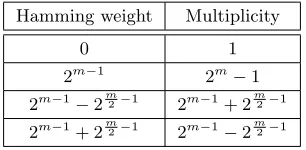
Table 3: The weight distribution ofC whenmis even
Now, using Proposition 4, we give in the following theorem the weight distribution of the code C whenm is even in any characteristic.
Theorem 2. Let p= 2 or p an odd prime. If m is even, then the weight distribution of C
is given by Table 2 and Table 3.
Proof. The weights comme from Theorem 1. One can easily get from Theorem 1 that there are pm−1 codewords of Hamming weight pm−pm−1. Set K := #{(α, β) ∈
F∗p × Fpm | ψ1∗( ¯αβ) = 0} and N0 := {γ ∈ Fpm | ψ1∗(γ) = 0}. Clearly, K = (p−1)N0 and (p−1)(pm−N0) = #{(α, β)∈F∗p×Fpm |ψ1∗( ¯αβ)6= 0}. Now, according to Proposition 4,
N0=pm−p
m
2−1+p
m
2. Thus,
K = (p−1)(pm−1+pm2−1(p−1))
=pm−pm−1+pm2−1(p−1)2,
and
(p−1)(pm−N0) = (p−1)(pm−pm−1−p
m
2−1(p−1))
= (pm−pm−1)(p−1)−pm2−1(p−1)2.
Now, according to Theorem 1, the number of codewords of Hamming weightpm−pm−1−
pm2−1(p−1) is equal to pm −pm−1 +p
m
2−1(p−1)2 and the number of codewords of
Hamming weightpm−pm−1+pm2−1 is equal to (pm−pm−1)(p−1)−p
m
Hamming weight Multiplicity
0 1
pm−pm−1 2pm−pm−1−1
pm−pm−1−(−1
p ) m+1
2 pm
−1
2 (pm−1+pm
−1 2 )(p−1)
2
2
pm−pm−1+(−1
p ) m+1
2 p m−1
2 (pm−1−p m−1
2 )(p−1) 2
2
Table 4: The weight distribution ofCwhenmis odd
Theorem 3. Letp be an odd prime. Ifm is odd, then the weight distribution ofCis given by Table 4.
Proof. Let us take again similar notations as those used in the proof of Theorem 2. Set
K := #{(α, β)∈Fp∗×Fpm |ψ∗1( ¯αβ) = 0} and Nj :={γ ∈Fpm |ψ1∗(γ) =j}. According to Theorem 1, the number of codewords of weightpm−pm−1is equal topm−1+K =pm−1+ (p−1)N0 while the number of codewords of Hamming weightpm−pm−1−(−p1)p
m−1 2 and
of Hamming weightpm−pm−1+(−p1)pm−21 are equal respectively toP
j∈{1,···,p−1},(pj)=1Nj
and P
j∈{1,···,p−1},(jp)=−1Nj. According to Proposition 4,
pm−1 + (p−1)N0=pm−1 + (p−1)(pm−1) = 2pm−pm−1−1;
X
j∈{1,···,p−1},(pj)=1
Nj =
X
j∈{1,···,p−1},(pj)=1
(p−1)(pm−1+pm2−1)
= (pm−1+pm2−1)(p−1
2 )(p−1); and
X
j∈{1,···,p−1},(jp)=−1
Nj = X
j∈{1,···,p−1},(pj)=−1
(p−1)(pm−1−pm−21)
= (pm−1−pm2−1)(p−1
2 )(p−1).
6
Concluding remarks
our codes have dimension m+ 1, they have the same weight distribution as a subcode of some of the codes in [4] whenp= 2 and the same weight distribution as a subcode of some of the codes in [6, 36] when pis odd.
References
[1] R. Anderson, C. Ding, T. Helleseth, and T. Klve. How to build robust shared control systems. Designs, Codes Cryptography, vol. 15, no. 2, pages 111-124, 1998.
[2] A. R. Calderbank and J. M. Goethals. Three-weight codes and association schemes.
Philips J. Res., vol. 39, pages 143-152, 1984.
[3] A. R. Calderbank and W. M. Kantor. The geometry of two-weight codes.Bull. London Math. Soc., vol. 18, pages 97-122, 1986.
[4] A. Canteaut, P. Charpin and H. Dobbertin, Weight divisibility of cyclic codes, highly nonlinear functions on GF(2m), and crosscorrelation of maximum-length sequences,
SIAM J. Discrete Math., vol. 13, pages 105–137, 2000
[5] C. Carlet, P. Charpin and V. Zinoviev, Codes, bent functions and permutations suit-able for DES-like cryptosystems, Designs, Codes and Cryptography, vol. 15, pages 125–156, 1998.
[6] C. Carlet, C. Ding, and J. Yuan. Linear codes from perfect nonlinear mappings and their secret sharing schemes. IEEE Trans. Inform. Theory, vol. 51, no.6, pages 2089-2102, 2005.
[7] C. Carlet and S. Mesnager. Four decades of research on bent functions. Journal Designs, Codes and Cryptography. To appear.
[8] S.-T. Choi, J.-Y. Kim, J.-S. No, and H. Chung. Weight distribution of some cyclic codes. IEEE Int. Symp. Inf. Theory, pages. 2901-2903, 2012.
[9] G. Cohen, S. Mesnager and A. Patey On Minimal and quasi-minimal linear codes.
Proceedings of Fourteenth International Conference on Cryptography and Coding, Ox-ford, United Kingdom, IMACC 2013, LNCS 8308, pages 85-98. Springer, Heidelberg, 2013.
[11] G. Cohen and S. Mesnager. Variations on Minimal Linear Codes. Proceedings of the 4th International Castle Meeting on coding theory and ApplicationSeries: CIM Series in Mathematical Sciences, Vol. 3, Springer-Verlag, pages 125-131, 2015.
[12] G. Cohen, S. Mesnager and H. Randriambololona. Yet another variation on mini-mal linear codes. Journal Advances in Mathematics of Communications (AMC). To appear.
[13] B. Courteau and J.Wolfmann. On triple-sum-sets and two or three weights codes.
Discrete Math., vol. 50, pages 179-191, 1984.
[14] P. Delsarte. On triple-sum-sets and two or three weights codes. IEEE Trans. Inf. Theory, 21(5) pages 575-576, 1975.
[15] J. Dillon. Elementary Hadamard difference sets. PhD thesis, University of Maryland, 1974.
[16] C. Ding. Linear codes from some 2-DesignsIEEE Transactions on Information Theory
61(6), pages 3265-3275, 2015.
[17] C. Ding. A Construction of binary linear codes from Boolean functions
arXiv:1511.00321v1, 2015.
[18] K. Ding and C. Ding. Binary linear codes with three weights. IEEE Communications Letters 18(11), pages 1879-1882, 2014.
[19] K. Ding and C. Ding. A Class of two-weight and three-weight codes and their ap-plications in secret sharing. IEEE Transactions on Information Theory61(11), pages 5835-5842, 2015.
[20] C. Ding, C. Li, N. Li, and Z. Zhou. Three-weight cyclic codes and their weight distributions. Preprint.
[21] C. Ding, J. Luo, and H. Niederreiter. Two weight codes punctured from irreducible cyclic codes. Proc. 1st Int. Workshop Coding Theory Cryp- tography, Y. Li, S. Ling, H. Niederreiter, H. Wang, C. Xing, and S. Zhang, Eds., Singapore, pages 119-124, 2008.
[22] C. Ding and X. Wang. A coding theory construction of new systematic authentication codes. Theoretical Comput. Sci., vol. 330, no. 1, pages 81-99, 2005.
[24] T. Helleseth and A. Kholosha. Monomial and quadratic bent functions over the finite fields of odd characteristic. IEEE Transactions on Information Theory, 52(5), pages 2018- 2032, 2006.
[25] T. Helleseth and A. Kholosha. New binomial bent functions over the finite fields of odd characteristic. IEEE Transactions on Information Theory56(9), pages 4646-4652, 2010.
[26] T. Helleseth and A. Kholosha. Bent functions and their connections to combinatorics.
Surveys in Combinatorics 2013, Cambridge University Press, pages 91-126, 2013.
[27] Z. Heng and Q. Yue Several class of cyclic codes with either optimal three weights or a few weights. arxiv.org/pdf/1510.05355, 2015.
[28] H. D. L. Hollmann and Q. Xiang A proof of the Welch and Niho conjectures on cross-correlations of binary m-sequences. Finite Fields Appl., Cambridge University Press, pages 253-286, 2001.
[29] P.V. Kumar, R.A. Scholtz and L.R. Welch. Generalized bent functions and their properties. Journal of Combinatorial Theory, Series A40, pages 90-107, 1985.
[30] C. Li, Q. Yue, and F. Li. Hamming weights of the duals of cyclic codes with two zeros.
IEEE Trans. Inf. Theory, vol. 60, no. 7, pages 3895-3902, 2014.
[31] S. Mesnager. Bent functions: fundamentals and results. Springer, New-York, 2016. To appear.
[32] O. S. Rothaus. On ”bent” functions. Journal of Combinatorial Theory, Series A, 20, pages 300-305, 1976.
[33] C. Tang, N. Li, Y. Qi, Z. Zhou and T. Helleseth Linear codes with two or three weights from weakly regular bent functions. ArXiv: 1507.06148v3, 2015.
[34] G. Xu and X. Cao Linear codes with two or three weights from some functions with low Walsh spectrum in odd characteristic. arXiv:1510.01031, 2015.
[35] Y. Xia, T. Helleseth, and C. Li Some new classes of cyclic codes with three or six weights. Adv. in Math. of Comm., 9(1), pages 23-36, 2015.
[36] J. Yuan, C. Carlet and C. Ding, The weight distribution of a class of linear codes from perfect nonlinear functions, IEEE Trans. Information Theory, Vol. 52, No. 2, pages 712–717, Feb. 2006.
[38] X. Zeng, L. Hu, W. Jiang, Q. Yue, and X. Cao. The weight distribution of a class of p-ary cyclic codes. Finite Fields Appl., vol. 16, no. 1, pages 56-73, 2010.
[39] Z. Zhou and C. Ding. A class of three-weight codes.Finite Fields Appl.,vol. 25, pages 79-93, 2014.