Compact VSS and Efficient Homomorphic UC
Commitments
Ivan Damg˚ard, Bernardo David, Irene Giacomelli, and Jesper Buus Nielsen? Dept. of Computer Science, Aarhus University
Abstract. We present a new compact verifiable secret sharing scheme, based on this we present the first construction of a homomorphic UC commitment scheme that requires only cheap symmetric cryptography, except for a small number of seed OTs. To commit to a k-bit string, the amortized communication cost isO(k) bits. Assuming a sufficiently efficient pseudorandom generator, the computational complexity isO(k) for the verifier and O(k1+) for the committer (where < 1 is a con-stant). In an alternative variant of the construction, all complexities are O(k·polylog(k)). Our commitment scheme extends to vectors over any finite field and is additively homomorphic. By sending one extra mes-sage, the prover can allow the verifier to also check multiplicative rela-tions on committed strings, as well as verifying that committed vectors a,bsatisfya=ϕ(b) for a linear function ϕ. These properties allow us to non-interactively implement any one-sided functionality where only one party has input (this includes UC secure zero-knowledge proofs of knowledge). We also present a perfectly secure implementation of any multiparty functionality, based directly on our VSS. The communication required is proportional to a circuit implementing the functionality, up to a logarithmic factor. For a large natural class of circuits the overhead is even constant. We also improve earlier results by Ranellucciet al.on the amount of correlated randomness required for string commitments with individual opening of bits.
1
Introduction
A commitment scheme is perhaps the most basic primitive in cryptographic protocol theory, but is nevertheless very powerful and important both in theory and practice. Intuitively, a commitment scheme is a digital equivalent of a secure box: it allows a prover P to commit to a secret s by putting it into a locked box and give it to a verifier V. Since the box is locked, V does not learn s at ?The authors acknowledge support from the Danish National Research Foundation
commitment time, we say the commitment is hiding. Nevertheless,P can later choose to give V the key to the box to let V learn s. Since P gave away the box, he cannot change his mind about s after commitment time, we say the commitment isbinding.
Commitment schemes with stand-alone security (i.e., they only have the bind-ing and hidbind-ing properties) can be constructed from any one-way function, and already this most basic form of commitments implies zero-knowledge proofs for all NP languages. Commitments with stand-alone security can be very efficient as they can be constructed from cheap symmetric cryptography such as pseudo-random generators [Nao91].
However, in many cases one would like a commitment scheme that composes well with other primitives, so that it can be used as a secure module that will work no matter which context it is used in. The strongest form of security we can ask for here is UC security [Can01]. UC commitments cannot be constructed without set-up assumptions such as a common reference string [CF01]. On the other hand, a construction of UC commitment in such models implies public-key cryptography [DG03] and even multiparty computation [CLOS02] (but see [DNO10] for a construction based only on 1-way functions, under a stronger set-up assumption).
With this in mind, it is not surprising that constructions of UC commit-ments are significantly less efficient than stand-alone secure commitcommit-ments. The most efficient UC commitment schemes known so far are based on the DDH as-sumption and requires several exponentiations in a large group [Lin11,BCPV13]. This means that the computational complexity for committing tok-bit strings is typicallyΩ(k3).
Our Contribution We first observe that even if we cannot build practical UC commitments without using public-key technology, we might still confine the use of it to a small once-and-for-all set-up phase. This is exactly what we achieve: given initial access to a small number of oblivious transfers, we show a UC secure commitment scheme where the only computation required is pseudorandom bit generation and a few elementary operations in a finite field. The number of oblivious transfers we need does not depend on the number of commitments we make later. The main observation we make is that we can reach our goal by combining the oblivious transfers with a “sufficiently compact” Verifiable Secret Sharing Scheme (VSS) that we then construct. The VSS has applications on its own as we detail below.
To commit to ak-bit string, the amortized communication cost isO(k) bits. The computational complexity isO(k) for the verifier andO(k1+) for the com-mitter (where <1 is a constant). This assumes a pseudorandom generator with linear overhead per generated bit1. In an alternative variant of the construction,
1
all complexities areO(k·polylog(k)). After the set-up phase is done, the prover can commit by sending a single string. Our construction extends to commit-ment to strings over any finite field and is additively homomorphic, meaning that given commitments to strings a,b, the verifier can on his own compute a commitment toa+b, and the prover can open it while revealing nothing beyond a+b. Moreover, if the prover sends one extra string, the verifier can also check that committed vectors a,b,csatisfy c =a∗b, the component-wise product. Finally, again by sending one extra string and allowing one extra opening, the verifier can compute a commitment toϕ(a), given the commitment toa, for any linear functionϕ. These extra strings have the same size as a commitment, up to a constant factor.
On the technical side, we take the work from [FJN+13] as our point of
depar-ture. As part of their protocol for secure 2-party computation, they construct an imperfect scheme (which is not binding for all commitments). While this is good enough for their application, we show how to combine their scheme with an efficient VSS that is compact in the sense that it allows to share several values from the underlying field, while shares only consist of a single field element. This is also known as packed secret sharing [FY92].
Our construction generalises the VSS from [CDM00] to the case of packed secret sharing. We obtain a VSS where the communication needed is only a constant factor larger than the size of the secret. Privacy for a VSS usually just says that the secret remains unknown to an unqualified subset of players until the entire secret is reconstructed. We show an extended form of privacy that may be of independent interest: the secret in our VSS is a set of `vectors
s1, ...,s`, each of length `. We show that any linear combination of s1, ...,s`
can be (verifiably) opened and players will learn nothing beyond that linear combination. We also build two new VSS protocols, both of which are non-trivial extensions. The first allows the dealer to generate several sharings of the vector 0`. For an honest dealer, the shares distributed are random even given the extra verification information an adversary would see during the VSS. This turns out to be crucial in achieving secure multiplication of secret-shared or committed values. The second new protocol allows us to share two sets of vectorss1, ...,s` and ˜s1, ...,s˜` such that it can be verified thatϕ(s1) = ˜s1, . . . , ϕ(s`) = ˜s` for a linear function ϕ. In the commitment scheme, this is what allows us to verify that two shared or committed vectors satisfy a similar linear relation.
Before we discuss applications, a note on an alternative way to view our commitment scheme: A VSS is essentially a multiparty commitment scheme. Therefore, given our observation that VSS and OT gives us efficient UC com-mitment, it is natural to ask whether our construction could be obtained using “MPC-in-the-head” techniques. Specifically, the IPS compiler [IPS08] is a general tool that transforms a multiparty protocol into a 2-party protocol implementing
the same functionality in the OT hybrid model. Indeed, applying IPS to our VSS does result in a UC commitment protocol. However, while this protocol is somewhat similar to ours, it is more complicated and less efficient (see Appendix D for more details).
Applications. One easily derived application of our commitment scheme is an implementation of any two-party functionality where only one party has input, we call this a one-sided functionality. This obviously includes UC secure zero-knowledge proofs of zero-knowledge for any NP relation. Our implementation is based on a Boolean circuitC computing the desired output.
We will focus on circuits that are not too “oddly shaped”. Concretely, we assume that every layer of the circuit is Ω(`) gates wide, except perhaps for a constant number of layers. Here one may think of ` as a statistical security parameter, as well as the number of bits one of our commitments contains. Second, we want that the number of bits that are output from layer i in the circuit and used in layerj is either 0 orΩ(`) for alli < j. We call such circuits well-formed. In a nutshell, well-formed circuit are those that allow a modest amount of parallelization, namely a RAM program computing the circuit can always executeΩ(`) bit operations in parallel and when storing bits for later use or retrieving, it can always addressΩ(`) bits at a time. In practice, since we can treat`as a statistical security parameter, its value can be quite small(e.g., 80), in particular very small compared to the circuit size, and hence a requirement that the circuit be well-formed seems rather modest. Using the parallelisation technique from [DIK10], we can evaluate a well-formed circuit using only parallel operations on`-bit blocks, and a small number of different permutations of bits inside blocks. This comes at the cost of a log-factor overhead.
Some circuits satisfy an even nicer condition: if we split the bits coming into a layer ofC into`-bit blocks, then each such block can be computed as a linear function of blocks from previous layers, where the function is determined by the routing of wires in the circuit. Such a function is called a block function. If each block function depends only on a constant number of previous blocks and if each distinct block function occurs at least` times, then C is calledregular(we can allow that a constant number of block functions do not satisfy the condition). For instance, block ciphers and hash functions do not spread the bits around much in one round, but repeat the same operations over many rounds and hence tend to have regular circuits. Also many circuits for arithmetic problems have a simple repetitive structure and are therefore regular.
We stress that the protocol we build works for any circuit, it will just be less efficient if C is not well-formed 2. We can also apply our VSS directly to
implement multiparty computation in the model where there are clients who have inputs and get output and servers who help doing the computation.
Theorem 2. For any functionalityF, there exists a UC perfectly secure imple-mentation ofF in the client/server model assuming at most a constant fraction of the servers and all but one of the clients may be corrupted. IfCis well-formed, the total communication complexity is in O(log(|C|)|C|). If C is regular, the complexity is O(|C|).
We are not aware of any other approach that would allow us to get perfect security and “constant rate” for regular circuits3.
A final application comes from the fact that our commitment protocol can be interpreted as an unconditionally secure protocol in the model where corre-lated randomness is given. In this model, it was shown in [RTWW11] that any unconditionally secure protocol that allows commitment to N bits where each bit can be individuallyopened, must use Ω(N k) bits of correlated randomness, where kthe security parameter. They also show a positive result that partially circumvents this lower bound by considering a functionality FN,r
com that allows commitment toNbits where onlyr < N bits can be selectively and individually opened. WhenrisO(1), they implement this functionality at constant rate, i.e., the protocol requires onlyO(1) bits of correlated randomness per bit committed to. We can improve this as follows:
Theorem 3. There exists a constant-rate statistically secure implementation of
FN,r
com in the correlated randomness model, wherer∈O(N1−)for any >0. We find it quite surprising thatrcan be “almost”N, and still the lower bound for individual opening does not apply. What the actual cut-off point is remains an intriguing open question.
Related Work In [DIK+08], a VSS was constructed that is also based on packed
secret sharing (using Shamir as the underlying scheme). This construction relies crucially on hyper invertible matrices which requires the field to grow with the number of players. Our construction works for any field, including F2. This
would not be so important if we only wanted to commit and reveal bits: we could use [DIK+08] with an extension field, pack more bits into a field element
2
It is possible to use MPC-in-the-head techniques to prove results that have some (but not all) of the properties of Theorem 1. Essentially one applies the IPS com-piler to a multiparty protocol, either a variant of [DI06] (described in [IKOS09]), or the protocol from [DIK10]. In the first case, the verifier’s computation will be asymptotically larger than in our protocol, in the second case, one cannot obtain the result for regular circuits since [DIK10] has at least logarithmic overhead for any circuit since it cannot be based on fields of constant size.
3
and still get constant communication overhead, but we want to do (Boolean) operations on committed bits, and then “bit-packing” will not work. It therefore seems necessary to construct a more compact VSS in order to get our results. In [BBDK00], techniques for computing functions of shared secrets using both broadcast channels and private interactive evaluation are introduced. However, their constructions are based specifically on Shamir’s LSSS and do not allow verification of share validity.
In recent independent work [GIKW14], Garayet al.also construct UC com-mitments using OT, VSS and pseudorandom generators as the main ingredients. While the basic approach is closely related to ours, the concrete constructions are somewhat different, leading to incomparable results. In [GIKW14] optimal rate is achieved, as well as a negative result on extension of UC commitments. On the other hand, we focus more on computational complexity and achieve homomorphic properties as well as non-interactive verification of linear relations inside committed vectors4.
2
Preliminaries
In this section we introduce the basic definitions and notation that will be used throughout the paper. We denote sampling a value r from a distributionD as
r← D. We say that a functionis negligible if there exists a constantcsuch that
(n)< p(1n)for every polynomialpandn > c. Two sequencesX={Xκ}κ∈Nand Y ={Yκ}κ∈N of random variables are said to becomputationally
indistinguish-able, denoted by X≈c Y, if for every non-uniform probabilistic polynomial-time (PPT) distinguisherDthere exists a negligible function(·) such that for every
κ∈ N, |P r[D(Xκ) = 1]−P r[D(Yκ) = 1] |< (κ). Similarly two sequences X andY of random variables are said to bestatistically indistinguishable, denoted byX ≈s Y, if the same relation holds for unbounded non-uniform distinguishers.
2.1 Universal Composability
The results presented in this paper are proven secure in the Universal Compos-ability (UC) framework introduced by Canetti in [Can01]. We consider security against static adversaries,i.e.all corruptions take place before the execution of the protocol. We consider active adversaries who may deviate from the protocol in any arbitrary way. It is known that UC commitments cannot be obtained in the plain model [CF01]. In order to overcome this impossibility, our protocol is proven secure in theFOT-hybrid model in, where all parties are assumed to have access to an ideal 1-out-of-2 OT functionality. In fact, our protocol is constructed in theFOTt,n-hybrid model (i.e.assuming access to t-out-of-n OT), which can be subsequently reduced to the FOT-hybrid model via standard techniques for ob-tainingFOTt,n fromFOT [Nao91,BCR86,NP99]. We denote byFOTt,n(λ) an instance
4
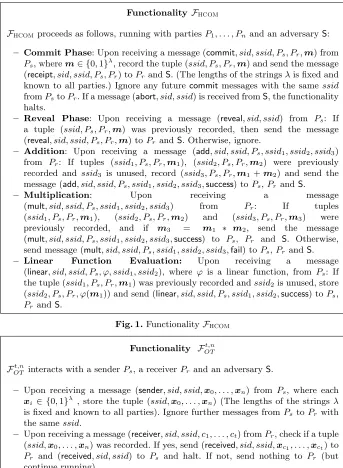
FunctionalityFHCOM
FHCOM proceeds as follows, running with partiesP1, . . . , Pn and an adversaryS:
– Commit Phase: Upon receiving a message (commit, sid, ssid, Ps, Pr,m) from Ps, wherem∈ {0,1}λ
, record the tuple (ssid, Ps, Pr,m) and send the message (receipt, sid, ssid, Ps, Pr) toPrandS. (The lengths of the stringsλis fixed and known to all parties.) Ignore any futurecommit messages with the samessid fromPstoPr. If a message (abort, sid, ssid) is received fromS, the functionality halts.
– Reveal Phase: Upon receiving a message (reveal, sid, ssid) from Ps: If a tuple (ssid, Ps, Pr,m) was previously recorded, then send the message (reveal, sid, ssid, Ps, Pr,m) toPr andS. Otherwise, ignore.
– Addition: Upon receiving a message (add, sid, ssid, Ps, ssid1, ssid2, ssid3) from Pr: If tuples (ssid1, Ps, Pr,m1), (ssid2, Ps, Pr,m2) were previously recorded and ssid3 is unused, record (ssid3, Ps, Pr,m1+m2) and send the message (add, sid, ssid, Ps, ssid1, ssid2, ssid3,success) toPs,Pr andS.
– Multiplication: Upon receiving a message
(mult, sid, ssid, Ps, ssid1, ssid2, ssid3) from Pr: If tuples (ssid1, Ps, Pr,m1), (ssid2, Ps, Pr,m2) and (ssid3, Ps, Pr,m3) were previously recorded, and if m3 = m1 ∗ m2, send the message (mult, sid, ssid, Ps, ssid1, ssid2, ssid3,success) to Ps, Pr and S. Otherwise, send message (mult, sid, ssid, Ps, ssid1, ssid2, ssid3,fail) toPs,Pr andS.
– Linear Function Evaluation: Upon receiving a message (linear, sid, ssid, Ps, ϕ, ssid1, ssid2), where ϕ is a linear function, from Ps: If the tuple (ssid1, Ps, Pr,m1) was previously recorded andssid2is unused, store (ssid2, Ps, Pr, ϕ(m1)) and send (linear, sid, ssid, Ps, ssid1, ssid2,success) toPs, Pr andS.
Fig. 1.FunctionalityFHCOM
Functionality Ft,n OT
FOTt,ninteracts with a senderPs, a receiverPrand an adversaryS.
– Upon receiving a message (sender, sid, ssid,x0, . . . ,xn) from Ps, where each xi ∈ {0,1}λ , store the tuple (ssid,x0, . . . ,xn) (The lengths of the stringsλ is fixed and known to all parties). Ignore further messages fromPs toPr with the samessid.
– Upon receiving a message (receiver, sid, ssid, c1, . . . , ct) fromPr, check if a tuple (ssid,x0, . . . ,xn) was recorded. If yes, send (received, sid, ssid,xc1, . . . ,xct) to Pr and (received, sid, ssid) to Ps and halt. If not, send nothing to Pr (but continue running).
Fig. 2.FunctionalityFt,n OT
functionalityFHCOMin Figure 1 andFOTt,n in Figure 2, further definitions can be found in Appendix A.
2.2 Linear Secret Sharing
In very short terms, a linear secret sharing scheme is a secret sharing scheme defined over a finite fieldF, where the shares are computed as a linear function of the secret (consisting of one or more field elements) and some random field elements. A special case is Shamir’s well known scheme. However, we need a more general model for our purposes. We follow the approach from [CDP12] and recall the definitions we need from their model.
Definition 1. A linear secret sharing schemeSover the finite field Fis defined
by the following parameters: number of players n, secret length `, randomness lengthe, privacy threshold t and reconstruction threshold r. Also, a n×(`+e) matrix M over F is given and S must have r-reconstruction and t-privacy as
explained below. If` >1, thenS is called apacked linear secret sharing scheme.
Letd=`+eand let P ={P1, . . . , Pn} be the set of players, then the row numberiofM, denoted bymi, is assigned to playerPi. IfAis a player subset, then MA denotes the matrix consisting of rows from M assigned to players in
A. To share a secret s ∈ F`, one first forms a column vectorf ∈
Fd where s
appears in the first ` entries and with the last e entries chosen uniformly at random. Theshare vector ofsin the schemeS is computed asc=M·f and its
i-th componentc[i] is the share given to the playerPi. We will useπ` to denote the projection that outputs the first`coordinates of a vector,i.e.π`(f) =s.
Now, t-privacy means that for any player subset A of size at most t, the distribution ofMA·f is independent ofs. It is easy to see that this is the case if and only if there exists, for each positionj ins, a sweeping vectorwA,j. This is a column vector ofdcomponents such thatMA·wA,j =0andπ`(wA,j) is a vector whosej-th entry is 1 while all other entries are 0.
Finally,r-reconstructionmeans that for any player subsetBof size at leastr, sis uniquely determined fromMB·f. It is easy to see that this is the case if and only if there exists, for each positionj ins, areconstruction vectorrB,j. This is a row vector of|B|components such that for any f ∈Fd,rB,j·MB·f =f[j], wheref[j] is thej-th entry inf.
A packed secret sharing scheme was constructed in Franklin and Yung [FY92]. However, to get our results, we will need a scheme that works over constant size fields, such an example can be found in [CDP12].
Multiplying shares: forv,w∈Fk, wherev⊗iw = (v[i]w[j])j6=i, the vector v⊗w∈Fk2 is defined byv⊗w= (v[1]w[1], . . . ,v[k]w[k],v⊗
M·f1∗ M ·f2 = Mc· f1⊗f2 >
where ∗ is just the Schur product (or componentwise product). Note that ift is the privacy threshold of S, then the scheme Sbalso has thet-privacy property. But in general it does not hold that theSbhasr-reconstruction. However, suppose thatSbhas (n−t)-reconstruction, thenS is said to have the t-strong multiplication property.
In particular, ifShas thet-strong multiplication property, then for any player setAof size at leastn−tand for any indexj= 1, . . . , `there exists a row vector b
rA,j such thatbrA,j·
MA·f1∗ MA·f2=s1[j]s2[j] for anys1,s2∈F`.
3
Packed Verifiable Secret-Sharing
In aVerifiable Secret-Sharingscheme (VSS) a dealer distributes shares of a secret to the players inP in such a way that the honest players are guaranteed to get consistent shares of a well-defined secret or agree that the dealer cheated. In this section we present a packed verifiable secret sharing protocol that generalizes and combines the ideas of packed secret sharing from [FY92] and VSS based on polynomials in 2 variables from [BOGW88]. The protocol is not a full-blown VSS, as it aborts as soon as anyone complains, but this is all we need for our results. The proofs for all lemmas in this section can be found in Appendix B.
The protocol can be based on any linear secret-sharing schemeS over F as defined in Section 2. We assume an active adversary who corruptstplayers and possibly the dealer, and we assume that at least rplayers are honest. The pro-tocol will secret-share` column vectorss1, . . . ,s`∈
F`. In the following, F will
be ad×dmatrix with entries inFand for 1≤i≤nwe will definehi=F·m>i andgi=mi·F. It is then clear thatmj·hi=gj·m>i for 1≤i, j≤n. We will usefb to denote theb-th column ofF. The protocol is shown in Figure 3.
Packed Verifiable Secret-Sharing ProtocolπV SS
1. Lets1, . . . ,s`∈F` be the secrets to be shared. The dealer chooses a random
d×dmatrixF with entries inF, subject toπ`(fb) =sb for anyb= 1, . . . , `.
2. The dealer sendshi andgitoPi.
3. Each playerPj sendsgj·m>i toPi, fori= 1, . . . , n.
4. EachPi checks, forj = 1, . . . , n, thatmj·hi equals the value received from Pj. He broadcastsAcceptif all checks are OK, otherwise he broadcastsReject. 5. If all players saidAccept, then eachPjstores, forb= 1, . . . , `,gj[b] as his share
ofsb, otherwise the protocol aborts.
Fig. 3.The VSS protocol
For a column vectorv ∈ Fd, we will say thatv sharess∈F`, if π`(v) =s and each honest playerPj holdsmj·v. In other words,c=M·v forms a share vector ofsin exactly the way we defined in the previous section. We now show some basic facts aboutπV SS:
Lemma 2 (soundness).If the dealer inπV SSis corrupt, but no player rejects, then for b = 1, . . . , `, there exists a column vector vb and a bit string sb such that vb sharessb.5
Finally we need to show privacy. For VSS protocols this is normally just a result saying that if the dealer is honest, then the shares held by corrupt players have distribution independent of the secrets, thesb’s. However, we need in the following a more elaborate result saying that if we open any linear function of sb’s, then no further information on thesb’s is released.
To be more precise about this, assume T : F` 7→ F` 0
, where `0 ≤ `, is a surjective linear function. By T(s1, . . . ,s`), we mean a tuple (u1, . . . ,u`0) of column vectors in F` s.t. ub[a] = T(s1[a], . . . ,s`[a])[b]. Put differently, if we arrange the column vectorss1, . . . ,s`in a`×`matrix, then what happens is that we applyT to each row, and let theub’s be the columns in the resulting matrix. In a completely similar way, we define a tuple of `0 column vectors of length d
by the formulaT(f1, . . . ,f`) = (w1, . . . ,w`0). It is easy to see that iff1, . . . ,f` shares1, . . . ,s`, thenw1, . . . ,w`0 shareu1, . . . ,u`0, since the players can apply
T to the shares they received in the first place, to get shares ofu1, . . . ,u`0. In the following we will abbreviate and use T(F) to denoteT(f1, . . . ,f`).
Now, byopeningT(s1, . . . ,s`), we mean that the (honest) dealer makesT(F) public, which allows anyone to computeT(s1, . . . ,s`). We want to show that, in general, if T(s1, . . . ,s`) is opened, then the adversary learnsT(s1, . . . ,s`) and no more information about s1, . . . ,s`. This is captured by Lemma 3. Suppose
that A={Pi1, . . . , Pit} is a set of players corrupted by the adversary.
Lemma 3 (privacy). Suppose the dealer in πV SS is honest. Now, in case 1 suppose he executesπV SS with inputs1, . . . ,s` and then opensT(s1, . . . ,s`). In case 2, he executesπV SS with input es
1
, . . . ,es` and then opens T(es1, . . . ,es`). If
T(s1, . . . ,s`) =T( e
s1, . . . ,es`), then the views of the adversary in the two cases
are identically distributed.
As the last step, we show an extra randomness property satisfied by the share vectors obtained by Protocol πV SS. If C is a a×b matrix, define π`(C) as the a×` matrix given by the first ` columns of C and π`(C) as the `×b matrix given by the first ` rows of C. Note that, if V is a d×` matrix such that π`(V) = (s1, . . . ,s`), then the dealer might have chosen V as the first ` columns in his matrixF. We want to show that given the adversary’s view, any
V could have been chosen, as long as it is consistent with the adversary’s shares ofs1, . . . ,s`.
Lemma 4 (randomness of the share vectors). Suppose that the dealer in
πV SS is honest and let A ={Pi1, . . . , Pit} be a set of players corrupted by the
adversary. If we defineGA as the matrix whosej-th row isgij, then all thed×` matrices V such that π`(V) = (s1, . . . ,s`) and MA·V = π`(GA) are equally likely, even given the adversary’s entire view.
For the applications ofπV SS that we will show in Section 5, we will require some new specialized forms of πV SS, which we describe in the following two sections.
3.1 Applying a linear map to all the secrets
Letϕ:F`→
F` be a linear function. Suppose that the dealer executes two
cor-related instances of ProtocolπV SS in the following way: first the dealer executes
πV SS with input s1, . . . ,s` choosing matrix F in step 1, later on, he executes
πV SS with input ϕ(s1), . . . , ϕ(s`) under the condition that the matrix chosen for the second instance, Fϕ, satisfiesπ`(fϕ,i) =ϕ(π`(fi)) fori= 1, . . . , d. The dealer sends to Pi vectors hi and gi and also the vectors hϕ,i = Fϕ·m>i , gϕ,i=mi·Fϕ. The protocol is shown in figure 4.
Packed Verifiable Secret-Sharing Protocol forϕ,πV SSϕ
1. Lets1, . . . ,s`∈
F`be the secrets to be shared. The dealer chooses two random
d×dmatricesF,Fϕsubject toπ`(fb) =sbfor anyb= 1, . . . , `andπ`(fϕ,i) = ϕ(π`(fi)) for anyi= 1, . . . , d.
2. The dealer sendshi,gi,hϕ,iandgϕ,itoPi.
3. Each playerPj sendsgj·m>i andgϕ,j·m>i toPi, fori= 1, . . . , n.
4. EachPichecks, forj= 1, . . . , n, thatmj·hiandmj·hϕ,iare equal to the values received fromPjand also thatπ`(˜hi) =ϕ π`(hi)
. He broadcastsAcceptif all checks are OK, otherwise he broadcastsReject.
5. If all players saidAccept, then eachPj stores, forb= 1, . . . , `,gj[b] andgϕ,j[b] as his share respectively ofsbandϕ(sb), otherwise the protocol aborts.
Fig. 4.The VSS protocol forϕ
The completeness of theπϕV SS protocol is trivial to prove. Moreover we will show in the following lemma 5 and 6, that also the properties of soundness and privacy are still valid for theπϕV SS protocol.
Lemma 5. If the dealer inπϕV SS is corrupt, but no player rejects, then for any
b= 1, . . . , ` there exist column vectorsvb,vϕ,b andsb,sϕ,b such that vb shares
sb,vϕ,b sharessϕ,b andϕ sb=sϕ,b.
Lemma 6. Suppose the dealer in πV SSϕ is honest. Now, in case 1 suppose the dealer executesπϕV SS with inputs1, . . . ,s` and in case 2, he executesπϕ
V SS with input es1, . . . ,es`. Let A = {Pi1, . . . , Pit} be a set of players corrupted by the
adversary, then the adversary’s view in the two cases are identically distributed.
Finally we show the randomness property satisfied by the pair of share vectors ofsi,ϕ(si) obtained by theπϕV SS protocol.
whose j-th row is gij and Gϕ,A as the matrix whose jth column is gϕ,ij, then all the pairs of d×`matrices (V, Vϕ) such thatπ`(V) = (s1, . . . ,s`),π`(Vϕ) = (ϕ(s1), . . . , ϕ(s`)),M
A·V =π`(GA)andMA·Vϕ=π`(Gϕ,A)are equally likely, even given the adversary’s entire view.
3.2 Sharing an all zeros vector
We are interested in modifying Protocol πV SS in order to share several times just the vector 0`,i.e.the all zeros column vector in
F`. Suppose that the d×d
random matrix F chosen by the dealer has the first `rows equal to zero. LetR
be thee×dmatrix formed by the lasterows ofF, then
hi=F·m>i = 0, . . . ,0, R·m>i >
gi=mi·F = (mi[`+ 1], . . . ,mi[d])·R
Given the special form of the vectors hi, the players can check not only that the shares are consistent, but also that they are consistent with 0`. Define h0,i= R·m>
i >
,m0,i= (mi[`+ 1], . . . ,mi[d]) andM0,Aas the matrix whose rows are the vectors m0,i with Pi ∈ A. The protocol in this case is shown in Figure 5.
Packed Verifiable Secret-Sharing Protocol for0`’s π0V SS
1. The dealer chooses a randome×dmatrixRwith entries inF,
2. The dealer sendsh0,iandgi toPi.
3. Each playerPj sendsgj·m>i toPi, fori= 1, . . . , n.
4. EachPichecks that forj= 1, . . . , n,m0,j·h0,i equals the value received from Pj. He broadcastsAcceptif all checks are OK, otherwise he broadcastsReject. 5. If all players saidAccept, then eachPjstores, forb= 1, . . . , `,gj[b] as hisb-th
share of 0`, otherwise the protocol aborts.
Fig. 5.The VSS protocol for 0`’s
Again the completeness of ProtocolπV SS0 is trivial. We will show the sound-ness property in Lemma 8, while privacy is not required in this special case. Lemma 8. If the dealer in π0
V SS is corrupt, but no player rejects, then there exist column vectors v1, . . . ,v` each of which shares0`.
Finally we show that the randomness property that is satisfied by the share vectors obtained in Protocol πV SS is also satisfied by the share vectors of 0` obtained by Protocolπ0
V SS.
Lemma 9. Suppose that the dealer is honest and he executes Protocol π0
V SS.
Let A={Pi1, . . . , Pit}be a set of players corrupted by the adversary and define
GA as the matrix whosej-th row is gij, then all the e×`matricesV such that
4
Low Overhead UC Commitments
In this section we introduce our construction of UC commitments with low over-head. A main ingredient will be the n-player VSS scheme from the previous section. We will use n as the security parameter. We will assume throughout that the underlying linear secret sharing scheme S is such that the parameters
t and r are Θ(n), and furthermore that S has t-strong multiplication. We will call such anS a commitment-friendly linear secret sharing scheme.
The protocol first does a set-up phase where the sender executes the VSS scheme “in his head”, where the secrets are random stringsr1, . . . ,r`. The VSS
is secure against t corrupted players. Next, he choosesnseeds x1, . . . ,xn for a
pseudorandom generator G, and FOTt,n is used to transfer a subset of t seeds to the verifier. Finally, the sender sends the view of each virtual VSS player to the receiver, encrypted with G(x1), . . . , G(xn) as “one-time pads”. Note that the
receiver can decrypt t of these views and check that they are consistent, and also he now knowstshares of eachri.
To commit tom ∈ {0,1}`, the sender picks the next unused secretr η and sendsm+rη.
To open, the sender revealsmand the vectorfη (from the VSS) that shares rη. The receiver can now compute all shares ofrη and check that they match those he already knows.
Intuitively, this is binding because the sender does not know which VSS players the receiver can watch. This means that the sender must make consis-tent views for most players, or be rejected immediately. But if most views are consistent, then the (partially encrypted) set of shares ofrη that was sent dur-ing set-up is almost completely consistent. Since the reconstruction threshold is smaller thannby a constant factor this means that the prover must change many shares to move to a different secret, and the receiver will notice this with high probability, again because the sender does not know which shares are already known to the receiver.
Hiding follows quite easily from security of the PRGG and privacy of the VSS scheme, since the receiver only getstshares of any secret.
The Commit and Reveal phases of protocol πHCOM are described in Fig-ure 6 while the necessary steps for addition, multiplication and linear function evaluation are described separately in Section 5 for the sake of clarity.
The proof of the following theorem can be found in Appendix C.
Theorem 4. LetG:{0,1}`P RG → {0,1}2(`+e)be a pseudrandom generator and let πV SS be a packed verifiable secret sharing scheme as described in Section 3 with parameters(M, r, t), based on a commitment-friendly secret sharing scheme. Then protocol πHCOM UC-realizes FHCOM in the F
t,n
OT(`P RG)-hybrid model in the presence of static, active adversaries.
Protocol πHCOM in theFt,n
OT(`P RG)-hybrid model
LetG:{0,1}`P RG → {0,1}2(`+e) be a pseudorandom generator and letπV SS be a packed verifiable secret sharing scheme as described in Section 3 with parameters (M, r, t) based on a commitment-friendly linear secret sharing scheme. A sender Ps and a receiverPr interact between themselves and withFOTt,n(`P RG) as follows:
Setup Phase:At the beginning of the protocolPs and Pr perform the following steps and then wait for inputs.
1. For i= 1, . . . , n,Ps uniformly samples a random stringxi ∈ {0,1}`P RG. Ps sends (sender, sid, ssid, x1, . . . , xn) toFOTt,n(`P RG).
2. Pr uniformly samples a set of t indexes c1, . . . , ct ← [1, n] and sends (receiver, sid, ssid, c1, . . . , ct) toFOTt,n.
3. Upon receiving (received, sid, ssid) fromFt,n
OT,Psuniformly samplesnrandom stringsri← {0,1}`, i= 1, . . . , `and internally runsπV SS usingr1, . . . ,rnas input, constructingn strings ((hi)>,gi), i= 1, . . . , n of length 2(`+e) from the vectors generated byπV SS.Ps computes ((he
i
)>,egi) = ((hi)>
,gi) +G(xi) and sends (sid, ssid,((he
1
)>,eg1), . . . ,((he
n
)>,egn)) toPr.
4. Upon receiving (received, sid, ssid,xc1, . . . ,xct) from F t,n OT and (sid, ssid,((he
1
)>,eg1), . . . ,((he
n
)>,egn)) from Ps,Pr computes ((h cj)>,g
cj) = ((eh
cj )>,egc
j) − G(xcj),1 ≤ j ≤ t and uses the procedures of πV SS to check that the shares gc1, . . . ,gct are valid, i.e. it checks that mj ·hi = gj·m>i for i, j ∈ {c1, . . . , ct}. If all shares are valid Pr stores (ssid, sid,((hc1)>,g
c1), . . . ,((h
ct)>,g
ct)), otherwise it halts.
Commit Phase:
1. Upon input (commit, sid, ssid, Ps, Pr,m),Pschooses an unusedarandom string rη, computesfm=m+rη and sends (sid, ssid, η,fm) toPr.
2. Pr stores (sid, ssid,fm) and outputs (receipt, sid, ssid, Ps, Pr).
Reveal Phase:
1. Upon input (reveal, sid, ssid, Ps, Pr), to reveal a message m, Ps reveals the random stringrηby sending (sid, ssid,m,fη) toPr.b
2. Pr receives (sid, ssid, η,m,fη), computesMfη = (g1[η], . . . ,gn[η])>, checks that gj[η] = gj[η] for j ∈ {c1, . . . , ct}and that m = fm−rη. If the shares
pass this check, Pr outputs (reveal, sid, ssid, Ps, Pr,m). Otherwise, it rejects the commitment and halts.
aWe say that a stringr
ηis unused if it has not been selected byPsfor use in any previous commitment.
b
Recall that fη denotes the η-th column of F, π`(fη) = rη and that Mfη = (g1[η], . . . ,gn[η])>, i.e. fη determines the shares of rη generated in the setup phase.
Fig. 6.ProtocolπHCOM in theFt,n
encrypted with the seeds{xi}, as long as we have a PRG with sufficient stretch. This way we can accommodate as many commitments as we want, while only using the OT-functionality once6. Therefore, the amortised cost of a commitment
is essentially only what we pay after the OT has been done. We now consider what the cost will be per committed bit in communication and computation. Using the linear secret sharing scheme from [CDP12], we can get a commitment friendly secret sharing scheme over a constant size field, so this means that the communication overhead is constant.
As for computation, under plausible complexity assumptions, there exists a PRG where we pay only a constant number of elementary bit operations per output bit (see, e.g., [VZ12]), so the cost of computing the PRG adds only a constant factor overhead for both parties. As for the computation of Pr, let us consider the set-up phase first. LetCbe the set of players watched byPr, and let
GC, HC be matrices where we collect the hi and gj’s they have been assigned. Then whatPrwants to check is thatMCHC =GCMC>. In [DZ13], a probabilistic method is described for checking such a relation that has complexityO(n2) field
operations and fails with only negligible probability. This therefore also adds only a constant factor overhead because one VSS instance allows commitment to `2
bits which isΘ(n2). Finally, in the reveal phaseP
rcomputesMfη and verifies a few coordinates. If one can check Θ(n) such commitments simultaneously, the same trick from [DZ13] can be used, and we get an overall constant factor overhead forPr. We note that checking many commitments in one go is exactly what we need for the application to non-interactive proofs we describe later.
ForPs, using the scheme from [CDP12], there is no way around doing stan-dard matrix products which can be done inO(n2+σ) complexity forσ <1. This gives us overheadnσ per committed bit.
Finally, if we use instead standard packed secret sharing based on polynomi-als, the field size must be linear in n, but on the other hand we can use FFT algorithms in our computations. This gives a poly-logarithmic overhead for both players in communication and computation.
5
Homomorphic Properties
In this section, we show how to implement the add, multiply and linear function commands inFHCOM. As before, we assume a commitment-friendly linear secret sharing schemeS.
We first need some notation: consider a single commitment as we defined it in the previous section and note that the data pertaining to that commitment consists of a vectorf and the committed valuemheld byPs, whereasPr holds m+π`(f) as well as a subset of the coordinates of Mf. We will refer to the vectorm+π`(f) as themessage field of the commitment.
6 It is not hard to see that since a corruptPslooses as soon asPrsees a single
We will usecomS(m,f) as a shorthand for all this data, where the subscript
S refers to the fact that the matrix M of S defines the relation between the data of Ps and that ofPr. Whenever we writecomS(m,f), this should also be understood as stating that the players in fact hold the corresponding data.
The expressioncomS(m,f) +comS(m0,f0) means that both players add the corresponding vectors that they hold of the two commitments, and store the result. It is easy to see that we have
comS(m,f) +comS(m0,f0) =comS(m+m0,f +f0)
Furthermore, comS(m,f)∗comS(m0,f0) means that the players compute the coordinate-wise product of corresponding vectors they hold and store the result. We have
comS(m,f)∗comS(m0,f0) =comSˆ(m∗m0,f ⊗f0)
Note that ˆS appears in the last term. Recall that the coordinates of f ⊗f0 are ordered such that indeed the vector π`(f)∗π`(f0) appears in the first ` coordinates of f⊗f0.
Now, in order to support the additional commands, we will augment the set-up phase of the protocol: in addition toπV SS,Pswill executeπ0V SS andπ
ϕ V SS. For π0
V SS we use ˆS as the underlying linear secret sharing scheme, where the other VSS schemes use S. Furthermore, we need an instance of πϕV SS for each linear function ϕ we want to support. As before, all the views of the virtual players are sent toPrencrypted under the seedsxi.Prchecks consistency of the views as well as the special conditions that honest players check in π0
V SS and
πϕV SS.
Note that if one instance ofπV SShas been executed, this allows us to extract data for ` commitments. Likewise, an execution ofπV SS0 allows us to extract `
commitments of form comSˆ(0`,u) for a randomu, where by default we set the
message field to 0. Finally, having executed πV SSϕ , we can extract ` pairs of form comS(r,fr),comS(ϕ(r),f0r) where ris random such thatr=π`(fr) and
ϕ(r) =π`(f0r). Again, for these commitments we set the message field to 0. The protocols are shown in Figure 7.
Generalizations In the basic case we are committing to bit strings, and we note that we can trivially get negation of bits using the operations we already have: GivencomS(m,f),Pscommits to 1` so we havecomS(1`,f0), we output
comS(m,f) +comS(1`,f0) andPs openscomS(1`,f0) to reveal 1`.
If we do the protocol over a larger field than F2, it makes sense to also
consider multiplication of a commitment by a public constant. This is trivial to implement, both parties simply multiply their respective vectors by the constant.
Proof intution The protocol in Figure 7 can be proven secure by essentially the same techniques we used for the basic commitment protocol, but we need in addition the specific properties of πV SS, π0V SS and π
ϕ
Protocols for addition, multiplication and linear operations
Setup Phase:Is augmented by executions ofπV SS0 andπ ϕ
V SS as described in the text. Throughout, opening a commitmentcomS(m,f) means thatPs sends m,f andPr verifies, as inπHCOM.
Addition:Given commitmentscomS(m,f),comS(m0,f0), output
comS(m,f) +comS(m0,f0) =comS(m+m0,f+f0).
Multiplication: Given commitments comS(a,fa),comS(b,fb), and comS(c,fc) extract the next unused commitment fromπV SS0 ,comSˆ(0
`
,u). Form a default com-mitmentcomS(1`,f1), whereπ`(f1) = 1`and the other coordinates are 0. This can be done by only local computation.Ps opens the following commitment to reveal 0`:
comS(a,fa)∗comS(b,fb)−comS(c,fc)∗comS(1`,f1) +comSˆ(0 `
,u) = comSˆ(a∗b−c,fa⊗fb−fc⊗f1+u)
Linear Function Given commitment comS(m,f), extract from πV SSϕ the next unused paircomS(r,fr),comS(ϕ(r),fr0).Ps openscomS(m,f)−comS(r,fr) to reveal m−r. Both parties compute ϕ(m−r) and form a vector v such that π`(v) =ϕ(m−r) and the rest of the entries are 0. Output
comS(ϕ(r),f0r) +comS(ϕ(m−r),v) =comS(ϕ(m),f 0 r+v)
Fig. 7.Protocol for homomorphic operations on commitments.
a simulator for this protocol can extract the messages (and share vectors) in the commitments by following the same procedure as the simulator for the basic commitment protocol. The specific properties of the VSS protocolsπV SS,π0V SS and πV SSϕ come into play when constructing a simulator for the case when the sender is honest and the receiver is corrupted.
In the protocol for computing the addition of two commitments, the simulator for a corrupted sender can simply use the same procedure as in the case of the commitment protocol for extracting the messages m,m0 and proceed using this information. Security then follows from the same arguments as before. In the case when the receiver is corrupted, the simulator can also proceed as the commitment protocol simulator, i.e. by committing to random messages and then generating a valid opening to the real messages received from FHCOM. However, in this case, security follows from Lemma 3, which shows that we can construct a vector fˆcorresponding to an arbitrary linear function off and f0 such that the components ofMfˆchecked by the corrupted receiver are the same as the ones revealed at the setup phase. This vector can be used to simulate the honest Ps opening the sum.
comSˆ(0`,u) is really a commitment to 0` if the checks in the setup phase are
successful. In the case when the receiver is corrupted, the simulator generates commitments to random messages and later on computes valid openings cor-responding to the real messages received from FHCOM. Computing such valid openings for arbitrary messages (in the sense that the components of the share vectors revealed in the setup phase are the same) is guaranteed by Lemma 3 for bothπV SS andπ0V SS.
In the protocol for linear function evaluation, the simulator for a corrupted sender can use the same procedure as in the case of the commitment protocol to extract the messagemand proceeds from there. Security in this case follows from the same arguments used for the simulator for the commitment protocol and from Lemma 5, which guarantees that commitments that pass the tests at the setup phase are valid. In the case when the receiver is corrupted, the simu-lator commits to random messages and later on generates openings to the valid messages received from FHCOM. Lemma 3 (forπV SS) and Lemma 6 (forπϕV SS) guarantee that it is possible to generate new vectorsf (resp.f0r) corresponding to an arbitrary message such that the components ofMf (resp.Mf0r) revealed in the setup phase are the same.
6
Applications
6.1 Two-party One-sided Functionalities
In this section we consider applications of our implementation of FHCOM. We will implement a one-sided functionality where only one party Ps has inputx and some verifier is to receive output y, where y =C(x) for a Boolean circuit
C.
The basic idea of this is straightforward:Pscommits to each bit inxand to each output from a gate inCthat is produced whenxis the input. Now we can use the commands ofFHCOMto verify for each gate that the committed output is the correct function of the inputs. Finally, Ps opens the commitment to the final output to revealy.
However, we would like to exploit the fact that our commitments can contain
in the introduction we can instead do the required rerouting of bits between layers by evaluating linear block functions. Since regularity requires that any block function occurring is used several times, we can prepare commitments for checking such linear relations efficiently.
With these observations, we can useFHCOMoperations to computeC0instead of C. The difference to the first simplistic idea is that now every position in a block is used for computation. Therefore the protocol implementing this will have several nice properties: first of all, it is non-interactive, assuming the very first step doing the OT has been done. This is because Ps, since he knows C, can predict which multiplications and permutation operations Pr will need to verify, so he can compute the required opening information for commitments and send them immediately. Second, if we use the linear secret sharing scheme from [CDP12] as the basis for commitments, then the size of the entire proof as well as of the verifier’s computation will be of sizeO(|C|log|C|) for well formed circuits. IfCis regular we will get complexityO(|C|)): instead of using [DIK10] we can implement the rerouting between layers by evaluating the block functions directly. This can be done by calling the Linear Function operation fromFHCOM
a constant number of times for each block function. Thus we get the results claimed in Theorem 1.
6.2 Multiparty Computation
Due to space constraints the material on MPC based on our VSS (Theorem 2) is in Appendix E.
6.3 String Commitment with Partial Individual Opening
Here we wish to implement a functionalityFN,r
comthat first allowsPsto commit to
N bits and then to open up torbits individually, where he can decide adaptively which bits to open. We do this in the correlated random bits model where a functionality is assumed that initially gives bit strings to Ps and Pr with some prescribed joint distribution, the implementation must be statistically secure with error probability 2−k.
Note that our protocol can be seen as a protocol in this model if we let players start from the strings that are output by the PRG. In this case we get statistically secure commitments with error probability 2−Θ(`)(since`isΘ(n)). So we can choose` to beΘ(k) and get the required error probability. Then one of our commitments can be realised while consuming O(k) = O(`) correlated random bits.
Now we can implementFN,r
com withN =`u andr=`u−1 for someu, and the implementation is done by having Ps commit to the N bits in the normal way using r commitments, and when opening any single bit, we execute the above procedure. This consumes a total of O(N +r`) = O(N) correlated random bits. Thus the consumption per bit committed to isO(1). Furthermore, we have
r=N(u−1)/u =N1−1/u, so we get the result of Theorem 3 by choosing a large enough u.
Acknowledgements
We thank Yuval Ishai for pointing out interesting applications of our results and Ignacio Cascudo for clarifying key facts about algebraic geometric secret sharing schemes.
References
[App13] Benny Applebaum. Pseudorandom generators with long stretch and low lo-cality from random local one-way functions.SIAM Journal on Computing, 42(5):2008–2037, 2013.
[BBDK00] Amos Beimel, Mike Burmester, Yvo Desmedt, and Eyal Kushilevitz. Com-puting functions of a shared secret.SIAM J. Discrete Math., 13(3):324–345, 2000.
[BCPV13] Olivier Blazy, Celine Chevalier, David Pointcheval, and Damien Vergnaud. Analysis and improvement of lindells uc-secure commitment schemes. In Michael Jacobson, Michael Locasto, Payman Mohassel, and Reihaneh Safavi-Naini, editors,Applied Cryptography and Network Security, volume 7954 ofLecture Notes in Computer Science, pages 534–551. Springer Berlin Heidelberg, 2013.
[BCR86] G. Brassard, Claude Crepeau, and J.-M. Robert. Information theoretic re-ductions among disclosure problems. InFoundations of Computer Science, 1986., 27th Annual Symposium on, pages 168–173, Oct 1986.
[BOGW88] Michael Ben-Or, Shafi Goldwasser, and Avi Wigderson. Completeness theorems for non-cryptographic fault-tolerant distributed computation (ex-tended abstract). InSTOC, pages 1–10, 1988.
[BTH06] Zuzana Beerliova-Trubiniova and Martin Hirt. Efficient multi-party com-putation with dispute control. InTheory of Cryptography, pages 305–328. Springer, 2006.
[Can01] Ran Canetti. Universally composable security: A new paradigm for cryp-tographic protocols. In FOCS, pages 136–145. IEEE Computer Society, 2001.
[CC06] Hao Chen and Ronald Cramer. Algebraic geometric secret sharing schemes and secure multi-party computations over small fields. In Cynthia Dwork, editor, CRYPTO, volume 4117 of Lecture Notes in Computer Science, pages 521–536. Springer, 2006.
[CDP12] Ronald Cramer, Ivan Damg˚ard, and Valerio Pastro. On the amortized complexity of zero knowledge protocols for multiplicative relations. In Adam Smith, editor,ICITS, volume 7412 ofLecture Notes in Computer Science, pages 62–79. Springer, 2012.
[CF01] Ran Canetti and Marc Fischlin. Universally composable commitments. In Joe Kilian, editor,CRYPTO, volume 2139 ofLecture Notes in Computer Science, pages 19–40. Springer, 2001.
[CLOS02] Ran Canetti, Yehuda Lindell, Rafail Ostrovsky, and Amit Sahai. Univer-sally composable two-party and multi-party secure computation. InSTOC, pages 494–503, 2002.
[DG03] Ivan Damg˚ard and Jens Groth. Non-interactive and reusable non-malleable commitment schemes. In Lawrence L. Larmore and Michel X. Goemans, editors,STOC, pages 426–437. ACM, 2003.
[DI06] Ivan Damg˚ard and Yuval Ishai. Scalable secure multiparty computation. InAdvances in Cryptology-CRYPTO 2006, pages 501–520. Springer, 2006. [DI14] Erez Druk and Yuval Ishai. Linear-time encodable codes meeting the gilbert-varshamov bound and their cryptographic applications. In Proceed-ings of the 5th conference on Innovations in theoretical computer science, pages 169–182. ACM, 2014.
[DIK+08] Ivan Damg˚ard, Yuval Ishai, Mikkel Krøigaard, Jesper Buus Nielsen, and Adam Smith. Scalable multiparty computation with nearly optimal work and resilience. InAdvances in Cryptology–CRYPTO 2008, pages 241–261. Springer, 2008.
[DIK10] Ivan Damg˚ard, Yuval Ishai, and Mikkel Krøigaard. Perfectly secure mul-tiparty computation and the computational overhead of cryptography. In Proceedings of EuroCrypt, pages 445–465, Springer Verlag 2010.
[DNO10] Ivan Damg˚ard, Jesper Buus Nielsen, and Claudio Orlandi. On the neces-sary and sufficient assumptions for uc computation. InTheory of Cryptog-raphy, pages 109–127. Springer, 2010.
[DZ13] Ivan Damg˚ard and Sarah Zakarias. Constant-overhead secure computation of boolean circuits using preprocessing. InTheory of Cryptography, pages 621–641. Springer, 2013.
[FJN+13] Tore Kasper Frederiksen, Thomas Pelle Jakobsen, Jesper Buus Nielsen, Peter Sebastian Nordholt, and Claudio Orlandi. Minilego: Efficient secure two-party computation from general assumptions. In Thomas Johansson and Phong Q. Nguyen, editors, EUROCRYPT, volume 7881 of Lecture Notes in Computer Science, pages 537–556. Springer, 2013.
[FY92] Matthew K. Franklin and Moti Yung. Communication complexity of secure computation (extended abstract). InSTOC, pages 699–710. ACM, 1992. [GIKW14] Juan Garay, Yuval Ishai, Ranjit Kumaresan, and Hoeteck Wee. On the
complexity of uc commitments. To appear in EuroCrypt 2014, 2014. [IKOS08] Yuval Ishai, Eyal Kushilevitz, Rafail Ostrovsky, and Amit Sahai.
Cryptog-raphy with constant computational overhead. In Cynthia Dwork, editor, STOC, pages 433–442. ACM, 2008.
[IKOS09] Yuval Ishai, Eyal Kushilevitz, Rafail Ostrovsky, and Amit Sahai. Zero-knowledge proofs from secure multiparty computation.SIAM J. Comput., 39(3):1121–1152, 2009.
[Lin11] Yehuda Lindell. Highly-efficient universally-composable commitments based on the ddh assumption. In Kenneth G. Paterson, editor, EURO-CRYPT, volume 6632 ofLecture Notes in Computer Science, pages 446– 466. Springer, 2011.
[Nao91] Moni Naor. Bit commitment using pseudorandomness. J. Cryptology, 4(2):151–158, 1991.
[NP99] Moni Naor and Benny Pinkas. Oblivious transfer with adaptive queries. In Michael Wiener, editor,Advances in Cryptology CRYPTO 99, volume 1666 ofLecture Notes in Computer Science, pages 573–590. Springer Berlin Heidelberg, 1999.
[PVW08] Chris Peikert, Vinod Vaikuntanathan, and Brent Waters. A framework for efficient and composable oblivious transfer. In David Wagner, editor, Advances in Cryptology CRYPTO 2008, volume 5157 ofLecture Notes in Computer Science, pages 554–571. Springer Berlin Heidelberg, 2008. [RTWW11] Samuel Ranellucci, Alain Tapp, Severin Winkler, and J¨urg Wullschleger.
On the efficiency of bit commitment reductions. InAdvances in Cryptology– ASIACRYPT 2011, pages 520–537. Springer, 2011.
[VZ12] Salil Vadhan and Colin Jia Zheng. Characterizing pseudoentropy and sim-plifying pseudorandom generator constructions. InProceedings of the 44th symposium on Theory of Computing, pages 817–836. ACM, 2012.
A
Universal Composability
In this section we will present definitions pertaining to the Universal Compos-ability Framework of [Can01] according to the syntax of [CLOS02] and refer the readers to [Can01,CLOS02] for further definitions and details.
In the UC framework, the entities involved in both the real and ideal world executions are modeled as probabilistic Interactive Turing Machines (ITM) that receive and deliver messages through their input and output tapes, respectively. In the ideal world execution, dummy parties (possibly controlled by an ideal adversary S referred to as thesimulator) interact directly with the ideal func-tionality F, which works as a trusted third party that computes the desired primitive. In the real world execution, several parties (possibly corrupted by a real world adversaryA) interact with each other by means of a protocolπthat realizes the ideal functionality. The real and ideal executions are controlled by theenvironment Z, an entity that delivers inputs and reads the outputs of the individual parties, the adversary A and the simulatorS. After a real or ideal execution,Z outputs a bit, which is considered as the output of the execution. The rationale behind this framework lies in showing that the environment Z
(that represents all the things that happen outside of the protocol execution) is not able to efficiently distinguish between the real and ideal executions, thus implying that the real world protocol is as secure as the ideal functionality.
interaction between the simulatorSand the ideal functionalityFunder security parameterκ, inputzand randomness ¯r= (rZ, rS, rF), where (z, rZ),rS andrF are respectively related toZ, SandF. The real world execution is represented by the ensemble REALπ,A,Z = REALπ,A,Z(κ, z,¯r), κ ∈ N, z ∈ {0,1}∗ with a
uniformly chosen ¯r, while the ideal execution is represented byIDEALF,S,Z =
IDEALF,S,Z(κ, z,r¯), κ∈N, z∈ {0,1}∗ with a uniformly chosen ¯r.
Our protocol is run in aFOT-hybrid model,i.e.we assume that the parties have access to a 1-out-of-2 OT ideal functionality FOT. In this model, honest parties do not communicate with the ideal functionality directly, but instead the adversary delivers all the messages to and from the ideal functionality. We consider the communication channels to be ideally authenticated, so that the adversary may read but not modify these messages. Unlike messages exchanged between parties, which can be read by the adversary, the messages exchanged between parties and the ideal functionality are divided into apublic header and a private header. The public header can be read by the adversary and contains non-sensitive information (such as session identifiers, type of message, sender and receiver). On the other hand, the private header cannot be read by the adversary and contains information such as the parties’ private inputs. We denote the ensemble of environment outputs that represents the execution of a protocol π
in a G-hybrid model as HYBRIDGπ,A,Z (defined analogously to REALπ,A,Z). UC security is then formally defined as:
Definition 2. An n-party (n ∈ N) protocol π is said to UC-realize an ideal
functionality F in the G-hybrid model if, for every adversary A, there exists a simulator S such that, for every environment Z, the following relation holds:
IDEALF,S,Z c
≈HYBRIDGπ,A,Z
Adversarial Model: In this work we consider security against static adver-saries,i.e.all parties are corrupted before the execution of the protocol begins. We consider active adversaries who may deviate from the protocol in any arbi-trary way.
Setup Assumption: It is known that UC commitments (as well as most “inter-esting” functionalities) cannot be obtained in the plain model [CF01]. In order to overcome this impossibility, UC protocols require a setup assumption, that basically models a resource that is made available to all parties before execution starts. The security of our protocol is proved in the OT-hybrid model (referred to as theFOT-hybrid model in [Can01,CLOS02]), where all parties are assumed to have access to an ideal 1-out-of-2 OT functionality.
In this work we UC realize a homomorphic string commitment scheme, which is modeled by FHCOM, a (modified) version of theFMCOM functionality intro-duced in [CLOS02]. We denote byFHCOMan instance of the functionality that takes messages in {0,1}λ as input. F
HCOM basically adds commands for
to FMCOM. The abort is necessary to deal with inconsistent commitments that could be sent by a corrupted party.FHCOM is defined in Figure 1.
As mentioned before, our protocol is proven to UC-realize FHCOM in the
FOT-hybrid model. In fact, our protocol is constructed in theF t,n
OT-hybrid model (i.e.assuming access to t-out-of-n OT), which can be subsequently reduced to the FOT-hybrid model via standard techniques for obtaining F
t,n
OT from FOT [Nao91,BCR86,NP99]. We define FOT in Figure 8 and FOTt,n in Figure 2 follow-ing the syntax of [CLOS02]. Once again, FOT(λ) denotes an instance of the functionality that takes as input from the sender messages in {0,1}λ. Notice thatFOT can be efficiently UC-realized by the protocols in [PVW08], which can be used to instantiate our commitment protocol.
Functionality FOT
FOT interacts with a senderPs, a receiverPrand an adversaryS.
– Upon receiving a message (sender, sid, ssid,x0,x1) fromPs, where eachxi ∈ {0,1}λ
, store the tuple (ssid,x0,x1) (The lengths of the stringsλis fixed and known to all parties). Ignore further messages from Ps to Pr with the same ssid.
– Upon receiving a message (receiver, sid, ssid, c) from Pr, check if a tuple (ssid,x0,x1) was recorded. If yes, send (received, sid, ssid,xc) to Pr and (received, sid, ssid) to Ps and halt. If not, send nothing toPr (but continue running).
Fig. 8.FunctionalityFOT(λ)
B
Proofs of results for VSS
Lemma 1 (completeness for πV SS) If the dealer inπV SS is honest, then all honest players accept and the column vectorfb sharessb for any b= 1, . . . , `. Proof. The first claim is trivial. For the second, note first that π`(fb) =sb by construction ofF, and second that each honestPjholds the sharegj[b] =mj·fb. Lemma 2 (soundness forπV SS) If the dealer inπV SSis corrupt, but no player rejects, then for b= 1, . . . , `, there exists a column vectors vb and a bit strings sb such that vb shares sb.
Proof. Assume without loss of generality that (at least) players in the setD=
{P1, . . . , Pr} are honest. Forb= 1, . . . , `, letrD,b be the reconstruction vectors guaranteed byr-reconstruction ofS. Then we define
vb = r X
i=1
Note also that since all players accept, all honest players accept and therefore we havemj·hi=gj·m>i for all honestPi,Pj. It follows that for all honestPj we have
mj·vb= r X
i=1
rD,b[i]·mj·hi= r X
i=1
rD,b[i]·gj·m>i .
Now,gj·m>i is a scalar and hence equal to its own transpose. Hencegj·m>i = (gj·m>i )>=mi·g>j. Plugging into the above sum, we get
mj·vb = r X
i=1
rD,b[i]·mi·g>j =rD,b·MD·g>j =gj[b].
which is exactly theb-th share held byPj. We can definesb bysb[a] =vb[a] for
a= 1, . . . , `, and the lemma follows.
Lemma 3 (privacy for πV SS) Suppose the dealer in πV SS is honest and let
A = {Pi1, . . . , Pit} be a set of players corrupted by the adversary. Now, in
case 1 suppose the dealer executes πV SS with input s1, . . . ,s` and then opens
T(s1, . . . ,s`). In case 2, he executes π
V SS with inputes1, . . . ,es` and then opens
T(es1, . . . ,es`). If T(s1, . . . ,s`) = T( e
s1, . . . ,es`), then the views of the adversary in the two cases are identically distributed.
Proof. Let m = ` −`0. We can assume m > 0 since if m = 0, full infor-mation on the secrets is released and there is nothing to prove. Let the row vectors e1, . . . ,em be a basis for the kernel of T. Then, since T(s1, . . . ,s`) =
T(es1, . . . ,es`), there exists a set of coefficientsαi,j for i= 1, . . . , `, j = 1, . . . , m such that
(s1[i], . . . ,s`[i]) + m X
j=1
αi,j·ej= (es
1
[i], . . . ,es`[i])
or equivalently
sb[i] + m X
j=1
αi,j·ej[b] =esb[i]
Recall that by thet-privacy property ofS, for anyu= 1, . . . `, there exist vectors wA,usuch thatπ
`(wA,u) has 1 in positionuand 0 elsewhere andMA·wA,u=0. Moreover we can construct row vectorswv forv= 1, . . . , msuch thatπ`(wv) = ev andMA·w>v =0. This is easily done by lettingwv be an appropriate linear combination of the transposes of the wA,u’s, for u= 1, . . . , `. We then define
Wv,u=wA,u·wv. Note that this is a matrix (rather than a scalar). Now, letF be any matrix that might be used for the sharing in case 1, and define
e
F =F+W, whereW = ` X
u=1
m X
v=1
Letfb[a] be the entry in rowaand columnbofF (which issb[a]). We therefore get, by construction of theWv,u’s, that for 1≤a, b≤`:
e
fb[a] =fb[a] + ` X
u=1
m X
v=1
αu,v·Wv,u[a, b]
=sb[a] + ` X
u=1
m X
v=1
αu,v·wA,u[a]wv[b]
=sb[a] + m X
v=1
αa,v·wv[b]
=sb[a] + m X
v=1
αa,v·ev[b]
=esb[a]
So we see thatFe is a matrix that could have been used in case 2. Further, since by construction theWv,u’s satisfy MA·Wv,u =Wv,u·MA> = all-0 matrix, it is easy to see that then alsofei
k =fik and egik =gik for any player Pik in A. So this means the adversary’s view of the πV SS protocol is the same whether we useF orFe.
Consider now the information the adversary sees whenT(s1, . . . ,s`), respec-tively T(es1, . . . ,es`), is opened. In case 1, the dealer reveals T(F) and in the other case T(F +W) =T(F) +T(W). We claim that in factT(W) is an all-0 matrix so that in fact the same information is revealed in the two cases. To see this, note that we have
T(W) =T(
` X
u=1
m X
v=1
αu,v·Wv,u) = ` X
u=1
m X
v=1
αu,v·T(Wv,u)
Recall that Wv,u = wA,u·wv. This means that if r is any row of Wv,u, then
π`(r) is a multiple ofev. Sinceev is in the kernel ofT, we have thatT(Wv,u) is an all-0 matrix, and hence so isT(W).
In conclusion, adding W induces a 1-1 mapping between matrices used in case 1 and in case 2, and this mapping keeps the adversary’s view constant. The lemma follows.
Remark 1. We may generalize the privacy result even further: the dealer might execute several instances ofπV SS and open a linear combination of values from more than one of these instances. This can be shown to be secure in the same sense as we just proved by a similar argument, and we leave the details to the reader.
Remark 2. If we take T as the trivial function that maps all inputs to 0, then lemma 3 implies the usual privacy property for VSS protocols. In this case W