Collecting Data while Preserving Individuals’
Privacy: A Case Study
Alexis Bonnecaze 1, Robert Rolland2
Aix Marseille University IML and ERISCS
13288 MARSEILLE Cedex 9, France
1[email protected] 2[email protected]
Abstract—Several companies exploit medical data to
better understand medication consumption patterns. Their analyses are useful to various health actors in order to enhance health care management. In this article, we focus on a configuration which allows a network of pharmacies to forward medical data to a private company in order to construct a database. Pharmacies must operate in full compliance with legal requirements in terms of confiden-tiality and privacy. We show that our solution fulfills all the requirements. Our work leads us to introduce the concept of generalized discrete logarithm problem which is proven to be as hard as the discrete logarithm problem.
Index Terms—Privacy, Hash function, ElGamal
cipher-ing
I. INTRODUCTION
With the development of the digital world, a growing number of data are created every day in our society. These data can be very useful in many fields such as for example, commerce, marketing or medicine. They have a market value and are likely to be sold or to be made available to organizations or companies specialized in data analysis. However, these data often contain sensitive information that should not be leaked. Thus, data should be pre-treated in order to eliminate records which are to remain secret while preserving the consistency of the data. Moreover, statistical analysis of the data should not lead to the knowledge of any individual information. As an example, let us consider a database containing customer names with their purchases. It is possible to deduce clients’ profiles from statistical analysis. In order to insure privacy, clients’ name should be erased from the records but at the same time, it is required to be able to detect that two distinct articles have been purchased
by the same client.
In this article, we focus on a real case study which ad-dresses this problematic in the particular case of medical field. Indeed, our solution could be similarly applied to many other fields. We consider here a company which collects data from a number of pharmacies for statistical or economic analyses. In particular, these data contain patients’ names and information regarding the patients like the name of drugs they have bought.
The paper is organized as follows. Next section gives an overview of the chosen case study, including the different actors and the requirements attached to them. Section III addresses the problem of anonymizing a pharmacy which sends a data and Section IV presents our protocol to anonymize the identity of the patients and fulfill the requirements given in Section II. Section V is devoted to security considerations.
II. THE CASE STUDY
of a trusted party. However, the administration (in our case the CNIL department in France) requires to use a trusted third party, called TS, to avoid a direct contact between pharmacies and the company, and to insure that the protocol is fairly applied and that the cryptographic material is well-managed. Thus, we must consider that the existence of TS is a constraint of the problem. Therefore, having taken into account all the aforementioned requirements, pharmacies acquire the administrative rights to get the data out.
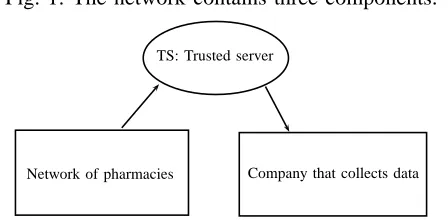
As illustrated in Figure 1, the architecture of the system is a network with three components: the network of pharmacies, the trusted server (TS) and the company which collects medical records.
Fig. 1: The network contains three components.
TS: Trusted server
Company that collects data Network of pharmacies
The objective of the system is to enable a pharmacy to forward a data to the company with the following requirements:
1) individual privacy must be preserved,
2) two records involving the same patient must have the same header.
Each component has the following requirements. Phar-macies must use a tamper proof box which makes transparent to the pharmacist the process of transmission of data. This box is able to encrypt using ElGamal algorithm. Key management is achieved by a certification authority. It is assumed that each box knows the public key of all the other boxes and that of the company. The trusted server needs to know the signature public key of the group of boxes. It is trusted in regards to transmission and non-disclosure of data transmission. However, it is not entitle to manage sensitive information. Its main work is to forward data to the company after having blinding it using a random number. In order to enhance privacy, TS is not authorized to know which pharmacy sends the data. Thus, TS should not be able to link any data with a pharmacy.
In terms of network transmission, it is assumed that a pharmacy can reach, through its box, TS and any other pharmacy, and TS can reach the company. The network
of boxes is managed in a centralized way.
A. Cryptographic concerns
Our protocol makes use of cryptographic primitives. Every encryption uses elliptic curve ElGamal encryption. We introduce here the mathematical objects that we will use thereafter. Let us consider a cryptographic elliptic curve Γ over a prime field Fp. Let Γp be the set of
Fp-rational points ofΓ andn= #Γp the number of Fp
-rational points of Γ. We suppose that Γ is such that n
is a prime number. Let us denote byGthe cyclic group of ordern of rational points onΓand let P be a public generator of G. The curveΓ is chosen in order that the discrete logarithm problem be hard. Examples of such curves can be found in [5], [6] or [2]. LetH be a public map-to-point function as defined for example in [7] or [4]. NamelyHtransforms a messagemto a pointH(M) of the curve and acts as a hash function.
III. ANONYMIZATION OF THE PHARMACIES
The set of pharmacies represents a private network. For this network, we choose to use a well known onion routing technique [8]. Each box of a pharmacy represents a node. In order to transmit a message to TS, a box has to
1) randomly choose a set of ordered nodes to pro-vide a circuit (N1, N2, . . . Nt) through which the
messagem will be transmitted.
2) Encrypt the message mwith the public keyKt of
Nt, then encrypt the result with the public key of
Nt−1 and so on, until obtaining
C =EK1(EK2(· · ·(EKt(m))· · ·)),
where EKi is the encryption function using the
public key Ki. At each level, the box includes
information regarding identity of the next node to which the onion must be transmitted.
3) As the onionCpasses to each node in the circuit, a layer of encryption is peeled away by the receiving node. Decryption is performed using the private key corresponding to the public key with which the layer was encrypted.
4) The last node Nt transmits the original message
m to TS.
Onion routing technique is used to hide the identity of the box which sends the message. Indeed, TS only knows the identity of Nt. We will see later that part of the
Fig. 2: A random circuit is constructed to anonymize the sender when sending its message to TS.
N1
N2
N3
TS
Network of pharmacies
IV. ANONYMIZATION OF THE HEADER
In this section, we describe the cryptographic protocol which allows the header m to be anonymized. First, let us consider the following simple solution: the header
m of a record is hashed using a hash function. This solution is far from being secure, as it is vulnerable to dictionary attack. It is therefore necessary to provide a more comprehensive mechanism.
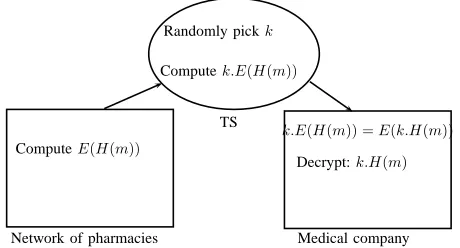
An overview of our protocol is illustrated in Figure 3, where the encryption function is denoted E(). The important property of this function is that k.E(M) =
E(k.M) for any message M. This property ensures the second requirement, the encryption ensures the first requirement with regard to TS and the masking by k
ensures the first requirement with regard to the company.
Fig. 3: Anonymization of the record.
ComputeE(H(m))
Network of pharmacies
Randomly pickk
Computek.E(H(m))
k.E(H(m)) =E(k.H(m))
Decrypt:k.H(m)
TS
Medical company
We describe here in more details the process to anonymize the headerm of the record to transmit. The cryptographic set up phase is as follows:
1) The trusted party TS picks at random a keyksuch that 0≤k≤n−1and keeps it secret.
2) The company picks at random a key a such that 0≤a≤n−1 and keeps it secret. Moreover 3) the company computes the point Q = aP and
transmits it to the network of pharmacies (this is the public key of the company).
When the set up is done, any pharmacy’s box can forward a data.
1) A box P draws at random an integerk1 between 0 andn−1. Then P computes
P1 =k1P P2 =H(m) +k1Q.
The points P1 and P2 are sent to the trusted third
party TS.
2) The trusted third party TS computes, using its secret keyk, the two following points
R1=kP1 R2=kP2
and sends R1 andR2 to the company.
3) Now the company computes the anonymous num-ber AN associated to the header
AN = (R2−aR1)x
where (R2 −aR1)x denotes the x-coordinate of
the pointR2−aR1.
Remark 1: The random number k1 drawn by the
pharmacy’s box must be recalculated for each record. However the secret keyk of the trusted third party must remain the same throughout the study.
Proposition 1: The anonymous number AN is
AN = kH(m) x.
Proof: We compute R2−aR1 and obtain
succes-sively:
R2−aR1 =kH(m) +kk1Q−akP1
=kH(m) +kk1aP −akk1P =kH(m).
V. SECURITY CONSIDERATIONS
In this section, we show that our protocol fulfills the security requirements. This system does not intend to prevent any pharmacy to be corrupted. Indeed, it is technically impossible to prevent a pharmacist to disclose information he or she has access.
A. Privacy in regards to TS
It is required that TS be able to authenticate a message received from a pharmacy without being able to distin-guish what pharmacy sent it. Every message is dated and signed using the boxes’ private key (all the boxes use the same key). At the transport level, the onion routing method provides anonymization with regard to TS. At this level, confidentiality is not mandatory since the header of the data is encrypted by an elliptic curve Elgamal ciphering. More precisely, the header H(m) is masked by k1Q where k1 is random.
Proposition 2: Under the assumption that DDH
prob-lem is hard on the group of the chosen curve, the trusted party is not able to distinguish whether two encrypted headers represent the same plaintext header or not.
Proof: It is well known that this type of ciphering
is indistinguishable under chosen plaintext attack (IND-CPA) in the random oracle model, as far as we work on a group where the decisional Diffie-Hellman problem is hard (see [9] or [1]). In particular, it means that TS is not able to distinguish whether two encrypted headers represent the same plaintext header or not.
B. Privacy in regards to the company
The company needs to be sure that the sender is TS. Authentication is done by adding a timestamp and signing the message. Even-though confidentiality is not required, a protocol like TLS may be used. When the company receives the plaintext message, it remains to treat the header. Using homomorphic properties of the ciphering, the company can eliminate the mask k1.
The header is now protected by the blinding factor
k. The underlying security problem is the generalized discrete logarithm problem on the chosen elliptic curve. This problem which, as far as we know, has not been considered yet in the literature is analyzed in the next subsection.
C. Generalized discrete logarithm of orders
It remains to study the following problem. Suppose that an attacker knows some identities of clients of the network of pharmacies and the set of corresponding blinded headers. Since the blinding value k is fixed, is he able to calculate k?
Mathematically, this problem can be written as follows. Let an integer s be such that 1≤s≤n−1, let a (non ordered) set of rational points A = {A1, . . . , As} and
let kbe an integer such that 1< k < n−1. We denote
kAthe set{kA1, kA2,· · · , kAs}. The problemPsof the
generalized discrete logarithm of order s on the group Γp is the following: GivenA andA′=kA, calculatek.
Remark 2: The knowledge of A and A′ = kA is
equivalent to the knowledge ofB =∁AandB′ =kB =
∁A′. In particular,P
n−1 is equivalent to P1, the discrete
logarithm problem (DLP).
In our case study, the value s is much smaller than n
and in practice, we may assume that500≤s≤106
. We will show that Ps is at least as hard as DLP.
Theorem 1: Suppose we know an algorithmA(Γp, s)
which solves Ps in a time bounded by T(s), then it is
possible to construct an algorithm which solves DLP on Γp in a time bounded by T(s) +st0 where t0 is the
time needed to choose an integermand to calculate two scalar multiplications on Γp.
Proof: LetA1,A′1 =kA1be an instance of the DLP.
Let us choose distinct integersm2,· · · , mssuch that1<
mi < n in order to construct the points Ai = miA1
and A′
i = miA′1. We have A′i = mikA1 = kmiA1 =
kAi. Thus, if A′ :={A′1, A′2,· · · , A′s}, we obtainA′ =
kA. By this way, we just constructed an instance ofPs.
The time needed for this construction is bounded byst0.
Applying the algorithm A(Γp, s) to this instance ofPs,
we can obtain k. We have therefore solved DLP in a time bounded by T(s) +st0.
Consequently, if we had a practical algorithm to solve
Ps, s being sufficiently small (in order that st0 can be
reached in practice), then we could solve DLP overΓp.
As an example, if we choose a curve overZ/pZwhere the size ofpis around 256 bits, then from Weil’s bound, the size of nis of the same order. This means that n is of order 2256
and the best known algorithms to solve DLP need about 2128
operations. If s is bounded by 106
(our case study), thensis negligible compared with 2128
. Thus, unless breaking the DLP for this size, we cannot obtain an algorithm to solve Ps with a number
of operations significantly less than2128
.
VI. CONCLUSION
is not allowed to the third party designed to forward the data and blind the header. Our analysis led us to introduce the concept of generalized discrete logarithm problem of order s and we proved that this problem is at least as hard as the discrete logarithm problem.
REFERENCES
[1] Pierre Barthélemy, Robert Rolland and Pascal Véron. Cryptogra-phie principes et mises en oeuvre- 2e édition. Editions Hermes Lavoisier, Lavoisier. 2012.
[2] ECC Brainpool. ECC Brainpool Standard Curves and Curve Generation, October 2005. http://www.ecc-brainpool.org/ download/Domain-parameters.pdf.
[3] Cynthia Dwork Differential privacy: A survey of results. In Theory and Applications of Models of Computation, Springer, pages 1–19, 2008.
[4] Thomas Icart. How to Hash into Elliptic Curves. CRYPTO 2009: 303-316, 2009.
[5] Hamish Ivey-Law and Robert Rolland. Constructing a database of cryptographically strong elliptic curves. Proceeding of SAR-SSI, , 2010. http://www.acrypta.com/index.php/telechargements# ARCANA.
[6] NIST. NIST-FIPS 186-3 (website), 2009. http://csrc.nist.gov/ publications/fips/fips186-3/fips_186-3.pdf.
[7] Dimitrios Poulakis and Robert Rolland. A signature scheme based on elliptic curve discrete logarithm and factoring. Cryp-tology ePrint Archive, 2012/134, 2012.
[8] Michael Reed, David Goldschlag and Paul Syverson. Hid-ing routHid-ing information. Lecture Notes in Computer Science, 1174:137–150, 1996.