R E V I E W
Multiple Mini-Interviews: Current Perspectives on
Utility and Limitations
This article was published in the following Dove Press journal: Advances in Medical Education and Practice
Sobia Ali 1
Muhammad Suleman
Sadiq Hashmi1
Mehnaz Umair1
Mirza Aroosa Beg 2
Nighat Huda1
1Department of Health Professions Education, Liaquat National Hospital & Medical College, Karachi 74800, Pakistan; 2Department of Medical Education, Sindh Institute of Urology and Transplantation (SIUT), Karachi 74200, Pakistan
Abstract:The growing role of healthcare professionals urged admissions committees to restructure their selection process and assess key personal attributes rather than academic achievements only. Multiple mini interviews (MMIs) were designed in 2002 to assess such domains in prospective healthcare professions. Being a high-stake assessment, the utility and limitations of MMI need to be explored. The purpose of this article is to review the available evidence to establish its utility. The claim of the reliability is verified by the studies assessing the effect of number of stations, duration of stations, format and scoring systems of stations and number of raters assessing the applicants. Similarly, by gathering evidence concerning its content validity, convergent/divergent correlation and predictive ability, validity is ensured. Finally, its acceptability and feasibility along with limitations is discussed. This article concludes by providing recommendations for further work required to deal with the limitations and enhance its utility.
Keywords:MMI, utility, reliability, validity, acceptability, feasibility, limitations
Introduction
The selection of a suitable candidate for health professional schools is one of the most important initial steps that pave the way for developing a competent and caring health professional. In recent years, schools have selected candidates who not only excel in academics but possess key personal attributes essential for competent health professionals. The importance of selecting the right candidate increases once we observe that the selected candidate for health profession
educa-tion ultimately graduates, whether within the designated time or beyond.1,2 To
address these requirements, universities across the globe strive to develop robust assessment tools assessing multifaceted attributes.
In the UK, the Medical School Council Consensus Statement on attributes of a good doctor guides medical schools on admission criteria.3This encompasses attributes and qualities required by doctors, such as good communication skills, the ability to work as part of a team, non-judgmental behavior, empathy and integrity. Thus, attaining a high level of performance only in the academics is inadequate for a career in medicine.
Similarly, the Liaison Committee for Medical Education–the accrediting body
for the MD program in USA and Canada–has specified lists of core attributes for
accepted applicants that cover intelligence, integrity, personal and emotional char-acteristics, for effective performance in future.4
Many institutes globally assess both cognitive and non-cognitive abilities during their admission process. Cognitive abilities are judged by academic records and written
Correspondence: Sobia Ali Department of Health Professions Education, Liaquat National Hospital & Medical College, National Stadium Road, Karachi 74800, Pakistan
Email [email protected]
Advances in Medical Education and Practice
Dove
press
open access to scientific and medical research
Open Access Full Text Article
Advances in Medical Education and Practice downloaded from https://www.dovepress.com/ by 118.70.13.36 on 19-Aug-2020
tests such as the MCAT (Medical College Admission Test in North America), PCAT (Pharmacy College Admission Test), the GAMSAT (Graduate Australian Medical Schools Admission test in Australia), UKCAT (the United Kingdom Clinical Aptitude Test), and the Undergraduate Medical School Admission Test (UMAT). A positive predictive abil-ity of academic achievement is evident in the literature,5,6 whereas the predictive ability of these tests is varied.
To quantify the challenging task of assessing individual aptitude, health sciences schools use a wide range of selection tools including reference letters, co-curricular and other accomplishment records and written personal statements, but have concluded with low reliability.7–9
Going face-to-face with a single interviewer or a panel with varying degrees of structured interview is a common part of the selection process. A structured interview is intended to measure professional aptitudes such as commu-nication skills, decision-making, teamwork skills and insight about self. Although the validity and the reliability of interview ratings are enhanced through this,10the proven high degree of variability of its predictive ability makes it a weak measure for future performance assessment.
In an attempt to overcome the limitations of panel
inter-view, Eva et al.,11 in 2002 at McMaster, introduced
a “multiple sample-based” approach to assess the
non-academic attributes and named it the Multiple Mini Interview (MMI). This is an OSCE-style exercise, compris-ing multiple focused encounters. It intended to assess a range of personal attributes such as critical thinking, ethical deci-sion-making, communication skills and knowledge of the healthcare system, which were previously inadequately assessed by personal interview. Initially, the MMI was used for admission in medical schools only; however, increasing research and proven robust psychometrics have led to its application in entrance to residency programs, dental, phar-macy, nursing and physiotherapy schools.
Utility of MMI
MMI-based testing needs to be verified on the basis of
principles of assessment, which contributes greatly as to who should be admitted to the program. For this very reason, multiple studies have been done to establish the utility of MMI. The concept of utility of assessment is
defined by Van der Vleuten as multiplicative function of
following elements:12
(A) reliability, (B) validity,
(C) educational impact, (D) acceptability, and
(E) cost/feasibility
However, depending on the context and purpose of assessment, the weightage of these elements could be varied. For example, in a high-stake examination relia-bility has more weightage, while on the other hand, educational impact would have higher weightage as compared to reliability. Being a high-stake examination, the focus of this study would be more on validity, reliability, acceptability and feasibility than educational impact.
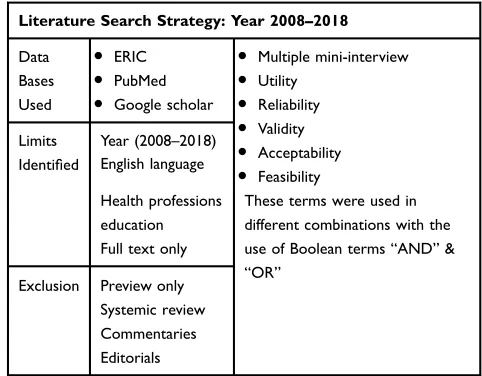
Literature Search Strategy
In order to gain an overview of relevant and updated research on the topic of interest, PubMed, ERIC and Google Scholar databases were searched which included articles published from 2008 to 2018. A preliminary search yielded most useful results with the following key words:
“Multiple mini-interviews, Utility, Reliability, Validity, Acceptability, Feasibility, Limitations”in“allfields”
The research is further refined using limits –English
language and Health Professions Education with full text available.
This literature search yielded 74 publications. To assess the relevance of articles, abstracts or if necessary full texts were reviewed. After removal of duplicates, systematic reviews, commentaries and editorials, 50 articles were
selected for review (see Table 1). However, an article in
Table 1Literature Search Strategy
Literature Search Strategy: Year 2008–2018
Data Bases Used
● ERIC ● PubMed ● Google scholar
● Multiple mini-interview ● Utility
● Reliability ● Validity ● Acceptability ● Feasibility Limits
Identified
Year (2008–2018) English language
Health professions education
These terms were used in different combinations with the use of Boolean terms“AND”&
“OR” Full text only
Exclusion Preview only Systemic review Commentaries Editorials
Note:The abstracts or if necessary full texts were reviewed for relevance and repetitions.
Advances in Medical Education and Practice downloaded from https://www.dovepress.com/ by 118.70.13.36 on 19-Aug-2020
the category of special communication is included because of the presence of original findings in our context.
Reliability of MMI
Targeting various aspects, multiple studies have been done to establish the reliability of MMI scores.
Intraclass correlation, evidence of internal consistency of the station, is calculated by Cronbach's alpha. Indication of a well-constructed station is established by assessing the required constructs turns high among all.13––15Along with high internal consistency, item-total correlation for each station was from 0.53 to 0.96, assessing the desired
attri-bute adequately.16 High composite reliability was also
mentioned in the admission process of Malaysia.17
Identifying the appropriate number of stations has been the most discussed parameter in establishing the reliability evidence of the MMI. The G-coefficient along with D-studies (decision studies) has continually showed that increasing the number of stations results in greater reliability. An initial D-study by Eva et al.11claimed that using 12 stations could lead to a G-coefficient of 0.85, but later studies decreased the desired number of stations to 10, 9, 7 and even 5.18–25
The duration of the station has also been discussed in context to establish reliability evidence. Dodson et al. com-pared the G-coefficient for 5- and 8-min stations and found
minimal difference in reliability between the two.26
Similarly, other studies also reflect adequate reliability with 5 or 6, or 7 min.19,20,25This is possible because a decrease in duration can give a margin of increased number of stations that in turn could positively enhance the reliability. However, fear of losing authenticity and acceptability of the process requires keeping the length of station to an optimal
duration.20 This is further proven by an Internal Medicine
residency program induction, in which only 5 stations' MMI gave reliability of 0.9 in 8 min working time,24similar to Eva et al. with 12 stations.11
The format and scoring system also effect the
relia-bility. Sebastian et al.27 showed that the reliability of
MMI scores increased after changing the scoring system from Likert to a normative scoring rubric. Another inter-esting debate about reliability is based on the format of the stations. Using past behavioral and/or situational questions gave good reliability after minimizing the order bias.28 Applicant–station interaction has proven to be the major source of variance in scores. This variance declined from behavioral interview to situational judg-ment question and hence internal consistency also varied in this sequence.29
Raters have been identified as important facets for
improving reliability. Inter-rater reliability, rater type and rater training is being discussed. Whether calculated by interclass correlation or G -coefficient, inter-rater reliabil-ity turns out high,17,22,24,29 indicating less importance of number of raters per stations. To maintain the consistency in scoring, raters' training is highly recommended, as this
helps in improving subjectivity reflecting in scores given
by raters.31–34Griffin et al. highlighted the importance of rater training by comparing the variance in MMI scores after transforming information-based training to skills-based training. The resultant variance was reduced after improving strategies of training sessions.31
In addition, the effect of rater type (lenient vs stringent, faculty vs students or community members) on reliability has been studied. Contrasting evidence has been found between those who claim and those who do not claim a prominent difference.11,18,19
Validity
Validity is a unitary construct that refers to different types of validity testing.35Studies assessing the validity of MMI have focused on the following aspects.
Content Validity
Blue-printing before construction of MMIs is thefirst step
to ensure content validity. Themes are selected as per institutional guidelines and expected entry-level
compe-tencies defined by relevant professional colleges,
espe-cially by its originator at McMaster.16,17,34,36,37 Further validation of the content was achieved by calculating
item difficulty and discrimination indices.17 Emergence
of a unidimensional construct on factor analysis provided support to consider and use mean score as overall performance.17
A longitudinal study (2006–2012) claimed that the
effect of item reuse, familiarity with the items, deliberate availability of material on the internet and candidate
coaching showed no effect on MMI scores.39
Convergent and Divergent Correlation
Studies suggest that MMI showed positive correlation with the assessment methods measuring the same construct, and vice versa. The MMI scores of the applicants for the Australian Medical School were correlated with scores on NEO PI-R Domains scale for assessing the Big Five person-ality variables. There was positive correlation among MMI scores with extraversion and conscientiousness. However,
Advances in Medical Education and Practice downloaded from https://www.dovepress.com/ by 118.70.13.36 on 19-Aug-2020
neuroticism was unrelated and self-consciousness was nega-tively correlated with MMI scores.40
In another study for admissions to a Doctor of Veterinary program, the MMI scores were correlated with extraversion and emotionality, using HEXACO-PI-R-60.
Total MMI scores had significant correlation with
extra-version but were not related to emotionality.14
A multi-institutional study under the Australian
Specialty Training program evaluated correlation of 6 sta-tion MMIs with 50-item Situasta-tional Judgment tests and
demonstrated evidence for convergent validity.36
Another significant correlation of the MMI with part 2
of UMAT (in the format of a situational judgment test) provides the evidence of its convergent validity. For instance, part 2 of UMAT in the format of a Situational Judgment test assessing interpersonal understanding was
positively correlated with the MMI.40
MMIs showed discriminant validity in many studies comparing no correlations with past academic
perfor-mances like grade point average (GPA)33 or logical
rea-soning ability or non-verbal rearea-soning.40
Predictive Validity
For the predictive validity of MMI, evaluated through communication interviews administered 8 months later, the two-factors model was supported with high correla-tions for oral communication and problem evaluation
con-structs. MMI problem evaluation scores were significantly
correlated with scores on building a relationship and
explaining and planning portions of the interview.14
In the recruitment process for Psychology students, comparison was done between two admission processes, one being high GPA (75% of admitting students) and the other cognitive plus non-cognitive (MMI), selecting 25% of the students. The results showed fewer drop-outs after two years of study, better academic performances and better academic learning self-efficacy and critical thinking with the latter admission process.41
The predictive validity of MMI and OSCE was eval-uated for an Internal Medicine Residency program,
show-ing significant positive correlation between average MMI
interpersonal score and communication score in the OSCE, and negligible relation between average MMI overall
score and communication score on the OSCE.42
The University of Hamburg evaluated the predictive validity of MMI conducted for medical school applicants by conducting follow-up studies over the course of two years. The result showed that MMI measures the
competencies related to practical contexts like general practice evaluations of psychosocial competencies,
suit-ability for the medical profession as well as in OSCE.43
Similarly, in the Physician Associate Program and the Midwifery Program in the UK, MMI scores positively
predict communication during OSCE.13,37
In pharmacy admission, the MMI has significantly
predicted the performance in the Pharmacy Examining
Board of Canada (PEBC) and licensing examination.38
Important evidence for the validity of the MMIs is provided by demonstrating that MMI scores are related to peer assessment conducted four years later. The scores of two MMIs (MOR and MIRKAM) were moderately correlated with the peer assessment done during clinical
studies in medical school.44Empathy, medical knowledge,
teamwork, ability to cope with pressure and
communica-tions skills were among the domains identified for peer
evaluation. The most significant correlation was for
com-munication skills.
Acceptability
Acceptability of the MMI accounts for the acceptance and the perception of the stakeholders, which includes evalua-tors/examiners and the candidates/examinees.
The combined analysis of both candidates and inter-viewers reflected that the MMI was a fair,17,28,45
transpar-ent, reliable46 and authentic47 assessment tool and were
satisfied with the level and quality of the process.48 The overall experience of the MMI was positive.23,45,49
This was further verified by a qualitative analysis
which indicated that a one-to-one interview improves the quality of the interaction and gives interviewers a chance to express diverse opinions. Multiple assessment opportu-nities in the MMI make the interviewer relaxed and facil-itate multiple viewpoints of a candidate. The standardized scenario-based assessment in the MMI makes the process authentic and creates a more purposeful assessment pro-cess. However, in one study, candidates felt stressed as the time was short and they had to change their thought process after every other station.50
Candidates
Candidates reflected that the MMI is an innovative idea for a selection process with no cultural,49age or gender30bias. They enjoyed the MMI,24,30,51,52especially the role plays48 and found the experience relaxing and positive.45,53
When comparing it with the traditional interview, it was found that the MMI was fair as opposed to the
Advances in Medical Education and Practice downloaded from https://www.dovepress.com/ by 118.70.13.36 on 19-Aug-2020
traditional interview and non-cognitive skills were evalu-ated more effectively through the MMI.24,30Another study claimed that the participants were in favor of mixed of MMI and unstructured interaction when compared to MMI alone (p < 0.01). One of the significant findings in the study was that a lower MMI performance was associated with higher preference of the traditional interview, a higher MMI performance was associated with higher MMI pre-ferences and the mix of interview methods were not
cor-related with MMI performance.54
MMI provides candidates with better opportunities to
portray themselves.17,30 They have sufficient time and
require no specialized knowledge to express at
stations.23,45,49,55 However, in another study there was a mix of opinions regarding the time limitation, which varied from a shortage of time to more than enough time for each station.49
Comparison between the past behavioral questions and situational questions showed that past behavioral questions
were more acceptable than the situational questions.28
The MMI was conducted through Skype in 2011 at The University of Sydney to assess international appli-cants for their medical and dental graduate programs. Candidates gave positive feedback regarding its format
and experience.56
Interviewer
Interviewers specified that MMI tested a valid range of
competencies. It provided the opportunity to appreciate the complete and authentic picture with a larger range of skills
from the candidates,30 especially in professionalism and
communication skills.47 In their opinion, the MMI was
a reasonable method for accurate portrayal of abilities of the candidates23,46by pushing them to think deeply.
The interviewers appreciated the organization of the process including the number of stations, the diversity
of case scenarios and their relevancy to the program.49
The interviewers stated that there was sufficient time to
evaluate the candidates.46,49,55 They valued the impor-tance of orientation sessions for candidates,30,45,49,55 but also stated that candidates required some specialized
knowledge to perform at the stations.46 They agreed
that the time allotted was sufficient to evaluate the
candidates.46,49,55 For them, the overall experience and
atmosphere was satisfying,49 better than the traditional
interview, and thus they were in favor of continuing
with the MMI.24
Feasibility
Most of the studies regarding the feasibility issue claim that
the MMI is feasible and could be implemented
successfully.19,57,58Few schools had feasibility problems in offering over 2 hrs of interview time per candidate.20Time and commitment were a key requirement from the station developers and the examiners in formulating the stations,
attending training sessions and conducting the MMI.59
However, due to interest in the process, the time commitment
was manageable.58
When it comes to cost, the MMI is more challenging compared to the traditional interviews.11,60 The involve-ment of staff for planning, impleinvolve-mentation and data entry
as well as salaries for overtime59are required. Moreover,
miscellaneous expenses for refreshment, actors and avail-ability of the infrastructure are also made.
Successful implementation of the MMI requires sequen-tial efforts in terms of planning and resource provision like OSCE. It is therefore suggested to direct efforts the same
way to ease its development and implementation.11
Limitations of the MMI
Candidates argued that the MMI restricts the opportunity to discuss the past achievements and experiences and, in
turn, limits the opportunity to reflect the motivation and
willingness to be a medical graduate. Furthermore, they
found the MMI forced students to “perform” rather than
respond naturally.50
Cultural diversity between the interviewer and the can-didates affected the assessment process and made the evaluator feel unreliable to gauge a response correctly. A language barrier was reported as another limitation.
Those candidates who lack proficiency in English were
reported as more nervous and having greater difficulty in
expressing themselves.47
Feasibility issues also pose limitations to its effective-ness. Being resource-intensive, the MMI requires more efforts in its planning, development, implementation and evaluation. Along with station structure, context and raters' training, the venue also has an important impact on exam-iners' rating. The availability of a comfortable and sound-proof venue is thus recommended for effective processing
of MMIs.19
The limitation is also confined to inadequate
general-izability as the data in studies are usually derived from a single cohort and a single institution.55 Similarly, con-trasting evidence regarding the effect of rater's type,11,18,19
Advances in Medical Education and Practice downloaded from https://www.dovepress.com/ by 118.70.13.36 on 19-Aug-2020
station structure and its format28,29have been found. This is apparently considered as a limitation, but in fact, it is urged to have variation in study results due to the need to adapt
MMIs for the specific requirements of schools, and this in
turn could lead to variable context and then content.61
Conclusion
Evidence regarding the admission criteria of health profes-sions establishes the utility of the MMI considerably well. A well-established internal consistency, based on optimal number of stations and duration, and a well-constructed scoring system with a single interviewer has been recog-nized. Strong evidence regarding its content validity and predictive ability is available. MMI scores show positive correlation with assessment tools measuring the same attribute while at the same time showing negative correla-tion with tests measuring different attributes. Although its acceptability is established by an abundance of literature, evidence regarding its feasibility is less. Resources need to
be allocated both financially and in terms of manpower.
The cost should be calculated by considering the follow-ing: generation of interview material, human resource (i.e., interviewer and support staff) use, training of interviewer, and the support staff and infrastructure requirements. Further research is desired to address the limitations in terms of cultural diversity, language barrier, and effect of raters' type.
Disclosure
The authors report no conflicts of interest in this work.
References
1. Yates J. When did they leave, and why? A retrospective case study of attrition on the Nottingham undergraduate medical course.BMC Med Educ.2012;12:43. doi:10.1186/1472-6920-12-43
2. Fortin Y, Kealey L, Slade S, Hanson MD. Investigating Canadian medical school attrition metrics to inform socially accountable admissions planning. Med Teach.2015. doi:10.3109/0142159X.2015.1045847
3. Guiding principles for the admission of medical students, Revised March 2010. Available from: https://www.medschools.ac.uk/media/ 1931/guiding-principles-for-the-admission-of-medical-students.pdf. Accessed February 9, 2019.
4. Liason committee on medical education Available from:https://med. virginia.edu/ume-curriculum/wp-content/uploads/sites/216/2016/07/ 2017-18_Functions-and-Structure_2016-03-24.pdf. Accessed February 9, 2019.
5. McManus IC, Powis DA, Wakeford R, Ferguson E, James D, Richards P. Intellectual aptitude tests and A levels for selecting UK school leaver entrants for medical school.BMJ.2005;331:555–559. doi:10.1136/bmj.331.7516.555
6. Mercer A, Puddey IB. Admission selection criteria as predictor of outcomes in an undergraduate medical course: a prospective study. Med Teach.2011;1–8. doi:10.3109/0142159X2011.577123
7. Ferguson E, James D, O’Heir F, Sanders A. Pilot study of the roles of personality, references, and personal statements in relation to perfor-mance over the five years of a medical degree. BMJ. 2003;326:429–432. doi:10.1136/bmj.326.7386.429
8. Cleland J, Dowell J, McLachlan J, Nicholson S, Patterson F Identifying best practice in the selection of medical students.2012. General Medical Council Available from: http://www.gmcuk.org/ Identifying_best_practice_in_the_selection_of_medical_students. pdf_51119804.pdf. Accessed February 11, 2014.
9. Salvatori P. Reliability and validity of admissions tools used to select students for the health professions. Adv Health Sci Educ. 2001;6:159–175. doi:10.1023/A:1011489618208
10. Lambe P, Bristow D. Predicting medical student performance from attributes at entry: a latent class analysis.Med Educ.2011;45:308–316. doi:10.1111/med.2011.45.issue-3
11. Eva KW, Rosenfeld J, Reiter HI, Norman GR. An admission OSCE: the multiple mini-interview. Med Educ. 2004;38:314–326. doi:10.1046/j.1365-2923.2004.01776.x
12. Van der Vleuten CPM. The assessment of professional competence: developments, research and practical implications. Adv Health Sci Educ.1996;1:41–67.
13. Callwooda A, Cookea D, Bolgera S, Lemanskaa A, Allanb H. The reliability and validity of multiple mini interviews (MMIs) in values based recruitment to nursing, midwifery and paramedic practice programmes: findings from an evaluation study. IJNS. 2017; 77:138–144.
14. Oliver T, Hecker K, Hausdorf PA, Conlon P. Validating MMI scores: are we measuring multiple attributes? Adv Health Sci Educ. 2014;19:379–392. doi:10.1007/s10459-013-9480-6
15. Dowell J, Lynch B, Till H, Kumwenda B, Husbands A. The multiple mini-interview in the UK context: 3 years of experience at Dundee. Med Teach.2012;34:297–304. doi:10.3109/0142159X.2012.652706 16. Ayub R, Yousuf N, Asad M, Khan UA. Multiple mini interviews as
a measure of non-cognitive skills for admissions into undergraduate medical education programme in Pakistan: a validity study. J Pak Med Assoc.2017;67:1905–1909.
17. Abdul Rahim AF, Yusoff MSB. Validity evidence of a multiple mini interview for selection of medical students: Universiti Sains Malaysia experience.Educ Med J.2016;8:49–63. doi:10.5959/eimj.v8i2.437 18. Hecker K, Violato C. A generalizability analysis of a veterinary
school multiple mini interview: effect of number of interviewers, type of interviewers, and number of stations. Teach Learn Med. 2011;23(4):331–336. doi:10.1080/10401334.2011.611769
19. Cameron AJ, MacKeigan LD. Development and pilot testing of a multiple mini-interview for admission to a pharmacy degree program.Am J Pharm Educ.2012;76:1. doi:10.5688/ajpe76110 20. Roberts C, Walton M, Rothnie I, et al. Factors affecting the utility of
the multiple mini-interview in selecting candidates for graduate-entry medical school. Med Educ. 2008;42:396–404. doi:10.1111/j.13652 923.2008.03018.x
21. Sebok SS, Luu K, Klinger DA. Psychometric properties of the multiple mini-interview used for medical admissions:findings from general-izability and Rasch analyses.Adv Health Sci Educ.2014;19:71–84. doi:10.1007/s10459-013-9463-7
22. Hofmeister M, Lockyer J, Crutcher R. The multiple mini-interview for selection of international medical graduates into family medicine residency education. Med Educ. 2009;43:573–579. doi:10.1111/ med.2009.43.issue-6
23. Dore KL, Kreuger S, Ladhani M, et al. The reliability and accept-ability of the multiple mini-interview as a selection instrument for postgraduate admissions.Acad Med.2010;85:S60–S63. doi:10.1097/ ACM.0b013e3181ed442b
24. Fraga JD, Oluwasanjo A, Wasser T, Donato A, Alweis R. Reliability and acceptability of afive-station multiple mini-interview model for residency program recruitment. J Community Hosp Intern Med Perspect.2013;3:21362. doi:10.3402/jchimp.v3i3-4.21362
Advances in Medical Education and Practice downloaded from https://www.dovepress.com/ by 118.70.13.36 on 19-Aug-2020
25. Kim KJ, Nam KS, Kwon BS. The utility of multiple mini-interviews: experience of a medical school. Korean J Med Educ. 2017;29 (1):7–14. doi:10.3946/kjme.2017.48
26. Dodson M, Crotty B, Prideaux D, Ward A, de Leeuw E. The multiple mini-interview: how long is long enough?Med Educ.2009;43:168–174. 27. Uijtdehaage S, Hy Doyle L, Parker N. Enhancing the reliability of the multiple mini-interview for selecting prospective health care leaders. Acad Med.2011;86:1032–1039. doi:10.1097/ACM.0b013e3182223ab7 28. Yamada T, Sato J, Yoshimura H, et al. Reliability and acceptability of six station multiple mini-interviews: past-behavioural versus situa-tional questions in postgraduate medical admission.BMC Med Educ. 2017;17:57. doi:10.1186/s12909-017-0898-z
29. Eva KW, Macala C. Multiple mini-interview test characteristics:‘tis better to ask candidates to recall than to imagine. Med Educ. 2014;48:604–613. doi:10.1111/medu.12402
30. Campagna-Vaillancourt M, Manoukian J, Razack S, Nguyen LHP. Acceptability and reliability of multiple mini interviews for admis-sion to otolaryngology residency. Laryngoscope. 2014;124:91–96. doi:10.1002/lary.24122
31. Griffin BN, Wilson IG. Interviewer bias in medical student selection. Med J Aust.2010;193:343–346.
32. Ali S, Shoaib H, Rehman R. Exploring the usefulness of inter-viewers’training before and after Multiple Mini Interviews (MMI) for undergraduate medical students’selections: was it really helpful? Pak J Med Sci.2016;32:1459–1463. doi:10.12669/pjms.326.11175 33. Christensen MK, Lykkegaard E, Lund O, O’Neill LD. Qualitative
analysis of MMI raters’ scorings of medical school candidates: a matter of taste? Adv Heal Sci Educ. 2018;23(2):289–310. doi:10.1007/s10459-017-9794-x
34. Alaki SM, Shinawi LA, Yamani I, Hassan MHA, Tekian A, Park YS. Gathering validity evidence in the use of multiple mini-interviews as an admission tool for dental students: preliminary evidence from Saudi Arabia. Med Teach. 2016;38:S45–51. doi:10.3109/014215 9X.2016.1142510
35. Streiner DL, Norman GR, Cairnay J. Validity.Health Measurement Scales: A Practical Guide to Their Development and Use. 5th ed. UK. Oxford University Press;2015. p. 227–250
36. Roberts C, Clark T, Burgess A, Frommer M, Grant M, Mossman K. The validity of a behavioural multiple-mini-interview within an assessment centre for selection into specialty training. BMC Med Educ.2014;14:1–11. doi:10.1186/1472-6920-14-169
37. Kumar N, Bhardwaj S, Rahman E. Multiple mini-interview as a predictor of performance in the objective structured clinical examina-tion among physician associates in the United Kingdom: a cohort study. Adv Med Educ Pract.2018;9:239–245. doi:10.2147/AMEP.S159412 38. Cameron AJ, MacKeigan LD, Mitsakakis N, Pugsley JA. Multiple
mini-interview predictive validity for performance on a pharmacy licensing examination. Med Educ. 2017;51:379–389. doi:10.1111/ medu.2017.51.issue-4
39. Moshinsky A, Ziegler D, Gafni N. Multiple mini-interviews in the age of the internet: does preparation help applicants to medical school?Int J Test.2017;17(3):253–268.
40. Griffin B, Wilson I. Associations between the big five personality factors and multiple mini-interviews.Adv Heal Sci Educ.2012;17 (3):377–388. doi:10.1007/s10459-011-9316-1
41. Makransky G, Havmose P, Vang ML, Andersen TE, Nielsen T. The predictive validity of using admissions testing and multiple mini-interviews in undergraduate university admissions. High Educ Res Dev.2017;36(5):1003–1016. doi:10.1080/07294360.2016.1263832 42. Oluwasanjo A, Wasser T, Alweis R. Correlation between MMI per-formance and OSCE perper-formance–a pilot study.J Community Hosp Intern Med Perspect.2015. doi:10.3402/jchimp.v5.27808
43. Knorr M, Schwibbe A, Ehrhardt M, Lackamp J, Zimmermann S, Hampe W. Validity evidence for the Hamburg multiple mini-interview. BMC Med Educ. 2018;18:1–12. doi:10.1186/s12 909-018-1208-0
44. Hadad A, Gafni N, Moshinsky A, Turvall E, Ziv A, Israeli A. The multiple mini-interviews as a predictor of peer evaluations during clinical training in medical school.Med Teach.2016;38:1172–1179. doi:10.1080/0142159X.2016.1181730
45. Cope PY, Clendon S. The multiple mini-interview : a possible solu-tion to problems associated with the interview processes for a selected entry allied health program. J Allied Health. 2017;46: e91–e95.
46. Andrades M, Bhanji S, Kausar S, Majeed F, Pinjani S. Multiple Mini-Interviews (MMI) and semistructured interviews for the selec-tion of family medicine residents : a comparative analysis.Int Sch Res Notices.2014;1–6. doi:10.1155/2014/747168
47. Kelly ME, Dowell J, Husbands A, et al. The fairness, predictive validity and acceptability of multiple mini interview in an interna-tionally diverse student population- a mixed methods study.BMC Med Educ.2014;14:13. doi:10.1186/s12909-014-0267-0
48. Roh H, Lee HJ, Park SB, et al. Multiple mini-interview in selecting medical students. KJME. 2009;21:103–115. doi:10.3946/kjme. 2009.21.2.103
49. Hofmeister M, Lockyer J, Crutcher R. The acceptability of the multi-ple mini interview for resident selection. Fam Med. 2008; 40:734–740.
50. Kumar K, Roberts C, Rothnie I, Fresne C, Walton M. multiple mini interviews Experiences of the multiple mini-interview : a qualitative analysis. Med Educ. 2009;43:360–367. doi:10.1111/med.2009.43. issue-4
51. Razack S, Faremo S, Drolet F, Snell L, Wiseman J, Pickering J. assess-ment issues multiple mini-interviews versus traditional interviews : stakeholder acceptability comparison.Med Educ.2009;43:993–1000. doi:10.1111/med.2009.43.issue-10
52. Pau A, Chen YS, Kar V, Lee M, Sow CF, Alwis RD. What does the multiple mini interview have to offer over the panel interview?Med Educ Online.2016;21:29874. doi:10.3402/meo.v21.29874
53. Husbands A, Rodgerson MJ, Dowell J, Patterson F. Evaluating the validity of an integrity-based situational judgement test for medical school admissions.BMC Med Educ.2015;1–9. doi:10.1186/s12909-015-0424-0.
54. Hopson LR, Burkhardt JC, Stansfield RB, Vohra T, Turner-lawrence D, Losman ED. The multiple mini-interview for emergency medicine resident selection.J Emerg Med. 2014;46:537–543. doi:10.1016/j. jemermed.2013.08.119
55. Hecker KG, Donnon T, Illanes O, Morck D. Assessment of applicants to the veterinary curriculum using a multiple mini-interview method. JVME.2009;36:166–173. doi:10.3138/jvme.36.2.166
56. Tiller D, Mara DO, Rothnie I, Dunn S, Lee L, Roberts C. selection Internet-based multiple mini-interviews for candidate selection for graduate entry programmes. Med Educ. 2013;43:801–810. doi:10.1111/medu.12224
57. Flynn O. Can multiple mini interviews work in an Irish setting? A feasibility study.IMJ.2016;107:6.
58. Finlayson HC, Townson AF, Finlayson H, Centre SR, Columbia B. Resident selection for a physical medicine and rehabilitation program.Am J Phys Rehabil.2011;90:330–335. doi:10.1097/PHM. 0b013e31820f9677
59. Eva KW. A cost efficiency comparison between the multiple mini-interview and traditional admissions interviews. Med Educ. 2009;43:767–775. doi:10.1111/j.1365-2923.2009.03407.x
60. Hissbach JC, Sehner S, Harendza S, Hampe W. Cutting costs of multiple mini-interviews–changes in reliability and efficiency of the Hamburg medical school admission test between two applica-tions.BMC Med Educ.2014;14:54. doi:10.1186/1472-6920-14-54 61. Reiter H, Eva K. Vive la difference: the freedom and inherent resposibilities when designing and implementing multiple mini interviews. Acad Med. 2018;93:969–971. doi:10.1097/ACM.000 0000000002042
Advances in Medical Education and Practice downloaded from https://www.dovepress.com/ by 118.70.13.36 on 19-Aug-2020
Advances in Medical Education and Practice
Dove
press
Publish your work in this journal
Advances in Medical Education and Practice is an international, peer-reviewed, open access journal that aims to present and publish research on Medical Education covering medical, dental, nursing and allied health care professional education. The journal covers undergraduate education, postgraduate training and continuing medical education
including emerging trends and innovative models linking education, research, and health care services. The manuscript management system is completely online and includes a very quick and fair peer-review system. Visit http://www.dovepress.com/testimonials.php to read real quotes from published authors.
Submit your manuscript here:http://www.dovepress.com/advances-in-medical-education-and-practice-journal
Advances in Medical Education and Practice downloaded from https://www.dovepress.com/ by 118.70.13.36 on 19-Aug-2020