Private Anonymous Data Access
Ariel Hamlin∗ Rafail Ostrovsky† Mor Weiss‡ Daniel Wichs§
April 17, 2018
Abstract
We consider a scenario where a server holds a huge database that it wants to make accessible to a large group of clients. After an initial setup phase, clients should be able to read arbitrary locations in the database while maintaining privacy (the server does not learn which locations are being read) andanonymity (the server does not learn which client is performing each read). This should hold even if the server colludes with a subset of the clients. Moreover, the run-time of both the server and the client during each read operation should be low, ideally only poly-logarithmic in the size of the database and the number of clients. We call this notion Private Anonymous Data Access (PANDA).
PANDA simultaneously combines aspects ofPrivate Information Retrieval(PIR) and Oblivi-ous RAM (ORAM). PIR has no initial setup, and allows anybody to privately and anonymously access a public database, but the server’s run-time is linear in the data size. On the other hand, ORAM achieves poly-logarithmic server run-time, but requires an initial setup after which only a single client with a secret key can access the database. The goal of PANDA is to get the best of both worlds: allow many clients to privately and anonymously access the database as in PIR, while having an efficient server as in ORAM.
In this work, we construct bounded-collusion PANDA schemes, where the efficiency scales linearly with a bound on the number of corrupted clients that can collude with the server, but is otherwise poly-logarithmic in the data size and the total number of clients. Our solution relies on standard assumptions, namely the existence of fully homomorphic encryption, and combines techniques from both PIR and ORAM. We also extend PANDA to settings where clients can write to the database.
∗
Department of Computer Science, Northeastern University, Boston, Massachusetts, USA,
†
Department of Computer Science, UCLA, LA, California, USA,[email protected].
‡
Department of Computer Science, Northeastern University, Boston, Massachusetts, USA,
§
Contents
1 Introduction 2
1.1 Prior Work Extending PIR and ORAM . . . 3
1.2 Our Results . . . 4
1.3 Our Techniques . . . 5
1.3.1 Read-Only PANDA . . . 5
1.3.2 PANDA with Writes . . . 9
2 Preliminaries 10 2.1 Locally Decodable Codes (LDCs). . . 10
3 Read-Only PANDA 11 3.1 A Bounded-Access Read-Only PANDA Scheme . . . 13
3.1.1 Proof of Security . . . 14
3.2 Public-Encoding PANDA . . . 16
3.3 Read-Only PANDA with Unbounded Accesses. . . 20
4 PANDA With Writes 21 4.1 A Public-Writes PANDA Scheme . . . 21
4.1.1 A Public-Writes PANDA Scheme for Map Structures and Dynamic Databases 28 4.2 A Secret-Writes PANDA Scheme . . . 30
5 Extensions and Additional Results 35 5.1 Adaptive Security. . . 35
5.2 Maliciously-Corrupted Parties . . . 35
5.2.1 Read-Only PANDA . . . 35
5.2.2 PANDA with Writes . . . 37
5.3 Alternative Solutions Without Anonymity . . . 37
5.4 Non-Client Writes . . . 38
1
Introduction
As individuals and organizations increasingly rely on third party data stored remotely, there is often a need to access such data both privately and anonymously. For example, we can envision a service that has a large database of medical conditions, and allows clients to look up their symptoms; naturally clients do not want to reveal which symptoms they are searching for, or even the frequency with which they are performing such searches.
To address this, we consider a setting where a server holds a huge database that it wants to make accessible to a large group of clients. The clients should be able to read various arbitrary locations in the database while hiding from the server which locations are being accessed (privacy), and which client is performing each access (anonymity). We call this Private Anonymous Data Access (PANDA).
In more detail, PANDA allows some initial setup phase, after which the server holds an encoded database, and each client holds a short key. The setup can be performed by a trusted third party, or via a multi-party computation protocol. After the setup phase, any client can execute a read
protocol with the server, to retrieve an arbitrary location within the database. We want this protocol to be highly efficient, where both the server’s and client’s run-time during the protocol should be sub-linear (ideally, poly-logarithmic) in the database size and the total number of clients. For security, we consider an adversarial server that colludes with some subset of clients. We want to ensure that whenever an honest client performs a read access, the server learns nothing about the location being accessed, or the identity of the client performing the access beyond the fact that she belongs to the group of all honest clients. For example, the server should not learn whether two accesses correspond totwo different clients reading the same location of the database, or one client readingtwo different database locations.1
We call the above a read-only PANDA, and also consider extensions that allow clients to write to the database, which we discuss below in more detail.
Connections to PIR and ORAM. PANDA combines aspects of both Private Information Retrieval (PIR) [CGKS95, KO97] and Oblivious RAM (ORAM) [GO96]. Therefore, we now give a high-level overview of these primitives, their goals, and main properties.
In a (single-database) PIR scheme [KO97], the server holds a public database in the clear. The scheme has no initial setup, and anybody can run a protocol with the server to retrieve an arbitrary location within the database. Notice that since there are no secret keys that distinguish one client from another, a PIR scheme also provides perfect anonymity. However, although the communication complexity of the PIR protocol is sub-linear in the data size, the server’s run-time is
inherently linear in the size of the data. (Indeed, if the server didn’t read the entire database during the protocol, it would learn something about the location being queried, since it must be among the ones read.) Therefore, PIR does not provide a satisfactory answer to the PANDA problem, where we want sub-linear efficiency for the server.
In an ORAM scheme, there is an initial setup after which the server holds an encoded database, and a client holds a secret key. The client can execute a protocol with the server to privately read or write to arbitrary locations within the database, and the run-time of both the client and the server during each such protocol is sub-linear in the data size. However, only a single client in possession of a secret key associated with the ORAM can access the database. Therefore, ORAM is also not directly applicable to the PANDA problem, where we want a large group of clients to
1We assume clients have an anonymous communication channel with the server (e.g., using anonymous mix
access the database.
1.1 Prior Work Extending PIR and ORAM
Although neither PIR nor ORAM alone solve the PANDA problem, several prior approaches have considered extensions of PIR and ORAM, aimed to overcome their aforementioned limitations. We discuss these approached, and explain why they do not provide a satisfactory solution for PANDA.
ORAM with Multiple Clients. As mentioned above, in an ORAM schemeonly a single client
can access the database, whereas in PANDA we want multiple clients to access it. There are several natural ways that we can hope to extend ORAM to the setting of multiple clients.
The first idea is to store the data in a single ORAM scheme, and give all the clients the secret key for this ORAM. Although this solution provides anonymity (all clients are identical) it does not achieve privacy; if the server colludes with even a single client, the privacy of all other clients is lost.
A second idea is to store the data in a separate ORAM scheme for each client, and give the client the corresponding secret key. Each client then accesses the data using her own ORAM. This achieves privacy even if the server colludes with a subset of clients, but does not provide anonymity since the server sees which ORAM is being accessed.2
The third idea is similar to the previous one, where the data is stored in a separate ORAM scheme for each client, and the client accesses the data using her own ORAM. However, unlike the second idea, the client also performs a “dummy” access on the ORAM schemes of all other clients to hide her identity. This requires a special ORAM scheme where any client without a secret key
can perform a “dummy” access which looks indistinguishable from a real access to someone that
does not have the secret key. It turns out that existing ORAM schemes can be upgraded relatively easily to have this property (using re-randomizable encryption). Although this solution achieves privacy and anonymity, the efficiency of both the server and the client during each access is linear in the total number of clients.
Lastly, we can also store the data in a single ORAM scheme on the server, and distribute the ORAM secret key across several additional proxy servers. When a client wants to access a location of the data, she runs a multiparty computation protocol with the proxy servers to generate the ORAM access. Although this solution provides privacy, anonymity and efficiency, it requires having multiple non-colluding servers, whereas our focus is on the single server setting.
Variants of the above ideas have appeared in several prior works (e.g., [MBN15, MMRS15, KPK16, BHKP16, ZZQ16]) that explored multi-client ORAM. In particular, the work of Backes et al. [BHKP16] introduced the notion of Anonymous RAM (which is similar to our notion of secret-writes PANDA, discussed below), and proposed two solutions which can be seen as variants of the third and fourth ideas discussed above. Nevertheless, despite much research activity, no prior solution simultaneously provides privacy, anonymity and efficiency in the single-server setting.
Doubly Efficient PIR. As noted above, the server run-time in a PIR protocol is inherently linear in the data size, whereas in PANDA we want the run time of both the client and the server
to be sub-linear. However, it may be possible to get a doubly efficient PIR (DEPIR) variant in which the server run-time is sub-linear, by relaxing the PIR problem to allow a pre-processing
stage after which the server stores an encoded version of the database. This concept was first
2
proposed by Beimel, Ishai and Malkin [BIM00], who showed how to construct information-theoretic DEPIR schemes in themulti-server setting, with several non-colluding servers. Two recent works, of Canetti et al. [CHR17] and Boyle et al. [BIPW17], give the first evidence that this notion may even be achievable in the single-server setting. Concretely, they consider DEPIR schemes with a pre-processing stage which generates an encoded database for the server, and a key that allows clients to query the database at arbitrary locations. They distinguish betweensymmetric-key and
public-key variants of DEPIR, depending on whether the key used to query the database needs to be kept secret or can be made public. Both works show how to construct symmetric-key DEPIR under new, previously unstudied, computational hardness assumptions relating to Reed-Muller codes. The work of [BIPW17] also shows how to extend this to get public-key DEPIR by additionally relying on a heuristic use of obfuscation. Unfortunately, both of the above assumptions are non-standard, poorly understood, and not commonly accepted.
In relation to PANDA, symmetric-key DEPIR suffers from the same drawbacks as ORAM, specifically, only a single client with a secret key can access the database.3 If we were to give this key to several clients, then all privacy would be lost even if only a single client colludes with the server. On the other hand, public-key DEPIR immediately yields a solution to the PANDA problem, at least for the read-only variant. Moreover, it even has additional perks not required by PANDA, specifically: the set of clients does not need to be chosen ahead of time, anybody can use the system given only a public key, and the server is stateless. Unfortunately, we currently appear to be very far from being able to instantiate public-key DEPIR under any standard hardness assumptions.
1.2 Our Results
Read-Only PANDA. In this work, we construct abounded-collusionPANDA scheme, where we assume some upper boundt on the number of clients that collude with the server. The client and server efficiency scales linearly witht, but is otherwise poly-logarithmic in the data size and the total number of clients. In particular, our PANDA scheme allows for up to a poly-logarithmic collusion sizetwhile maintaining poly-logarithmic efficiency for the server and the client. Our construction relies on the generic use of (leveled)Fully Homomorphic Encryption (FHE) [RAD78,Gen09] which is in turn implied by theLearning With Errors (LWE)assumption [Reg09]. Our basic construction provides security against a semi-honest adversary, and we also discuss how to extend this to get security in the fully malicious setting. In summary, we get the following theorem.
Theorem 1.1(Informal statement of Theorem3.12). Assuming the existence of FHE, there exists a (read-only) PANDA scheme withnclients,tcollusion bound, database sizeLand security parameter λsuch that, for any constant ε >0, we get:
• The client/server run-time perread operation is t·poly(λ,logL).
• The server storage is t·L1+ε·poly(λ,logL).
PANDA with Writes. We also consider extensions of PANDA to a setting that supports writes to the database. If the database is public and shared by all clients, then the location and content of write operations is inherently public as well. However, we still want to maintain privacy and anonymity forreadoperations, as well as anonymity forwriteoperations. We call this apublic-writes
3
PANDA and it may, for example, be used to implement a public message board where clients can anonymously post and read messages, while hiding from the server which messages are being read. We also consider an alternate scenario where each client has her own individual private database which only she can access. In this case we want to maintain privacy and anonymity for both the reads and writes of each client, so that the server does not learn the content of the data, which clients are accessing their data, or what parts of their data they are accessing. We call this a
secret-writes PANDA.4 We show the following results.
Theorem 1.2 (Informal statement of Theorems 4.4 and 4.9). Assuming the existence of FHE, there exists a public-writesPANDA with nclients, tcollusion bound, database size Land security parameter λsuch that, for any constant ε >0, we get:
• The client/server run-time perread operation is t·poly(λ,logL).
• The client run-time per write isO(logL), and the server run-time is t·Lε·poly(λ,logL).
• The server storage is t·L1+ε·poly(λ,logL).
The same results as above hold for secret-writes PANDA, except that the client run-time per write
increases to t·poly(λ,logL), and L now denotes the sum of the initial database size and the total number of writes performed throughout the lifetime of the system.
Extensions. We also consider the PANDA problem in stronger security models in which the adversary canadaptively choose the access pattern, and maliciously corrupt parties. Our construc-tions are also secure in the adaptive setting. Moreover, the read-only PANDA scheme is secure against maliciously-corrupted clients, and a variant of it (which employs Merkle hash trees and succinct interactive arguments of knowledge) is secure if additionally the server is maliciously cor-rupted. Finally, we discuss modifications of our PANDA with writes schemes that remain secure in the presence of malicious corruptions. See Section 5for further details.
1.3 Our Techniques
We now give a high-level overview of our PANDA constructions. We start with the read-only setting, and then discuss how to enable writes.
1.3.1 Read-Only PANDA
Our construction relies on Locally Decodable Codes (LDCs) [KT00], which have previously been used to construct multi-server PIR [CGKS95,WY05]. We first give an overview of what these are, and then proceed to use them to build our scheme in several steps.
Locally Decodable Codes (LDCs). An LDC consists of a procedure that encodes a message into a codeword, and a procedure that locally decodes any individual location in the message by reading only few locations in the codeword. We denote the locality byk. An LDC hass-smoothness
if any s out of k of the codeword locations accessed by the local decoder are uniformly random and independent of the message location being decoded. Such LDCs (with good parameters)
4Note that in the read-only setting, having a scheme for a shared public database is strictly more flexible than a
immediately give information-theoreticmulti-server doubly-efficient PIRwithout any keys [BIM00]: each of the k servers holds a copy of the encoded database, and the client runs the local decoding procedure by reading each of the k queried codeword locations from a different server. Even if
s out of k servers collude, they don’t learn anything about the database location that the client is retrieving.5 LDCs with sufficiently good parameters for our work can be constructed using Reed-Muller codes [Ree54,Mul54].
Initial Idea: LDCs + ORAM. Although LDCs naturally only give a multi-server PIR, our initial idea is to think of these as “virtual servers” which will all be emulated bya single real server
by placing each virtual server under a separate ORAM instance. Each client is assigned a random committee consisting of a small subset of these virtual servers, for which she gets the corresponding ORAM keys. When the adversary corrupts a subset of the clients, it gets all of their ORAM keys, and can therefore be seen as corrupting all the virtual servers that are on the committees of these clients. Nevertheless, we can ensure that the committee of any honest client has sufficiently few corrupted virtual servers for LDC smoothness to hide the client’s queries.
In more detail, we think of having k0 different virtual servers, for somek0 which is sufficiently larger than the locality k of the LDC. For each virtual server, we choose a fresh ORAM key, and store an LDC encoding of the database under this ORAM. Each client is assigned to a random committee consisting of k out of k0 of these virtual servers, for which she gets the corresponding ORAM keys. To read a location of the database, the client runs the LDC local decoding algorithm, which requests to seekcodeword locations. The client then reads each of thekcodeword locations from a different virtual server on her committee, by using the corresponding ORAM scheme. Notice that an adversary that corrupts some subset oftclients, thus obtaining all of their ORAM keys, can be seen as corrupting all the virtual servers on their committees. We can choose the parameters to ensure that the probability of the adversary corrupting more thansout of k of the virtual servers on the committee of any honest client is negligible (specifically, setting k0 = tk2 and s to be the security parameter). As long as this is the case, our scheme guarantees privacy, since the server only learns at mostsout of thekcodeword locations being queried (by the security of ORAM), and these locations reveal nothing about the database location being read (by the LDC smoothness).
Indeed, although the above solution already gives a non-trivial multi-client ORAM with privacy and low server storage (see further discussion in Appendix5.3), it does not provide anyanonymity. The problem is that each client only accesses the k out of k0 ORAM schemes belonging to her committee, and doesn’t have the keys needed to access the remaining ORAM schemes. Therefore, the server can distinguish between different clients based on which of the ORAMs they access.
One potential idea to fix this issue would be for the client to make some “dummy” accesses to the k0 −k remaining ORAM schemes (which are not on her committee) without knowing the corresponding keys. Most ORAM schemes can be easily modified to enable such “dummy” accesses without a key, that look indistinguishable from real accesses to a distinguisher that doesn’t have the key. Unfortunately, in our case the adversarial colluding serverdoes have the keys for many of these ORAM schemes. Therefore, to make this idea work in our setting, we would need an ORAM where clients can make a “smart dummy” access without a key that looks indistinguishable from a real access to a random location even to a “smart” distinguisher that has the key. The square-root ORAM scheme [Gol87,GO96] can be modified to have this property, but the overall client/server efficiency in the final solutions would be at least square-root of the data size. Unfortunately, more
5In standard PIR schemes, the servers hold the original database, and each query is answered by computing the
efficient ORAM schemes with poly-logarithmic overhead (such as hierarchical ORAM [Ost90,GO96] or tree-based ORAM [SvDS+13]) do not have this property, and it does not appear that they could
be naturally modified to add it. Instead, we take a different approach and get rid of ORAM altogether.
Bounded-Access PANDA: LDCs + Permute. Our second idea is inspired by the recent works of Canetti et al. [CHR17] and Boyle et al. [BIPW17] on DEPIR, as well as earlier works of Hemenway et al. [HO08,HOSW11]. Instead of implementing the virtual servers by storing the LDC codeword under an ORAM scheme, we do something much simpler and use aPseudo-Random Permutation (PRP) to permute the codeword locations. In particular, for each of the k0 virtual servers we choose a different PRP key, and use it to derive a different permuted codeword. Each client still gets assigned a random committee consisting of k out of k0 of the virtual servers, for which she gets the corresponding PRP keys. To retrieve a value from the database, the client runs the LDC local decoding algorithm, which requests to see k codeword locations, and reads these locations using the virtual servers on her committee by applying the corresponding PRPs. She also reads uniformly random locations from thek0−k virtual servers that are not on her committee.
In relation to the first idea, we can think of the PRP as providing much weaker security than ORAM. Namely, it reveals whenthe same location is read multiple times, but hideseverything else
about the locations being read (whereas an ORAM scheme even hides the former). On the other hand, it is now extremely easy to perform a “smart dummy” access (as informally defined above) by reading a truly random location in the permuted codeword, which is something we don’t know how to do with poly-logarithmic ORAM schemes.
It turns out that this scheme is already secure if we fix some a-priori bound B on the total number of read operations that honest clients will perform. We call this notion a bounded-access PANDA. Intuitively, even though permuting the codewords provides much weaker security than putting them in an ORAM, and leaks partial information about the access pattern to the codeword, the fact that this access pattern is sampled via a smooth LDC ensures that this leakage is harmless when the number of accesses is sufficiently small. More specifically, our proof follows the high-level approach of Canetti et al. [CHR17], who constructed a bounded-access (symmetric-key) DEPIR which is essentially equivalent to the above scheme in the setting with a single honest client and
exactly kvirtual servers, where the adversarydoesn’t get any of the PRP keys. In our case, we need to extend this proof to deal with the fact that the adversary colludes with some of the clients, and therefore learns some subset of the PRP keys.
Upgrading to Unbounded-Access PANDA. Our bounded-access PANDA scheme is only secure when the number of accesses is a-priori bounded by some boundB, and can actually be shown to be insecure for sufficiently many accesses beyond that bound (following the analysis of [CHR17]). In the work of Canetti et al. [CHR17] and Boyle et al. [BIPW17], going from bounded-access DEPIR to unbounded-access DEPIR required new non-standard computational hardness assumptions. In our case, we will convert bounded-access PANDA to unbounded-access PANDA using standard assumptions, namely leveled FHE which can be instantiated under the LWE assumption. The main reason that we can use our approach for PANDA, but not for DEPIR, is that it makes the server stateful. This is something we allow in PANDA, whereas the main goal of DEPIR was to avoid it.
we derive an epoch-specific PRP key for each server by applying the corresponding PRF on i. We then use this PRP key to freshly permute the codeword in each epoch. The clients get the PRF keys for the virtual servers in their committee. This lets clients derive the corresponding epoch-specific PRP keys for any epoch, and they can then proceed as they would using the bounded-access PANDA. The only difficulty is making sure that the server can correctly permute the codeword belonging to each virtual server in each epoch without knowing the associated PRF/PRP keys. We do this by storing FHE encryptions of each of the PRF keys on the server and, at the beginning of each epoch, the server performs a homomorphic computation to derive an encryption of the correctly permuted codeword for each virtual server. The clients also get the FHE decryption keys for the virtual servers in their committee, and thus can decrypt the codeword symbols that they read from the virtual servers. Note that the server has to do a large amount of work, linear in the codeword size, at the beginning of each epoch. However, we can use amortized accounting to spread this cost over the duration of the epoch and get low amortized complexity. Alternately, the server can spread out the actual computation across the epoch by performing a few steps of it at a time during each access to get low worst-case complexity. (This is possible because the database is read-only, and so its contents at the onset of the next epoch are known in advance at the beginning of the current epoch.) The security of this scheme follows from that of the bounded-access PANDA since in each epoch, thereadoperations are essentially performed using a fresh copy of the bounded-access PANDA (with fresh PRP keys).
PANDA with Public Encoding. Our construction of (unbounded-access) PANDA scheme described above has some nice features beyond what is required by the definition. Specifically, although the server is stateful and its internal state is updated in each epoch, the state can be computed using public information (the FHE encryptions of the PRF keys), the database, and the epoch number.6 We find it useful to abstract this property further as a PANDA with public
encoding. Specifically, we think of the PANDA scheme as having a key generation algorithm which doesn’t depend on the database, and generates a public-key for the server and secret-keys for each of the clients. The server can then use the public-key to create a fresh encoding of the database with respect to an arbitrary epoch identifier (which can be a number, or an arbitrary bit string). The clients are given the epoch identifier, and can performreadoperations which consist of reading some subset of locations from the server. Security holds as long as the number of read operations performed by honest clients with respect to any epoch identifier is bounded by B. Such a scheme can immediately be used to get an unbounded-access PANDA by having the server re-encode the database at the beginning of each epoch with an incremented epoch counter.
Note that our basic security definition considers a semi-honest adversary who corrupts the server and some subset of the clients, but otherwise follows the protocol specification. However, with the above structure, it’s also clear that fully malicious clients (who might not follow the protocol) have no affect on the server state, and therefore cannot violate security. A fully malicious server, on the other hand, can lie about the epoch number and cause honest clients to perform too many
read operations in one epoch, which would break security. However, if we assume that the epoch number is independently known to honest clients (for example, epochs occur at regular intervals, and clients know the rate at which accesses occur and have synchronized clocks) then this attack is prevented. The only other potential attack for a fully malicious server is to give incorrect values for the locations accessed in the encoded database. We can also prevent this attack by using succinct
6For example, the state does not depend on the history of protocol executions with the clients, and is unaffected
(interactive) arguments to prove that the values were computed correctly.
1.3.2 PANDA with Writes
We also consider PANDA schemes where clients can write to the database, and discuss two PANDA variants in this setting which we call public-writes and secret-writes.
Public-writes PANDA. In a public-writes PANDA, we consider a setting where the server holds a shared public database which should be accessible to all clients. Clients can write to arbitrary locations in the database but, since the database is public, the locations and the values being written are necessarily public as well. However, we still want to maintain anonymity for the write
operations (i.e., the server does not learn which client is performing each write), and both privacy
and anonymity for thereadoperations (namely, the server does not learn which client is performing each read, or the locations being read). Our write operation is extremely simple: the client just sends the location and value being written to the server. However, even if we use PANDA with public encoding, the server cannot simply update the encoded database since this would require (at least) linear time.
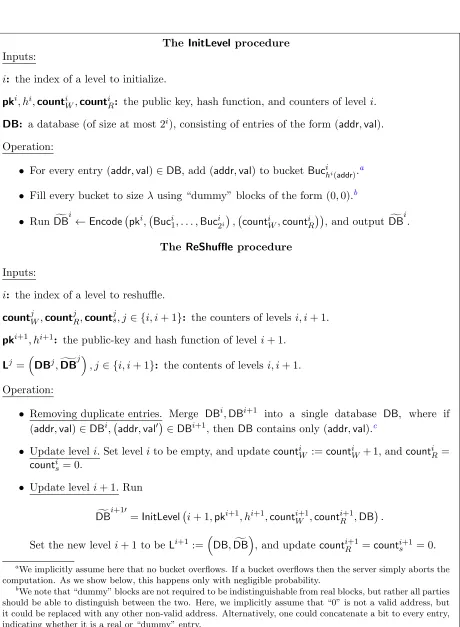
Instead, we use an idea loosely inspired by hierarchical ORAM [Ost90,GO96]. We will store the database on the server in a sequence of logL levels, where L is the database size. Each level
i consists of a separate instance of a read-only PANDA with public encoding, and will contain at mostLi= 2i database values. We think of the levels as growing from the top down, namely level-0
(the smallest) is the top-most level, and level-logL (the largest) is the bottom-most. Initially, all the data is stored in the bottom level i= logL, and all the remaining levels are empty. When a client wants to read some locationj of the database, she uses the read-only PANDA for each of the logL levels to search for location j, and takes the value found in the top-most level that contains it. When a client writes to some location j, the server will place that database value in the top level i= 0. The server knows (in the clear) which database values are stored at each level. After every 2i writeoperations, the server takes all the values in levels 0, . . . , i and moves them to level
i+ 1 by using the public encoding procedure of PANDA and incrementing the epoch counter; level
i+ 1 will contain all the values that were previously in levels ≤ i+ 1, and levels 0, . . . , i will be emptied.7 Although the cost of moving all the data to level i+ 1 scales with the data size Li+1, theamortized cost is low since this only happens once every 2i writes.8
One subtlety that we need to deal with is that our read-only PANDA was designed as an array data structure which holds L items with addresses 1, . . . , L. However, the way we use it in this construction requires a map data structure where the intermediate levels store Li L items
with addresses corresponding to some subset of the values 1, . . . , L. We can resolve this using the standard data-structures trick of storing a map in an array by hashing the naddresses into n
buckets where each bucket contains some small number of values (to handle collisions). Our final public-writes PANDA scheme can also be thought of as implementing a map data structure, where database entries can be associated with arbitrary bit-strings as addresses, and clients can read/write to the value at any address. We can also allow the total database size to grow dynamically by adding additional levels as needed.
Secret-writes PANDA. In this setting, instead of having a shared public database, we think of each client as having an individual private database which only she can access. We want the
7
Note that the epoch counters are also incremented, and the encodings are refreshed, when sufficiently many reads occur at that level, just like in the read-only case.
8
clients to be able to read and write to locations in their own database, while maintaining privacy and anonymity so that the server doesn’t learn the identity of the client performing each access, the location being accessed, or the content of the data.
Our starting point is the public-writes PANDA scheme, which already guarantees privacy and anonymity ofreadoperations, and anonymity ofwriteoperations. The clients can also individually encrypt all their content to ensure that it remains private. Therefore, we only need to modifywrite
operations to provide privacy for the underlying location being written. To achieve this, we rely on the fact that our public-writes PANDA scheme already supports a map data structure, where data can be associated with an arbitrary bit-string as an address. As a first idea, when a client wants to write to some location j in her database, she can use a client-unique PRF, associating the data with the address P RF(j), and then write it using the public-writes scheme. While this partially hides the location j, the server still learns when the same location is written repeatedly. To solve this problem, we also add a counter c, and set the address to be P RF(j, c). Whenever a client wants to read some locationj, she uses thereadoperation of the public-writes PANDA to perform a binary search, and find the largest countcsuch that there is a value at the addressP RF(j, c) in the database. Whenever a client wants to write to locationj, she first finds the correct count c(as she would in areadaccess), and then writes the value to addressP RF(j, c+ 1). This ensures that the address being written reveal no information about the underlying database location. The only downside to this approach is that the server storage grows with the totalnumber of writes, rather than the total data size. Indeed, since the server cannot correlate different “versions” of the same database location, it cannot delete old copies. Although we view this as a negative, we note that many existing database systems only support “append only” operations, and keep (as a backup) all old versions of the data. Therefore, in such a setting the growth in server storage caused by our scheme does not in fact add any additional overhead.
2
Preliminaries
Throughout the paperλdenotes a security parameter. We use standard cryptographic definitions of Pseudo-Random Permutations (PRPs), Pseudo-Random Functions (PRFs), and Fully Homo-morphic Encryption (FHE) (see, e.g., [Gol01,Gol04]). For a vector a= (a1, . . . , an), and a subset S ={i1, . . . , is} ⊆[n], we denoteaS = (ai1, . . . , ais).
Parameter Names. For all variants of the PANDA problem, we will let n denote the number of clients, L denote the database size, and t denote a bound on the number of corrupted clients colluding with the server.
2.1 Locally Decodable Codes (LDCs).
Locally decodable codes were first formally introduced by [KT00]. We rely on the following defini-tion of smooth LDCs.
Definition 2.1 (Smooth LDC). An s-smooth,k-querylocally decodable code with message length
L, and codeword size M over alphabet Σ, denoted by (s, k, L, M)Σ-smooth LDC, is a triplet (Enc,Query,Dec) of PPT algorithms with the following properties.
Syntax. Enc is given a message msg∈ΣL and outputs a codeword c∈ΣM,
Queryis given an index`∈[L] and outputs a vectorr= (r1, . . . , rk)∈[M]k,
and Dec is givencr= (cr1, . . . , crk)∈Σ
Local decodability. For every message msg∈ΣL, and every index `∈[L],
Pr [r←Query(`) : Dec(Enc(msg)r) =msg`] = 1.
Smoothness. For every index ` ∈ [L], the distribution of (r1, . . . , rk) ← Query(`) is s-wise
uniform. In particular, for any subsetS ⊆[k] of size|S|=s, the random variablesri :i∈S
are uniformly random over [M] and independent of each other.
We will use the Reed-Muller (RM) family of LDCs [Ree54, Mul54] over a finite field F which,
roughly, are defined bym-variate polynomials overF. More specifically, to encode messages inFL,
one chooses a subset H ⊆F such that |H|m ≥L. Encoding a messagemsg ∈FL is performed by
interpreting the message as a functionmsg:Hm →
F, and lettingmsgg :F
m→
Fbe the low degree
extensionofmsg; i.e., them-variate polynomial of individual degree<|H|whose restriction toHm
equals msg. The codeword cconsists of the evaluations of msgg at all points ifFm. We can locally
decode any coordinate `∈[L] of the message by thinking of ` as a value in Hm. This is done by choosing a random degree-s curve ϕ : F → Fm such that ϕ(0) = `, and querying the codeword
on k ≥ ms(|H| −1) non-0 points on the curve. The decoder then uses the answers a1,· · ·, ak
to interpolate the (unique) univariate degree-(k−1) polynomial ϕe such that ϕe(i) = ai for every
1 ≤ i ≤ k. It outputs ϕe(0) as the `’th message symbol. To guarantee that the field contains
sufficiently many evaluation points, the field is chosen such that|F| ≥k+ 1. The codeword length isM =|F|m.
Theorem 2.2. For any constantε >0, there exist(s, k, L, M)Σ-smooth LDCs with|Σ|=poly(s,logL), k=poly(s,logL) andM =L1+ε·poly(s,logL). Furthermore, the encoding time is Oe(M) and the decoding time is Oe(k).
Proof. Let ˆs = max{s,dlogLe}. For any constant c ≥ 1, choose H and m such that |H| = ˆsc
and m = d(logˆsL)/ce. This satisfies |H|m ≥ L as required. Furthermore m ≤ ˆs. Then we set k = ms(|H| −1)≤ sˆc+2 and we can choose a characteristic-2 field Σ =
F of size k+ 1 ≤ |F| ≤
2k≤sˆc+3. This givesM =|F|m ≤(ˆsc+3)d(logsˆL)/ce≤(ˆsc+3)(ˆsc+3)(logsˆL)/c≤L1+3/c·poly(s,logL). We get the bound in the Theorem by picking c > 3/ε. For the run times, we can rely on FFT techniques for fast multi-variate polynomial interpolation and evaluation. See Appendix A for a further discussion.
3
Read-Only PANDA
In this section we describe our read-only PANDA scheme. We first formally define this notion. At a high level, a PANDA scheme is run between a serverS andnclientsC1,· · ·, Cn, and allows clients
to securely access a database DB, even in the presence of a (semi-honestly) corrupted coalition consisting of the server S and a subset of at most t of the clients. In this section, we focus on the setting of aread-only, public database, in which the security guarantee is thatread operations of honest clients remain entirely private and anonymous, meaning the corrupted coalition learns nothing about the identity of the client performed the operation, or which location was accessed.
Definition 3.1(RO-PANDA). ARead-Only Private Anonymous Data Access (RO-PANDA)scheme consists of procedures (Setup,Read) with the following syntax:
• Setup(1λ,1n,1t,DB) is a function that takes as input a security parameter λ, the number of clients n, a collusion bound t, and a database DB ∈ {0,1}L, and outputs the initial server
state stS, and client keys ck1,· · · ,ckn. We require that the size of the client keys |ckj| is
• Readis a protocol between the server Sand a client Cj. The client holds as input an address
addr ∈[L] and the client key ckj, and the server holds its current states stS. The output of
the protocol is a value valto the client, and an updated server statest0S.
We require the following correctness and security properties.
• Correctness: In any execution of the Setup algorithm followed by a sequence of Read pro-tocols between various clients and the server, each client always outputs the correct database valueval=DBaddr at the end of each protocol.
• Security: Any PPT adversaryA has onlynegl(λ) advantage in the following security game with a challenger C:
– Asends to C:
∗ The valuesn, tand the database DB∈ {0,1}L.
∗ A subsetT ⊂[n] of corrupted clients with |T| ≤t.
∗ A pair of read sequences R0 = jl0,addr0l
1≤l≤q, R
1 = j1
l,addr1l
1≤l≤q (for some q∈N) , where jlb,addrbl
denotes that client jb
l ∈[n] reads address addrbl ∈[L].
We require that jl0,addr0l= jl1,addr1l for everyl∈[q] such thatjl0 ∈T∨jl1∈T. – C performs the following:
∗ Picks a random bitb← {0,1}.
∗ Initializes the scheme by computingSetup 1λ,1n,1t,DB.
∗ Sequentially executes the sequenceRb ofReadprotocol executions between the hon-est server and clients. It sends to A the views of the server S and the corrupted clients{Cj}j∈T during these protocol executions, where the view of each party
con-sists of its internal state, randomness, and all protocol messages received.
– Aoutputs a bit b0.
The advantageAdvA(λ) ofAin the security game is defined as: AdvA(λ) =|Pr [b0 =b]−12|.
Efficiency Goals. Since a secure PANDA scheme can be trivially obtained by having the client store the entire database locally, or having the server send the entire database to the client in every
read request, theefficiency of the scheme is our main concern. We focus on minimizing the client storage and the client/server run-time during each Read protocol. At the very least, we require these to bet·o(|DB|).
Bounded-Access PANDA. We will also consider a weaker notion of a bounded-access RO-PANDA scheme, for which security is only guaranteed to hold as long as the total number of read operations q is a-priori bounded. Such schemes will be useful building blocks for designing RO-PANDA schemes with full-fledged security.
Definition 3.2 (B-access RO-PANDA). LetB be an access bound. We say that (Setup,Read) is a
Remark on Adaptive Security. Note that, for simplicity, our definition is selective, where the adversary chooses the entire read sequences R0, R1 ahead of time. We could also consider a stronger adaptive security definition where the adversary chooses the sequence of reads adaptively
as the protocol progresses. Although our constructions are also secure in the stronger setting (with minimal modifications to the proofs), we chose to present our results in the selective setting to keep them as simple as possible.
3.1 A Bounded-Access Read-Only PANDA Scheme
As a first step, we now show how to construct a bounded-access RO-PANDA scheme, yielding the following theorem.
Theorem 3.3 (B-access RO-PANDA). Assuming one-way functions exist, for any constantε >0
there is a B-bounded access RO-PANDA where, for n clients witht collusion bound and database size L:
• The client and server complexity during each Read protocol ist·poly(λ,logL).
• The client storage ist·poly(λ,logL).
• The server storage is α≤t·L1+ε·poly(λ,logL).
• The access bound is B=α/(t·poly(λ,logL)).
Note that in the above theorem we can increase the access-bound B arbitrarily by artificially inflating the database sizeLto increaseα. However, we will mainly be interested in having a small ratioα/B while keepingα as small as possible.
Construction Outline. As outlined in the introduction, our idea is inspired by the recent works of Canetti et al. [CHR17] and Boyle et al. [BIPW17] on DEPIR. We rely on ans-smooth,k-query LDC where s = λ is set to be the security parameter. We think of the server S as consisting of
k0 =k2t different “virtual servers”, where t is the collusion bound. Each virtual server contains a permuted copy of the LDC codeword under a fresh PRP. Each client is assigned a random committee consisting of k out of k0 of the virtual servers and gets the corresponding PRP keys. To retrieve an entry from the database, the client runs the LDC local decoding algorithm, which requests to see k codeword locations, and reads these locations using the virtual servers on its committee by applying the corresponding PRPs. It also reads uniformly random locations from thek0−kvirtual servers that are not on its committee.
Construction 3.4 (B-Access RO-PANDA). The scheme uses the following building blocks:
• An (s, k, L, M)Σ-smooth LDC (EncLDC,QueryLDC,DecLDC) (see Definition 2.1, Theorem2.2).
• A CPA-secure symmetric encryption scheme KeyGensym,Encsym,Decsym
.
• A pseudorandom permutation (PRP) family P : {0,1}λ ×[M] → [M] where for every K ∈ {0,1}λ the functionP(K,·) is a permutation.
The scheme consists of the following procedures:
– Database encoding. Generate the codewordDBf =EncLDC(DB) withDBf ∈ΣM.
– Virtual server generation. For every 1≤i≤k0:
∗ Generate a PRP key KPRPi ← {0,1}λ, and an encryption key Ki
sym ←
KeyGensym 1λ.
∗ Let DBc i
∈ ΣM be a permuted database which satisfies DBc i P(Ki
PRP,j) = DBfj for all j∈[M].
∗ LetDBf i
be the encrypted-permuted database with DBf i
j =Encsym
Ksymi ,DBc i j
.
– Committee generation. For every j∈[n], pick a random size-k subsetSj ⊆[k0].
– Output. For each client Cj, set the client key ckj = (Sj,
KPRPi , Ksymi : i∈Sj ) to
consist of the description of the committee and the PRP and encryption keys of the virtual servers on the committee. Set the server state stS ={DBf
i
: i∈[k0]} to consist of the encrypted-permuted databases of every virtual server.
• The Read protocol. To read database entry at location addr ∈ [L] from the server S, a clientCj with key ckj = (Sj,
Ki
PRP, Ksymi : i∈Sj ) operates as follows.
– (Query.) DenoteSj ={v1, . . . , vk} ⊆[k0]. Sample (rv1,· · ·, rvk)←QueryLDC(addr), and
for each v ∈ Sj set ˆrv = P(KPRPv , rv) to be the query to virtual server v. For every v∈[k0]\Sj, pick ˆrv ∈R[M] uniformly.
– (Recover). Send (ˆr1,· · ·,ˆrk0) to the serverSand obtain the answers
f
DB1ˆr1,· · · ,DBf k0
ˆ
rk0
.
For everyv=vh ∈Sj, decryptah=Decsym
Ksymv ,DBf v
ˆ
rv
, and outputDecLDC(a1,· · · , ak).
Remark. Note that in the above construction the server is completely static and stateless. Indeed theReadprotocol simply consists of the client retrieving some subset of the locations from the server.
3.1.1 Proof of Security
We prove the following claim about the above construction.
Claim 3.5. Assuming the security of all of the building blocks, Construction 3.4 is B -bounded-access RO-PANDA for B=M/(2k2).
Claim implies Theorem. It’s easy to see that Claim 3.5 immediately implies Theorem 3.3 by plugging in the LDC parameters from Theorem 2.2. In particular, for n clients,tcollusion bound and database sizeL:
• The client/server run-time is k0log|Σ|=tk2log|Σ|=t·poly(λ,logL).
• The client storage is k0·(poly(λ) + logL) =t·poly(λ,logL).
• The server storage isα=k0·M ·log|Σ|=tk2M ·log|Σ|=t·L1+ε·poly(λ,logL).
Background Lemmas. To show that the construction is secure, we rely on two lemmas. The first lemma comes from the work of Canetti et al. [CHR17].
Lemma 3.6 (Lemma 1 in [CHR17]). LetX = (X1,· · · , Xm), Y = (Y1,· · · , Ym)be l-wise indepen-dent random variables such that for every 1 ≤ i ≤ m, Xi, Yi are identically distributed. Assume also that there is a value?such that Pr [Xi =?]≥1−δ. ThenSD(X, Y)≤(mδ)l/2+ml−1δl/2−1≤
2ml−1δl/2−1 ≤2m(m2δ)l/2−1.
The second lemma deals with the intersection size of random sets.
Lemma 3.7. Let T ⊆[n] be an arbitrary set of size|T| ≤t. LetS1,· · ·, Sn be chosen as random subsets Sj ⊆[k0] of size |Sj|= k, where k0 =k2t. Then, for all ρ > 2e, the probability that there exists some j∈[n]\T such that |(∪i∈TSi)∩Sj| ≥ρ is at most n·2−ρ.
Proof. Define E =S
i∈TSi and let `=|E|so that `≤tk. For any fixed j ∈ [n]\T the setSj is
random and independent ofE and therefore we have
Pr [|Sj∩E| ≥ρ] = ` ρ
k0−ρ k−ρ k0 k ≤ e` ρ ρ ·
k0−ρ k−ρ k0 k ≤ e` ρ ρ
· k(k−1)· · ·(k−ρ+ 1)
k0(k0−1)· · ·(k0−ρ+ 1)
≤ e` ρ ρ 1 ` ρ ≤ e ρ ρ ≤ 1 2 ρ
were the third line follows since kk0−−xx ≤ kk0 ≤ 1` for 0≤x ≤ρ−1. The lemma follows by a union bound over allj∈[n].
Proof of Claim. We are now ready to prove Claim 3.5.
Proof of Claim 3.5. The correctness of the scheme follows directly from the correctness of the LDC and the symmetric encryption scheme. We now argue security.
LetAbe a PPT adversary corrupting the server and a subsetT of at mosttclients. LetR0, R1
be the two sequences of read operations of length q ≤ B which A chooses in the security game. Without loss of generality, we can assume thatR0, R1 do not containreadoperations by corrupted clients sinceAcan generate the corresponding accesses itself (and it does not affect the server state in any way). Let S1, . . . , Sn be the random committees chosen during Setup and let E =Si∈TSi.
We proceed via a sequence of hybrids.
H1 HybridH1 is the security game as in Definition3.1.
H2 In hybrid H2, for all i6∈ E, we replace the encrypted database DBf i
by a dummy encryption (e.g.,) of the all 0 string.
Hybrids H1 and H2 are computationally indistinguishable by CPA security of the encryption
H3 In hybrid H3, for all i 6∈ E we replace all calls to the PRP P(KPRPi ,·) during the various
executions of theRead protocol with a truly random permutationπi : [M]→[M].
Hybrids H2 and H3 are computationally indistinguishable by PRP security. Here we rely
on the fact that in both hybrids the encrypted database DBf i
for i 6∈E is independent of the permutation.
H4 In hybrid H4, if during the committee selection in the Setup algorithm it occurs that there exists somej∈[n]\T such that |E∩Sj| ≥s/2, then the game immediately halts.
Hybrids H3 and H4 are statistically indistinguishable by Lemma 3.7, where we set ρ =s/2.
Recall thats=λand therefore n·2−ρ=negl(λ).
H5 In hybrid H5, we replace the queries (ˆr1,· · · ,rˆk0) created during the execution of each Read protocol with truly random values (u1,· · ·, uk0)←[M]k
0 .
The main technical difficulty is showing that hybridsH4andH5are (statistically) indistinguish-able, which we do below. Once we do that, note that hybridH5is independent of the challenge bitb and therefore in hybridH5 we have Pr[b=b0] = 12. Since hybridsH1 and H5 are indistinguishable, it means that in hybrid H1 we must have|Pr[b=b0]−12|=negl(λ) which proves the claim.
We are left to show that hybrids H4 and H5 are statistically indistinguishable. We do this by showing that for everyReadprotocol execution, even if we fix the entire view of the adversary prior to this protocol, the queries sent during the protocol in hybridH4 are statistically close to uniform. The protocol is executed by some honest client j with committee Sj ={v1, . . . , vk} and we know
that|Sj∩E| ≤s/2. Let (ˆr1, . . . ,ˆrk0) be the distribution on the client queries in the protocol.
(i) For allv6∈Sj the values ˆrv are chosen uniformly at random and independently by the client.
(ii) Forv∈Sj∩E, the values ˆrv=P(KPRPv , rv) are uniformly random by thes-wise independence
of{rv}v∈Sj and the fact that |Sj∩E| ≤s/2.
(iii) For v∈Sj\E, we want to show that the values ˆrv =πv(rv) are statistically close to uniform,
even if we condition on (i),(ii). Note that the values{rv}v∈Sj\E ares/2-wise independent even
conditioned on the above, and therefore so are the values{rˆv}v∈Sj\E. For eachv, letZv ⊆[M]
be the set of valuesπv(r) that were queried in some prior protocol execution by some client. Then |Zv| ≤ B. Note that if ˆrv = πv(rv) 6∈ Zv then ˆrv is simply uniform over [M]\ Zv by
the randomness of the permutation πv. We can define random variables Xv where Xv = ˆrv
when ˆrv ∈ Zv andXv =? otherwise. We can then think of sampling{ˆrv}v∈Sj\E by sampling
{Xv}v∈Sj\E and defining ˆrv = Xv when Xv 6= ? and sampling ˆrv uniformly at random over
[M]\ Zv otherwise. Note that{Xv}v∈Sj\E is a set of|Sj\E| ≤kvariables which ares/2-wise
independent and Pr[Xv = ?] ≥ 1−δ where δ ≤ |Zv|/M ≤ B/M. Therefore, by applying
Lemma 3.6, the variables {Xv}v∈Sj\E are statistically close to truly independent variables
{Yv}v∈Sj\E such that eachYv has the same marginal distribution asXv, where the statistical
distance is 2k(k2B/M)s/4−1≤2k(1/2)s/4−1=negl(λ). Replacing the variables{Xv}by {Yv}
is equivalent to replacing the values{rˆv}v∈Sj\E by truly uniform and independent values.
3.2 Public-Encoding PANDA
PANDA schemes that support writes. At a high level, a public-encoding bounded-access PANDA scheme contains a key-generation algorithmKeyGenthat generates a public keypk and a set{ckj}
of client secret keys. Any database owner can locally encode the database using only the public key. The scheme guarantees privacy and anonymity, even if the adversary obtains a subset of the secret keys, as long as the honest clients make at most B accesses to the database. Furthermore, we allow the server to create many encodings of the same, or different, databases with respect to some labelslab, and the clients can generate accesses using the corresponding labellab. As long as the clients make at most B accesses with respect to any one label, security is maintained.
Definition 3.8 (Public-Encoding PANDA). A public-encoding PANDA (PE-PANDA) consists of a tuple of algorithms (KeyGen,Encode,Query,Recover) with the following syntax.
• KeyGen(1λ,1n,1t,1L) is a PPT algorithm that takes as input a security parameter λ, the number of clients n, and the collusion bound t, and a database size L. It outputs a public keypk, and a set of client secret keys{ckj}j∈[n].
• Encode(pk,DB,lab) is a deterministic algorithm that takes as input a public-keypk, a database
DB, and a labellab, and outputs an encoded databaseDBf.
• Query(ckj,addr,lab) is a PPT algorithm that takes as input a secret-keyckj, an address addr
in a database, and a labellab, and generates a list (q1,· · ·, qk0) of coordinates in the encoded database.
• Recoverckj,lab,
f
DBq1,· · · ,DBfq k0
is a deterministic algorithm that takes as input a
secret-keyck, a labellab, and a listDBfq1,· · · ,DBfq k0
of entries in an encoded database, and outputs a database valueval.
We require that it satisfies the following correctness and security properties.
• Correctness: For every λ, n, t, L ∈ N, every DB ∈ {0,1}L, every label lab ∈ {0,1}∗, every
addressaddr∈[L], and every client j∈[n]:
Pr
pk,{ckj}j∈[n]
←KeyGen 1λ,1n,1t,1L
f
DB=Encode(pk,DB,lab) (q1,· · · , qk0)←Query(ckj,addr,lab)
val=Recoverckj,lab,
f
DBq1,· · ·,DBfq k0
:val=DBaddr
= 1.
• B-Bounded-Access Security: Every PPT adversaryA has onlynegl(λ) advantage in the following security game with a challenger C:
– Asends to C values n, t, L, and a subset T ⊂[n] of size |T| ≤t.
– C executes pk,{ckj}j∈[n]
← KeyGen 1λ,1n,1t,1L
and sends pk and {ckj}j∈T to A.
Additionally, C picks a random bitb.
– Ais given access to the oracleQueryb{ck
j}that on input (j0, j1,addr0,addr1,lab) such that j0, j1∈/ T, outputsQuery(ckjb,addrb,lab).
We restrict A to make at most B queries to the oracle with any given label lab, but allow it to make an unlimited number of queries in total.
The advantageAdvA(λ) ofAin the security game is defined as: AdvA(λ) =|Pr [b0 =b]−12|.
Next, we construct a public-encoding PANDA scheme, based on our bounded-access PANDA scheme (Construction 3.4 in Section 3.1). The high-level idea is to use fresh PRP keys for every label, by creating them via a PRF applied to the label. The public key of the server contains FHE encryptions of the PRF keys. This enables the server to create the encoded-permuted databases for each virtual server, as in Construction 3.4, by operating on the PRF keys under FHE.
Construction 3.9 (Public-Encoding PANDA). The scheme uses the same building blocks as Construction3.4. In addition we rely on:
• A pseudo-random functionF : {0,1}λ× {0,1}∗ → {0,1}λ.
• The symmetric-key encryption scheme in Construction3.4 will be replaced by a symmetric-key leveled FHE scheme (KeyGenFHE,EncFHE,DecFHE,EvalFHE).
The scheme consists of the following algorithms:
• KeyGen 1λ,1n,1t,1L
operates as follows:
– Let the parameterss, k, M, k0 be chosen the same way as in Construction 3.4.
– For every virtual serveri∈[k0]:
∗ Generates a random FHE keyKFHEi ←KeyGenFHE 1λ. We use a leveled FHE that can evaluate circuits up to some fixed polynomial depthd=poly(λ,logM) specified later.
∗ Generates a random PRF keyKPRFi ← {0,1}λ.
∗ Encrypts the PRF key: KePRFi ←EncFHE KFHEi , KPRFi
.
– Generates the random size-kcommitteeSj ⊆[k0] for every 1≤j≤n.
– Outputs the public key pk =
L,nKePRFi o
i∈[k0]
, and the secret keys
ckj = Sj, L,
KPRFi , KFHEi : i∈Sj
j∈[n].
• Encode
pk=
L,nKePRFi o
i∈[k0]
,DB,lab
operates as follows:
– LetDBf =EncLDC(DB) using and LDC with parameters s, k, L, M as in the Setup
algo-rithm of Construction3.4.
– For every i∈[k0]:
∗ Generates an encrypted keyKePRPi =EvalFHE
CF,lab(·),KePRFi
, whereCF,x(·) is the
circuit that on inputK computes F(K, x).
∗ Generate an encrypted-permuted databaseDBf i
=EvalFHE
CP,
f
DB(·),Ke
i PRP , where CP, f
DB(·) is the circuit that on input K computes the permuted databaseDBc which
satisfiesDBc i
P(K,j) =DBfj for all j∈[M].
– Outputs
f
DB1,· · ·,DBf k0
.
Leveled FHE Remark. In the above construction we set parameterdrepresenting the maximum circuit depth for the leveled FHE to be the combined depth of the circuits CF,x(·) and CP,DBf (·)
defined above. Since we can use a permutation network which permutes data of size M in depth logM, so we have d = poly(λ,logM). We assume that the leveled FHE scheme allows us to compute circuits C of depthdin time|C| ·poly(λ, d).
Claim 3.10. Assuming the security of all of the building blocks, Construction3.9is a B -bounded-access secure public-encoding PANDA scheme for B =M/(2k2).
Proof. Correctness follows directly from the correctness of Construction3.4, and the correctness of the underlying LDC and FHE scheme. We now argue that the scheme is secure via a sequence of hybrids. LetA be a PPT adversary and letT be the subset of at mostt clients that it chooses to corrupt. Let S1, . . . ,Sn be the random committees chosen duringSetup and let E =
S
i∈T Si. We
proceed via a sequence of hybrids which mirrors the proof of Claim 3.5.
H1 HybridH1 is the security game as in Definition3.8.
H2 In hybridH2, for all i6∈E, we replace KePRFi by an FHE encryption of the all-0 string.
HybridsH1 andH2 are computationally indistinguishable by security of the FHE encryption scheme.
H3 In hybrid H3, for all i 6∈ E, whenever the Query algorithm computes KPRPi := F KPRFi ,lab
and usesP(KPRPi ,·) we instead replace this by a truly random permutationπi,lab[M]→[M].
HybridsH2 and H3 are computationally indistinguishable by the PRF and PRP security.
H4 In hybrid H4, if during the committee selection in the Setup algorithm it occurs that there exists somej∈[n]\T such that |E∩Sj| ≥s/2 then the game immediately halts.
HybridsH3 and H4 are statistically indistinguishable by Lemma3.7, where we set ρ =s/2. Recall that s=λand therefore n·2−ρ=negl(λ).
H5 In hybrid H5, we replace the values (q1,· · · , q0k) generated by Query(ckjb,addrb,lab) by
uni-formly random values (u1,· · ·, uk0)←[M]k 0
.
To show hybridsH4 andH5 are indistinguishable, we use a sequence of intermediate hybrids where we do the switch for each distinct label lab queried by the adversary one at a time. Performing each such switch follows the exact same argument as in Claim 3.5by relying on the fact that each label corresponds to a fresh and independent permutation πi,lab.
Note that hybrid H5 is independent of the challenge bit b and therefore in hybrid H5 we have Pr[b=b0] = 12. Since hybridsH1 andH5 are indistinguishable, it means that in hybridH1we must have |Pr[b=b0]−12|=negl(λ) which proves the claim.
Theorem 3.11 (Public-Encoding PANDA). Suppose leveled FHE exists. Then for any constant ε >0 there is a PE-PANDA scheme withB-bounded access security, fornclients,tcollusion bound and database size L where:
• The complexity of Query andRecover procedures is t·poly(λ,logL).
• The server public key and the client secret keys are each of size t·poly(λ,logL).
• The complexity of the encoding procedure and the size of the encoded database isα≤t·L1+ε·
• The access bound is B=α/(t·poly(λ,logL)).
Proof. All of the parameters are set the same way as in Construction 3.4 and Theorem 3.3. We only have to analyze the complexity of the encoding procedure. Here we rely on the fact that
EncLDC(DB) can be computed in time Oe(M) =L1+ε·poly(λ,logL). We also rely on the fact that
performing operations under leveled FHE only introduces poly(λ, d) multiplicative overhead where
d=poly(λ,logM) =poly(λ,logL).
3.3 Read-Only PANDA with Unbounded Accesses
In this section we use the public-encoding PANDA scheme of Section 3.2, which hasB -bounded-access security, to obtain a read-only PANDA scheme that is secure against any unbounded number of accesses. Specifically, we will prove the following:
Theorem 3.12 (Read-Only PANDA). Suppose leveled FHE exists. Then for any constant ε >0
there is a read-only PANDA, for nclients, t collusion bound and database sizeL where:
• The client/server complexity during eachRead protocol is t·poly(λ,logL).
• The client keys are of sizet·poly(λ,logL).
• The server state is of size t·L1+ε·poly(λ,logL).
The high-level idea for our construction is conceptually simple: after every B operations, the server re-encodes the database with a fresh label. We think of these sequences of B consecutive accesses as “epochs”, and the label is simply a counter indicating the current epoch. The clients get the current epoch number by reading it from the server before performing an access.
Construction 3.13 (Read-only PANDA). The scheme uses a PE-PANDA scheme (KeyGen,Encode,Query,Recover) with B-bounded-access security as a building block. We define the following procedures.
• Setup(1λ,1n,1t,DB). Takes as input a security parameter λ, the number of clients n, a collusion bound t, and a databaseDB∈ {0,1}L. It does the following.
– Counter initialization. Initializes anepoch counter counte, and astep counter counts, to
0.
– Generating keys. Runspk,{ckj}j∈[n]
←KeyGen 1λ,1n,1t,1L
.
– Encoding the database. Runs DBf =Encode(pk,DB,counte).
– Output. For each client Cj,1 ≤j ≤nset the client key to ckj :=ckj. For the serverS
setstS:= (pk,DBf,counte,counts).
• The Read Protocol. To read the data block at address addr from the server, a client Cj
and the serverS run the following protocol.
– The client reads the epoch countercounte fromS.
– The client runs (q1,· · · , qk0)←Query(ckj,addr,counte), and sends (q1,· · ·, qk0) to S.
– The server S updates its state as follows: if counts < B −1, S updates counts :=
counts+ 1. Otherwise, S updates counts := 0,counte:=counte+ 1, and replacesDBf :=
Encode(pk,DB,counte). If the complexity of the computationEncode(pk,DB,counte) is cEncode, the server performs cEncode/B steps of this computation during each protocol
execution so that it is completed by the end of the epoch.
Claim 3.14. Assuming we start with a PE-PANDA scheme that hasB-bounded-access security as a building block, then Construction 3.13 is a secure RO-PANDA scheme.
Proof. The correctness of Construction3.13follows directly from the correctness of the underlying PE-PANDA scheme. As for security, since the encoded database is updated everyB read requests, and there are at mostpoly(λ) read requests overall, any PPT adversaryAin the security game of Definition3.1obtains at mostB queries to each ofpoly(λ) encoded databases (each generated with a unique label). Therefore, security follows directly from the security of the PE-PANDA scheme.
The proof of Theorem 3.12now follows.
Proof of Theorem 3.12. We instantiate Construction 3.13 with the PE-PANDA scheme of Theo-rem 3.11. The client complexity of any read operation entails running Query and Recover once (and reading the counter), which is t·poly(λ,logL). The server complexity additionally entails performingcEncode/B=α/B ≤t·poly(λ,logL) steps per read operation to re-encode the database
once per epoch (here, cEncode is the complexity of the Encode algorithm, and α is the complexity
of the encoding procedure of the PE-PANDA scheme). The server storage and the client key sizes are the same as in the PE-PANDA.
Remark 3.15. We note that when Construction3.13 is instantiated with the PE-PANDA scheme of Construction 3.9, the concrete server complexity can be improved: instead of freshly encoding the database in each epoch (which requires computing an LDC encoding and then permuting it under FHE) we can just re-permute the LDC-encoded database under the FHE scheme. Since Construction3.9uses the RM-LDC, which is quasilinear-time encodable, this modification does not improve the asymptotic complexity of the resultant PANDA scheme. However, it could potentially allow one to replace the RM-LDC with a different LDC that is not quasilinear-time encodable.
4
PANDA With Writes
In this section we extend the read-only scheme of Section 3 to support writes. We first construct (Section 4.1) a PANDA scheme in the public database setting. We then design (Section 4.2) a PANDA scheme that supports writes in theprivate database setting.
4.1 A Public-Writes PANDA Scheme
guarantees the privacy ofwrite operations when all clients are honest. Indeed, one can implement a (standard) single-client ORAM scheme on top of the public-writes PANDA scheme, for which all clients know the private client key. (We note that the transformation might require FHE-encrypting the PANDA, to allow the server to perform operations on the PANDA which are caused by client operations on the ORAM.)
We now formally define the notion of a public-writes PANDA scheme.
Definition 4.1 (Public-Writes PANDA (PW-PANDA)). A public-writes PANDA (PW-PANDA)
scheme consists of procedures (Setup,Read,Write), where Setup,Read have the syntax of Defini-tion 3.1, and Writehas the following syntax. It is a protocol between the server S and a clientCj.
The client holds as input an address addr ∈[L], a value v, and the client key ckj, and the server
holds its current statesstS. The output of the protocol is an updated server state st0S.
We require the following correctness and security properties.
• Correctness: In any execution of the Setup algorithm followed by a sequence of Read and
Write protocols between various clients and the server, where the Writeprotocols were exe-cuted with a sequenceQof values, the output of each client in a readoperation is the value it would have read from the database if (the prefix of)Q (performed before the corresponding
Read protocol) was performed directly on the database.
• Security: Any PPT adversaryA has onlynegl(λ) advantage in the following security game with a challenger C:
– Asends to C:
∗ The valuesn, t, and the databaseDB∈ {0,1}L.
∗ A subsetT ⊂[n] of corrupted clients with |T| ≤t.
∗ A pair of access sequencesQ0 = opl,val0l, jl0,addr0l1≤l≤q, Q1= opl,val1l, jl1,addr1l1≤l≤q, where opl,valbl, jlb,addrbl
denotes that client jlb performs operation opl at address
addrbl with valuevalbl (which, if opl =read, is ⊥).
We require that opl,val0l, jl0,addr0l = opl,val1l, j1l,addr1l for every l ∈ [q] such that
jl0 ∈T∨jl1 ∈T; and val0l,addr0l= val1l,addr1l for everyl ∈[q] such that opl=write
(in particular, write operations differ only in the identity of the client performing the operation).
– C performs the following:
∗ Picks a random bitb← {0,1}.
∗ Initializes the scheme by computingSetup 1λ,1n,1t,DB.
∗ Sequentially executes the sequenceQbofReadandWriteprotocol executions between the honest server and clients. It sends to A the views of the server S and the corrupted clients{Cj}j∈T during these protocol executions, where the view of each
party consists of its internal state, randomness, and all protocol messages received.
– Aoutputs a bit b0.
The advantageAdvA(λ) ofAin the security game is defined as: AdvA(λ) =|Pr [b0 =b]−12|.