ISSN 2348 – 7968
Design and analysis of High sensitive Biosensor Using
MEMS
P
1
P
Mr. Gulshan v. P 2
P
Thakare, Anup Nage
P
1
P
P. G. Scholar, Electronics and Communication Engineering G. H. Raisoni Academy of Engg. And Technology,Nagpur, India
P
2
P
Assistant Professor, Electronics and communication Engineering G. H. Raisoni Academy of Engg. And Technology, Nagpur, India
Abstract
Biosensor using MEMS i.e. BIOMEMS is a device which is used for various biomedical applications. This paper presents a cantilever based biosensor which converts biological recognition analysis into measurable mechanical displacement which is highly sensitive in nature. As the sensitivity of a device is the most important factor regarding to biomedical equipments, this paper deals with the sensitivity of a device. Sensitivity of a cantilever based biosensor decreases with decrease in the concentration of analytes . The sensitivity depends on its deflection of a cantilever based Bio-MEMS due to interaction between the analyte and its complementary bio-receptor molecules. Therefore, designing a cantilever based biosensor which can assay analytes in low concentration is important. The design and development of the cantilever based biosensor to make a device high sensitive either by using different shapes and sizes or a different material for a cantilever structure. This paper proposed to review on an improvement of the sensitivity of a conventional cantilever structure.
Keywords:Micro-cantilever, Bio-MEMS, MEMS, Bio-receptors, Biosensor.
1.
INTRODUCTION
In the today’s world, Early stage detection is a necessity as all non curable diseases can be detected in advance stage. MEMS i.e. Micro-electromechanical system to be a best alternative for biochemical application. MEMS i.e. Micro-electromechanical system is a process technology which is used to create very small integrated devices or systems that combines an electrical and mechanical component. It ranges from micro to few millimeters and having an ability to sense, control as well as actuate on the micro scale, and generate effect on the macro scale [1]. Bio-MEMS are a micro technology of operating for biological and
biomedical applications, which may or may not be contain electronics and mechanical function. It is an integral combination of Electronics engineering, mechanical Engineering, chemical engineering and biomedical engineering. It includes various kinds if applications like proteomics, genomics, diagnostics etc. Biosensor is the device which is used to convert bio-recognition analysis event into measurable signal [2]. In biomedical equipments, bio-receptor plays vital role which is nothing but bio-molecules combines with and detect a target molecules. The interaction of analyte and antibodies, proteins, nucleic acids are the most common used bio-receptors. Labeling of molecules is a basic requirement for detecting and analyzing bio-molecules and bio-reaction. As it is very expensive, lengthy, and time consuming process, we use a label free detection. For label free detection of bio-molecules, the cantilever biosensor is one of the most significant options as a sensing device due to high throughput [2].
On a cantilever beam structure, the anchor surface is made bio-sensitive by using sensing layer deposited onto it. It contains bio-receptors which are covalently bonded with it [2]. The unique reaction can take place in between analytic solution and its bio-receptor molecules. Fig. 1 shows that when analyte molecules are absorbed by the bio-receptor which is present on the anchor surface of a cantilever structure. The surface stress i.e. force exerted on the surface per unit area is generated that causes to bend the cantilever beam. The deflection is depends on the concentration of the analytic solution. The stress
ISSN 2348 – 7968
:
Target analyteY: Bio-receptors
Fig1. Working Principle of cantilever based biosensor.
induced on the beam is converted into its equivalent concentrated load that means the surface stress induced by the absorption of bio-molecules on the cantilever surface is equivalent to the concentrated load at free end of a cantilever [2,4].
2.
THEORY
The cantilever biosensor plays vital role in the field of label free detection. The sensitivity of a cantilever based biosensor depends on its deflection which is due to interaction between analyte and its respective bio-molecules [5]. Fig. 1 shows working principle of a cantilever biosensor where the cantilever is functionalized by depositing a bio-receptor layer. Target analyte is unknown bio-molecules which want to be determined. The dimensions of the cantilever beam are critical for surface stress sensing application. The deflection of free end the cantilever ∆𝑧is given as
∆𝑧=4𝑙
2
𝜎(1−𝑣)
𝐸𝑡2 (1)
Where l,𝜎,v,E,t are length ,surface stress, poisson ratio, young’s modulus, thickness respectively [6].
The deflection of a rectangular cross cantilever beam with fixed boundary condition and subjected to a concentrated load as its free end is
∆𝑧=4𝐹𝑙3
𝐸𝑏𝑡3 (2)
Where l, b, t are length, width and thickness of cantilever; E, F are Young’s modulus and Applied load respectively [6].
From equation 1 and 2 the relation between applied load and induced surface stress can be a given as
𝐹=𝜎𝑏𝑡(𝑙1−𝑣) (3)
Thus the surface stress induced deflection of cantilever can be converted into concentrated load induced deflection. In other words, the surface stress induced by the adsorption of bio-molecules on the cantilever surface is same as that obtained by applying a concentrated load at cantilever free end. Equation 3 is used to calculate load on the simulation process. We have to applied concentrated load instead of surface stress directly at free end to reproduce the adsorption induced surface stresses in the cantilever beam.
3.
DESIGN ANALYSIS AND
RESULTS
The design of cantilever biosensor as shown in the fig 3a. With the help of array of eight cantilever arntz et al.[7] reported that the maximum stress of 0.05 N/m is generated on injection of 50ug/ml(~2.5um) myglobin protein on silicon based cantilever which produced maximum 0.9um deflection at free end. M.Z. ansari et al.[8] proposed their model having cantilever size of 500x100x0.5um and its young’s modulus of 130Gpa and poisson ratio of 0.28 respectively. The displacement of cantilever can be produced by a concentrated load of 3.6 × 10⁻⁹𝑁 applied at free end of cantilever.
Fig 3. The conventional and proposed cantilever designs;
a. Conventional model has uniform cross
section area
b. Proposed model has a narrow throat section near base.
Fig.3b shows the proposed model has a narrow throat section near anchor. The strip of 50 um long and 20 um wide. The length and thickness of the two models are same. The maximum deflection can be produce is of
ISSN 2348 – 7968
0.936um. This data and cantilever model will be used as reference in this study. The model having a material gold for cantilever gives better results than reference model by keeping all dimensions as it is. The coventorware is used to analyze both the cantilever design.
A. Effect of Cantilever material
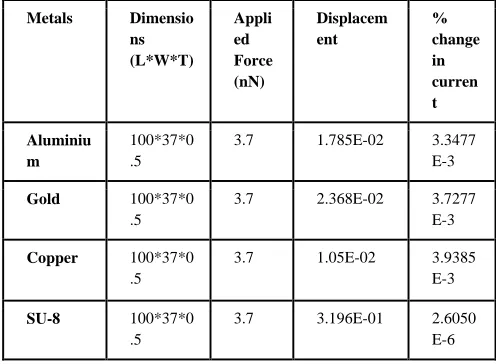
Aluminum, Gold, copper, and su-8 polymer are the common material used in cantilever fabrication. However SU-8 polymer is given as most attractive results but in the liquid domain SU-8 gives a poor results so that we have chosen gold as young’s modules of gold in lower than other materials. Table 1 shows the material properties of different material. The stiffness or spring constant of the cantilever beam is given by the formula
𝑘=𝐸𝑏𝑡3
4𝑙3 (4)
Where, E, b, t, l are young’s modulus, width thickness and length of cantilever respectively [9]. Table 2 shows the design analysis of different material which shows the gold is the best metal suited for biomedical application as gold having hydrophobic environment which is useful for bio-receptor layer which is present on gold layer [9].
Table 1. Material properties of different simulated Materials
Properties Aluminum Gold Copper SU-8
Young’s modulus, E(GPa)
77
57 128 4.4
Poisson ratio,
v 0.3 0.35 0.36 0.22
Density,𝝆(𝒌𝒈
𝒎𝟑)
2300 19300 8900 1200
Table 2. Analysis of change in displacement with different materials.
Metals Dimensio ns (L*W*T)
Appli ed Force (nN)
Displacem ent
% change in curren t
Aluminiu m
100*37*0 .5
3.7 1.785E-02 3.3477
E-3
Gold 100*37*0 .5
3.7 2.368E-02 3.7277
E-3
Copper 100*37*0 .5
3.7 1.05E-02 3.9385
E-3
SU-8 100*37*0 .5
3.7 3.196E-01 2.6050
E-6
B. Effect of Geometry
The geometry of the design also plays vital role in case of sensitivity of the device. Table shows the different dimensions and their effect on the displacement. From the table it is clear that the displacement mainly depends on length and thickness of the device, there is marginal effect of change of width which is negligible in case of designing. The graph shows the effect of change in length and thickness respectively. Maximum length gets maximum deflection [9,11].
Table 3. Analysis of change in displacement with different dimensions.
Metal Dimensions
(L*W*T)
Appl ied Forc e (nN)
Displac ement
% change in current
Gold 200*37*0.5 3.7
1.78E-01
-9.0469E-05
Gold 100*18.5*1 3.7
6.11E-03
-1.9570E-03
Gold 100*72*0.25 3.7
3.95E-02
6.809E-04
ISSN 2348 – 7968
Fig.4a Rectangular Cantilever with 0.948um
deflection
Fig.4b Rectangular Cantilever with narrow throat having 2.52um deflection
Fig.4c U-shaped Cantilever with 0.82um deflection
As the thickness is inversely proportional to the displacement, minimum thickness will gives more displacement .The thickness is not less than 0.5um, the cost will be increased with reduction in the thickness
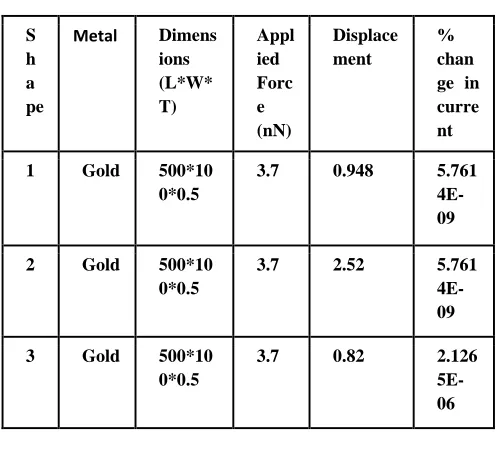
.The shape of the device also plays important role in the case of sensitivity. Table 4 shows the effect of shapes of same dimension on the displacement. As the sensitivity is depends upon the displacement structure of device is one of the important parameter to be calculated. Fig a, b, c illustrates the different shapes of the cantilever having same material and dimensions.
Table 4. Analysis of change in displacement with different structures.
S h a pe
Metal Dimens
ions (L*W* T)
Appl ied Forc e (nN)
Displace ment
% chan ge in curre nt
1 Gold 500*10 0*0.5
3.7 0.948 5.761 4E-09
2 Gold 500*10 0*0.5
3.7 2.52 5.761 4E-09
3 Gold 500*10 0*0.5
3.7 0.82 2.126 5E-06
4.
CONCLUSION
The simulation result for cantilever design is shown in the fig4a. The cantilever size of 500x100x0.5 um gives the displacement of 0.948um. Fig4 b, c shows the simulation results of the proposed model. In this case, for the same load of 3.6 × 10⁻⁹𝑁, a deflection of 2.52um and 0.82um is observed. This deflection is nearly 2.5 times than conventional cantilever model deflection. Therefore, we can conclude that by introducing different material, dimensions, shapes of cantilever, the flexural stiffness of cantilever is decreased significantly which eventually results in increased deflection. MemPZR module to compute a piezoresistive sensor’s potential field and the resulting the change in current due to applied stresses.
ISSN 2348 – 7968
REFERENCES
[1] Julian W. Gardner, Vijay K. Varadan, Osama O. Awadelkarim, “Microsensor MEMS and Smart Devices” Wiley publication
[2] S.M. SZE, “VLSI Technology”, Tata McGraw-Hill Publications
[3] Yu-Jie Huang, Che-Wei Huang et.al. Fellow, IEEE, and Shey-Shi Lu, Senior Member, IEEE, “ A CMOS Cantilever-Based Label-Free DNA SoC With Improved Sensitivity for Hepatitis B Virus Detection”, IEEE
Transaction on biomedical circuits and
systems,vol.7,No.6,December 2013.
[4] G. Wu, H. Ji, K. Hansen, T. Thundat et.al. “Origin of nanomechanical cantilever motion generated from biomolecular interactions,” Proc. Nat.Acad. Sci., vol. 98, pp. 1560–1564, 2001.
[5] Scott MacKay, David Wishart, James Z. Xing, and Jie Chen, “Developing Trends in Aptamer-Based Biosensor Devices and Their Applications”, IEEE Transaction on biomedical circuits and systems,vol.8,No.1,February 2014
[6] G. G. Stoney, “The tension of metallic film deposited by
electrolysis,” Proceedings of Royal Society of London A, vol. 82, pp. 172–175, 1909.
[7] Sandeep Kumar, Ram P Bajpai, Lalit M Bharadwaj, “ Lab-on-a-chip Based On BioMEMS”, IEEE IClSlP 2004.
[8] Mohd. Zahid Ansari and Chongdu Cho, “ Design and Analysis of a high sensitive Microcantilever Biosensor
for Biomedical Applications”, 2008 International
Conference on BioMedical Engineering and Informatics.
[9] Yang-Choon Lim, Abbas Z. Kouzani, Wei Duan, and
Akif Kaynak, ” Effects of Design Parameters on
Sensitivity of Microcantilever Biosensors” The 2010 IEEE /ICME international conference of complex medical Engineering JULY 13-15,2010 Australia
[10] Yang Choon Lim, Abbas Z. Kouzani, Member, IEEE, Wei Duan, Xiujuan J. Dai, Akif Kaynak, and Douglas Mair, “A Surface-Stress-Based Micro cantilever
Aptasensor”, IEEE Transaction on biomedical circuits and systems,vol.8,No.1,February 2014.
[11]Jayu P. Kalambe and Rajendra M. Patrikar “ Design of Microcantilever-Based Biosensor with Digital Feedback Control Circuit” Hindawi Publishing Corporation, Journal of Sensors ,Volume 2012, Article ID 586429